A Daily History of Holes, Dots, Lines, Science, History, Math, Physics, Art, the Unintentional Absurd, Architecture, Maps, Data Visualization, Blank and Missing Things, and so on. |1.6 million words, 7500 images, 4.9 million hits| Press & appearances in The Times, Le Figaro, Mensa, The Economist, The Guardian, Discovery News, Slate, Le Monde, Sci American Blogs, Le Pont, and many other places… 5000+ total posts since 2008.

Category: Chemistry, history of

  • On Found-Poetry in a Work on Clouds by the Great Chemist, Michael Faraday (1827)

    JF Ptak Science Books   Quick Post

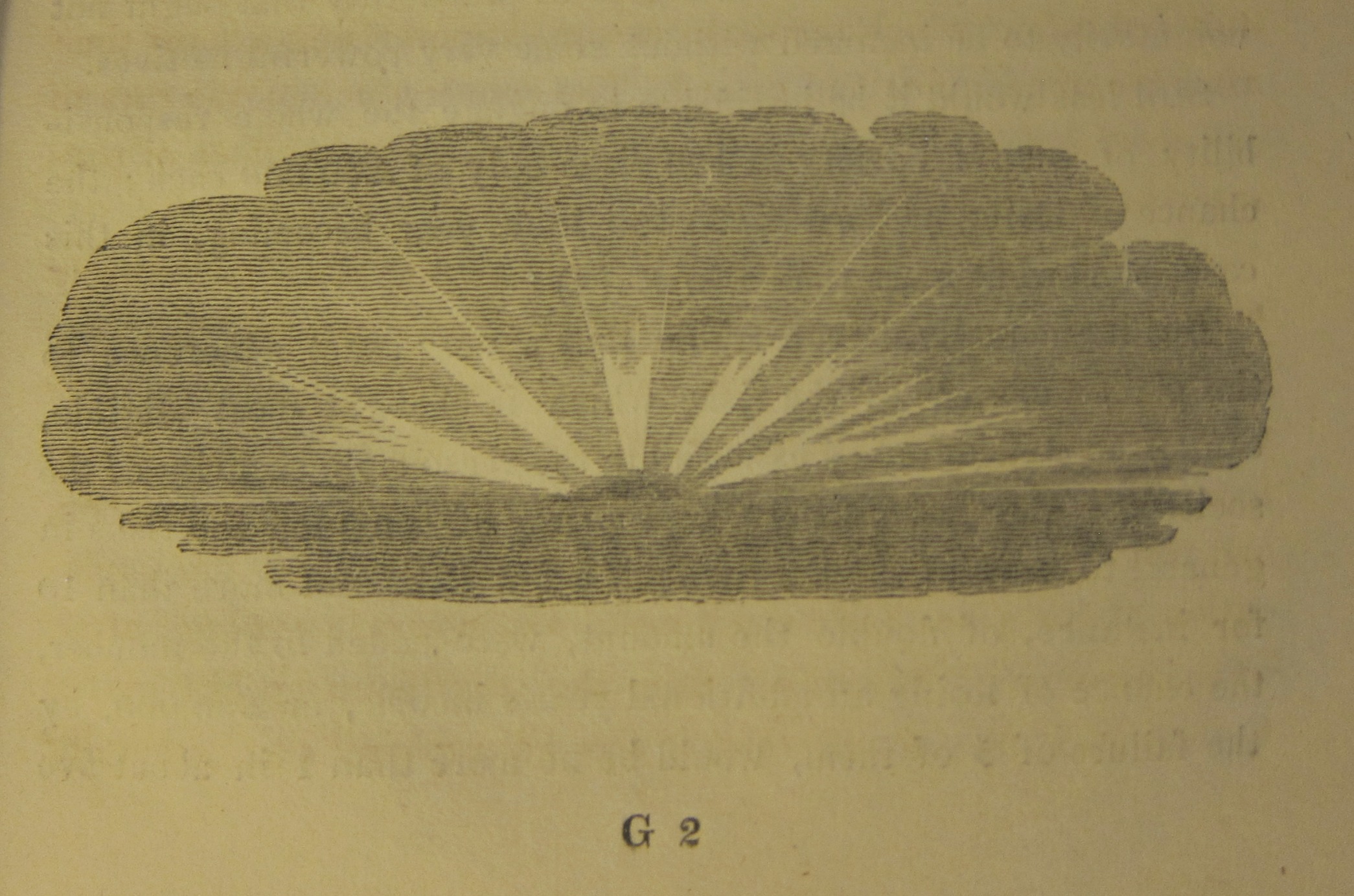
    Tucked away inside a volume of  The Quarterly Journal of Science, Literature,  and the Arts1  is this short contribution by Michael Faraday. Faraday is not particularly well-known for a writerly style although in his huge output of papers and books he was a very effective communicator. I found in this article, “On a Peculiar Perspective Appearance of Aerial Light and Shade” , that he was really very elegant and perhaps even poetic in describing what I think are cloud shadows– explaining the illusions created by cloud shadows, with the “aerial perspective” part perhaps not having to do with what is normally assumed to be the optical/painterly version of the term, although frankly I’m not sure.

    This is the small woodcut that accompanies the three-page article, depicting the “rays” of light coming from a setting sun, which I think is charming in itself:
    Faraday clouds

    He writes:

    “Although the appearance on this evening was exceedingly beautiful and rare, and the more striking from the absence to the observer of the sun or clouds, and the complete insulation of the phenomenon, yet by close observation upon other evenings, it was found that partial effects of the same kind were very common, and from the manner in which these could be observed the explanation above given fully confirmed.”

    And the wonderful closing sentence:

    “All these phenomena with their variations were easily referrible to their causes and may be observed at almost any sun set in fine weather, but the effect of the first evening so similar in kind though so different in appearance was not again remarked. It is with a view of guarding persons who may observe the same effect against any mistake as to its origin that the appearance with its nature has been thus particularly described.” 

    I haven’t read that much in Faraday, but this does seem to be a bit of a departure–in form and content–and so I thought I’d share it a bit.  

    Notes:

    1. The Quarterly Journal of Science, Literature,  and the Arts (of the Royal Society of Great Britain). London, printed by John Murray,  volume XXII, 1827; 8.5×5”, viii, 418 pp,, 3 engraved plates.  Other interesting contributions in the volume include:  (Thomas Young), “Practical Application of the Doctrine of Chances, as it regards the Subdivision of Risks (by a Correspondent)”; (Michael Faraday, signed “M.F.” in the article), “On the Confinement of Dry Gases over Mercury”, in the Miscellaneous Intelligence section, pp 220-221; John MacCulloch, “Observations on the Geological History of the Formation of Coal”; and these shorter notices from the “Miscellaneous Intelligence” section including  Wollaston “On Electro-Magnetic Rotation” and  Becquerel “On the Conducting Power of Metals for Electricity” pp 374-378.

  • Found-Art and Light Irony in Selenium, 1891

    JF Ptak Science Books  Quick Post

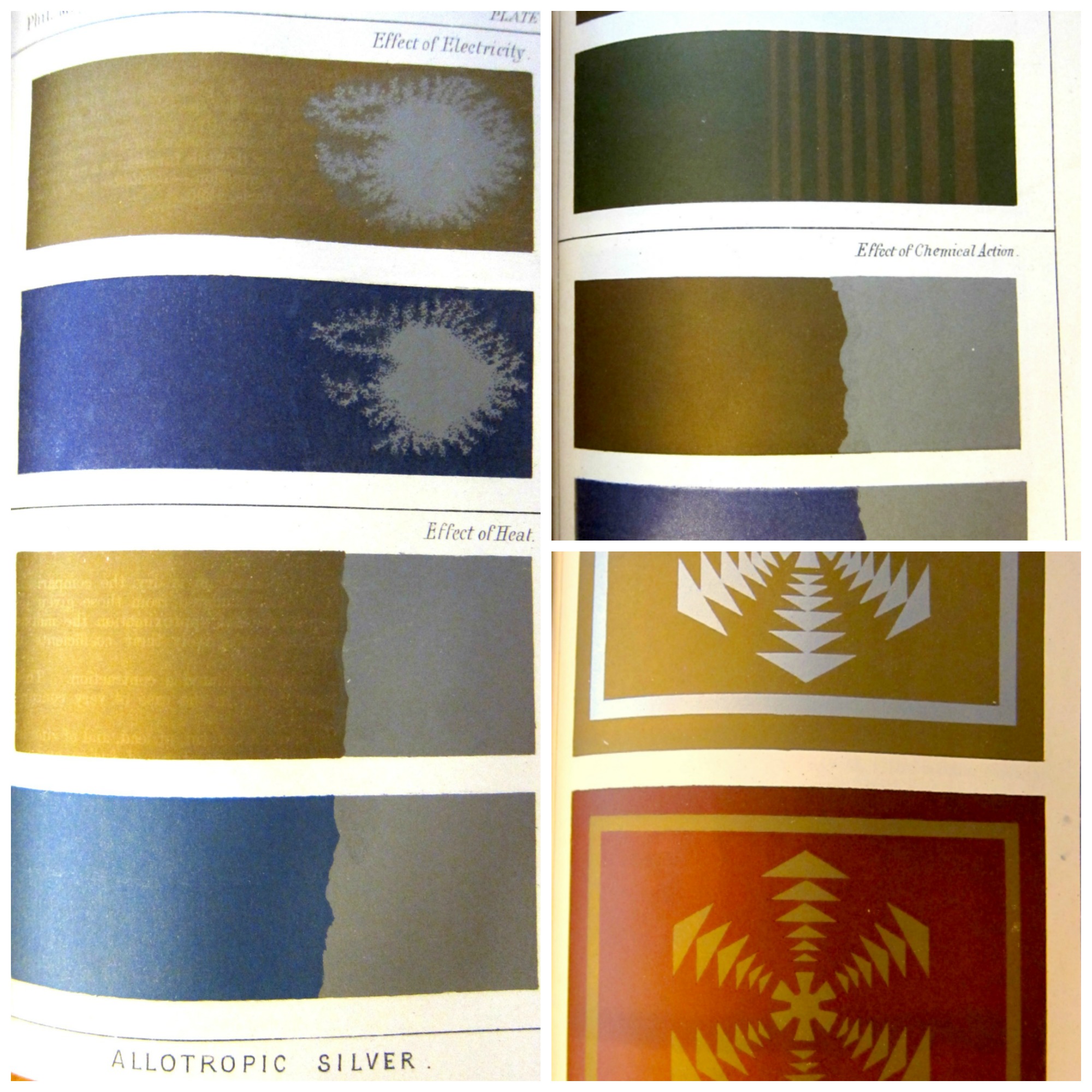
    Roughing my way through a volume of the Philosophical Magazine for 1891 I came upon an article1 illustrated with these beautiful and slightly ironic images of experiments conducted on selenium. The slightly odd thing about this is that in the first image on the left in the montage of the three images (below) of selenium we see that the basic colors at play here are yellow/gold and blue, which happens to be the colors of the national flag of Sweden–the chemical symbol for the element selenium is “Se”, and the detailed country code for Sweden happens also to be “.Se”.  Further, the man who first identified the element selenium back in 1817 was  J.J. Berzelius (1779-1848), who of course is Swedish, and widely recognized as being the Father of Chemistry in Sweden (contributing the coining of the words “catalysis, “Polymer”, “isomer”, and “allotrope”, among much else). So, well, that’s that–there was just a lot of Se/Sweden stuff going on here. (The last bit here is a stretch: Berzelius does among other thigns have a lunar crater named for him, appropriately, as the Greek word for “moon” is “selene”, the root of the name of the element.)

    And of course the images are beautiful, and wouldn’t stand a chance at being recognized as a found-art form for another two decades with the first appearances of non-representational art (as art).  

    Selenium montage


    Notes:

    1. Shelford Bidwell, “Some Experiments with Selenium Cells”, pp 250-256, found in The London, Edinburgh, and Dublin Philosophical Magazine and Journal of Science, (edited by William Thomson, George Fitzgerald, and William Francis. Printed in London by Taylor and Francis), volume XXXI, fifth series, January-June 1891. viii, 523pp, 6 engraved plates.

    And the full images:


    ·Posted by :

    ·in:


  • A Course in Chemistry Offered by Michael Faraday, 1825

    JF Ptak Science Books  Quick Post

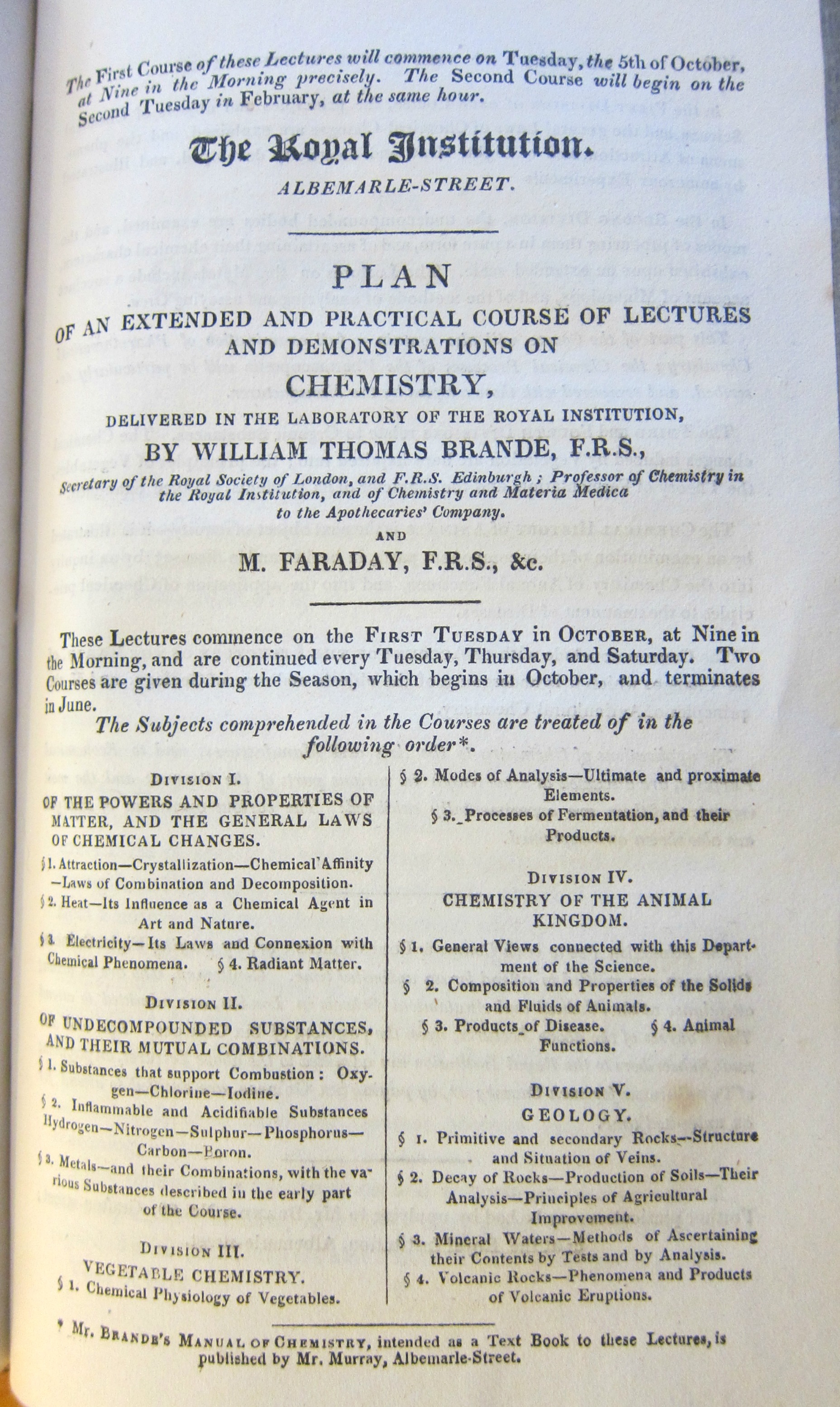
    Here’s an interesting bit I just found in a volume of  The Quarterly Journal of Science, Literature, and the Arts 1(of the Royal Society of Great Britain): a wonderful two-page advertisement for a course in chemistry, given by William Thomas Brande (1788-1866) and “M. Faraday” (1791-1867). Brande was the more-established and more socially-correct figure at this point (1825), though Faraday had already made a major contribution to the history of chemistry in 1821; still, the overall accomplishments and appeal of Brande probably explains the top billing. Be that as it may, lecturing under the auspices of the Royal Institution was a very big deal, and obviously a major imprimatur for any career. (Also it is interesting to note that Brande’s Manual of Pharmacy I advertised for sale on a full page opposite page vi.)

    Faraday lectures _a_

    ·Posted by :

    ·in:


  • Last of the Elements Discovered: Periodic Table and Element Use (1951)

    JF Ptak Science Books   Quick Post

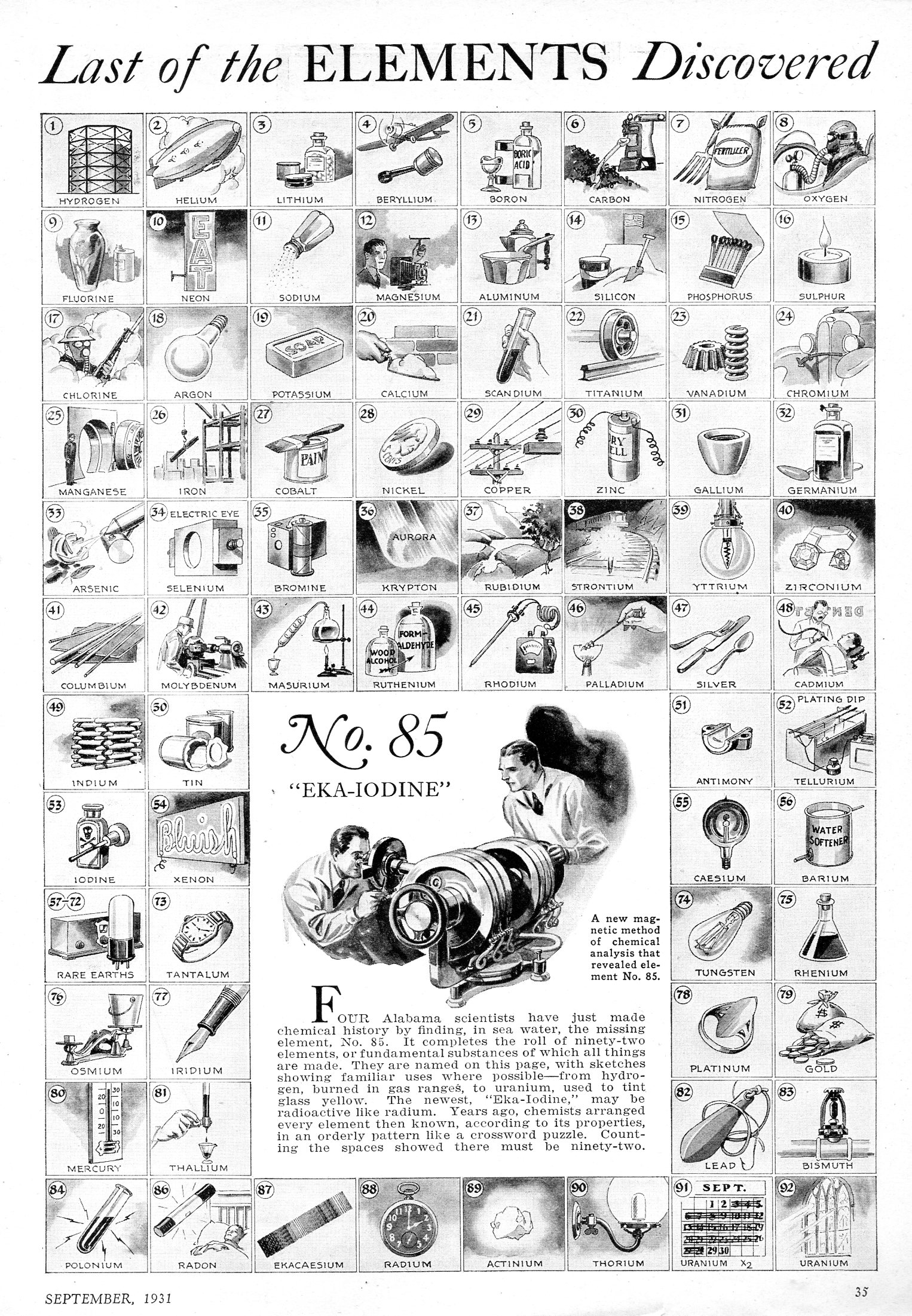
    I found this down in the warehouse this morning, published in Popular Science Monthly, September 1951.  It sin’t every day that you see a periodic table with drawings showing the employment of the elements, especially the stained glass windows for the element with the atomic number 92.  Actually uranium glass was a “thing” once upon a time,, at least until the Cold War kicked in, putting a crimp in the supplies of uranium for glass plates and beads and that sort of thing.  

    Periodic table369


  • Antique Chemistry Prints–Rees Cyclopedia, 1802-1920

    JF Ptak Science Books  Quick Post

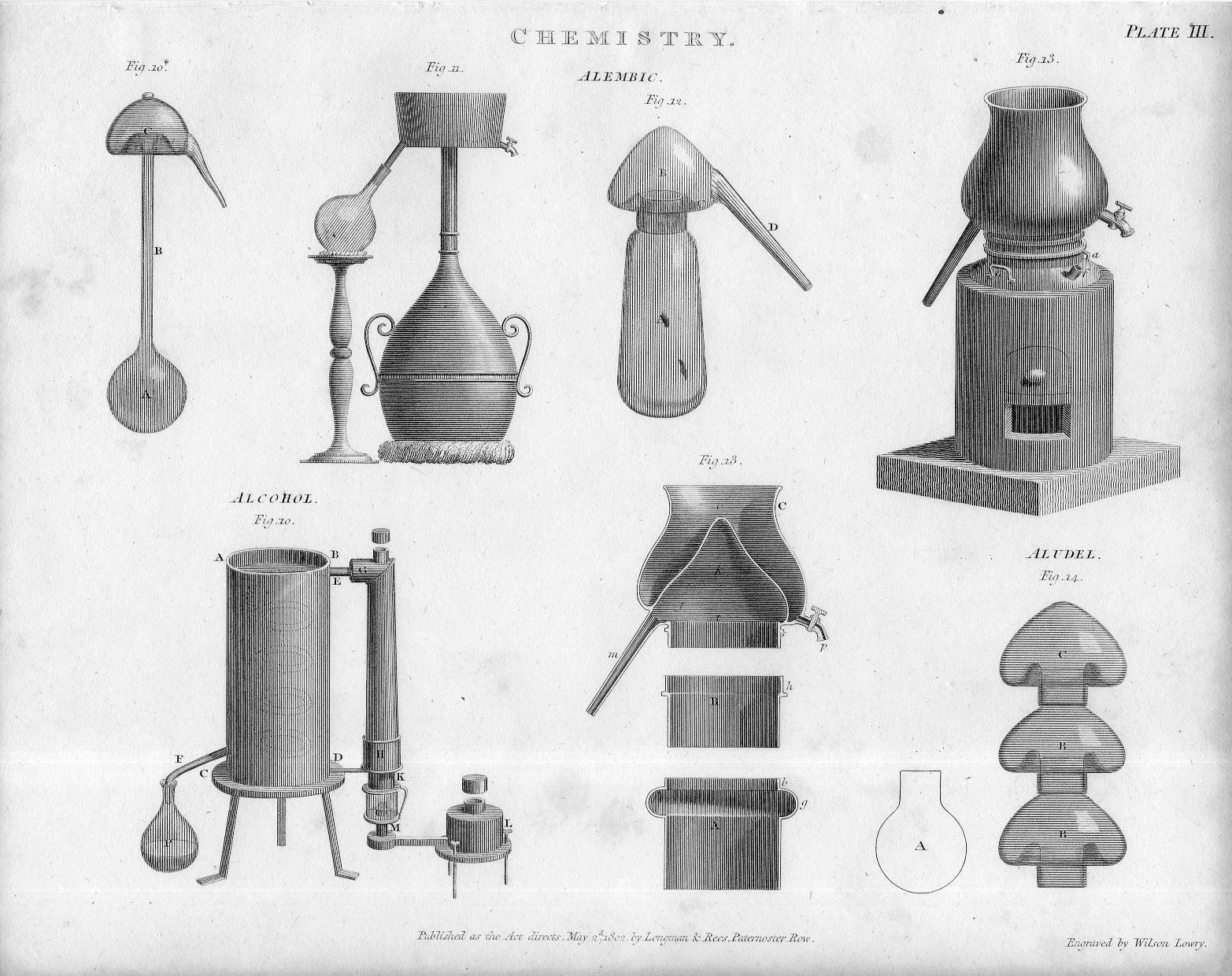
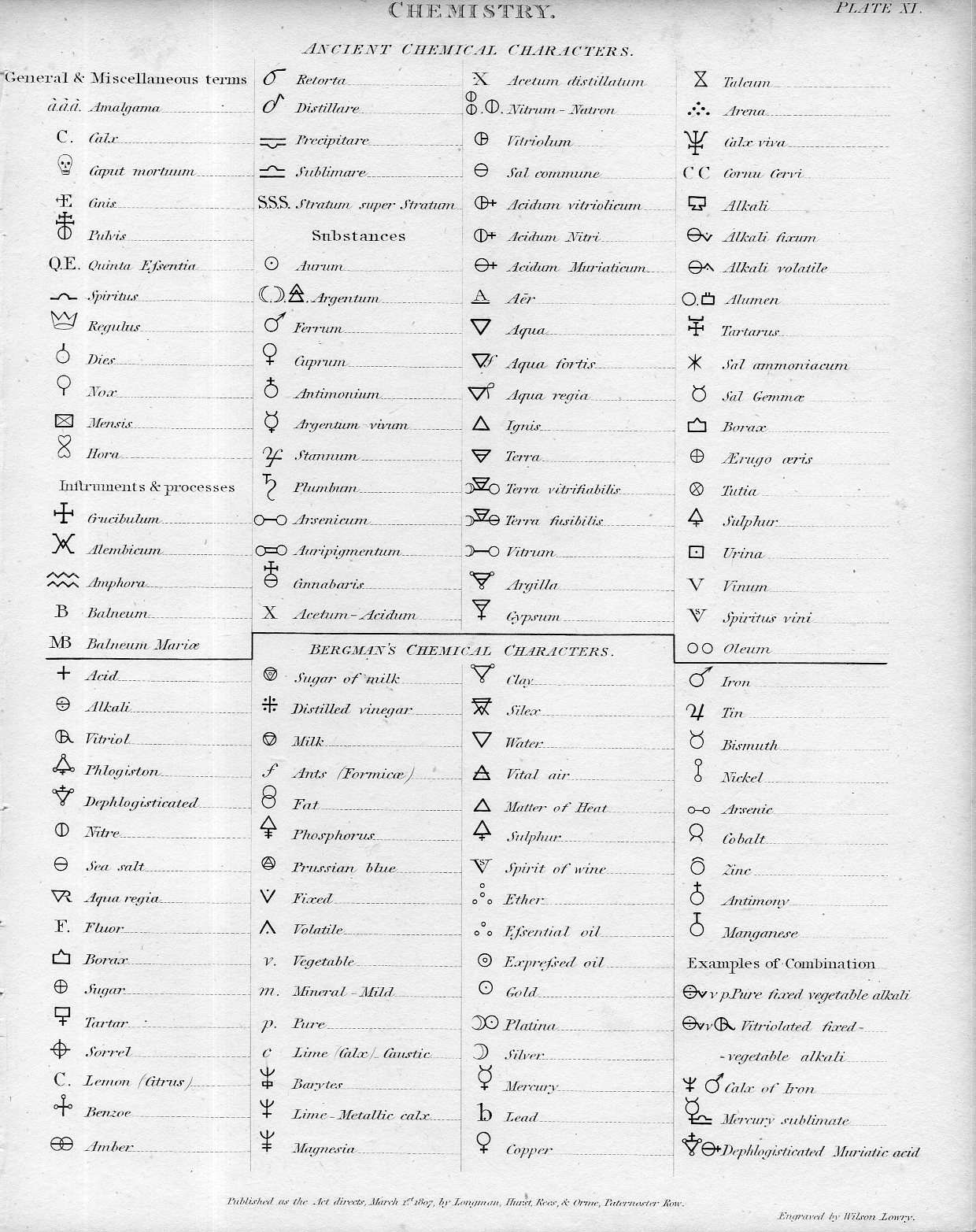
    The following images relating to chemistry were found in the illustration volumes of Abraham Rees’ (1743-1825) great work, Cyclopædia; or, Universal Dictionary of Arts, Sciences, and Literature. This was a massive undertaking for Rees, but his leadership and editorial skills were up tot eh task–in the end, 39 volumes were published containing nearly 40 million words, plus another six thick volumes contained the engraved illustrations to the monograph-length articles.  This section (below) displays some of the chemistry-related items.  Elsewhere in this blog Rees’ images relating to logic, math, and geography are displayed–just search under “Rees” in the Google search box at left.)

    • All of the following may be purchased via the blog’s bookstore, here. 


    Chremistry--alembics 1802 Rees063Rees, WIlson Lowry, London, 1802.

    Chremistry--symbols068Rees, WIlson Lowry, London, 1805.


  • Build Your Own Chemical Slide Rule!

    JF Ptak Science Books    Post 2425

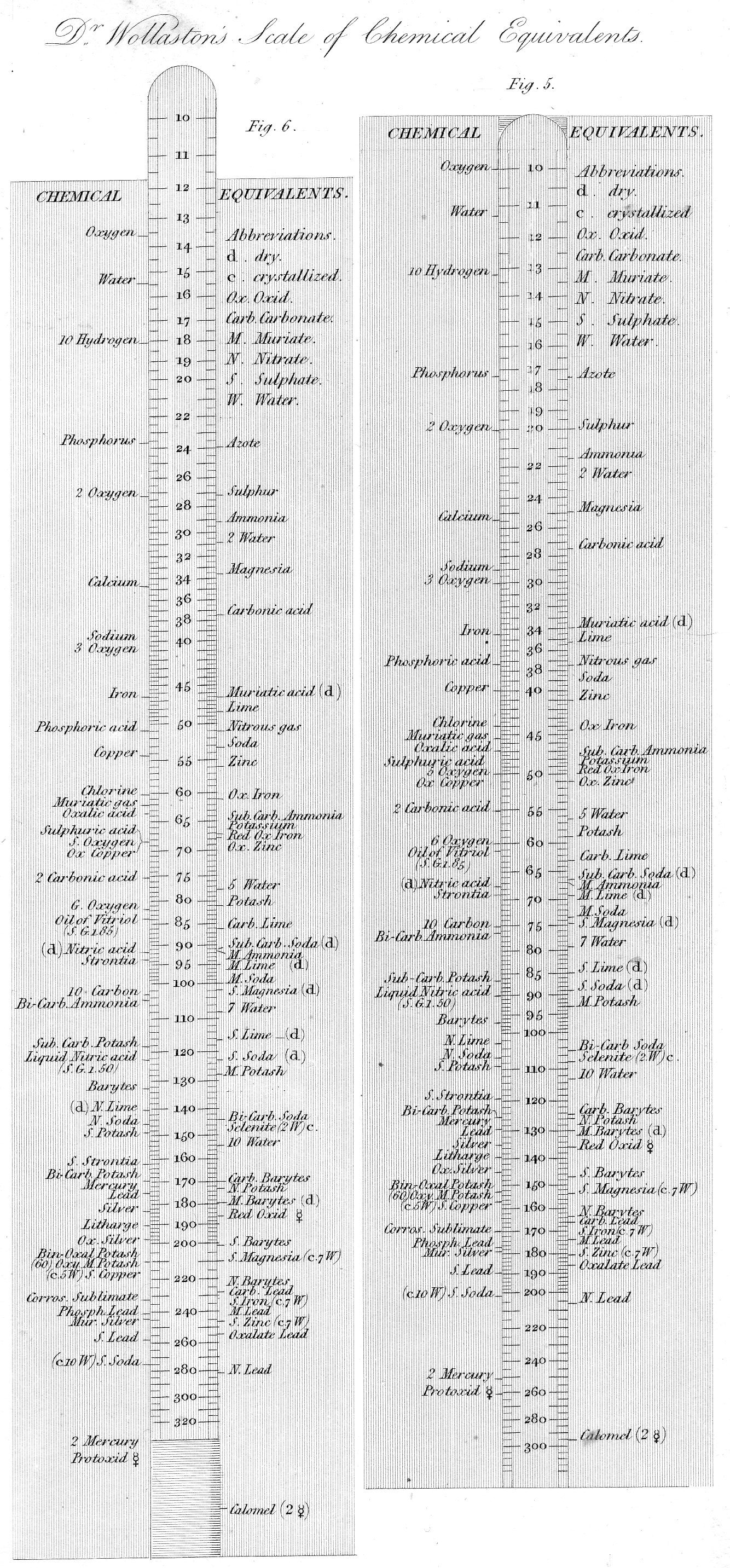
    Well, not a chemical-chemical slide rule/computer, not a biological thing, “just” a push-pull homemade bit cut-out from an article on chemical equivalents from 1814. But very neat, and  a major bit of thinking and articulation for the early 19th century. The original occurs in 1814 in a paper published by the Royal Society in the Philosophical Transaction by the eminent chemist William Wollaston, and a good description of the effort appears on Carmen Giunta’s excellent Chemistry Classics site (http://web.lemoyne.edu/giunta/):

    “In late 1813 he read a paper [published in 1814] that included an extensive compilation of “equivalent weights” or combining masses (closely related to molar masses) and a sort of chemical slide rule on which the weights were arranged. Wollaston’s paper included not only a table of equivalent weights but a summary of data from which he compiled the table, mainly analyses published by other chemists…”

    The copy of the slide rule that I’m using here is found in the great encyclopedia by Abraham Rees and which was published a few years later (1818)–its just a sharper copy with different design details than found in the original.

    Wollaston835

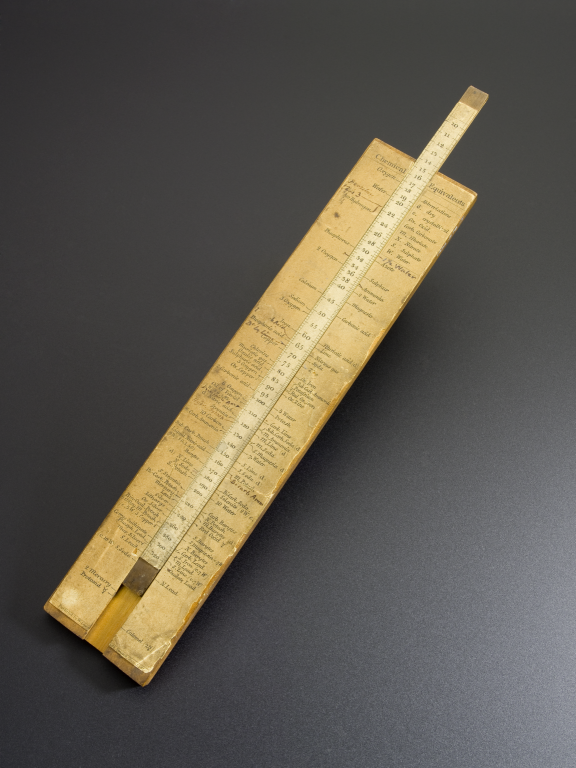
    And a photograph of an antiquarian version from the Science Museum (U.K.): 
    Wollaston[Source, #2, below)

    Notes:

    1. Full text of the 1814 paper:  William Hyde Wollaston, “A Synoptic Scale of Chemical Equivalents,” Philosophical Transactions of the Royal Society 104, 1-22 (1814).

    Another good article from the Chemical Heritage Foundation (“The Golden Rule”) :http://www.chemheritage.org/discover/media/magazine/articles/29-3-the-golden-rule.aspx

    2. And another from the Science Museum (UK) http://www.sciencemuseum.org.uk/online_science/explore_our_collections/objects/index/smxg-12515


  • Candy & Cellophane & duPont=Food! For Profit! (1939)

    JF Ptak Science Books  Quick Post

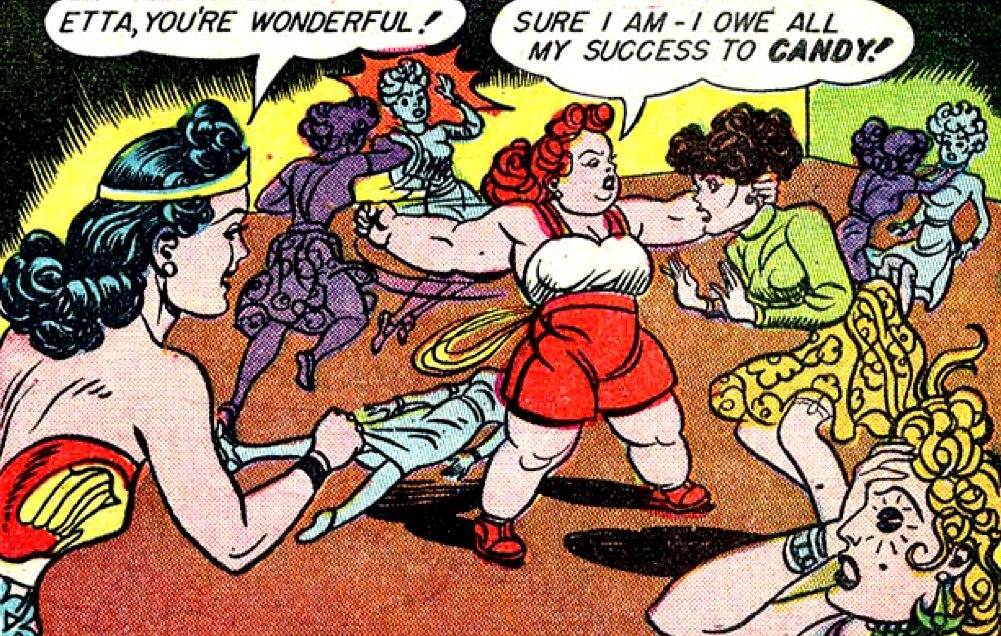
    Candy & WOnder Woman

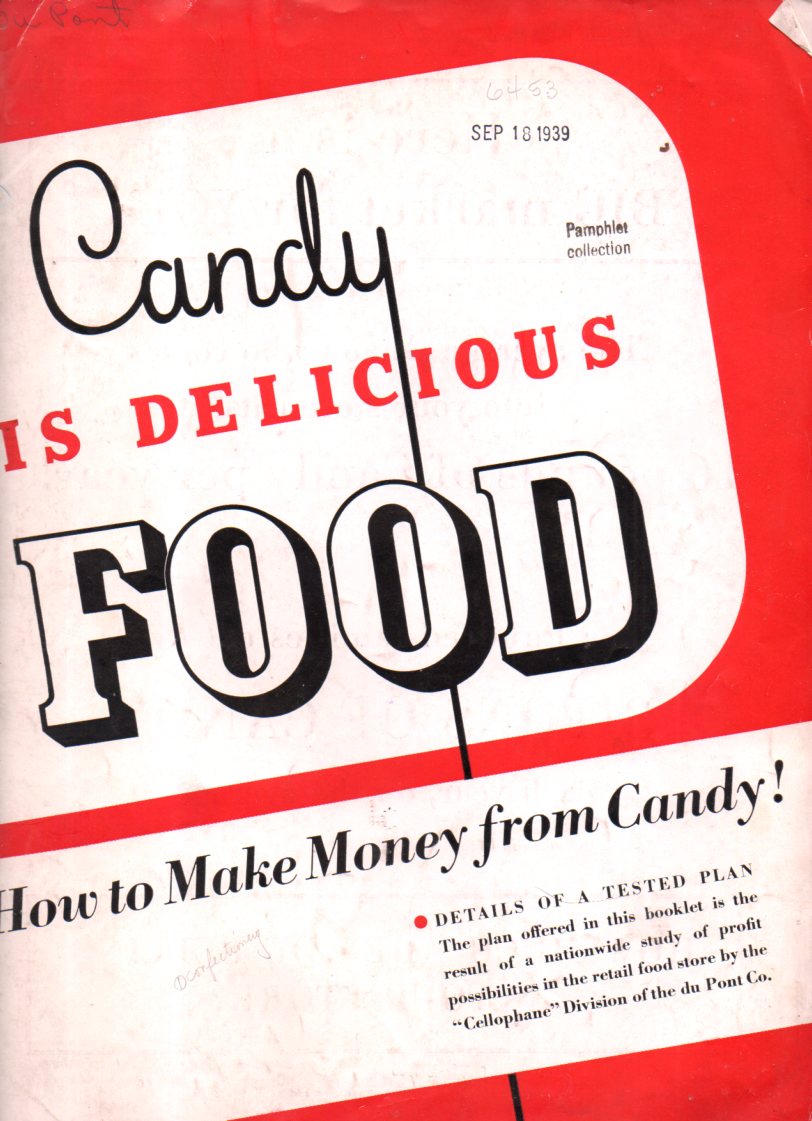
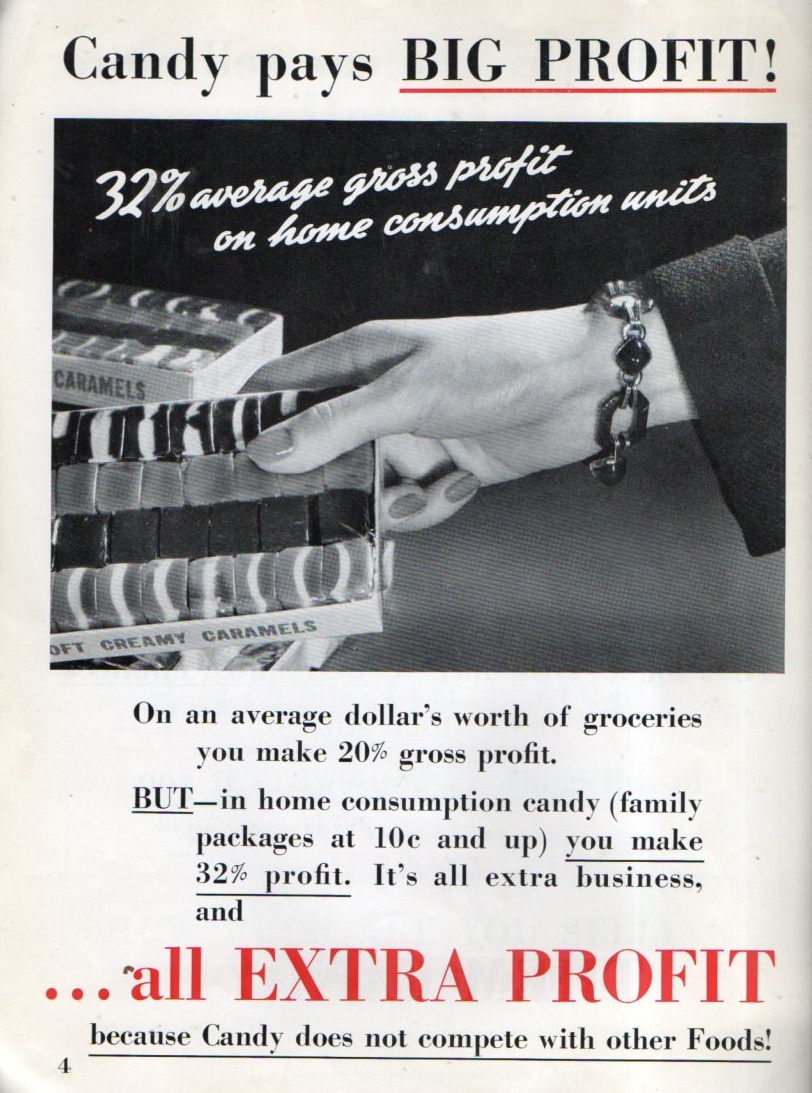
    This hand-out pamphlet seems to be a case where the sale of an edible product is made for the sale of its packaging.

    Candy is food609

    The pamphlet shouts that CANDY IS DELICIOUS FOOD, which is certainly a correct statement if food=digestible.  It tells/sells the story of candy as a profit-maker to the grocery seller, saying that “32% average gross profit on home consumption units“, those delicious-sounding unit-things being the candy.

    There are bits and pieces about candy display and placement, all on the advice of the maker of the stuff that in which the candy was wrapped–cellophane. The publisher and distributor of the pamphlet, the “Cellophane” Division of the E.I. du Pont de Nemours & Co. Inc., had a huge vested interest in candy sales: candy was mostly wrapped in Cellophane (starting with Whitman in 1912) and by the time du Pont achieved its water- and moisture-proof Cellophane in Delaware the product accounted (in 1938) for 25% of the company’s profits.  That’s pretty big, and so candy as a major muncher of Cellophane would be promoted by du Pont as pretty big, too. And as food, for added Bigness.  

    Candy is food610


  • The Molecular World in Not-Quite 3-D

    JF Ptak Science Books  Quick Post

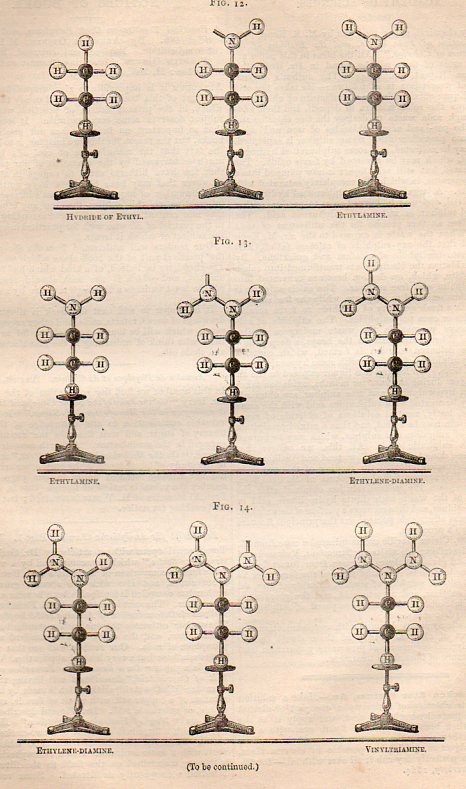
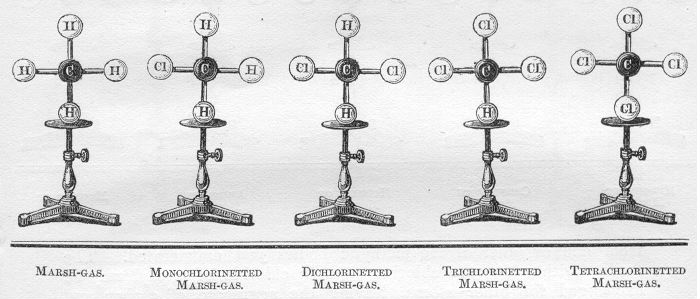
    Hofmann models046


    Hofmann models


    August Hofmann (a German organic chemist of high calibre, 1818-1892)  made this presentation1 to the Royal Institution in 1865, and it is one in which hand-made three-dimensional models of molecules2 are used for one of the first times for public demonstration.  (He actually made parts of it in different lectures, that is, but I have not yet been able to compare the two.)  The models aren’t quite three-dimensional, as Hofmann arranged them so that they would have at least 3-D molecules though their arrangement in space was veyry much liek they would appear on a piece of paper.  (This might be a bit off, and the molecules were all the same size, but the colors he employed to represent molecules are still being used: black/carbon, yellow/sulphur, white/hydrogen, blue/nitrogen, red/oxygen, green/chlorine.  

    Notes:

    1. HOFMANN, August Wilhelm. “On the Combining Power of Atoms”, in three parts, all in The Chemical News, October 5, 1865, pp 166-169; October 13, 1865, pp 175-179; and in October 20, 1865, pp 187-190.

    2.  The idea of molecules goes back 2000  years, to Empedocles, Leucippus, Democritus, and Epicurus. It should be noted I guess that the modern idea of the world (mostly?) owes itself to an 1873 article in Nature by James Clerk Maxwell.  He titled the paper, well, “Molecules”, and this is how he defined his terms: “An atom is a body which cannot be cut in two; a molecule is the smallest possible portion of a particular substance.”


  • Bad Poetry Yields Good Results in the Celebration of the “Atom-Molecule”, 1874

    JF Ptak Science Books  Quick Post

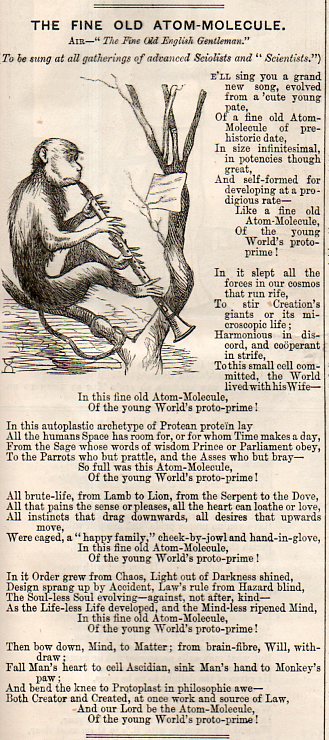
    Browsing  the 1874 volume of the London Punch an interesting but truly bad poem slid from the page. The poem certainly suffers from itself, but there are interesting insights, and poetics aside there’s some good thinking going on in spite of a probably-very-quick composition time.

    For example, the first line of this stanza “In this autoplastic archetype of Protean protein lay” is a real tooth-popper, but it does dig down into some interesting turf:

    All the humans Space has room for, or for whom Time makes a day,

    From the Sage whose words of wisdom Prince or Parliament obey,

    To the Parrots who but prattle, and the Asses who but bray–

          So full was this Atom-Molecule,

          Of the young World’s proto-prime!

    Atom molecule696
    The poem wobbles and wrangles within its own very tight and bumpy twists (”  Of the young world’s proto-prime!”) though the essence of existence does seep through:

    In it slept all the forces in our cosmos that run rife,

    To stir Creation’s giants or its microscopic life;

    Harmonious in discord, and cooperant in strife,

    To this small cell committed, the World lived with his Wife–

          In this fine old Atom-Molecule,

          Of the young world’s proto-prime!

    It is a curious work which I liked in the end, or at least I liked it as a vehicle to get you to another place: 

    In it Order grew from Chaos, Light out of Darkness shined,

    Design sprang up by Accident, Law’s rule from Hazard blind,

    The Soul-less Soul evolving–against, not after, kind–

    As the Life-less Life developed, and the Mind-less ripened Mind,

          In this fine old Atom-Molecule,

          Of the young World’s proto-prime.


  • Timeline of the Discovery of the Elements

    JF Ptak Science Books 
    Timeline of the Discovery of the Elements
    I found this very useful timeline presented in a not very friendly way at the about.com site. I couldn’t help but to coyp it and clean it up a little to make it a little more accessible.  Caveat: none of this is my own work–all of the credit for putting this list together goes to Anne Marie Helmenstine, Ph.D.   The original site for the list is About.com. 
    “Here’s a helpful table chronicling the discovery of the elements. The date is listed for when the element was first isolated. In many cases, the presence of a new element was suspected years or even thousands of years before it could be purified. Click on an element’s name to see its entry in the Periodic Table and get facts for the element.”