A Daily History of Holes, Dots, Lines, Science, History, Math, Physics, Art, the Unintentional Absurd, Architecture, Maps, Data Visualization, Blank and Missing Things, and so on. |1.6 million words, 7500 images, 4.9 million hits| Press & appearances in The Times, Le Figaro, Mensa, The Economist, The Guardian, Discovery News, Slate, Le Monde, Sci American Blogs, Le Pont, and many other places… 5000+ total posts since 2008.

Category: Brevity and Complexity

  • The False Card Catalogs for the Library of Babel

    JF Ptak Science Books  Post 2538
    Books

    “Cataloguing is an ancient profession; there are examples of such “ordainers of the universe” (as they were called by the Sumerians) among the oldest vestiges of libraries.” ― Alberto Manguel, A History of Reading (and also translator of Borges and co-editor of A  Dictionary of Imaginary Places, a book worthy of high consideration as the The Book that you could have with you on a desert island.)

    • [On the other end of the infinite library, see an earlier post here on “The Library of One Book”, here: https://historyofideasblog.com/thesciencebookstore/2009/10/the-library-of-one-book.html]

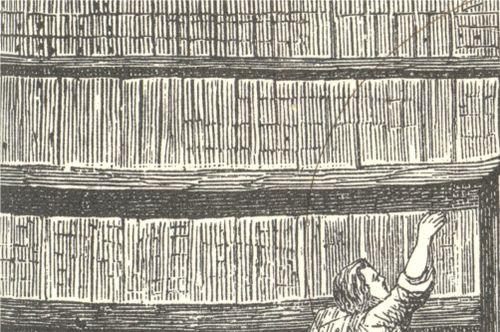
    In Jorge Borges’ “The Library of Babel” (published in 1944 and translated into English in 1962) we find that an infinity, or a universe, or a heaven, is declared to be a sort of endless library, stocked with hexagonally-shaped rooms books filled with books, all the same size, with the same number of characters. The rooms are endless, as are the books, which are written in every conceivable language and containing 29 necessary elements (including the alphabet, and the period, comma, and very interestingly concluding with the space). There are endless varieties of possibilities, and the place is staffed by librarians who have interests and obsessions from, well, A to Z, or Az^Z^Z^Z to ZA^A^A and so on, until we run out of time.  (Others have done some smart thinking on Borges’ great thought experiment/short story, and have estimated the size of the library in terms of stacked orders of magnitude beyond the atoms of the universe–but you can find all of that stuff elsewhere with a quick google search.)

    And then there’s this sample fro Borges on what sorts of books make up the library:

    “…the detailed history of the future, the autobiographies of the archangels, the faithful catalog of the Library, thousands and thousands of false catalogs, the proof of the falsity of those false catalogs, a proof of the falsity of the true catalog, the gnostic gospel of Basilides, the commentary upon that gospel, the true story of your death, the translation of every book into every language . . .”

    Here’s how you arrange an infinite library: you don’t.

    The books are not sorted to any sort of classification, only collected to the point that they are together.

    The many seem to be written in indefinable languages. Some of the librarians spent their time pursuing the holy grail–since all books that could ever be published would be present here, which theoretically include an index to library, or some sort of organizing principle.

    But since there was no verifiable organizing principle at play here, the library was useless as a “library”, though for the individual bits, it was perfectly fine. The structure though just turned into a long, endless, shelf.  This might explain why the caretaker/librarians of the place are so desperate.

    I cannot recall a mention of a card catalog, which I guess could be as all-powerfully impossible as the library, given that the library is not-classifiable. This is particularly true when you consider that there must also be a catalog of the arrangement of all possible false catalogs of all possible false books in the library, in addition to the true catalog. Perhaps the cards from this catalog would take up all of the space in the universe that would bump up against our own.  

    On the other hand, the logician W.V.O. Quine has written in a short piece that the Borges library is finite, because at some point there will come a time that all that can be written or will be written has been written:

    “It is interesting, still, that the collection is finite. The entire and ultimate truth about everything is printed in full in that library, after all, insofar as it can be put in words at all. The limited size of each volume is no restriction, for there is always another volume that takes up the tale — any tale, true or false — where any other volume leaves off. In seeking the truth we have no way of knowing which volume to pick up nor which to follow it with, but it is all right there.”

    He reduces this argument elegantly but completely without the humor of Borges, and says that all that is known can be represented in two symbols from which everything else can be derived–a dot, and a dash. He writes: 

    “The ultimate absurdity is now staring us in the face: a universal library of two volumes, one containing a single dot and the other a dash. Persistent repetition and alternation of the two is sufficient, we well know, for spelling out any and every truth. The miracle of the finite but universal library is a mere inflation of the miracle of binary notation: everything worth saying, and everything else as well, can be said with two characters.”

        “The ultimate absurdity is now staring us in the face: a universal library of two volumes, one containing a single dot and the other a dash. Persistent repetition and alternation of the two is sufficient, we well know, for spelling out any and every truth. The miracle of the finite but universal library is a mere inflation of the miracle of binary notation: everything worth saying, and everything else as well, can be said with two characters. It is a letdown befitting the Wizard of Oz, but it has been a boon to computers.” [Quine’s “Universal Library” is found at Hyperdiscordia, here: http://hyperdiscordia.crywalt.com/universal_library.html]

    Quine’s approximation cuts way down on the size of the library, which evidently would not fit in the known universe, which opens the gates for Heaven, which I think doesn’t depend on such restrictions–unless of course it was too big for that, which means believers would be in trouble, and none too happy with being kicked out of paradise to make space for a book.


  • Should There be a Post about Question Marks?

    JF Ptak Science Books  Post 2506

    • “You talkin’ to me?”–Travis Bickle
    • “Is it safe?” — Christian Szell
    • “Who’s on first?”–Bud Abbott & Lou Costello

    Question mark trio

    Well, almost a post.

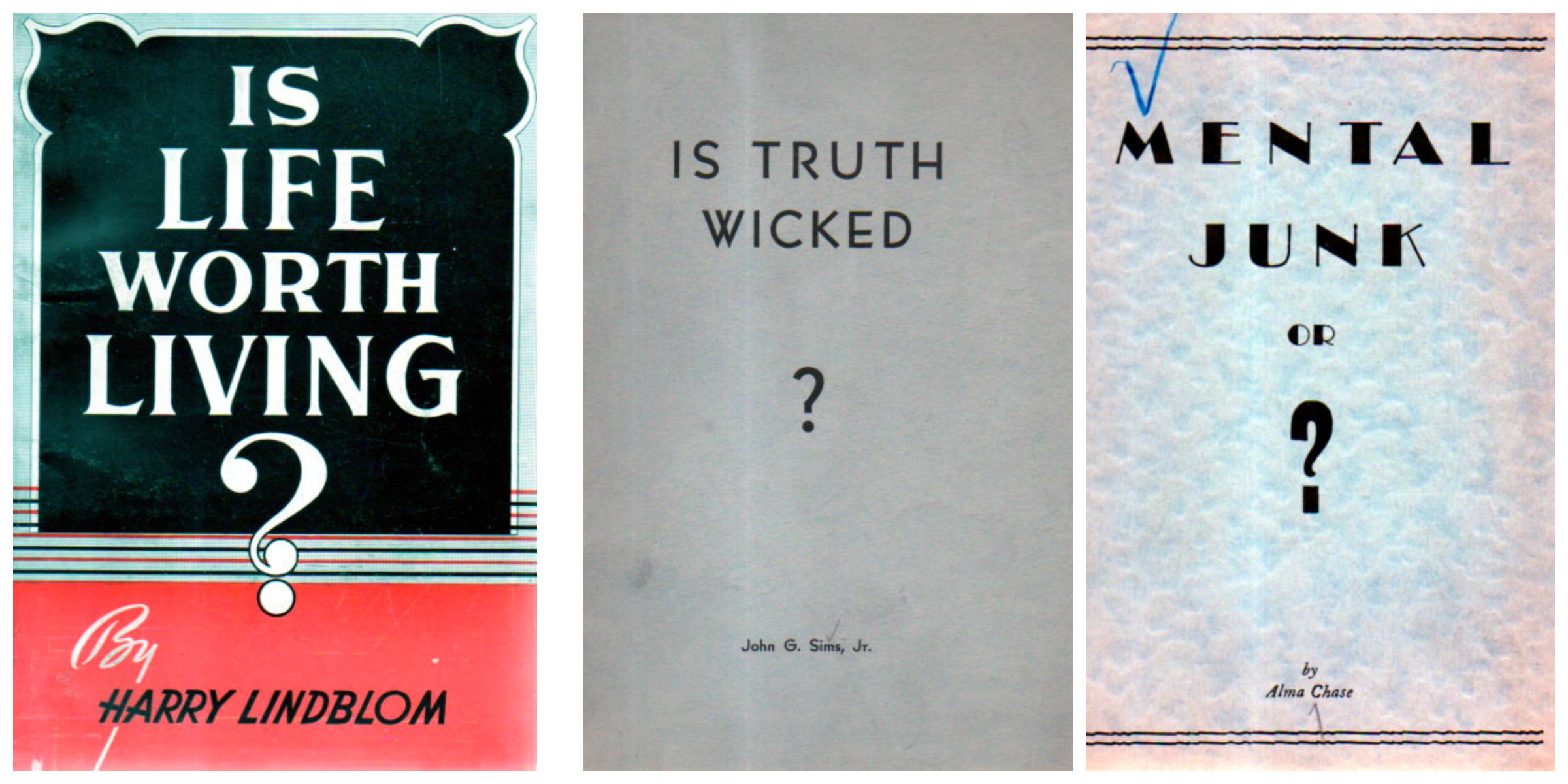
    In my haul of the 90,000-item Pamphlet Collection from the Library of Congress some number of years ago oh my brothers and sisters I created many standard and many odd categories into which the pamphlets would hopefully fall into some sort of wishful order. One of the straightforward categories was Titles with Questions, which was actually a combination of a great number of other categories, including the Found-Absurd, the Found-Surreal, and the Glibly Naive, including more-standard selections.  The Question Marks could stand on their own, though, because they were ungainly, so stark, and bizarre, and unexpected–they just demanded a certain consideration for themselves. 

    Sometimes these question marks could easily be an exclamation point. 

    For some reason these three were separated from the pack, but they’re good enough to stand as representatives of the collection, all of which gathered together might make for an interesting exhibition. But for now, three will do.

    They bring up a larger though perhaps not-very-interesting issue of other more interesting works in other fields where the title is a question.

    For example, here are some good questions, (one in translation):

    • “Is the inertia of a body dependent on its energy content?” (“Ist die Trägheit eines Körpers von seinem Energieinhalt abhängig?”)1
    • “Can quantum-mechanical description of physical reality be considered complete”2

    As a matter of fact, they’re  really good questions–and the person putting the question mark into the title of these papers was Albert Einstein in the first case and then Albert Einstein, Boris Podolsky, and Nick Rosen in the second.

    There are many others to be sure, but it is a difficult question to answer offhand, like this, and will take a much longer think.  (Another good question comes in the title of Richard Courant’s book, What is Mathematics?)

    There is a recent paper3 of questionable use for someone like me that looks at the rise of the use of question marks in scientific papers over the last fifty odd years or so. (I must commend the author though as he utilized more than 2 million papers in the comparison.)

    But then there are the great philosophical questions like “Why did the chicken cross the road?”,”Does God Exist?”, “If a tree falls…?,” “Is there Life after Death?”, “Father, Why Have You Forsaken Me?”, and “Where’s Waldo?”

    And of course great books have their fair share of questions–I can quickly come up with the following examples and no doubt some real thought will produce many more: P.D. Eastman’s Are You My Mother?, Horace McCoy They Shoot Horses, Don’t They?, Ed Albee Who’s Afraid of Virginia Woolf?, PK Dick’s Do Androids Dream of Electric Sheep?

    Political (Lenin, What is to be Done?), musical (“Will You Miss Me When I’m Gone?” by the Carter Family), and question marks in film (“O Brother, Where Art Thou?”, “Whatever Happened to Baby Jane?”), all need to be addressed for such a future post.  

    But not right now–for the moment, it is just these three delightful pamphlets.

    Notes:

    1.  One of the four miracle papers of 1905, published in the Annalen der Physik 18(13):639-641

    2. This is the EPR Partadox, a great contribution to physics published in the Physical Review in 1935,  47(10):0777-0780

    3.  “The titles of scientific articles have a special significance. We examined nearly 20 million scientific articles and recorded the development of articles with a question mark at the end of their titles over the last 40 years. Our study was confined to the disciplines of physics, life sciences and medicine, where we found a significant increase from 50% to more than 200% in the number of articles with question-mark titles. We looked at the principle functions and structure of the titles of scientific papers, and we assume that marketing aspects are one of the decisive factors behind the growing usage of question-mark titles in scientific articles.”– “Scholarly communication in transition: The use of question marks in the titles of scientific articles in medicine, life sciences and physics 1966–2005”, by Rafael Ball, in Scientometrics, June 2009, Volume 79 #3, pp 667-679,


  • The Unstoppable Mawson (1914)

    JF Ptak Science Books   Post 2495

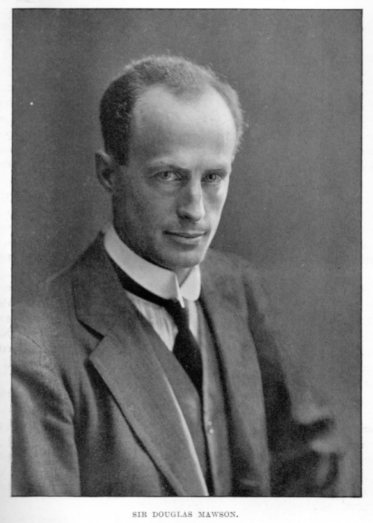
    Mawson scan portrait216

     Oh bloody hell–was there anyone as tough as Douglas Mawson?  The impossible situations he survived for months on end are just, well, impossible. He just kept going in the most extreme environment in the Antarctic in the face of long and endless perdition–and won. And to be honest I’m not sure who claims him–the Brits because he was born there, or the Aussies because he emigrated with his folks when he was two years old–but I’d fight for him being mine whatever the position on the globe I was in.  I’ve read Mawson’s Will  by Lennard Bickel and also parts of his own The Home of the Blizzard (available at Project Gutenberg but it reads much better with an older print version, so you can feel its big chunkiness in your hands). The books are both about his 1911-1914 Australasian Antarctic Expedition, which Sir Edmund Hilary calls “the most outstanding solo journey ever recorded in Antarctic history”, and which is no overstatement.

    Mawson scan portrait215

    So when I discovered  that I had a small publication from the Geographical Journal (September 1914)  by Sir Douglas called  “The Australasian Antarctic Expedition, 1911-1914” I was pretty excited. It is short (29pp) but it seems to be the first time that he addressed the expedition in any detail; it is first-person and very concise, nearly so to the point of brittleness. And it has a couple of killer folding maps (large folding ones for King George V Land and Adelie Land) to illustrate the trek.  There’s also a do-not-stand-in-my-way portrait of Mawson, who recounts the trek and what was supposed to be the charting and geological/glaciological reconnaissance of the 1500-mile Antarctic coast southward of Australia. Then there was the tragedy, and his 160km 30-day solo march through The Bad Stuff. 

    You can read the article online via Wiley and JSTOR by following this link http://www.jstor.org/stable/1778688?seq=1#page_scan_tab_contents and getting a JSTOR permit. If you don’t have an account that includes JSTOR, it is well worth the effort of signing up for the free stuff that it offers.  

    • There are three film clips in existence for the expedition, found at Australian Screen: http://aso.gov.au/titles/documentaries/home-blizzard/

  • A King-Hell Review of the U.S.: “Who Reads an American Book?” (1820)

    JF Ptak Science Books   Post 2474

    Criticism109

    Sydney Smith was a cleric and critic; I don’t know much about the former, but I have seen some of the later, and it could be insightful and acidic. Here’s an example that I had seen years ago and then bumped into again this morning, a massive and stinging observation on the United States, in general. It comes in a review of a seemingly brickish/factoid work by Seybert, and is a data-trove publication of statistical information, and appears in The Edinburgh Review.

    After a lengthy appreciation of the work, Smith can hold himself no more. It is in the final two paragraphs of the review in which he freezes everything stock still, wanting whomever was reading his words to answer his series of questions so that they can form the answers themselves–but no matter, Smith provides the answer in the end, impatient for someone else to do the thinking.  That’s okay–the man made a good point.  

    In my experience if this wit is remembered at all it is for the opening fragment about the American book–that actually comes way at the end of the page-long paragraph; and it is really in the rejoinder, the final bit of that long sentence ending the paragraph, where the real venom sits, waiting for its victim to step into it.

    “…In the four quarters of the globe, who reads an American book? Or goes to an American play? or looks at an American picture or statue? What does the world yet owe to American physicians or surgeons? What new substances have their chemists discovered? Or what old ones have they advanced? What new constellations have been discovered by the telescopes of Americans? What have they done in mathematics? Who drinks out of American glasses? or eats from American plates? or wears American coats or gowns? or sleeps in American blankets? Finally, under which of the old tyrannical governments of Europe is every sixth man a slave, whom his fellow-creatures may buy, and sell, and torture?”

    “When these questions are fairly and favourably answered their laudatory epithets may be allowed. But till that can be done we would seriously advise them to keep clear of superlatives.” –Review of  Adam Seybert’s Annals of the United States, published in The Edinburgh Review (January, 1820).1

    Ouch.  I wanted to get to the main quote straight-away in this short blog post; it is preceded by some rougher stuff, as insightful as the above but not as committed to the overall social memory:

    “…The Americans are a brave industrious and acute people but they have hitherto given no indications of genius and made no approaches to the heroic either in their morality or character. They are but a recent offset indeed from England and should make it their chief boast for many generations to come that they are sprung from the same race with Bacon and Shakspeare and Newton. Considering their numbers indeed and the favourable circumstances in which they have been placed they have yet done marvellously little to assert the honour of such a descent or to show that their English blood has been exalted or refined by their republican training and institutions. Their Franklins and Washingtons and all the other sages and heroes of their revolution were born and bred subjects of the King of England and not among the freest or most valued of his subjects. And since the period of their separation a far greater proportion of their statesmen and artists and political writers have been foreigners than ever occurred before in the history of any civilized and educated people. During the thirty or forty years of their independence they have done absolutely nothing for the Sciences for the Arts for Literature or even for the statesman like studies of Politics or Political Economy…”

    The entire review is worth a read–it is a good overview of the data, and is also peppered with choice nuggets, like this one on Florida:

     Notes:

    1.  The review is reprinted in The Literary and Scientific Repository, and Critical Review, Volume 1, by Charles Kitchell Gardner, pp 177-186.

    • Read a short, interesting insight into the book that Smith was reviewing here, by Eric Salughter.

    ·Posted by :

    ·in:


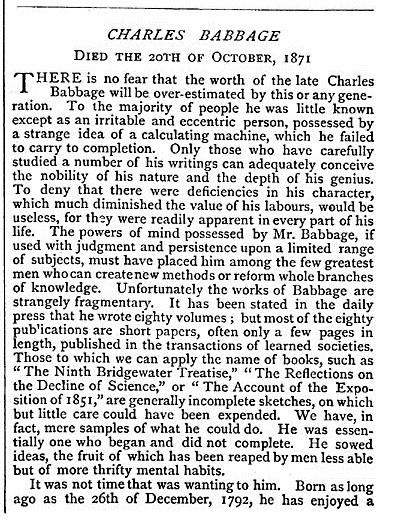
  • Babbage Obituary and Other Babbage Bits

    JF Ptak Science Books    Quick Post

    BBabbage portrait detail

    [Image source: Giants of Science]

    Here’s a fine piece of work on Charles Babbage from a very early period (volume 5) of Nature–succinct and tight and only two pages.  (It was buried in the middle of the issue, which surprised me, as I thought he’d be placed up front rather than tucked into the middle. So it goes.)

    Some other bits on Babbage on this blog:

    • Poe, Babbage, and Thinking Machines, 1836 (here) 
    • The Broken Windows of Uncle Chuckles–Charles Babbage Figures Stuff Out, 1857 (here)


    NATURE Babbage obit

    ·Posted by :

    ·in:

    —

  • Demolition Tightrope Act with Pick Axe, 1915

    JF Ptak Science Books   Quick Post

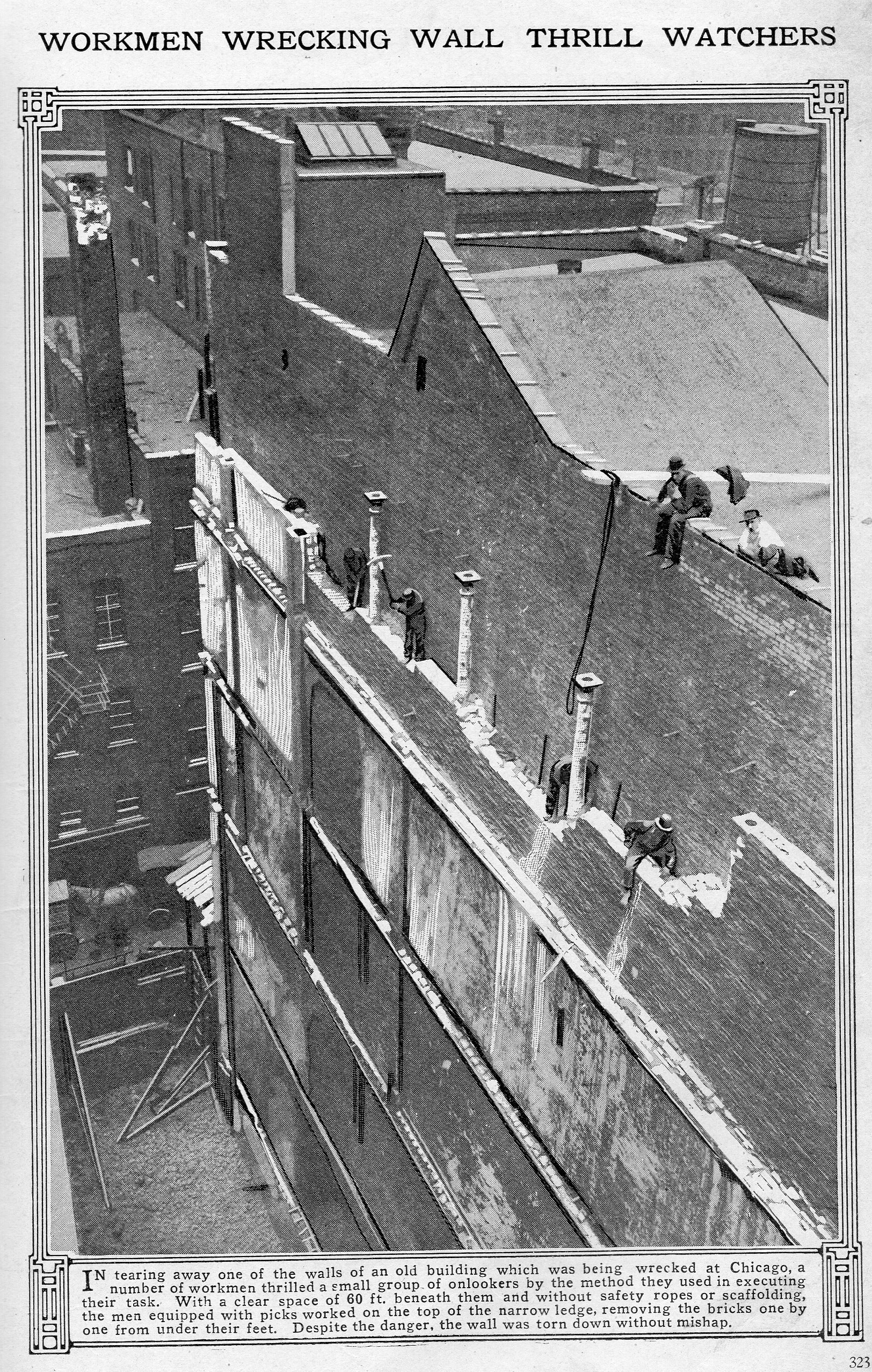
    There was a job to do in Chicago, and these men did it–how it all worked out safely accomplished, I do not know, because the episode is gut-wrenching just looking at the photo.  Not much can be said here except, “oh, wow”. 

    And for the record they are removing a wall from a mostly-demolished building, the last wall standing, built against its neighbor.  And what these guys did six stories up was swing a pickaxe to remove the wall beneath ,them, all the way down, brick-by-brick.  

    Demolition791

    [Image source: Popular Mechanics, August,, 1915, pg 323]


  • A Dominance of Observations from our Future Skeleton (1635)

    JF Ptak Science Books    Post 2413

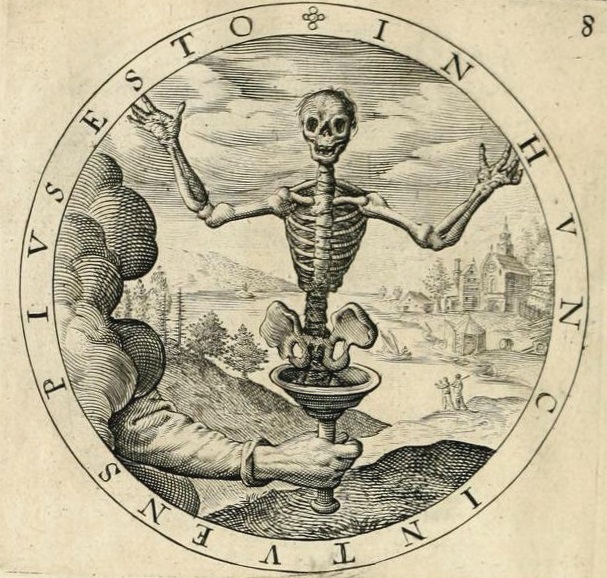
    Emblem skeleton detail

    The poem asks some good and thoughtful questions that could lead a person to re-evaluate their self-centered existence, all the while mentioning “God” and the everlasting only  twice (though it does invoke the concept of “piety” up at  the very beginning and again at the end), so to me this strikes me as being a half-way morality-of-consumption consideration on the one hand and a plea for repentance for “new life, with endless glorie” on the other.   

    This fine emblem book was found for me this morning by the wonderful Public Domain Review site. George Wither (1588-1667) published his book  A Collection of Emblemes, Ancient and Moderne, Quickened with Metricall Illustrations, both Morall and Divine, and Disposed into Lotteries…. in 1635 in London by Henry Taunton, and engraved by William Marshall (1617-1650).  It is a lovely and surprising book, filled with sprinkled gems, not the least of which is the lottery-maker (referred to in the title), which we will come to below.  

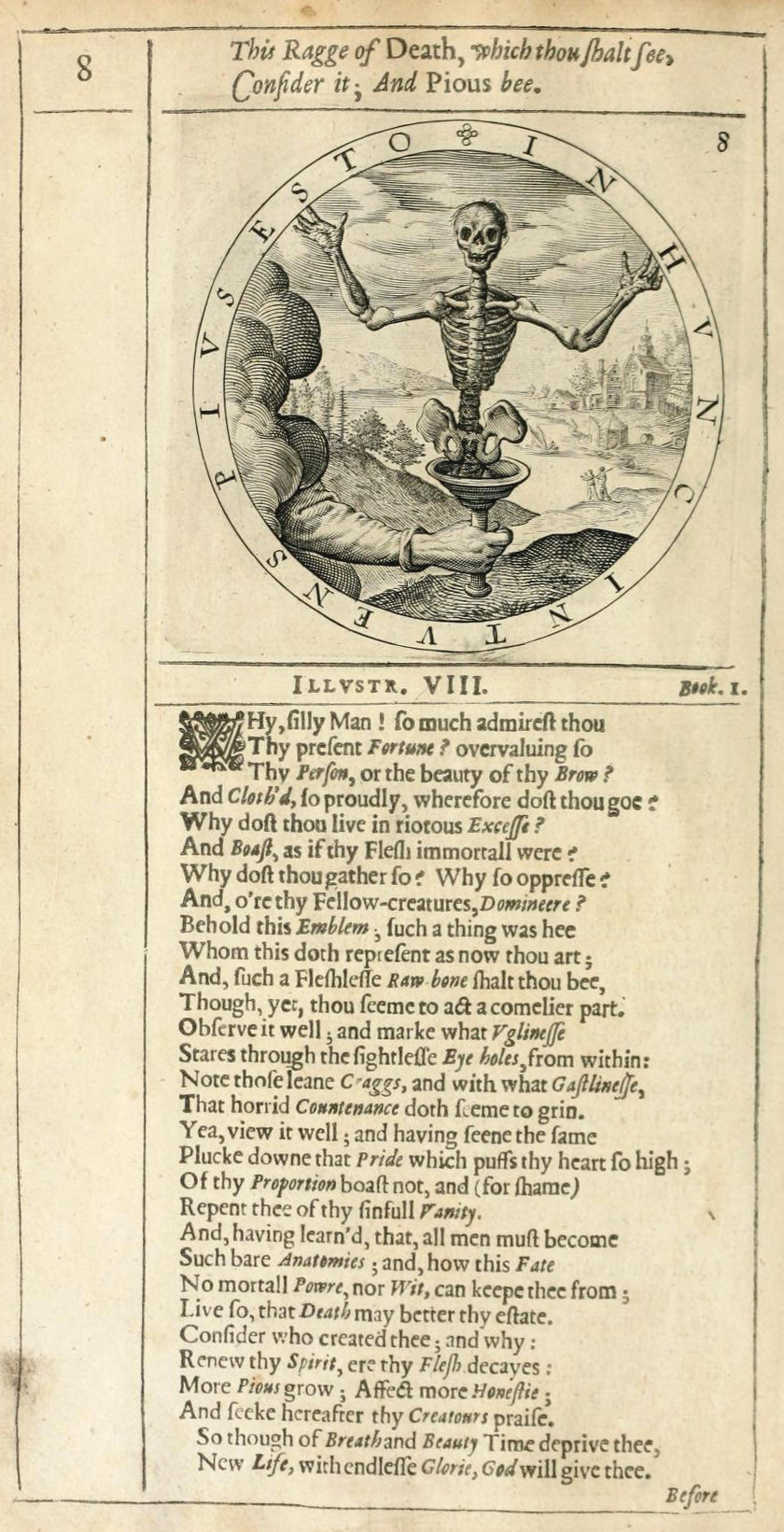
    The emblems were meant to be  striking metaphorical/allegorical images to spark ideas and reflection, and illustrated with a poem to make that process longer and deeper.  For example, consider the aspect of the death that awaits us all and how we live our lives:

    Emblem skeleton


    In an odd occurrence of the word “overvaluing”, the writer (and skeleton) asks us right away if we are “overvaluing so thy person, or the beauty of thy brow?” and “Why dost thou live in riotous excesse?” There are a few other provocative questions from and for the future (“Why so oppresse, and o’er thy fellow-Creatures, dominere?”) delivered to us from us from our “fleshless raw bone thou shalt bee”–our skeleton seeing things clearly though its “sightlesse eye holes from within”.  Mostly though what remains for us in the poem are admonitions/suggestions about what we might do with our time before we have none. For example, “of thy Proportion boast not and (for shame) repent thee of thy sinful vanity”, and “renew thy spirit ere thy flesh decays”.  There’s a lot going on in the 36 lines of this poem, more so than you’d expect, and it certainly gives the reader something to think about as they slink towards their own exposed anatomies.  

    The poem asks some good and thoughtful questions that could lead a person to re-evaluate their self-centered existence, all the while mentioning “God” and the everlasting only  twice (though it does invoke the concept of “piety” up at  the very beginning and again at the end), so to me this strikes me as being a half-way morality-of-consumption consideration on the one hand and a plea for repentance for “new life, with endless glorie” on the other.    

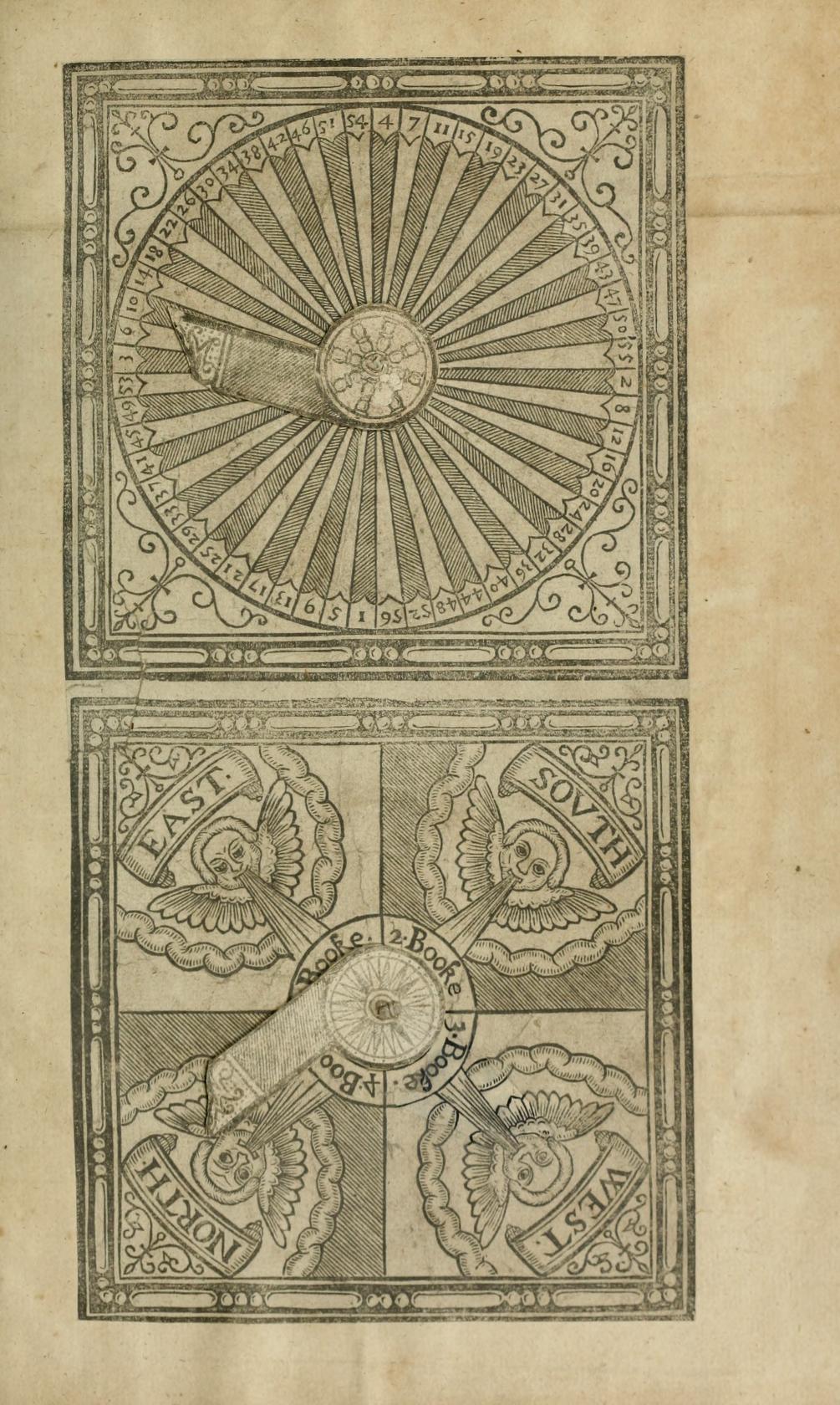
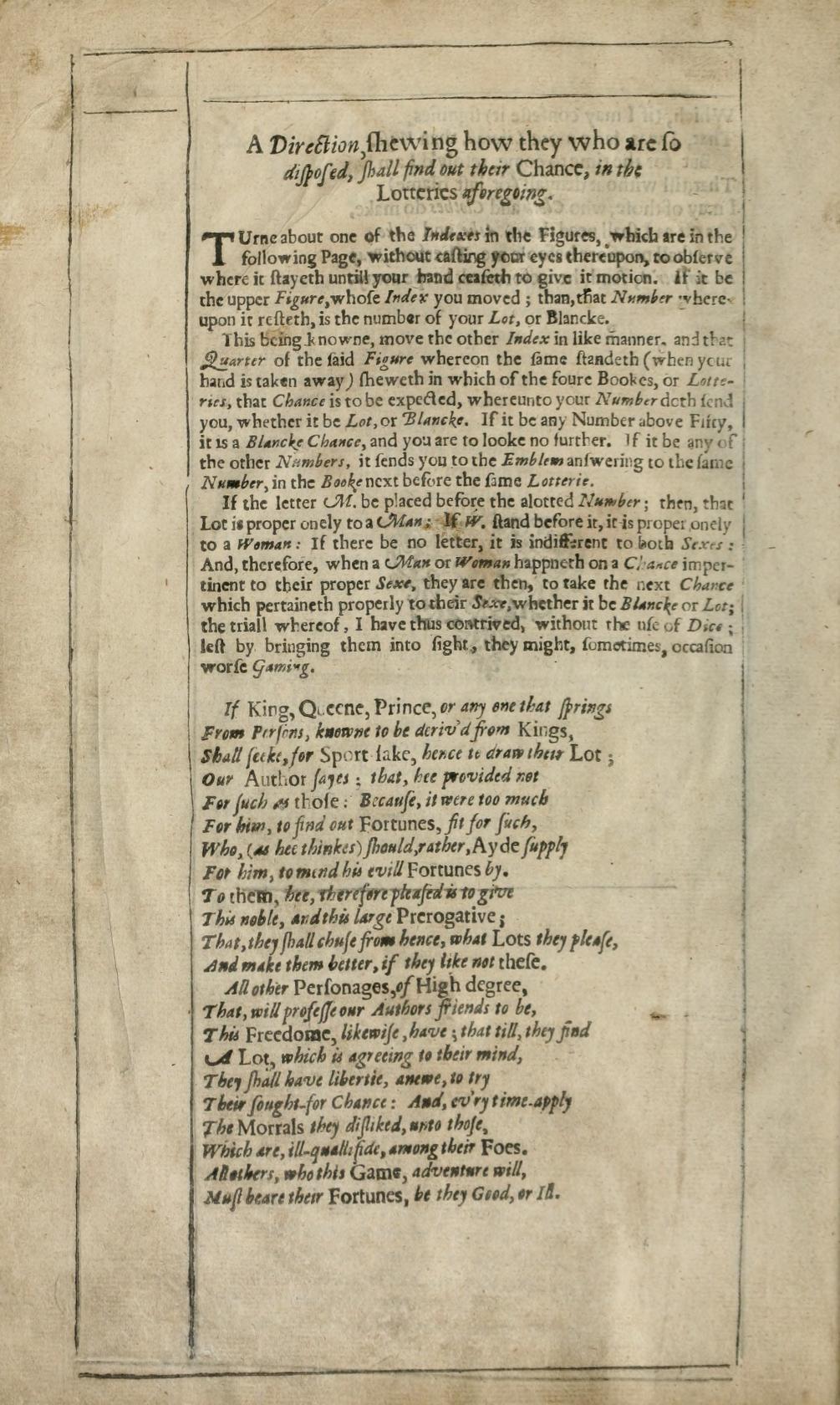
    Now to one aspect of the “Lotteries” referred to in the title:  the book comes with its own chance-maker.  That is, at the very end there are two movable-paper circular calculators (volvelles, actually), paper disks made to turn one on top of the other, that the reader would move to select an emblem to read by chance:

    Emblem volvelleand he text:

    Embleme volvelle explanationThe book is segmented into four parts, with each section having about 50 emblems each, so the reader would determine which book they would go to by the direction of the wind or some other whimsy, and then choose the numbered emblem by turning the pointer on the larger dial, which would send them off to the found/appropriate emblem.  

    Overall the book grows its own comparative form of “curious”, and is an enjoyable read, and an uncommon one.  As the Public Domain Review points out, “Of Wither’s mostly forgotten literary talents the Scottish author and poet George Gilfillan wrote that “Wither was a man of real genius, but seems to have been partially insane”.  It happens.   


  • A Child’s History of Writing and Books Writ Small, 1726

    JF Ptak Science Books  Quick Post

    On Writing

    Children--writing

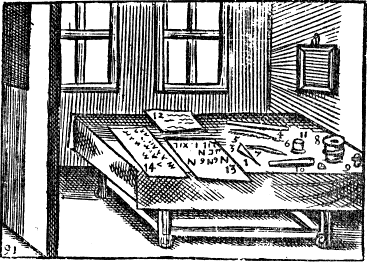
    [Images from John Comenius,  Orbis Senfualium Piélus: Omnium Principalium in Mundo Rerun/ &f m Vita Alопит,  translated as Pictura et Nomenclatur, the Visible World, or A Nomenclature, and Pictures of all Chief Things that are int he World, translated into English by Charles Hoof…1726.  See an earlier post here for more on Comenius. Image Source:  PROJECT GUTENBERG.]

    The Ancients writ
    in Tables done over with wax
    with a brazen Poitrel, 1.
    with the sharp end, 2. whereof
    letters were engraven
    and rubbed out again
    with the broad end, 3.

    Afterwards
    they writ Letters
    with a small Reed, 4.

    We use a Goose-quill, 5.
    the Stem, 6. of which
    we make
    with a Pen-knife, 7.
    then we dip the Neb
    in an Ink-horn, 8.
    which is stopped
    with a Stopple, 9.
    and we put our Pens,
    into a Pennar, 10.

    We dry a Writing
    13with Blotting-paper,
    or Calis-sand
    out of a Sand-box, 11.

    And we indeed
    write from the left hand
    towards the right, 12.
    the Hebrews
    from the right hand
    towards the left, 13.
    the Chinese and other Indians,
    from the top
    downwards, 14.


  • Devastation and Capital

    JF Ptak Science Books  Quick Post

    Sumatra391

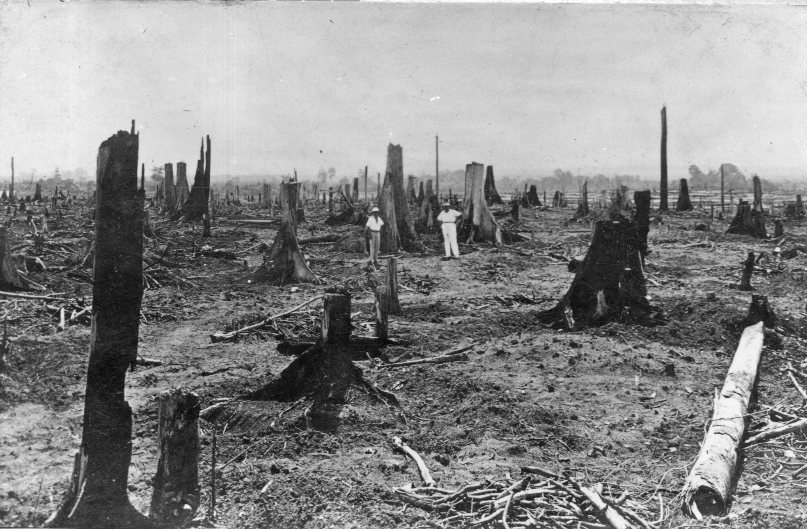
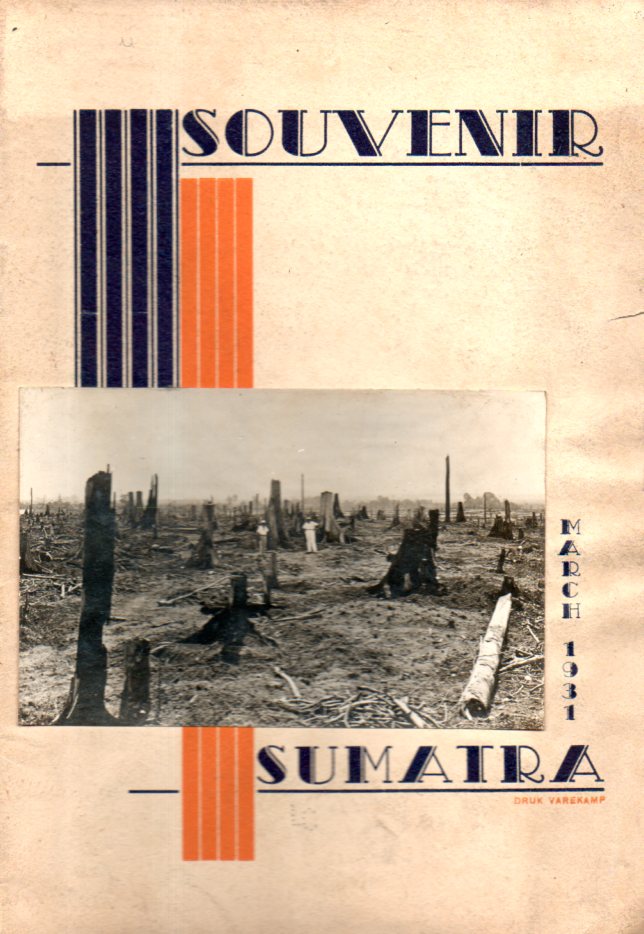
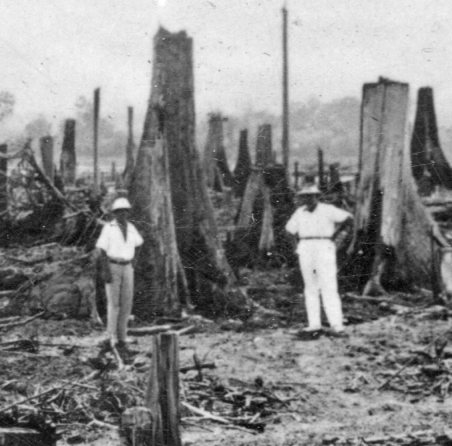
    The history of exploration and capitalism and imperialism and conquest for much of its history is a fleshed-out skeleton based on misery and temptation and ruin. There are of course many images of he background to fortune of the beauty that hard-fought money has brought. It is interesting to look though at the scenes  when the wizards draw back the curtain to history, accidentally or not, even in such inauspicious locations as this pamphlet, a minor work on the rubber industry in Sumatra. 

    The photograph of the decimated and routed forest is one of pride, ca. 1931-style, a mark of progress, development, industry, capital.

    Sumatra387

    There were millions of acres under cultivation at this point, with (according to the figures quoted in the pamphlet) more than 320,000 workers/laborer-peasants doing the heavy lifting, the vast percentage of these being from China and Java.  There is also a mention of the worker agreements that would get them to Sumatra, noted as “penal sanctions”–the practice required people to work for three or five years and if they somehow forfeited that agreement they would be imprisoned and sentenced to further labor when released.  It was a vicious enterprise. 

    But as strong as this was it must have undoubtedly been a manifestation of an even wider form of societal control, such as worker society existed there, living under the domination of the plantation owners.  

    In any event the photograph on the cover was a prideful thing that today would be seen as usurious and representative of some deep tragedy. In short: nothing new. 

    Sumatra390

    ·Posted by :

    ·in:


  • When a Non-Prediction Was and Wasn’t a Prediction (1651-1666)

    JF Ptak Science Books   Quick Post
    London fire
    [Source: the City of London]

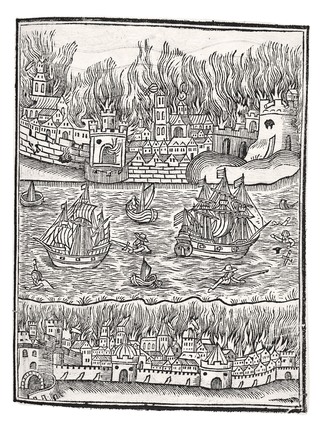
    There was once a scrutable man who wrote a scrutable book with the description of a scrutable event that was actually a non-event of a scrutable happening. There was no problem with all of this–especially as it was lounging beneath layers of a Very Demanding Title–until one of the events  somewhat “foretold” by the author came to be true.  It could not have been a bigger deal unless the story had been about the king or queen, and maybe not even then.  The event was the catastrophic Great Fire of London, an extreme ravage that burned for four days in September 1666, and which ate up 13,000 houses and 87 parish churches.  

    The event was predicted after a fashion by astrologer William Lilly (1602-1681) in his book Monarchy or No Monarchy, which was printed in 1651, fifteen years before the event.  Perhaps it might have attracted less notice to authorities had Lilly not written (and illustrated) what he thought to be the coming of a great plague in the same work–the plague struck London a year before the Fire.  

    The Great Plague killed far more than the Great Fire, perhaps 100,00 or more with teh plague, and far fewer than that in the fire, though the fire did cause huge destruction. (It seems that casualty figures for the fire are indeterminate, from a few to hundreds to thousands.)  

    So some central figures in government bade Mr. Lilly visit them soon after the fire, just to make sure that “England’s Merlin” and the most popular astrologer of his day did not have an actual role in starting the fire. He didn’t of course have anything to do with the fire, or the plague.  His predictions were cloudy enough to both mean something and nothing, part of the great anti-charm that is the heart and soul of all manner of  what James Randi calls “Whoo-whoo”.  He was left to the rest of his life, which still had a fair bit of fame and social acclaim left to it, though most of that would slip away with the Restoration.  It turns out that a number of people predicted a great fire for London, which was not surprising given the way the city expanded and converted itself into a major metro area (of 500,000+ people) which was partially built on kindling.  

    ·Posted by :

    ·in: