JF Ptak Science Books Quick Post
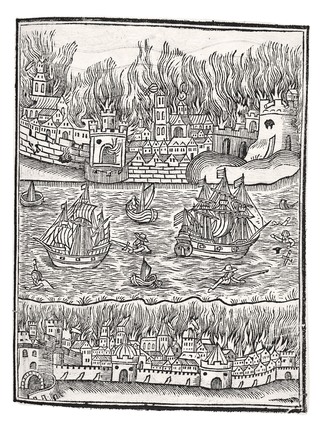 [Source: the City of London]
There was once a scrutable man who wrote a scrutable book with the description of a scrutable event that was actually a non-event of a scrutable happening. There was no problem with all of this–especially as it was lounging beneath layers of a Very Demanding Title–until one of the events somewhat “foretold” by the author came to be true. It could not have been a bigger deal unless the story had been about the king or queen, and maybe not even then. The event was the catastrophic Great Fire of London, an extreme ravage that burned for four days in September 1666, and which ate up 13,000 houses and 87 parish churches.
The event was predicted after a fashion by astrologer William Lilly (1602-1681) in his book Monarchy or No Monarchy, which was printed in 1651, fifteen years before the event. Perhaps it might have attracted less notice to authorities had Lilly not written (and illustrated) what he thought to be the coming of a great plague in the same work–the plague struck London a year before the Fire.
The Great Plague killed far more than the Great Fire, perhaps 100,00 or more with teh plague, and far fewer than that in the fire, though the fire did cause huge destruction. (It seems that casualty figures for the fire are indeterminate, from a few to hundreds to thousands.)
So some central figures in government bade Mr. Lilly visit them soon after the fire, just to make sure that “England’s Merlin” and the most popular astrologer of his day did not have an actual role in starting the fire. He didn’t of course have anything to do with the fire, or the plague. His predictions were cloudy enough to both mean something and nothing, part of the great anti-charm that is the heart and soul of all manner of what James Randi calls “Whoo-whoo”. He was left to the rest of his life, which still had a fair bit of fame and social acclaim left to it, though most of that would slip away with the Restoration. It turns out that a number of people predicted a great fire for London, which was not surprising given the way the city expanded and converted itself into a major metro area (of 500,000+ people) which was partially built on kindling.