A Daily History of Holes, Dots, Lines, Science, History, Math, Physics, Art, the Unintentional Absurd, Architecture, Maps, Data Visualization, Blank and Missing Things, and so on. |1.6 million words, 7500 images, 4.9 million hits| Press & appearances in The Times, Le Figaro, Mensa, The Economist, The Guardian, Discovery News, Slate, Le Monde, Sci American Blogs, Le Pont, and many other places… 5000+ total posts since 2008.

Category: History of Dots

  • Found-Poetry in a Technical Work on Bubbles (1896)

    JF Ptak Science Books  Quick Post   (Overall Post 5118) 
    Bubbles “The water of those wellis sprynge vp with grete bobles.”–W. Caxton tr. Myrrour of Worlde ii. xxi. sig. h4   OED

    Rummaging again through the eminently-rummagable early years of Nature1 I found a lovely little article on the physics of bubbles. The language to me seems delightful, and it comes from the first part of a very long opening paragraph of the paper:

    “He has studied the behaviour of big bubbles and of little ones,

    of bubbles in large and small tubes,

    of bubbles of air in a liquid,

    and of one liquid in another,

    of bubbles in heavy land in light liquids,

    of bubbles in liquids of various degrees of viscosity

    and with various degrees of surface tension at their surfaces.”

    • [IMAGE: “THAUMATROPE for showing the formation and oscillation of drops.” From C.V. Boys’ Soap Bubble and the Forces Which Mold Them, 1896.]

    In spite (or because of) the fact that bubbles are serious things, they are wonderfully named and as C.V. Boys points out in his fantastic Soap Bubble and the Forces Which Mold Them (1896), they are as magnificent as they are simple: “I do not suppose that there is any one in this room who has not occasionally blown a common soap-bubble, and while admiring the perfection of its form, and the marvelous brilliancy of its colours, wondered how it is that such a magnificent object can be so easily produced”.

    Bubbles have a long history in experimental physics2 and continue to work their magic today–when I googled this title I came up with only three pages of hits, including the following, which in their own little way beg to be read:

    • “Film thickness measurements in liquid–liquid slug flow “
    • “Effects of Bubbles on the Hydraulic Conductivity of Porous Materials “
    • “Bubble deformations and segmented flows in corrugated microchannels at large capillary numbers “
    • “Bubble transport through constricted capillary tubes with application to resin transfer molding”
    • “Transport of bubbles in square microchannels”
    • “Step-Wise Velocity of an Air Bubble Rising in a Vertical Tube Filled with a Liquid Dispersion of Nanoparticles”

    From the 1894 article:

    “EVERY student of physics has observed the motion of bubbles in tubes. Which of them has not used a big bubble to show the little ones their duty in clearing out the air when filling a barometer tube? Who has not spent his time and patience in whisking a spirit thermometer to drive a bubble out of the column? Mr. Trouton has recently communicated to the Royal Society the result of some researches on this subject. He has studied the behaviour of big bubbles and of little ones, of bubbles in large and small tubes, of bubbles of air in a liquid, and of one liquid in another, of bubbles in heavy land in light liquids, of bubbles in liquids of various degrees of viscosity and with various degrees of surface tension at their surfaces. From this enumeration it is evident that the number of different magnitudes involved is very great, and at the start it seemed almost hopeless to disentangle the effects due to each. The first matter to observe was that, as in other cases of fluid motion, two cases must be distinguished. These are the cases of slow motion and of quick motion. When the motion is slow the viscosity of the liquid causes the flow to be very simple. It entirely stops all whirling and swirling, such as is seen in the water behind a boat. When the motion is quick, on the other hand, the flow is very complicated. Whirls and swirls are set up, and the resistance is increased, owing to the increased energy that has to be communicated to the whirling and swirling liquid for each centimetre that the bubble moves. The slow kind may be described as viscous flow, and the quick as turbulent flow. The most interesting point observed in connection with the turbulent flow was that it was sometimes possible to increase the rate of flow by increasing the viscosity…”

    Notes:

    1. “On the Motion of Bubbles in Tubes”, in Nature, a Weekly Illustrated Journal of Science, 8 February 1894 (vol 49 no. 1267)/ I should point out that Nature back then was almost entirely readable by almost anyone—nowadays of course it is a vastly different story; I stopped my subscription a while back when I found out that I wasn’t understanding even the titles of some of the papers….

    2. “I have freely made use of the published work of many distinguished men, among whom I may mention Savart, Plateau, Clerk Maxwell, Sir William Thomson, Lord Rayleigh, Mr. Chichester Bell, and Prof. Rücker. The experiments have mostly been described by them, some have been taken from journals, and I have devised or arranged a few. I am also indebted to Prof. Rücker for the use of various pieces of apparatus which had been prepared for his lectures.”–C.V. Boys, Soap Bubble and the Forces Which Mold, 1896.
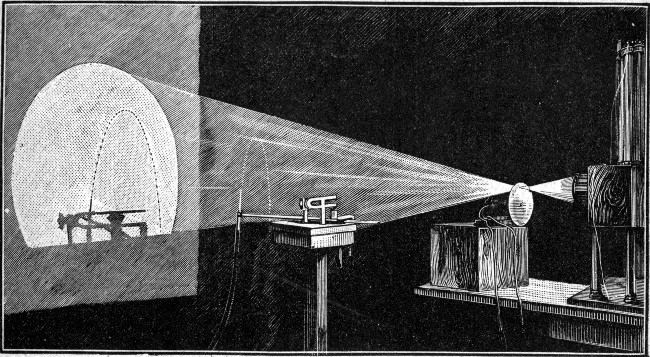
    Front“Experiment for showing by intermittent light the apparently stationary drops into which a fountain is broken up by the action of a musical sound.”–from the Boys book.  

  • A Hole in the Ground vs. a Hole in the Sky

    JF Ptak Science Books  Quick Post

    Tunnel collage


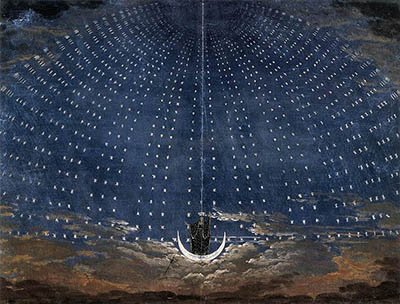
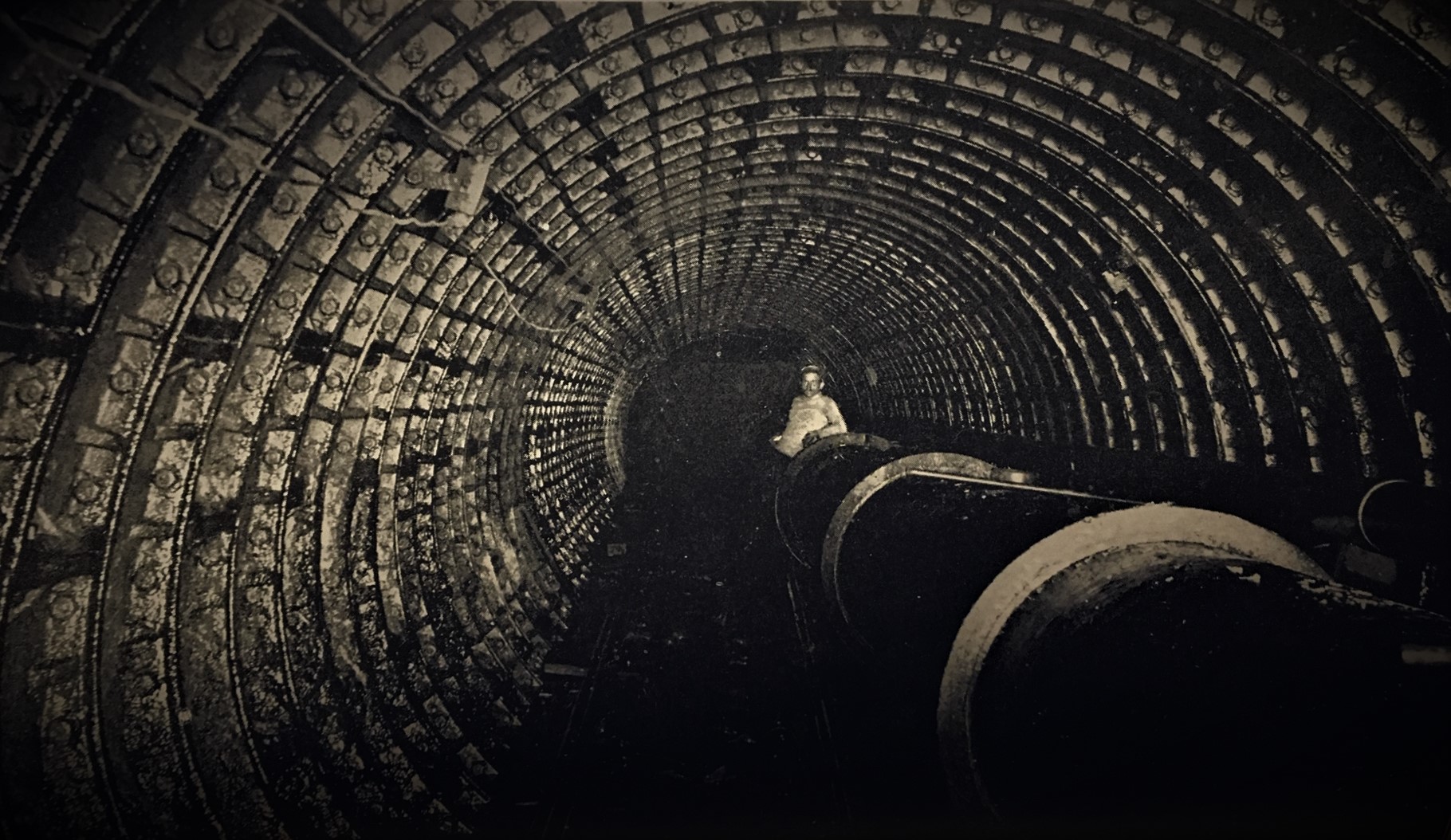
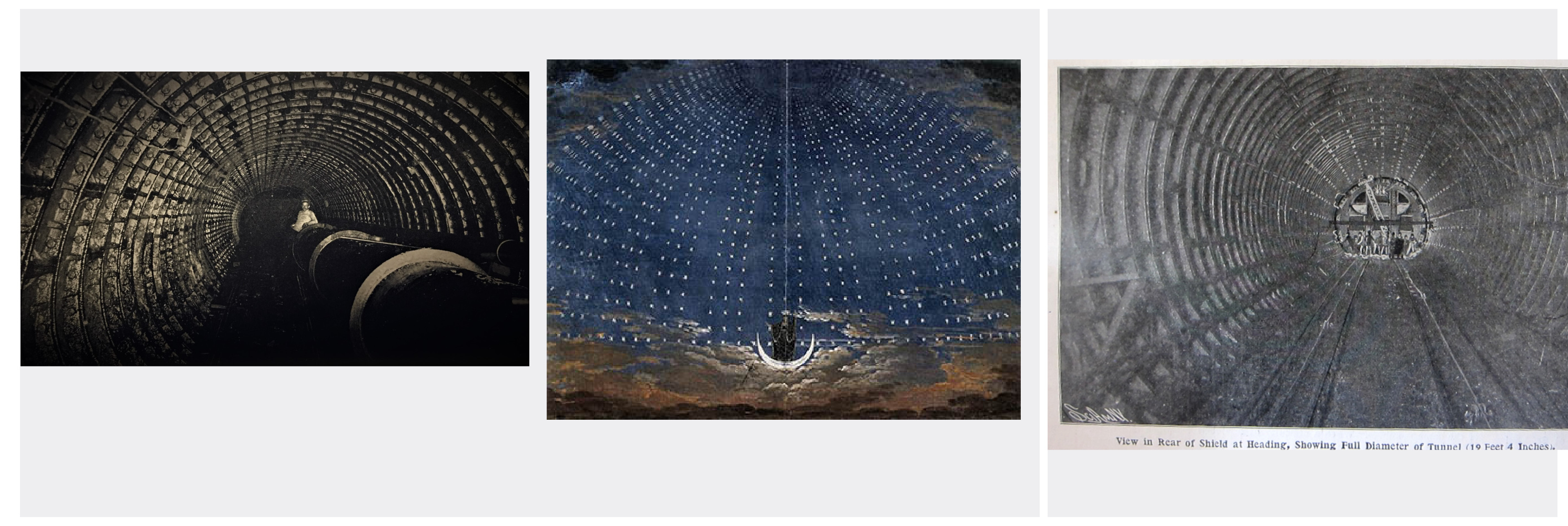
    Mozart tunnel _2_A while ago I wrote about a brief connection that I saw in a  photographic view of the 19′ tunnel section of the Hudson River tunnel with  the 1815 stage set by Karl Friedrich Schinkel (1781-1841) for Mozart’s Magic Flute1. Its just the initial reaction to the perspective pulled up the Schinkel more than anything else, except maybe for a non-existent underground image from Jan Vredeman de Vries’ book on perspective. That said, the set design I’m thinking of features the arrival of the Queen of the Night/Königin der Nacht, so perhaps this association isn’t too meshuga…excepting the ripped-to-shreds lust for revenge that the Queen of the Night sings about, which hasn’t much to do with digging a tunnel. 


    Perhaps this is an association that can be made for any tunnel being dug and illuminated in the 19th century, as I stumbled upon another example of this association, a photograph2 in another NYC tunnel–this one the tunnel under construction under the East River for the East River Gas Company, 1894. It is a little antithetical that these similarities are seen between an image of starry vault surrounding the Earth while the photos depict a lighted tube surrounded by Earth, a sort of alpha and omega of endless light…a contraction of environment filled with light compared to a contraction of the limitless night sky as seen as a theatrical set.  (I understand that there aren’t a long series of lights in the tunnels, just that it looks so because of the no-doubt heavy-duty light source and its reflections on the odd surfaces/bolts/etc. the metal tubing surfaces…and that is a riff in itself.)

    In any event, I like these images, and so I’ll share the newest of my finds here this morning.  

    Tunnel lights mozart


  • A Map of Prostitution AND “Negro” as a Nationality (1913)

    JF Ptak Science Books  Post 2813

    There were two big surprises in this 1913 work1 on prostitution in Portland, Oregon–I mean, aside from the normal “surprises” and “unexpecteds”one expects from an early 20th c study on the sex trade. (If someone wanted to do a version of The Deuce as Portlandia Nights 1913 this report would be atomic material.) The book runs 200 pages and for the time is filled with unusual social history, snapshot observations, interviews, police involvement, data of all shapes and sizes, and that sort. The book is fairly comprehensive–all things considered–and the efforts are distributed to the following sections: “A Report on the Social Evil, as affecting places of public resort and accommodation; hotels, apartment houses, rooming and lodging houses”, pp 4-81; “On the Legal and Police Aspects of the Social Evil”, pp 81-122; “A Report on the Juvenile Aspect”, pp 123-164; “Report on the Economic Aspect”, pp 165-202; “Report on a Segregated District”, pp 203-216.) Overall it is a survey of the grand scheme of prostitution (the “Social Menace”) in Portland as it existed in one section of the city (Irving Street-Hall Street-23rd St-Harbor line). It investigated 547 buildings/rooming houses and found 98 to be “moral”, 431 to be “immoral”, and a balance of 98 falling into a gray-ish “doubtful” category. 

    • This post is based on a copy of this report that I have here–there is something online text at Hathi that has a slightly different title but looks to be the same that you can enjoy here: https://catalog.hathitrust.org/Record/100641247

    The report surfaces some fascinating info: for example, there is a section on interviews with proprietors of the erstwhile hardly-vanilla hotels, which includes a number of very colorful quotes, including one “madame” from a bawdy house on Sixth Street, who claimed “Portland is the best town on the coast for a sporting woman to make money in.” Other madams agree! There are interviews with “sources of vice” (“grills, chauffeurs, pool rooms, messenger boys newsboys…”), police, civil service, hotel folk, that sort..  A good standard example of a description of one of the bawdy houses reads: “Hotel [unnamed and with no street address identified] Taylor Street. Shabby place of 46 rooms. Run by man and woman, who occupy front rooms, one of which the woman uses as a parlor, the other as a bed room for immoral business. Three prostitutes work for management, paying one-half of their earnings from bed money. Liquor sold.”

    The “study of the docket”  is a listing of occupations of prostitutes, arrests, charges, fines, and wages paid the prostitute; there is a section on “testimony” in which the sex worker tells her story, and another section on the general living conditions in the bawdy houses. The last section in the publication deals with “segregation”, though the type of segregation here has nothing to do with race, and simply means that there would be a set-aside space for sex businesses in Portland.

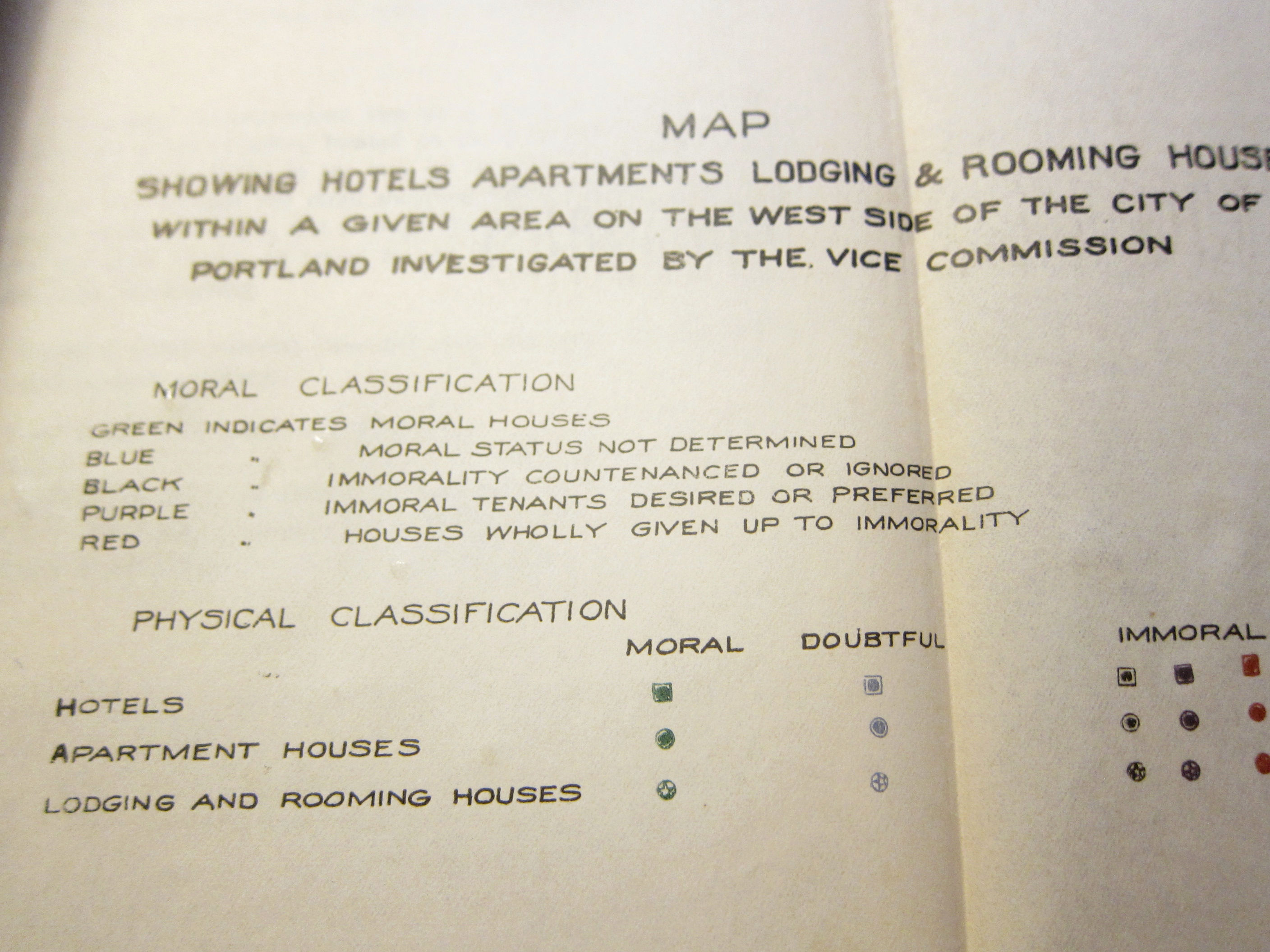
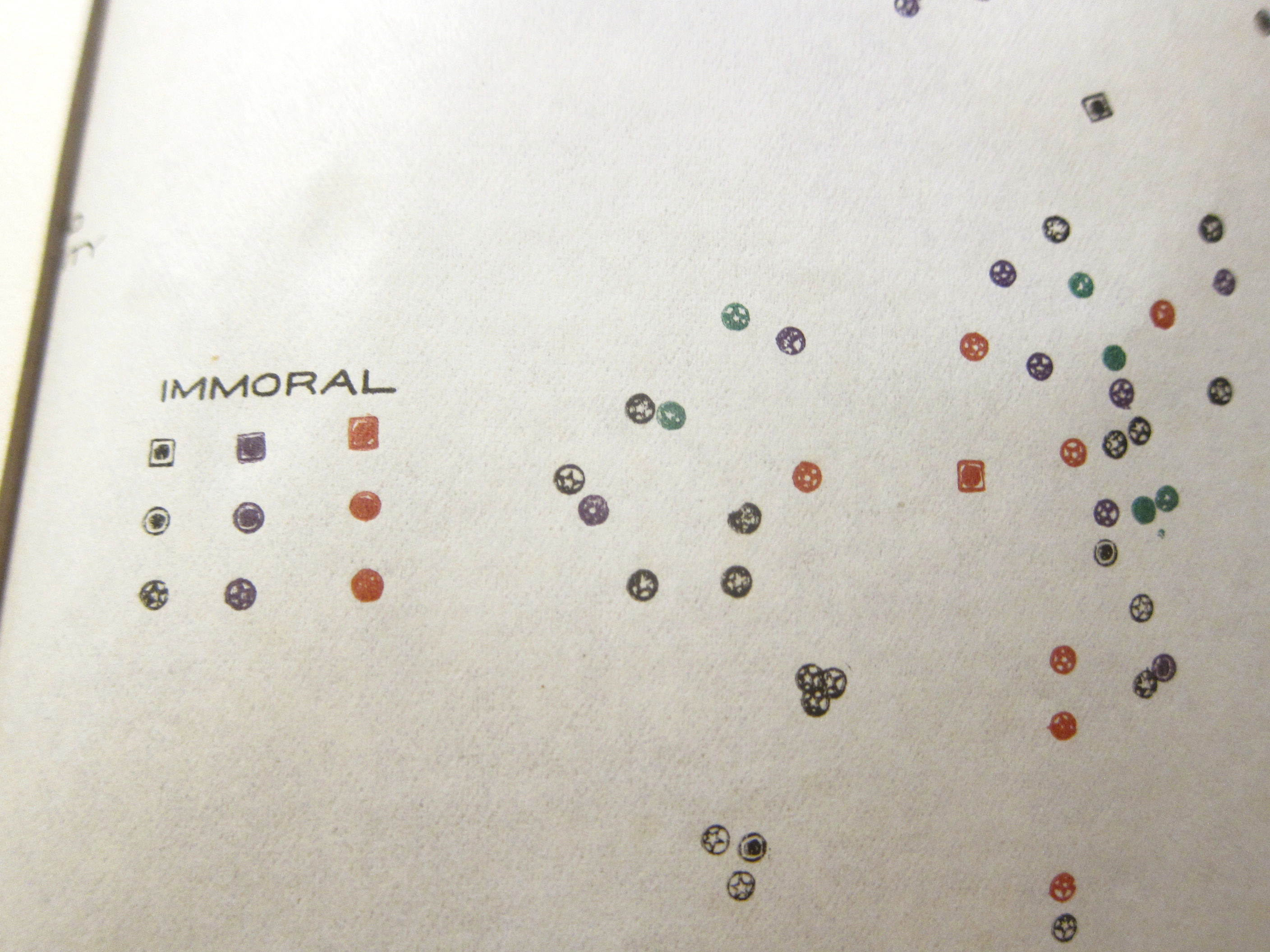
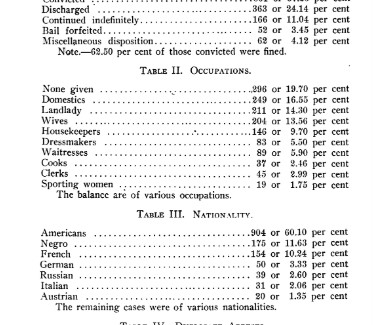
    So, the first surprise: there is also a very daring and fascinating map in the first section of the report which identifies hundreds of the Social Evils establishments. They are classified top-to-bottom in the following way: “Moral houses”, followed by “Moral status not determined” and then steeping into “immortality countenanced or ignored”, to “immoral tenants desired or preferred”, and then finally to “house wholly given up to immorality”. The odd thing about the map is that it seems to be overlay, meaning that the details of the actual geographical part of the map are left out and there is no underlying map on which this skeleton map is laid (as published). The map isn’t quite a “map” as much as it shows approximate vicinities and coagulations of these establishments in relation to one another and confined to that one particular part of Portland. I guess that leaving out the exact addresses was a preventative measure to squash the possible plans of some enterprising people to use a detailed map as a Guidebook to Portland Houses of Ill Repute.  

    Portland Vice Map
    Portland Vice Map

    The second major unexpected surprise: on page 96 there is a listing of nationalities of prostitutes arrested—in the accompanying table the leading nationality is “American” followed by “Negro” and then “German”…which seems to me that U.S. Citizenship is being denied to African Americans on the basis of race, and that, evidently, “Negroes” are not American citizens. And according to the law in the state of Oregon in 1913, “Negroes” were not even allowed to migrate to the state, stated as such right in the Oregon constitution—a law that was not addressed and eliminated until 1924. I suspect that African Americans were illegally in the state and thus, somehow, had their rights of citizenship in the USA stripped away. Or perhaps this was the work of a racist editor, or author, or someone;; one person, one small group, that instigated this classification. Or maybe it was someone ignorant who just go the whole thing wrong and which was subsequently missed by the editor. I don’t know. All I can say about this is that this is the first time I’ve seen African Americans introduced in a statistic post-1865 as citizens of the U.S. who were deemed to be not so. 

    Negro Nationality

    Notes:

    1. Talbot, Henry Russell. Report of the Portland Vice Commission to the Mayor and City Council of the City of Portland, Oregon.. Portland, 1913. 9”x 6”, 216pp. Original stiff wrappers. Provenance: Library of Congress via the Washington DC Public Library.   


  • One of the Earliest X-Rays of “Dots”: Medical Imagery, 1896

    JF Ptak Science Books  Quick Post--History of Dots series

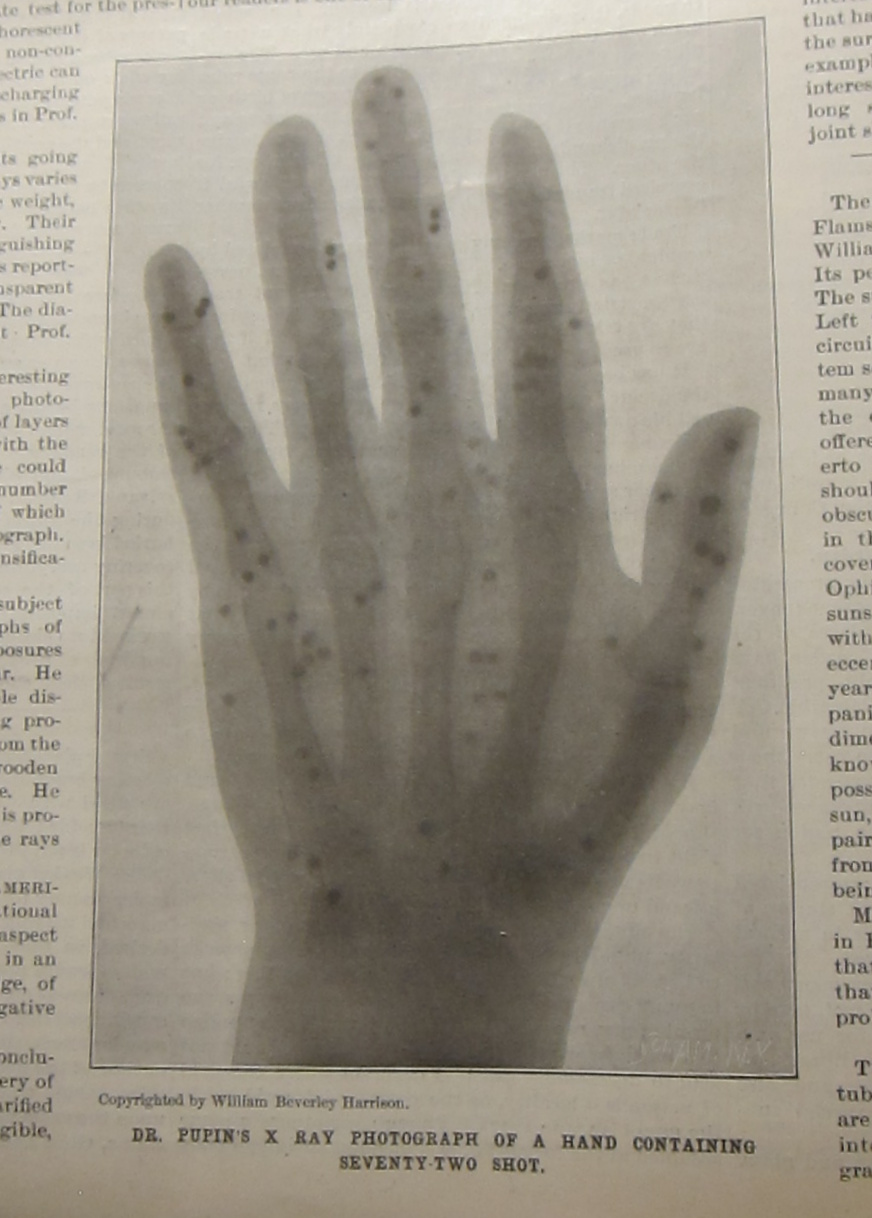
    In the long line of the history of “firsts” in photography are a number of sub-categories, and subs- to those subs, an example of which is scene in the pages of Scientific American for 1896. Here we have the history of photography=>medical photography=>clinical applications of X-rays=>X-ray photographs=>X-ray photographs of gunshots, or some such thing. Anyway, here in the March 21 1896 issue of the great magazine is one of two articles on the X-ray, the second of which features what may be one of the very earliest–if not the earliest–images made of a human limb peppered with rifle/field canon pellets. This comes only two months or so following the discovery and first imagery using  X-rays by Wilhelm Roentgen (1845-1923) made November 8 1895, the experimental results published soon after on January 8 1896 in his paper “Ueber eine neue Art von Strahlen” in the Würzburg Physico-Medical Society.

    The interest in X-rays was spectacular, with more than 1000 papers published on the subject in 1896 alone. This is understandable given the revolutionary nature of the announcement plus the relative ease and simplicity of equipment necessary to produce results.  The Roentgen paper was translated and printed in Nature (for the first time in English) almost immediately on January 23 1896, and it was the very next issue in which advertisements appeared for the relatively cheap necessaries (Crookes tubes etc.) for interested parties to produce their own X-rays at home. Absolutely everyone was interested in this discovery. (For the Scientific American there were 9 articles on the X-ray for January-June, 1896, with the first appearing on February 3; for July-December there were 33.) 

    The image below was made by Columbia University’s Michael Pupin, and was one of the earliest general clinical uses of the new discovery, following what was probably the first medical use (at least in the U.S.) by Frank Austin (Dartmouth) in February 1896. The extraordinary development had an epochal impact on medicine, as now for the first time in the history of the planet a person could see inside a person/living being without cutting them open and poking around.  The X-ray was soon put into use on the battlefield six months later, at about the same time that some of the pioneers (E. Thomson, Morton, Tesla) began to report exposure burns (as some of their photographic exposures using X-rays were 20 minutes long…) 

    (By the way this is the man for whom Pupin Hall was named–this place became ultra famous in my mind, anyway, for the seminal work done their in cutting edge areas by Peagram and Fermi and Urey and Rabi and Dunning, among many others. Also Pupin was awarded the Nobel Prize for Literature in 1924 for his scientific memoir/autobiography, a highly unusual feat for such a subject.) 

    Sci Am 1896 x-ray


  • Electricity and Telegraphy Before the Electric Telegraph: the (Electric) Shock of Recognition (1825)

    JF Ptak Science Books  Quick Post

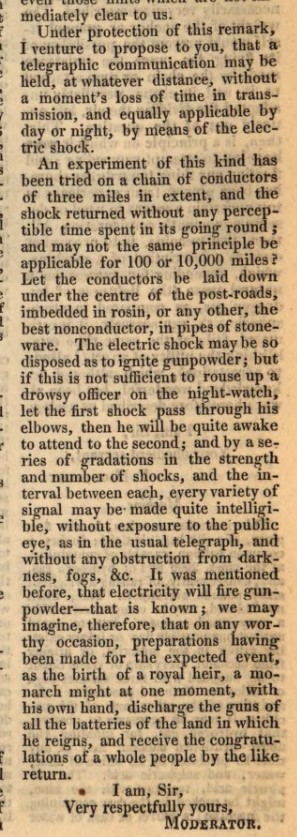
    Electric shockHere’s an interesting twist on electricity and the telegraph, but not quite what you’d expect. The note, written by “Moderator”, appeared in Mechanics’ Magazine for 15 June 1825 (volume iv, p 148). Since this is 1825, the telegraph being referred to here is an “atmospheric telegraph”, or semaphore, the electric telegraph of Morse being another dozen years away and another 5 or 6 before its practical appearance.

    The electricity here was being used in part to alert (where “alert” = “shock”) whoever it was that was snoozily sitting at their post to instantly pay attention to whatever it was being signaled to that point in the semaphore chain:

    “The electric shock may be so disposed as to ignite gunpowder; but if this is not sufficient to rouse up a drowsy officer on the night-watch, let the first shock pass through his elbows, then he will be quite awake
    to attend to the second…”

    I can’t tell if this is being suggested along a A Modest Proposal sympathy, or not. 

    This shock-bit though is preceded by something interesting that I also don’t quite understand, though that is starting to sound like the modern electric telegraph:

    “…and by a series of gradations in the strength and number of shocks, and the interval between each, every variety of signal may be made quite intelligible, without exposure to the public eye…”

    In any event, it is an interesting footnote in the history of communication and those sleeping through it. 


  • One of the Earliest Appearances in Print of One of the World’s Most Famous Series of Dots (1838)

    JF Ptak Science Books  Post 2790   Part of the “History of Dots” series

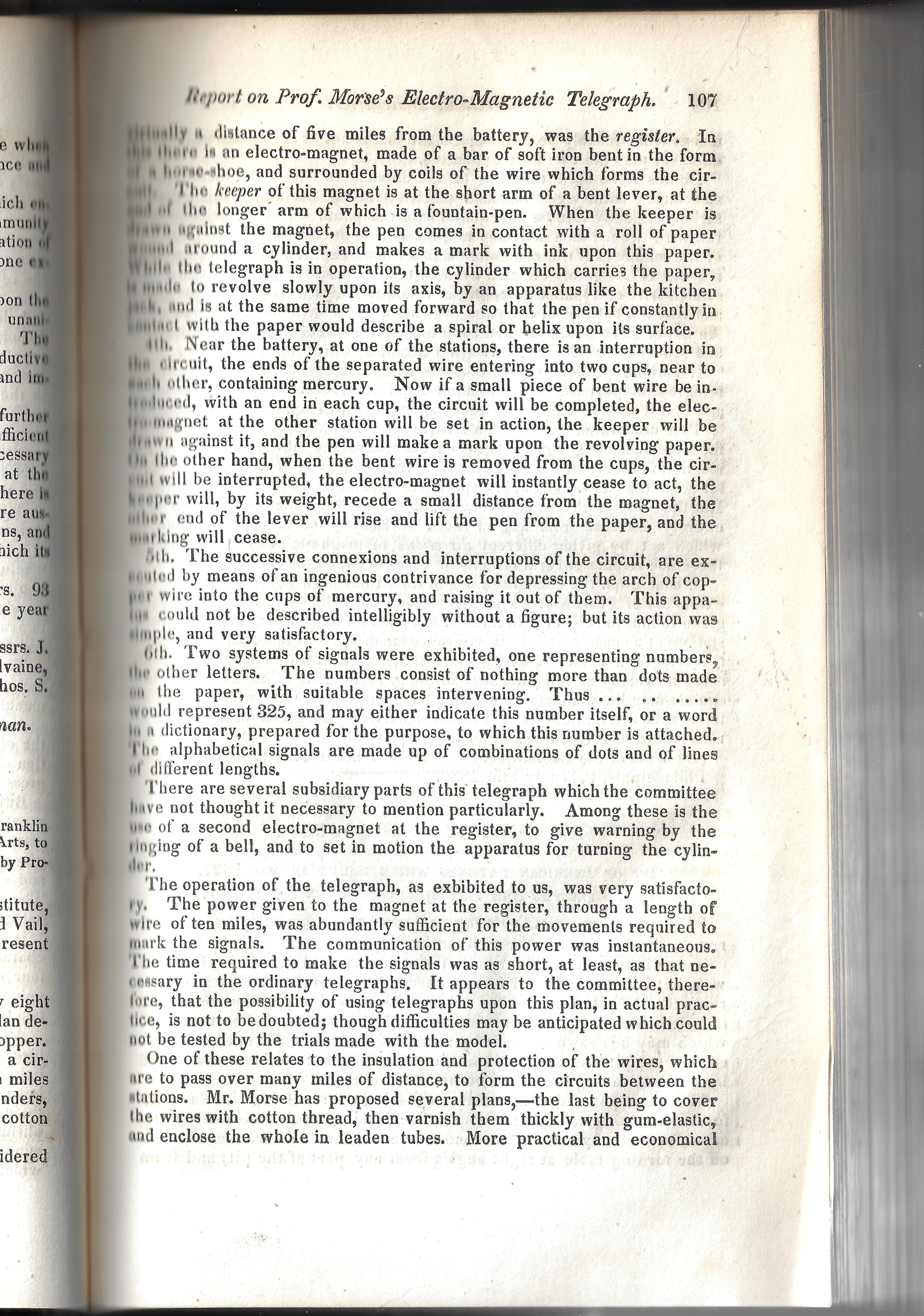
    I was looking in Journal of the Franklin Institute (1838) for what I thought was an important report by Charles Goodyear on his “vulcanization” process, where he is finally able to present the results of his experiments on saving rubber from itself for commercial use. But I was wrong–the report was a step in the correct direct, the finalization occurring the next year (and not a moment too soon for the very highly economically challenged Goodyear). Anyway, I poked around the index (which is a half-miserable affair) grazing for something else interesting when I saw the entries for “telegraph”, with subdivisions for “electric” and “electromagnetic”. Now, both of these types of telegraphs had been around for a score or three of years, but just for the play of it I checked out the “electromagnetic telegraph” on page 106.  And there he was: Samuel Morse. And Alfred Vail. And their electromagnetic recording telegraph–all of which appeared in the paper called “Report on Prof. Morse’s Electro-Magnetic Telegraph“.1

    This was a significant report. As it turns out Morse makes the first public demonstration of his and Alfred Vail’s recording electromagentic telegraph on January 6 1838 at Speedwell Ironworks near Morristown, New Jersey, just weeks before this JFI appearance.  On this success, Morse went south to Philadelphia and demonstrated his invention to the Franklin Institute on February 8, 1838 (summarized in the present report), appearing two weeks later on February 21 1838 midway between Phila and home in Washington D.C., demonstrating the apparatus to President Van Buren and members of the Congressional Committee on Commerce2,3.

    This may well be the one of the two earliest journal appearances of the successful demonstration of the Morse/Vail electromagnetic recording telegraph, and is perhaps the very first appearance of the “dot” end of the Morse Code.

    Morse dots _2_

    The demonstration in January and February 1838 used the Vail register (accentuated in italics in the JFI report) and did away with the Morse pendulum apparatus for recording the message–this was evidently a great improvement.

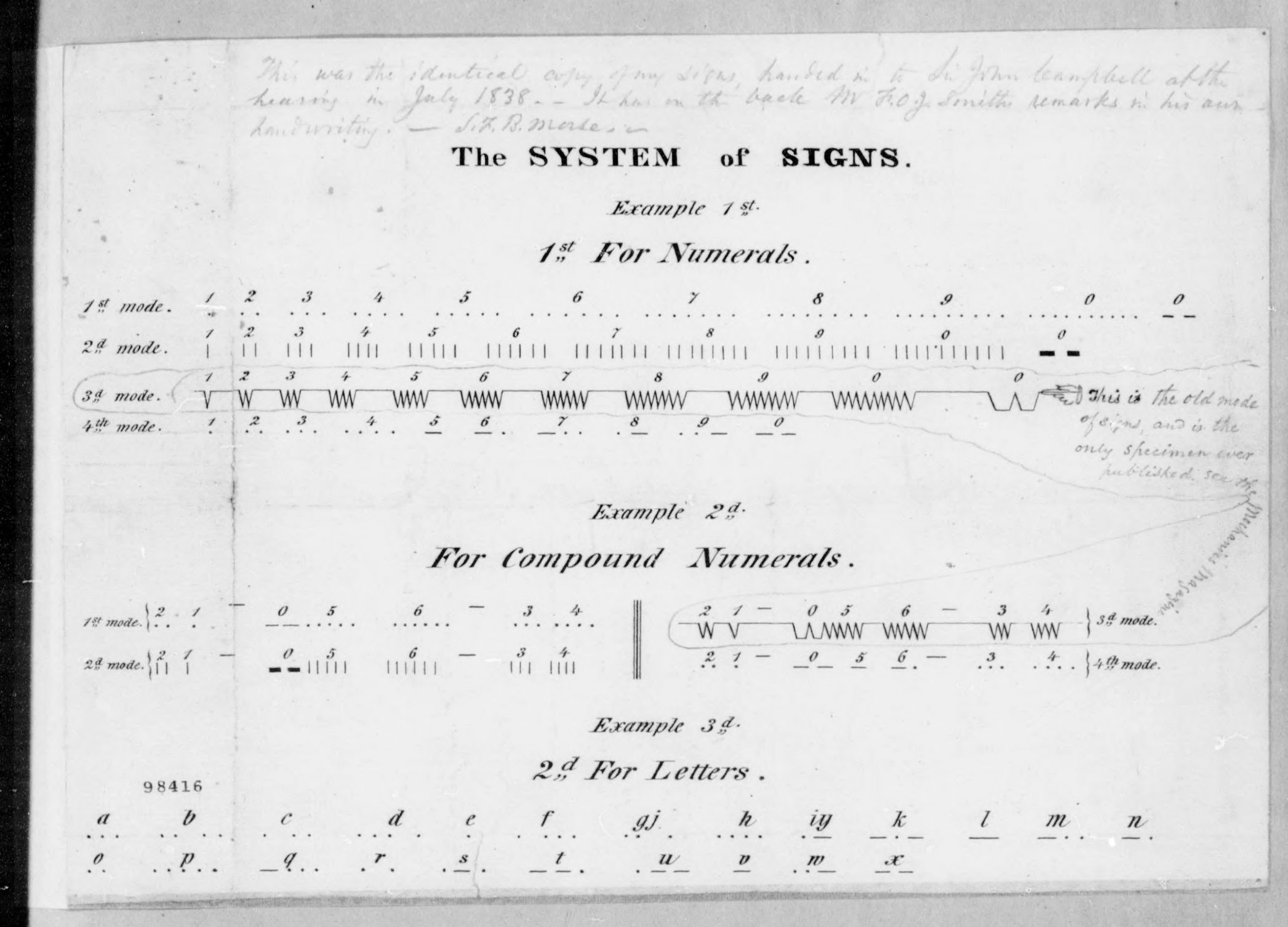
    The narrative identifies two systems of signals (“…one representing numbers, the other letters”) that were displayed in the demonstration. The first “representing numbers” were a series of dots. This is perhaps the first publication in a journal of the dot method of transcribed signals of a recording electromagnetic telegraph. The dots are pictured “…   ..   …..” on page 107, representing the number “325” or as explained could also mean the word represented by the number “325” in Morse’s code book (“indicate…a word in a dictionary, prepared for this purpose…”). The second, “alphabetical signals are made up by a combination of dots and lines of different lengths”), an example of which is not shown. 

    Morse dots _1_I have only been able top locate a symbolic system of the code in published journal reports (and a newspaper article) showing a “V” system, as in the American Journal of Science and the Arts (vol 33 #1, 1838), which prints an image of the register, and shows a “specimen of telegraphic writing” using this “V”: so, “V   VV   VVV” governed by spaces of long and short intervals,  would stand for 1,2,3 or 123, or to some word designated “123” in a code book. (I should point out that this article is about half the length of the JFI article.) 

    What is surprising is to see what Morse himself had to say on this issue. Here are his notes on the system of notation, from the SFB Morse papers at the Library of Congress, Manuscripts Division, bound volume 28 November 1835-18 April 1838, page 154 (“Drawings to Accompany Copy of Caveat of Oct 6 1837”). The penciled note states “this is old mode of sign and is the only specimen ever published. See the Mechanics Magazine”.  It was also evidently published in the American Journal of Science and Arts at about the same time. There is no reference to the JFI report or the “dots” (or “1st Mode”).  It may simply be the case that at the time of his writing this that Morse was simply unaware of the JFI report, as the three appearances were all published at about the same time (within weeks of one another). 

    Morse system signs _2_

    The famous “first” telegraph “What Hath…”1  transmission (at least seven years after the true “first”) was made of a series of raised symbols corresponding to Morse’s dictionary. 

    I’m no expert in this field, but I haven’t been able to turn out any earlier use of the dots than this report. 

    Notes:

    1. The full quote, suggested by a young girl, was from Numbers xxiii, 23:

    “22…Surely there is no enchantment against Jacob, neither is there any divination against Israel: according to this time it shall be said of Jacob and of Israel, What hath God wrought!

    24 Behold, the people shall rise up as a great lion, and lift up himself as a young lion: he shall not lie down until he eat of the prey, and drink the blood of the slain.”

           2.  Reports of the Capitol demonstration were published in the American Journal of Science and Arts, vol 33, pg. 168, and then in the Mechanics’ Magazine (London) for 10 February 1838.

           3.  There was also an earlier attempt made at Morse’s New York (City) University on 2 September 1837, though this appears to have been unsuccessful. 


  • Outside Looking Out–Space, 1899.

    JF Ptak Science Books   Post 2751

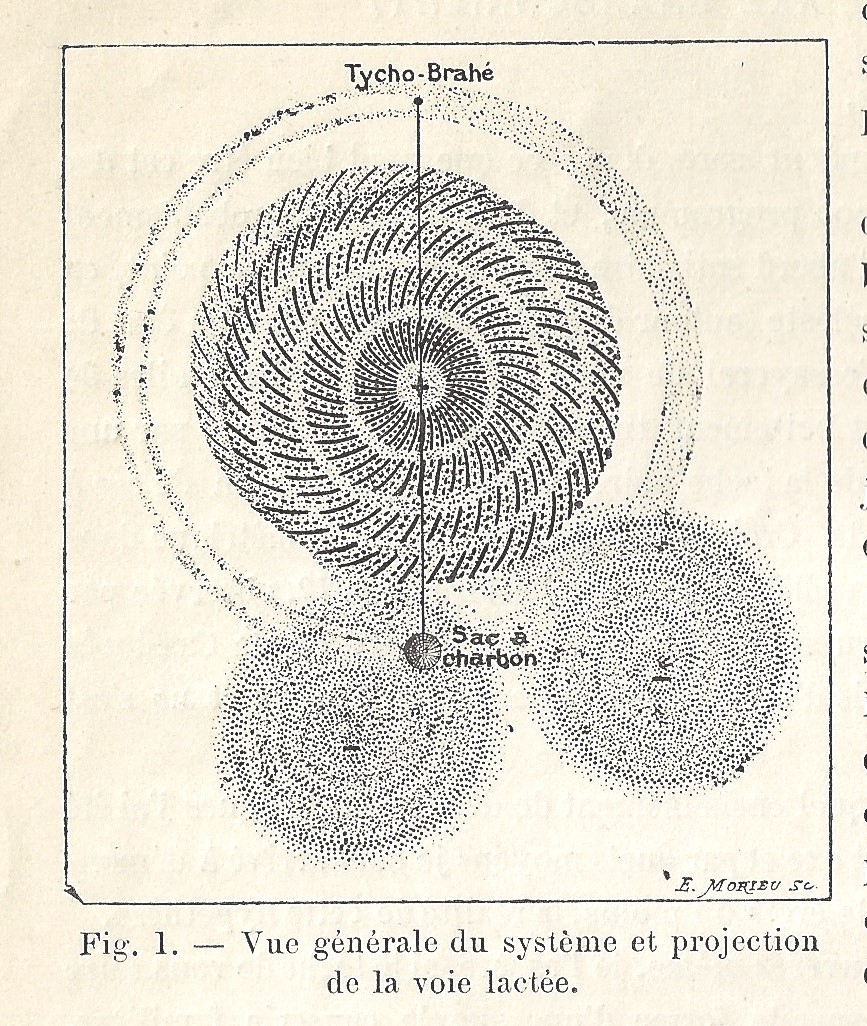
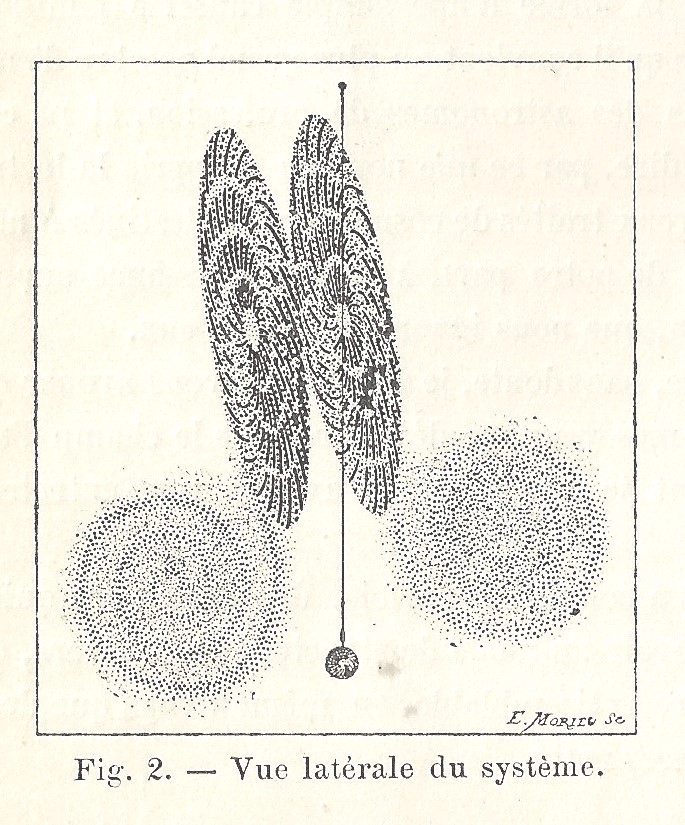
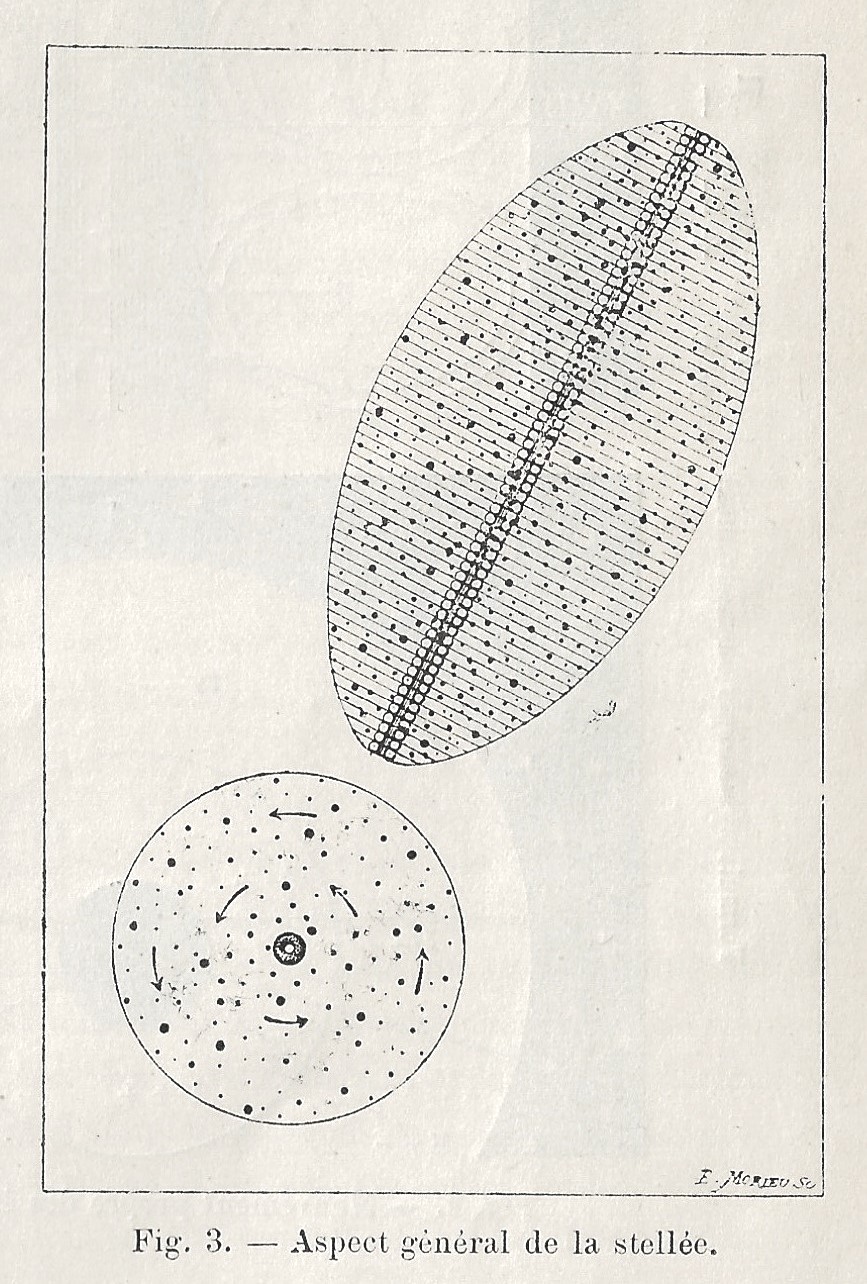
    Back in 1899 the astronomer Adolphe Duponchel1 published a pamphlet on his very involved theories of the motion of the stars and star clusters and the shape of the universe.  I couldn’t understand much of it, and when I thought about it more, I understood less, and probably less than that. I just couldn’t decide what the idea was that he was trying to decipher and share, except to say that it was big. 

    I wouldn’t have thought about this pamphlet at all it if was not illustrated, because the illustrations in this short pamphlet are quite, well, inspired:

    DocFile (3)

    Duponchel was an accomplished and published civil engineer, canal and bridge builder, and hydrologist, who later in life veered into cosmogony, publishing on the effects of meteors and solar activities on the distribution of stars, the structure of the galaxy, and the motions of the planets. He met with no success from what I can determine, though he seems to have been very active in his starry pursuits through the 1890’s, which was a prime period for French cosmogony. At the very least his ideas look entertaining, and as I said the imaging is quite lovely.

    DocFile (4)

    The truth of the matter is that I do not understand what he is talking about, though sometimes it seems as though he is talking about black holes and the motion of stars, except that he seems to be talking about “apex charbonnier” that are dark regions of space that could not be penetrated given the optics of the day. In general though he writes about what effects the “circulation” of the stars and star clusters.  Liberally translating he states that “no astronomical problem could offer more interest, and in the absence of a solution of a rigorously demonstrated accuracy can be I am happy to have arrived at finding a plausible and at least probable explanation of the simultaneity of all these coordinated movements in the same state of general equilibrium.

    After this very pro forma and enormous statement, we arrive at the unknown stuff of his insight: 

    “…points noirs isolate correspondent a des rayons visuels qui auraient traverse les mailles des deux reseaux sans rencontrer aucune etoile sur leur passage. Dans une seule direction, sur un espace sans doute assez restreint, mais parfaitement defini par son contour piriforme, cette illumination fait reellement defaut.” (“Isolated black/dark spots correspond to visual rays that would have passed through the meshes of the two networks without encountering any stars in their path. In one direction, on a space which is doubtless rather small, but perfectly defined by its “piriforme” outline, this illumination is really lacking.” The translation doesn’t help the original too much, which left me understanding nothing.

    Then, a few pages later, he writes: 

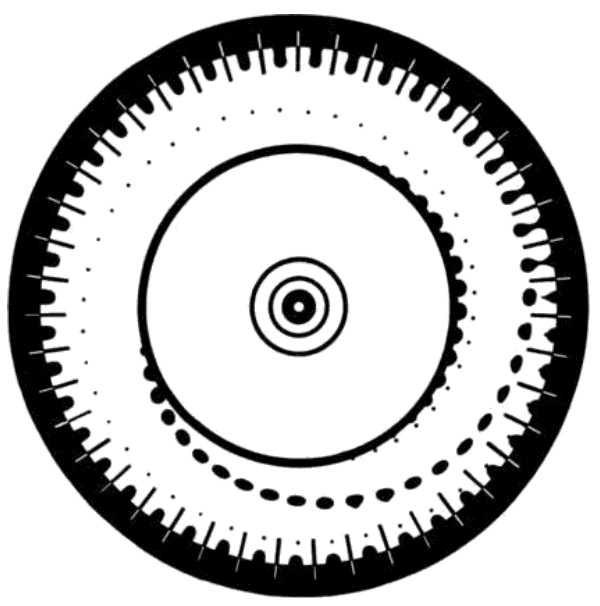
    “…étudier ici tapissant en quelque sorte les parois du vide de l axe s y trouveraient distribuées en anneaux ou pour mieux dire en tores successifs dont chacun correspondrait à une strate particulière en forme discoi dale d étoiles extérieures. Ces to res successifs (figs 1+2) correspondant aux sphères magnétiques qui accompagnent les noyaux solides du Soleil et des planètes comprendraient chacun un certain nombre d étoiles circulant autour de l axe du tore avec un mouvement de rotation ac célérée en spirale comme celui des sphères magnétiques mais avec des vitesses alternativement de sens direct et de sens inverse de manière à assurer des vitesses concordantes de même direction aux points de tangence de deux tores consécutifs…” Or, “Firstly, to study here somehow lining the walls of the void of the axis would be distributed in rings or, to put it better, in successive tori, each of which corresponds to a particular stratum in the form of a disc of external stars. These successive rests (fig 1+2) corresponding to the magnetic spheres that accompany the solid nuclei of the Sun and planets would each include a number of stars circulating around the axis of the torus with a spiral arc rotational movement like that of the magnetic spheres but with alternately direct and reverse direction so as to ensure concordant speeds of the same direction at the points of tangency of two consecutive tori…”  Again, a not-good translation, but I really didn’t have much of an idea of what he was writing about. 

    DocFile (1)

    The pictures are pretty.

    If I’m missing something big, please let me know.


    Notes:

    1. Adolphe Duponchel,  “Circulation de notre groupe stellaire autour de l’axe charbonnier et mouvement parallactique de l’apex Solaire”. Printed by the author, in Paris, 1899, from its appearance in Societe Astronomique de France, 1 March 1899.  9×6″, 18pp.  WorldCat/OCLC reports 1 copy in the U.S. And either 1 or 3 copies at the Observatoire de Paris—otherwise there are no other copies of this work located. Provenance: Smithsonian Institution, and then the Library of Congress (small mostly-faded oval stamp for the SI on front cover, and the LC surplus stamp on the back cover).  

    “Et les individus qui participent à cet engouement pour la quête des origines cosmiques n’épargnent ni leurs efforts ni leur temps pour développer, étayer, rendre publique, et faire reconnaître leurs théories. Ainsi, l’ingénieur des Ponts et Chaussées Adolphe Duponchel (1821-1903), après avoir déposé un pli cacheté à l’Académie des sciences le 27 mars 1893 contenant le sommaire d’une brochure exposant ses « Principes de cosmogonie générale », fait imprimer celle-ci à ses frais et l’envoie à l’assemblée savante. Il n’obtient aucune réponse mais persévère et soumet six Notes ou Mémoires à l’Académie sur ce sujet entre 1893 et 1894. Ne parvenant pas à obtenir le soutien académique qu’il recherche, Duponchel va finalement publier sa théorie dans des revues populaires de science, d’abord dans la revue Cosmos le 2 septembre 1893 puis, sous une forme augmentée, dans la Revue Scientifique les 28 juillet et 4 août 1894.”Volny Fages, “Dire l’origine scientifique des astres. L’engouement pour la cosmogonie en France dans la seconde moitié du XIXe siècle”https://www.cairn.info/revue-romantisme-2014-4-page-32.htm

    See:

    ASTRONOMES FRANÇAIS 1850 – 1950 D’ABBADIE, Antoine.  www.obs-hp.fr/dictionnaire/astronomes_A-Z.pdf

    See: Agnes Mary Clerke , A Popular History of Astronomy During the Nineteenth Century, p 202, a review of some of the later 19th c solar astronomers.

    ·Posted by :

    ·in:

    — —

  • Warm Sulphur, Coal, and the Cosmos, 1836

    JF Ptak Science Books   Quick Post    An installment in the History of Dots series. 

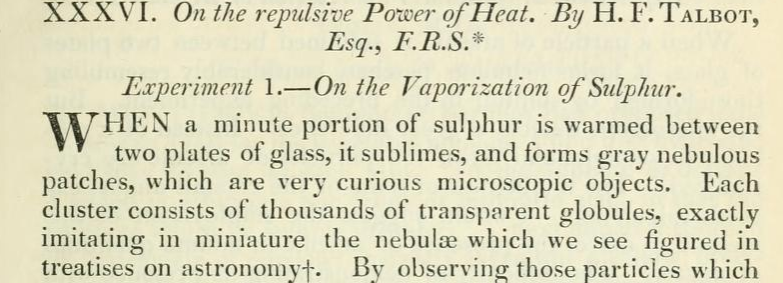
    William Henry Fox Talbot (1800-1877) was among the earliest of the photographic pioneers, or pre-pioneers, as he asserted priority of his photographic method for 1835 when Daguerre revealed his own (very different) method in 1839. Talbot (or Fox Talbot)  was also a practitioner of the art, publishing a stone-cold and revolutionary work of photographically illustrated books, The Pencil of Nature. The work I am interested in for the moment though is this interesting observation he made in the Philosophical Magazine (third series, vol 8) for 1836, when he unexpectedly turns somewhat poetic in the start of his paper:

    Talbot nebulae


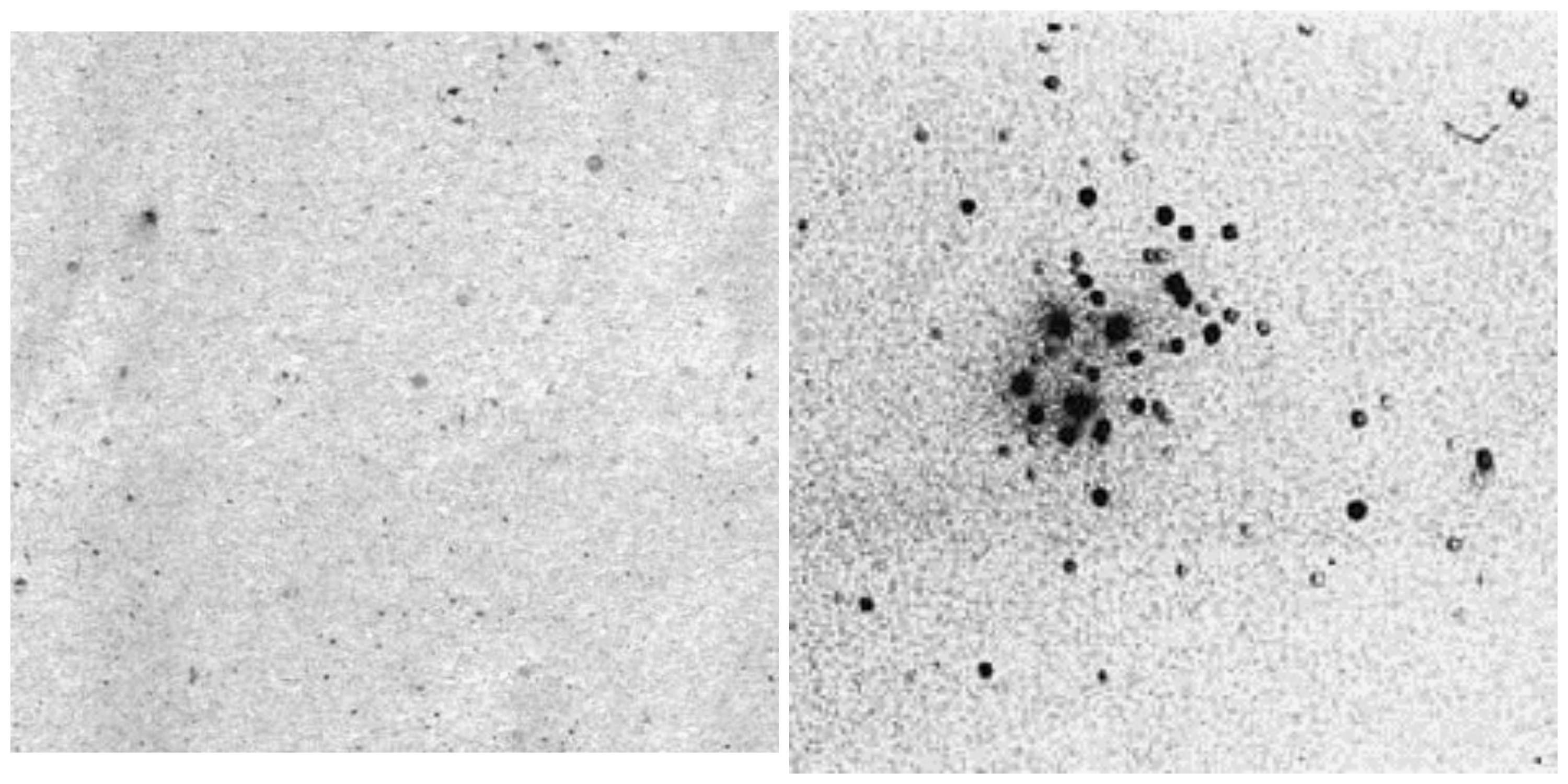
    I don’t know about the history of likening some collections of objects to a starry night of deep space–certainly it has been going on for a long time, with people finding similarities (and perhaps corollaries!) between collections of stuff (dust, moles, sand, so on) and the night sky. (There are several such observations on this blog, the most recent one, on deterioration of paper in a book and the negative of a deep space image, appears here:  https://historyofideasblog.com/thesciencebookstore/2016/08/page-in-a-book-or-stellar-field.html )  Funny thing here is that there is some small connection between my paper-damage-night-sky and the Talbot’s sulphur–some part of this ‘foxing”, those reddish discolored “dots” on the page of the book, is a product of the interaction of the paper and sulphur oxides, like sulphur dioxide, produced in the burning of coal. So: coal and the cosmos. 

    Here’s the image from that earlier not-Talbot  piece on the blog–one is a close-up of paper deterioration in a book from 1820, and the other is an ultraviolet photograph of the Pleiades made in 2009:

    Book universe montage

     Unfortunately Mr. Talbot only provided a thinking-image of his experiment…

    ·Posted by :

    ·in:

    —

  • An Extraterrestrial Society Views the Earth, 1896

    JF Ptak Science Books   Quick Post

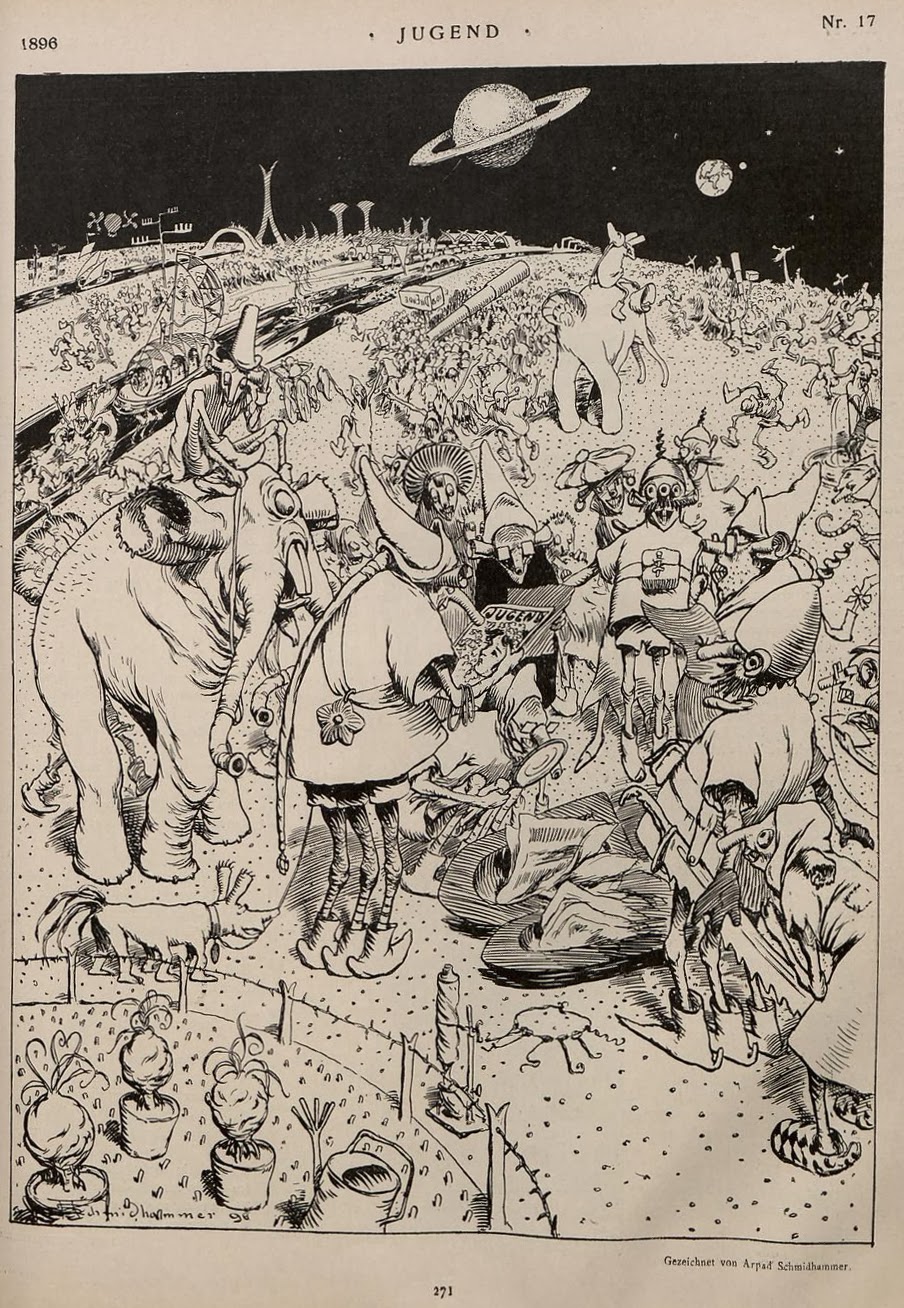
    The Munich-based Jugend magazine (1896-1940), founded by Georg Hirth, was host to an entire generation of art nouveau artists, lending its name (“Jugendstihl”) to a movement of expression of German Art Nouveau.  In the April 25, 1896 issue we find an unusual image of extraterrestrial life within our own solar system, drawn by the artist and illustrator Arpad Schmidhammer. It depicts life on a  planet beyond Saturn–complex life, complete with what we’d imagine automobiles of the future from 1935 to look like, as well as cities, and large crowds very engaged in receiving an object from a world alien to their’s.  The commotion seems to be a space-shell of some sort, and of course it carries issues of Jugend magazine.  There is all manner of action around the magazine in the foreground, and slightly beyond that we see another large group of people crowding around a telescope, hoping for a view of the Earth, while another dense crowd farther in the background swells around another Earth-intent telescope.  It is intended as a humorous scene, no doubt, but the fact is that there weren’t all that many scenes of alien life forms taking an interest in a floating Earth in the background.  Perhaps Wilhelm Roentgen’s newly-discovered X-rays helped an image like this along with the idea of entirely unseen worlds made visible…

    Alien art Jugend 1896

    [This image found thanks to an image-share by the Ephemera Society USA. Image Source: University of Missouri libraries, http://muspeccoll.tumblr.com/post/144371190257/jugend-1896-no-17-katya-s-jugend-mu-nchen utm_content=buffera68da&utm_medium=social&utm_source=twitter.com&utm_campaign=buffer]

    And just for the record, “extraterrestrial” finds life in English as far back as 1868: 

    1868   W. Lockyer & J. N. Lockyer tr. A. Guillemin Heavens (ed. 3) 188   Bodies situated in the extra-terrestrial regions.
    1882   Nature 21 Dec. 173/2   The oblique direction of the meteor..is another evidence of its extra-terrestrial origin.
    [Oxford English Dictionary]
     
    The detail from the busy upper-left corner:

    Alien art Jugend 1896 detail


  • Unfathomable Dots–324,198 Stars and Knowing the Structure of the Milky Way, 1873

    JF Ptak Science Books  Post 1107 (from 2010, Appended April 27, 2015)
    [A continuation of our History of Dots  series.]

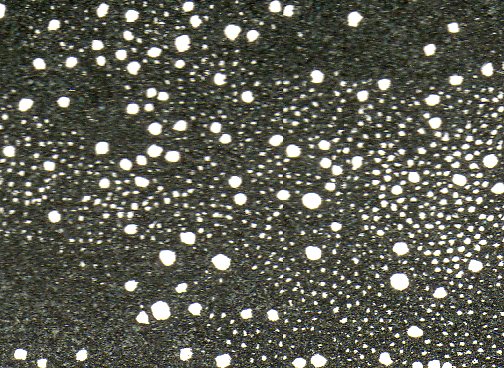
    Stars--vivible stars 2 det304


    The history of dots must have some fair share of its content filled with a very varied history of astronomy, which just goes to show that even within the seeming-sameness of microscopic investigations of dots that its subcategories could be so vast and differentiated. (The image above is a small detail from the following image, below.)

    Dots aren’t necessarily just dots–even in representing the stars, dots have a rich history. The first star-dots published in the West appear in 1482, taken from the work of the first century astronomer and philosopher Hyginius1, and is a book that contains maps of the constellations composed of such beautiful light-encrusted bits.  There wouldn’t be another work like this one, strangely, for another 75  years. Alessandro Piccolomini’s2 work of 1559 (which would be the first true star atlas), and again we see the familiar representation. 

    Galileo’s dots were very aggressive.  By 1610 he had produced his fifth and most powerful telescope, allowing things to be seen one thousand times closer, using it to make enormous discoveries–discoveries so big in fact that their towering significance is a but hard to understand today in the context of early 17th century knowledge. It was all published in his fantastic Sidereus Nuncius on March 4, 1610—the extraordinary  very title page3 of the book proclaiming some of the great discoveries of Galileo’s adventure.

    One monumental outcome of Galileo’s work was expanding the number of stars in the sky, which was basically mucking around with the perfect plan of the creator–formerly a cornerstone for the existence of a divine being.  With the exception of comets and eclipses the sky had remained immutable, a perfect score of the creator’s creation, until 1572, when Tycho Brahe noticed something new in Cassiopeia, something that was not a comet—a “something” that was a star. This was momentous because the night sky had been seen for centuries as being complete—a new star, the Nova of Brahe, contradicted this high belief, offering the possibilities of newness where there had not been one previously.  And so too with Kepler’s new star of 1602.

    One of the things that Galileo brought to the world was an entirely new sky, revealed to him through his telescope—so many stars that he could only guess (though he reckoned that there was an order of magnitude more stars than previously known “stars in myriads, which had never been seen before….and which surpasses the old, previously known, stars by ten times”).
       
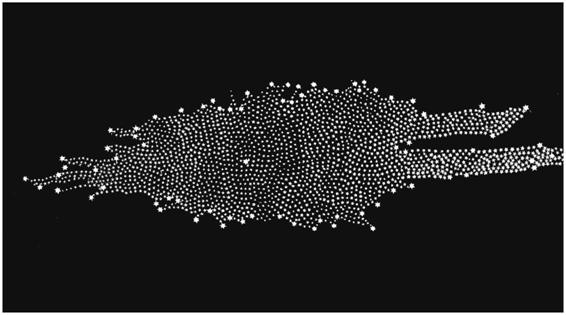
    Which brings me to the images that I stumbled on today from “Statement of Views respecting the Sidereal Universe”4which was  the work of the astronomer and great popularizer,  Richard A. Proctor (“B.A. (Cambridge), Honorary Fellow of King’s College, London”).

    Proctor’s dots challenge all dots that have come before so far as theorizing on the structure (and extent) of the Milky Way is concerned.  Proctor refers to William Herschel’s5–the man who first gave the Milky Way its shape and who fixed our own sun in an inferior and not-particularly-special place inside that map–statement that the extent and constitution of the Milky Way is “unfathomable”. 
     
    Proctor gets there by presenting a map of the night sky with stars visible to the naked eye:

      Stars--vivible stars 2303
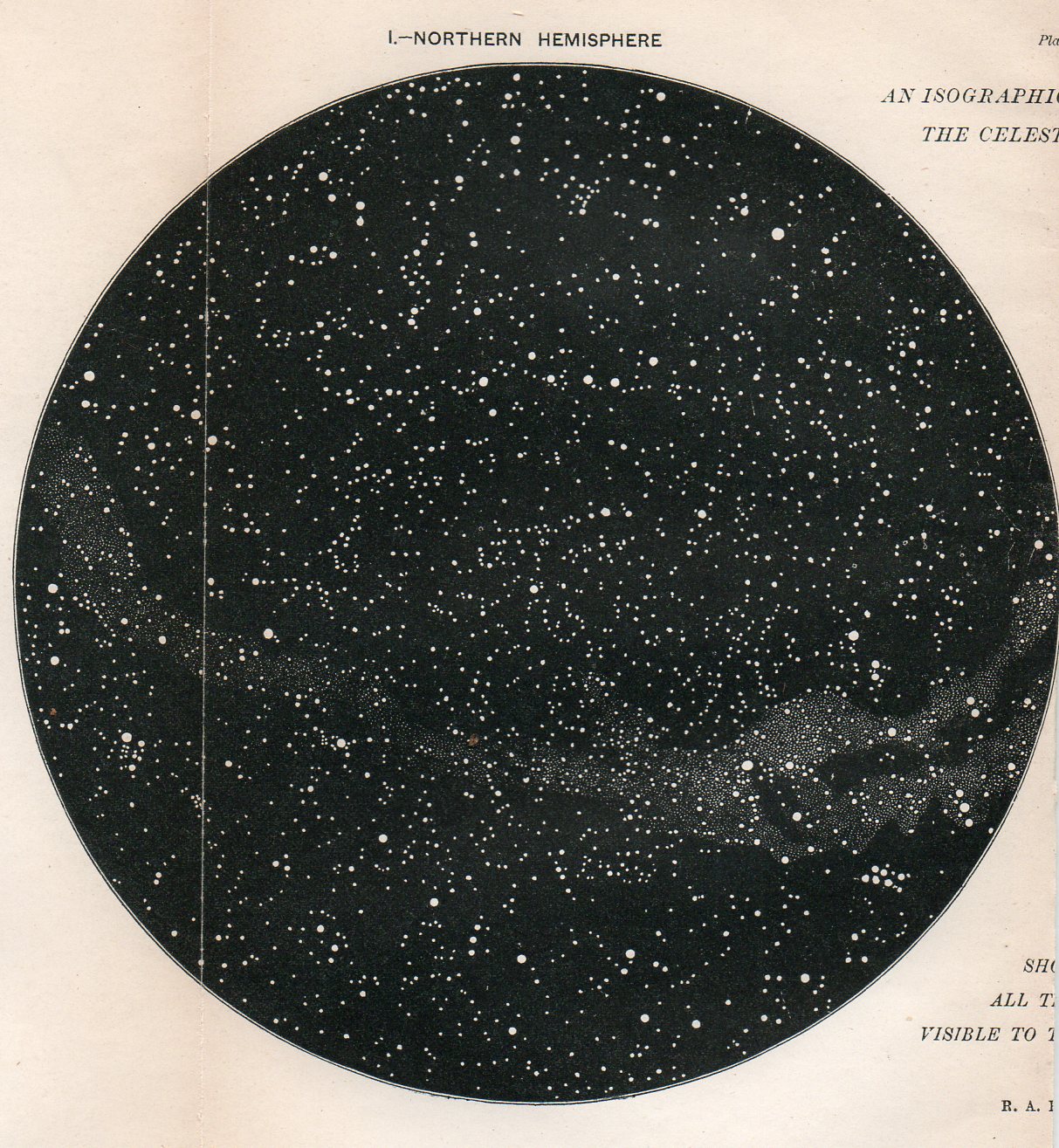
    And then the double hemisphere map of the northern and southern skies “We have here the first step towards just views of the constitution of the Milky Way, or rather the next step beyond the great, but little noticed, discovery of Sir W. Herschel’s, that the bright clouds of the Milky Way are for the most part spherical clusters of stars.”(Page 546.)

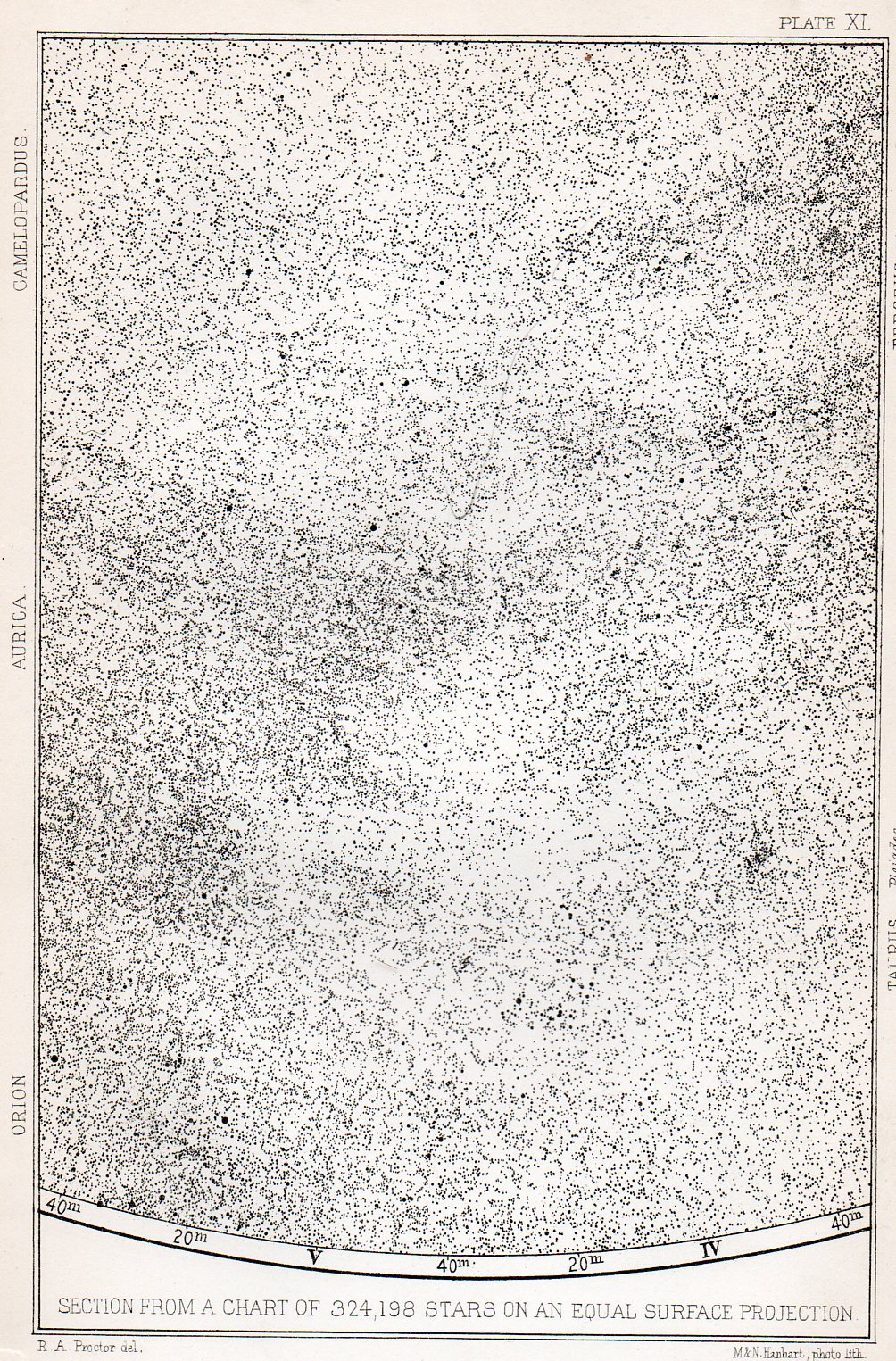
    Finally is the crux of the matter: two sections of an fantastic map displaying 324,198 stars visible via a 2.5 inch aperture telescope.

    Stars--324k300
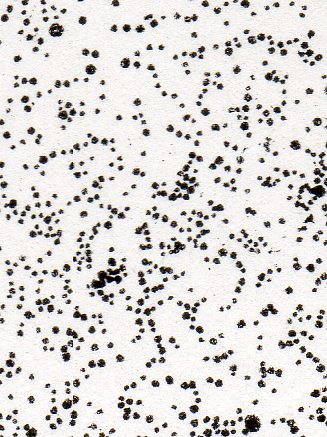
    (The following being a small detail in the above section:)

    Stars--324k deyt301
    He comments:“I assert, without the slightest fear of contradiction by any possessing such knowledge, that the broad teaching of the equal-surface chart. 0/3 24,000 stars disposes finally of all theories of the constitution of the sidereal universe which had previously been enunciated. The chart does not definitively indicate a new theory—rather it suggests the idea that the constitution of the sidereal universe is too complex to be at present ascertained. But it completely negatives (i), the stratum theory (even in the modified form apparently retained by Sir W. Herschel) ; (ii), the flat-ring theory of Sir John Herschel ; and (iii) the infinitely extended stratum theory, with condensation towards the mean plane, which Struve adopted.” (Page 547)

    I think that for 1873 the verbose Mr. Proctor got his point across.     

    Notes

    1. Hyginius Mythographus (fl. 1st century A.D.). Poeticon astronomicon. Edited by Jacobus Sentinus and Johannes Lucilius Santritter. Venice: Erhard Ratdolt, 14th October 1482. The first star atlas per se, standing alone in its field for a century.

    2. Piccolomini, Alessandro.  De la Sfera del Mondo.  1559                              

    3.  Galilei, Galilei  Sidereus Nuncius (known in English as Starry Messenger), published 1610
    The title page reads: Great and very wonderful spectacles, and offering them to the consideration of every one, but especially of philosophers and astronomers; which have been observed by Galileo Galilei … by the assistance of a perspective glass lately invented by him; namely, in the face of the moon, in innumerable fixed stars in the milky-way, in nebulous stars, but especially in four planets which revolve round Jupiter at different intervals and periods with a wonderful celerity.

    4. Journal of the Royal Astronomical Society, Paper, Abstracts and Reports of the Proceedings of the Society from Niovember 1872 to June 1873, vol XXXIII, London, printed by John Strangeways, 1873.                    

    5. It seems that few people now remember Frederick William Herschel as a great discoverer of alternative existences, but, well, that’s pretty much what he did–and he did it during a time that must’ve made his astronomical discoveries seem like science fiction .For example, in 1785 Herschel published a revolutionary image of the “Stellar System” (the Milky Way), showing its irregular pattern and the off-center placement of our sun amidst a panoply of other stars.
    (His image was remarkably and substantially correct, with the most grievous error being the placement of the sun too close to the center of the galaxy.) It was an image which bought the concept of a not so humano-centric idea into popular philosophy, and that our sun was a star among stars in a sea of stars.

    Herschel