A Daily History of Holes, Dots, Lines, Science, History, Math, Physics, Art, the Unintentional Absurd, Architecture, Maps, Data Visualization, Blank and Missing Things, and so on. |1.6 million words, 7500 images, 4.9 million hits| Press & appearances in The Times, Le Figaro, Mensa, The Economist, The Guardian, Discovery News, Slate, Le Monde, Sci American Blogs, Le Pont, and many othr places… 5000+ total posts since 2008. Contact johnfptak at gmail dot com

Category: Perception

  • Found Poetry in Lost Plankton (1930)

    JF Ptak Science Books   Quick Post   Overall Post 5125

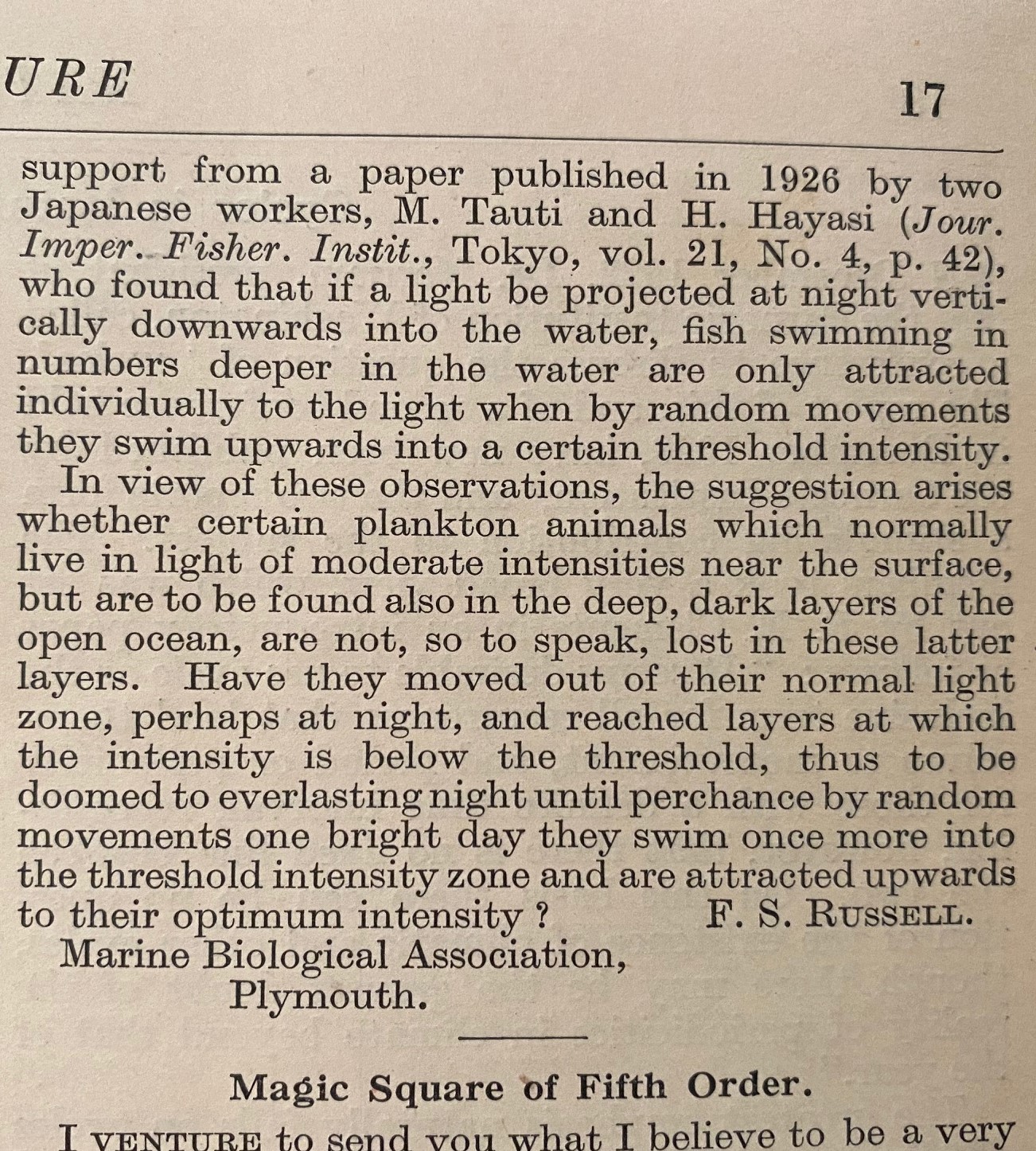
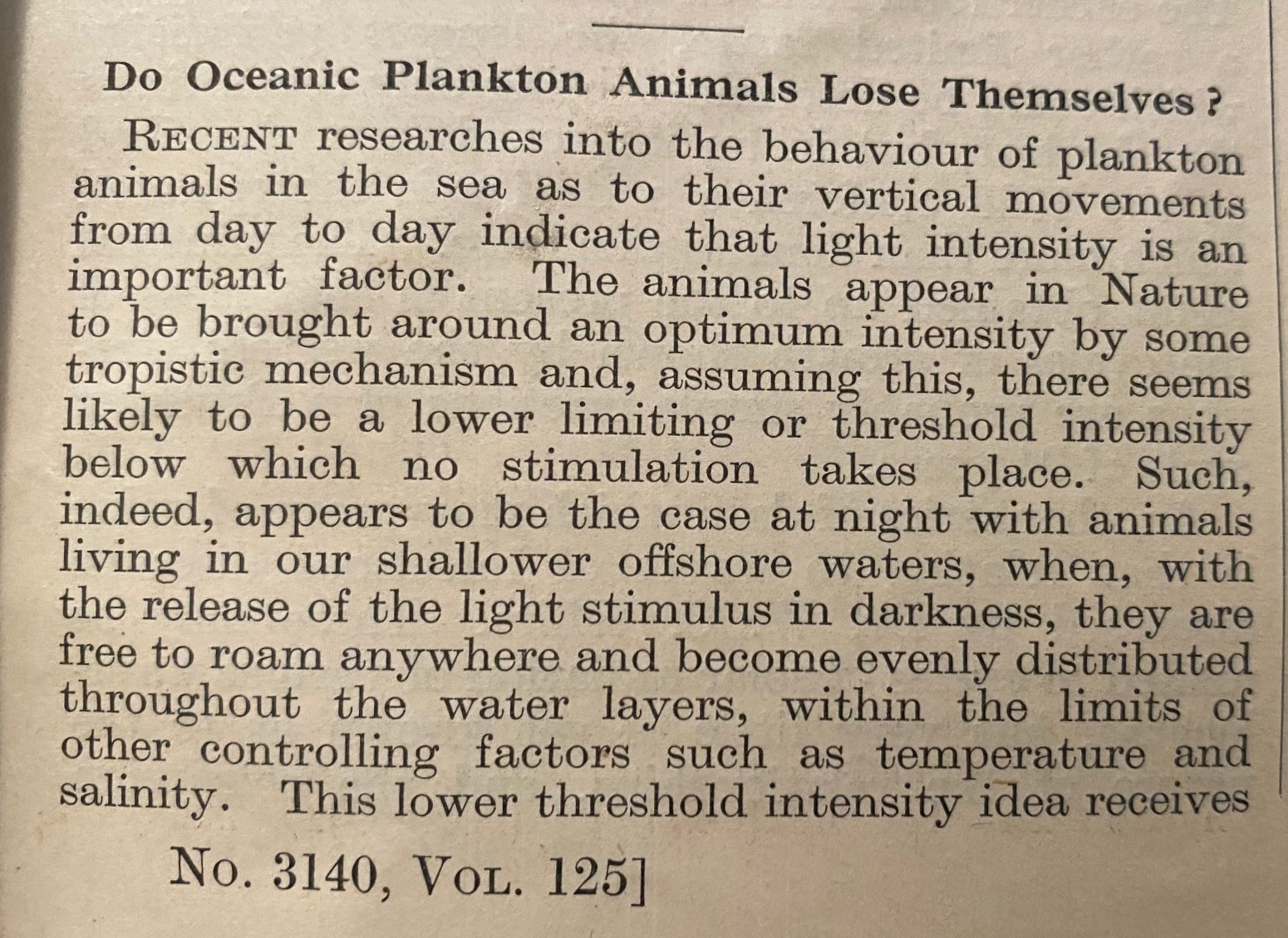
    IMG_5066Over on my blog I’ve made a number of posts on “Found Poetry”–phrases and constructions of interesting structural images that when removed from a narrative form and subjected to a different display find a sort of light art form in themselves. The phrases and sentence are in their original order—spacing and delineation have changed a bit to focus their attractiveness. There have been posts on “Found Poetry” in the (sometimes very extended) titles of Renaissance books, recipes and instructions on cooking dainty sardines, a disintegrating machine from 1877, descriptions of clouds from 1726, and well, you get the picture. “Found art is where you don’t find it”, as M. Duchamp didn’t say—sometimes the found poetry is pretty obvious, sometimes not. Today’s entry has a terrific title, though the text lets us down a little, but then closes up very strong in the last paragraph. And so, from Nature, 4 January 1930, volume 125, no. 3140, the last sentences of the last paragraph:

    “Do Ocean Plankton Animals Lose Themselves?

    Have they moved out of their normal light,

    and reached layers at which the intensity

    is below

    the threshold, thus to be doomed

    to everlasting night until perchance by random movements

    one bright day

    they may swim once more

    into the threshold intensity zone

    and attracted upwards

    to their optimum intensity?”

                –F.S. Russell, Marine Biological Association, Plymouth

    IMG_5067


  • One of the Earliest X-Rays of “Dots”: Medical Imagery, 1896

    JF Ptak Science Books  Quick Post--History of Dots series

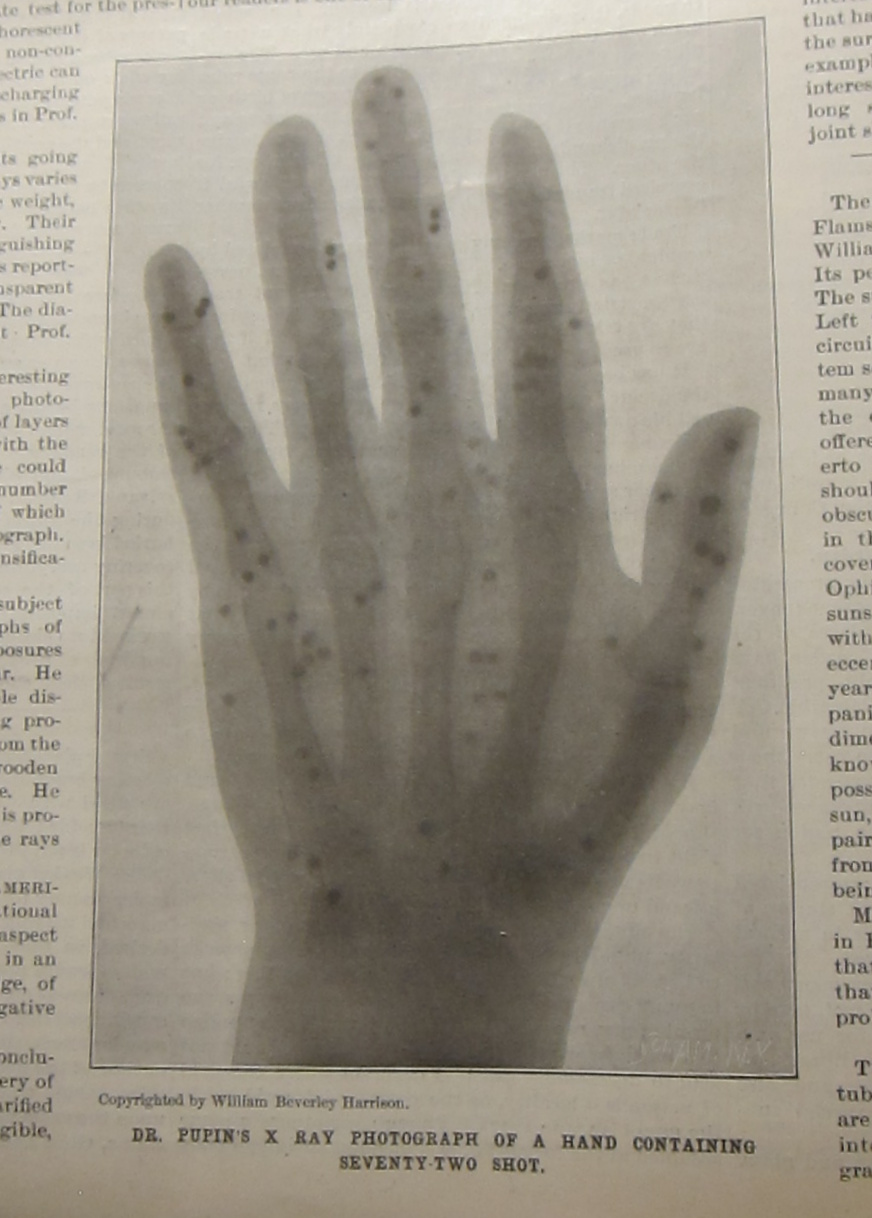
    In the long line of the history of “firsts” in photography are a number of sub-categories, and subs- to those subs, an example of which is scene in the pages of Scientific American for 1896. Here we have the history of photography=>medical photography=>clinical applications of X-rays=>X-ray photographs=>X-ray photographs of gunshots, or some such thing. Anyway, here in the March 21 1896 issue of the great magazine is one of two articles on the X-ray, the second of which features what may be one of the very earliest–if not the earliest–images made of a human limb peppered with rifle/field canon pellets. This comes only two months or so following the discovery and first imagery using  X-rays by Wilhelm Roentgen (1845-1923) made November 8 1895, the experimental results published soon after on January 8 1896 in his paper “Ueber eine neue Art von Strahlen” in the Würzburg Physico-Medical Society.

    The interest in X-rays was spectacular, with more than 1000 papers published on the subject in 1896 alone. This is understandable given the revolutionary nature of the announcement plus the relative ease and simplicity of equipment necessary to produce results.  The Roentgen paper was translated and printed in Nature (for the first time in English) almost immediately on January 23 1896, and it was the very next issue in which advertisements appeared for the relatively cheap necessaries (Crookes tubes etc.) for interested parties to produce their own X-rays at home. Absolutely everyone was interested in this discovery. (For the Scientific American there were 9 articles on the X-ray for January-June, 1896, with the first appearing on February 3; for July-December there were 33.) 

    The image below was made by Columbia University’s Michael Pupin, and was one of the earliest general clinical uses of the new discovery, following what was probably the first medical use (at least in the U.S.) by Frank Austin (Dartmouth) in February 1896. The extraordinary development had an epochal impact on medicine, as now for the first time in the history of the planet a person could see inside a person/living being without cutting them open and poking around.  The X-ray was soon put into use on the battlefield six months later, at about the same time that some of the pioneers (E. Thomson, Morton, Tesla) began to report exposure burns (as some of their photographic exposures using X-rays were 20 minutes long…) 

    (By the way this is the man for whom Pupin Hall was named–this place became ultra famous in my mind, anyway, for the seminal work done their in cutting edge areas by Peagram and Fermi and Urey and Rabi and Dunning, among many others. Also Pupin was awarded the Nobel Prize for Literature in 1924 for his scientific memoir/autobiography, a highly unusual feat for such a subject.) 

    Sci Am 1896 x-ray


  • Unusual Shading/Shadows (1866)

    JF Ptak Science Books  Quick Post

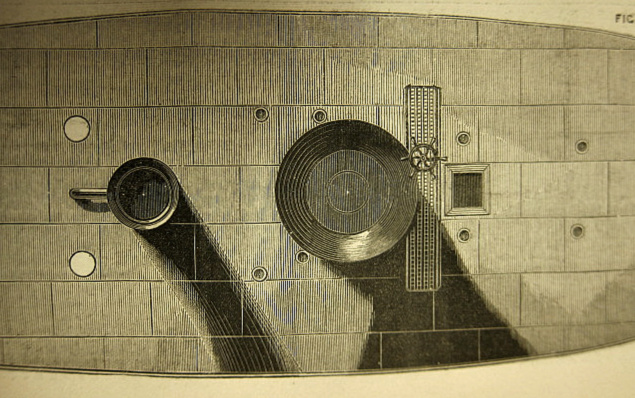
    I’ve made a number of entries on this blog of beautiful/odd shadow practices in antique mechanical and technical drawings, though not so for a while. Today’s entry comes from a stout volume of Engineering (volume 2) 0.for 1866 and comes in an illustration for the U.S. Navy torpedo boat, the Spuyten Duyvil. The boat’s name seems like a bit difficult to maneuver, except if you’re Dutch, though it is far-better sounding than the original name, which was Stromboli.  In any event this was a torpedo boat that saw a little bit of service right at the end of the Civil War–mostly on the James River in Virginia, it seems–and was a torpedo boat. (The “torpedo” at this time was more like a mine than a powered underwater “missile” that we’d think of in these terms today.)  The chief attraction for me for these images though is a bit wholly unnecessary to understanding the boat or its workings, and that’s the shadowing for the exhaust stacks, which to me seem a little unusual, though quite lovely. And so the sharing…

    ENgineer 1866_2_


  • “A Drop of Water on its Travels” (1878)

    JF Ptak Science Books   Quick Post

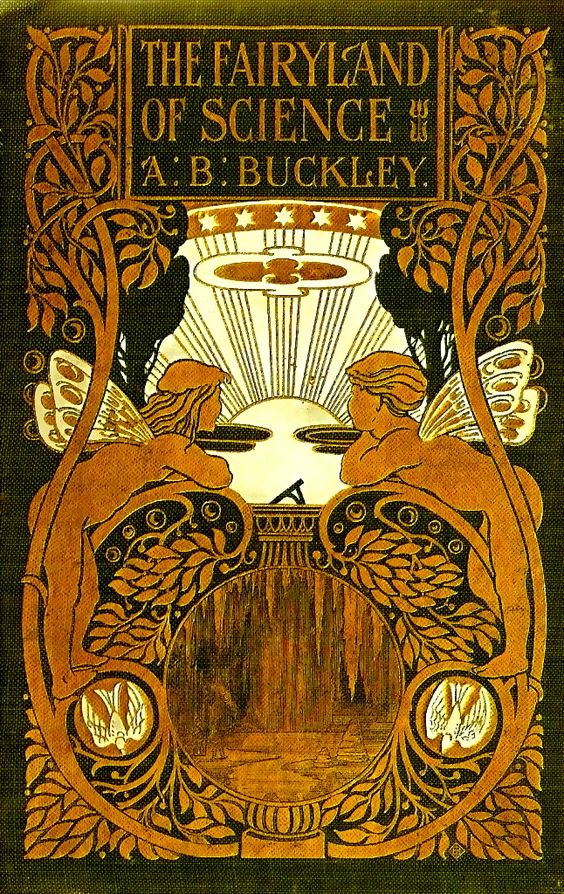
    Books covers fairyland of scienceHere’s an absolutely lovely book: The Fairyland Of Science, written by Arabella Burton Buckley (1840-1929), published in 1878. To start with I was more interested to see how many other books have “fairyland” and “science” in their titles and checked it out on WorldCat—I was not surprised to see there was only one other (George McPherson’s Fairyland Tales of Science , published in 1891). Well, there was a second title, but that was Buckley’s sequel to her 1878 book with its title repeated in the title of the newer book. But that was it.

    A look at the contents though shows that Buckley wove some fairy dust into the sciences, and reading of it confirms this observation:

    Lecture I The Fairy-Land of Science; How to Enter It; How to Use It; And How to Enjoy It
    Lecture II Sunbeams, and the Work They Do
    Lecture III The Aerial Ocean in Which We Live
    Lecture IV A Drop of Water on its Travels
    Lecture V The Two Great Sculptors – Water and Ice
    Lecture VI The Voices of Nature, and How We Hear Them
    Lecture VII The Life of a Primrose
    Lecture VIII The History of a Piece of Coal
    Lecture IX Bees in the Hive
    Lecture X Bees and Flowers

    The author gently and beautifully opens the book for the young reader with the following, there being little greater a wish for the appreciation of science than this:

    • “I HAVE promised to introduce you today to the fairy-land of science – a somewhat bold promise, seeing that most of you probably look upon science as a bundle of dry facts, while fairy- land is all that is beautiful, and full of poetry and imagination. But I thoroughly believe myself, and hope to prove to you, that science is full of beautiful pictures, of real poetry, and of wonder-working fairies; and what is more, I promise you they shall be true fairies, whom you will love just as much when you are old and greyheaded as when you are young; for you will be able to call them up wherever you wander by land or by sea, through meadow or through wood, through water or through air; and though they themselves will always remain invisible, yet you will see their wonderful poet at work everywhere around you.”

    Buckley walks the reader through familiar territory, explaining the great and overall consequences of water, ice, bees, flowers, coal, and the like, and how these everyday bits figure in the greater scheme of the workings of the world. Here’s the table of contents, which is splendid all on its own.

    She ends the book as nicely:

    • “Neither is it pleasure alone which we gain by a study of nature. We cannot examine even a tiny sunbeam, and picture the minute waves of which it is composed, traveling incessantly from the sun, without being filled with wonder and awe at the marvelous activity and power displayed in the infinitely small as well as in the infinitely great things of the universe.”

    Full text via Gutenberg: http://www.gutenberg.org/cache/epub/5726/pg5726-images.html

    Buckley followed a few years later with a companion volume, equally as accessible and interesting as her first: Through Magic Glasses…(1890) explaining how telescopes/microscopes/spectroscopes work and what they reveal—a fine accomplishment.

    Again, full text provided by Gutenberg: http://www.gutenberg.org/ebooks/37589


    ·Posted by :

    ·in:


  • On Looking for One Thing and Finding Another (1878). What Does Criminality Look Like?

    JF Ptak Science Books   Quick Post

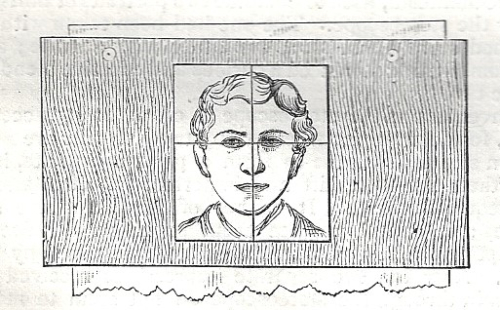
    Galton faceSir Francis Galton’s “Composite Portraits” article in May 23, 1878 volume of Nature (pp 97-100) came early on in the prehistory of cognitive and computational aspects of “facial recognition”, though more like an analog development for a later digital environment. In this paper he discusses his attempts to see the face of criminality before crime was committed. Galton put together and projected a number of portraits of criminals to see if a fundamental picture of criminality arose–what he found was the opposite, and poetic. He started with a first set of eight portraits of people convicted of murder, manslaughter, or robbery accompanied by violence. What he found I’m sure must’ve been surprising to him: the composite of the eight were “much better looking” than the individual components, and that the “special villainous irregularities…have disappeared”. It was the “common humanity that underlies each of them (that) has prevailed”.

    Galton continues to state that the composite “represents not the criminal, but the man who is likely to fall into crime”.

    There is then a fair amount of discussion of the many uses of the composite photograph, though I think for our purposes we can stop right here.

    [A sample composite image, above.]


    ·Posted by :

    ·in:

    — —

  • On Displays of Humor, Joke-Making, and Shame in Dogs (1875)

    JF Ptak Science Books  Quick Post  

    George J. Romanes1, “Sense of Humour and Reason in Animals” (from Nature, volume 12, 1875, p 66) [With a few added annotations]

    “IN the recently published edition of the Descent of Man there is some additional matter concerning the above subjects, and as the following illustrative cases fell under my own observation, I think it is worth while to publish them as supplementary to those adduced by Mr. Darwin.

    Several years ago I used to watch carefully the young Orang Outang at the Zoological Gardens, and I am quite sure that she manifested a sense of the ludicrous. One example will suffice. Her feeding tin was of a somewhat peculiar shape, and when it was empty she used sometimes used invert it on her head. The tin then presented a comical resemblance to a bonnet, and as its wearer would generally favour the spectators with a broad grin at the lime of putting it on, she never failed to raise a laugh from them. Her success in this respect was evidently attended with no small gratification on her part.

    I once had a Skye terrier2 which, like all of his kind, was very intelligent. When in good humour he had several tricks, which I know to have been self-taught, and the sole object of which was evidently to excite laughter. For instance, while lying upon one side and violently grinning,* he would hold one leg in his mouth. Under such circumstances nothing pleased him  much as having his joke duly appreciated, while if no notice was taken of him he would become sulky. On the oilier hand, nothing that could happen displeased him so much as being laughed at when he did not intend to be ridiculous.

    Mr. Darwin says:—’Several observers have stated that monkeys certainly dislike being laughed at’ (p. 71)3. There can be little or no doubt that this is true of monkeys; but I never knew of a really good case among dogs save this one, and here the signs of dislike were un-equivocal. To give one instance. He used to be very fond of catching flies upon the window-panes, and if ridiculed when un-successful, was evidently much annoyed. On one occasion, in order to see what he would do, I purposely laughed immoderately every time he failed. It so happened that lie did so several times in succession—partly, I believe, in consequence of my laughing—and eventually he became so distressed that he positively pretended  to catch the fly, going through all the appropriate actions with his lips and tongue, and afterwards rubbing the ground with his neck as if to kill the victim : he then looked up at me with a triumphant air of success. So well was the whole process simulated, that I should have been quite deceived, had I not seen that the fly was still upon the window. Accordingly I drew his attention to that fact, as well as to the absence of anything upon the floor; and when he saw that his hypocrisy had been detected, he slunk away under some furniture, evidently very much ashamed of himself.”

    Notes:

    Romanes (1848-1894) was an interesting man, an evolutionary biologist and physiologist, and one of the founders of comparative psychology who wrote broadly on the intelligence and emotions of animals and the connections of animal intelligence and that of humans. He also was the first to use the term of “anthropomorphism”. He was a good and life-long friend of Darwin, and spent the years between Darwin’s death (1882) and his own defending and arguing Darwin’s ideas.

    Skye Terrier. I had to look this up, so aI reproduce the info from the American Kennel Club: “Long, low, and level, this unique earthdog is among the AKC’s most distinctive-looking breeds. Skyes stand 9 or 10 inches high and feature a long, flat-lying coat and peekaboo hairdo. They’re known for big, feathery ears that stand up like bat wings, but Skyes can also have “drop ears,” which lie flat against the large, long head. Beneath the profuse coat are short, muscular legs and a deep chest. When seen in profile, these elegant but substantial terriers are twice as long as they are high.”

    Darwin, Charles. The Descent of Man, and Selection in Relation to Sex, first printed in 1871.

    The note in Nature says “p.71”, but actually appears on page 42. Page 70 begins the interesting second half of a chapter on “Comparison of the Mental Powers of Man and the Lower Animals  the difference in mental power between the highest ape and the lowest savage, immense…” which could have led to the confusion. In any event, the quote:

    “Most of the more complex emotions are common to the higher animals and ourselves. Every one has seen  how jealous a dog is of his master’s affection, if lavished on any other creature; and I have observed the same fact with monkeys. This shews that animals not only love, but have the desire to be loved. Animals manifestly feel emulation. They love approbation or praise; and a dog carrying a basket for his master exhibits in a high degree self-complacency or pride. There can, I think, be no doubt that a dog feels shame, as distinct from fear, and something very like modesty when begging too often for food. A great dog scorns the snarling of a little dog, and this may be called magnanimity. Several observers have stated that monkeys certainly dislike being laughed at; and they sometimes invent imaginary offences. In the Zoological Gardens I saw a baboon who always got into a furious rage when his keeper took out a letter or book and read it aloud to him; and his rage was so violent that, as I witnessed on one occasion, he bit his own leg till the blood flowed.”
    ·Posted by :

    ·in:

    — —

  • Picturing What a Nightmare Looks Like Outside Itself (1878)

    JF Ptak Science Books   Post 2650

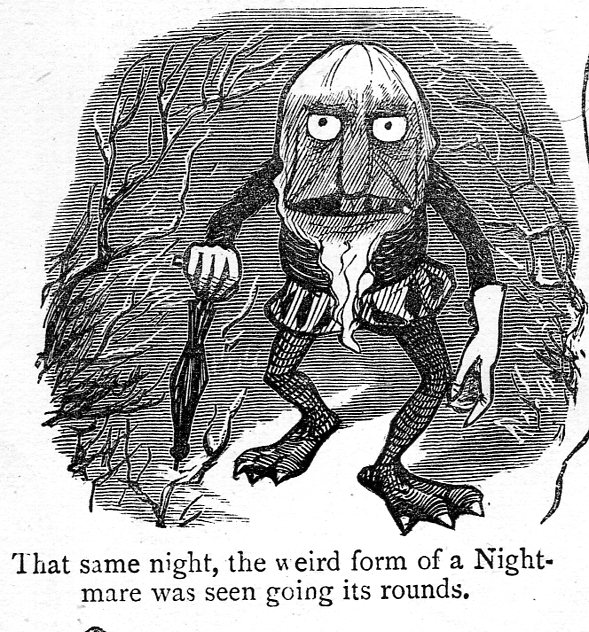
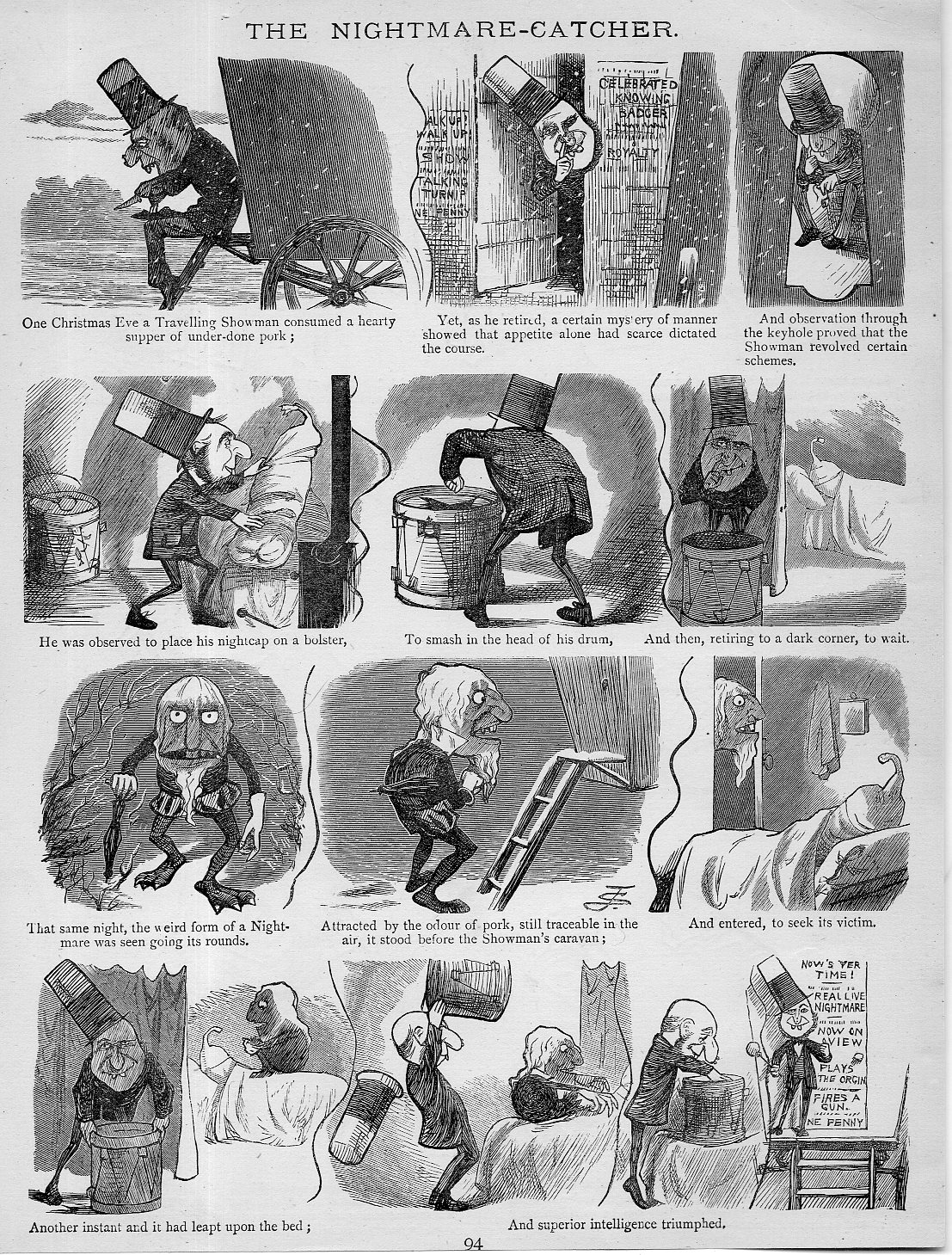
    In my career of looking-at-things it is becoming an easier job to recognize something that is out of place, or uncommon, or wrong–far more so I think than the opposite, because the “expected” happens to be expected, and so fits right into place, somewhere.  So it came to be that this cartoon featuring the depiction of an anthropomorphic nightmare stood out so clearly and oddly. It is the work of James Francis Sullivan (and published in 1878 in a volume of his darkly humorous single-page six-ten panel cartoons ungainly titled The British Working Man by one who does Not Believe in Him, and other Sketches) and in my experience is a very early depiction of the nightmare itself as a corporeal thing. There have been untold numbers of depictions of the contents of nightmares in literature and art and such, but I’m having a hard time of picturing another source that would stand as a dictionary illustration of what a nightmare looks like devoid of its content. 

    Nightmare803

    I checked in with the Oxford English Dictionary and found to my surprise that the nightmare started out at some point in English to be a “female spirit or monster”–it was not surprising to see the definitions stretching back to Chaucer and earlier1. Next stop was the cataloging and reference tool WorldCat, where I searched for the appearance of “nightmare” in the title of a book and found nothing (seemingly) published so until John Bond’s  An essay on the incubus, or nightmare, in 1753. This is just a casual search, and nothing very scientific, but at least at this level there isn’t much to see, perhaps six titles only until 1800, after which the use of the word grows. In contrast, titles appearing using the word “dream” are a solid+ order of magnitude beyond “nightmare’. 

    Nightmares and dreams abound everywhere but in the titles of books, and sometimes actually lead to a chain of events in the waking world.  Ramanujan famously dreamed mathematical dreams (in addition to hearing solutions to massively complex problems from “angels” in a waking state); R.L. Stevenson dreamed the premise for Mr. Hyde; Socrates used the medium (dreampt or not); Mary Wollstoncraft nightmare lead to her big nightmare book, and so on, on and on, into the dream/nightmare-filled night.  In my memory of such stories, though, the nightmare or dream never seems to have its own face, and that nothing exists beyond the contents of the thing beyond itself–this is what makes the nightmare-catcher story by Sullivan so unusual to me.  

    I don’t have anywhere to go with this, presently, beyond simply reporting it.

    In any event, the cartoon goes as follows: a travelling showman (already evidently entertaining people with a “talking turnip” and a “celebrated knowing badger”) resolved to capture a nightmare for his show. In that he mocks up a sleeping version of himself in his bed, and waits upon the nightmare, and when the nightmare makes his appearance the showman captures him with a broken drum. The nightmare is then put on display in the travelling show (also playing the “orgin” and firing a gun) for all to see for the cost of one penny. 

    This all happens on Christmas Eve–I can think of better stories than this to share on that or any night.  

    Nightmare802

    Notes:

    1. “Nightmare” from the OED:

     a. A female spirit or monster supposed to settle on and produce a feeling of suffocation in a sleeping person or animal. Also fig. Now rare.

    c1410  (▸c1390)    Chaucer Miller’s Tale (Cambr. Dd.4.24) (1902) 3485   Blisse this hous fri euery euyl wyght ffor the nyghtesmare [c1390 Hengwrt nyghtesuerye] the whȝt Pater noster.

    1440   Promptorium Parvulorum (Harl. 221) 356   Nyghte mare [v.r. Nyhtmare], Epialtes.

    1530   J. Palsgrave Lesclarcissement 248/1   Nightmare, goublin.

    1608   E. Topsell Hist. Serpents 173   The spirits of the night, called Incubi and Succubi, or else Night-mares.

    1696   J. Aubrey Misc. (1721) 147   It is to prevent the Night-Mare (viz.) the Hag, from riding their Horses.

    1770   T. Chatterton Compl. Wks. (1971) I. 211   The dethe-owle loude dothe synge, To the nyghte-mares as heie goe.

    1804   J. Collins Previous Apostrophe in Scripscrapologia p. x,   Let thy Pegasus then, spurn the Nightmare of Sloth, Nor by Day let her hag-ride thy Pen.

    1822   Shelley Prince Athanase in Posthumous Poems (1824) 110   Like an eyeless night-mare grief did sit Upon his being.

    1851   N. Hawthorne House of Seven Gables xvi. 270   So heavy and lumpish that we can liken him to nothing better than a defunct nightmare, which had perished..and left its flabby corpse on the breast of the tormented one.

    1886   R. L. Stevenson Kidnapped x. 92   There was that tightness on my chest that I could hardly breathe; the thought of the two men I had shot sat upon me like a nightmare.


  • Musical Realism and Ethnology, 1891

    JF Ptak Science Books   Post 3636

    I first came upon Jesse Walter Fewkes for his work on the U.S. Southwest pottery, and knew of some of his work casually–I did not know about his work with the phonograph until I bumped into this article in Nature for 1890. Evidently, Fewkes’  work, “On the Use if the Edison Phonograph in the Preservation of the Languages of the American Indians”, (in Nature, April 17, 1890, volume 41, #1068, p 560), was among the earliest (if not the earliest) reports on using a phonograph to record Native American songs and rituals. He reports on his use of the relatively new phonograph (14 years old now) to record music, folk tales, language and other aspects of the expressive culture of the Passamaquoddy Indians of Maine–this before heading to the Southwest to make recordings of the Zuni (in 1890) and Zuni (in 1891). 

    This is interesting no doubt because Fewkes offered the world proof of these societal sounds, an imprimatur on authenticity. This must have exploded or leaked into the rest of teh world like the involvement of photography in reporting the news. It was shown early on, during the U.S. Civil War, that engravings made after photographic images and identified so were believed more so in terms of authenticity than the artists rendering a scene “on the spot”. Then of course when Stephen Horgan’s halftone process was introduced and began to be widely-employed–at about the same time as this article, in fact–and would begin to replace hand-drawn images in newspapers and journals, and offer a new version of what was deemed “trustworthy” and “authentic”…until of course this new process came into question via photo manipulation and fraud. But for the time being, here in 1890, there was a new sense of the concept of “realism”, and I think that this doesn’t happen very often. 

    On the Use of the Edison Phonograph in the Preservation of the Languages of the American Indians.

    “THE present state of perfection of the Edison phonograph led me to attempt some experiments with it on our New England Indians as a means of preserving languages which are rapidly becoming extinct I accordingly made a visit to Calais Maine and was able through the kindness of Mrs W Wallace Brown to take upon the phonograph a collection of records illustrating the language folk lore songs and counting out rhymes of the Passamaquoddy Indians. My experiments met with complete success and I was able not only to take the records but also to take them so well that the Indians themselves recognized the voices of other members of the tribe who had spoken the day before. One of the most interesting records which was made was the song of the snake dance sung by Noel Josephs who is recognized by the Passamaquoddies as the best acquainted of all with this song of old time. He is always the leader in the dance and sang it in the same way as at its last celebration I also took upon the same wax cylinder on which the impressions are made his account of the dance including the invitation which precedes the ceremony. In addition to the song of the snake dance I obtained on the phonograph an interesting trade song and a Mohawk war song which is very old. Several other songs were recorded. Many very interesting old folk tales were also taken In some of these there occur ancient songs with archaic words imitation of the voices of animals old and young. An ordinary conversation between two Indians and a counting out rhyme are among the records made I found the schedules of the United States Bureau of Ethnology of great value in my work and adopted the method of giving Passamaquoddy and English words consecutively on the cylinders. The records were all numbered and the announcement of the subject made on each in English Some of the stories filled several cylinders but there was little difficulty in making the changes necessary to pass from one to the other and the Indians after some practice were able to make good records in the instrument. Thirty six cylinders were taken in all. One apiece is sufficient for most of the songs and for many of the short stories. The longest story taken was a folk tale which occupies nine cylinders about Podump and Pook jin Squiss the Black Cat and the Toad Woman which has never been published. In a detailed report of my work with the phonograph in preserving the Passamaquoddy language I hope to give a translation of this interesting story.”  [Source:  Google Books. I do own the original of this paper, should anyone want to purchase it…]


    ·Posted by :

    ·in:

    —

  • Flat and Full Perspectives

    JF Ptak Science Books  Post 2602

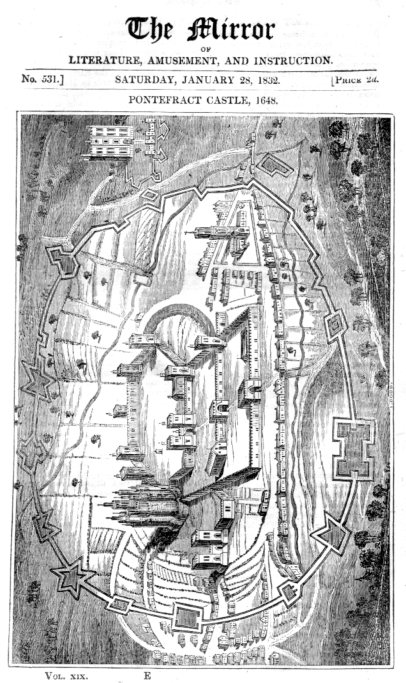
    There were two images that I came across tonight in the studio as I was chasing Pooches the Cat/Dog–they’re not quite on the opposite ends of themselves on the compass rose, but they are certainly in the neighborhood. I like it though that they came to me by chance, one after the other. One is very, very flat; the other is very “full”, and has a large sense of dimensionality.  The first is a 1832 woodcut of a 1648 rendering of Ponterfract Castle. Although perspective had been discovered (or rediscovered at 250 years earlier, the image has a Medieval taste to it, as we see both two- and three-dimensional representations together in the same image.  I think that most of that was done by design and the print was dual-purposed–first to show the plan of the castle and then secondly to show the fortifications and some buildings in elevation. The overall effect I think portrays more flatness than not.  

    Flat perspective089

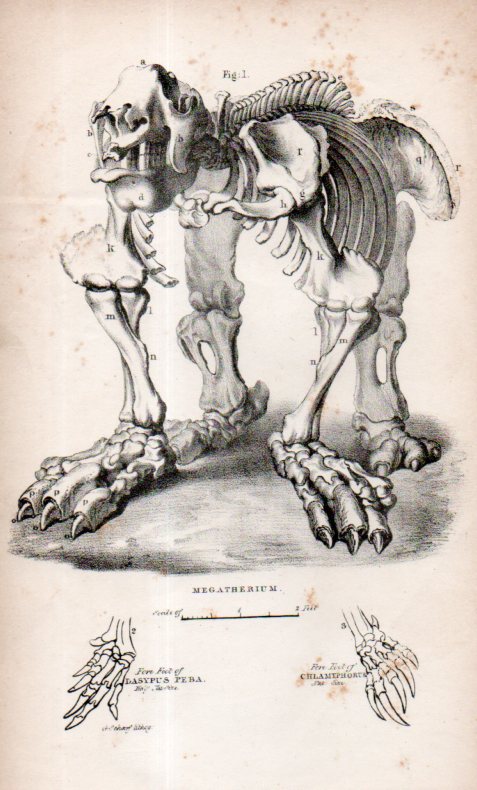
    The second perspective is something that I’ve always thought had a deep depth for a piece of paper. My copy is simply a loose engraving, bought years ago at Pageant Book Shop in Manhattan–a stray bit in a  “sciences” bin or some such, and I’ve had it ever since.  Again I’m not sure of its origin but my guess is that is is English from a popular science dictionary or geological text 1825-1850.  It just has a great perspective–plus it also looks as though we’ve just surprised it, a little.  It is a Megatherium (“giant/beast”) and was discovered first in 1788 by Manuel Torres and then assembled in the next year by Juan Bautista Bru, who evidently made the first illustrations of it.  An engraving of the magnificent mammal appeared in the second edition of Georges Cuvier’s Recherches sur les ossemens fossiles, (1812) which was a justifiably iconic image, though I like this little and odd-perspective one from above better.  

    Megathermin088


  • On The Flood, Comets, and a Recantation (1823-1831)

    JF Ptak Science Books   Post 2592

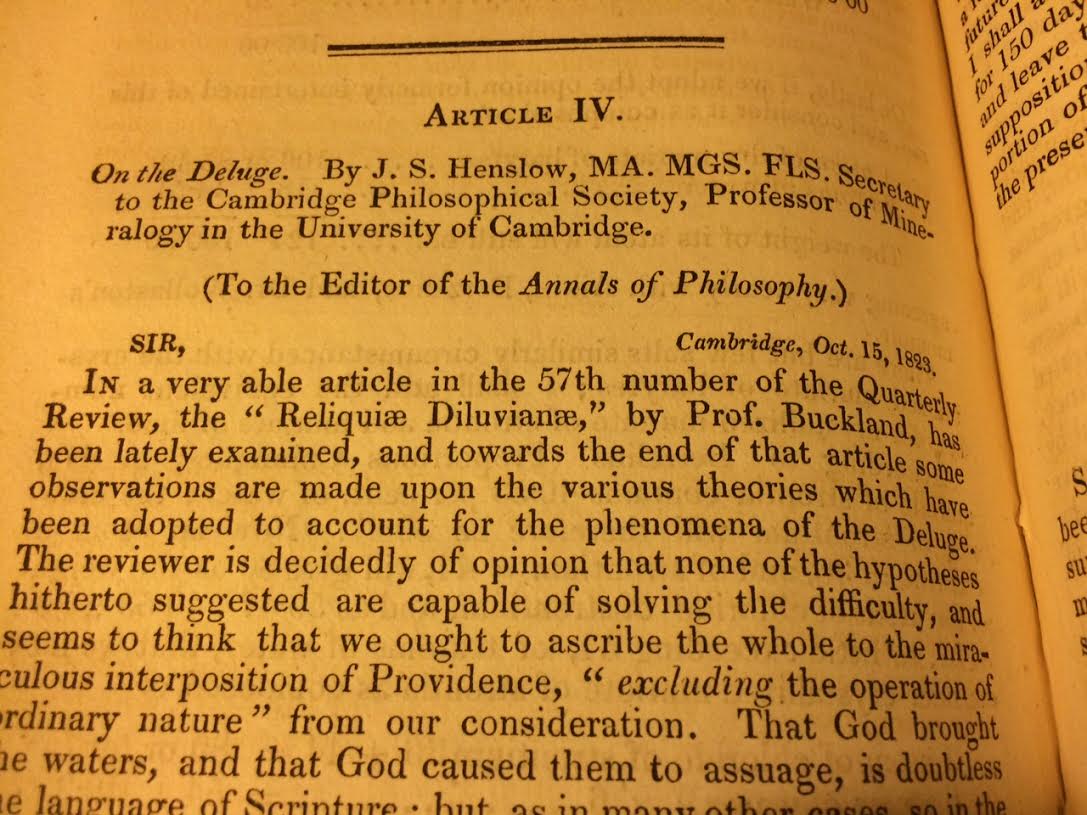
    I pulled a volume at random of the Annals of Philosophy from the shelves–it was volume VI (new series) from 1823. Trying to think of what might be a hot-button issue (in English) for that year, I started flipping through the pages, reading the page headers: Humboldt on volcanoes, Beaufoy’s astronomical observations, Mr. Moyle on the temperature of mines, Prevost on the blood, Pond on some astronomical topic, Ramond on the barometer, book reviews, scientific society announcements, and so on. Nothing really drew me in–until in the back, at page 344, this running header: “Prof. Henslow on the Deluge”. That was a “something” that I was looking-but-not-looking-for.  

    Flood

    This was a late-ish contribution to the history of the geology of the Great Flood, and in it, John Henslow (a great naturalist and botanist, 1796-1861) postulates that the flood was caused by the near-passing of a comet that disintegrated and contributed its enormous aequeous “nebulae” to the Earth’s atmosphere producing the Noachic flood.  He quickly sites a contemporary (one of many), William Buckland1, in this, who was one of the late leaders in the geological response to the flood, and who theorized a natural history of the flood and a production of an Ice Age.  The belief that there was some scientific basis in the divinely-induced flood was buoyed by the general flavor of the mythology of the flood, which turns up in more than 100 cultures–so part of the Noahic flood argument as being true is the broad cultural base for it. Commonality across cultures like this doesn’t necessarily make something real–there are many many parallels between the Bible and other sacred books besides this, like for example the savior descending into Hell for three days before resurrection, and that in stories that precede the New Testament. So common story bases make them popular, though not necessarily correct.

    So Henslow thinks about the comet in a long tradition of Genesis geology, like Buffon and his comet. But what is more interesting to me in this issue is another contemporary, Reverend Adam Sedgwick, Woodwardian Professor of Geology at Cambridge University, who at the end of several decades in theorizing on catastrophic flood geology decided that he had taken a wrong turn.  What happened then, in 1831, was a remarkable refutation of his earlier work. It was an enormous thing, a statement of real courage and conviction to the scientific process.