A Daily History of Holes, Dots, Lines, Science, History, Math, Physics, Art, the Unintentional Absurd, Architecture, Maps, Data Visualization, Blank and Missing Things, and so on. |1.6 million words, 7500 images, 4.9 million hits| Press & appearances in The Times, Le Figaro, Mensa, The Economist, The Guardian, Discovery News, Slate, Le Monde, Sci American Blogs, Le Pont, and many othr places… 5000+ total posts since 2008. Contact johnfptak at gmail dot com

Category: Mistakes, The Importance of

  • On The Flood, Comets, and a Recantation (1823-1831)

    JF Ptak Science Books   Post 2592

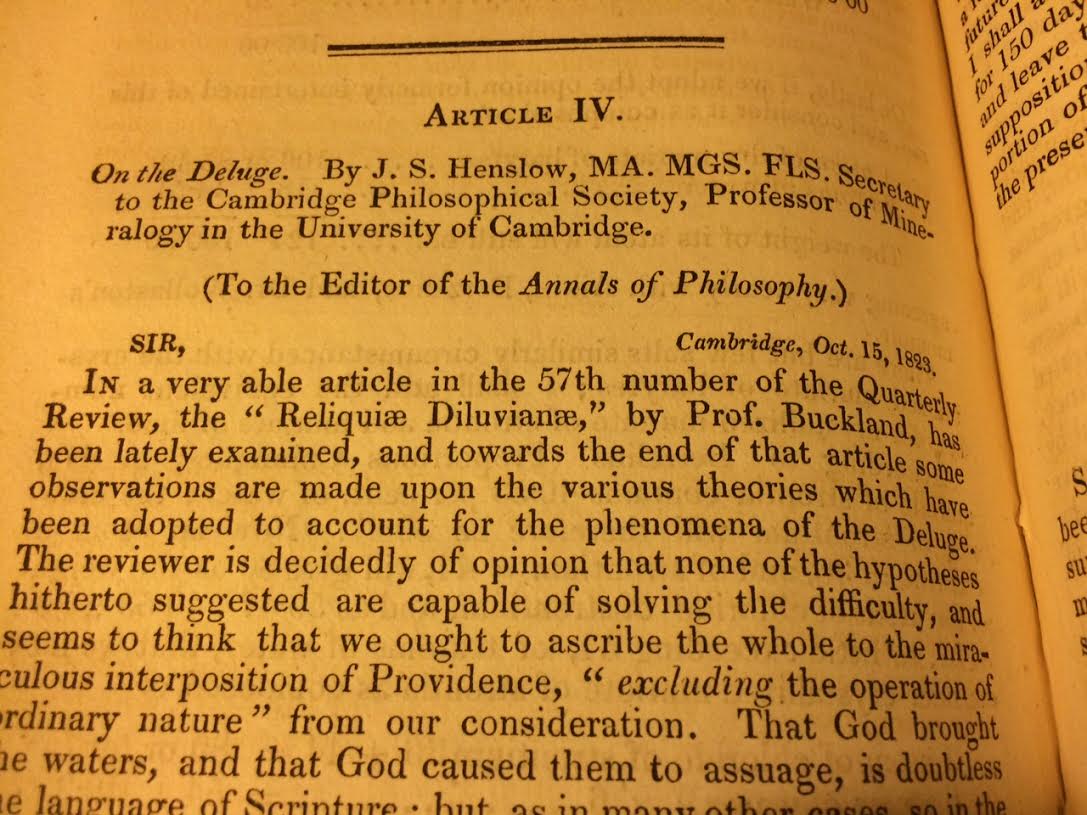
    I pulled a volume at random of the Annals of Philosophy from the shelves–it was volume VI (new series) from 1823. Trying to think of what might be a hot-button issue (in English) for that year, I started flipping through the pages, reading the page headers: Humboldt on volcanoes, Beaufoy’s astronomical observations, Mr. Moyle on the temperature of mines, Prevost on the blood, Pond on some astronomical topic, Ramond on the barometer, book reviews, scientific society announcements, and so on. Nothing really drew me in–until in the back, at page 344, this running header: “Prof. Henslow on the Deluge”. That was a “something” that I was looking-but-not-looking-for.  
    Flood

    This was a late-ish contribution to the history of the geology of the Great Flood, and in it, John Henslow (a great naturalist and botanist, 1796-1861) postulates that the flood was caused by the near-passing of a comet that disintegrated and contributed its enormous aequeous “nebulae” to the Earth’s atmosphere producing the Noachic flood.  He quickly sites a contemporary (one of many), William Buckland1, in this, who was one of the late leaders in the geological response to the flood, and who theorized a natural history of the flood and a production of an Ice Age.  The belief that there was some scientific basis in the divinely-induced flood was buoyed by the general flavor of the mythology of the flood, which turns up in more than 100 cultures–so part of the Noahic flood argument as being true is the broad cultural base for it. Commonality across cultures like this doesn’t necessarily make something real–there are many many parallels between the Bible and other sacred books besides this, like for example the savior descending into Hell for three days before resurrection, and that in stories that precede the New Testament. So common story bases make them popular, though not necessarily correct.

    So Henslow thinks about the comet in a long tradition of Genesis geology, like Buffon and his comet. But what is more interesting to me in this issue is another contemporary, Reverend Adam Sedgwick, Woodwardian Professor of Geology at Cambridge University, who at the end of several decades in theorizing on catastrophic flood geology decided that he had taken a wrong turn.  What happened then, in 1831, was a remarkable refutation of his earlier work. It was an enormous thing, a statement of real courage and conviction to the scientific process.  


  • Get Off the Earth: an Example of Institutionalized Discrimination from 1896 and What it Means Today

    JF Ptak Science Books   Post 1824

    Racism and discrimination are never so more obvious I think than when it is present in everyday bit and pieces of our lives, as gratuitous indulgences, unnecessary except to disparage its target–it is at these times that you can see how deeply something is ingrained in the culture of a place. 

    And an excellent example of this is the transforming/movable puzzle created by the master puzzleteer, Sam Loyd.  He patented the idea of mechanism of the thing in 1896 and published it in the same year, selling millions of varieties of the thing. One of the most successful of the puzzles using the design was called, with a fantastically indelicate title, Get Off the Earth. 

    Working version from the  murderousmaths.co.uk website, here.

    The title would mean less had not the most popular version of the game featured Chinese men who were getting off the Earth, and this of course at a time of indoctrinated, inculcated, adjudicated and legislated, legalized segregation and discrimination.  It was a time of very high Sinophobia, with all manner of advancements against people of Chinese descent:  the Anti-Coolie Laws of 1862, the Pigtail Ordinances (of California) of 1873, the Chinese Exclusion Act of 1882 (renewed in 1892 and 1902), and so on, displayed America’s unease and at times hatred of the Chinese people.  Loyd referred to the men as “warriors”, which I think disingenuous, as the characters hardly have a warrior-like quality to them–they are simply racist.  And they were being made to disappear from the Earth, something many people in this country wanted to happen. 

    According to several web sources, the puzzle was actually used by the William McKinley campaign of 1896 in an effort to out anti-Chinese his opponents2.

    What these objects do for us today is help us think about what “get off the Earth” objects we have in 2012, and how awful they’ll look in the decades to come. The fabric of society has not crumbled under the weight of allowing non-land-holders to vote, or to allow women more equal rights or the right to vote; abandoning slavery did not crush the country, nor did Brown v. Board of Ed, nor did the abandonment of the miscegenation laws.  I can hardly believe that an issue such as Gay marriage will be the great under of the Republic as it has been present in legislation and state constitutional amendments; it will look as bad in a few decades from now as does the Get off the Earth puzzle looks now, or the idea of slavery, or the idea of voting privileges only for the privileged male, or maintaining Jim Crow laws, and so on, on a nd on into the misty night of bad ideas and societal discrimination.

    Notes:

    1.  Nice stories on Sam Loyd and deep on puzzles in general, here.  Sam Loyd’s book of 5,000 puzzles.

    2.  A summary of the McKinley presidential campaign making use of the puzzle to help raise itself in the eyes of the anti-Chinese voters, see here.

    The odd thing is that current sites have referred to the men surrounding the globe (below) as “Chinamen”, or still use the Loyd reference to “Chinese warriors”, and many still hold to the indulgences that this is a simple puzzle and nothing else.  It is hardly that simple.


  • On the Royal Hating of the Evil and Devil-Stink of Tobacco–King James I, 1604

    JF Ptak Science Books    Post 1676

    ”[Smoking is] a custom loathsome to the eye, hateful to the nose, harmful to the brain, dangerous to the lungs, and in the black stinking fume thereof, nearest resembling the horrible Stygian smoke of the pit that is bottomless.”–King James I, in “Counter Blaste To Tobacco”:, published 1604

    James I hated tobacco.  He hated every aspect of it, particularly since some smokers favored the stuff because of its purported medicinal and curing qualities–but for James it all led to vile stink, Devil worship and deep sin.  He just simply hated the whole idea–that and the person who introduced the notion and practice to James’ fair island, who was Sir Walter Raleigh.  And what did Raleigh get out of that deal?  Well, he certainly over the course of tars-filled time introduced the possiblity of grim, cancerous death to a billion practicers and had a miserable pipe tobacco named for him.  And he also was beheaded.  I can’t help but think that the smoking business had something to do with pulling James’ head into pulling Raleigh’s head off. (Well, it was actually “chopped” off, his bodyk buried and his head treated and stuffed and kept by his wife for the next 29 years.  In his prison cell in the Black Tower, Raleigh left a small container of tobacco, with the sentiment Comes meus fuit illo miserrimo tempo (It was my companion at that most miserable time) engraved upon its lid.)

    And so James wrote this piece in 1604, a thin 32-page evisceraton of tobacco and tobacco-users.  It is an antiquarian rush to righteous vindication, and it in no small measure helped James’ cause that he was right on a lot of his viciously-placed claims.

     
    Christmas Santa ciggies367

    The sins and vanities of the filthy use of tobacco were many but evidently described in three layers, like a good cake, though he does make a good case for the habit’s vileness.  Tobacco is mainly a sin of guilt and selfishness, of drunkness which is one of the great malfactors of all bad things, and of course the greatest sin of all in that it would impede the protection of the King and the realm.  James makes the case for tobacco use being an indolent, sick-making, vile producer of impotence and uncaring, driving all manner of sin that would lead to personal downfall and to the general “mollicie and delicacie of the wrath of overthrow” of kingdoms.

    First are you not guiltie of sinnefull and shamefull lust? (for lust may bee as well in any of the senses as in feeling) that although you bee troubled with no disease, but in perfect health, yet can you neither be merry at an Ordinarie, nor lasciuious in the Stewes…

    Secondly it is, as you vse or rather abuse it, a branche of the sinne of drunkennesse, which is the roote of all sinnes: for as the onely delight that drunkards take in wine is in the strength of the taste, and the force of the fume thereof that mounts vp to the braine: for no drunkards loue any weake, or sweete drinke: so are not those (I meane the strong heate and the fume), the onely qualities that make Tobacco so delectable to all the louers of it? …

    Thirdly, is it not the greatest sinne of all, that you the people of all sortes of this Kingdome, who are created and ordeined by God to bestowe both your persons and goods for the maintenance both of the honour and safetie of your King and Commonwealth, should disable yourselves in both?

    Christmas RR366
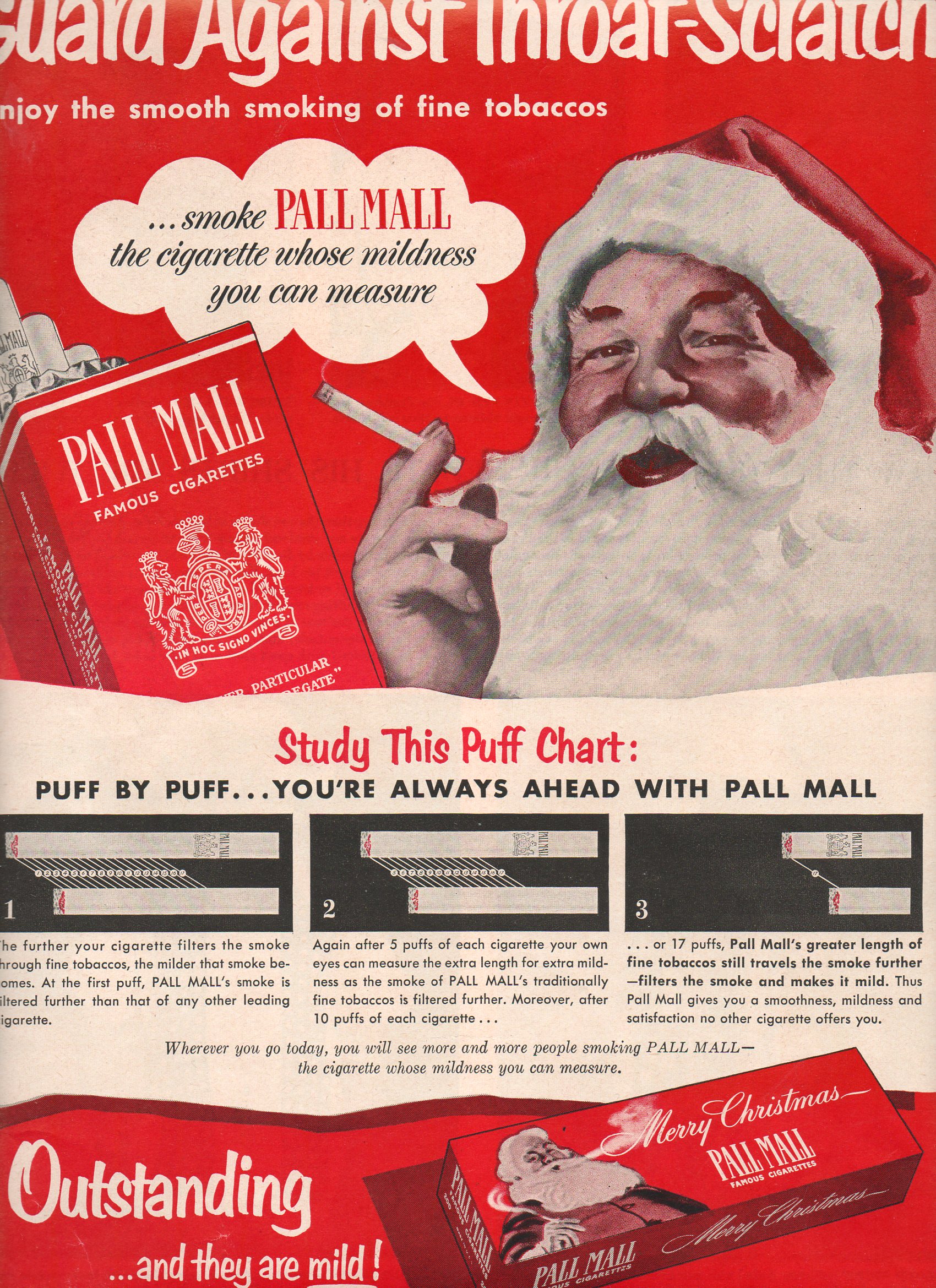
    The King also attacks the attractive and bogus medicinal properties of tobacco, and he takes care to list some of its precious capacities, from ridding people of the gout (instantly), to wakening the brain, to pox-curing, and even having the ability to cast out devils. Of course this belief was sustained as semi-fact for hundreds of years now, eventually worming its way into the all vast pockets of the Middle Class via print and other media as advertisements with doctors, dentists, nurses, pilots, sports figures, politicians (most famously perhaps being R. Reagan), and of course Santa Claus extolling various curative properties of cigarettes.  In the 20th century there was also the strong influence of Sexerettes–the possibility of sexiness curled around languid figures selling cigarettes to the young and old alike.


  • The Book of Accidents Designed for Young Children, 1831.

    JF Ptak Science Books   Quick Post

    Accidents
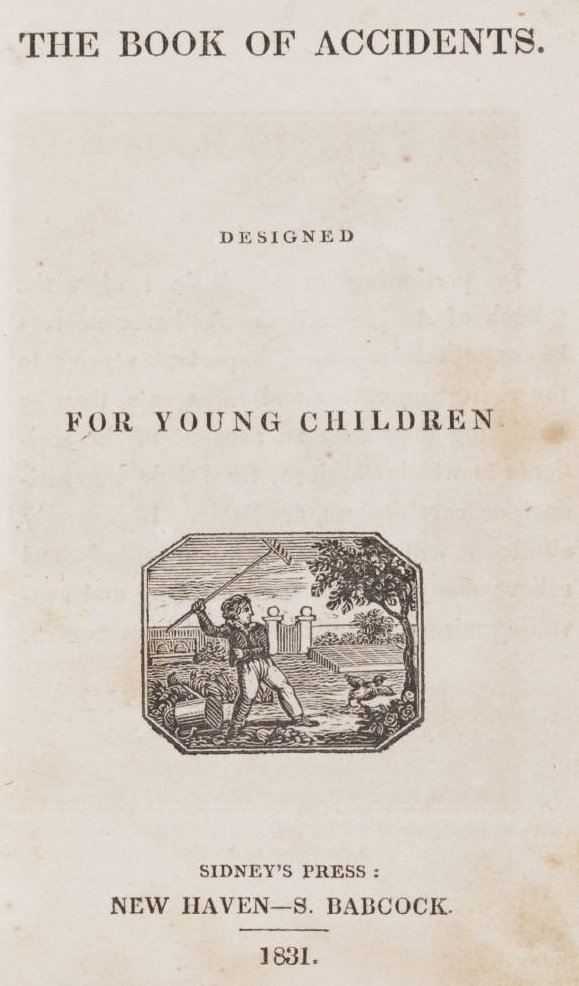
    The very Gorey-ish title of this book–seemingly designed to manufacture accidents for children–is actually a children’s advocate book. Its a small book, a chapbook, made for small hands, produced on the cheap and meant to be consumed by children and adults alike, warning people of the commonplace dangers that called on children in the 1830’s.  Scalding, being kicked by a horse, falling, being injured while playing with knives and candles and firearms, crossing the street, being tossed by a bull or wild horse, falling out of a coach, drowning, playing and throwing stones, tumbling down stairs and the like made a devastating impact on the lives of children–sometimes ending them, as the author points out.  By pointing out these dangers, and by having them read by (or to) children, the author believed that the lives of thousands of children could be saved.

    [Image sources:  Beinecke Rare Book and Manuscript Library, Yale University.]

    http://brbl-images.library.yale.edu/PATREQIMGX01/size3/D1169/1026953.jpg

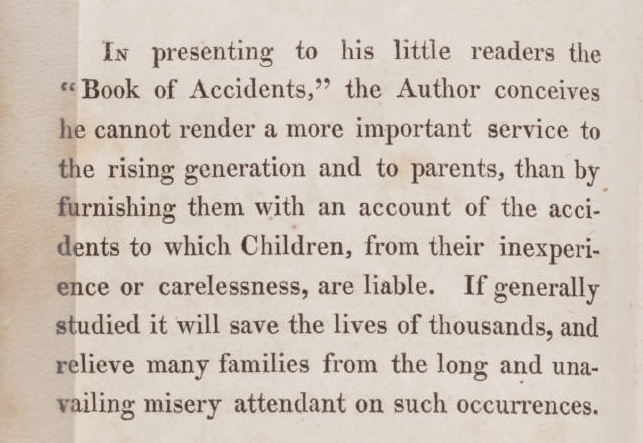
    The mission statement:

    Accidents 2

    He was correct, of course; its a legendary problem trying to protect children from the obvious.

    http://brbl-images.library.yale.edu/PATREQIMGX01/size3/D1169/1026954.jpg


  • Found in Stone: (1) Alphabet and (2) Geometrical Forms, 1664

    JF Ptak Science Books  Post 1353

    Kircher--alpha bet477

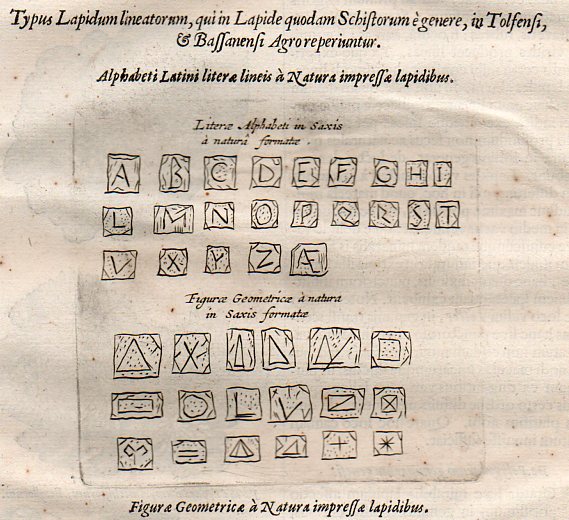
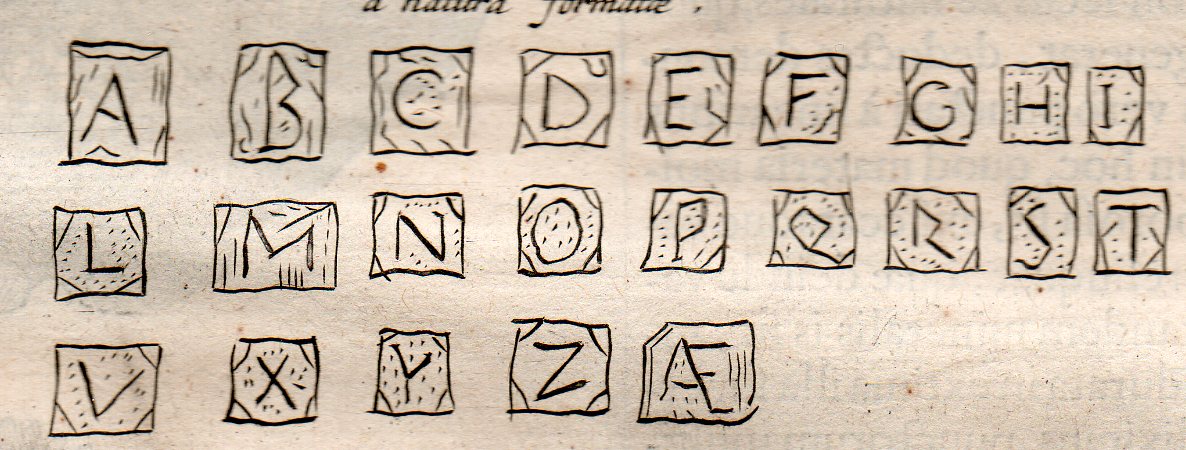
    I wrote about Athanasius Kircher’s Mundus Subterreaneus (1664) a few days ago (in “Birds With Stone Wings”, here and elsewhere), particularly staying within the first section of the eight book of Mundus, De Lapidibus, in which he investigated stones, gems, fossils and then “found figures” in agates. 

    Kircher--alpha bet476

    Kircher did not believe that finding these symbols in stone were a direct consequence of any supreme anything, recognizing that they were formed and collected by chance. He did formulate some interesting and early and sometimes-correct observations on the evolution of languages, but was entirely constrained by the authentic history as presented in the early books of the Bible.  While recognizing that languages of a certain region are or could be relational, and that the Romance languages were a corruption of Latin and that there was a  Semitic and Graeco-Latin connection, they were all necessarily descendants of Hebrew, which was the language given by the creator to man, mystical symbols handed down from Heaven to Adam.  And so it goes–I guess that you can only take so far as imposed limits like that allow.  Horizon Aeternitatis.

    [The original image is available for purchase from our blog bookstore, here.]

    And in detail:

    Kircher--alpha bet479

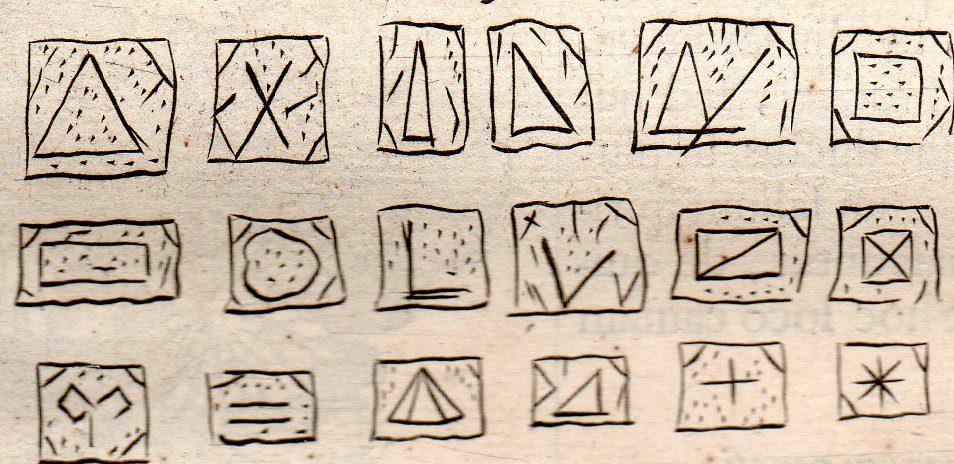
    And then of course the stone-found geometrical figures:

    Kircher--alpha bet478

      These engravings of the originals in Kircher’s cabinets of curiosities did take some sharp-eyed sleuthing and gathering. 


  • Birds with Stone Wings: Athanasius Kircher, 1664

    JF Ptak Science Books   Post 1347

    The great semi-mystifying polymath Athanasius Kircher (1602-1680) lived for a long time and filled his life with ideas and words,  producing dozens of books during his time on Earth, some of which were never published even though written, some manuscripts lost forever. His was a massive output of extraordinary breadth, most of which was original to him, and a lot of which was original to others and not credited, as was often the case with some scholarship at this time in history.   He wasted little time what I can see, writing on a spectacular range of subjects, enlightening people, confusing people, generating great theories and some bad ideas. 

    The image below comes from his Mundus Subterraenus (“Athanasii Kircheri Mundus subterraneus in XII libros digestus… “), published in 1664, and which was concerned mainly with geology and the theory of the Earth.  Kircher a product of the great Jesuit institution, the Collegio Romano, postulated the structure of the interior of the Earth, the origin of heat, the source of the tides, the composition of light, mechanics, the structure of music, linguistics, astronomy, and of course the existence of the Virgin Mary in amber.  There was also a fair amount of work on one of his side interests that populated a number of his works, alchemy and the search for the organization of materials.

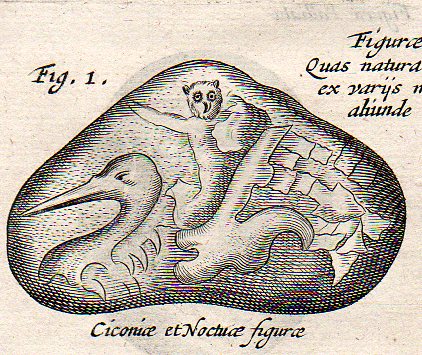
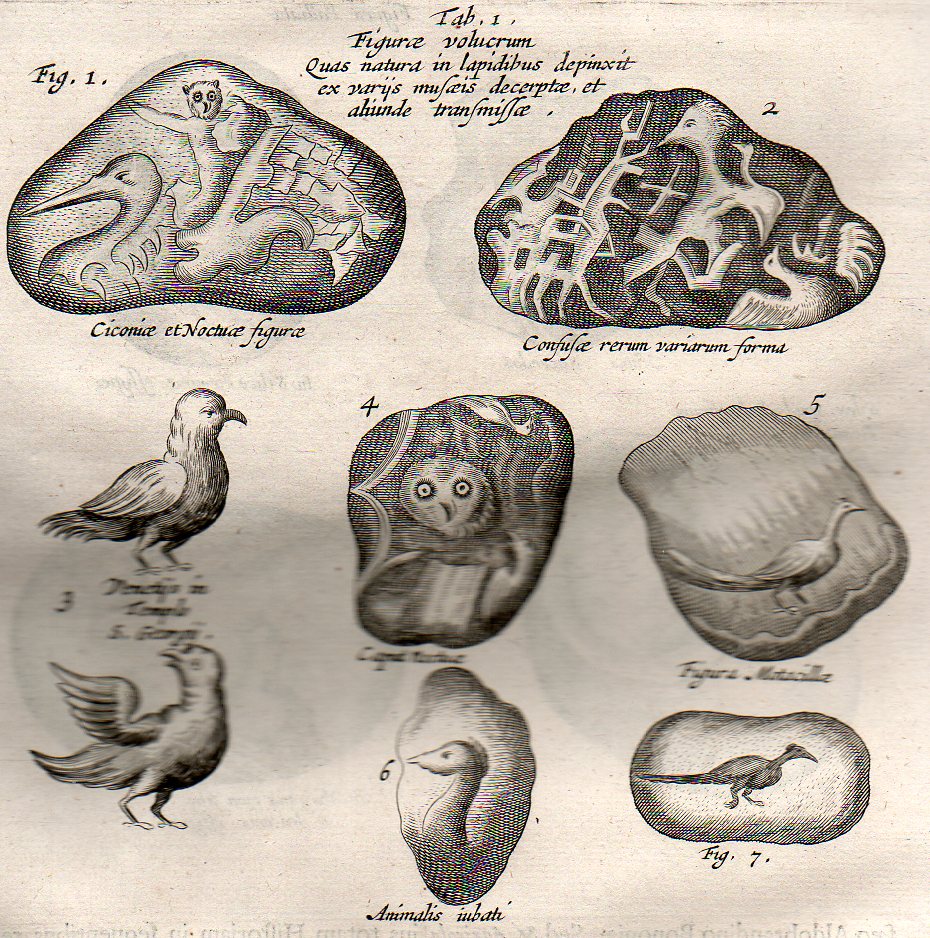
    But what I am looking at today with Kircher is the Mary-in-Amber part, his investigations (and theorizing, and documentation) on naturally-appearing, organic objects found in inorganic material–rocks and minerals–like these birds:

    Kircher  lapidibus birds451

    Which is a detail from  

    Kircher  lapidibus birds449
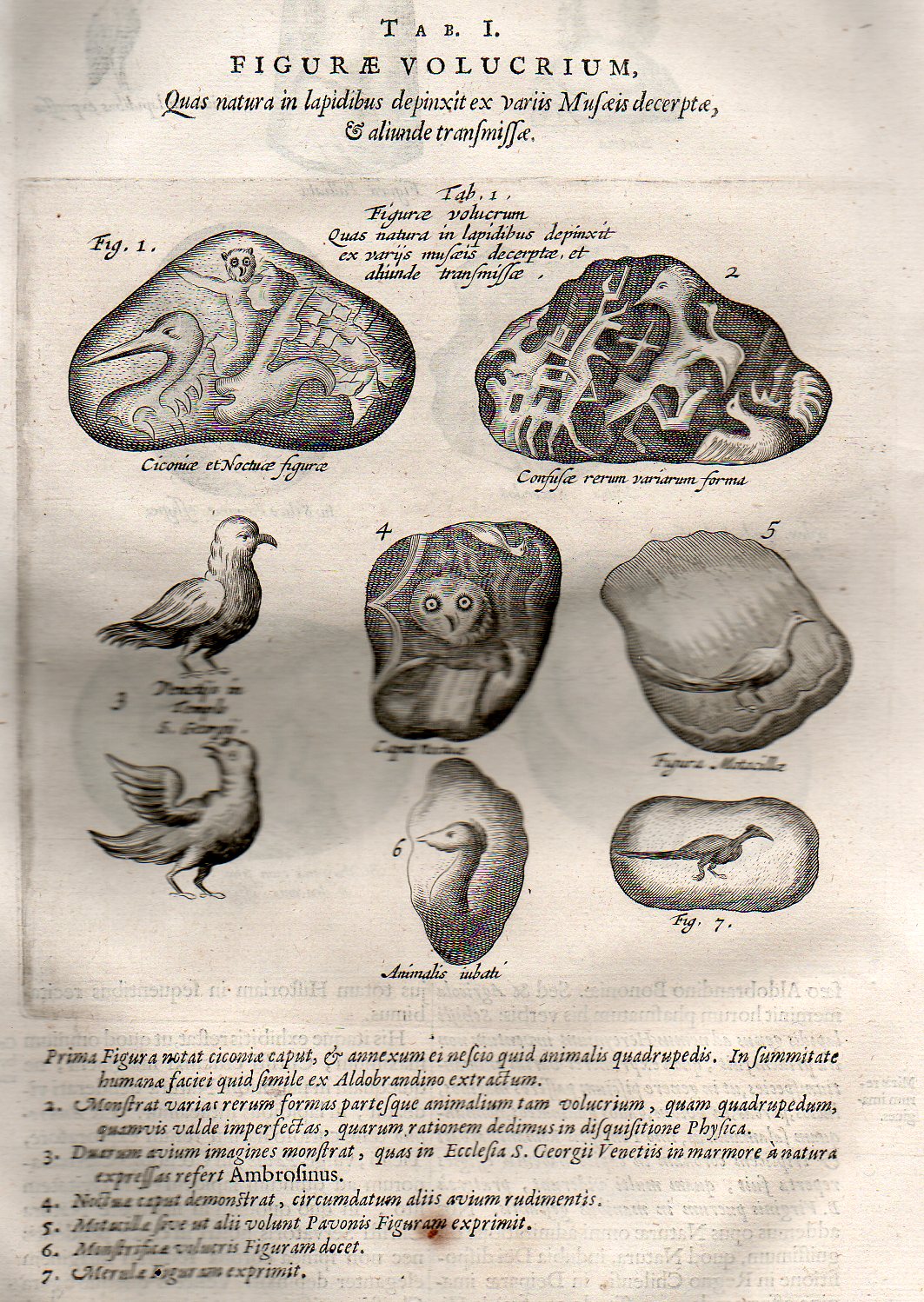
    The engraving (the original of which is available from our blog bookstore), entitled Figure Volucrum, quas Natura in lapidibus depinxit, ex variis Museia decerpt et aliunde transmissa (or “Figures of winged creatures, painted by nature on stones, taken from various museums, and otherwise transmitted.”) shows Kircher’s collection of anthropomorphically based inorganic items.  It is a remarkable exercise to try and place yourself within the context of the scientific world of Kircher’s time, 350 years ago, and try to explain these naturally-occurring phenomena, without even the benefits of the conception of long geologic time, or of expanded time in general. 

    The descriptive text (at the bottom of the engraving) from Kircher on these objects is translated, as follows:

    1.  The first figure represents a head of a Stork, together with some, but I do not know what, quadruped. At the top is something like a human face. Extracted from Aldobrandinot (see PI. XXIII. Fig. 1).
    2.  Shows various forms and parts of animals, winged creatures as well as quadrupeds, although very imperfect, the cause of which we give in the physical examinations (see PI. XXIII. Fig. 2).
    3.  Represents the figures of two birds expressed by nature on marble in the church of St. George’s, at Venice, referred to by Ambrosinua (see Vol. VII. PI. II. Figs. 3, 4).
    4.  Shows the head of an Owl, surrounded by rudiments of other birds (see PI. XXIV. Fig. 2).
    5.  Represents the figure of a Wagtail, or as others prefer, of a Peacock (PI. XXIV. Fig. 3).
    6.  Shows the figure of a monstrous bird (Vol. VII. PI. II. Fig. 4).
    7.  The figure of a Merle (Vol. VII. PI. II. Fig. 5).

    A closer look at the image:

      Kircher  lapidibus birds450


  • The Importance of Mistakes: Kircher’s Table of Transformations, 1664

    JF Ptak Science Books   Post 1325

    The great semi-mystifying polymath Athanaseus Kircher (1602-1680) lived for a long time and filled his life with ideas and words,  producing dozens of books during his time on Earth, some of which were never published even though written, some manuscripts lost forever. His was a massive output of extraordinary breadth.  He wasted little time what I can see, writing on a spectacular range of subjects, enlightening people, confusing people, generating great theories and some bad ideas. 

    The image below comes from his Mundus Subterraenus, published in 1664, and which was concerned mainly with geology and the theory of the Earth.  He postulated the structure of the interior of the Earth, the origin of heat, the source of the tides, the composition of light, and of course the existence of the Virgin Mary in amber.  There was also a fair amount of work on one of his side interests that populated a number of hs works, alchemy and the search for the organization of materials. 

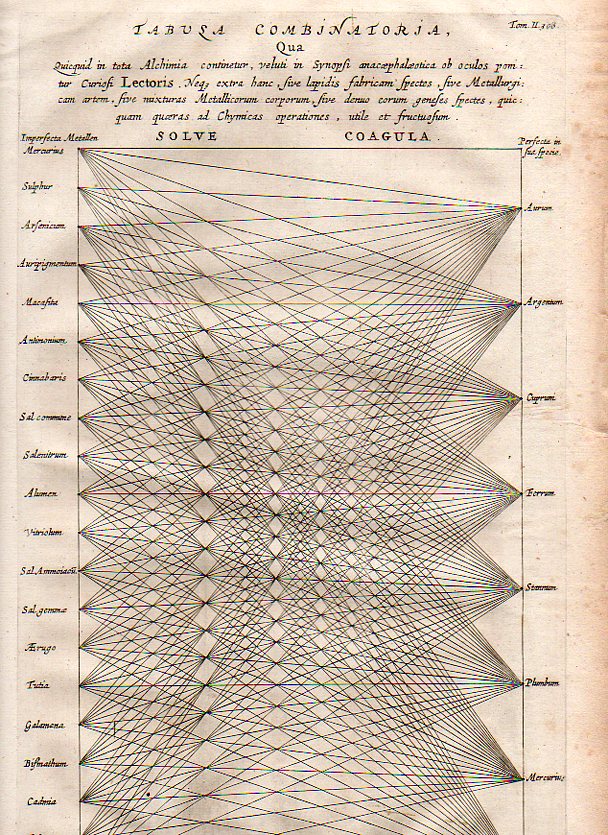
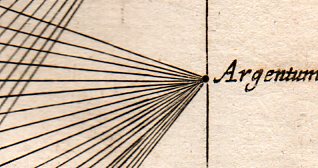
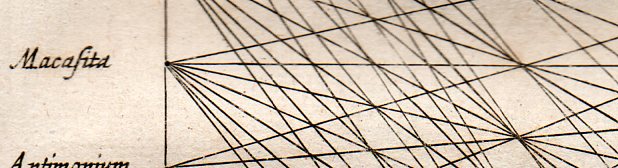
    This image, “Tabula Combinatoria” (combinatory table or table of combinations) was an attempt to classify the alchemical transformation of metals and nonmetals via solve and coagula (mediante igne solvuntur et coagulatur),  of solution and coagulation, a Curiosi Lectoris of  Chymicas operationes, in a search for the key to all transformations, the prima materia. [The original erngraving is available from our blog bookstore, here.]

    Kircher as I said exceeded his learning and logic all throughout his life, usually with positive results to us here in his future; but in this case, his alchemical quest–like the million words and countless hours and lead-based brain damage undertaken by Sir Isaac–proved to be a dry hole.  But dry holes like mistakes in general are not necessarily without importance–they are valueless if and only if nothing comes of them, or nothing is recognized in i n the method of leading to the mistake, or if by our using the mistake it didn’t allow you to pursue something else.  Science life is filled with almost nothing but error to the observer–it is our job to do something with the stuff that doesn’t work. 

    Kircher tabula345
     [the image is continued but trailed off of my scanner.]

    Kircher tabula b346

    Kircher tabula c347