JF Ptak Science Books Post 2602
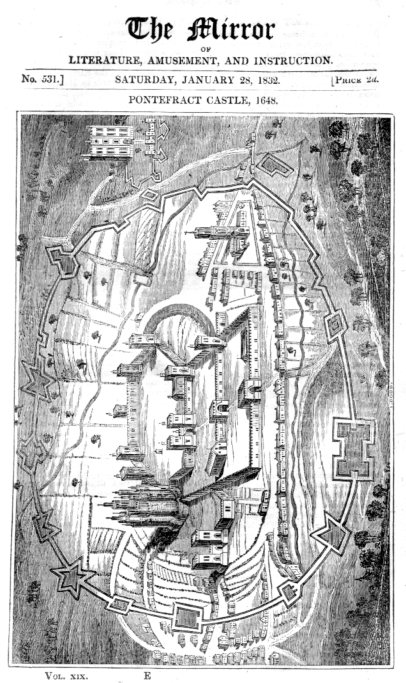
There were two images that I came across tonight in the studio as I was chasing Pooches the Cat/Dog–they’re not quite on the opposite ends of themselves on the compass rose, but they are certainly in the neighborhood. I like it though that they came to me by chance, one after the other. One is very, very flat; the other is very “full”, and has a large sense of dimensionality. The first is a 1832 woodcut of a 1648 rendering of Ponterfract Castle. Although perspective had been discovered (or rediscovered at 250 years earlier, the image has a Medieval taste to it, as we see both two- and three-dimensional representations together in the same image. I think that most of that was done by design and the print was dual-purposed–first to show the plan of the castle and then secondly to show the fortifications and some buildings in elevation. The overall effect I think portrays more flatness than not.
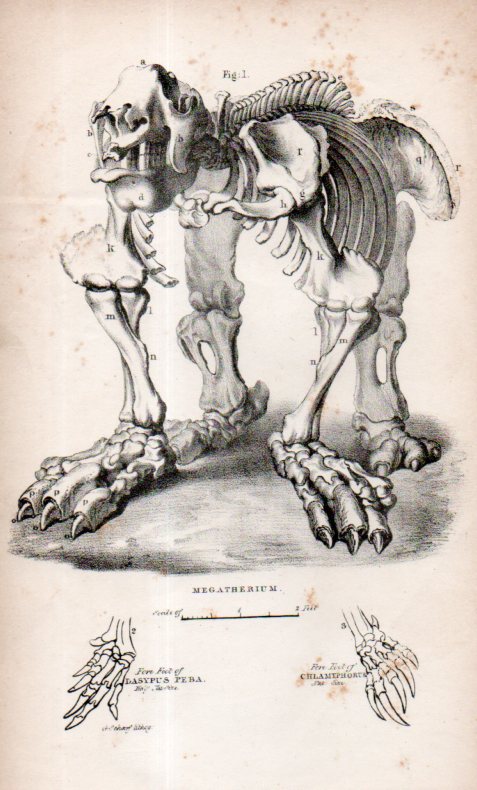
The second perspective is something that I’ve always thought had a deep depth for a piece of paper. My copy is simply a loose engraving, bought years ago at Pageant Book Shop in Manhattan–a stray bit in a “sciences” bin or some such, and I’ve had it ever since. Again I’m not sure of its origin but my guess is that is is English from a popular science dictionary or geological text 1825-1850. It just has a great perspective–plus it also looks as though we’ve just surprised it, a little. It is a Megatherium (“giant/beast”) and was discovered first in 1788 by Manuel Torres and then assembled in the next year by Juan Bautista Bru, who evidently made the first illustrations of it. An engraving of the magnificent mammal appeared in the second edition of Georges Cuvier’s Recherches sur les ossemens fossiles, (1812) which was a justifiably iconic image, though I like this little and odd-perspective one from above better.