A Daily History of Holes, Dots, Lines, Science, History, Math, Physics, Art, the Unintentional Absurd, Architecture, Maps, Data Visualization, Blank and Missing Things, and so on. |1.6 million words, 7500 images, 4.9 million hits| Press & appearances in The Times, Le Figaro, Mensa, The Economist, The Guardian, Discovery News, Slate, Le Monde, Sci American Blogs, Le Pont, and many other places… 5000+ total posts since 2008.

Category: Women, History of

  • Statements by the Editor of Nature on Equality in the Sciences (1910).

    JF Ptak Science Books  Overall Post 5143
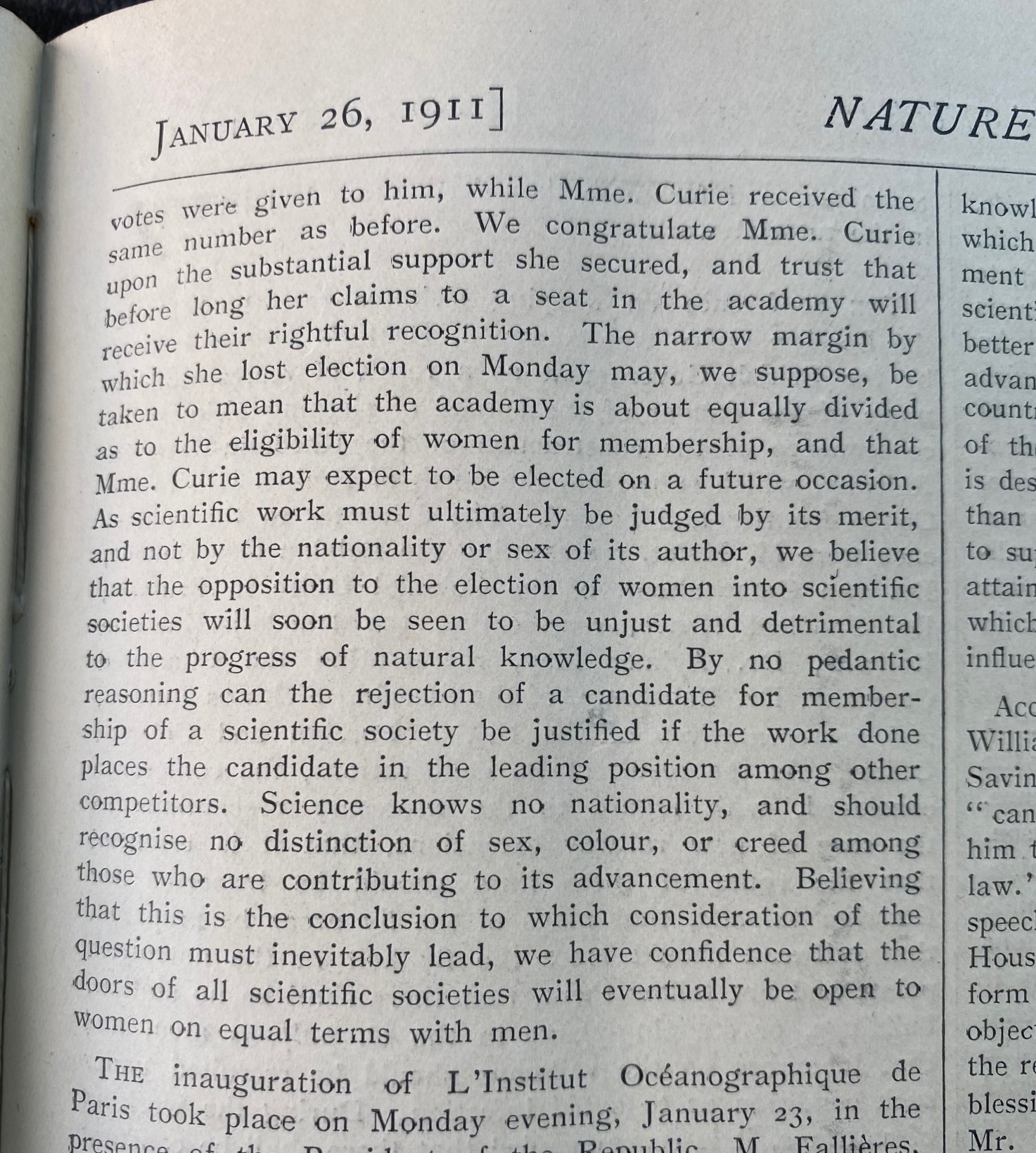
    IMG_7448This is a short note on an interesting series of reports in the venerable journal Nature (1911) regarding the status of women in the sciences.  These are three short articles (about 1750 words total) on the recent elections to a seat at the French Academy of Sciences in which Mme. Curie–one of two candidates–was not elected, her candidacy lost by vote to Edouard Branly. (Branly is an important figure in the history of wireless communications and inventor of the Branly coherer, but Curie was, well, far advanced of that.) The editorial staff of Nature took exception, reporting on the issue and the vote’s unfortunate outcome. Being fairly familiar and having worked in Nature (for the 1869-1950 period) I was a little surprised by the summation of this short note in the 26 January issue. It is a strong message, at least so far as scientific and other intellectual endeavors are concerned. (Women will not get the full vote in G.B. Until 1928, achieving partial victory in 1918, though the vote was limited then to women 30+ with adequate property.) Still, I take this as a significant statement from Nature, even if it is limited to a short article in the “Notes” section of the weekly. I cannot recall other early pro-equality stances like this outside of a few articles here and there in support of women being able to attend classes at major universities, though not being able to receive academic credit for them. All caveats included, I find the Nature article to be a remarkable statement for the time. Perhaps someone out there with experience in this field will be able say whether these statements are actually as early as I think they are.  

    Here’s the conclusion of the 26 January article:

    “As scientific work must ultimately be judged by its merit,

    and not by the nationality or sex of its author, we believe
    that the opposition to the election of women into scientific
    societies will soon be seen to be unjust and detrimental
    to the progress of natural knowledge. By no pedantic
    reasoning can the rejection of a candidate for member-
    ship of a scientific society be justified if the work done
    places the candidate in the leading position among other
    competitors. Science knows no nationality, and should
    recognise no distinction of sex, colour, or creed among
    those who are contributing to its advancement. Believing
    that this is the conclusion to which consideration of the
    question must inevitably lead, we have confidence that the
    doors of all scientific societies will eventually be open to
    Women on equal terms with men.”

    By the way, Curie was never elected to the French Academy of Science, though she did receive membership to the Academie Nationale de Medicine…in 1922. She had already received the Nobel Prize in physics in 1903, and would be awarded the prize again in chemistry a few months after she lost this 1911 vote to the Academy. (Perhaps the “creed” part of the “sex. colour, or creed” pronouncement above referenced certain elements circulating the story that Curie was Jewish?)
    IMG_7450

    Notes:

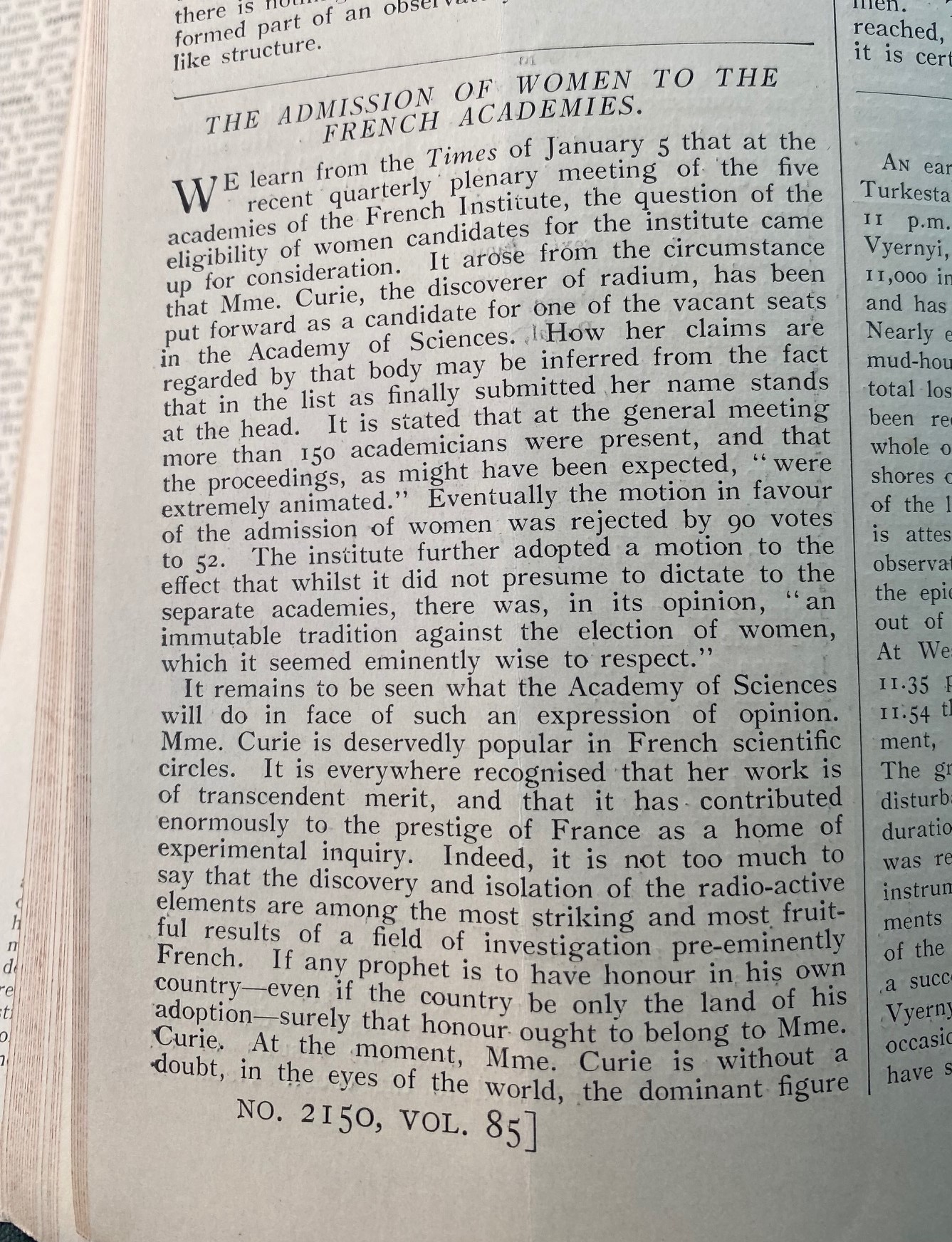
    Three issues of  Nature, London, Macmillan & Co., 1910, volume 85.  Including: “The Admission of Women to the French Academies”, pg 342 (full column, about 800 words), 12 January, in the issue #2150, pp 329-362. WITH: “The Admission of Women to the Paris Academy of Sciences”, in 19 January, pp 372-373 pp 363-396, issue 2151. AND WITH: [Women’s Rights], a 400-word contribution to the “Notes” section of 26 January issue no. 2152 pg 412-413 in the issue of pp 397-430. It is in the third contribution, the “Notes” section, that contains the strongest statement by the editor of Nature on the equality (at least in the sciences and intellectual pursuit) of sex, race, and religion. 
    ·Posted by :

    ·in:

    —

  • “A Physicist and Later a Housewife” (1896)

    JF Ptak Science Books   Quick Post   Overall Post # 5134

    Paging through some of the first half dozen or so volumes of the iconic Physical Review, I bumped into a paper1 by Caroline Willard Baldwin (“A Photographic Study of Arc Spectra. I” (and II)–and what stopped me was the “Caroline” part as the date of publication was 1896.  I did not expect to see this entry, and after going back to check the other two preceding volumes it can be said that this was the first paper published by a woman in the Physical Review. This may be common knowledge but it wasn’t to me–frankly I was a little surprised that the paper appeared this early on in the life of the journal. After a little research in some scant mentions I found that Baldwin (1869-1928) was the first woman to receive a doctorate in physics/Sc.D. from a U.S. university, and so far as I can see this was her only published paper. Baldwin had one other publication—a physics/mechanics textbook written with George Arthur Merrill–which was the end of her publishing career. She taught physics at the California School of Mechanical Arts in San Francisco, and then married in 1900, which ended her career, evidently, because there’s nothing more on her that I can find except for a few refences for her being “a physicist and later a housewife”, which caused quite a sad sigh. There is nothing wrong or demeaning or lessening in being a housewife, or graduating from being a physicist to being a housewife (or househusband for that matter), except there are all of those “firsts” next to her name…It seems as though she went as far as she could go in academic advancement despite her history and doctorate, having a position “…teaching physics at the California School of Mechanical Arts, a vocational secondary school in San Francisco associated with UC Berkeley”.2 Once married–and then married with children–her fate in physics was sealed.

    Notes:

    1. Caroline Willard Baldwin (1869-1928)  “A Photographic Study of Arc Spectra. I” and “A Photographic Study of Arc Spectra. II”, in  Physical Review, Series 1, volume 3, published 1 March  and 1 April 1896.
    2. +3. “Equipped with a doctorate, Baldwin nonetheless taught physics at the California School of Mechanical Arts, a vocational secondary school in San Francisco associated with UC Berkeley.  Baldwin’s status as a married woman with two children, similar to that of other Berkeley women graduates in STEM of her era,  would have been an obstacle to a position in higher education.”  Berkeley Mechanical Engineering, website, “Caroline Willard Baldwin” entry. 

    ·Posted by :

    ·in:


  • Found Portraits: Camouflage at the Front, 1918

    JF Ptak Science Books   Quick Post

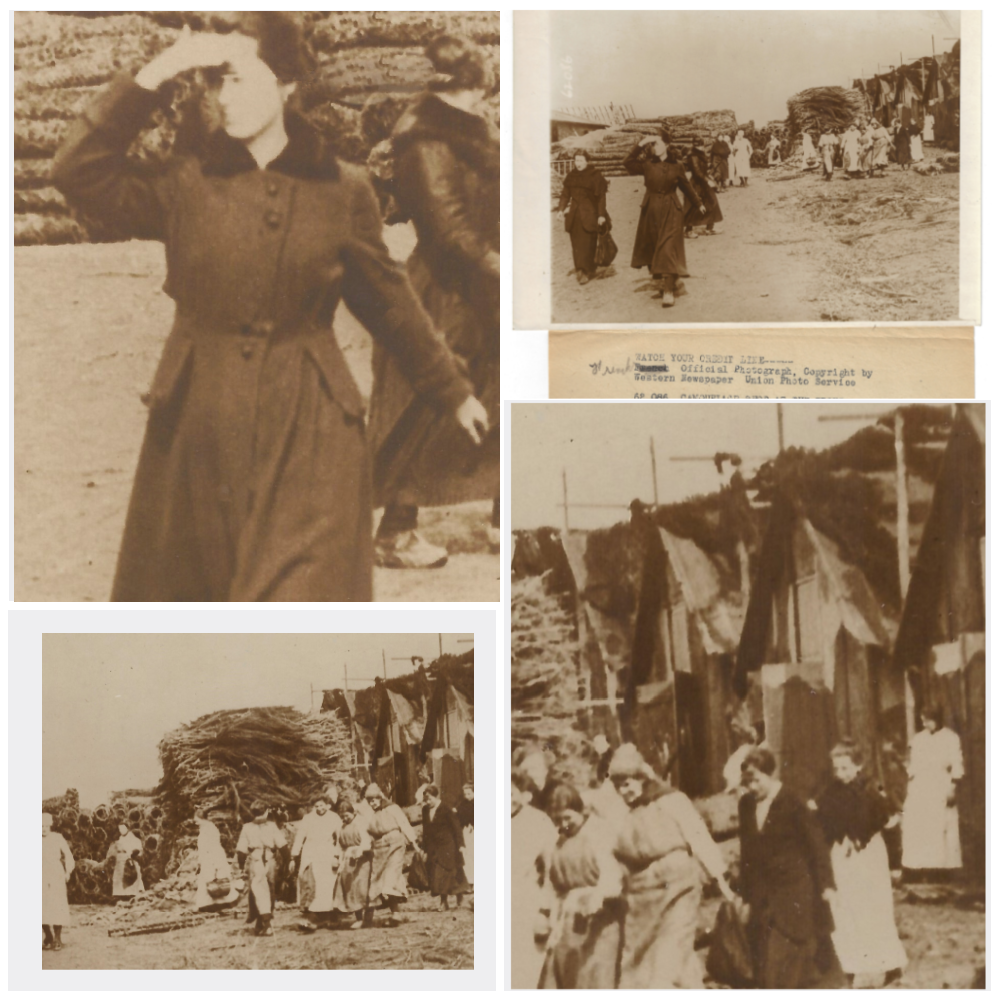
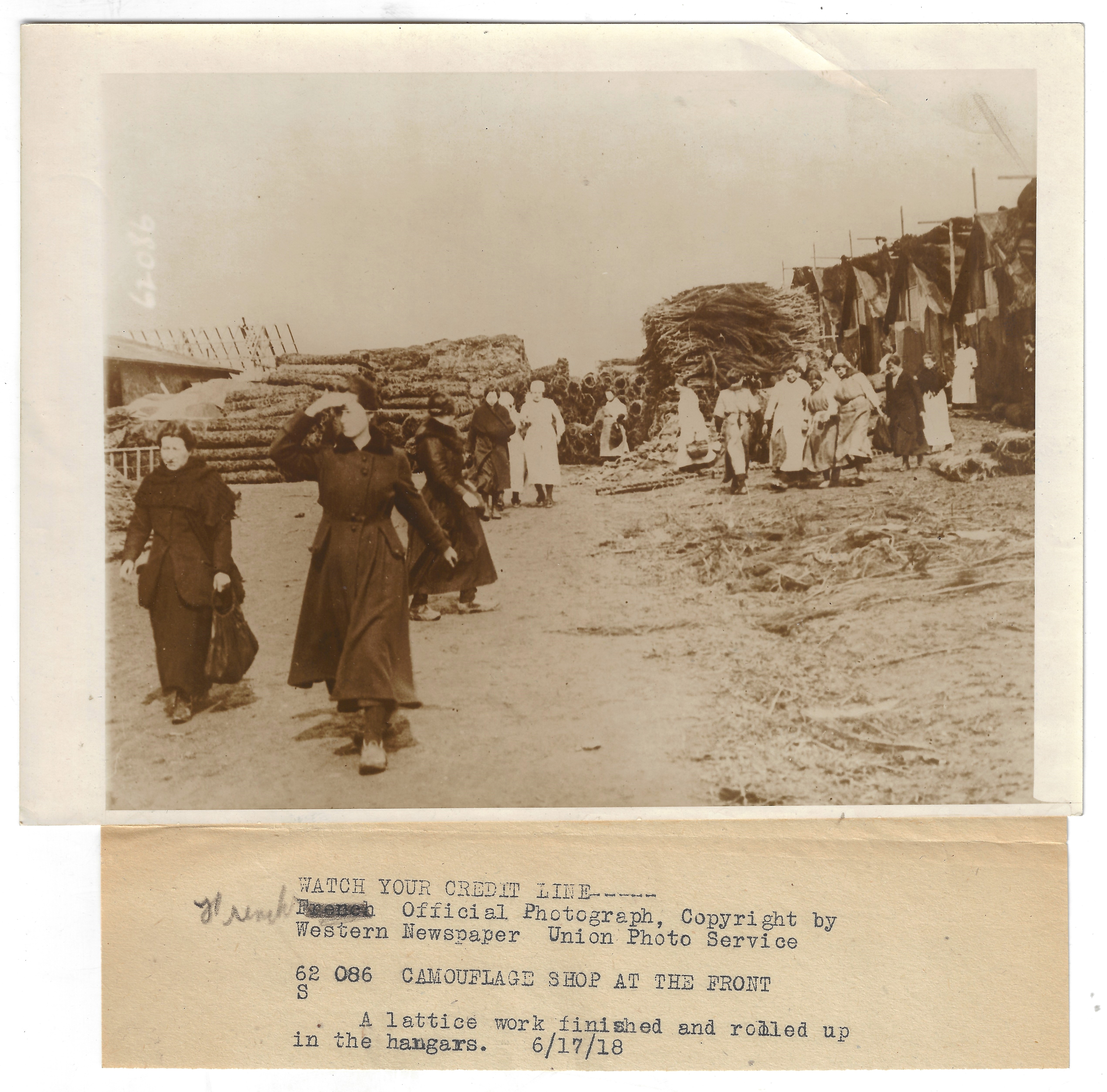
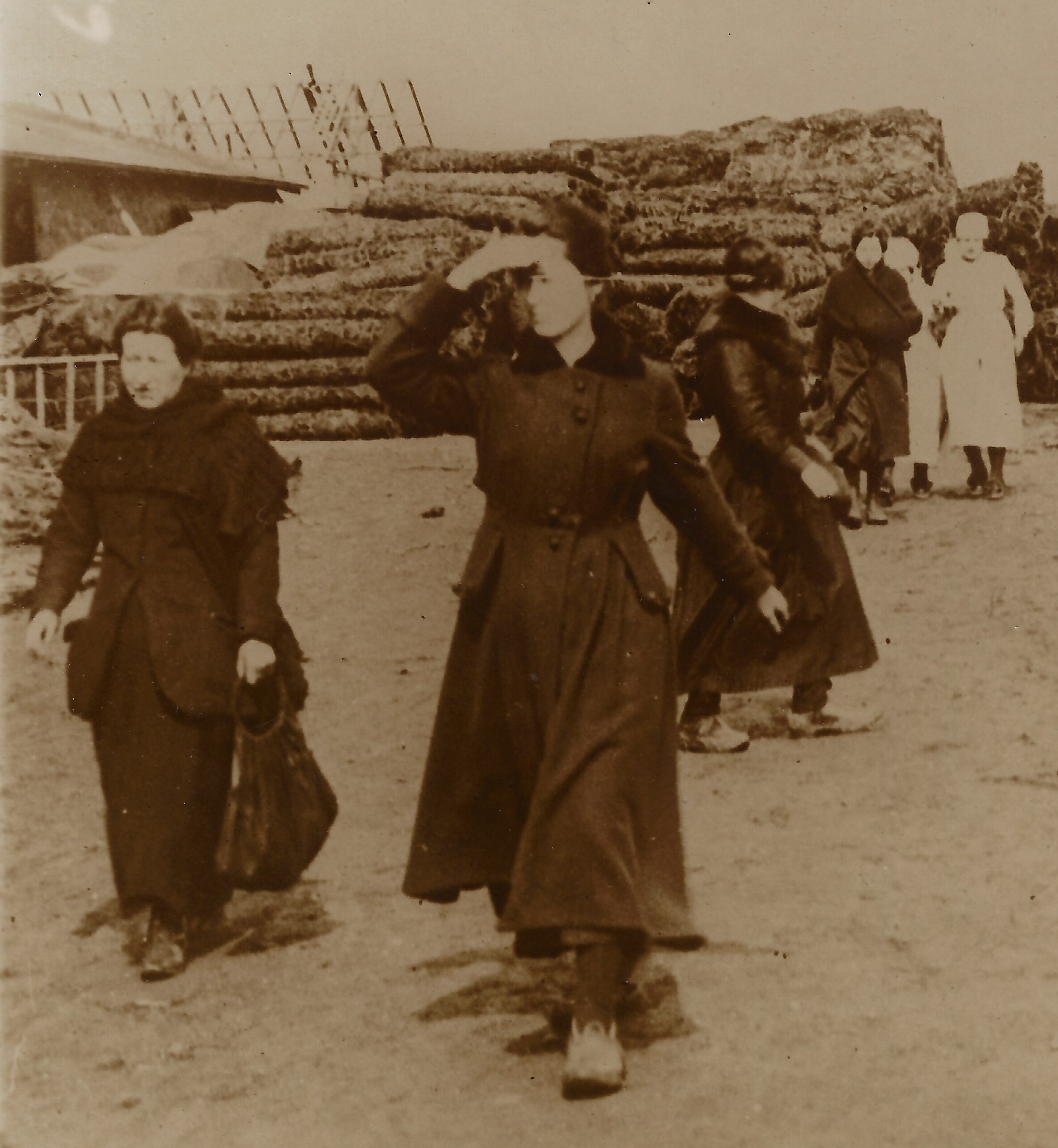
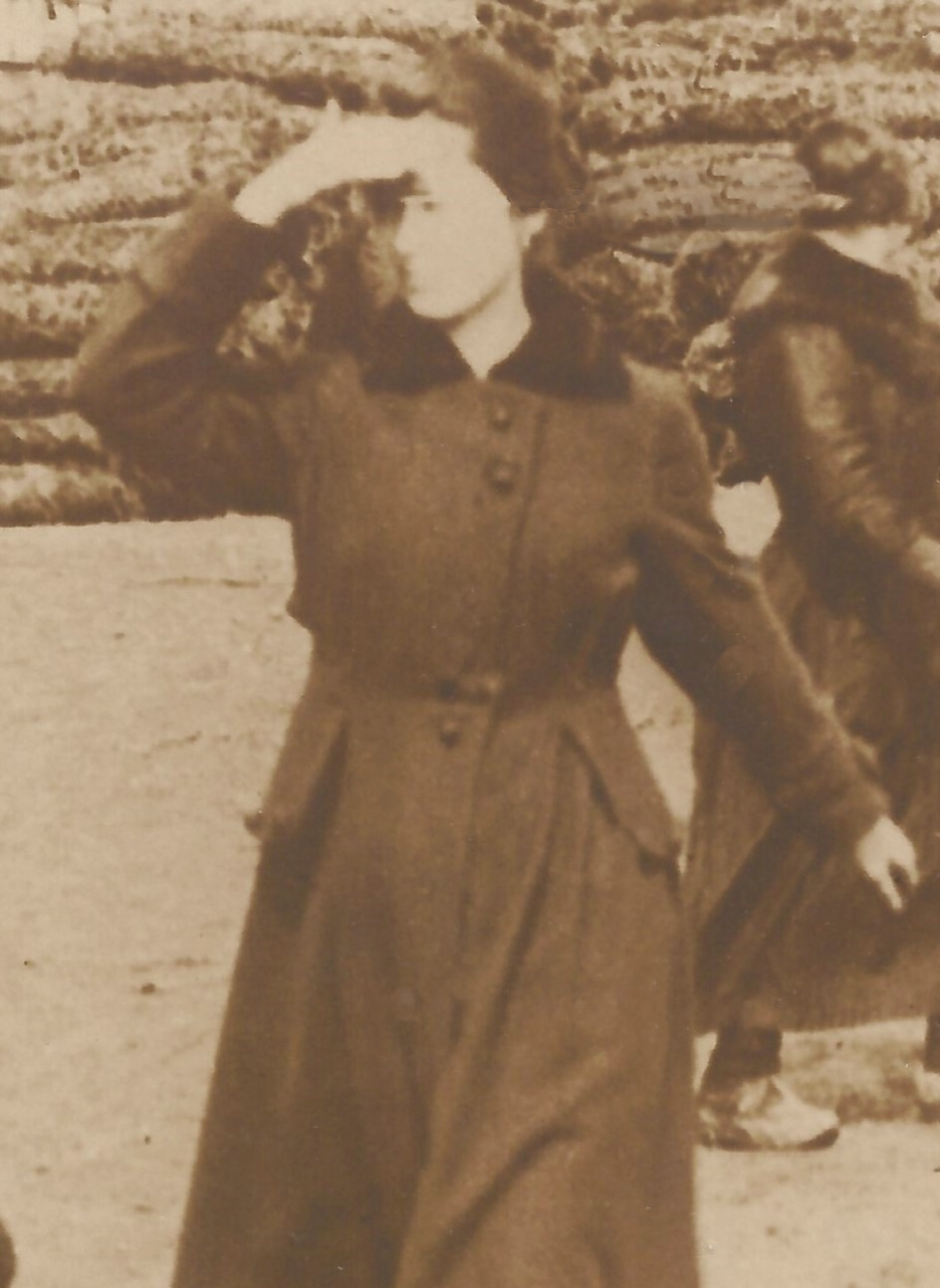
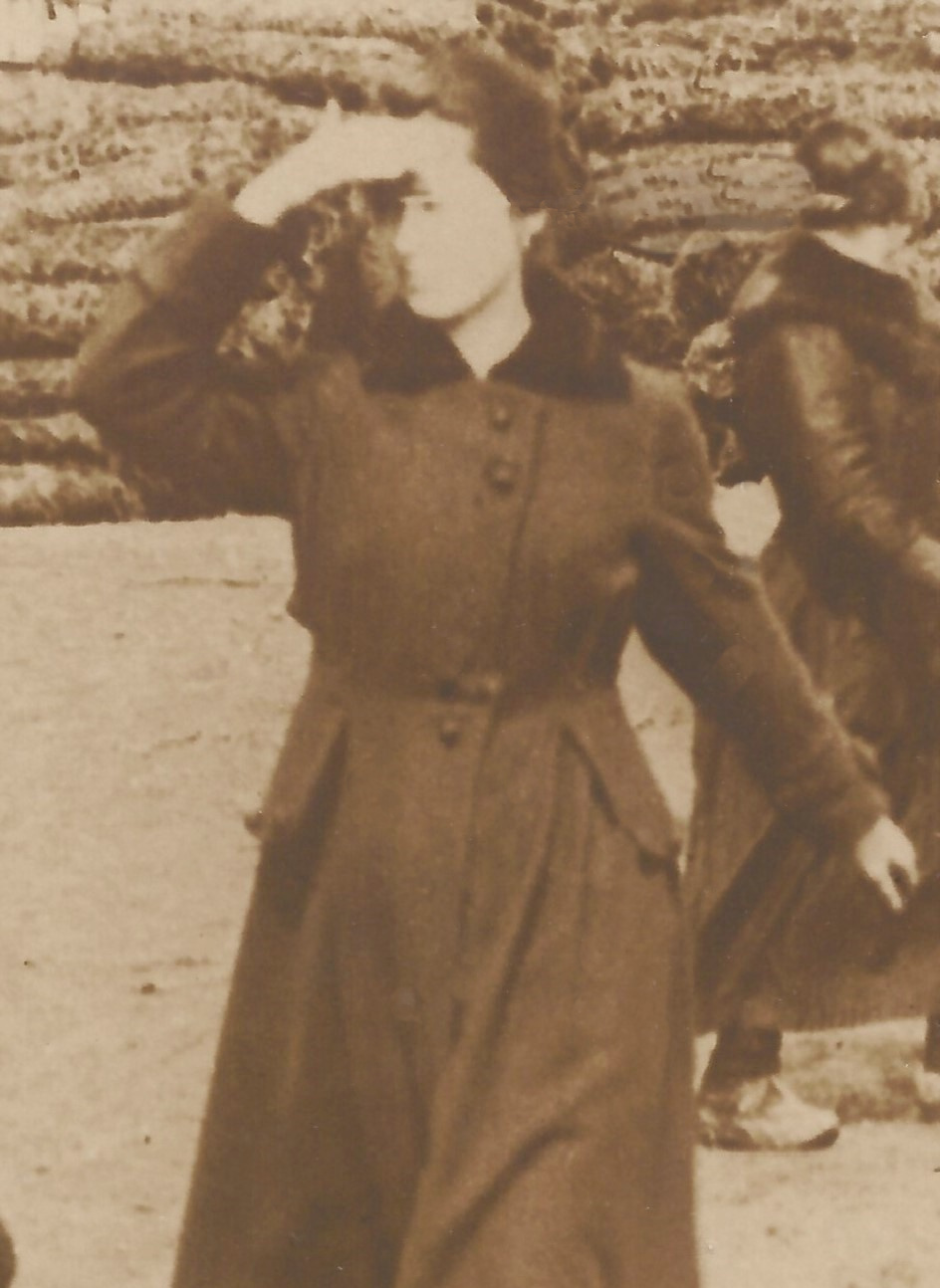
    WWI Photos camouflage detail _5_Just a few days ago I made a post here about camouflage (“Art & Artists as Wartime Magi–Making Things Disappear, 1918”, and now comes another, a WWI news service photo, “Camouflage Shop at the Front”.  Camouflage imagery has been relatively scarce in my experience with WWI photographs, particularly one like this, with women workers at the front (“A lattice work finished and rolled up in the hangars, 6/17/18”), shown at shift change or lunch break. Women were heavily involved in the production of camouflage during WWI (as with the U.S. Women’s reserve Camouflage Corps), with some netting and uniform designs being produced in domestic settings and then sent to the front. 

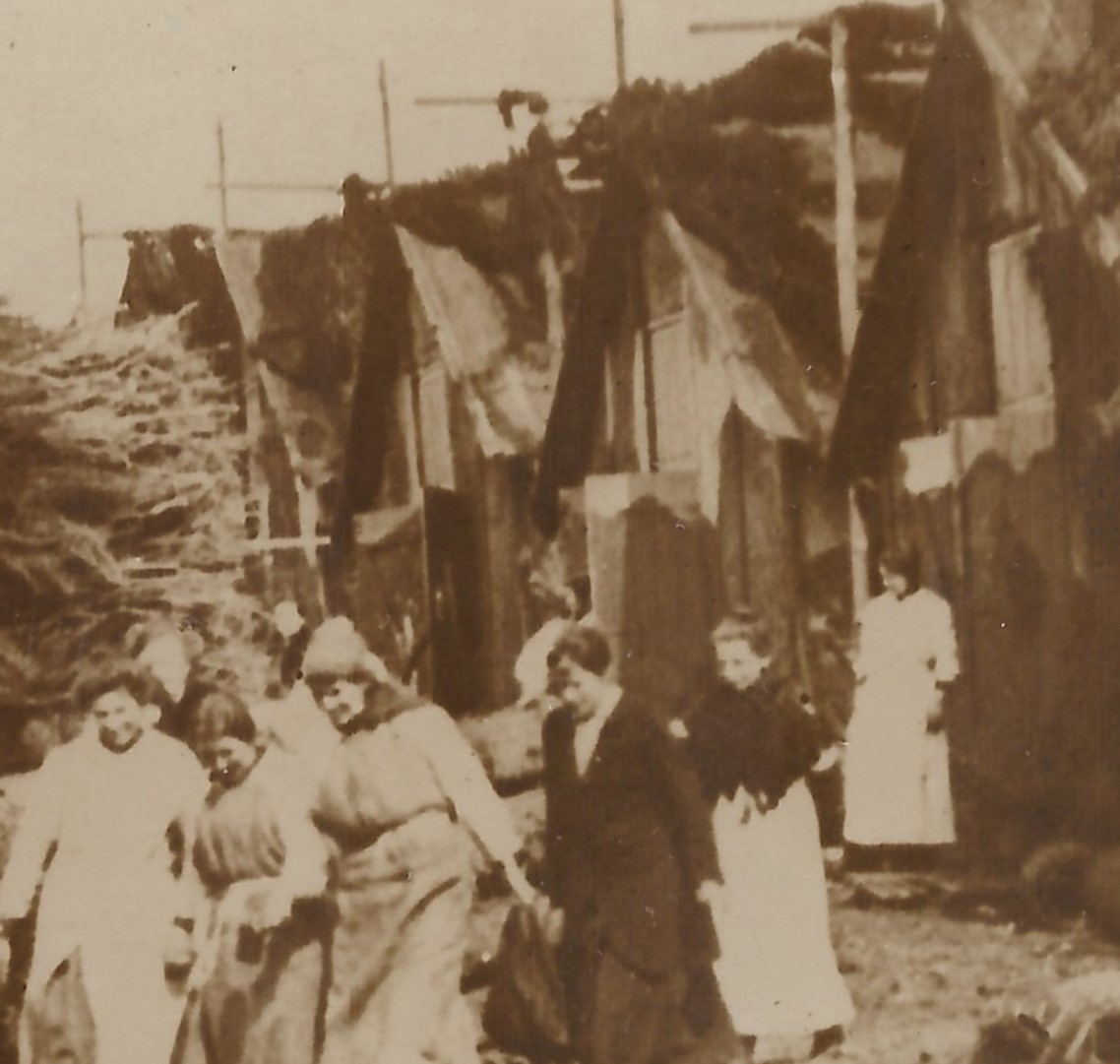
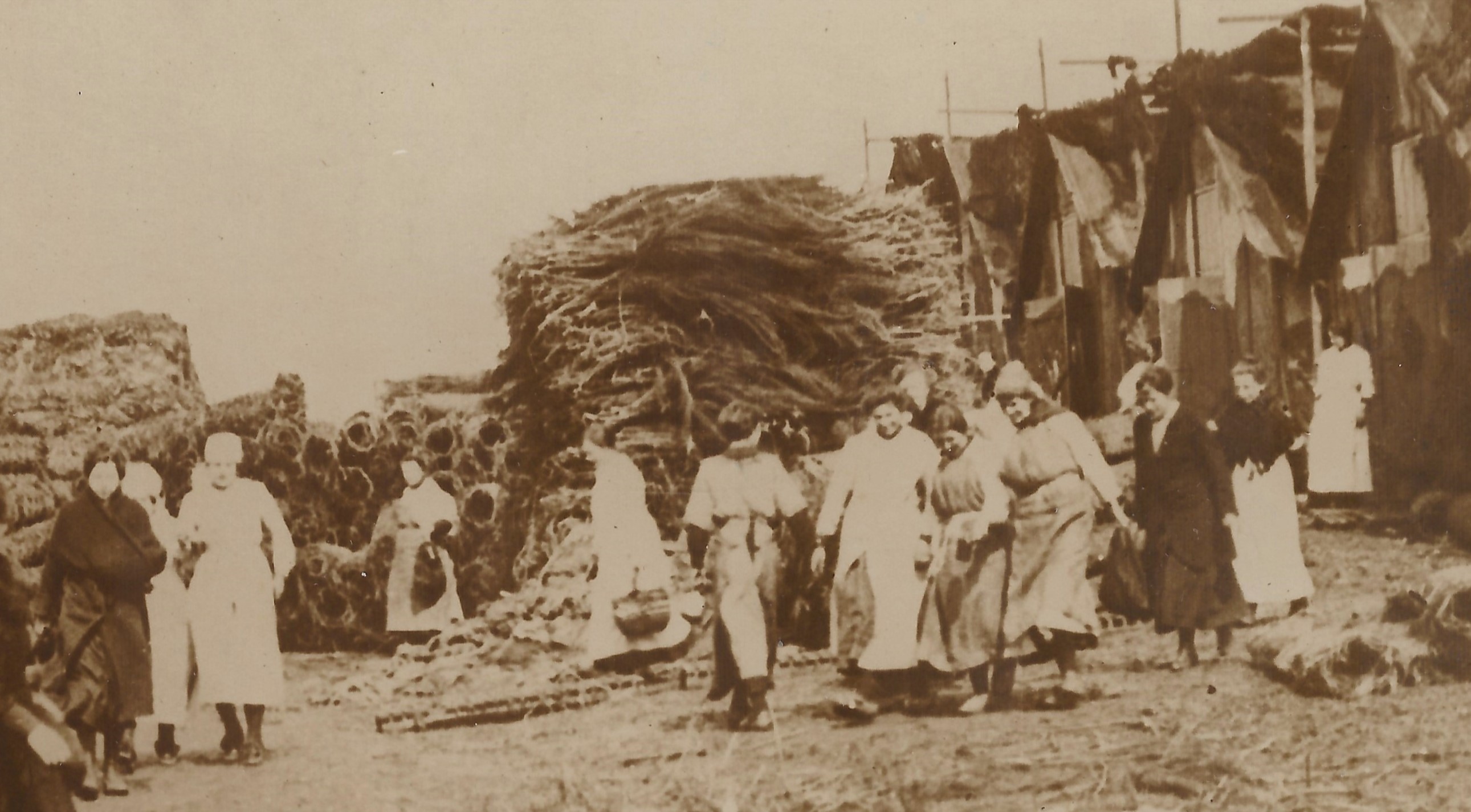
    What draws me in here, in this photo, is the woman at front-left: she seems tallish and ramrod-straight…and I like the long swing of her left arm. I imagine that it is lunch since there are no shadows to speak of and it was obviously sunny, and at some point of the 17th day of June 1918, these workers were on their way to a break. (I suspect that the date wasn’t very accurate for when the photo was made, as everyone here is wearing pretty heavy clothing for June, somewhere in north-eastern France or Belgium.  They were constructing camouflage made of rags and natural bits, piles of which you can see in the detail. The “hangars” are small ganged huts covered by camouflage netting.

    In any event I share this as I don’t easily see another example online quite like this one. 

    Collage of the full image and detail:WWI Photos camouflage  collage

    The full image, along with the suggested caption to be used on publication (supplied by the photo news agency):

    WWI Photos camouflage detail _2_

    The hangars:

    WWI Photos camouflage detail _2_Camouflage bits:

    WWI Photos camouflage detail _2_
    WWI Photos camouflage detail _2_

    ·Posted by :

    ·in:

    — —

  • A Remedial Introduction to “Politics” for Newly-Enfranchised Women in the U.K. (1918)

    JF Ptak Science Books Quick Post

    Books covers to women voters detail

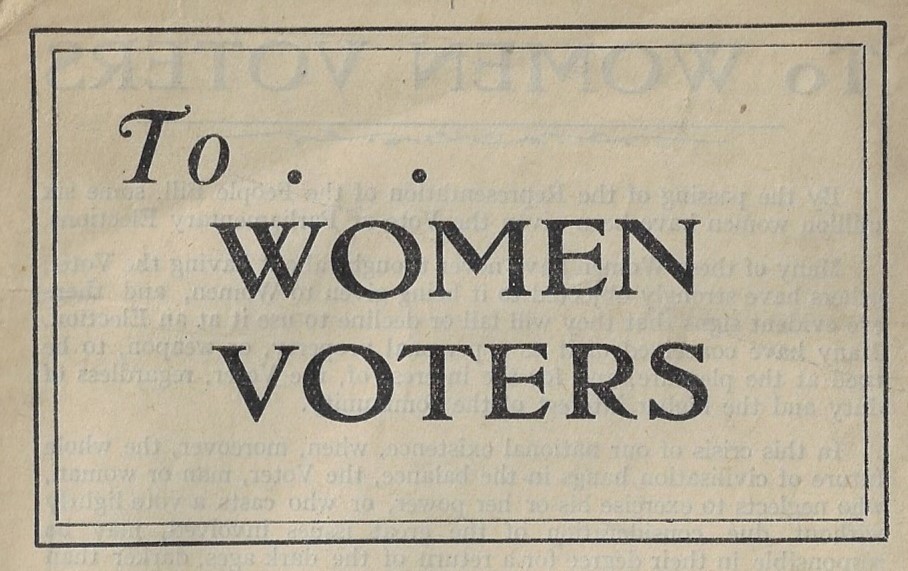
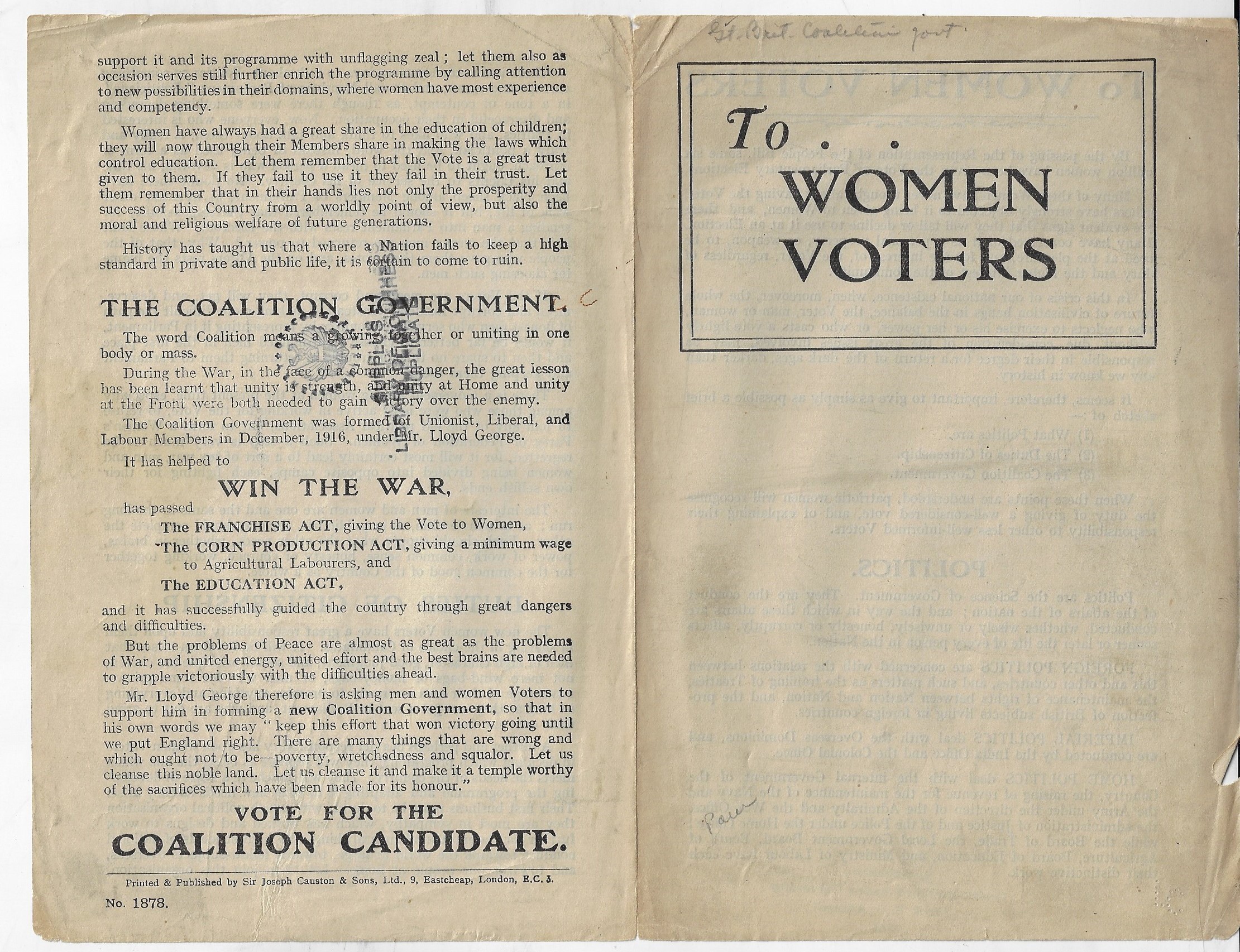
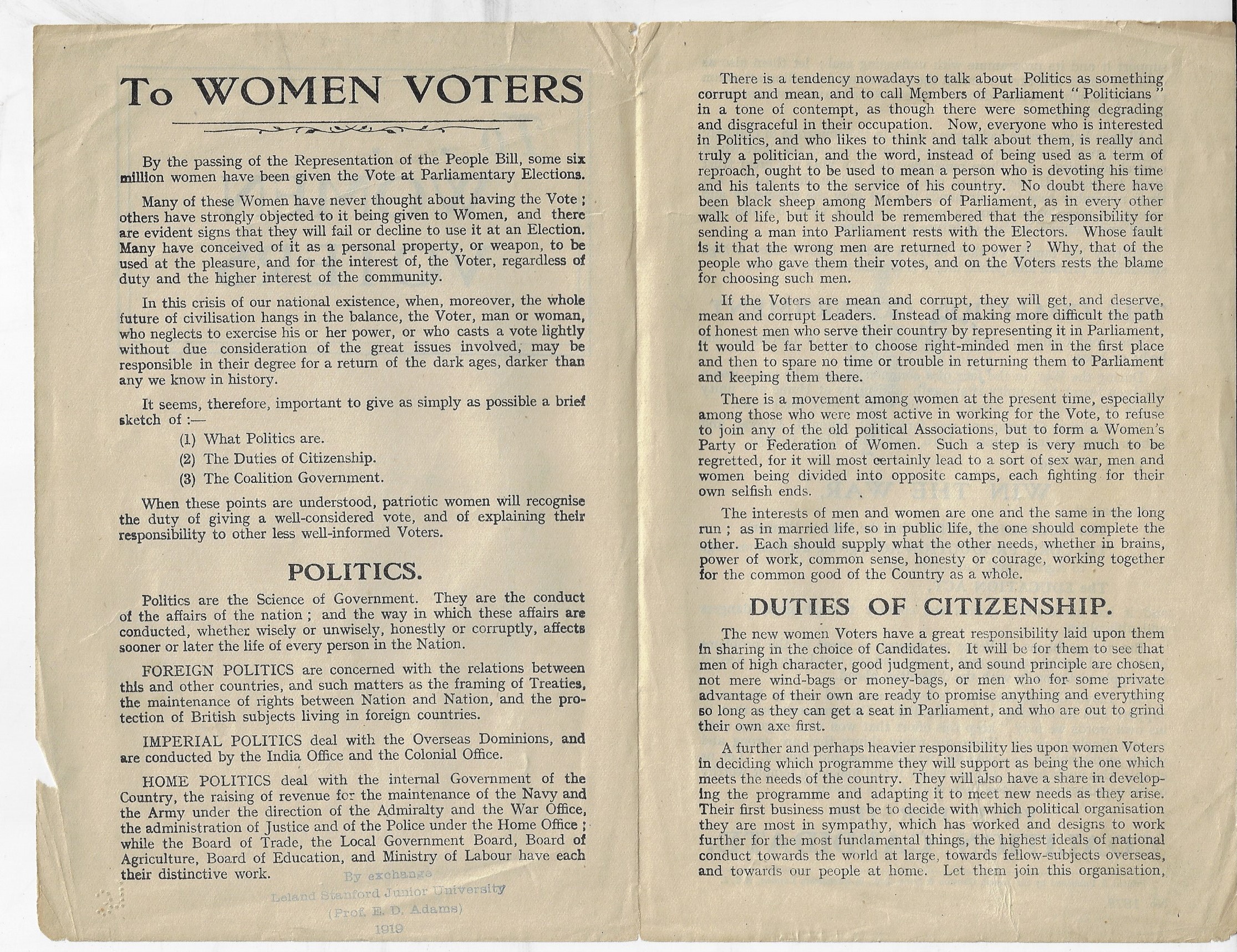
    To Women Voters1—a short and thin-lipped tearsheet printed by Sir Joseph Causton (viz Midsomer!) of London–was printed in 1918 for the Lloyd George U.K. Coalition Government.  (The coalition government of Lloyd George lasted until 1922 when it was replaced by that of Bonar Law.) It was printed in response to the Representation of the People Act of 19182, which enfranchised a certain set of women to the vote. This pamphlet was a very remedial introduction to the most basic ideas of government,  defining the subjects of “Politics”, “Duties of Citizenship”, and the “Coalition Government”, mostly in the service of having the women who could vote and would do so to vote for the Lloyd George ministry. The writer made a brittle assumption that women knew nothing about government and politics, and proceeded accordingly.

    I’ve reprinted the pamphlet below. 

    Notes:

    1.  8.5” x 5.5”, 4pp (one sheet folded in half).  Provenance: from the collection of Prof. E.D. Adams to Leland Stanford Jr University, and then the Library of Congress. The LC surplus stamp is on back cover, while the small Stanford stamp is at the bottom of page 2.  

    2. “The Representation of the People Act 1918 widened suffrage by abolishing practically all property qualifications for men and by enfranchising women over 30 who met minimum property qualifications. The enfranchisement of this latter group was accepted as recognition of the contribution made by women defence workers. However, women were still not politically equal to men (who could vote from the age of 21); full electoral equality was achieved in Ireland in 1922, but did not occur in Britain until the Representation of the People (Equal Franchise) Act 1928.”–Wikipedia

    Books covers to women voters

    Books covers women voters inside

    ·Posted by :

    ·in:

    —

  • The Private Public Face of the Brooklyn Bridge: Emily Roebling, 1883

    JF Ptak Science Books   Quick Post

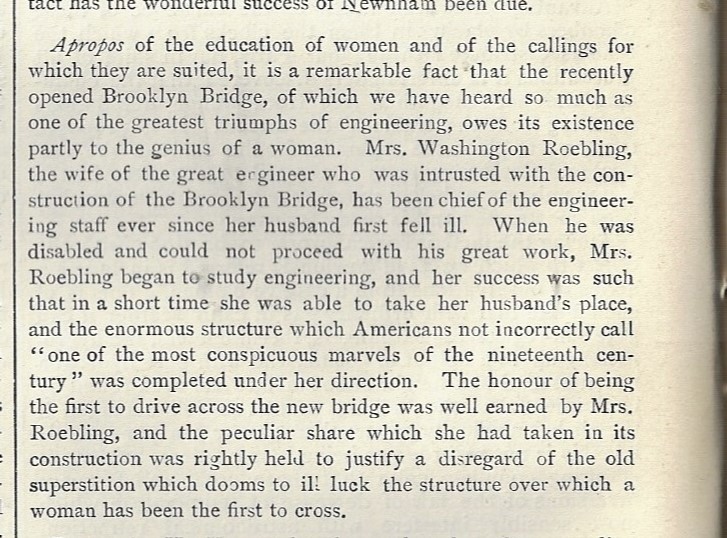
    I stumbled upon this, a fine notice on a matter of fact that was somewhat obscured, then and now–that the surrogate chief engineer of the Brooklyn Bridge was Emily Warren Roebling, the wife of the ill and disabled Washington Roebling.  The small notice of her achievement appears in the 14 June 1883 issue of Nature, just a few weeks after The Bridge was opened, with Emily Roebling being the first to cross. Washington Roebling took over as chief engineer following the death of his father, John A., in 1869, following a freak accident and the ill-conceived treatments for it that brought on the tetanus that wound up killing the man. Washington in just the next year suffered debilitating illnesses brought on by decompression sickness–that came on as a result of his famous leadership and participation in fighting an underwater fire in the Brooklyn caisson of the great bridge. After that, Washington became the shadowy Man-n-the-Window of his Brooklyn townhouse, seeing almost no one for years, though still conducting the engineering and almost everything else having to do with the construction of the bridge in concert with Emily. And so life went on like this for 13 years, and as David McCulloch wrote in his lovely work, The Great Bridge, Washington was as indispensable to the bridge as Emily was to Washington–it could not have been built without the pair of them.

    As encouraging as this small notice is in recognizing and congratulating “Mrs. Washington Roebling”, they did not recognize her given name. That was the practice, back then, but it would have made a finer point to elevate the woman to her own name rather than keep her as “the wife of”. 

    Nature 1883 MRs. Roebling

    Source:  Nature, volume 28, 14 June 1883, p 156.


  • Women, Recycling, and the War: England, 1918

    JF Ptak Science Books  Quick Post

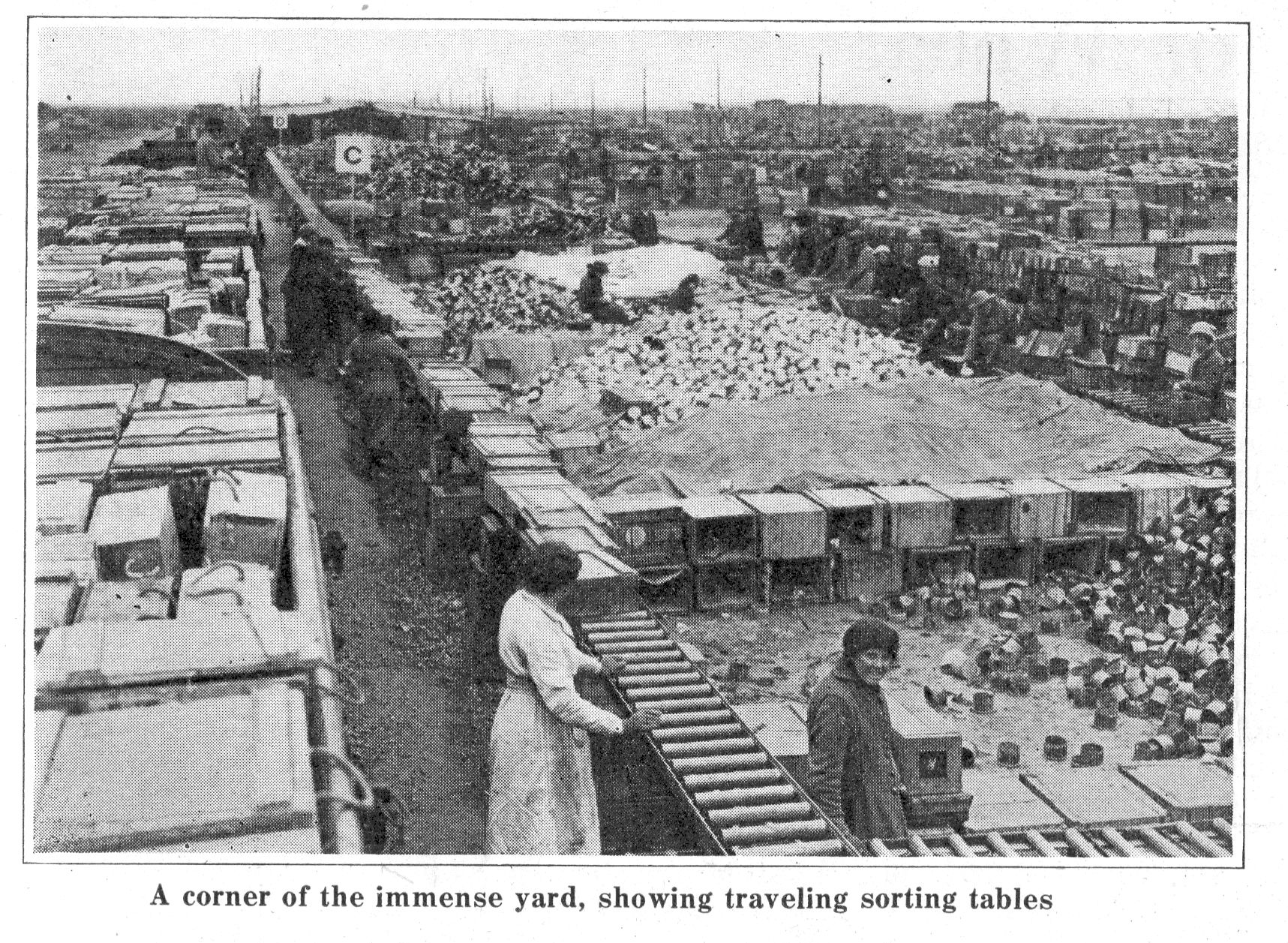
    WWI Project women working England 1918191

    [Source: Scientific American Supplement, August 31, 1918]

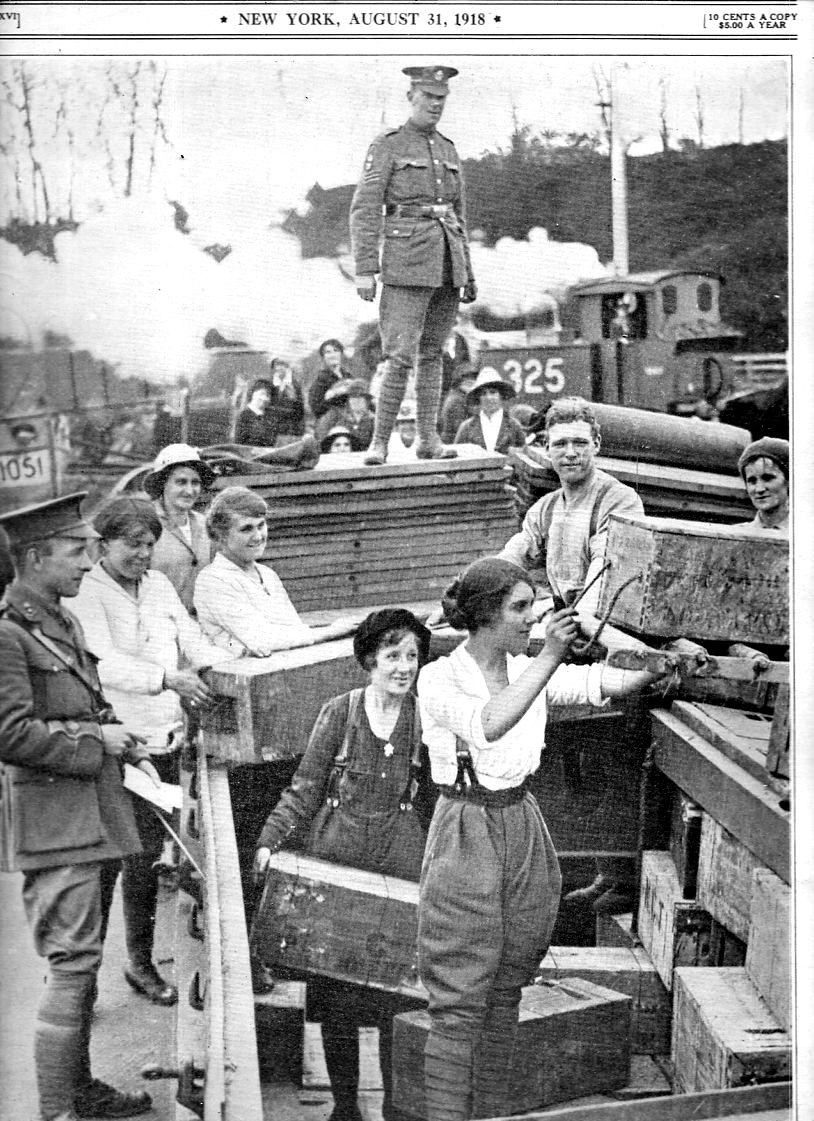
    There’s an unusual article in the August 31, 1918 issue of the Scientific American Supplement on the economics of recycling.  This recycling, however, was goods of war, and with that, mostly regarding the re-use of artillery casings. Since there were millions and millions used, that is millions of pounds of brass, which means there were also millions of pounds of copper. Seeing that copper was so much in use in so many other areas, it was established to recover as many casings as possible.  

    WWI Project women working England 1918190

    [Source: Scientific American Supplement, August 31, 1918]

    Recycling was important because as the article points out the expense of the war was limitless, while the economics of the countries involved were not–hence, the recycling.  And as we can see int eh photos accompanying the article, the supply for recycling was mountainous.  Curiously there was no mention of the women performing a bunch of these tasks even though they are prominently displayed in the photos–perhaps by this point in the war, fours years on and just a couple of months from ending–the role of women in reserve and the home front was already deeply established enough to let a particular mention of them go unmentioned.  


    WWI Project women working England 1918187

    [Source: Scientific American Supplement, August 31, 1918]

    ·Posted by :

    ·in:

    —

  • Not-Quite-a-Racing Line of Underpowered Convertibles (1928)

    JF Ptak Science Books  Quick Post

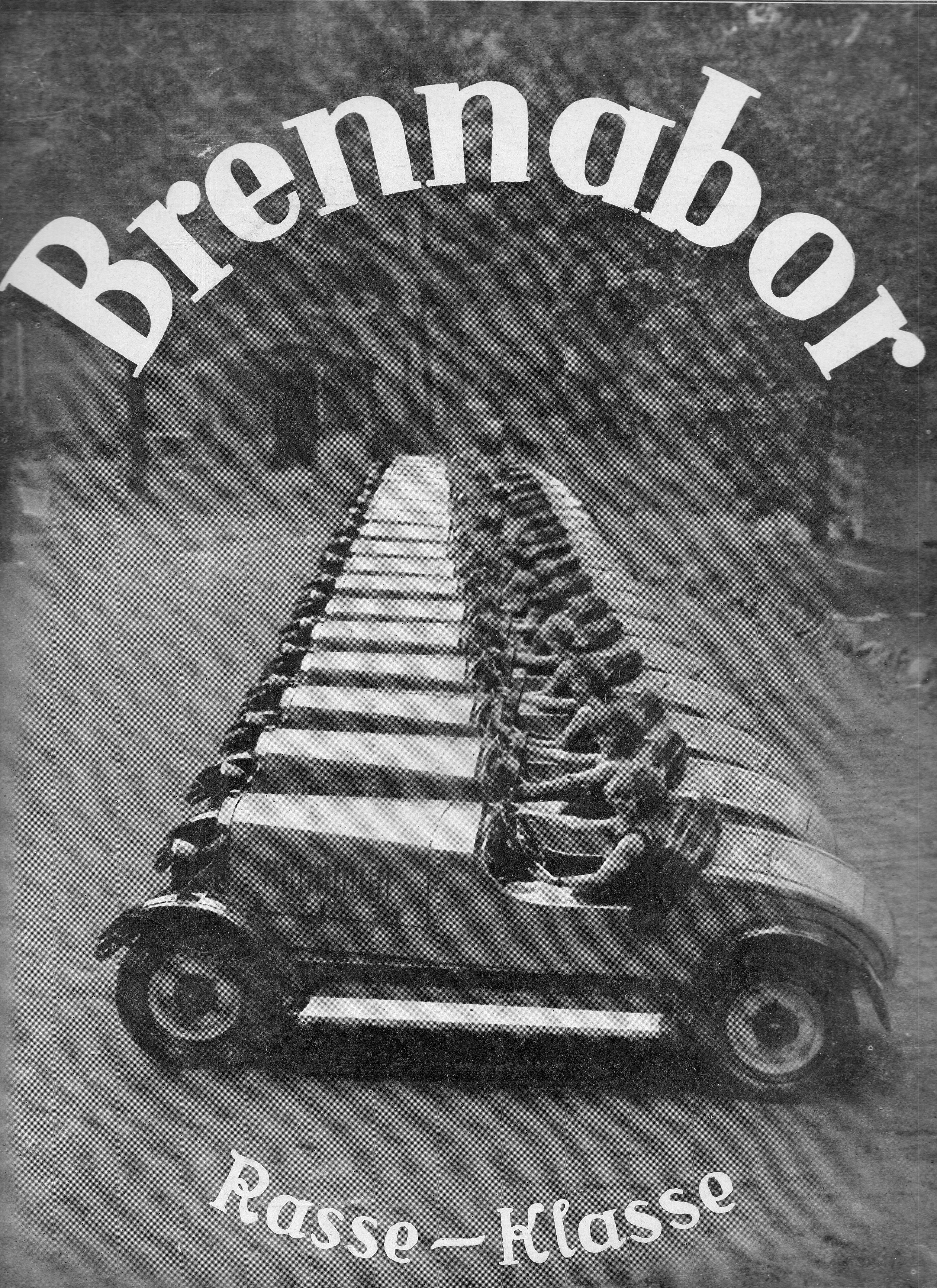
    Well, I really don’t have much to say about this ad except that I like the design and that it is not typical featuring nothing but women drivers in tanktops behind the wheel of the car you’re trying to sell.. It looks as though there are 20 cars in a row here, stretching back like 120′ or so from the camera.  The women are at the wheel of one of Brennabor’s four cylinder, 70 horsepower sports-ish vehicles, capable of seating two (not-big) people.

    Poster  brennabor089

    Source: Illustrirte Zeitung (Leipzig), ca. 1927/8


  • The Telephone-Wife (Lonely No More), 1925

    JF Ptak Science Books   Quick Post

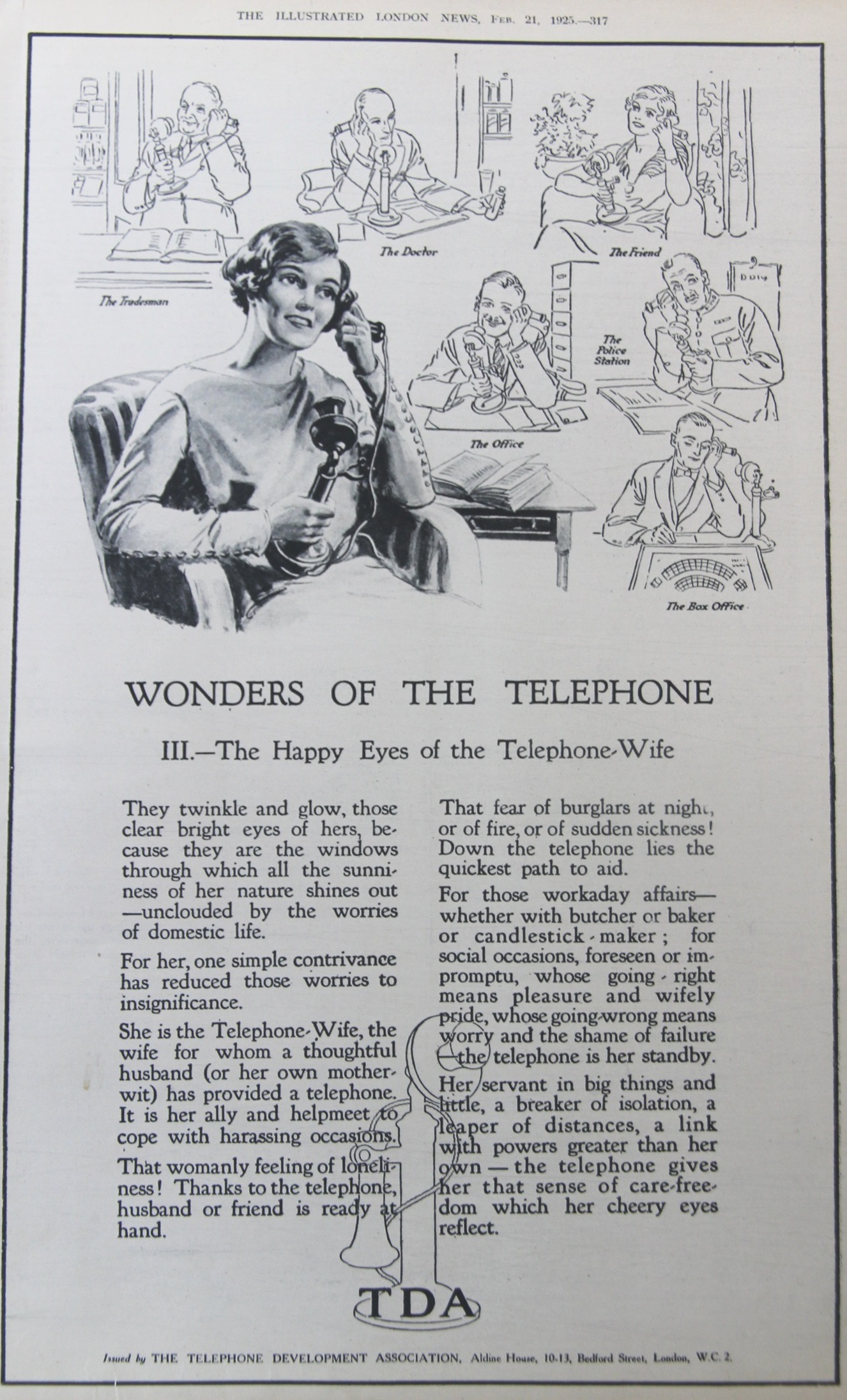
    I’m sure that there’s a song in this, somewhere, if only we had the power to return to 1925 to write the thing.  This add spoke to the married couples of the U.K., an appeal from the Telephone Development Association (TDA, of London), reminding people what the telephone was good for. Not the least of the reasons for installing a ‘phone in the house to help reduce worries to insignificance, and rid her of “that womanly feeling of loneliness”. 

    Telephone-wife[Source: The Illustrated London News, February 21, 1925.]


  • Dr. Lise Meitner, Fission, and Comic Books (1946)

    JF Ptak Science Books   Post 2448

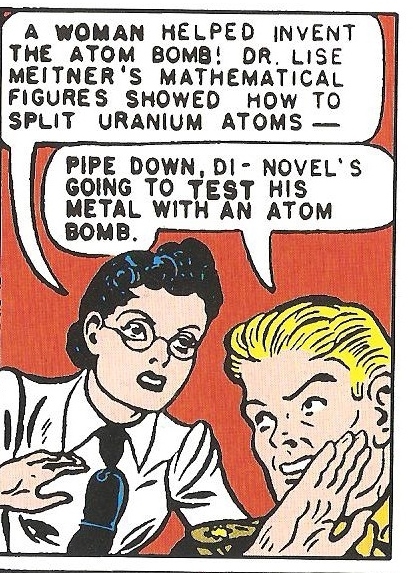
    I don’t often venture into the comic book world unless I’m looking for something, and in a hunt for atomic bomb references in comics <1955 I stumbled upon a reference to Dr. Lise Meitner. (A good short bio and summary of her work can be found here at the American Nuclear Society.) Seeing great physicists in comic books is evidently not common, as  subsequent series of searches seem to indicate.  The Meitner (1878-1968) mention in Wonder Woman, though, was pretty interesting.  Meitner did get a lot of press coverage when she made her tour of the USA in 1946, which I guess led to the panel.  She would have been more famous if she had been properly treated by the Nobel committee when they awarded the Nobel Prize in Chemistry of 1944 to Otto Hahn for work (“for his discovery of the fission of heavy nuclei”)  that she and Hahn had carried out jointly for years.  But it didn’t happen, for various reasons, and she really didn’t get an official prize/award of recognition for her work until 1966 when she was given the Enrico Fermi award.  She did receive an ultimate honor in 1997 when the chemical element with the atomic number of 109 was named (discovered in 1982) was named “Meitnerium” in her honor–the only non-mythological woman’s name to be used in designating a chemical element. And she is featured on a few stamps, but outside the general physics community she sort of languished in obscurity for decades–odd since she was about the most significant woman in the history of 20th century physics.  

    Scientists in comics meitner

    [Source: found in the blog Shakeville, here.Wonder Woman, 1946.]

    “Disintegration of Uranium by Neutrons: A New Type of Nuclear Reaction”, by Lise Meitner and Otto R. Frisch; Nature, 143, 239-240, (Feb. 11, 1939). Full text here via Atomic Archive.

    See below for the Meitner/Frisch paper from Nature 1939, and also the footnotes for papers cited (a number of which may be purchased via the blog bookstore id you were so inclined to own documents like this).  

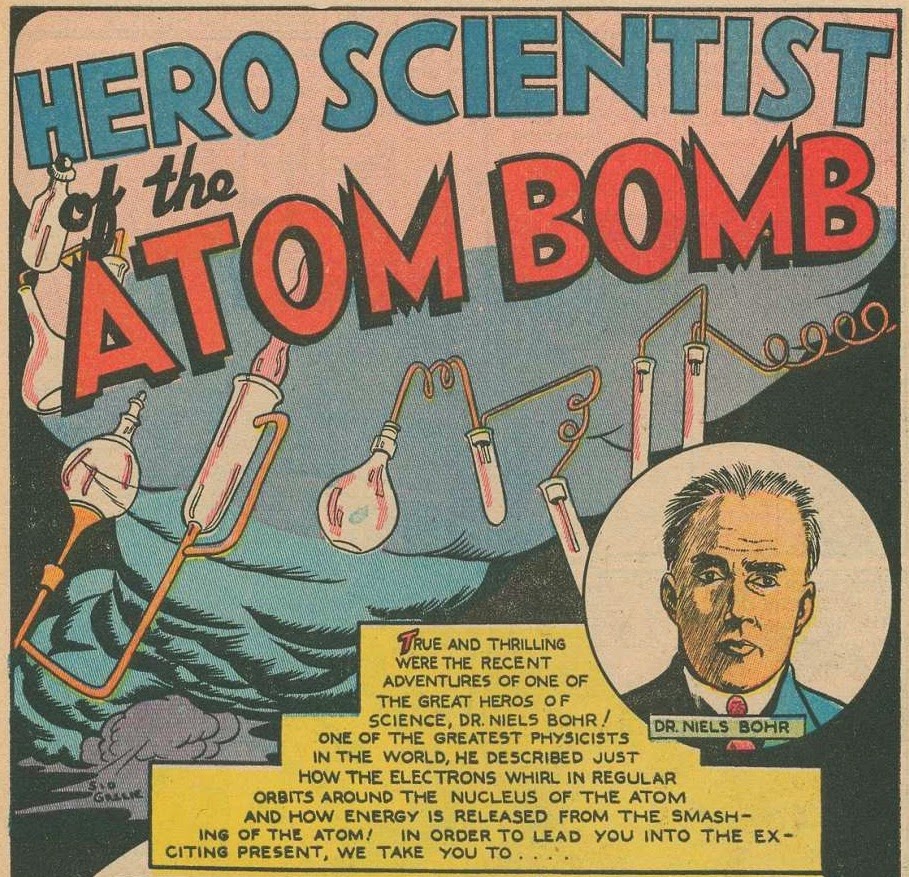
    And here’s a surprise appearance of Niels Bohr!

    Scientisits in comics Bohr

    http://physicsbuzz.physicscentral.com/2014/06/7-public-domain-physics-comics-worth.html


    Papers cited in Meitner/Frisch Nature 1939:

    1. Fermi, E., Amaldi, F., d’Agostino, O., Rasetti, F., and Segré, E. Proc. Roy. Soc., A, 146, 483 (1934).
    2. See Meitner, L., Hahn, O., and Strassmann, F., Z. Phys., 106, 249 (1937).
    3. Curie, I., and Savitch, P., C.R., 208, 906, 1643 (1938).
    4. Hahn, O., and Strassmann, F., Naturwiss., 26, 756 (1938).
    5. Hahn, O., and Strassmann, F., Naturwiss., 27, 11 (1939).
    6. Bohr, N., NATURE, 137, 344, 351 (1936).
    7. Bohr, N., and Kalckar, F., Kgl. Danske Vis. Selskab, Math. Phys. Medd. 14, Nr. 10 (1937).
    8. See Meithner, L., Strassmann, F., and Hahn, O., Z. Phys. 109, 538 (1938).
    9. Bethe, A. H., and Placzec, G., Phys. Rev., 51, 405 (1937).


  • Cigarette Women of the Second Dimension, 1940

    JF Ptak Science Books   Quick Post

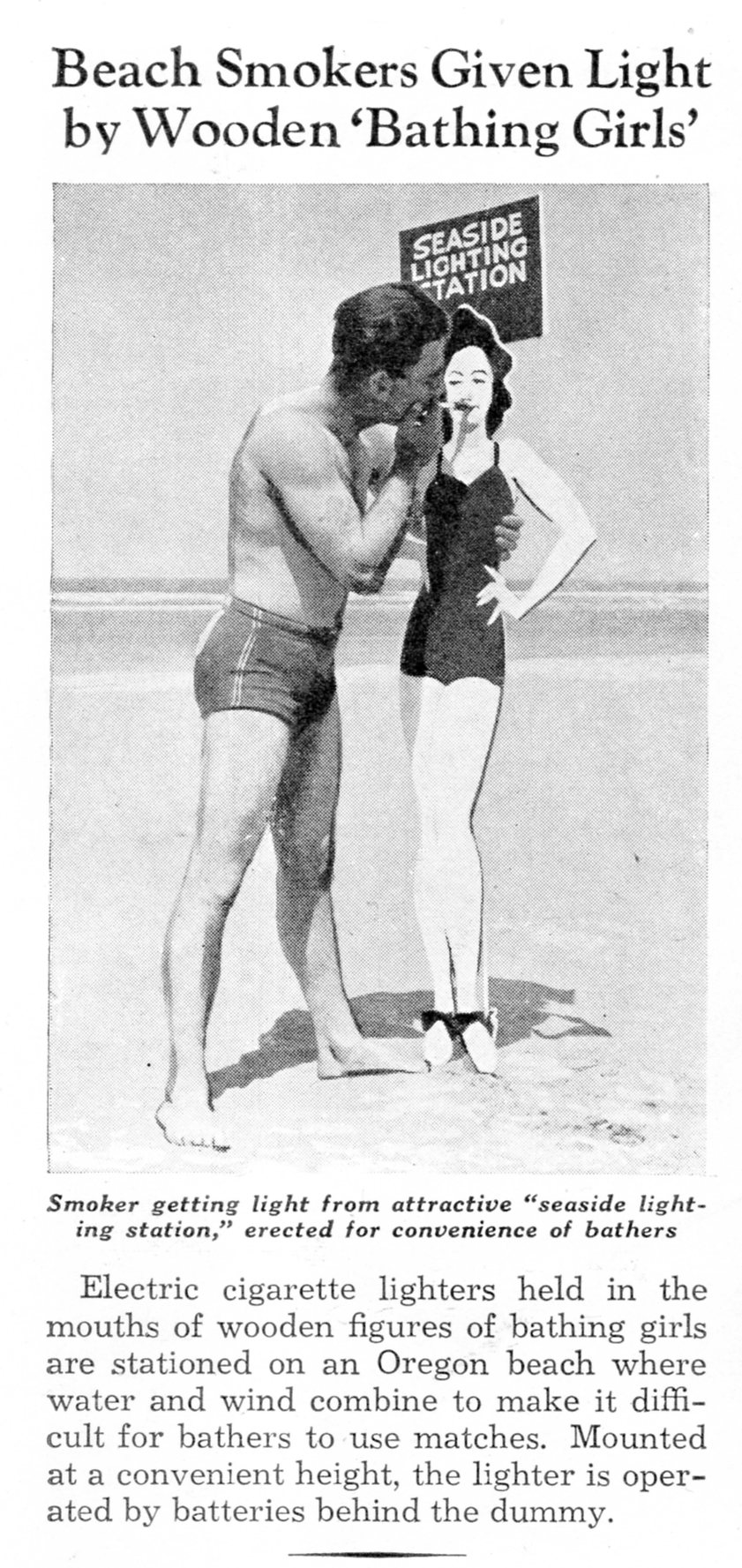
    Nothing quite spells out the duties of subjugation as being a one-dimensional-purposed two-dimensional object.  And in the world of these things few seem to come as close to becoming-a-real-girl in the Pinocchioiana sense than this item.


    Woman ciggie lighter corrected875

    It is a cigarette-lighting girl for beachgoers, found sleeping lightly on page 556 of the October 1940 issue of Popular Mechanics.  It seems that it is an issue for people being able to light their cigarettes on the beach, so cigarette manufacturers or their agents or agents of agents manufactured this device to make sure that no ill wind would come between the cigarette consumer and the uninterrupted consumption of cigarettes.  And so this device was created–the lightless ciggie smoker would come up to the cut-out and place their cigarette tip into the recesses of the lighting element in the cutout’s mouth.

    Weird, filled with dread, and true.  

    ·Posted by :

    ·in:

    —