JF Ptak Science Books Quick Post
I stumbled upon this, a fine notice on a matter of fact that was somewhat obscured, then and now–that the surrogate chief engineer of the Brooklyn Bridge was Emily Warren Roebling, the wife of the ill and disabled Washington Roebling. The small notice of her achievement appears in the 14 June 1883 issue of Nature, just a few weeks after The Bridge was opened, with Emily Roebling being the first to cross. Washington Roebling took over as chief engineer following the death of his father, John A., in 1869, following a freak accident and the ill-conceived treatments for it that brought on the tetanus that wound up killing the man. Washington in just the next year suffered debilitating illnesses brought on by decompression sickness–that came on as a result of his famous leadership and participation in fighting an underwater fire in the Brooklyn caisson of the great bridge. After that, Washington became the shadowy Man-n-the-Window of his Brooklyn townhouse, seeing almost no one for years, though still conducting the engineering and almost everything else having to do with the construction of the bridge in concert with Emily. And so life went on like this for 13 years, and as David McCulloch wrote in his lovely work, The Great Bridge, Washington was as indispensable to the bridge as Emily was to Washington–it could not have been built without the pair of them.
As encouraging as this small notice is in recognizing and congratulating “Mrs. Washington Roebling”, they did not recognize her given name. That was the practice, back then, but it would have made a finer point to elevate the woman to her own name rather than keep her as “the wife of”.
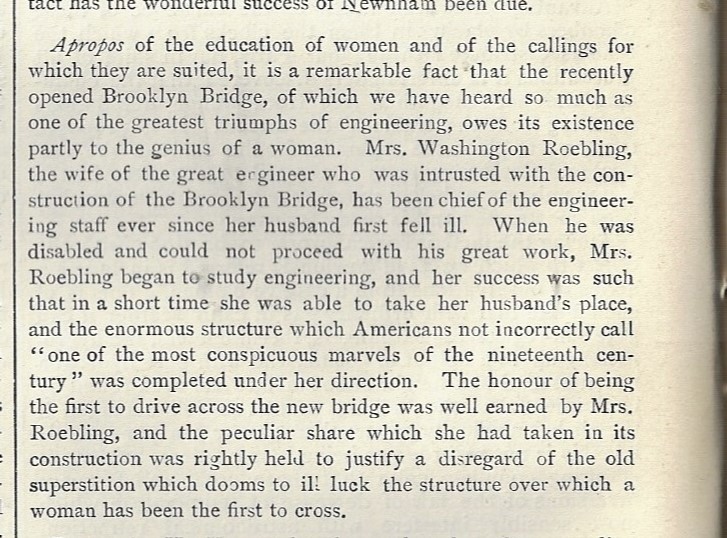
Source: Nature, volume 28, 14 June 1883, p 156.