A Daily History of Holes, Dots, Lines, Science, History, Math, Physics, Art, the Unintentional Absurd, Architecture, Maps, Data Visualization, Blank and Missing Things, and so on. |1.6 million words, 7500 images, 4.9 million hits| Press & appearances in The Times, Le Figaro, Mensa, The Economist, The Guardian, Discovery News, Slate, Le Monde, Sci American Blogs, Le Pont, and many other places… 5000+ total posts since 2008.

Category: History of Holes

  • Color, in Living Color! Occasional and Segmented Brutalist Design in Data Visualization. (1944)

    JF Ptak Science Books  Quick Post        

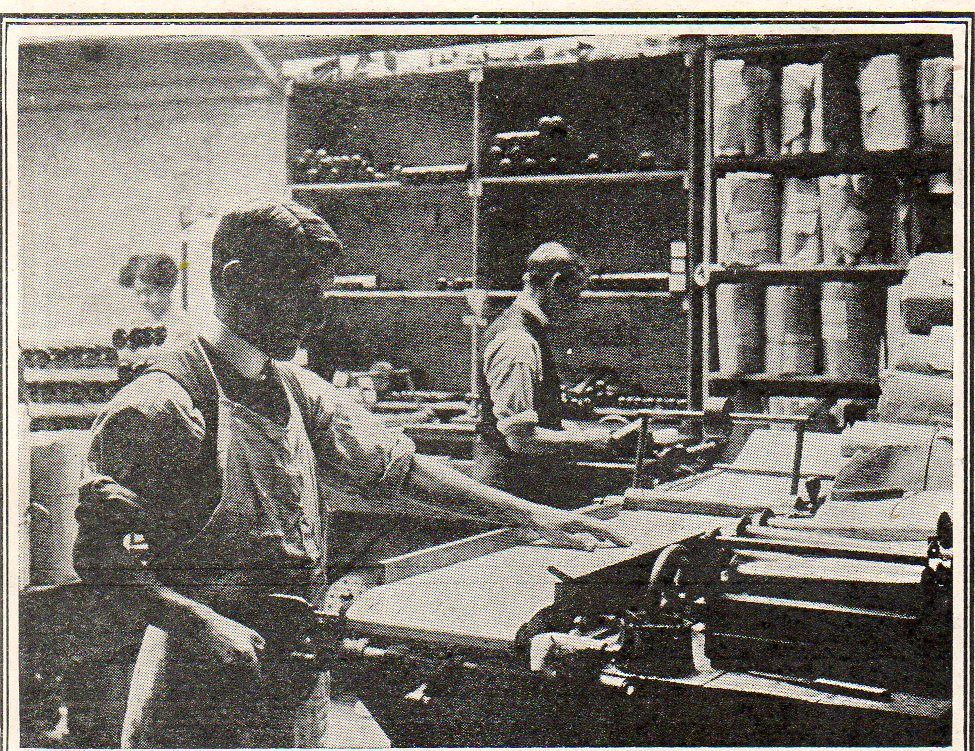
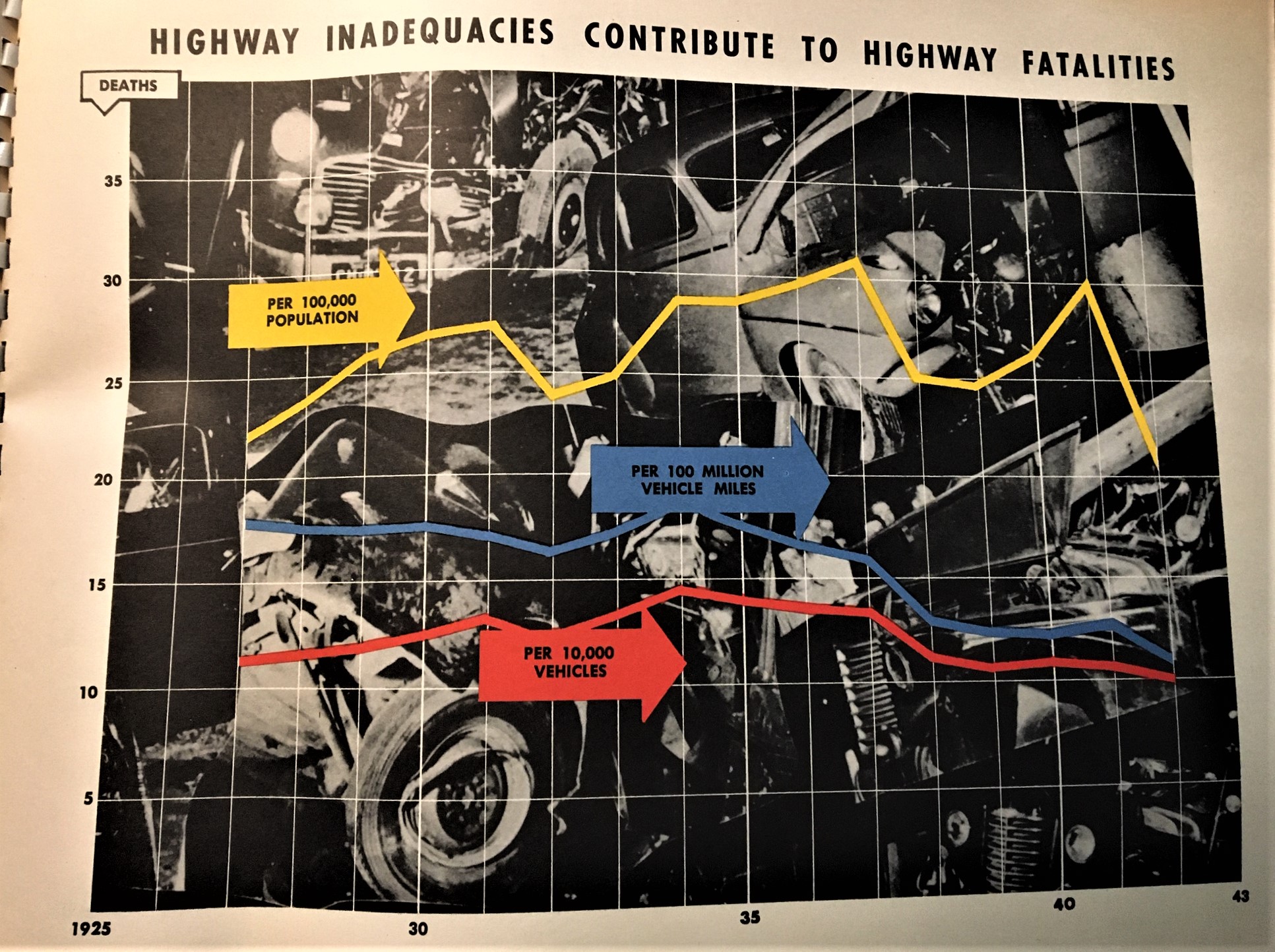
    I’ve made a number of posts to this blog on color and the lack of it (for example, see the series on “Color and its Advanced Abuses”) mostly concentrating on MONUMENTAL color or the lack of it when it could have been there (this, for example, exemplified in a beginner book on color theory with illustrations in glorious black and white). Today’s example comes from a oversize pamphlet called The Story of Highways, which I think was a vehicle used to deliver highway stats to crowds of congressional interest. The 16″-wide pamphlet contains 26 graphs/charts that reproduce 30″x 40″ posters used in a presentation somewhere to justify federal money spent on highways during WWII.  Some of them are unexpectedly colorful, very flat, and as I said in the title of this post, somewhat Brutalist in design. It isn’t quite Soviet Style or Brut Soviet, but there are those elements that I think are pretty noticeable. And if not, they’re interesting to see.

    IMG_1912


  • A Hole in the Ground vs. a Hole in the Sky

    JF Ptak Science Books  Quick Post

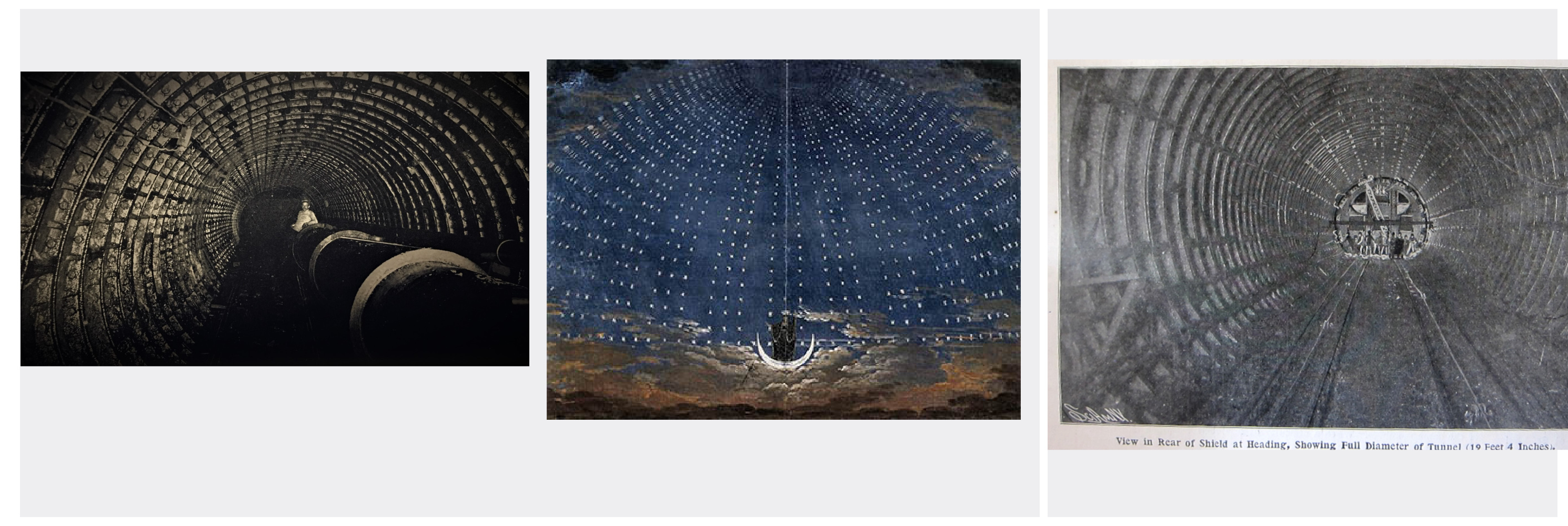
    Tunnel collage


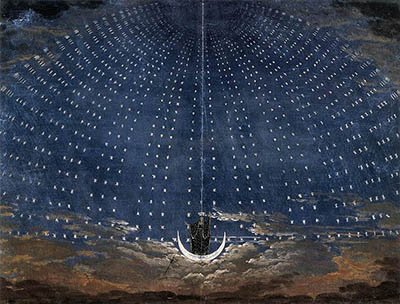
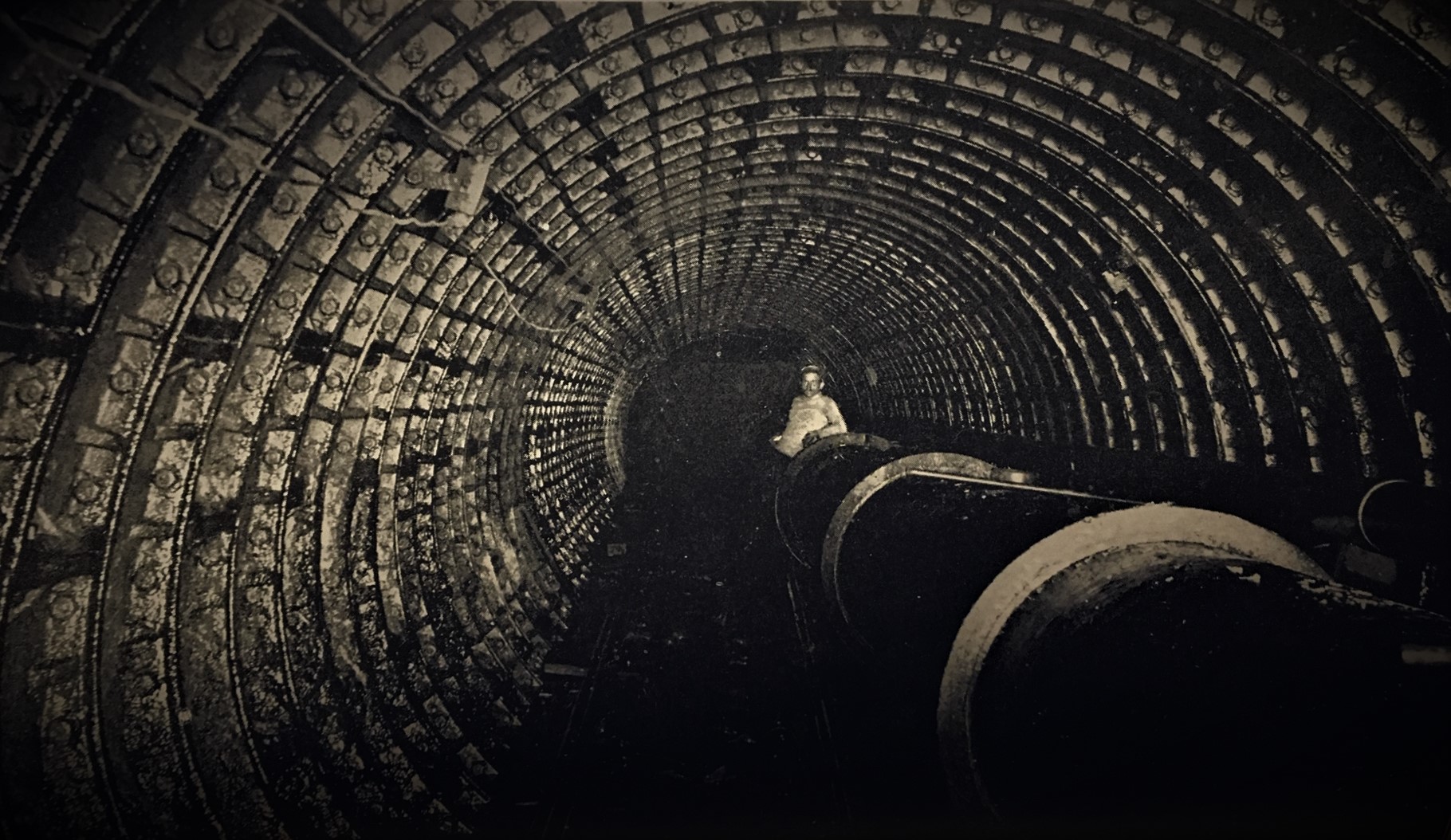
    Mozart tunnel _2_A while ago I wrote about a brief connection that I saw in a  photographic view of the 19′ tunnel section of the Hudson River tunnel with  the 1815 stage set by Karl Friedrich Schinkel (1781-1841) for Mozart’s Magic Flute1. Its just the initial reaction to the perspective pulled up the Schinkel more than anything else, except maybe for a non-existent underground image from Jan Vredeman de Vries’ book on perspective. That said, the set design I’m thinking of features the arrival of the Queen of the Night/Königin der Nacht, so perhaps this association isn’t too meshuga…excepting the ripped-to-shreds lust for revenge that the Queen of the Night sings about, which hasn’t much to do with digging a tunnel. 


    Perhaps this is an association that can be made for any tunnel being dug and illuminated in the 19th century, as I stumbled upon another example of this association, a photograph2 in another NYC tunnel–this one the tunnel under construction under the East River for the East River Gas Company, 1894. It is a little antithetical that these similarities are seen between an image of starry vault surrounding the Earth while the photos depict a lighted tube surrounded by Earth, a sort of alpha and omega of endless light…a contraction of environment filled with light compared to a contraction of the limitless night sky as seen as a theatrical set.  (I understand that there aren’t a long series of lights in the tunnels, just that it looks so because of the no-doubt heavy-duty light source and its reflections on the odd surfaces/bolts/etc. the metal tubing surfaces…and that is a riff in itself.)

    In any event, I like these images, and so I’ll share the newest of my finds here this morning.  

    Tunnel lights mozart


  • The Geometry of Pebble-Making (1878)

    JF Ptak Science Books  Quick Post

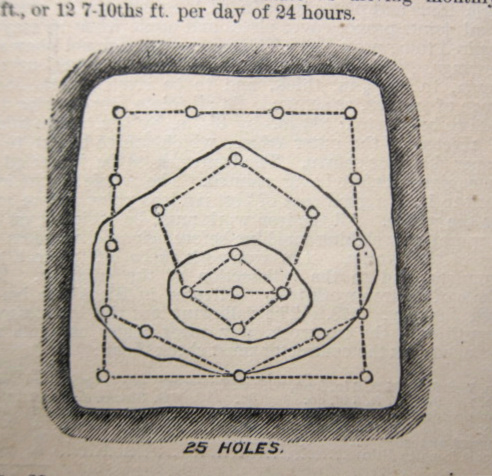
    Holes boring tunnelHere’s a good, no-longer-missing missing part of entries for the virtually bottomless History of Holes section of this blog—blasting holes drilled into rock faces for tunneling, appearing in an article in the Scientific American Supplement, February 2, 1878.  I’ve never considered the placement of the holes drilled through rock before, mostly I guess because I’ve never though about it before today–also I have no doubt that I would not have been able to figure out what sort of info was being represented in the small drawings if they were out of context. The circles and lines standing apart from any explanation or legend could’ve represented any number of things, from pole or column placement to fort construction, though blasting holes would’ve been far from my guess list of what these geometries were.

    There are a number of tunnels under consideration, all of different lengths, through different media, of different dimensions, and so on, all of which come into play when considering drilling and blasting one’s way through 20,000 or 50,000 running feet of mountain.

    The article was dryly fascinating, particularly in the human elements. On average it seemed as though for the tunnels surveyed in the article that 15-30 feet of earth would be removed each day, which seems like a lot given the time and the space to work in. Most of the excavating faces seem to have been about 8′ x 10′, or about 80 square feet, and in that space there were usually six workers operating the drills at one time. That seems to me to be very very cramped quarters operating big and noisy machines generating a lot of dust, all of which was happening with not-great lighting with a questionable air supply. That was one tough job. 


  • Bad Places to Be (1922)

    JF Ptak Science Books  Quick Post  (Part of the series on the History of Holes)

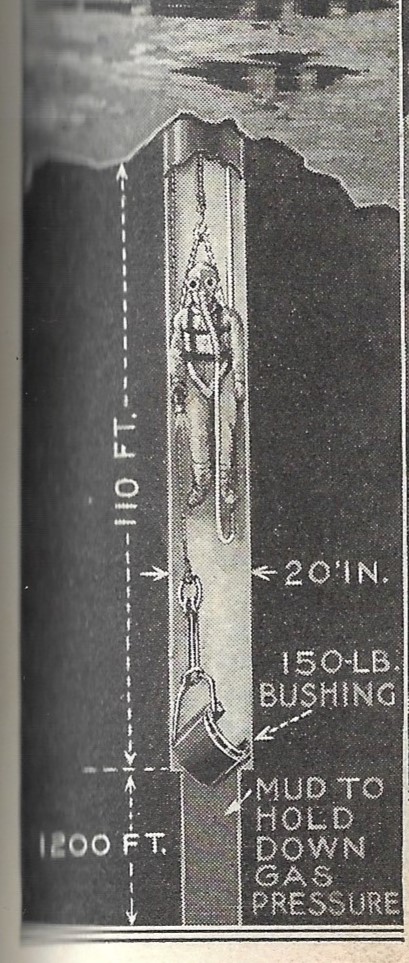
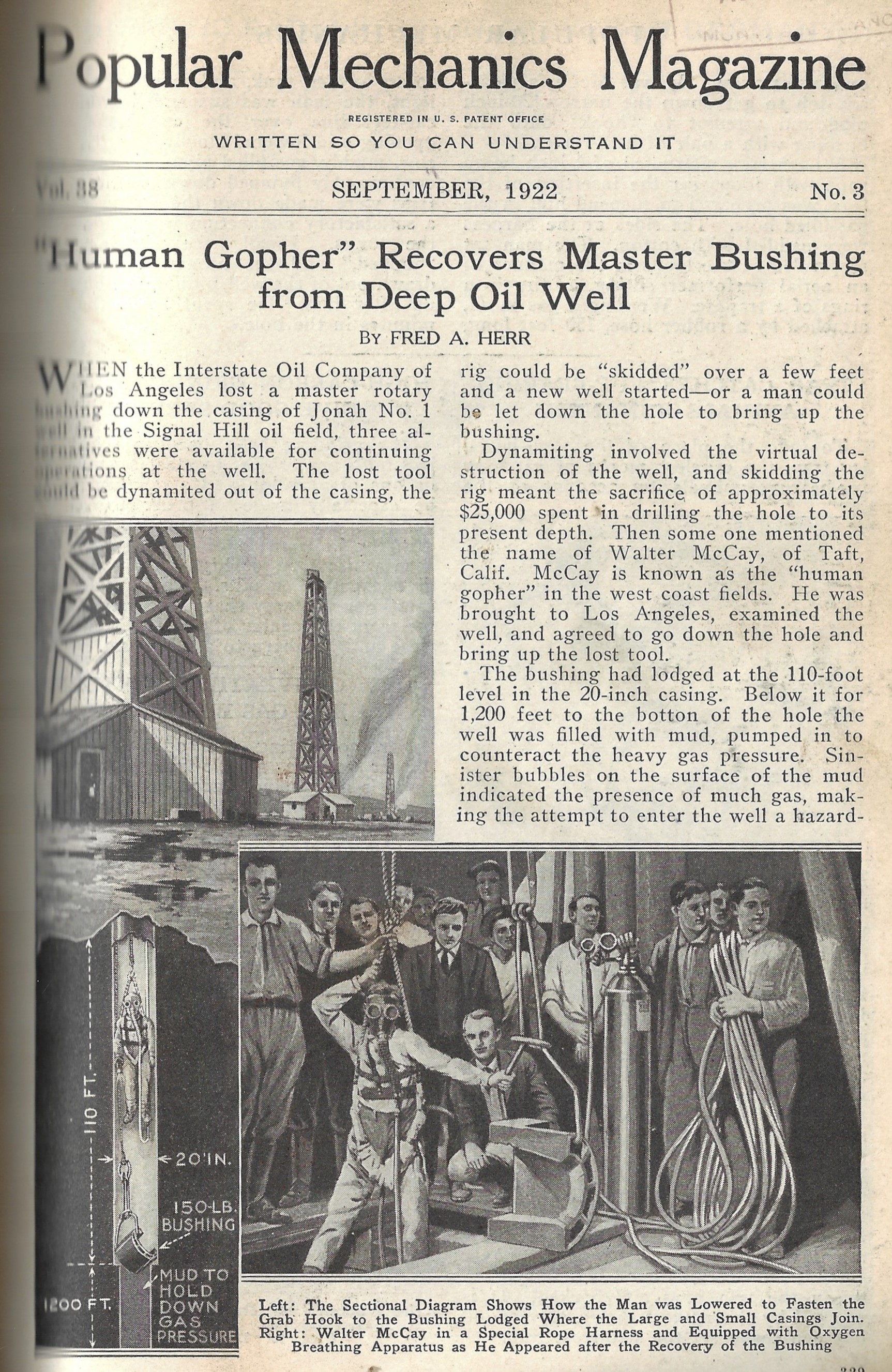
    Pop Mech 1922 bad place well retrieval detailThere could have been many dozens of posts in this sub category–many. There are posts dedicated to B-17 belly gunners, sappers tunneling under trenches, workers struggling away in the enormous and dank and terrifically unhealthy Brooklyn Bridges (not fireproof!) caissons, WWI coffin-like observation cars dangling from a 500′-long cable, and so on. (And as long as I’ve mentioned coffins, there are the illustrations of patent drawings showing people saving themselves from premature burial.) There’s an endless variety of these situations though I’ve only identified a half-dozen or so in this blog of 4500+ posts. 

    I never did add a subcategory for this and labeling posts in this way simply got away from me, though it did just return this morning seeing the adventures of the human mole man. This guy would’ve been made of slim steel to do what he did, as just the idea of it gives me some low stomach shivers. He’s wearing half-overalls, a rudimentary mask, and with one flashlight in his right hand he’s lowered 110′ down a well that is just a little wider than his shoulders (20″) to collect a stuck 150-lb bushing. (I just measured 20″ across the width of my shoulders and I can say easily that I would’ve turned into a plug very quickly.)  Down the hole this man went, and emerged victorious, posing at the end of it all with his broken trophy.  It could’ve been worse–the hole could’ve been filled with water, or on fire, or filled with water on fire–but not by much.

    Bad places to be human mole

    [Source: Popular Mechanics, June 1922.]

    ·Posted by :

    ·in:


  • History of Holes: Filling Holes Up

    JF Science Books  Post 2786   (Part of, yes, the History of Holes series)

    Holes and Dots (and anti-Dots) and Circles all have some longish threads running through this blog, though where they are actually running to is unknown at this point–perhaps when they get “there” they’ll recognize it and stop. Today’s installment scopes out the writing property for filling-holes-up, perhaps on the road to a Picture Alphabet of Hole-Filling:  filling holes with seeds, explosives, death, trains, square pegs, cities, music, everything in existence, soldiers, blood, superconducting super colliders, fallout shelters, radioactive waste, books, a shadow, a sunbeam, light in general, and so on.

    Somehow though it seems a larger and more explosive time in describing how holes are made in the first place, but that’ll be for another time. 

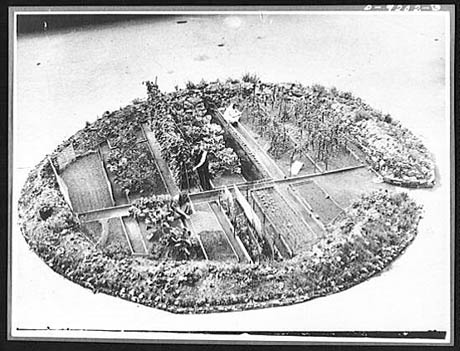
    The first image comes from Ediblegeography and shows a Nazi-caused bomb crater during the Battle of Britain ca. 1940/1 with its new innards. 
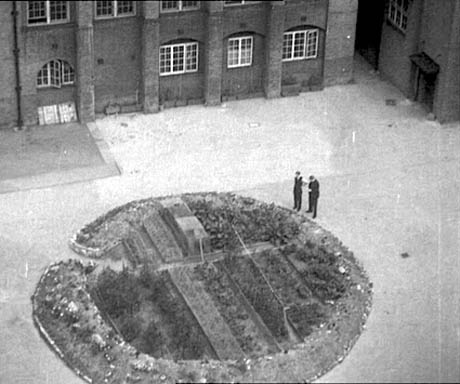
    And ditto1 here:
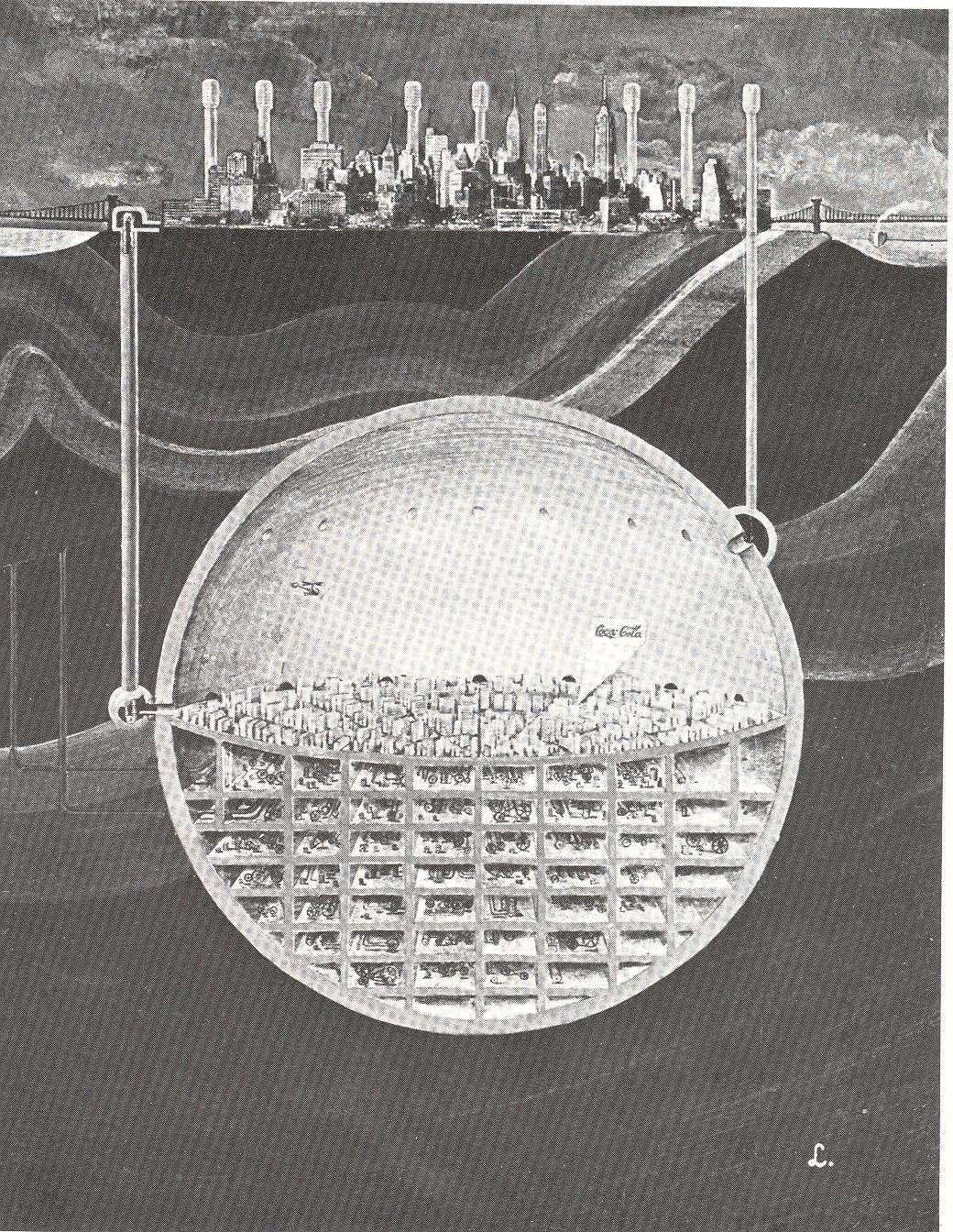
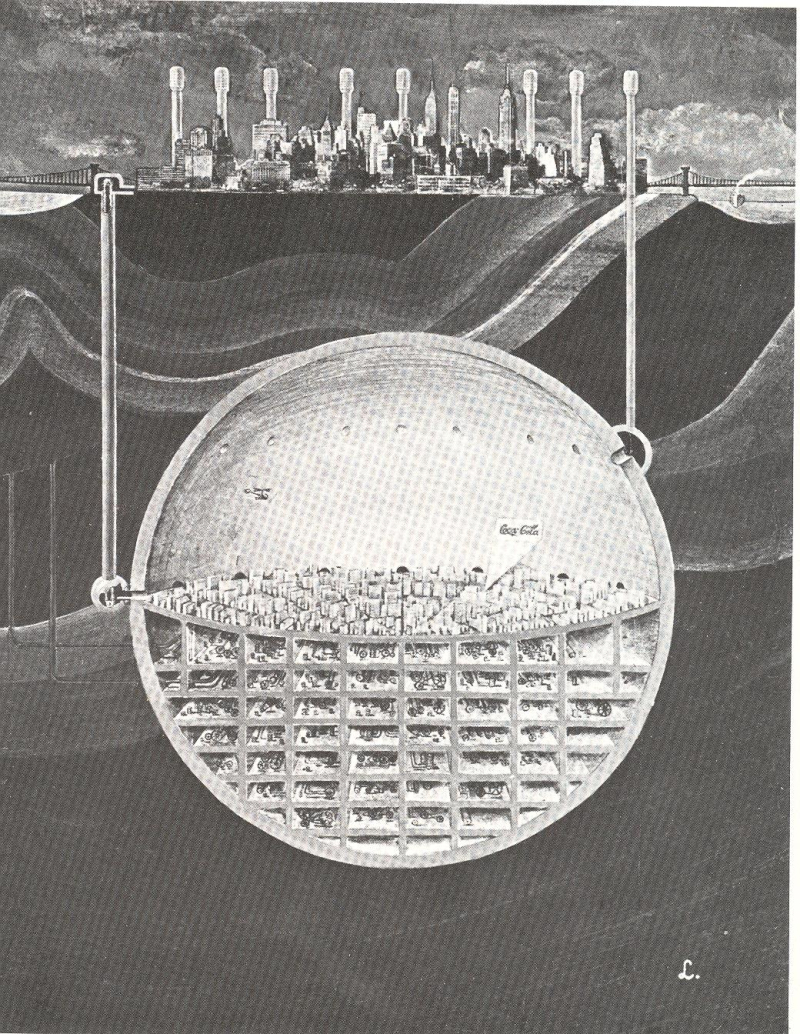
    A very unusual instance of filling holes up is when they are filled with cities.  Underground holes for some reason sang out their siren tunes of underground cities, landing the listening Oscar Newman on the rocks with his singular design.  The 1969 underground city (the image of which can be found in Alison Sky and Michelle Stone’s  Unbuilt America,  McGraw Hill, 1976, page 192–no home should be without this book) shows his fascination and unguarded belief in such an idea, though the whole things reminds me of a dog-buried ball.
    Blog--april 5 atomic city

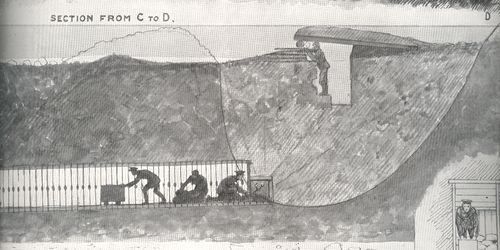
     During WWI  the indomitable sappers would dig long, tenuous tunnels under the field of battle to the enemy’s position, and then fill up the end of their hole with a lot of explosive, and then blow their enemy to kingdom come. This would be the Hole Filled With Death.
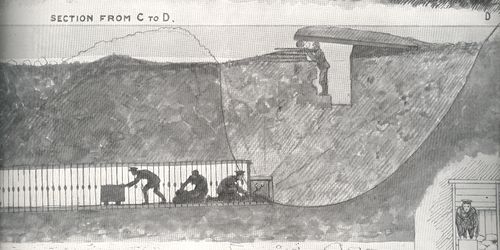
    Holes--sapper

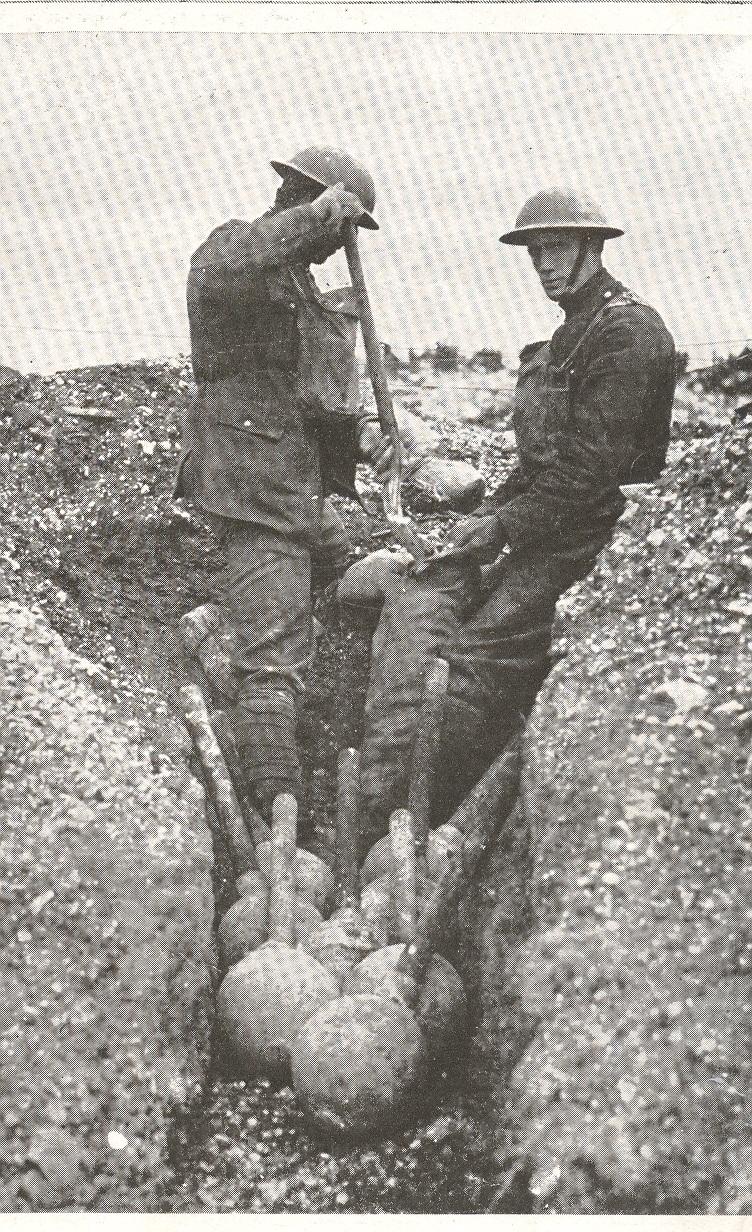
    Holes filled with men–if holes can be considered so that are half-a-hole, as in a “trench”, then the period from 1914-1918 saw a 25,000-mile half-hole filled with 50 million men, half of whom would not come out alive, as they had been riddled with holes that got filled up with their blood.   Blog april 29 trench

    recording telegraphs made holes in paper tape so that the messages could be played back in their entirety later on

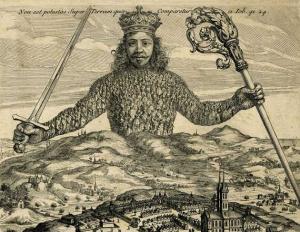
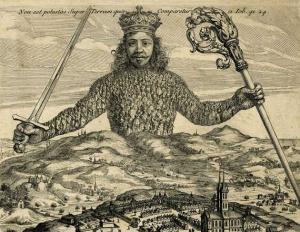
    I suppose too that a case could be made for the Leviathan, the empty holes of the political impresario filled to capacity with its subjects, the popular puppets filling the empty monarch because there is nothing there save for its need to be filled up, filled in the way that Gargantua and Pantagruel were filled.
    Leviathan_135448t
    Another very famous hole was filled with dark, a shadow cast by a stick, a lovely experiment carried out thousands of years ago by Aristarchus of Samos to prove his theory that the Earth was round.

    Not quite on the other hand is the sunbeam allowed to fall on the floor of the cathedral of S. Petronio in  Bologna through a speculuum in the ceiling, creating a solar clock (this being only one of many such examples).

    And I guess too that light entering one end of the telescope or microscope could also be considered a variant of filling-up-a-hole, if we can establish that a tube is a hole.  

    These holes below were filled with music–rather, they made it possible for music to be made through them, that they could actually produce a piano to play whatever music had been “transcribed” in them.

    In any event, this was meant to be a short thinking-out-load pieces on a Pictorial Alphabet of Hole-Filling, and it seems like a nice start.
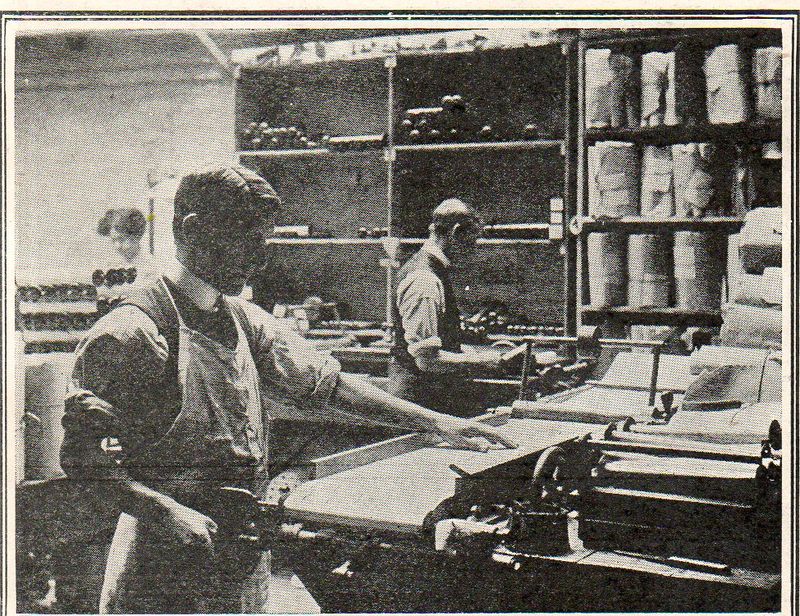
      Music role making--1871


    Notes:

    1.  Again from Ediblegeography:  “Bomb crater victory garden (sadly long gone) near Westminster Cathedral, image from Pathé Films footage via City Farmer News”.
    ·Posted by :

    ·in:


  • A Note on Becoming Distracted (Mass-energy Equivalence, Missing Continents, 19th C Martian Communication, and Levels)

    JF Ptak Science Books   Post 2768

    Here’s one of those languid, curling, endless river bends research stories that takes you totally away from where you wanted/needed to go. After a chat with my friend  Eric that involved conspiratorial otherworlders I had the idea of checking out some other other-minded folks who I would normally never consult for some possible angle I might have missed in a long-simmering research topic. I’ve been looking in bits and pieces for the first publication of the world’s most famous equation, E=mc^2: as it turns out this is not a trivial question. I’m not talking about the idea of mass-energy equivalence, but the appearance of equation that everyone on the planet knows. The first derivation that appeared in Einstein’s 1905 paper would not be recognizable as such by a general reader, nor would many of the others. The first appearance of E=mc^2 under Einstein’s name after some considerable digging is in 1946 (!), in the inaugural issue of Science Illustrated; withina  few months the equation appeared in the upper level of an atomic bomb mushroom cloud on the cover of Time magazine…but that all is another and more complicated story.

    Anyway my idea was to look at some anti-Einstein-relativity books to see what I might be missing, and in a short time I found a reference to the equation and Gustave Le Bon in a 1914 issue of the Comptes Rendus. Luckily I have that run, and so I checked out the paper–it did not contain the equation, of course, though it did have some references to him claiming to have had the idea of mass-energy equivalence in a series of papers published in Revue Scientifique (Rose) int eh early 1900s to 1905. I decided to check these out to because, with luck again, I have these down in the studio.

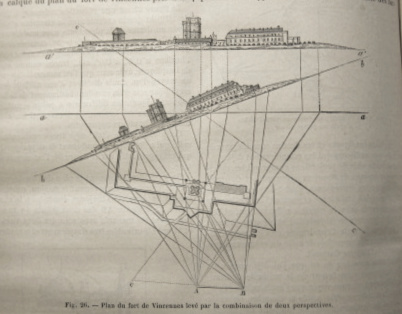
    Le Bon is an interesting/odd guy, who may or may not have been the great polymath he played in his script in life, though he was formidable enough to be considered for the Nobel Prize in 1903. So I worked from 1888 forward in the Revue (called “Rose” because the wrappers each weekly came in were rose colored) and bumped into Le Bon quite a bit. The man was interested in everything, and traveled to those ends to meet his curiosity. In one paper in 1892 he wrote on the origins of the arts of India (as he also happened to be a pioneer anthropologist), and I saw that the article proceeding it was in an area I was working in for a customer relating to the planet Mars. (This was by Norman Lockyer, editor of Nature, who wrote on Mars and it canals, canali, the “canals” part of their interpretation mightily disapproved-of by the old gent.) The Lockyer referenced something in I was actually looking for, an article by Henri Jules Perrotin (in the same journal but in 1888) who wrote of his observations of the planet, happily reporting that he did find the at-that-time-evasive canals, but also noted the disappearance of a Martian continent under what he suspected might be periodic “flooding”.  Anyway on the return to the Lockyer I went too far and with great satisfaction found the following drawing:

    LEvel camera _3_

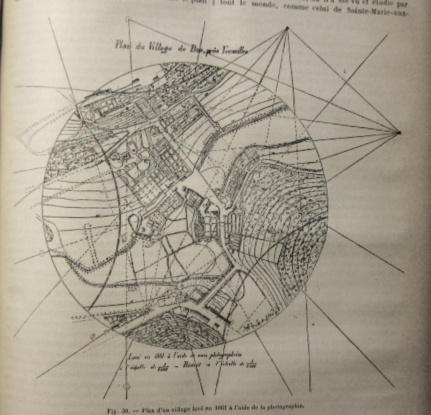
    That was quite a wide turn–anti-Einstein, where the hell is E=mc^2?, Gustave Le Bon’s 1905 A-bomb, Lockyer’s review of how to communicate with Martians, Perrotin’s disappearing continents–to get to this lovely drawing, no? It was almost worth it! This lovely thing (and oh to be able to render this in 3-D!) appeared in an article on a new application of photography to the surveying art/craft, M. Laussedat’s “Historique de l’Application de la Photographie au Lever des Plans”, November 5 1892. Its an interesting article, and two of the illustrations for are excellent pieces of art, in and out of context:


    Level camera _2_

    I know that was a long way to drag the reader to share two drawings, but I needed to get rid of the story…


  • Outside Looking Out–Space, 1899.

    JF Ptak Science Books   Post 2751

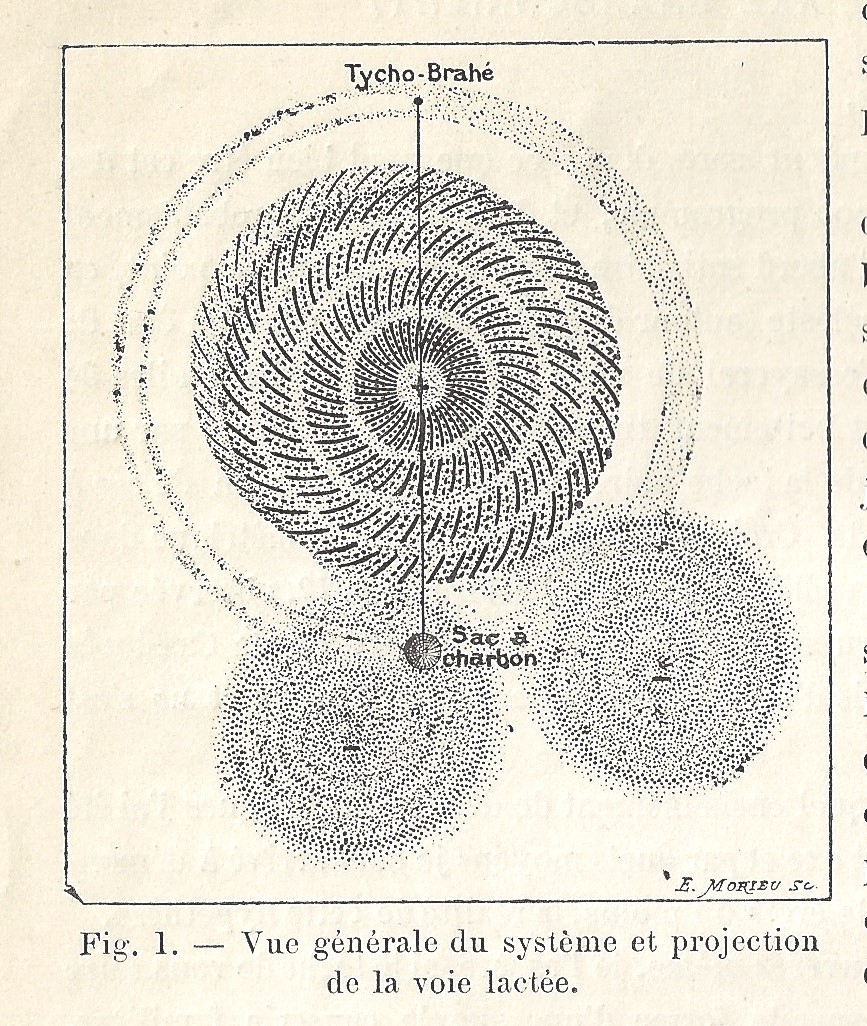
    Back in 1899 the astronomer Adolphe Duponchel1 published a pamphlet on his very involved theories of the motion of the stars and star clusters and the shape of the universe.  I couldn’t understand much of it, and when I thought about it more, I understood less, and probably less than that. I just couldn’t decide what the idea was that he was trying to decipher and share, except to say that it was big. 

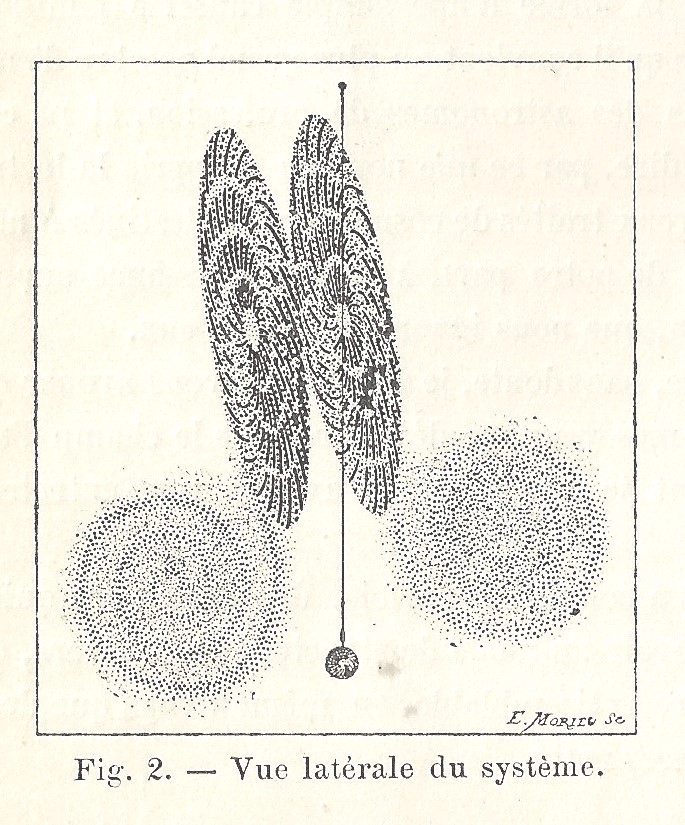
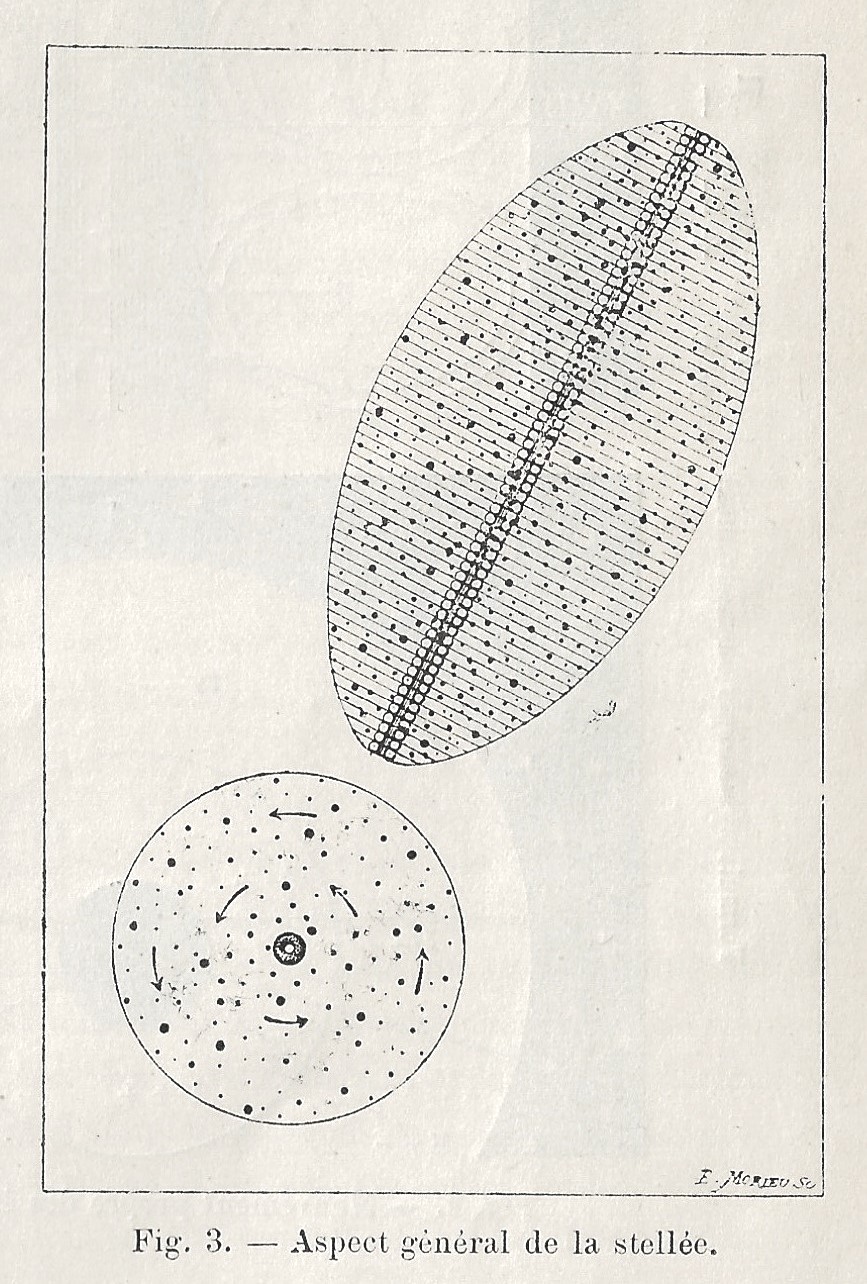
    I wouldn’t have thought about this pamphlet at all it if was not illustrated, because the illustrations in this short pamphlet are quite, well, inspired:

    DocFile (3)

    Duponchel was an accomplished and published civil engineer, canal and bridge builder, and hydrologist, who later in life veered into cosmogony, publishing on the effects of meteors and solar activities on the distribution of stars, the structure of the galaxy, and the motions of the planets. He met with no success from what I can determine, though he seems to have been very active in his starry pursuits through the 1890’s, which was a prime period for French cosmogony. At the very least his ideas look entertaining, and as I said the imaging is quite lovely.

    DocFile (4)

    The truth of the matter is that I do not understand what he is talking about, though sometimes it seems as though he is talking about black holes and the motion of stars, except that he seems to be talking about “apex charbonnier” that are dark regions of space that could not be penetrated given the optics of the day. In general though he writes about what effects the “circulation” of the stars and star clusters.  Liberally translating he states that “no astronomical problem could offer more interest, and in the absence of a solution of a rigorously demonstrated accuracy can be I am happy to have arrived at finding a plausible and at least probable explanation of the simultaneity of all these coordinated movements in the same state of general equilibrium.

    After this very pro forma and enormous statement, we arrive at the unknown stuff of his insight: 

    “…points noirs isolate correspondent a des rayons visuels qui auraient traverse les mailles des deux reseaux sans rencontrer aucune etoile sur leur passage. Dans une seule direction, sur un espace sans doute assez restreint, mais parfaitement defini par son contour piriforme, cette illumination fait reellement defaut.” (“Isolated black/dark spots correspond to visual rays that would have passed through the meshes of the two networks without encountering any stars in their path. In one direction, on a space which is doubtless rather small, but perfectly defined by its “piriforme” outline, this illumination is really lacking.” The translation doesn’t help the original too much, which left me understanding nothing.

    Then, a few pages later, he writes: 

    “…étudier ici tapissant en quelque sorte les parois du vide de l axe s y trouveraient distribuées en anneaux ou pour mieux dire en tores successifs dont chacun correspondrait à une strate particulière en forme discoi dale d étoiles extérieures. Ces to res successifs (figs 1+2) correspondant aux sphères magnétiques qui accompagnent les noyaux solides du Soleil et des planètes comprendraient chacun un certain nombre d étoiles circulant autour de l axe du tore avec un mouvement de rotation ac célérée en spirale comme celui des sphères magnétiques mais avec des vitesses alternativement de sens direct et de sens inverse de manière à assurer des vitesses concordantes de même direction aux points de tangence de deux tores consécutifs…” Or, “Firstly, to study here somehow lining the walls of the void of the axis would be distributed in rings or, to put it better, in successive tori, each of which corresponds to a particular stratum in the form of a disc of external stars. These successive rests (fig 1+2) corresponding to the magnetic spheres that accompany the solid nuclei of the Sun and planets would each include a number of stars circulating around the axis of the torus with a spiral arc rotational movement like that of the magnetic spheres but with alternately direct and reverse direction so as to ensure concordant speeds of the same direction at the points of tangency of two consecutive tori…”  Again, a not-good translation, but I really didn’t have much of an idea of what he was writing about. 

    DocFile (1)

    The pictures are pretty.

    If I’m missing something big, please let me know.


    Notes:

    1. Adolphe Duponchel,  “Circulation de notre groupe stellaire autour de l’axe charbonnier et mouvement parallactique de l’apex Solaire”. Printed by the author, in Paris, 1899, from its appearance in Societe Astronomique de France, 1 March 1899.  9×6″, 18pp.  WorldCat/OCLC reports 1 copy in the U.S. And either 1 or 3 copies at the Observatoire de Paris—otherwise there are no other copies of this work located. Provenance: Smithsonian Institution, and then the Library of Congress (small mostly-faded oval stamp for the SI on front cover, and the LC surplus stamp on the back cover).  

    “Et les individus qui participent à cet engouement pour la quête des origines cosmiques n’épargnent ni leurs efforts ni leur temps pour développer, étayer, rendre publique, et faire reconnaître leurs théories. Ainsi, l’ingénieur des Ponts et Chaussées Adolphe Duponchel (1821-1903), après avoir déposé un pli cacheté à l’Académie des sciences le 27 mars 1893 contenant le sommaire d’une brochure exposant ses « Principes de cosmogonie générale », fait imprimer celle-ci à ses frais et l’envoie à l’assemblée savante. Il n’obtient aucune réponse mais persévère et soumet six Notes ou Mémoires à l’Académie sur ce sujet entre 1893 et 1894. Ne parvenant pas à obtenir le soutien académique qu’il recherche, Duponchel va finalement publier sa théorie dans des revues populaires de science, d’abord dans la revue Cosmos le 2 septembre 1893 puis, sous une forme augmentée, dans la Revue Scientifique les 28 juillet et 4 août 1894.”Volny Fages, “Dire l’origine scientifique des astres. L’engouement pour la cosmogonie en France dans la seconde moitié du XIXe siècle”https://www.cairn.info/revue-romantisme-2014-4-page-32.htm

    See:

    ASTRONOMES FRANÇAIS 1850 – 1950 D’ABBADIE, Antoine.  www.obs-hp.fr/dictionnaire/astronomes_A-Z.pdf

    See: Agnes Mary Clerke , A Popular History of Astronomy During the Nineteenth Century, p 202, a review of some of the later 19th c solar astronomers.

    ·Posted by :

    ·in:

    — —

  • Burroughs, Batman, and Bullets in the History of Holes and Punched Card Computation

    JF Ptak Science Books   Post 2722

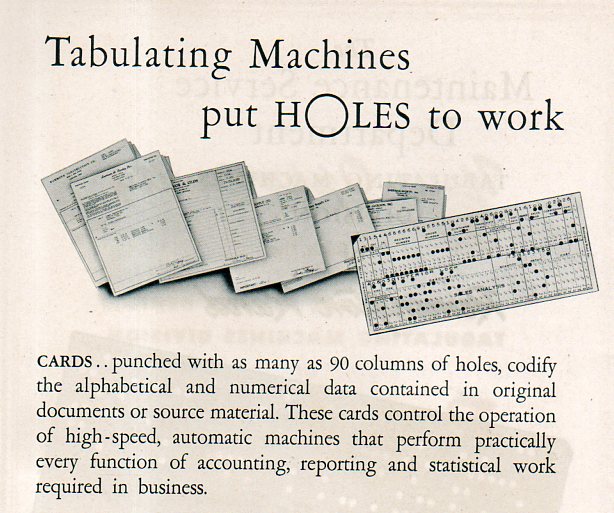
    There is a continuing thread on this blog on The History of Holes–it is a series about, well,  holes and what isn’t in them/what used to be in them/what you can see through them, and so on. This particular section of holes relates to the control and distribution of data and the great efficacy of utilizing holes punched into cards which would be arranged and tabulated in such a way as to order and manipulate mountains of data.  That said I don’t recall seeing anything in print from the heyday of keypunching that actually mentioned the holes, as it does here–nor have I seen a non-William-Burroughs connection made between handguns, bullets, holes, and tabulation. Oddly enough, there is a connection with a crime fighter who didn’t use a gun and whose sidekick used the exclamation “Holy ______ (computer, etc., and no expletives). And so we get to unite punched cards, computers, W.S. Burroughs, Batman, and The Time Tunnel.  (The Time Tunnel?–yes indeed, the tv show from the 60’s can be brought into this as well..)

    Remington rand holes057

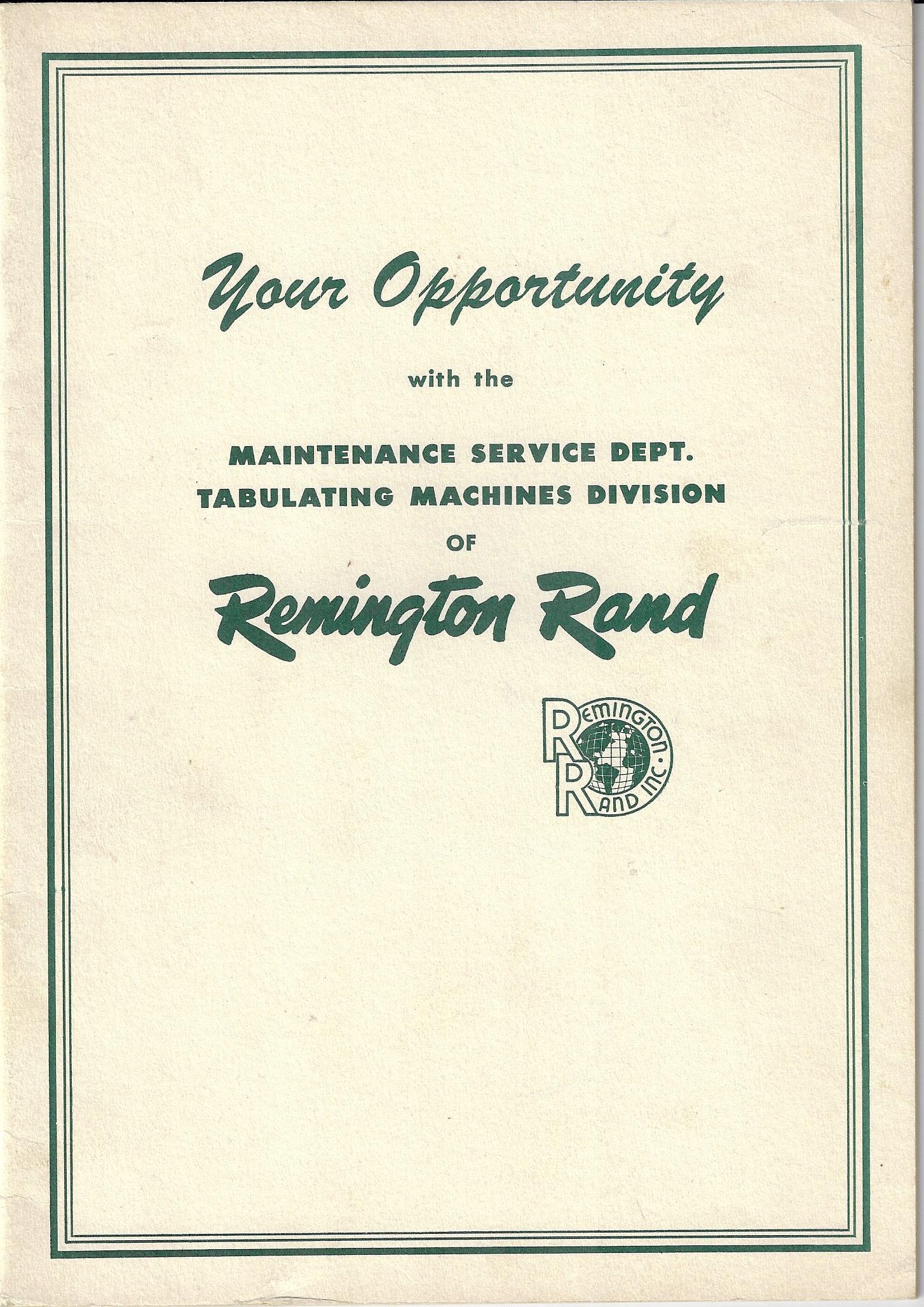
    This is one of the first pages in a promotional pamphlet entitled Your Opportunity with the Maintenance Service Department Tabulating Machines Division of Remington Rand (ca. 1935-40). The title is stubby and factual, and the company was putting out a feeler for future engineering employees who could be trained to service and repair the many machines produced by Remington Rand that could be found in a largish business. 

    Remington Rand at one time was Remington Arms, and then diversified to produce all manner of light and heavy electrical goods (and of course famously producing the standard U.S. Army sidearm, the 45-calber Remington M1911 pistol), and by the end of WWII the company produced a vast line of tabulating equipment (of another order of high caliber).  Interestingly the pamphlet exclaims that a person working for RR could work there for as long as they wanted, that the company was there to stay.  

    Remington rand holes058

    Certainly the company would hang on for some time in one form or another, but the tabulating card division was about to change drastically.  In 1950 RR purchased Eckert-Mauchly Computer Company (ENIAC) and a few years later (1952) secured another giant computer pioneer, Engineering Research Associates (ERA), making Remington Rand about the largest computer company in the world. RR would be purchased a few years later by Sperry in 1955, becoming Sperry Rand, and then simply Sperry a short time after that; later, in 1986, Sperry would merge with Burroughs and become Unisys. Somewhere in there all of these tabulating machine repairmen and techs hired fresh in 1946 would be out of their lifetime job less than a decade later.  

    Now back to William S. Burroughs–the gun/tabulating connection there is that Mr. Burroughs accidentally shot and killed his wife in a game of “William Tell”–he is also the grandson of William Seward Burroughs of Burroughs Adding/Tabulating Machine and computer mainframe fame. (Burroughs was founded in 1886 and became Burroughs Corp in 1953 and was one of the nine major computer manufacturers in the U.S. 100 years after its founding Burroughs Corp merged with Sperry–which had absorbed Remington Rand–to become Unisys.) 

    On to The Batman of the 1960’s tv show where the connection between punched holes and “holy” is obvious and obscure–the caped crusader and Robin used a Burroughs computer (the B205) in the Batcave. The same goes for The Time Tunnel, where we see another use of the B205, used to enable the intrepid time travelers to jump into their funnel-shaped time machine and dive into a hole in time much like Harry Potter at platform 9 3/4.   I suspect that there are more examples, but I’ll stop here.

    • (A big salute to the “Starring the Computer” website, which has an extensive list of the B205 appearing in movies and television: http://starringthecomputer.com/computer.html?c=45  as well as a very long list of appearances of many other non-fictional computers. It is an excellent effort!)

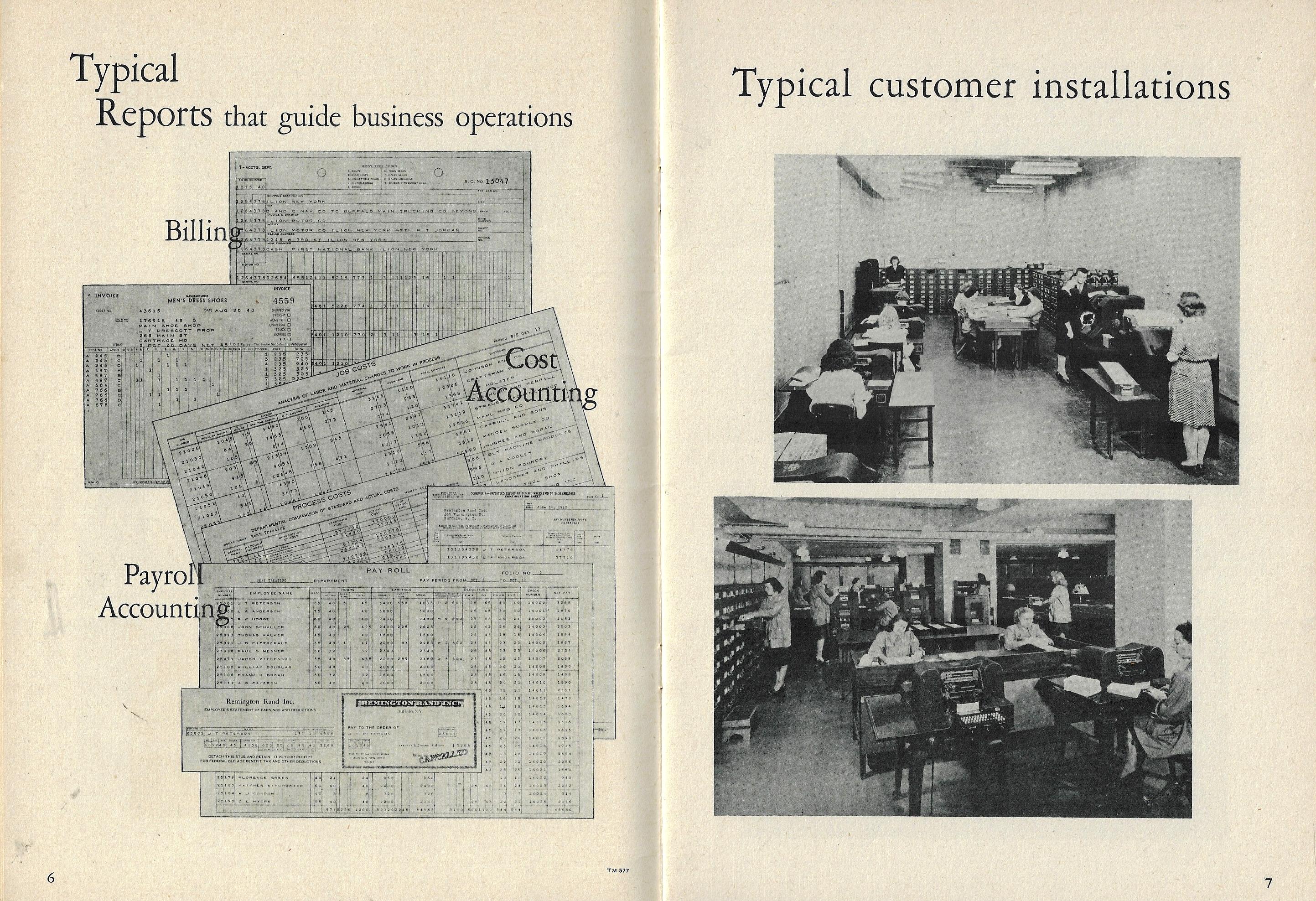
    Lastly, some illustrations from the pamphlet, which surpisingly does not show up at all in WorldCat/OCLC.


    Remington rand holes059

    [“Typical office installations of Remington Rand equipment”]

    Remington rand holes060

    Remington Rand Opportunity _2__0001
    Remington Rand Opportunity _2__0001
    Remington Rand Opportunity _2__0001
    Remington Rand Opportunity _2__0001


  • Holes for the Living and the Dead: Prisoners & Roman Columbaria

    JF Ptak Science Books   Quick Post   Part of the History of Holes series

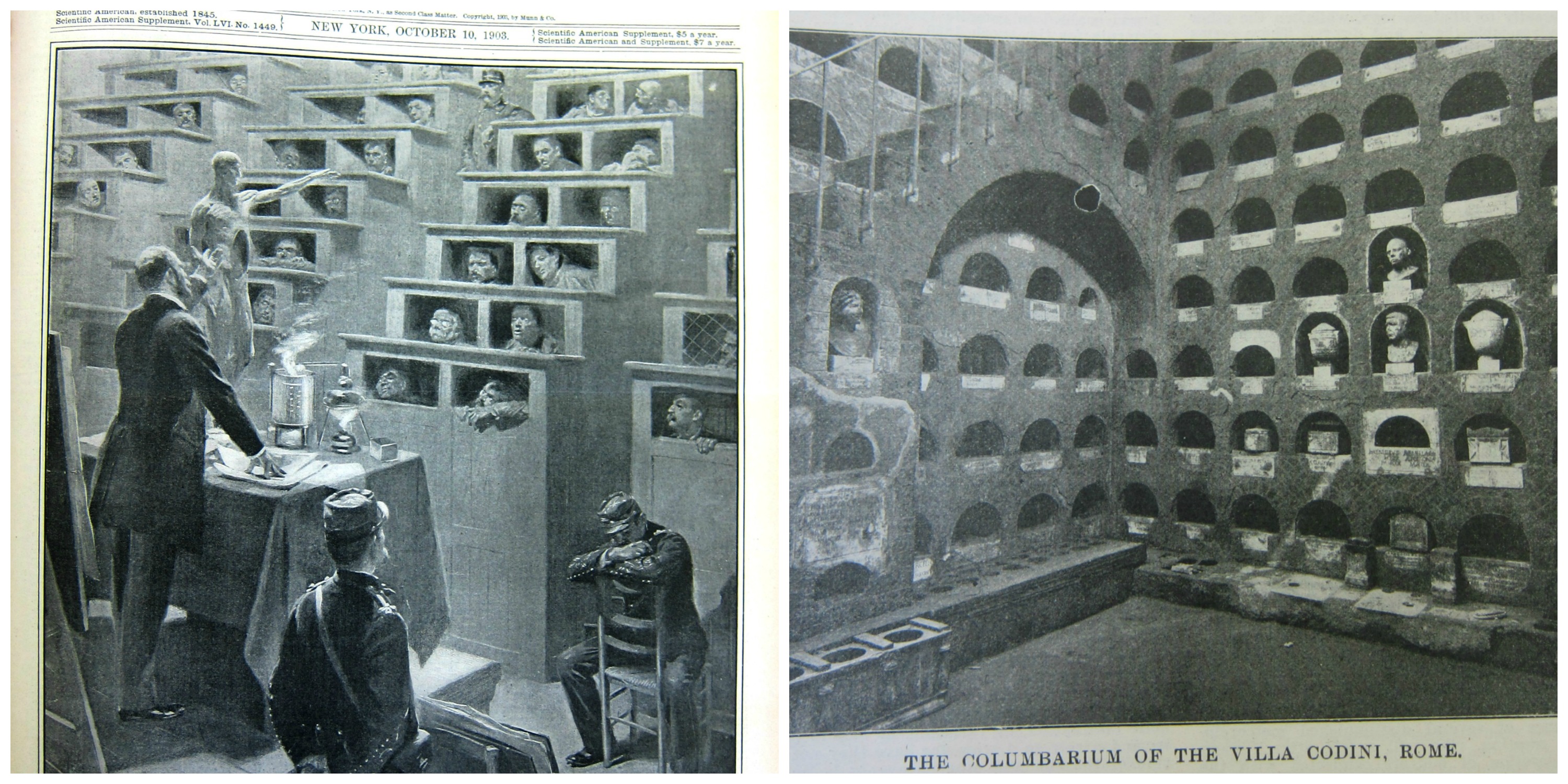
    While browsing a volume of the Scientific American  (Scientific American Supplement #1453, November 7, 1903) I came across a picture of the Columbarium of the Villa Codini, Licinian Gardens, Rome, and then within a minute I came upon a similar scene just dozens of pages away–a striking likeness, though this time the sculpted openings were for the living.  It showed a lecture being delivered to inmates of a criminal sanatorium, hearing about the evils of alcohol, each prisoner stored away in his own little box. “Columbarium” comes from the Latin word (“columba”) for “dove-cote”, and it is easy to see the similarity between the sepulchral images. 

    Columbarium collage


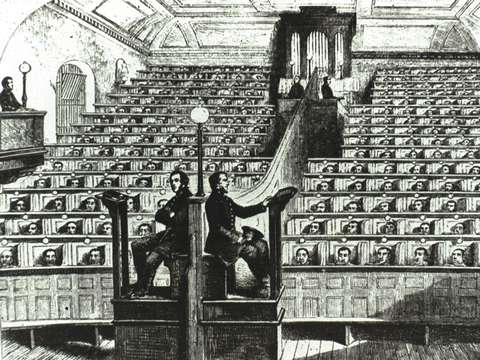
    There is another image that I’ve saved but which has no reference for origin. It depicts prisoners in a European institution attending a Sunday service:

    Hats heads


  • Found Poetry Going into Nothingness (Gestapo Prison, 1944)

    JF Ptak Science Books   Post 2565

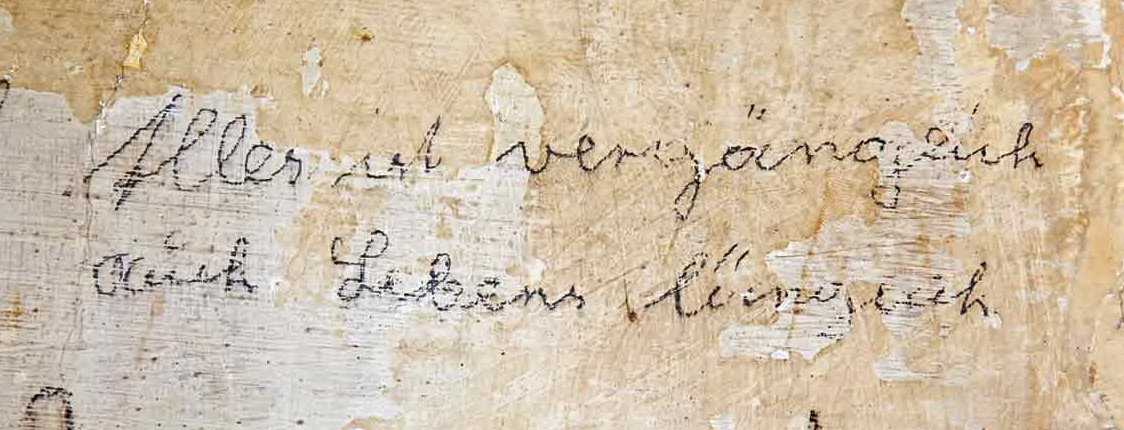
    El-De House inscription

    “Everything is transient–even a life sentence.” [Image source: http://www.museenkoeln.de/ns-dokumentationszentrum/pages/764.aspx?s=764#!prettyPhoto ]

    So reads the inscription on a wall in one of the cells in the former Gestapo “house prison” at the EL-DE House in Koln. There’s no real telling how many people the Gestapo brought to this place.  There were 10 cells in the basement of the building seized of Leopold Dahmen (the “L.D.” of “EL-DE”), but they could be made to hold many people (some as many as thirty) for interrogation and torture. From there, people were sent off to other Gestapo prisons, or to the Buchenwald sub-camp nearby at the fairgrounds,  or shot in the head, or executed right there in the basement on a mobile gallows built for seven that was stored next to the kitchen.

    The Gestapo negotiated to use the building (Appellhofplatz 23-25, at the corner of Elisenstrasse) and put it to heavy use for the next ten years, arresting and kidnapping social agitators, anti-NSDAP, Communists, Democrats, Gypsies, gays, and others deemed to be detriments to society or threats to the government, where they were questioned, beaten, and then generally sent off to some fatal rendezvous.

    The sizable EL-DE Haus survived the 262 air raids on Koln, including the massive (and first) 1000-bomber raid (May 30-31, 1942).  The majority of its seized occupants did not survive EL-DE Haus.  

    Today the building is an historical landmark in the city, a museum of the Nazi era. Many of the inscriptions etched/drawn on the walls of the cells by their prisoners are still visible and have been preserved–some have been restored (in spite of some being painted over in 1979 in a decision no-doubt being either resistant to understanding and full of malicious thought or being entirely thoughtless).

    The inscriptions are recorded at the museum’s website ( http://www.museenkoeln.de/ns-dokumentationszentrum/pages/764.aspx?s=764#!prettyPhoto) along with numerous photos of the cells and the structure.  

    One is particularly lonely, and fearful, and reads in a way like found-poetry of dread unknowing and anticipation:

    “7/9/44 Thursday, 8/9/44 Friday;

    9/9/44 alone

    11/9/44 Monday, 2 Frenchwomen;

    12/9/44 Tuesday, 13/9/44 Wednesday, one German woman;

    14/9/44 Thursday 15/9/44 Friday  

    Wednesday 18th October 1044 Been here 26 days,

    Thursday 19 October 27 days,

    Friday 28th October 28 days,

    Saturday 21 October  29 days,

     Sunday 22 October 30 days.

    So one month here.”

    Someone was desperate. trying to capture time spent in the dank place, recording an existence, calling time by its full name, every day.  And then off to nothing.