A Daily History of Holes, Dots, Lines, Science, History, Math, Physics, Art, the Unintentional Absurd, Architecture, Maps, Data Visualization, Blank and Missing Things, and so on. |1.6 million words, 7500 images, 4.9 million hits| Press & appearances in The Times, Le Figaro, Mensa, The Economist, The Guardian, Discovery News, Slate, Le Monde, Sci American Blogs, Le Pont, and many other places… 5000+ total posts since 2008.

Category: History of Holes

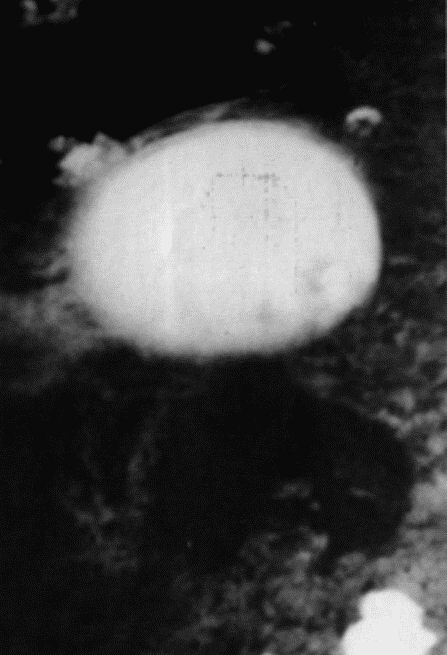
  • A History of Holes: the Hole in the Clouds Over Nagasaki, revisited

    JF Ptak Science Books  (An earlier post from 2010, revised)    [Atomic and Nuclear Weapons Series]

    This post is one in a continuing series on the history of holes–the appearance of this particular hole meant the difference of life and death for hundreds of thousands of people, and it killed almost as many people as it didn’t kill. 

    The hole was in a cloud.  It was a corollary cloud to missing clouds from a few days earlier. 
    NagasakiCloud1Large


    On 6 August, 1945, the primary target of the first atomic bomb to be dropped on Japan was Hiroshima1–had there been unfavorable weather conditions, had the target been obscured by clouds or haze, a second target would be engaged–that was the Kokura Arsenal on the north shore of  Kyushu.  But conditions were bomb-favorable on that day, and Hiroshima was the city that was killed. Little Boy, the U-235 bomb dropped by Paul Tibbets from the Enola Gay  exploded 1,900 feet above Hiroshima. The bomb detonated and–with blast and shock wave and the ensuing damage and conflagration–70,000-80.000 people were killed (and at least double that number within five years).       

    It was a day before the news of the bombing was verified for Tokyo, and another day before the Big Six leaders of the Japanese army and government decided that they couldn’t decide in what to do with the Potsdam declarations and order of surrender.  It was a raging debate among those leaders, and it was a failure.           

    The second bomb, the plutonium Fat Man, was to be dropped by Major Charles Sweeney from Frederick Bock’s  B-29  Superfortress Bockscar on the next target, which was decided to be the  Kokura Arsenal.  And so Fat Man was taken over Kokura on 9 August, but by the time Major Sweeney (who had piloted the Great Artiste behind the Enola Gay on the Hiroshima bombing)  had arrived the previously comfortable atmospheric conditions had turned cloudy, overcast, the target obscured. Sweeney made three runs over the target, but it stayed hidden from the bombardier, and so the people of Kokura were spared. Major Sweeney tuned to his secondary target, Nagasaki.  With fuel running out, the clouds were also running thick over Nagasaki, until the last moment, when a hole opened in the canopy and the bomb was released through it,  exploding  with the impact of 22,000 tons of TNT at about 1640 feet above the city, killing 70,000 people (by the end of the year, 140,000 by 1950).

    The hills around Nagasaki confined the blast and protected those on the other side of them.  Kokura had no such terrain, which means that had the bomb been dropped there, even more people would have been killed outright and many more so over time. 

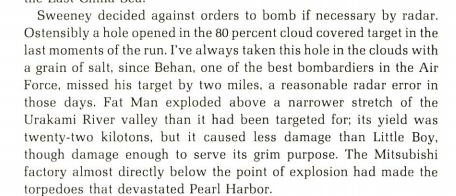
    The hole theory though is not necessarily complete–there may not have been a hole. Nobelist (physics) Luis Alvarez, who made major contributions to the firing mechanism for the weapon and a genius-in-general, and who flew as part of an Aerial Observation Team to assess the yield of the bombs, thought that perhaps there was a hole in the clouds and perhaps there wasn’t–“ostensibly” there was a hole, he wrote. Perhaps the bombardier saw the target, and perhaps not. In his Adventures of a Physicist (1989), Alvarez writes about the misery and the snaufedness of the mission, the clouds over Kokura and the multiple runs, the very low fuel which allowed only for one run on the Nagasaki secondary, and the growing accuracy of the flak from below. On page 145 he states that pilot Sweeny had decided against orders to attempt a radar-guided bombing of the 80% cloud-covered target–until suddenly the famous hole appeared, and bombardier Kermit Behan found the target and released the weapon.  Alvarez records that the bomb detonated about 2 miles off-target, which he said would have been a “reasonable error” for a radar-controlled drop, which would fit nicely with the his claim that Behan was Air Forces’s “best bombardier”.  Alvarez said that he took the report of the hole “with a grain of salt”2.  (See extract below.)

    In any event, some sort of hole opened for Nagasaki, and closed for Kokura.

    It is interesting to note that “the luck of Kokura” or “Kokura luck” is a translated Japanese euphemism for the unknown avoidance of disaster, of escaping a tremendous fate without knowing it.  (This appears often on the internet though I am using as a source The History and Science of the Manhattan Project, by Bruce Cameron Reed, Springer, 2014, pg 400.)

    Notes:

    New York Times correspondent William L. Laurence flew in the Great Artiste, following Bockscar  that delivered the bomb 1640 feet over Nagasaki. His report on Nagasaki appeared a month later in the newspaper, and the full text is available via the Atomic Archive blog here.  

    1. The targets discussed  by the Targeting Committee (“Minutes of the second meeting of the Target Committee, Los Alamos, May 10-11, 1945″) on 10 and 11 May 1945 included the following:
    (1) Kyoto (the former capital with one million people, a center of religious and intellectual life in Japan This target is an urban industrial area with a population of 1,000,000. It is the former capital of Japan and many people and industries are now being moved there as other areas are being destroyed. From the psychological point of view there is the advantage that “Kyoto is an intellectual center for Japan and the people there are more apt to appreciate the significance of such a weapon as the gadget”;  (2) Hiroshima (listed as an Army depot though “due to rivers it is not a good incendiary target”; (3) Yokohama (one of the largest remaining untouched industrial centers in Japan); (4) Kokura Arsenal (one of the largest in Japan and situated by urban industrial sprawl); (5) Nigata (port on Honshu) and (6)the Emperor’s palace (which was discussed  as a possible target but dismissed almost immediately).[Yawata was also considered (as an industrial center) (during the preliminary meeting of the targeting committee on 2 May 1945) (along with Tokyo, Nagoya, Osaka, Kyoto, Kobe, Hiroshima and Nagasaki.]
    .
    The members of the targeting committee (source for this material is Gene Dannen at Dannen.com, transcribing targeting material of the U.S. National Archives, Record Group 77, Records of the Office of the Chief of Engineers, Manhattan Engineer District, TS Manhattan Project File ’42-’46, folder 5D Selection of Targets, 2 Notes on Target Committee Meetings) included (on 10 May): “General Thomas  Farrell,  Dr. Charles C. Lauritsen, Colonel L.E. Seeman, Dr. Norman Ramsey, Captain Parsons,  Dr. Robert L. Dennison, Major John A. Derry, Dr. John von Neumann, Dr. Stearns, Dr. Robert R. Wilson, Dr. Richard C. Tolman, Dr. William G. Penney, Dr. Robert Oppenheimer.”  In attendance for the 11 May discussion was  Dr.Hans Bethe and Dr. Brode, plus: Colonel Seeman,  Dr. Stearns, Captain William S. Parsons, Dr. John von Neumann, Major Derr, Dr. Robert L. Dennison, Dr. Richard C. Tolman, Dr. Penney, Dr. Oppenheimer , Dr. Ramsey and Dr. Wilson.”

    2.  Alvarez on the hole:
    Alvarez nagasaki[Source, Luis Alvarez, Adventures of a Physicist, 1989, p 146.]

  • Millions of Miles of Hole-Filled Paper–Dystopia, Entertainment, Vonnegut and Prison

    JF Ptak Science Books 

    {Part of this blog’s History of Holes and History of the Future series.]

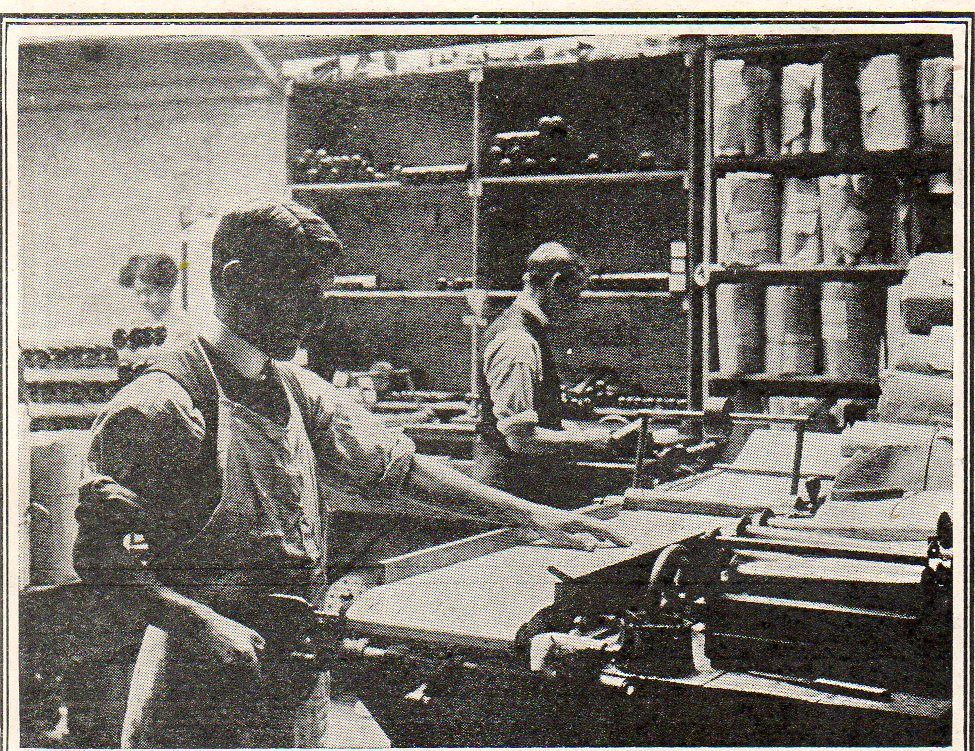
      Music role making--1871 There is a certain layered, geological dystopic quality to the  images of these men laboring at producing piano rolls for player pianos (and found in The Illustrated London News for 18 December 1909). This is true especially for the details, the small boxes in the background to where the rolls are being “processed”–music pounded out with metal points on a hard surface, as though produced by whatever it was that was in those little labeled wooden containers, far removed from the artistry of melody. These are images of a culture being made into hundreds of thousands of miles of hole-filled paper.

    The piano roles remind me of automatons replacing humans in entertainment, and then replacing the humans making the piano roles; of machines taking over the jobs of people writ large.  There’s a long and rich literary history of this idea, not the least (or first) of which is the appropriately-named Player Piano, Kurt Vonnegut’s first novel, written in 1952.  Like a tiny idea-machine, Vonnegut manufactured part of his tale from Brave New World, with Huxley having taken his bit from an earlier novel, We, written by Yevgeny Zamyatin in 1921–they’re all bleak images of a future dominated by machines, the humans acquiring numbers for names, like the replaceable and expendable units they became. 
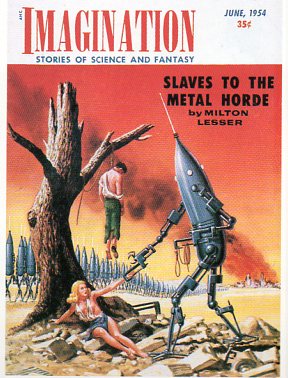
    (Artwork by Malcolm Smith for Imagination, June 1954.)

    Robots in ocntrol--hanging human879

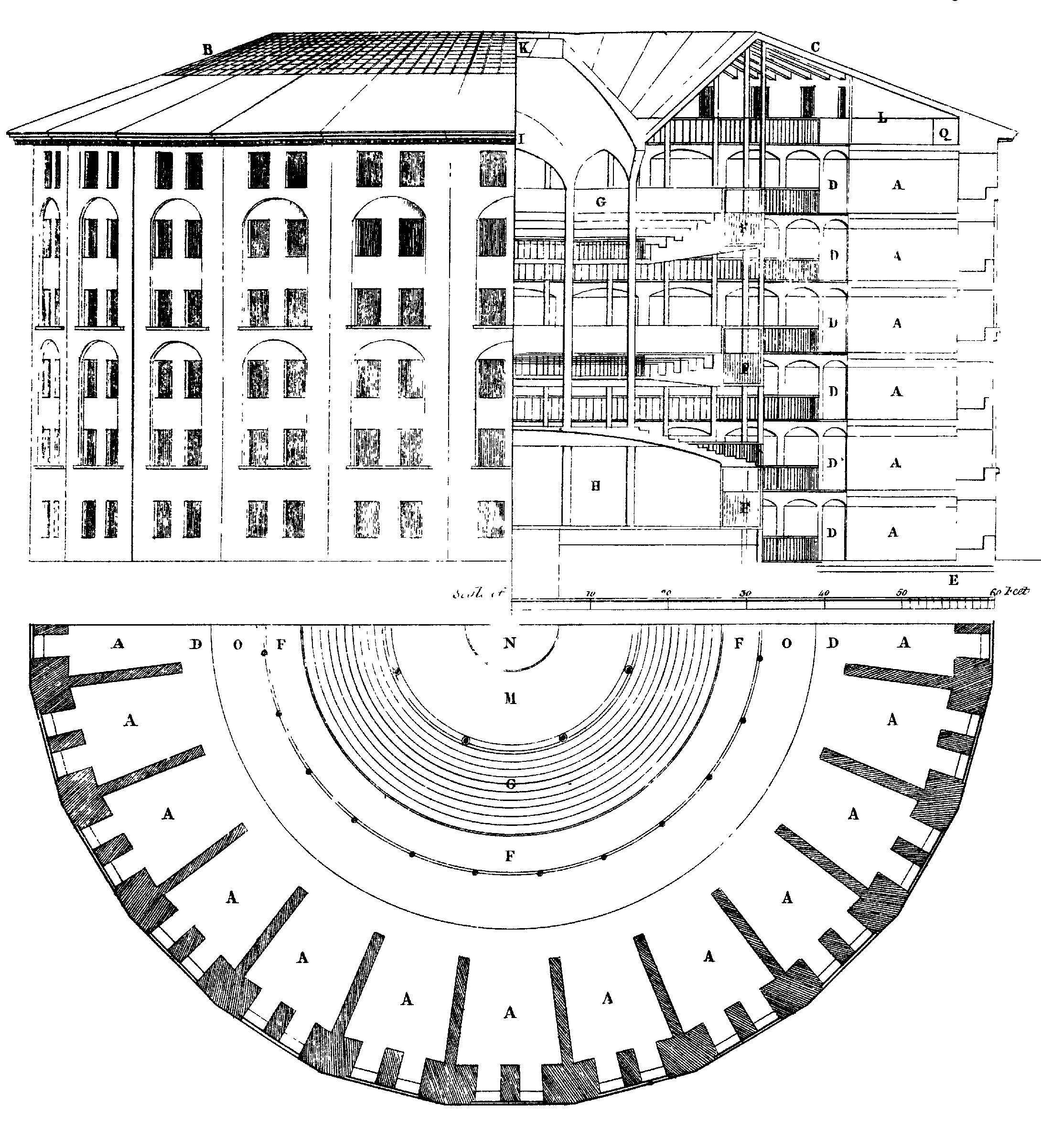
    The devices for producing the roles remind me of Jeremy Bentham’s panopticon, a functional prison designed so that all of the prisoners could be viewed from one central point.  The profile of the place reminds me of the geared punch machine for the piano roles; I’m not at all sure about what the function of the prison reminds me of.  But in the history of holes, I guess all it foes it fill u its empty holes with people, keeping them there for months or years or decades, and then replacing them with other people, part of a long and continuing series.

    File:Panopticon.jpg

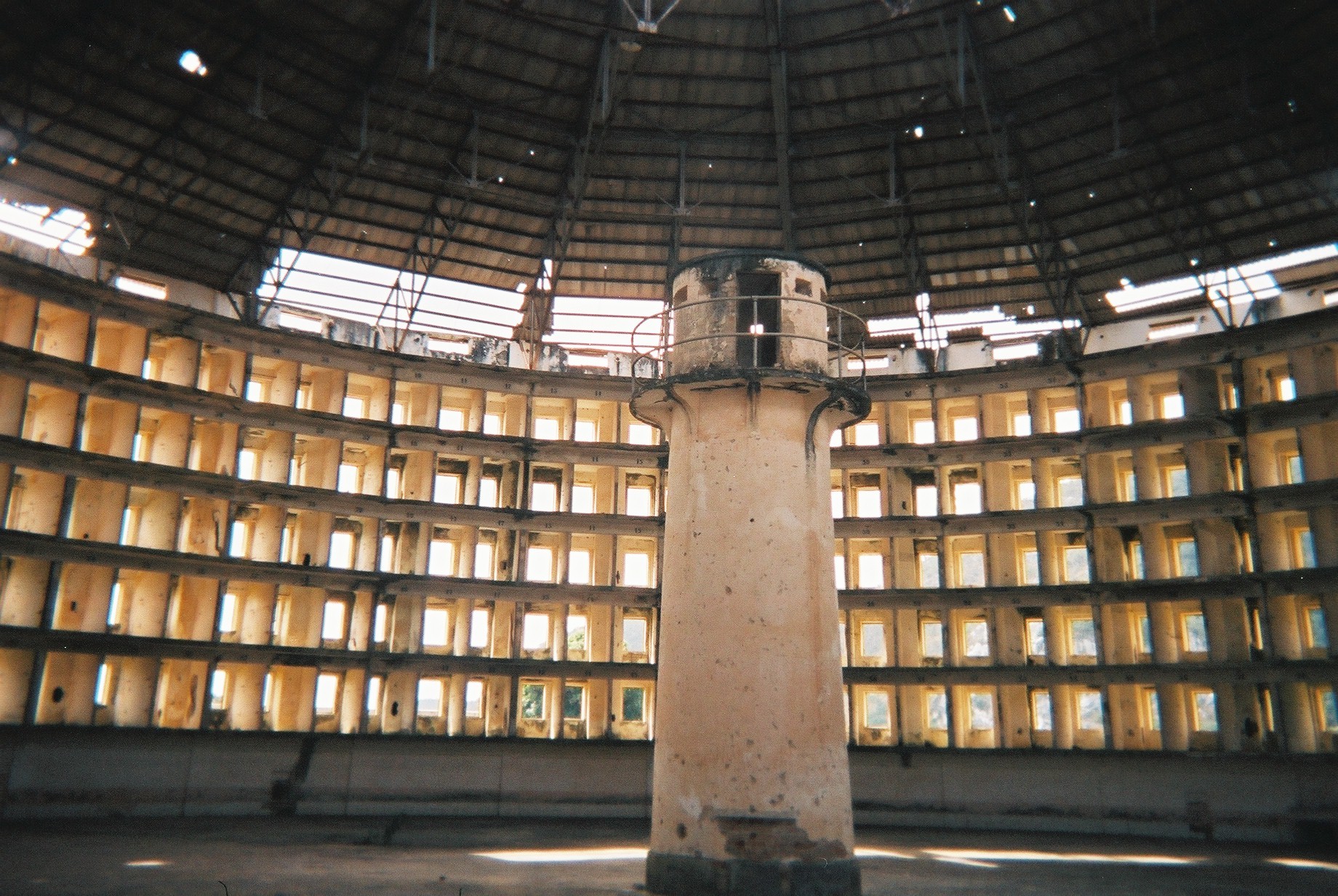
    Here’s the panopticonal prison at Presidio Modelo, Isla De la Juventud, Cuba–with the walls laid flat, and some cells filled-up, and reduced, you may be able to make a certain music with it, like reading the scores made by pigeons roosting on a five-wire-strung staff of utility poles. My daughter Emma just suggested that there could be a Morse Code crossover as well!)

    File:Presidio-modelo2.JPG

    The plan and elevation of these prisons relate to the player paino paper, like the early dots and dashes of communication, like the punched cards that Vonnegut had in mind when he was writing his early classic. 

    Now, the rest of the Illustrated London News story:


  • A Big Dark Spot in the History of Spots

    JF Ptak Science Books   Quick Post    

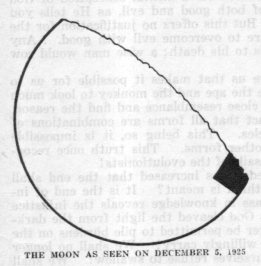
    Spots.  Being in a tight spot, Spot the dog, SPOT satellite, spot-on, spot price, spotlight, Data’s (STNG) Spot the cat, the Great Red Spot, and on and on, most of the remained of “spots” seemingly having to do with animal and largely bird names (spot-billed, -necked, -legged, -breasted, -tailed, etc.). There are certainly “spots” in the history of art, though I have a hard time referring to Malevich’s circles as spots; I have no problem calling Damien Hirst’s spots “spots” though I would not call them “art”. There were spots on the Moon for some time under they were revealed to be Mare, and in the world history of spots I think that was the only spot relating to the Moon, outside of the spot picked for the Apollo spacecraft to land. That is until today, when I bumped into this not-remarkable remarkable outsider-y pamphlet that was ostensibly a screed against the International Court of Justice and the League of Nations…except that the broadside opens with a mighty salvo proclaiming a miracle of a black geometric spot that appeared on the Moon’s surface on December 5, 1925.

    If there was any proof necessary beyond a drawing of the spot, there is none.  Why throughout the world of telescopes and observatories that no one anywhere thought to make a photograph of an irregular quadrilateral shape occupying 5% of the surface of a half-Moon is a secret mysterious outer space mystery secret.  Mystery.

    But there is a drawing of it. And here it is.  

    Moon spot494


    [Source of the mystery:  “The Great Miracle of Yesterday! As Thou Sawest it, so ws it!” , by “A Humanist”, one-page, two-sided broadsheet, printed 1925. I have a number of other bits by the author, all of which are as slippery with commonly-acknowledged reality as this one.]

    ·Posted by :

    ·in:


  • A Cemetery for Craters

    JF Ptak Science Books  Post 2364                                                           History of Holes series

    [Thanks to Jonathan Harvey for surfacing this image earlier today.]

    Cemetery for Craters.  That is what came to mind reading an article on WWI and the Hooge Crater Cemetery

    Craters are holes usually filled with dead people, a cemetery powering its way through the air looking for a place to land.  You can assume that many of the shells fired dfuring WWI were indeed flying cemeteries which landed and exploded, making their crater and creating a cemetery in it. 

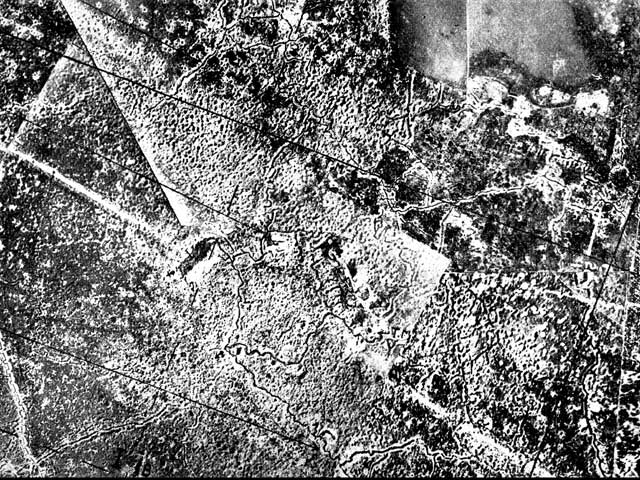
    This is what the town of Hooge looked like after the vicious fighting that took place there in the  Battle(s) of Ypres: 

    Crater hooge aerial

    [Source: Australians on the Western Front]

    The Hooge Crater Cemetery is actually a cemetery in Hooge, Belgium, which was a salient in the massive ultra-battle of Ypres, which was just about a war in itself, along with other gigantic battles such as Verdun and the Somme. And Gallipoli.  And Brusilov. And another two dozens battles in which 100,000+ were killed.  Ypres was actually three major battles which were fought in 1914, 1915 and 1917; the Hooge Crater was made by a giant mine placed by the British in the German lines on 30 July 1915.  Since the geography of Hooge was fairly flat, and since the mine made such a huge crater with massive uplifts, it became a significant part of the battlefield itself–it was captured and lost and re-captured numerous times over a three year period, the last time in September 1918, right before the end of the war.  

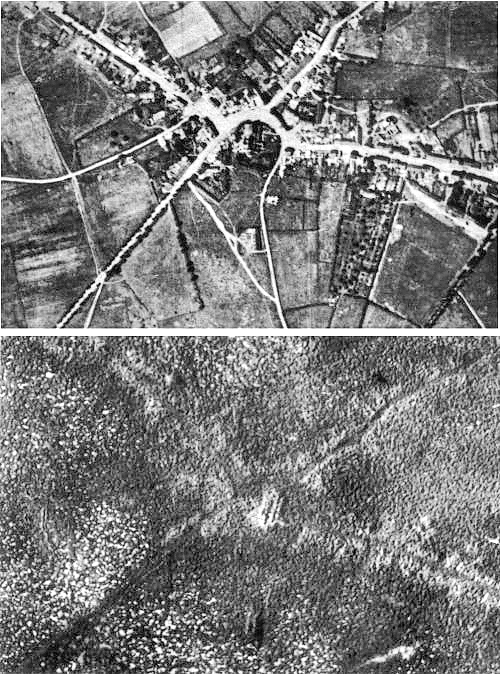
    I didn’t find a before/after aerial for Hooge, but I did for the village of Passchendaele, which turned into another cemetery of craters, especially after the vicious fighting that took place there in the Third Battle of Ypres in 1917.  Nothing but holes: 

    Crater passchendaele_aerial_view

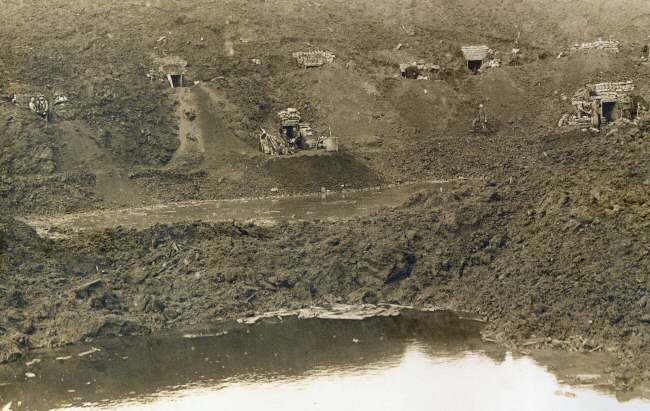
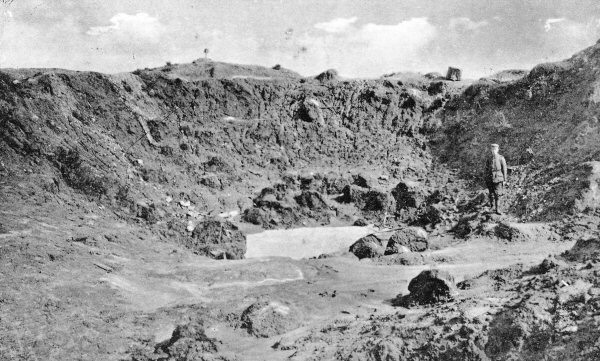
    The Hooge Crater was made by an explosive at the end of a 200′ tunnel dug by the175th Tunnelling Company of the Royal Engineers under No Man’s Land to find itself under the German entrenchments–when the charges placed at the end of the tunnel were exploded, it created a crater 20′ deep and 150′ across.  

     This is what it looked like from a crater’s-eye-view, with dugouts being made its walls:

    Crater hooge dugouts

    [Source: World War I Battlefields:  Hooge, here.]

    And another:

    Hooge_crater_1915[Source: World War I Battlefields:  Hooge, here.]

    I recollect that there were hundreds of millions of artillery rounds fired during WWI, most I think above 75mm (I cannot find this source offhand)–in any event the total number of crater creators was somewhere in the vicinity of the world’s population, something on that order.  A lot. 

    And the very odd thing is that there were enough holes made to perhaps bury every other person on the planet.  

    ·Posted by :

    ·in:

    —

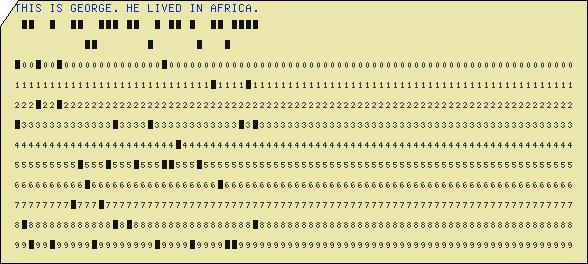
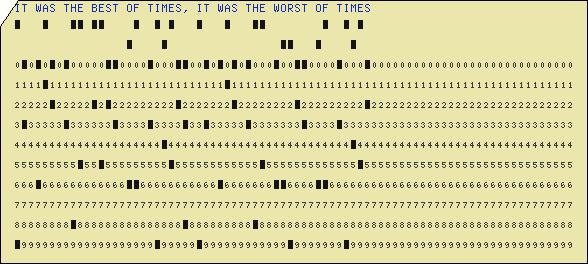
  • Great Opening Lines of Fiction in Punch Card Form

    JF Ptak Science Books   Quick Post   History of Holes series

    Happily (!) featured today (14 July) on the blog of the 

    Paris review 2

    Punch card georgeH.A. Rey, Curious George.  

    Isn’t this great?  I bumped into a wonderful site called kloth.net  (http://www.kloth.net/services/cardpunch.php) that provides a free-to-all and unrestricted use of their punch card emulator.  It was found while looking for dating ideas for an IBM 5081 card that I have that has programming information for the BINAC computer (ca. late 1940’s), and kloth.net had info on the history of IBM cards as well as the emulator–plus other stuff. Completely distracted from the BINAC quest, I created some cards using some great first lines of literature.  You can play too!  


    Punch card dickens

    Charles Dickens, A Tale of Two Cities.


    ·Posted by :

    ·in:


  • History of (Electronic) Holes, 1946

    JF Ptak Science Books  Post 2229           History of Holes series

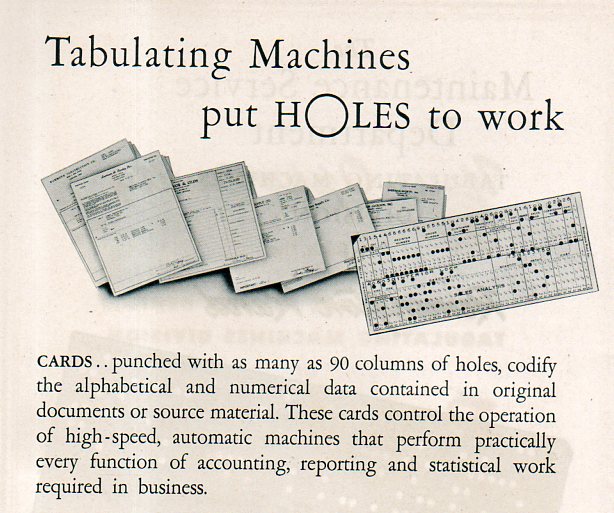
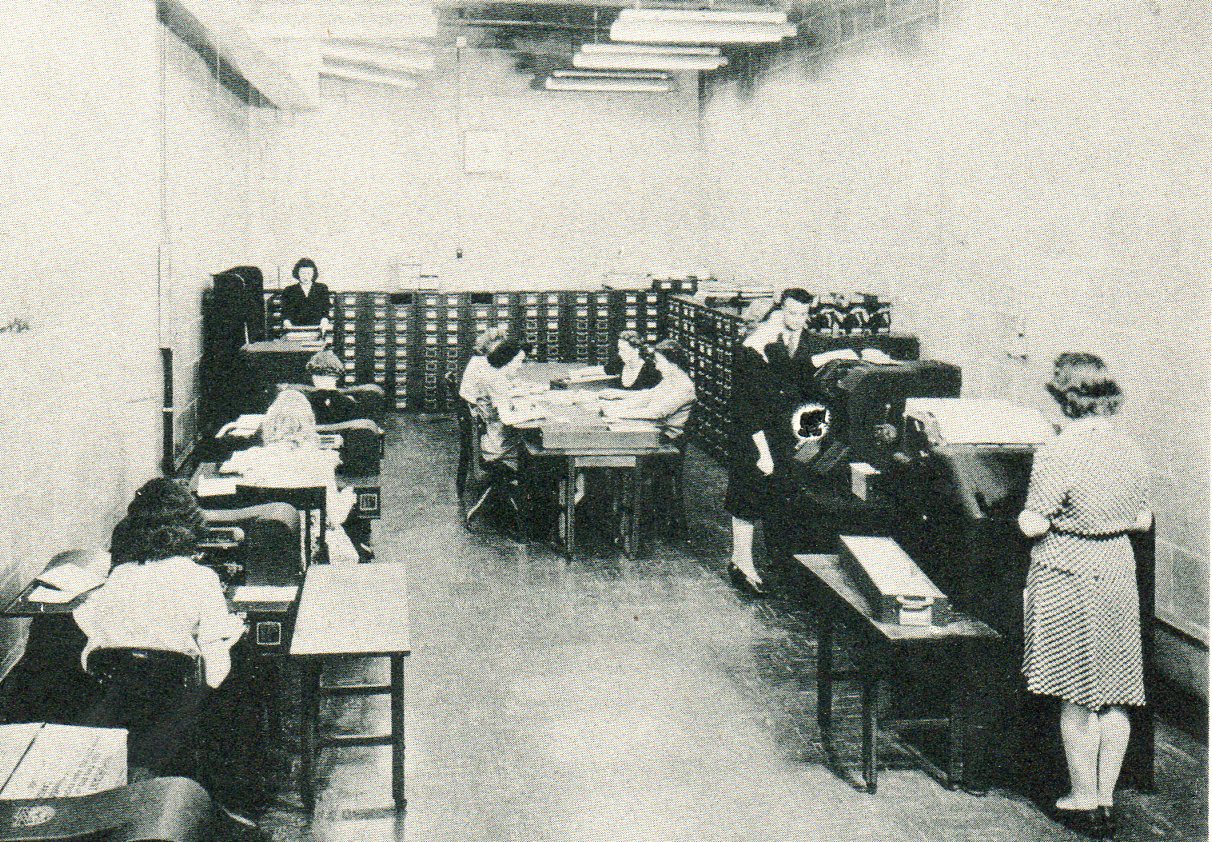
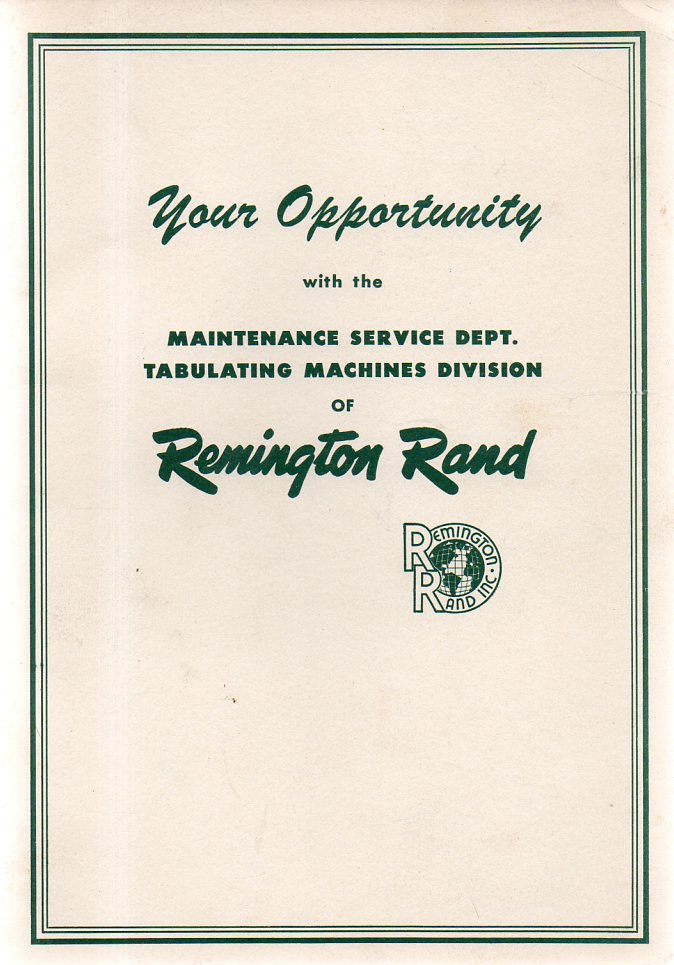
    I’ve written elsewhere in this History of Holes series about holes and electricity and the Jacquard loom and early tabulating machines–but I’ve never seen anything in-print from this period of time using the word “holes” to promote a tabulating device.  And here it is in a Remington Rand promotional for scouting field service technicians, and printed ca., 1946:

    Remington rand holes057

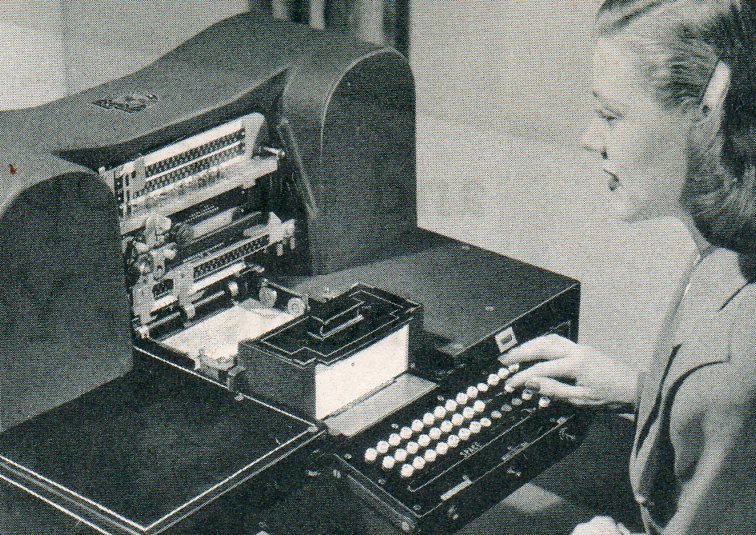
    Remington Rand at one time was Remington Arms, and then diversified to produce all manner of light and heavy electrical goods (and of course famously producing the standard U.S. Army sidearm, the 45-calber Remington M1911 pistol), and by the end of WWII the company produced a vast line of tabulating equipment (of another order of high caliber).  Interestingly the pamphlet exclaims that a person working for RR could work there for as long as they wanted, that the company was there to stay.  

    Remington rand holes058

    Certainly the company would hang on for some time in one form or another, but the tabulating card division was about to change drastically.  In 1950 RR purchased Eckert-Mauchly Computer Company (ENIAC) and a few years later (1952) secured another giant computer pioneer, Engineering Research Associates (ERA), making Remington Rand about the largest computer company in the world. RR would be purchased a few years later by Sperry in 1955, becoming Sperry Rand, and then simply Sperry a short time after that; later, in 1986, Sperry would merge with Burroughs and become Unisys. Somewhere in there all of these tabulating machine repairmen and techs hired fresh in 1946 would be out of their lifetime job less than a decade later.  

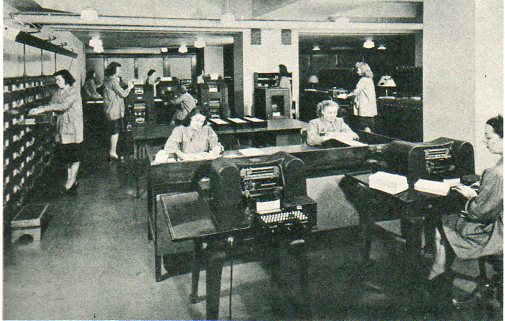
    [“Typical office installations of Remington Rand equipment”]

    Remington rand holes059

    Remington rand holes060

    Remington rand holes061


  • Fortified and Organized Shell Holes

    JF Ptak Science Books  Post 2150    History of Holes

    Organized Shell Holes     craters: organised

    In this blog’s longish series on the History of Holes, holes caused by explosions meant to kill people have shown up only once (on a post about Dien Bien Phu).  There is an associated post on the use of people-killing nuclear eapons being used to excavate vast amounts of Earth (and for dust abatement), and another on stump blasting, but thus far there has been little on killing holes.  (There are a number of posts about coffins and digging graves, but that is another story.)

    The holes for today are symbols for various types of holes that were used on WWI trench maps found in the MacMaster University collection. The site has an introductory page relating to the symbols used on the trench and battle-field maps, signifying the palcement of crates made by high explosives and whether those holes were being re-purposed–mainly, were they still just holes, or were they being used now for troop placement, and whether those holes were fortified, and whether they were organized.  Given the millions of rounds of ammunition/HE thrown from one side to the other it stands to reason that the craters left by bombardment would be put to some good purpose, and that the commanders would necessarily need maps of their placement and where these holes fit in with the existing defensive arrangement (the trenches, for example, being themselves a sort of hole)–still, seeing the symbols for the re-engineering of the death-holes seemed wrenching to me, even in spite of the need to make them useful.  

    Craters: 

    Organized Shell Holes     craters: organised

      regular    craters: regular  

    fortified    craters: fortified
     

    ·Posted by :

    ·in:


  • History of Holes: Holes in the Quickening of Telegraphy, 1859

    JF Ptak Science Books   Post 2075   History of Holes series  Follow Me on Pinterest


    While grazing through the 1859 volumes of the Comptes Rendus1, looking around for anything having anything to do with Mr. Darwin and his Big Book published later in this year (on 24 November), I got a little lost as usual, and was digging around the early months, and came upon the drawing above.  Mostly I was attracted to it for the holes, as there is a longish thread/series on this blog devoted to the History of Holes, and though at first blush that it might actually be a Runic something, or Islander counting stick.  When I actually started to read the article it was none other than the recording strip for telegraphy, devised by Charles Wheatstone (1802-1875), famous for his Wheatstone bridge and for his experimental determination of the speed of electricity2).  Now the recorder part of this was not on the receiving end, but rather on the sending–Wheatstone devised a way of recording the strokes of a telegrapher’s key and translating them into two rows of holes; the message was recorded on the strip of paper and then fed into a machine that would do the keywork, using the punched paper tape to control the transmitter–it turns out to have been a significantly faster method than by simply having messages struck by human operators, which was  abig deal at the time because of the expense of sending telegraphic messages, reaching speeds of 130 wpm early on (and then 300-400 wpm later on a good circuit)3. 


  • The History of Holes: Empty Holes in an Early “PC”

    JF Ptak Science Books   Post 2074   History of Holes series  Follow Me on Pinterest

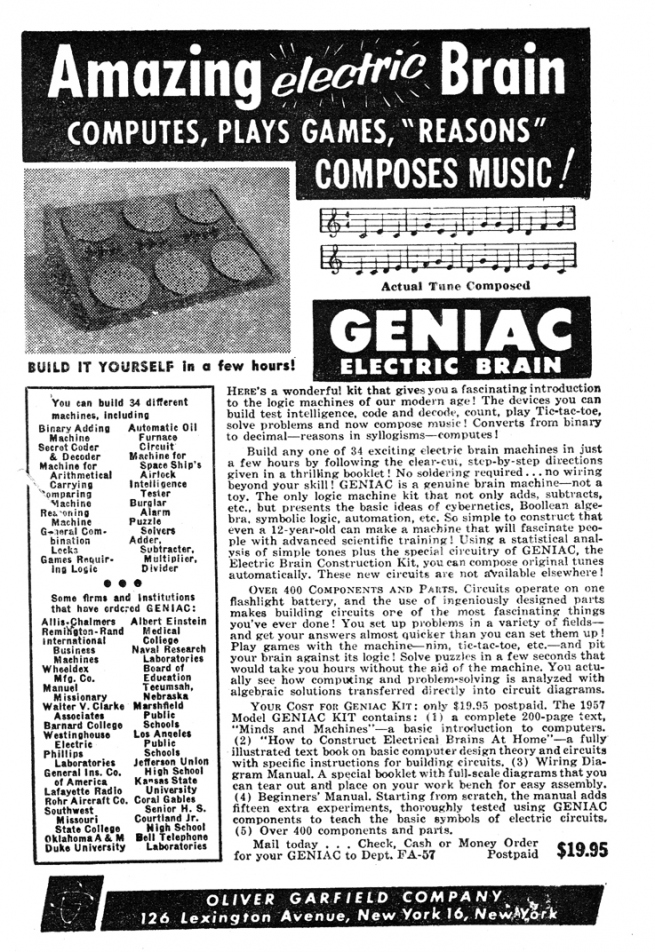
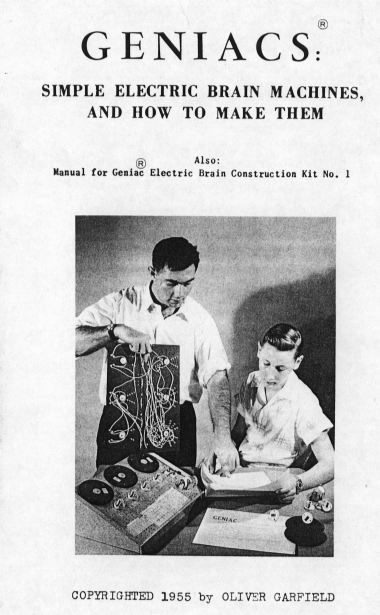
    These are some of the earliest holes in one of the very first personal computers–they were made for ease of wiring and other applications in the Geniac, a 1955 DYI kit from the indomitable Ed Berkeley, a machine well in advance but much of course the inferior of the Mark 8 (1974) and the Altair 8800 (1975), the later of the two seen as being about the very first modern “personal computer”. There weren’t too many empty holes in those two machines.


    Geniac415
    What had no relays, or transistors, or tubes, and was manually self-sequencing and human bit state switching, the name ending in “-iac”, and made in 1955? The “Geniac”, made and manufactured by the smart and enterprising Edmund Berkeley and Oliver Garfield–the “Genius Almostt Automatic Computer”. It was I think the first in a line of early non-computer-computer-that-really-was-a-computer-according-to-Alan-Turing computers that a person could own and own at home, and it was followed pretty close on heals by the Tinyac, the Weenyac, and the Brainiac. 

    Geniac[Source: Dr. Gangrene, here.]

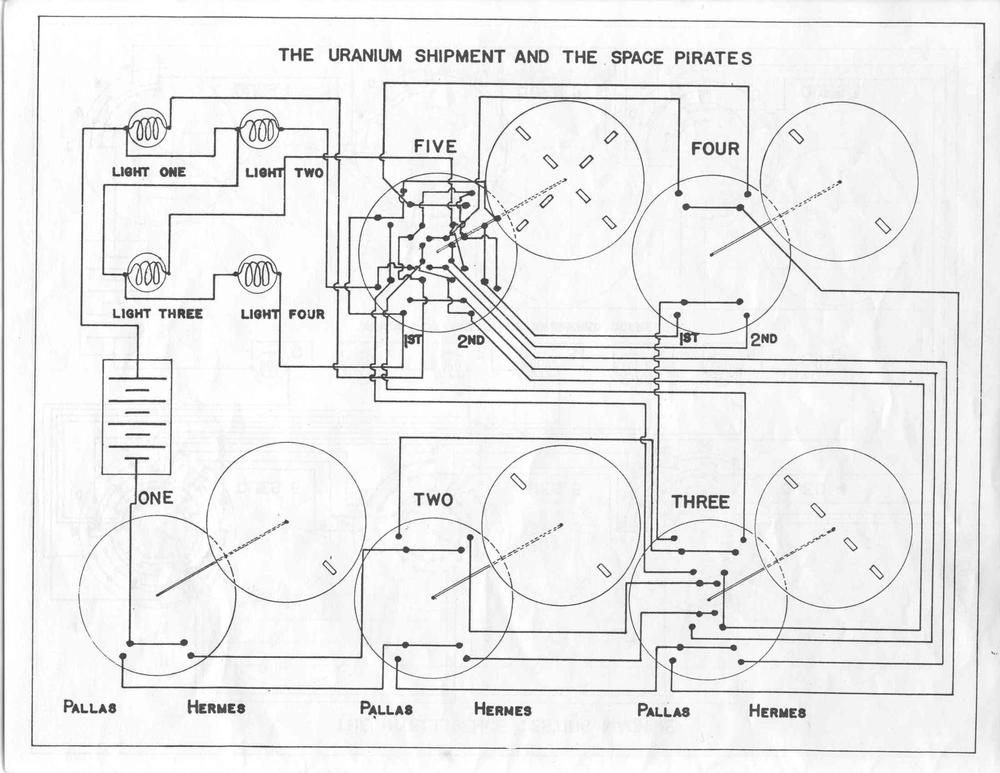
    The Geniac was/is a pretty neat tool–I hesitate to call it a “toy” as others have, mainly because it takes itself pretty seriously and still have fun, and includes diagrams and drawings for interesting sets of problems and tasks, from playing tic-tac-toe, to “testing” I.Q., to determining the male/female-ness of the respondent, to playing a very very mildly interactive game of uranium prospecting and alien hunting.  It was a fine construction, and  introduced the user to Boolean equations and the concepts of a working computer, all with hands-on education and a dry cell power course.  And that’s pretty good. 

    Geniac cover[Source:  Blinkenlights, here.]

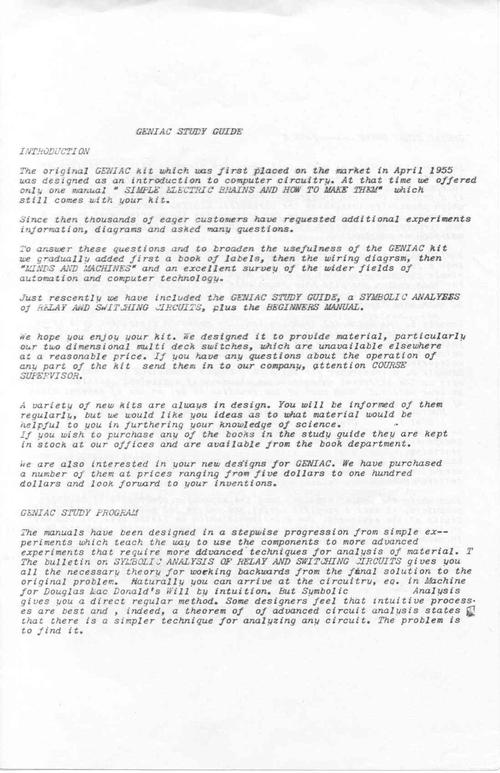
    Geniac Study Guide, via Computercollector.com (for the rest of the document):

    GEniac study guide
    Wiring diagran for the Uranium Shipment and Space Pirate game, again, via the computercollector.com

    Geniac  uranium
    See also the GENIAC entry at the Old Computer Museum, here.


  • Deep Depth: the DepthScraper or Deadscraper of 1931?

    JF Ptak Science Books Quick Post  Part of the History of Holes series

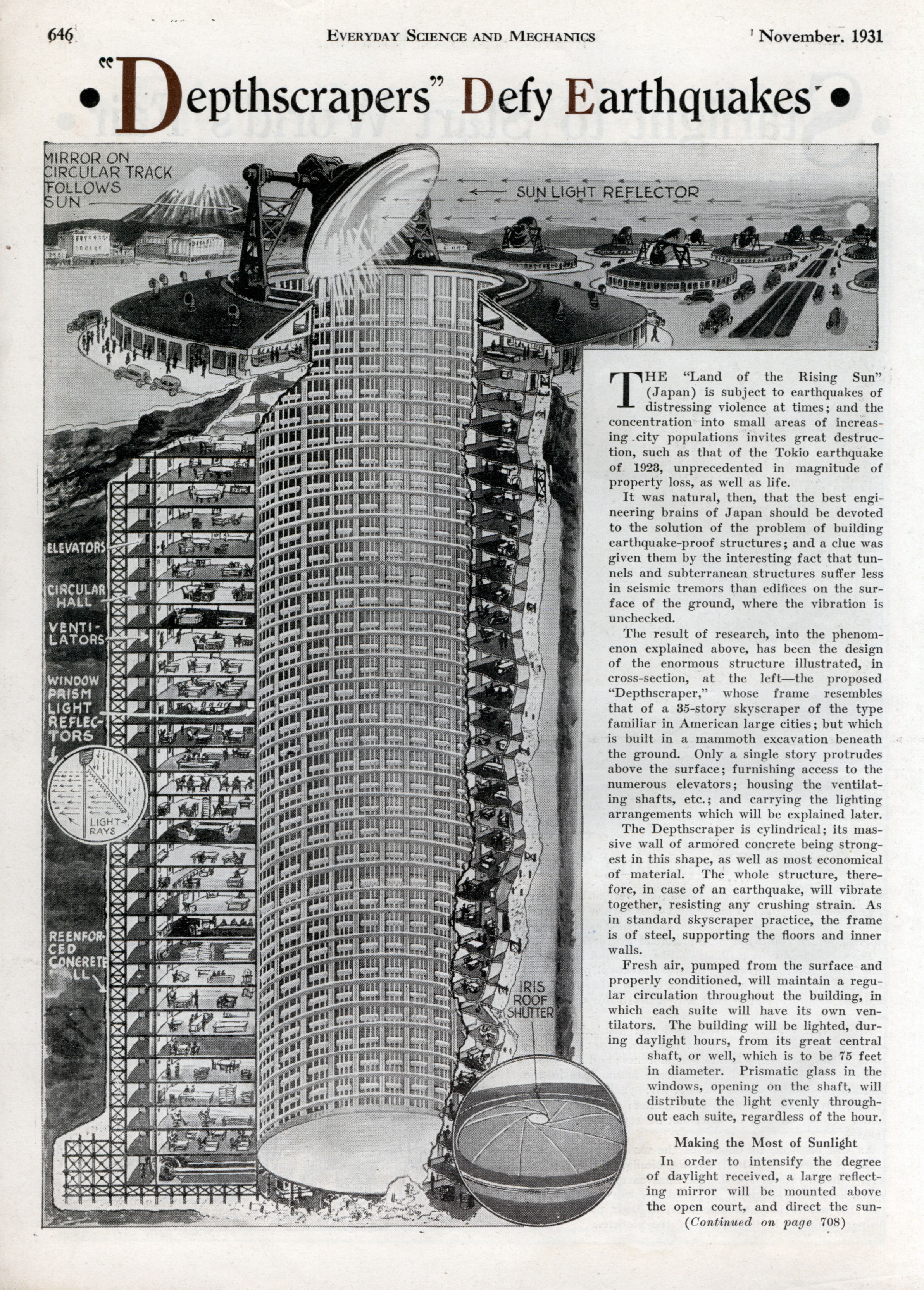
    I’m more interested in how this hole was dug and how it got filled up again than in what is filling it.  I estimate the “filled” aspect of this reverse-and-inside-out-upside-down monastery to be about 25,000,000 cubic feet, or about two-thirds of the volume of the Empire State Building (which was just being constructed when this article was published).  The 40-storey building would about 500′ low, and the surrounding supporting structures seem to make the whole of it at least 75′ in diameter–finished.  That makes for a big hole in the digging of the thing, substantially multiples the volume of the Empire State Building removed in order to achieve the construction needs.  That is a lot of dirt.

    Underground depthscraperAnd so how do we remove the dirt/rock from the 450′ level of a 75′-wide hole in 1931?  I doubt that  it is being hauled out by crane systems, and the hole is certainly wider than 75′ at  the bottom.  I guess these questions could only be answered with the information on what the material is that these folks would be working with.  But suffice to say–it would be a big project.

    Also:  I don’t know why this structure would be “earthquake proof”, though that is the impetus behind the construction of this monster–the Japanese architects who dreamed this building still had the 140,000 deaths of the 1923 Great Kantō earthquake fresh in their minds.  The building looks like it has the capacity to sustain major damage in an earthquake, making it perhaps a flaming and inescapable tomb. It would certainly make a neat if not inexpensive cemetery.

    [Image source: Popular Mechanics, 1931, from the great Modern Mechanix site–http://blog.modernmechanix.com/depthscrapers-defy-earthquakes/]