A Daily History of Holes, Dots, Lines, Science, History, Math, Physics, Art, the Unintentional Absurd, Architecture, Maps, Data Visualization, Blank and Missing Things, and so on. |1.6 million words, 7500 images, 4.9 million hits| Press & appearances in The Times, Le Figaro, Mensa, The Economist, The Guardian, Discovery News, Slate, Le Monde, Sci American Blogs, Le Pont, and many other places… 5000+ total posts since 2008.

Category: History of Holes

  • A Hole in the Mirror–Part of the History of Holes series

    JF Ptak Science Books  Quick Post in the History of Holes series

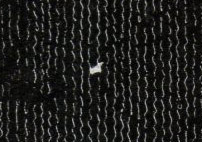
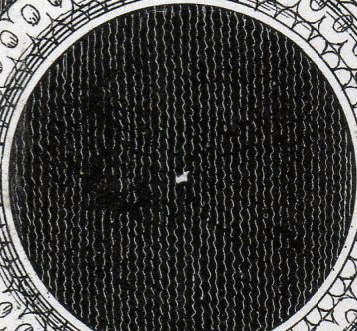
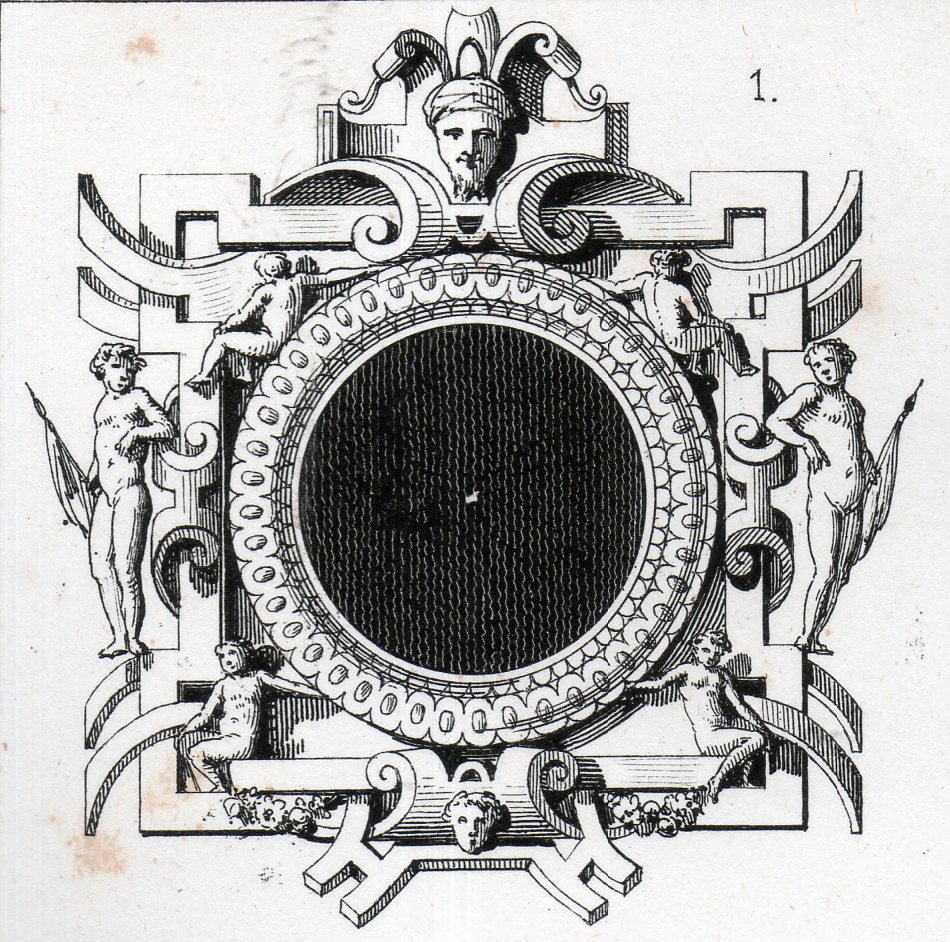
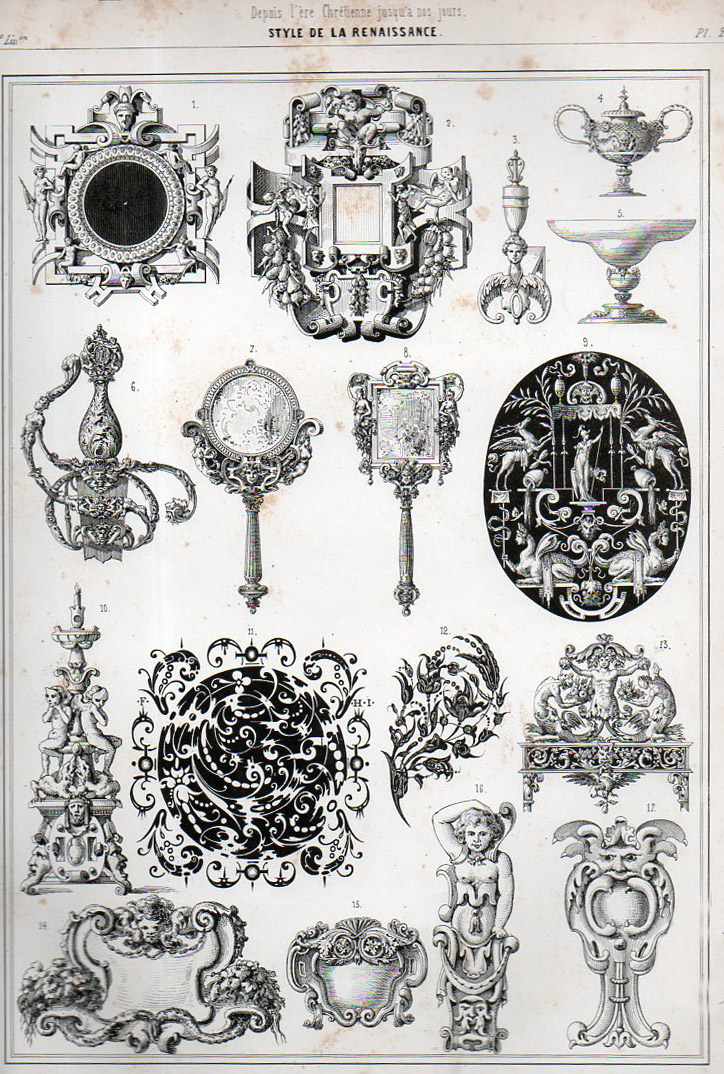
    While looking through D. Guilmard’s La Connaissance des Styles de l’Ornementation (published around 1860)–a work that is a sort of early clip-art assembly of aspects of bits and details of historical ornamentation from the Gothic to Louis XVI– I found several engravings of mirrors with some unusual detail.  For some reason the Renaissance mirrors nearly all had a small white dot–a hole–in the center of their jet-black mirror surface.  I imagine that this was a simple printing error, but I liked the idea of this spec of a mistake right in the middle of a dark field, in effect making a hole in the mirror, looking something like a light leak. It makes for an intriguing series of images.


    Mirror a

    Mirror b

    Mirror c

    Mirror936

    Which is a detail (about 2×2 inches in life) from the full sheet, below

    Mirror e938


  • History of Holes and Covering Them Up: Windows

    JF Ptak Science Books   Post 1893

    Holes  windows762
    The series of posts on this blog, The History of Holes, has generated several sub-series, including the History of Filling Holes Up, and of course The Great Efficacy of Deciding the Differences Between Hole and Circles.

    And now: Filling Holes Up.

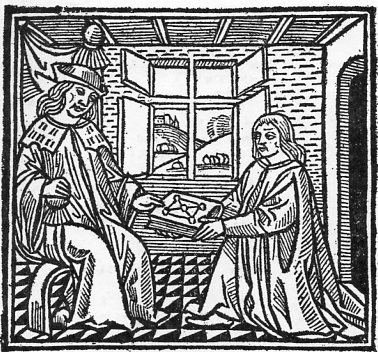
    This post really started as an exerecise in noticing invisible differences in old prints.  Unfortunately I’ve lost the reference for the woodcut I’m working with tonight (a terrible thing losing it to nothingness), though I’m sure it is a book illustration and early 16th century, and I suspect that it is German, and I believe it would have appeared on the title page or very soon thereafter, possibly in the dedication of the work.

    In the image we see the presentation of a book (the book, the book in which the image appears), a large volume, bound probably in tooled pigskin with brass or wooden tacks on the covers, there to protect the volume over long usage.  The scene itself probably depcits the book’s author presenting his work to his patron, or to the decicatee of the work, the person who made the printing and publication possible–hence the author kneeling, presenting the work with two hands; the receiver is seated, and with a hat and wide collar, accepting the book in a noble posture, nobly, with one hand.  (I wonder if the action is taking place in the bedroom, as would not be uncommon at the time–there is a tapestry pulled back and away from an enclosure to the left-rear of the patron.  It could be a bed. But it is definitely a private room, what with the ceiling not much higher than headroom of the doorframe.)

    What attracted my attention though were the windows and their double shutters.  The word “window” goes back a long, deep way, mainly in Scandanavian languages, and there coming to mean, mostly, “hole” or “opening” in the ceiling (for fireplace smoke and ventilation).  Noah Webster gives “window” a nice turn in the 1828 edition of his dictionary, defining the word as a “wind-door”, which is poetic but not very much in keeping with the word’s etymoloigcal history so far as I can tell.

    The coverings for windows are natually as old as the window, though sometimes it received some very fancy covering–in Rome, for instance, there are examples of glass windows, though there the glass is largely opaque. But here, in this image, in the high Renaissance, the window coverings were wooden, which is a long way home from hide or cloth or other such material. It is a little curious to see the shutters opening inwards–I’m no window/fenestration/architectural expert, but it seems now in cozy memory that these sort of shutters are not usual to my experience of Renaissance interiors.  (One quick source for looking at a number of these scenes is Jost Amman and Hans Sachs’ Standebuch (“The Book of Trades”), published in 1568. It shows people at work at their craft, mostly inside; and of these dozens of woodcuts, when the windows are shown with coverings they are depicted with glass. When not, there is simply nothing to see–but being merchants, and these places being “stores” of a sort, there were probably exterior shutters fixed either at the top to provide an awning when open, or at the sides. )

    In any event, it is always interesting to go back and look at familiar objects and images, and see what your brain comes up with with the newest iteration of recognition.  I’ve known this print on-and-off for a long time, but I don’t think I ‘ve ever thought of it in terms of holes. Until today. And then it became a new image. 

    ·Posted by :

    ·in:


  • The Ultimate Earthly Holes & the Geocosm of Fr. Kircher

    JF Ptak Science Books   Poat 1871 [Part of a series on The History of Holes.]

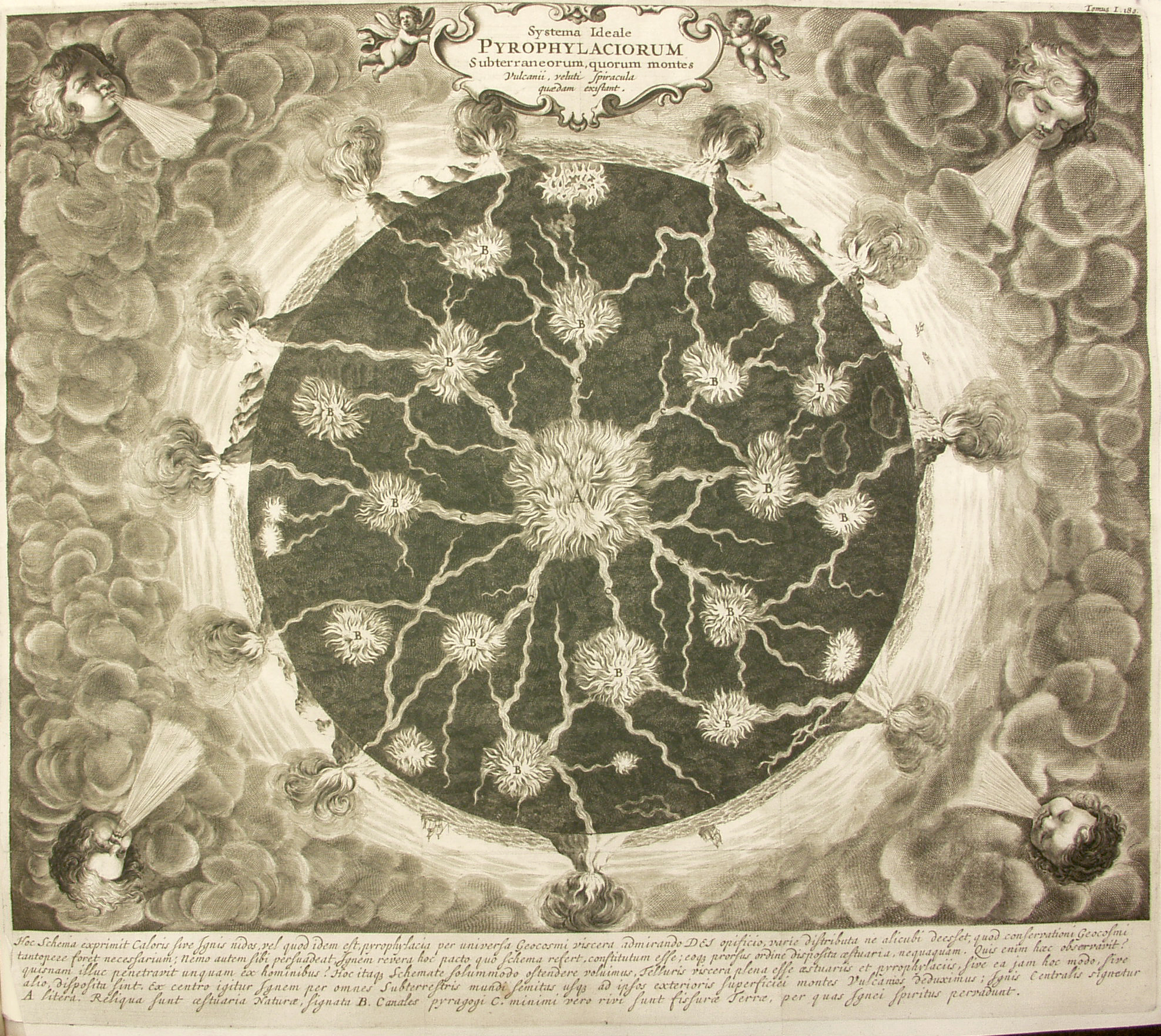
    “Water, Fire; Fire, Water; mutually, as it were, cherish one another; and by a certain unanimous consent, conspire to the Conservation of the Geocosm, or Terrestrial World.”–A. Kircher, Mundus Subterraneus, 1665 (quoting a source on the University of Oklahoma library blog, here.)

    Kircher hole_edited-1[Detail from the image below.]

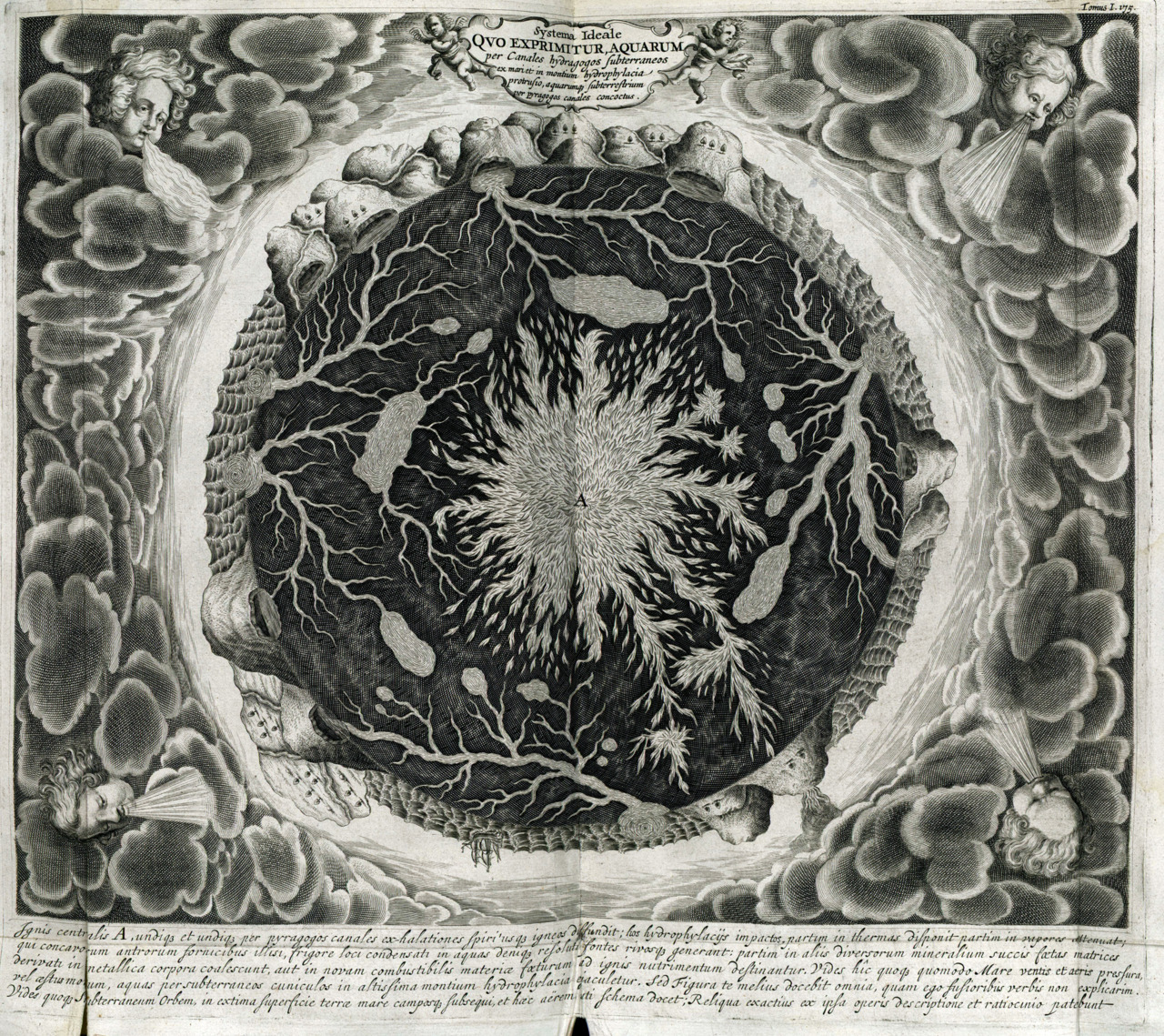
    The great Athanasius Kircher (1602-1680)  pride of the Jesuits (and a member of the Collegio Romano, where he also was curator of the natural history collection there) and very forward thinker, was a prolific writer of vast ideas, thought about teh origins and circulation of water (among many other things) in his semi-encyclopedic Mundus Subterraneus (1665).  The Mundus–one of Kircher’s forty books–was one of the most beautiful books produced in the 17th century, and was chock-filled with ingenuity and insight and good thinking that went everywhere, though some of that “everywhere” went nowhere. In any event the man reached very high in an absolutely varied way, writing in the fields of language, optics, astronomy, geology, chemistry, math, magnetism, music, zoology and so on through the alphabet of wonder.

    Kircher hole
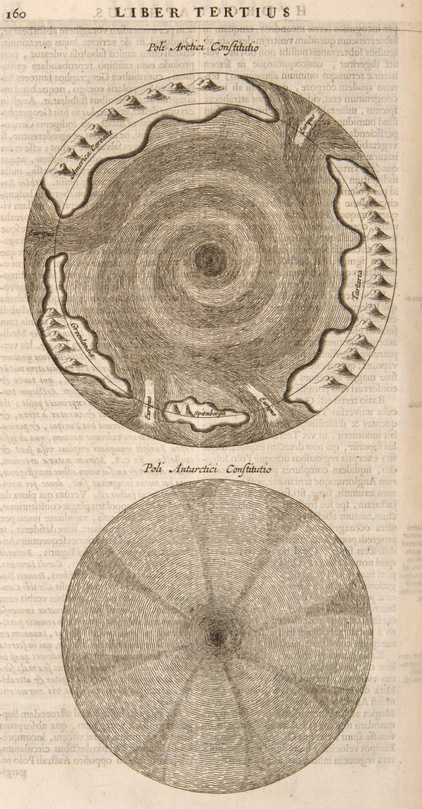
    In this case, Kircher worked on the problem of water–where it came from, where it went, and how the process unfolded, which was part of an overall theory of the physical construction of the Earth.  Kircher’s idea–which relative to other theories of the time was pretty scientific–was that the Earth was a solid mass save for interludes of caves and pockets of water and fire.  The fire (‘pyrophylacia”) represented the origins of earthquakes and volcanoes, and was complemented by a system of underground lakes and rivers (“hydrophylacia”) which was the basis for the movement of all water

    The “holes” part of this post comes in right now, as we see in the engraving that depicts polar portal for water to descend into, great holes (like Spongebob Squarepant’s encounter with the main drain of the oceans) that allowed the water to continue its endless migration.  Water would rise and fall in accordance with the tides, which would act as the power source for raising water to mountainous heights, where it would start its life again, flowing down via creeks and streams into lakes and rivers and then to the ocean where it would ultimately make its way to some severe maelstrom, and down into the Earth to come back up again.  And I think that the primum mobile for this action was the wind produced by the interaction of the fire and water. 

    I’m unsure thus far about the placement of this primal hole. 

    Next:  Descartes Firehole. 

    Below: images of the fire- and water-based subterranean worlds of necessity to Kircher’s geocosm.

    Fire:

    Kirhcer pyro
    Water:

    Kircher water


  • History of Holes: Making 1=2 or 3, or More (ca. 1700)

    JF Ptak Science Books   Post 1830  Part of the series on the History of Holes. (Apologies for no-para spacing–Typepad is buggy again.)

    A beautiful and inventive way of addressing issues of perspective and un-reality in the centuries before the introduction of electricity was more able to suspend belief in the existing/obvious was via the catopticum1. This object (an example of which is pictured below, taken from the oddball/genius/problematic polymath Athanasius Kircher in his book Ars Magna Lucis et Umbrae…2 printed in 1676), and the name of which is taken from the Greek katoptron, mirror) was an advanced parlor toy and artwork, a sort-of primitive free-standing theatre of multiplied objects, a box that contained things that were seemingly larger than their container. 

    The catoptric theater. From Ars Magna Lucis et Umbrae (1671 ed.), p. 776

    Source:  Kircher at Stanford University, here.

    This image makes the “image engine” a little clearer:

    Primeira PáginaPágina AnteriorDiminuir imagemImagem a 100%Aumentar imagemPróxima PáginaÚltima Página
    desd [757 KB]
    Source:  Tratado da Catoptrica, (manuscript, 1716);  from the Biblioteca Nacional Digital, here.
    It’s a romance of images machine,  a box of antique wonder, a peepshow of centuries before, putting more things into a space than could exist.  It was a relatively simple machine of great ingenuity:  the interior of the free-standing box with rows of holes along its top edge perpendicular to the ground, and was lined with mirrors (as shown above in the Spanish document), with some mirrors set of at 45% angles; when objects were placed within the imaging-area of the angled mirrors, the object was multiplied, and then multiplied over and over as a result of the surrounding mirrors, creating in effect a “hall of mirrors”, leaving the observer with a sense impression of many dozens of objects that were contained within a container that was impossibly too small for what was being seen. 
    This of course is a property of some holes–they tend to make things larger than they could previously possibly “be”. 
    In this case, the viewer would look through a hole into a Borgesian box which would contain a multitude of its possible interiors.  Looking through a hole in the end of a glass and mirror-ended tube and pointing it at the sky at night would reveal an enormous multiplication of a small part of that sky.  In the early case of Galileo, what  was first seen with the telescope was the multiplication of what was believed to be a finite and god-granted sky of perfection–he was seeing into some other sky, into a new vault of heaven, something never before seen, above-and-beyond what was known to exist.  Hooke and Louwenhoeck had a similar experience with their (second generation) microscopes, seeing details and life never before encountered, entire worlds in a place no bigger than the head of a pin. 
    Sometimes a hole is just a dark thing; but more often than not, it isn’t. 
    Notes:

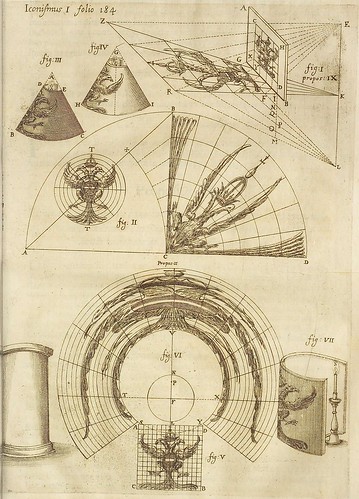
    1.  From the Greek, katoptron, mirror  or pertaining to a reflected image or reflected light, such as from a mirror.  There is another sort of catoptric that has been sort of widely used in antiquarian painting and parlor entertainments, which involves a canonical mirror reflecting a wide-field and distorted image into its proper perspective, which is known as catoptric anamorphosis.  Another version of this sort of optic imaging is optical anamorphosis, which requires the viewer to stand at a particular (usually sharp) angle to a painting containing a semi-hidden image whose proper perspective is revealed only at a particular angle of viewing.

    An example of catoptric anamorphosis, from the Kircher mentioned above:
    anamorphosis - eagle

    See here:  http://hyperphysics.phy-astr.gsu.edu/hbase/geoopt/catoptric.html
    2.  Ars Magna Lucis Et Umbrae In X. Libros digesta. Quibus Admirandae Lucis & Umbrae in mundo, atque adeo universa natura, vires effectusque uti nova, ita varia novorum reconditiorumque speciminum exhibitione, ad varios mortalium usus, panduntur. Editio altera priori multo auctior. The work is presented at Bibliodyssey, here.
    Mr. P.K.hauls out a great quote and summarization of the work of Kircher by Robert Moray in his letter to the great guiding post of the Royal Society, Henry Cavendish, which really captures the spirit of the very busy/very curious and curious old man:
    “Whatsoever Mr. Huygens & others say of Kircher, I assure you I am one of those that think the Commonwealth of learning is much beholding to him, though there wants not chaff in his heap of stuff composted in his severall peaces, yet there is wheat to be found almost every where in them. And though he doth not handle most things fully, nor accurately, yet yt furnishes matter to others to do it. I reckon him as usefull Quarries in philosophy and good literature. Curious workmen may finish what hee but blocks and rough hewes. Hee meddles with too many things to do any exquisitely, yet in some that I can name I know none goes beyond him, at least as to grasping of variety: and even that is not onely often pleasure but usefull.”  (My bold.)
    [Sir Robert Moray in a letter to Henry Oldenburg, 1665]  

  • The HIstory of Holes and Filing Them with Windows–Louis Sullivan’s “Jewel Boxes”

    JF Ptak Science Books     Post 1811

    Sullivan arch548
    In the History of Holes there exits a subcategory among many others that addresses holes in buildings and their filling-up.  The “holes” of course must be openings for windows, and the filled-in bit are the windows themselves.

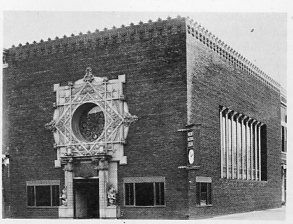
    The great American architect Louis Sullivan designed a number of bank buildings large-on-the-small–really, quite small for banks–but outfitted them with some spectacular detail, some of which were the windows, and some of which worked.  The size and scope of his (1914) Merchants National Bank, in Grinnell, Iowa, building is wonderful, though I’ve got to say that the enormous window in the facade and the crenulated baroque cartouche is really quite too much.  I don’t know where it all came from, but it seems as though it is from some other–much larger–building.  The idea seems to work though on some of he other buildings in this “series” of small-but-involved bank buildings–his “Jewel Boxes”–and particularly with larger, half-circular windows, but not I think with his pinhole camera ocular god effort here. 

    Sullivan arch549

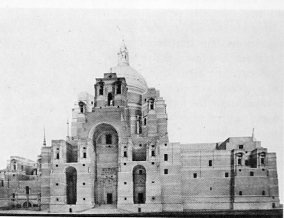
    (There’s plenty of time to discuss windows and holes and such outside of the work of Louis Sullivan‘s  (1856-1924) “jewel boxes”, and I can hardly wait to have a look at Edward Lutyen’s (1869-1944) proposal for the massive neo-gothic Liverpool Anglican Cathedral, above, where the windows are most uncompromising, but that will keep for later.  Don’t look now, but that would have been the world’s largest dome).

    And some of the other Sullivan minor miracles, his “Jewel Boxes”, can be seen below as they exist today.  This first example, The Peoples Savings Bank in Cedar Rapids, Iowa, was built in 1911.  If you squint your eyes a bit you can see what this building was meant to be, though today it lives in a case of urban bits of blight and a massive block of a building that seems to be pushing the poor Sullivan building into the street. 


  • Earths inside the Earth–a Short Note on Inner Civilizations. And Maps.

    JF Ptak Science Books   Post 1782

    There should or could be an enjoyable history written on the internal living history of the Earth, or Earths-within-the-Earth, because the idea is quite old, and latches itself like a good idea on top of a bad idea inside a decent idea.  The end result though is not so great, but, given the longevity of the interior Earth idea and the people who perpetuated it over time, I would like to read a history of the thing, even if it went nowhere.  I guess the history could be fiction and come out with almost the same result, but well, some of the happened-history is stranger than fiction. 

    I was brought to think about this by a patent granted to Herbet Francis Williams-Lyouns (British, 1863-1933).  Lyouns was a painter but for some reason cooked up this idea for an international exhibition just before the year 1900.    The patented idea was for a free-standing globe/sphere with a series of stairways that would get paying folks to a lighthouse at the top.  From what I can tell the thing was to be 150 feet high or thereabouts–it is difficult to tell since there are no technical specifications in the patent itself.  There was nothing really to suggest dimension and without physical specifications I’m not sure exactly what Lyouns was patenting, except for a big globe with a lighthouse on top that could be populated with a paying crowd. 


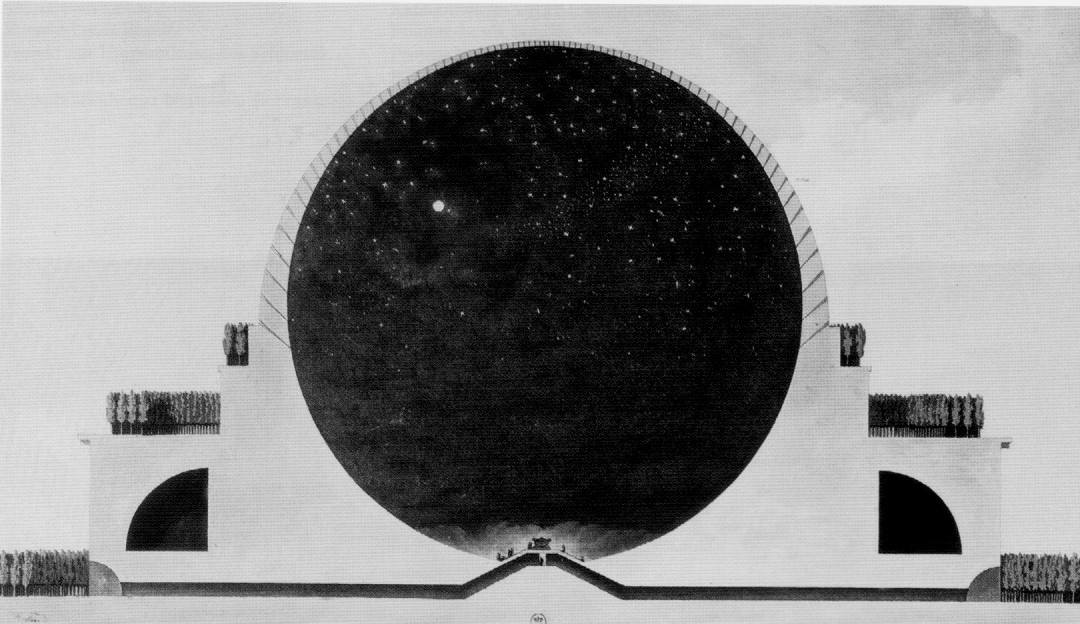
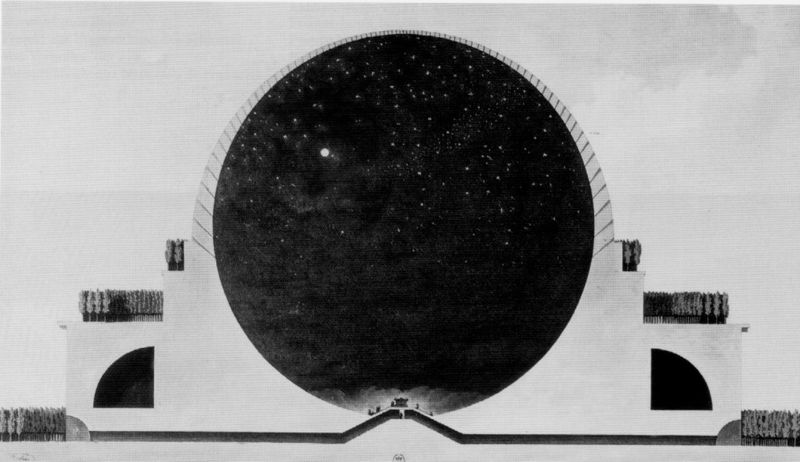
     It seems that Lyouns was patenting the idea for being able to ascend a hollow globe to a what would seem to be a redundant lighthouse (certainly there could have been some other structure a little more appropriate or crown-y) at the top, though I know I have seen several earlier visionary drawings about such a beast. One of these ideas belonged to Etienne Boullee (1728-1799), who designed a great hollow sphere for a cenotaph for Newton—Boullee however did not muck up the interior of his space with a massive stair structure, and kept it simple, with his folks milling about on the ground enjoying what was supposed to be an internal night sky.  Some of the others are pre-patent era, though I do recall one of a hollowed-globe interior for viewing a moving diorama that was definitely of the patent era–perhaps that inventor simply didn’t patent the apparatus.

    [The interior of the Lyoun globe, which I guess represent a giant winding staircase.]

    The Lyoun bit also reminds me of the Crystal Palace of 1851–rather, of a cartoon for the Crystal Palace, featuring the Palace at the top of a globe that was fully and completely, falling-off-the-sides inhabited.  Which makes it a bit different from the globe of Lyoun, which seems as though it could’ve been inhabited on the inside, only, and which steers us exactly to the opposite (?) of the Earth’s-Interior-Earth business.  After all, I started talking about other stuff and civilizations living underground, inside the Earth, possibly inside a massive hollowed out section of the Earth. 

    (Finding the top of the world was easier in 1851–at least to this illustration, showing the Crystal Palace of the Great Exhibition of 1851 sitting firmly in place above all. I can imagine that if you were sitting in Hyde Park along with the 1851-foot long building, it would be easy to think that you were indeed at the top of the food chain.  The structure was the crowning achievement of the  Exhibition:  it was almost one million feet under iron and wood and glass, and could hold tens of thousands of people who could view the enormous gardens housed there.)

    I’m talking about Jules Verne and his journey to the center of the Earth, and H.G. Well’s Morlocks, and a dim memory of Superman’s Mole Men, and E.R. Burrough’s Pellucidar sitting at some great depth below the Earth, and on and on, back into the misty past, past hollow Earth theories of even some great men like Edmond Halley, and back into mythological and anthropological stories of great antiquity.  But those stories will have to wait for a later tell.
    Boulle newton

    [Boullee’s cenotaph for Newton.]

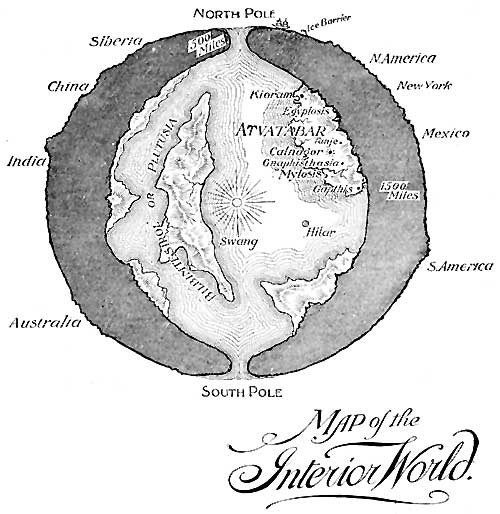
    One bit I’d like to point out is this extraordinary leap of imagination, an actual map of the interior civilization of the Earth provided by William R. Bradshaw to the readers of his Goddess of Atvatabar, which was published in 1892.  The story itself seems terribly purple and looks like a very difficult read–but the pictures are interesting in their own rippling ways.  And then there’s the case of the map–one of the very few I can think of that depict a civilization inside our own homey Earth. (I’d mention others but I can’t think of any straight away.)
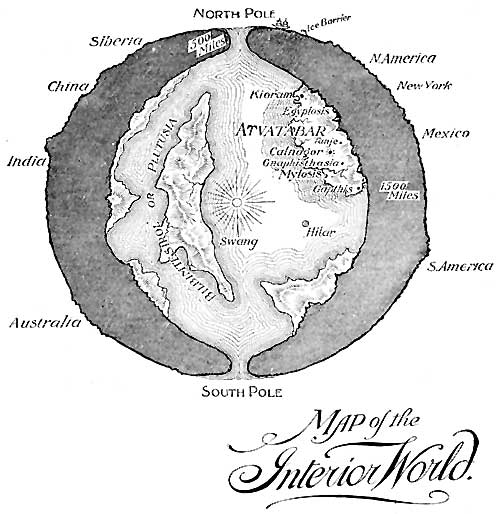
      Earth Interior William BRadshaw

    [Map of the Interior World, William Bradshaw. Source: Project Gutenberg, here: http://www.gutenberg.org/files/32825/32825-h/32825-h.htm]

    Another example of a map of interior Earths was brought to my attention by Rebekah Higgitt (of the excellent Teleskopos blog ), who sent me to the Petri Dish blog (of Katherine Pandora, and her post “Hollow Heads, Science, Fantasy, and What’s as Plain as the Earth Beneath our Feet”) and the internal Earth of WIlliam Reed (in 1906, illustrating his Phantom of the Poles):

    Reed's Hollow Earth

    And yet a third example, making my way through the Petri Dish article and found at the website of Engines of our Ingenuity by John Lienhard (from his post 2180, “Hollow Earth”):

    Americus Symmes' Hollow Earth

    [Symmes’ Hollow Earth published long after his death by his son, Americus Symmes.]

    And then another example, this from Marshall B. Gardiner, A Journey to Earth’s Center. 1920, which also shows the interior “central sun”:

    And a cross-section of the Earth from Gardiner:
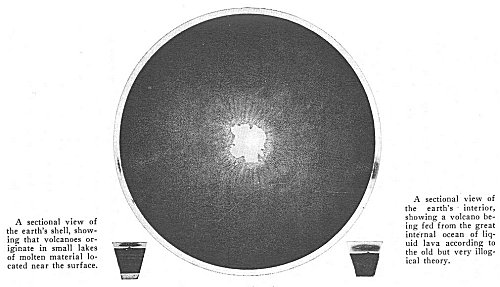
    http://www.sacred-texts.com/earth/jei/img/36400.jpg

    The literature of this hollow Earth business is very wide and long and not very deep, and includes a fair amount of scientific-y whoo whoo.  The sci-fi part of it looks mor eintereting, though from the little that I have read now most of it is very tight-fisted in the good-writing department.


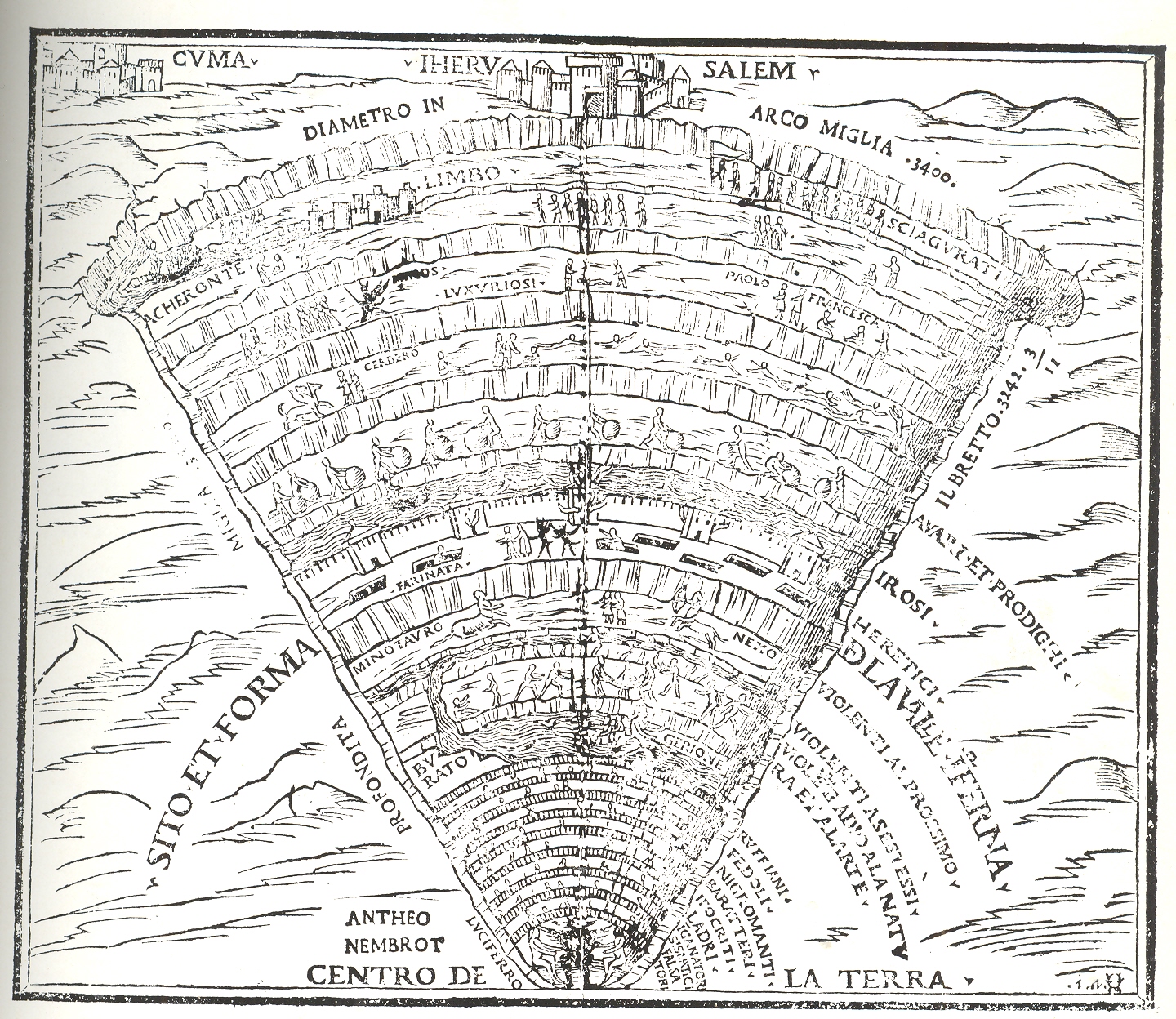
    This maps talk excludes Inferno maps like the following, for example–obviously–as there are many:
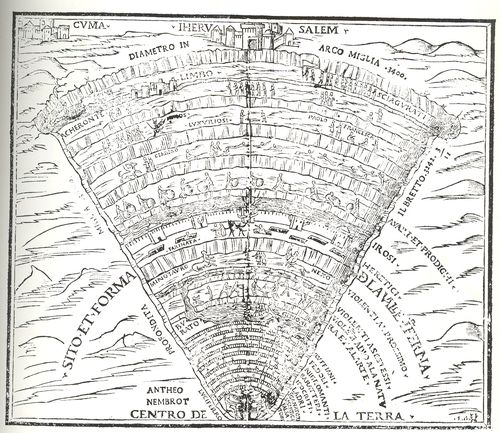
    Blog--feb 9--dante

    The classic sort of image may be something like this fantastic depiction of the Inferno of Dante (shown here in the Comedia published in Venice by Gregorio de Gregoriis in 1515.

    I should guess that there’s ample room for a collection of inner-Earth civilizations, and perhaps that will come to pass.

    A few more of the patent images for the Lyouns patent:


  • On Bombing the Sky with Bone (1914) and Making the Sky Bomb Us (1967)

    JF Ptak Science Books   Post 1774  [Part of the Strange Things in the Sky department]

    I’m not at all sure when the first stories were told on the implosion of the sky, or when the sky was peeled away like a layer of mica, or when an expanding hole was punched into the blue, or when the sky dissolved, or when it simply fell to the ground, or when it was simply exploded, any of which would leave a shambles of broken stars and a boring nothingness.

    Visions of the coming of hell or the apocalypse or the end of existence or the exaltation of duration were certainly depicted in art at least during the high Medieval period and the Renaissance, though I am uncertain of ever having noticed the sky on fire or facing obliteration. Perhaps the implications of its destruction would be clear in the symbolic representation of The End, the evidence of a smoking atmosphere in an infinite hole was just implied, Dr. Pangloss at play with Mr. Leibniz over paint and canvas.

    Heaven opened and stars fell in various texts, not the least of which is the Book of Revelation (6:14, KJV, “And the heaven departed as a scroll when it is rolled together; and every mountain and island were moved out of their places”). Imaging this part though was another story, especially when considering that destroying the sky was a secular event, and not driven by the great deities.

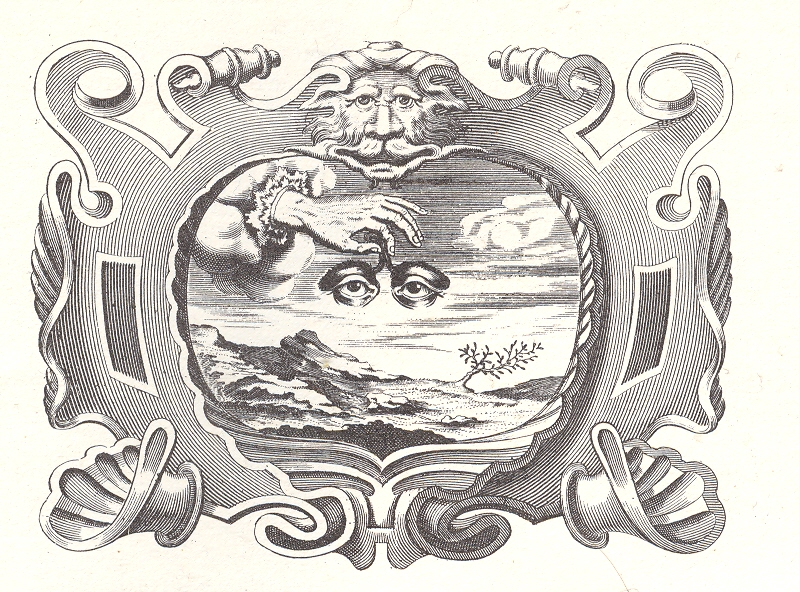
    Now holes do appear in the sky in Renaissance images, but they open to allow the hand of the creator to reach through it from the nether world, or heaven, or the infinite.  In the many examples of these holes that I have seen the background within the hole is entirely blank–plain white, no detail, no peek into heaven.  Then again, these are holes, and not a wholesale destruction of the sky.

    ++ Nov 26 eyes in sky

    As an example I’d like to point out the work by the Jesuit Franciscus Nerrincq (1638-1712), De goddelycke voorsienigheydt, in which there are several odd eyes that burn their way through the atmosphere.   Eyes/eye of the creator occur frequently in religious presentations and emblems, but not so very often as hands holding a pair of eyes.  I know all of this is very heavy stuff in the history of Christian iconography and the progression of emblemata, but I’d rather deal with the images out of context here and have them stand on their own without interpretation. 

     Of course the answer for the modern equivalents of this blowing-up-the-sky adventure must have deep and varied roots in the sci-fi canon, though presently they remain a mystery to me.  It is interesting to note that at one point in June 1945 in the Jornada del Muerto/the Dead Man’s Walk, at the Trinity site in the desert near Alamogordo, a group of scientists were placing bets as to whether or not the test explosion of the world’s first atomic weapon would set fire to the atmosphere. 

    In a way Tycho Brahe brought down the sky with his (naked eye) observation of a super nova on 11 November 1572. With the exception of comets and eclipses the sky had remained immutable, a perfect score of the creator’s creation, until Tycho Brahe noticed something new in Cassiopeia, something that was not a comet—a “something” that was a star. This was momentous because the night sky had been seen for centuries as being complete—a new star, the Nova of Brahe, contradicted this high belief, offering the possibilities of newness where there had not been one previously.  And so too with Kepler’s new star of 1602. This wasn’t perhaps a tearing-away of the old sky, but it certainly questioned the sky that was seen. 

    I should also point out that perhaps a reverse of the destruction of the celestial ceiling came about when Galileo turned his telescope to the sky and found to the astonishment of nearly everyone that there was an order of magnitude more stars in the heavens than anyone had ever experienced before. This in a way collapsed the old sky with its perfect and unchanging number of stars, showing that the creator of the universe had indeed provided more stars than anyone had ever imagined, though for reasons not yet known had kept that knowledge from humanity.  By 1610 Galileo had produced his fifth and most powerful telescope, allowing things to be seen one thousand times closer, using it to make enormous discoveries–discoveries so big in fact that their towering significance is a but hard to understand today in the context of early 17th century knowledge. It was all published in his fantastic Sidereus Nuncius on March 4, 1610—the extraordinary title page1 of the book proclaiming some of the great discoveries of Galileo’s adventure. One of the things that Galileo brought to the world was this entirely new sky, revealed to him through his telescope—so many stars that he could only guess (though he reckoned that there was an order of magnitude more stars than previously known “stars in myriads, which had never been seen before…and which surpasses the old, previously known, stars by ten times”). In a way Galileo introduced the sky-above-the-sky, available only to people with a special instrument to see it–the new reality.

     This is what I had in my mind when I saw this unusual patent application (above and below). Just weeks before the beginning of WWI, two weeks before the assassination of Archduke Ferdinand, followed quickly by a cascade of war declarations a few days after that, came this rather footloose idea for bombing the atmosphere

    J.M. Cordray came up with and patented this notion–a barrage of balloons, heavily armed balloons, sent aloft with dangerous cargo to be exploded in the atmosphere, which was supposed to initiate a chain-reaction of some sort which would end in supplying rain for the rest of us. Theoretically, anyway. The unspecified number of balloons would be sent aloft, laden with large amounts of crushed bone and concentrated sulfuric acid (to be combined to produce nitrogen), potash, water, and large amounts of crude oil for the fire’s fuel.  And a candle to light it all.

    It seems that the attempt to blow up a part of the sky with bone and sulphuric acid to make rain just didn’t work, though I cannot (easily) find a record of the experiment being attempted. 

    Mr. Cordray presented himself at the top of his patent as “J.M. Cordray/Rain Maker”.

    The one thing that is for certain is that Cordray’s attempt at weather modification was quite early–it would be another three decades before pioneering work of Kurt Vonnegut’s brother, Bernard, was published (beginning in 1947, finding the ice-nucleating properties of silver iodide, AgI),  which established the very real possibilities of altering the weather.  This practice was employed in the U.S. military’s Operation Popeye, which used cloud seeding to prolong the rainy seasons along the areas covered by the Ho Chi Minh Trail in Vietnam from March 1967 to July 1972.  This sort of weather warfare is now prohibited by international convention.

    And so in a way by employing weather modification as a tool of war we’ve been able to turn the sky into a weapon, which means that this post has followed the bombing of the sky to the sky bombing us. 


    See an interesting article at Paleofuture on the Cold War weather modification attempts here.

    Notes

    1. The title page in full reads:  Great and very wonderful spectacles, and offering them to the consideration of every one, but especially of philosophers and astronomers; which have been observed by Galileo Galilei … by the assistance of a perspective glass lately invented by him; namely, in the face of the moon, in innumerable fixed stars in the milky-way, in nebulous stars, but especially in four planets which revolve round Jupiter at different intervals and periods with a wonderful celerity.


  • Early & Satirical Poetry on Evolution–1862

    JF Ptak Science Books   Quick Post

    “The Gorillas Dilemma”, 1862.

    This poem, which appeared in the London Punch in October 1862, three years after the first edition of Darwin’s On the Origin of Species,  addresses the confrontation between Richard Owen and Thomas Huxley (and by extension, of course, Charles Darwin).  Owen had earlier attacked the Origin in an anonymous review in the Edinburgh Review (volume 111, page 521, 1860), and Thomas Huxley, of course, who was one of the earliest and who became the greatest of Darwin’s “disciples” (and known as “Darwin’s Bulldog”).

    Owen wrote with a very heavy and dark pen, in 1860:

    “To him, indeed, who may deem himself devoid of soul and as the brute that perisheth, any speculation, pointing, with the smallest feasibility, to an intelligible notion of the way of coming in of a lower organised species, may be sufficient, and he need concern himself no further about his own relations to a Creator. But when the members of the Royal Institution of Great Britain are taught by their evening lecturer that such a limited or inadequate view and treatment of the great problem exemplifies that application of science to which England owes her greatness, we take leave to remind the managers that it more truly parallels the abuse of science to which a neighbouring nation, some seventy years since, owed its temporary degradation. By their fruits may the promoters of true and false philosophy be known.”

    Tough stuff.  And Darwin took it personally and seriously, absorbing the blows against himself (and his supporters, especially Huxley and Hooker), as well as the spurious and ethically-challenged mistaken assertions that Owen tricked out in his piece.  “It is painful to be hated in the intense depth with which Owen hates me” Darwin wrote a few months later  (Darwin Correspondence, volume 8, April 1860, page 154.)

    Huxley and Owen would have it out over the years (though Darwin himself would not partake due to illness and such, preferring to respond through written help to Huxley and others).

    And so the poem:

    ” (To Professor Owen & Huxley)

    SAY am I a man and a brother,
          Of only an anthropoid ape?
    Your judgment, be ‘t one way or ‘tother,

    ·Posted by :

    ·in:

    —

  • History of Holes series: Holes in Airships (1919 and 1937)

    JF Ptak Science Books   Post 1736 [History of Holes series.]

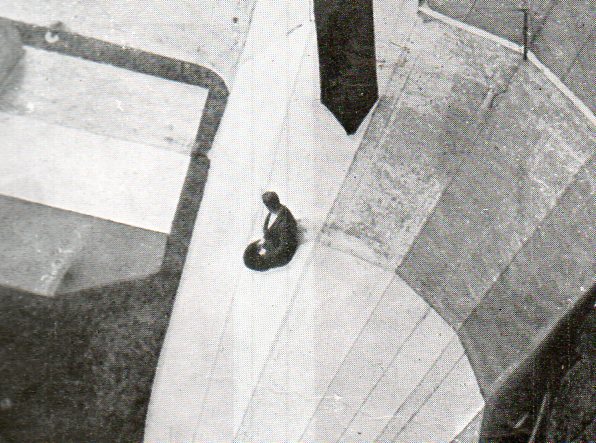
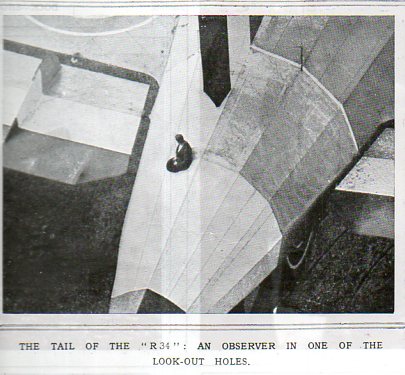
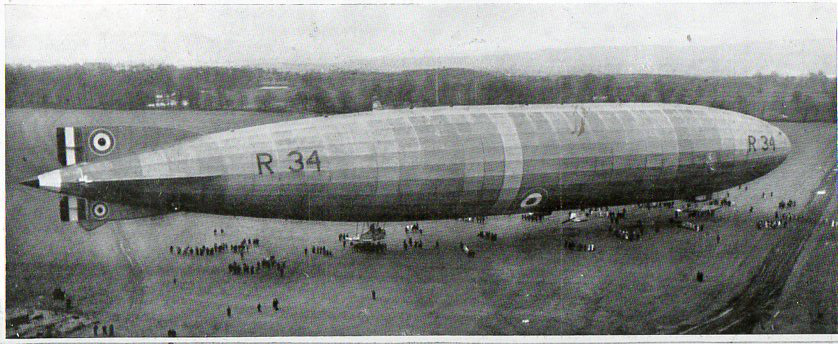
    Holes are of course everywhere–it just depends on how hard you look.  This image, though, struck me very quickly as an unexpected hole (though of course once you allow yourself a moment to think about ti the whole thing makes sense).  It is a very plain “observer’s perch” in the tail of the great British airship, the “R 34”, and appeared in the Illustrated London News in April, 1919, just before its first flight.  The aircraft was massive–643 feet long1–and on one superficial level its hard to imagine holes in its structure of any sort, let alone an unprotected observation post.  But there it is.
    Airship 297

    And this

    Airship 296

    Here’s a full view of the “R34”, successor to the “R33”:

    Airship 295
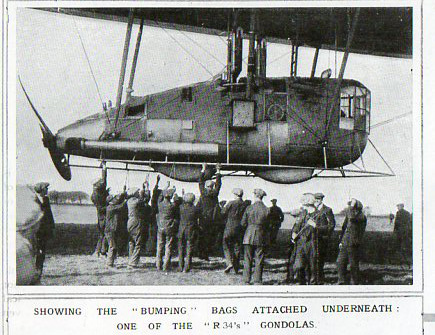
    This is an image of the (forward?) gondola of the airship, looking like it has come in for a landing, or touchdown, or whatever–there is something so very primal about this relatively small group of men reaching up for the railing on the gondola…a railing placed there specifically for that reason.  Its hard to imagine that such a seemingly small effort would be enough to control any part of the airship’s motion, though perhaps it was. 

    Airship 293And the detail, showing the man in the middle clearly off the ground–clearly he must be weighing his options:

    Airship 293_edited-1At least he seems to be wearing one glove, anyway

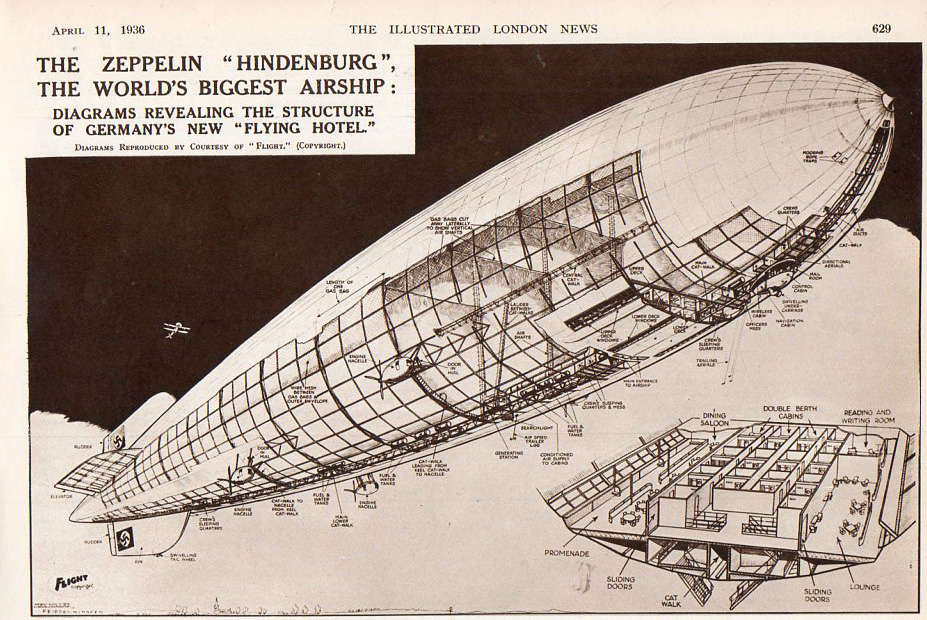
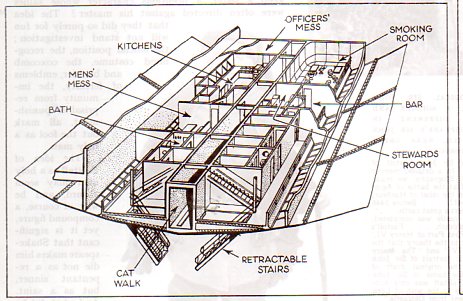
    Then there’s the image of the “bad” hole, the iconic image (photographic and motion picture) of the conflagration and crash of the Hindenburg, a result of a very quickly-spreading “hole” in the skin of the aircraft as it was coming in for a landing/mooring in Lakehurst, New Jersey, 1937.

    Here’s a cross-section of the Hindenburg as it appeared in the Illustrated London News in 1936:

    Airship 289

    Airship 292

    Notes:

    Specs on the “R34”:

    • Length: 643 ft 0 in (196 m)
    • Diameter: 79 ft 0 in (24 m)
    • Volume: 1,950,000 ft3 (55,000 m3)
    • Useful lift: 58,240 lb (26,470 kg)
    • Powerplant: 5 × Sunbeam Maori, 275 hp (205 kW) each

    The Hindenburg was quite a bit larger than the R34–in fact, it was the largest thing ever to fly, at 803 feet long and 135 feet in diameter…and 200,000 m3, almost 200% larger than the mammoth R34.


  • A Note on the Vast Wealth Possibilities of the Refill Business: Ink and Paper

    JF Ptak Science Books   Post 1735

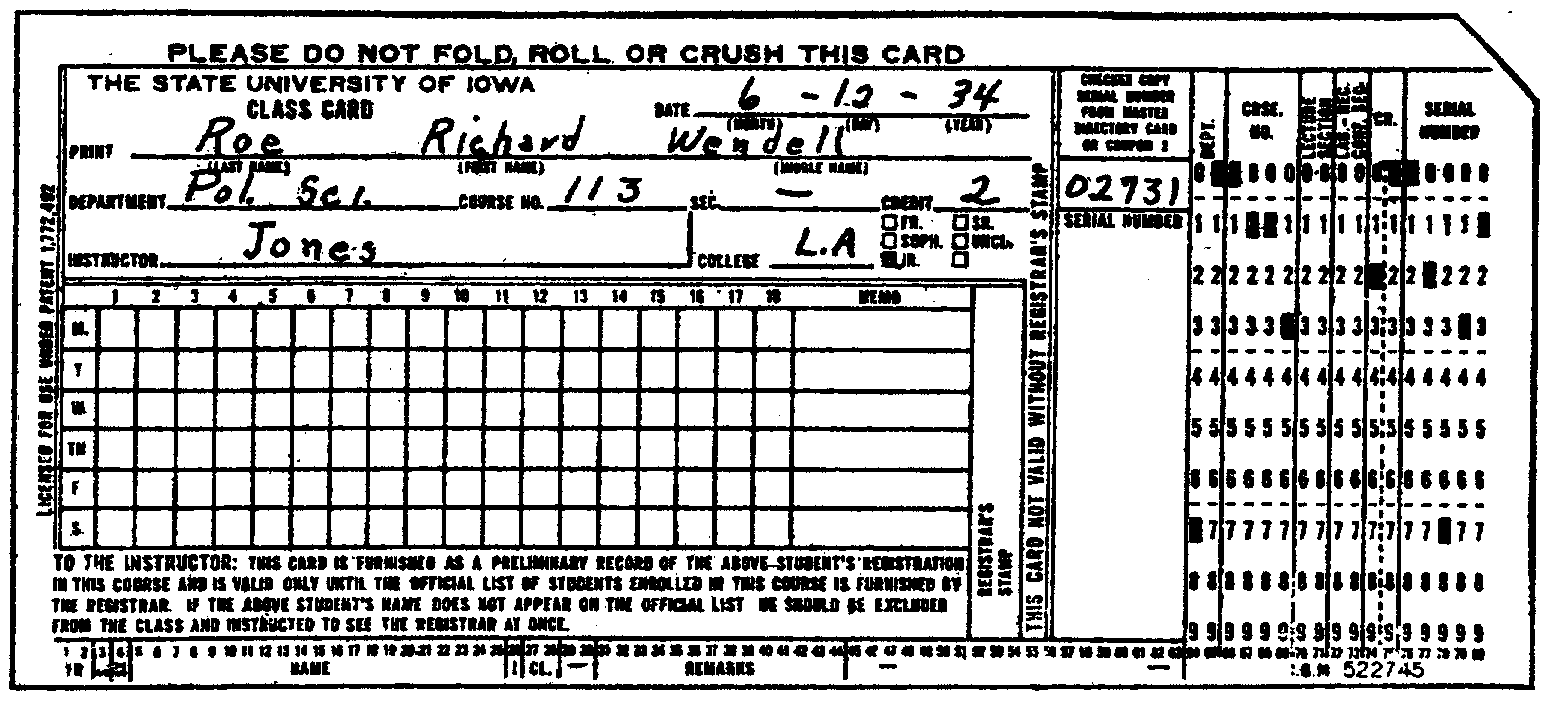
    http://www.columbia.edu/cu/computinghistory/reg-card-80.gif

    [Source: Columbia University computing history site, here.]

    I guess that the only reason why HP charges for their printers is that they can.  When you buy one of these products you’re basically purchasing the need to keep the things fed with semi-proprietary HP ink–and as everyone knows, printers are notoriously thirsty creatures, and one can easily spend multiples of the cost of the printer on ink in the first year alone. 

    This is a great idea so far as the manufacturer goes, but it is hardly a new one–International Business Machines counted on this sort of income for several decades, partially getting the company through the Great Depression. 

    And what was the IBM necessary-suppliable that their customers had to keep buying over and over?  It was the business machines themselves, because it was IBM practice to rent their machines out (which would pay for the initial investment and production in the machine in about two years, and most customers seemed to keep their rented mater1al for 5 or 7 or 10 years.  What IBM kept supplying their customers with was the stuff that they sent through the machines–the IBM cards.  The customer needed the cards from IBM itself, mainly because it was part of the contractual agreement for the lease of the machine, and also because the IBM product was superior to other mass-produced cards.  In the 1930’s the card business for IBM accounted to something like a few billion cards per year, which evidently would account for 30-40% of IBM’s yearly profit.  And that’s quite something. 

    The idea of the necessary refill is not IBM’s to claim for themselves–years earlier, Eastman Kodak accomplished the same deal with film for their cameras; and razor blades were supplied by Gillette to users of their razors.  And although you don’t need Ford gasoline to run a Ford automobile, in the 1930’s you did need a General-Motors spark plug to run a G-M vehicle.  Radio Corporation of America sold radios and also the necessary tubes to replace the ones in the stock radio; Thomas Edison too had a vastly controlling interest on how his light bulbs would be installed and replaced. 

    So as annoying as it might be to have to pay a fair amount of money for a small amount of ink to make your printer function, the printer-producing companies are just following an old (and highly profitable) business practice.