JF Ptak Science Books Post 1811
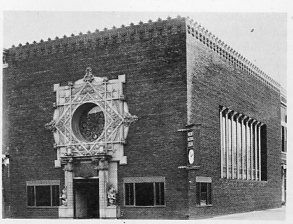
In the History of Holes there exits a subcategory among many others that addresses holes in buildings and their filling-up. The “holes” of course must be openings for windows, and the filled-in bit are the windows themselves.
The great American architect Louis Sullivan designed a number of bank buildings large-on-the-small–really, quite small for banks–but outfitted them with some spectacular detail, some of which were the windows, and some of which worked. The size and scope of his (1914) Merchants National Bank, in Grinnell, Iowa, building is wonderful, though I’ve got to say that the enormous window in the facade and the crenulated baroque cartouche is really quite too much. I don’t know where it all came from, but it seems as though it is from some other–much larger–building. The idea seems to work though on some of he other buildings in this “series” of small-but-involved bank buildings–his “Jewel Boxes”–and particularly with larger, half-circular windows, but not I think with his pinhole camera ocular god effort here.
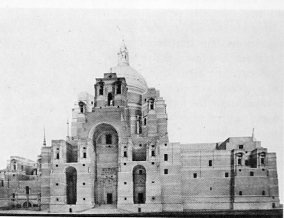
(There’s plenty of time to discuss windows and holes and such outside of the work of Louis Sullivan‘s (1856-1924) “jewel boxes”, and I can hardly wait to have a look at Edward Lutyen’s (1869-1944) proposal for the massive neo-gothic Liverpool Anglican Cathedral, above, where the windows are most uncompromising, but that will keep for later. Don’t look now, but that would have been the world’s largest dome).
And some of the other Sullivan minor miracles, his “Jewel Boxes”, can be seen below as they exist today. This first example, The Peoples Savings Bank in Cedar Rapids, Iowa, was built in 1911. If you squint your eyes a bit you can see what this building was meant to be, though today it lives in a case of urban bits of blight and a massive block of a building that seems to be pushing the poor Sullivan building into the street.