A Daily History of Holes, Dots, Lines, Science, History, Math, Physics, Art, the Unintentional Absurd, Architecture, Maps, Data Visualization, Blank and Missing Things, and so on. |1.6 million words, 7500 images, 4.9 million hits| Press & appearances in The Times, Le Figaro, Mensa, The Economist, The Guardian, Discovery News, Slate, Le Monde, Sci American Blogs, Le Pont, and many othr places… 5000+ total posts since 2008.

Category: Inventions

  • Mr. Burns, X-Rays, and the How to Answer a Telephone Call in 1877

    JF Ptak Science Books  Post 2906 (Overall post 5113)
    IMG_3383Mr. Burns, the terminally-alive money monster from The Simpsons, evidently gets it right when he answers his telephone with the phrase “ahoy ahoy”. It seems to me that was the established courtesy in the very earliest stages of telephonic communication. But how did you know the telephone was “ringing” to answer it in 1877 if there was no “ringer”?

    In 1877, Alex Graham Bell’s invention and demonstration of the telephone was only about a year old and was followed immediately by worldwide interest and experimentation. One aspect of the telephone that I hadn’t thought about before but stumbled upon last night1 is something seemingly simple—how did you know to answer a telephone call in 1877? Evidently, you did it with some difficulty, as there seems yet to have been a ringer/notification that a person was receiving a call.

    It seems that the first person to address this issue in a published paper was—unexpectedly–the discoverer of the x-ray, Wilhelm Rontgen.

    Rontgen (1845-1923) was still quite young and a lecturer at Strasbourg in 1877, publishing in the area of thermal conductivity of crystals (1870) and specific heats of gases; and he was still eighteen years away from his own epochal contribution to the history of science  (“Ueber eine neue Art von Strahlen”, “On a New Type of Ray” in 1895) and then for reasons presently unknown to me he was attracted to an issue with the new and magnificent invention of the telephone.
    He states the case pretty clearly in the opening paragraph of his 600-word article:

    “THE speaking of the telephone is admittedly so weak that it can only be caught by keeping the instrument in

    immediate contact with the ear. Hence there is transmitted through the telephone in its present

    form no sound which would be intense enough to announce to any one who was in a large room and who

    did not hold the telephone close to his ear, that a message was about to be sent from the transmitting station. 

    The consequence is that a warning apparatus must be attached to the telephone, so  that there may be no fear

    of missing a projected telephonic conversation.”

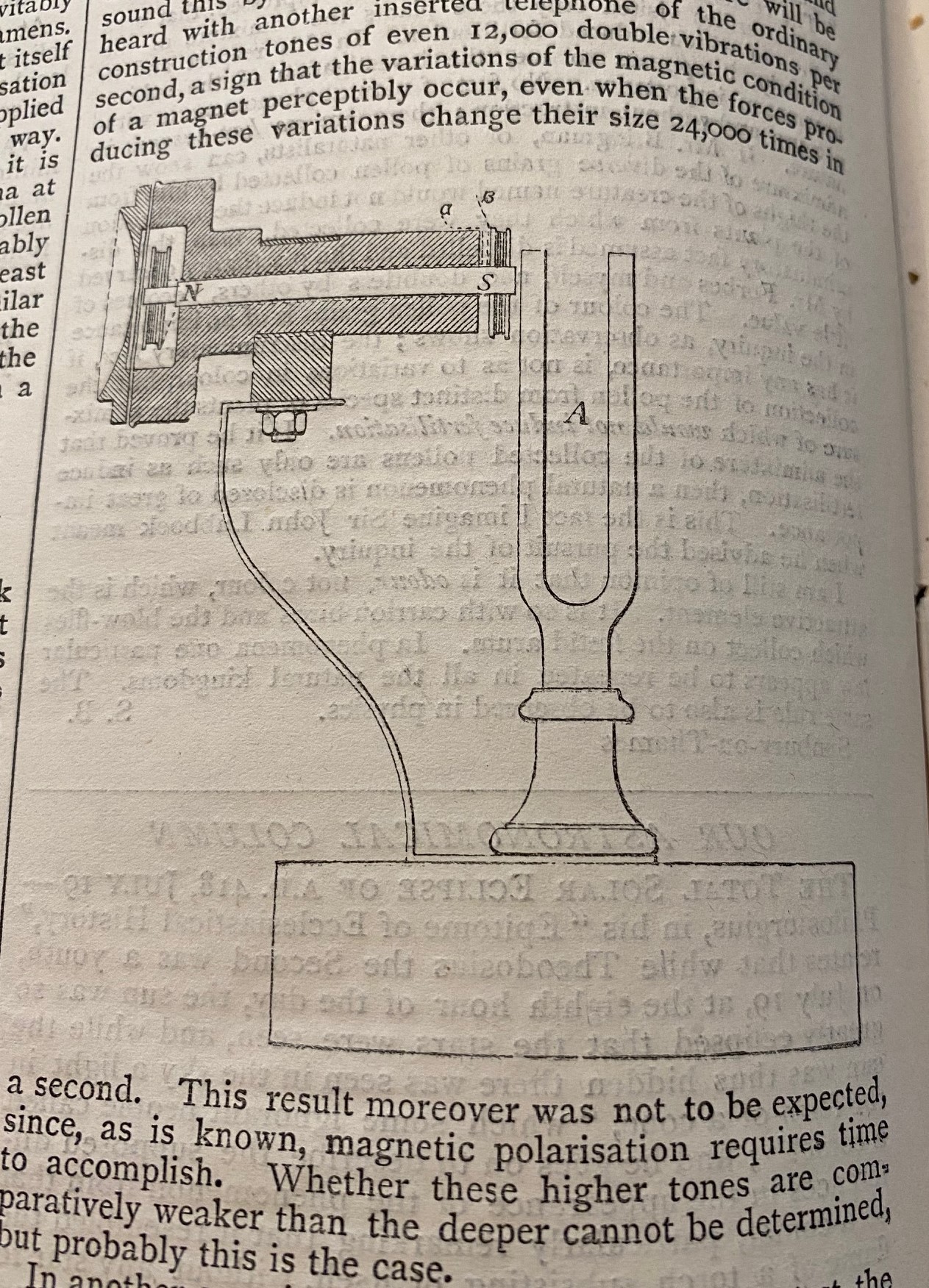
    Rontgen proceeds to experiment with an unused part of the telephone magnet attaching various tuning forks to the device which would become part of the circuit. He writes that:

    “the currents thereby induced in the coil are powerful enough to set the fork of the receiving station in such intense vibration that the sound may be distinctly heard in a large room; warned by this signal a person can in the usual way put the telephone to his ear and listen to the words of from the transmitting station. And so vice versa. “

    I’m not sure when a bell or warning device becomes part of the telephone experience after this, though I assume it comes quickly, once the issue had been identified. 

    Notes:

    Rontgen, W.C. “A Telephonic Alarum”, In NATURE, volume 17, no. 426, December 27, 1877, p165.

  • Found Poetry for a Disintegrating Machine from 1877

    JF Ptak Science Books  Quick Post

    I’ve made a number of posts here about the Found-poetry in indexes, title pages, instruction booklets, maps, and some other places. The moment may escape the poetry, but the poetry doesn’t escape the moment.

    IMG_2064What?

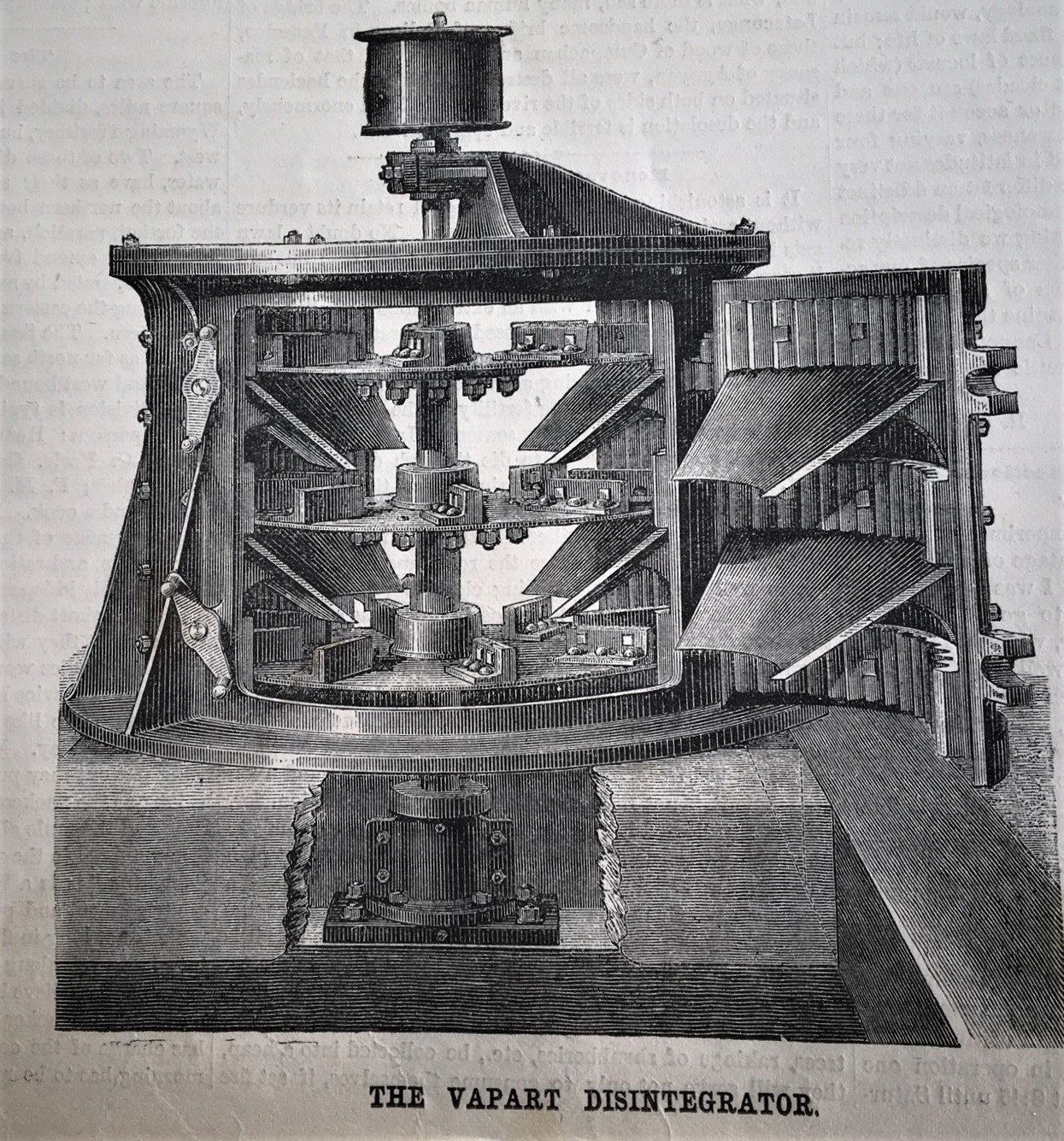
    That’s correct. Anyway, here’s another example from Scientific American for July 31, 1877, discussing and explaining the operating practices of the Vapart Disintegrator. We’re not discussing Star Trek here, just a crunching tearing shredding pulverizing way of grinding and/or destroying things.  The machine was big, and heavy, and torquey, and had a lot of big metallic teeth.  Here’s part of the description of how the device works. poemetized (all text original, spacing and punctuation not):

    Disintegration Can Be Carried To Any Desired Extent 

    I.

    The material to be disintegrated

    is fed 

    in from the top and

    falls 

    upon the upper disk,

     and the quick rotation of the latter drives the material 

    forcibly against the corresponding 

    toothed 

    segments.

    II.

    From here it falls down 

    the inclined plates, 

    and is delivered 

    on the middle portion 

    of the second disk,

    where the same operation is repeated on it, 

    as well as on the bottom disk,

    whence it is delivered 

    into a hopper

    below. 

    III.

    The disintegration can be carried to any desired extent.


  • Glorious Tech: Napier Bones of Words, a Calculating Money, and a Scroll-Fed Typewrtier (1916)

    JF Ptak Science Books   Quick Post 

    Pop Mech 1916 toy calculator monkeyI noticed three interesting devices in just a few dozen pages of each other in Popular Mechanics for 1916. The first was a calculating monkey adding machine/toy for kids–this is something I had never seen before and had I been aware of it 30 years ago I certainly would’ve used it in my store. The “toy” is actually pretty sophisticated, as it will add and subtract, multiply,divide, and extract square roots, which was more powerful than any machine I needed at the time for the store.  


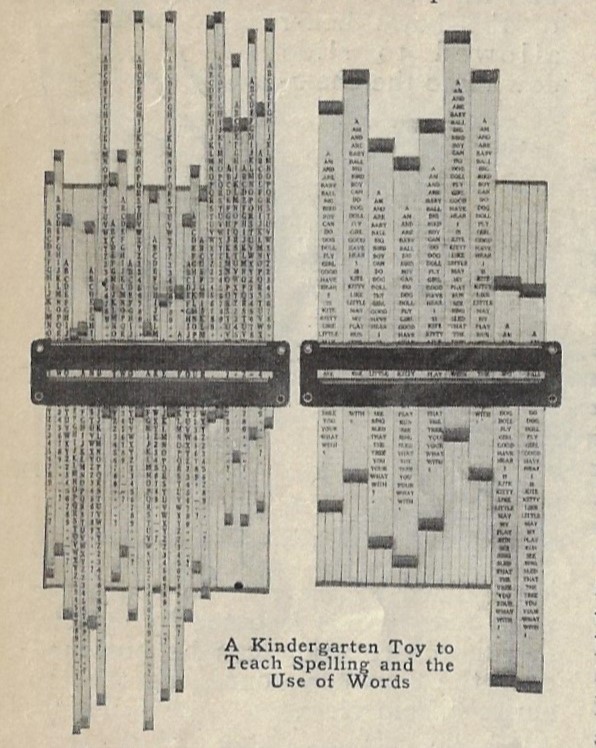
    The next piece of machinery was this Napier’s Bones-like device intended for kindergarten use. The device on the left uses a set of movable wooden strips with the alphabet printed on them; so by sliding the strips you can produce a simple or complex word, the result displayed in the open line of the rectangular piece of wood that holds the whole thing together. On the right is a set of strips with words on therm–used in the same fashion, the child could select a series of words to make simple sentences.  I like these two devices immensely,  (Unfortunately I have no information on this or the calculating monkey.)

    Pop Mech 1916 sliding wooden words

    The third item is a wonderful device, though this one not for kids–it is an electric automatic typewriter, punching out letters from a piano scroll-like master copy fed into a receiving typewriter. (Again, no manufacturing info here, and I don’t know how the typewriter would have responded to page breaks.) 

    ·Posted by :

    ·in:

    — —

  • An Improbable Advertisement in “Astrophysical Journal”, 1903.

    JF Ptak Science Books   Quick Post

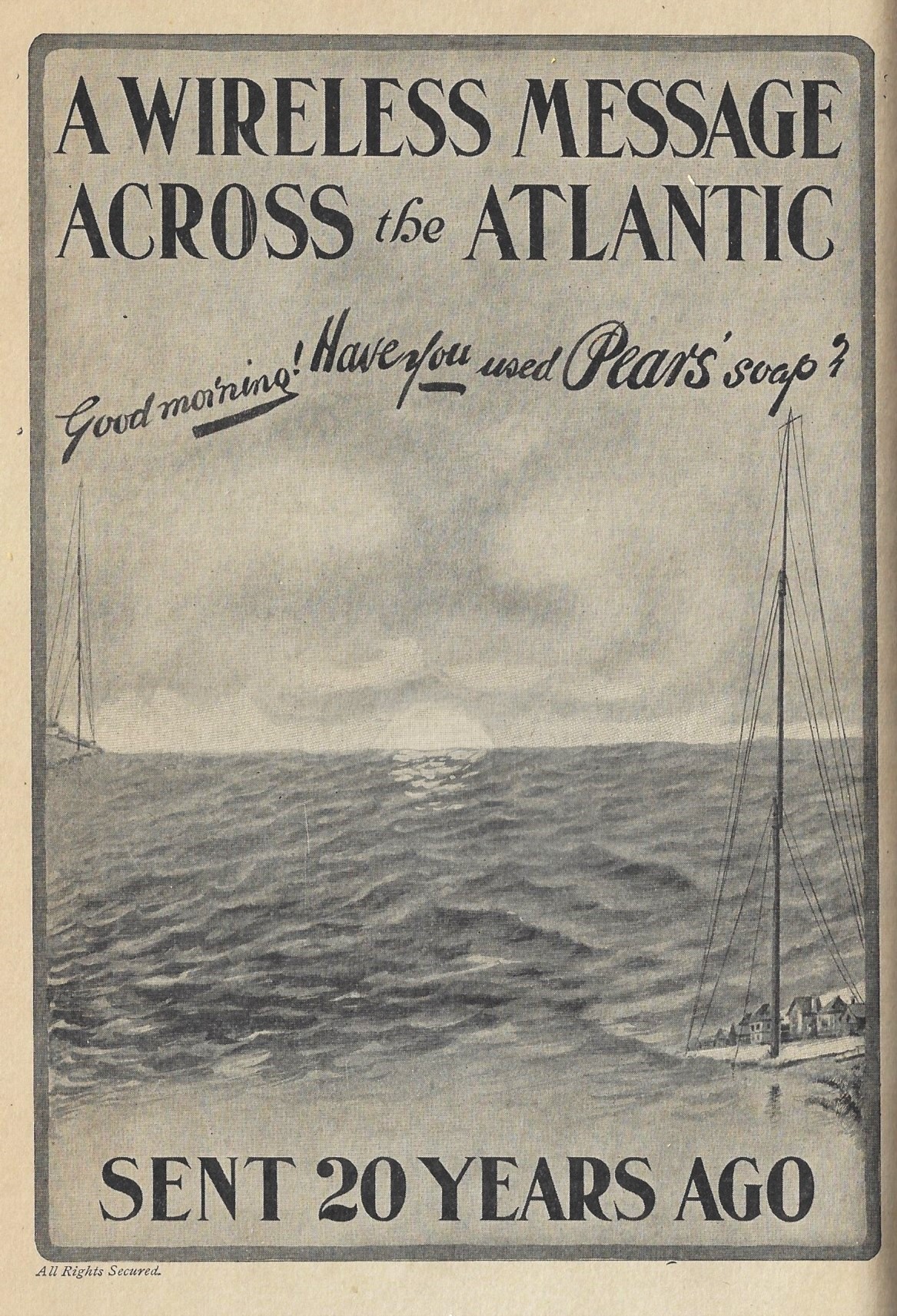
    Pears soapHere’s a scamperingly light post: an ad for Pears’ soap making a very curious and probably intentional incorrect claim. Of course it is just an ad, and it is just soap, but it is displayed proudly full-page on the inside cover of the prestigious Astrophysical Journal for 19031, and it seems to make an odd statement about transoceanic radio communication, inferring that a message was sent across the Atlantic via wireless “20 years ago”.

    Here’s the deal: I don’t understand why this ad is so purposefully wrong. The first message sent across the Atlantic didn’t occur “20 years ago” or 1883 as is coddled in the ad–that honor belongs to Marconi (1874-1934) who expanded on his first experiments in 1894 to send and receive radio signals across the Atlantic on 12 December 1903. (The signals originated in Poldhu, Cornwall, England, and was received at Signal Hill, St. Johns, Newfoundland—the message was a simple Morse code for the letter “s”.) Those twenty years notwithstanding, Marconi and Ferdinand Braun shared the Nobel in 1909 for their work in radio.

    Now, the ad says “sent 20 years ago” and not sent and received, or received at all for that matter. I know the “twenty years” doesn’t correspond to when Pears began operation, because that occurred in 1807. So I’m not sure what it is that they’re talking about here, though it is a pretty ad. If anyone has the answer to this little issue, I’d like to hear about it.

    (The antennas depicted here are very unlike the ones that Marconi constructed for his famous feat: “The spark-gap transmitter fed a mammoth antenna array — four hundred wires suspended from 20 masts, each 200 feet tall, placed in a circle. A similar station was set up on the American side of the Atlantic at South Wellfleet, Cape Cod.”–IEEE Milestones, “Milestones:Reception of Transatlantic Radio Signals, 1901.”)

    Notes:

    1. Oddly enough, Pears’ was about the only advertiser in the 1903 volume of the journal. I don’t know what the attraction was between soap and astronomy, though perhaps the elite at Pears’ just wanted to sponsor the relatively new journal.  


  • Electricity and Telegraphy Before the Electric Telegraph: the (Electric) Shock of Recognition (1825)

    JF Ptak Science Books  Quick Post

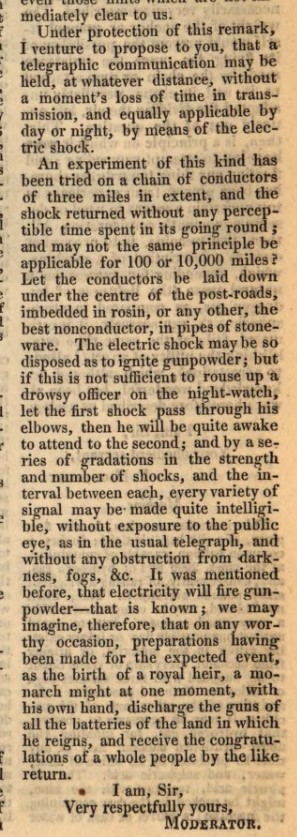
    Electric shockHere’s an interesting twist on electricity and the telegraph, but not quite what you’d expect. The note, written by “Moderator”, appeared in Mechanics’ Magazine for 15 June 1825 (volume iv, p 148). Since this is 1825, the telegraph being referred to here is an “atmospheric telegraph”, or semaphore, the electric telegraph of Morse being another dozen years away and another 5 or 6 before its practical appearance.

    The electricity here was being used in part to alert (where “alert” = “shock”) whoever it was that was snoozily sitting at their post to instantly pay attention to whatever it was being signaled to that point in the semaphore chain:

    “The electric shock may be so disposed as to ignite gunpowder; but if this is not sufficient to rouse up a drowsy officer on the night-watch, let the first shock pass through his elbows, then he will be quite awake
    to attend to the second…”

    I can’t tell if this is being suggested along a A Modest Proposal sympathy, or not. 

    This shock-bit though is preceded by something interesting that I also don’t quite understand, though that is starting to sound like the modern electric telegraph:

    “…and by a series of gradations in the strength and number of shocks, and the interval between each, every variety of signal may be made quite intelligible, without exposure to the public eye…”

    In any event, it is an interesting footnote in the history of communication and those sleeping through it. 


  • Alphabet Tubes (1895)

    JF Ptak Science Books  Quick Post

    I’ve written a couple of times on this blog on “tubes”, including tubular cars and ships, and of course pulp sci-fi adventures in tubular rocket ships, person intra-space tube propulsion systems, x-ray tubes, vacuum tubes, “tubes of uranium, and that sort, tubes as tubes. Plus there was the “extended tube”, like telescopes, canons, boilers, vacuum tubular whatzis of the future, plus the extended idea of the tube as an open-ended shaft and tunnel (there must be an opening on both ends otherwise you have a “hole”, which has its own category).  In these side tube researches I’ve never encountered the idea or phrase “alphabet tube”, until today. 

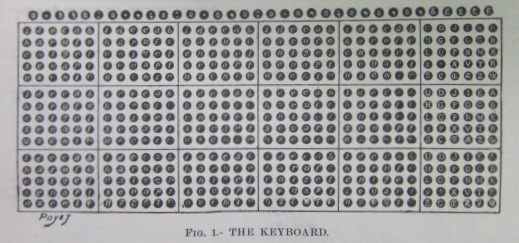
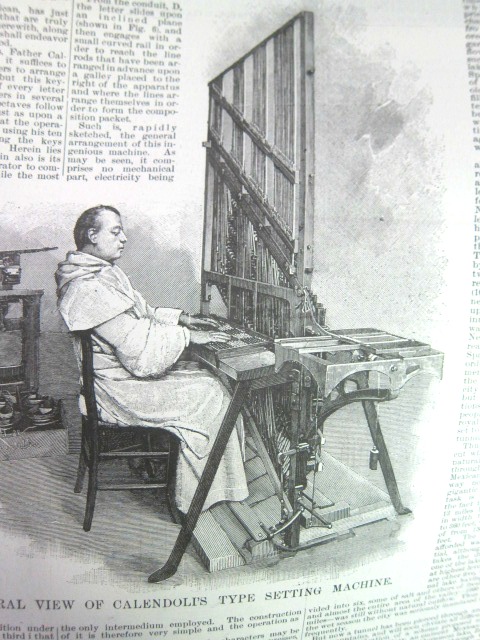
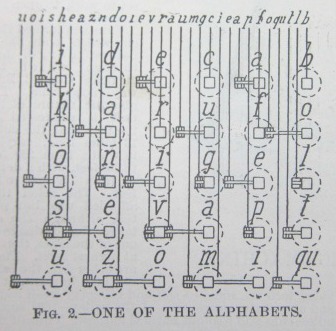
    The Domincan priest Father Vincenzo Calendoli invented (between 1893 to 1895) an unusual and seemingly-simple-but-hardly-so linotype machine that was seen by some as “the typsetting machine of the future…”(–C. Cochrane, American Printer and Lithographer, vols 21-23, 1896). The image below shows Calendoli in serene concentration seated at his machine which looks like a cross between a small Jacquard loom and an odd harpsichord (emphasis on the harp). And what Calendoli is concentrating on is this, his keyboard:


    Sci AM Mega typesetter _2_

    Sci AM Mega typesetter _3_

    The Scientific American Supplement  (1895, pp 16055-16057) illustration is reproduced exactly in an uncommon publication called the Rosary Magazine, (1895)–exact, with the exception of the additional caption: the writer annotates it by identifying the “checker board”, “inclined wire and galleys”, and the indescribably beautifully-named “alphabet tubes”! The explanation of what this tube is is far less interesting than its title–tubes filled with type–though the machine overall was extraordinary.


  • The Luminous Electric Flux at the Beginning of the Tunnel (1849)

    JF Ptak Science Books  

    JFI 1849 electric light StaiteOil lamps and candles are ancient, with candles being the junior in age at about 5000 years old compared to oil’s 6500 or thereabouts. So the introduction of an artificial source of light that was not based on these technologies and which took, basically, thousands of years to come to was an extraordinary occurrence.

    Humphrey Davy introduced the idea of the carbon arc electric light in the first decade of the 19th century. His light was successful if not practicable, as the electric source was a battery made of a series of a thousand or two liquid cells, though there was a much more practical public display of the idea in the ‘teens. The subject of this short post, William Staite1, enters the electric light arena in the 1840’s with no real scientific background and proceeded to make some impressive improvements, proving himself a thinker with the ability to design and construct the precision elements.

    Like all the others at this time he achieved very limited success given the problem of the electric power source—that would not be solved for another couple of decades with electric generators.

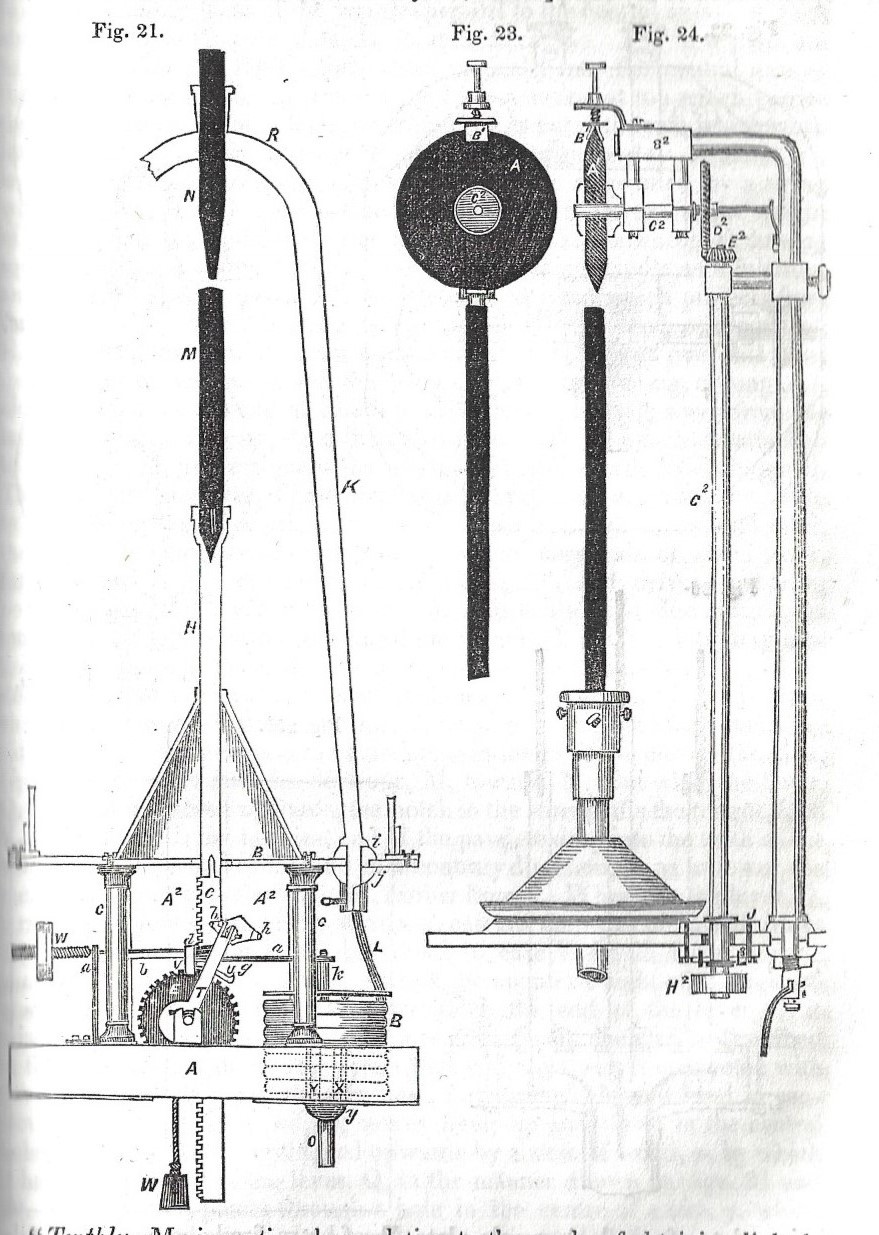
    Anyway I’m stopping by here to share the fine and beautiful drawings from Staite’s patent. Basically the light was produced in the gap between the electrodes (between N and M in the first figure) right there in the open air (as well as the ends of the electrodes/carbon rods that became heated and glowed, though this light source was minor). This actually looks a lot like some of the arc lighting used presently in projectors and searchlights and such, though with far more efficiency and lumens—also the arc is passing through a gas, like xenon, under high pressure to produce “sun-like” light.

    Staite tried to monetize his idea but with little success, and was dead by 1854…and seems to have passed into obscurity. His name is seldom mentioned, it seems, in any of the popular timelines/chronologies/histories that I’ve pecked around with online. But he was certainly there and made valuable contributions to that technology, though the effort would soon switch in the 1870’s to the incandescent bulb, and by 1880 Edison would introduce a successful little number who filament would burn for 1500 hours, and then the race was on.


    Notes:

    1. (William E. Staite), “Specification of Staite’s Patent Electric Light, [Patent dated July 13, 1847—specifications enrolled July 13, 1848.]” in the “Specification of English Patents sections, in Journal of the Franklin Institute of the State of Pennsylvania, devoted to the Mechanical Arts, Manufactures, General Science, and the Recording of American and other Patented Inventions, printed in Philadelphia at the Franklin, 1849; volume 17, third series, whole no. 47, pp 263-268, with 8 small woodcut figures of the apparatus.

    “W.E. Staite (1809-54) and W. Petrie (1821-1904) were pioneers of electric lighting who received little recognition for their work. Although a satisfactory self-regulating arc lamp was developed, commercial success was not achieved owing to their reliance on primary batteries as the only source of power. Numerous demonstrations were given throughout England, and serious interest in their system of electric lighting was shown by railway companies and dock authorities. The death of Staite in 1854 brought to an end these early attempts to use electricity for illumination.” And: “The pioneers…were finally defeated by the limitations and the expense of the primary cells which were their only source of electrical energy. –“Staite and Petrie: pioneers of electric lighting”, G. Woodward, in IEE Proceedings A – Physical Science, Measurement and Instrumentation, Volume: 136 , Issue: 6 , Nov. 1989.


  • Radio and Television, a Peep into the Future of 1930 from 1929

     JF Ptak Science Books   Post 2740

    Pop Mech 1929 radio of the future

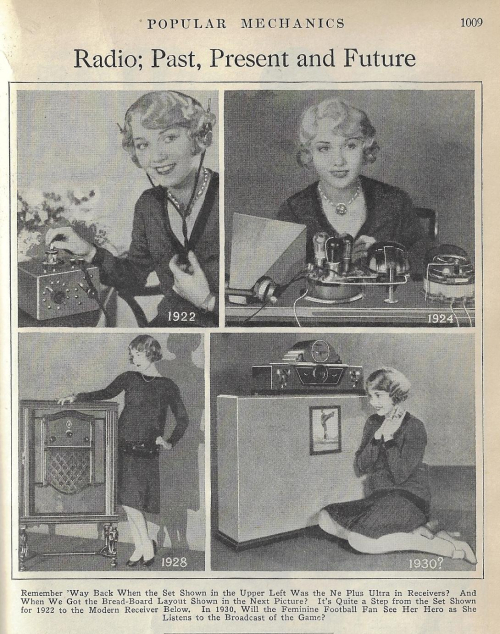
    The odd thing about this odd speculation for an odd look advancing a single odd year into the future is that it is so, well, odd. Here on page 1009 of the January-June volume of Popular Mechanics the editors speculated on what the approaching year might bring in the evolution/revolution of the radio. Radio as a popular medium was relatively new-ish in 1922 and the in six quick years very much developed for wide use, and so it must have appeared not too long a leap to jump into a radio for 1930 that offered images to accompany the broadcast. The idea of “seeing by wireless” was already upon folks back then, or at least the technology was.

    Since the vision of the future of 1930 was that of the radio, I’m assuming that the image that “the feminine football fan” was seeing in 1930 was a static image of someone punting–the capacity for that already existed, so I suppose that what Popular Mechanics was expressing was the general distribution of this new wireless set.  Perhaps “television” wasn’t mentioned because this was a speculation on radio.

    As a matter of fact, television as an invention was already established by 1929–deeply so. There was already a television station  (established in 1928, WRGB), which already was several years after John L. Baird’s1 first public demo of his mechanical tv at Selfrdige’s department Store in London on March 25, 1925. And by 1926 Baird had made a successful demonstration of a moving image, which was well documented in a 62-page book months later by Alfred Dinsdale, Seeing by Wireless, in which “television”  is elegantly described as an invention where “we see what is happening at a distance while it is happening”. (There is a famous and relatively creepy image that is described as the first photo of a moving image transmitted via television, a death-mask-like portrait of Baird’s business part, Oliver Hutchinson, and which first appeared in The Times on January 28, 1926.)

    In the same period a D.C. man, Charles Francis Jenkins, was having success with his electronic television, where by 1925 he had already publicly demonstrated a transmission of silhouetted images (and this following a dozen years after his first publication on the subject, “Motion Pictures by Wireless” in 1913).  Two years later (April 7, 1927) yet another very successful demo was made by Herbert E. Ives and Frank Gray (both of Bell Labs). A year later, on September 3, 1928, the beautifully-named Philo Farnsworth was far enough along with his invention that its public demonstration on that date is recognized as the first electronic television demonstration.

    In any event, I wanted to note some of the events in the development of television that occurred around the time of the publication of this issue of Popular Mechanics to show how much work and how far along the new medium had come to give  a little background into the question of why this photo essay would stand by a static-image radio while a moving image electronic television was being shown to be so successful. I’m a little stumped.

    Notes:

    1. I don’t know where else to hang this tidbit, so here it goes: it is just interesting to note that two Scots–Alexander Graham Bell and John Logie Baird–gave ears and eyes to human communication, one with the telephone and the other with the television.  There are many others who made very significant contributions to both developments, but I thought that this was worth a mention.

    Also, Frankenstein’s “monster” may not have been flesh and blood, but a moving picture of it. Here’s the work of one Frankenstein with a patent relating to the development of the media monster, television: “VON JAWORSKI, W. und FRANKENSTEIN, A., “Verfahren und Vorrichtung zur Fernsichtbarmachung von Bildung und GegenstÄnden mittels Selenzellen, Dreifarbenfilter und Zerlegung des Bilden in Punktgruppen durch Spiegel”, Brevet allemand, 172 376, 20 August 1904.”

    ·Posted by :

    ·in:

    —

  • A Fine Display of Pie Charts 1893

    JF Ptak Science Books   Quick Post

    “This apparatus works unerringly as the mills of the gods, but beats them hollow as to speed”–Electrical Engineer, November 11, 1891

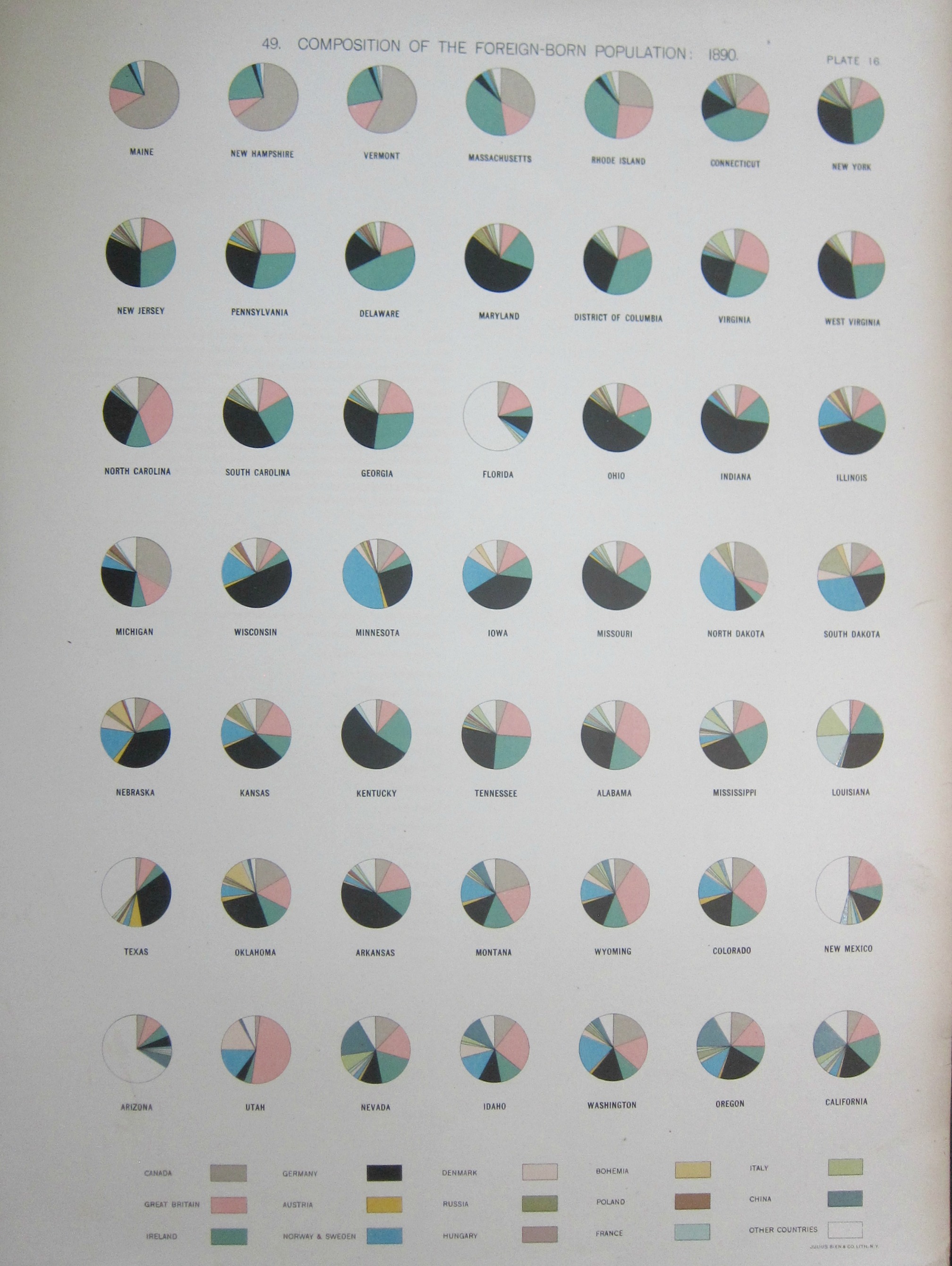
    Hollerith foreign born detail _3_

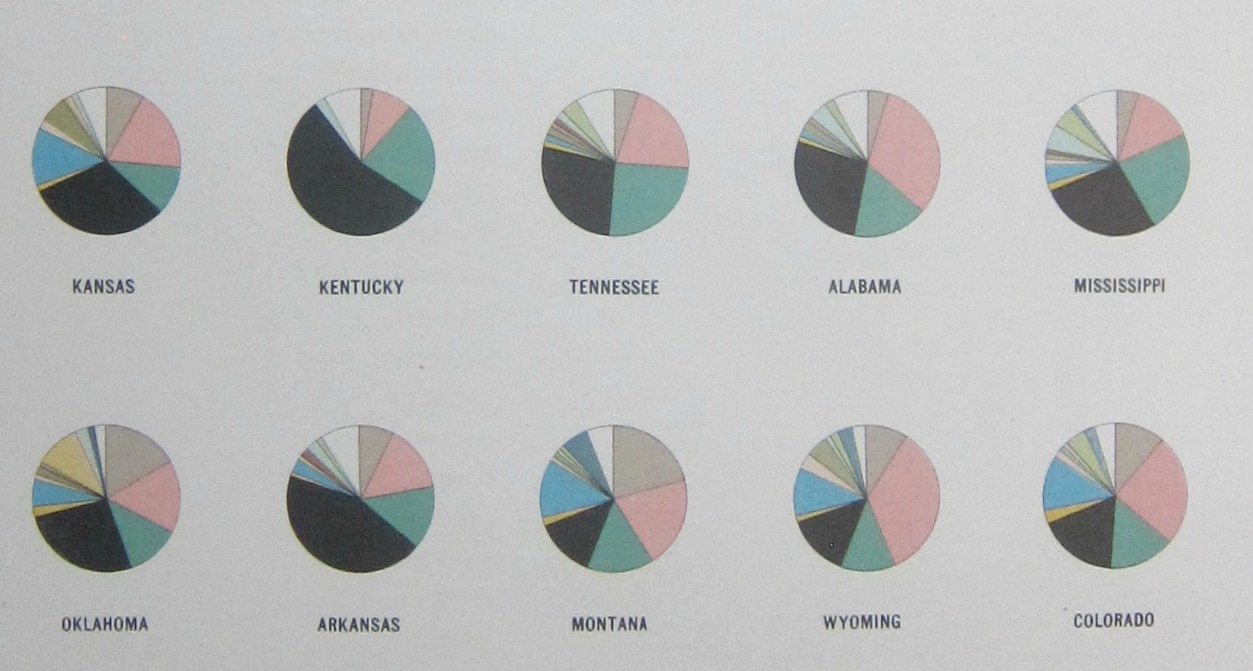
    Many splendid displays of newly-manipulable data made their appearance in the Henry Gannet atlas to accompany the great U.S. census of 1890 –this example displays the composition of foreign born inhabitants of each of the states.  Part of this was due to the use of the Herman Hollerith tabulators, which made their appearance for the census office to work their electromechanical magic to process data faster than the 8-year-long process of the 1880 census. As it stands, the Gannet atlas and the census report was published beginning just two years after the completion of the 1890 census, a job made possible by the “mills of the gods” machine and some 48,000 enumerators (who completed returns for 13,000,000 households).  With prodigious thanks to Hollerith, the census was completed quickly and with a wider variety of data collection rather than what would have been the opposite without them. 

    Hollerith foreign born pop _2_


  • A Submarine Research Platform, 1873

    JF Ptak Science Books  Quick Post

    In the same year as the British and American first appearances of Jules Verne’s Twenty Thousand Leagues Under the Sea there appeared in the pages of Scientific American this short article on a not-very-Victorian submarine exploring platform. Published in the April 19, 1873 issue was an illustrated (by cross-section) note on a  type of diving bell created by M. de Toselli:

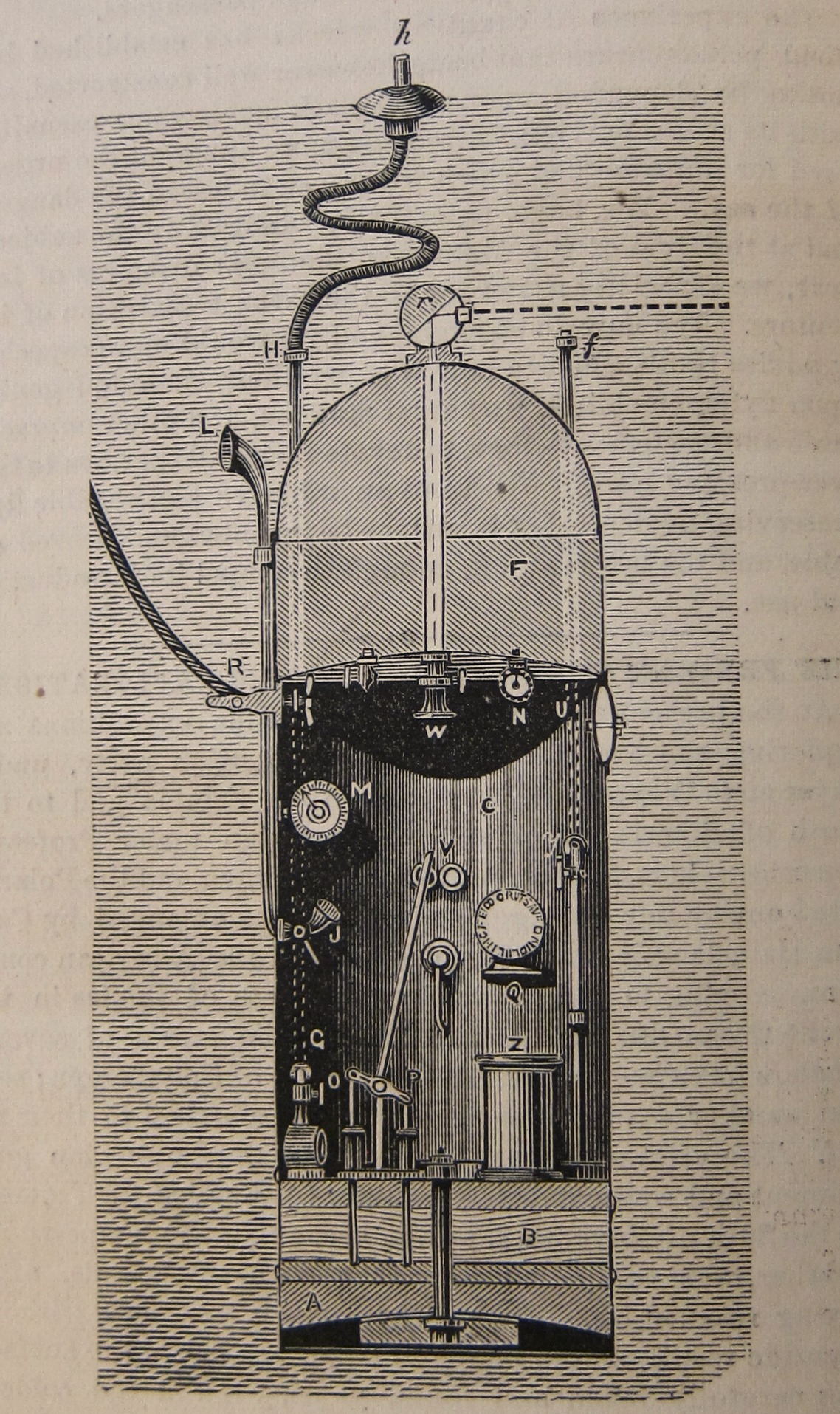
    Sci Am 1873 diving bell. 

    It is explained to us that the living compartment (C) holds a number of instruments and machines: there is a pump (P) for drawing and evacuating water (in compartment B) for the raising and lowering of the craft (there is also a layer of lead in compartment A for weighing down the vehicle); there are also two manometers (M and N), a telegraph (Q), and of course, a seat (Z); the top section (F) is for storing breathable air; (U) is a hatch for entering and exiting; and (R) is a rope/cable that connects the thing to a ship, and which also contains the telegraph cable. The text said that there are “small windows” but I can’t find them.  In any event this was intended as a scientific platform for research, including photography.