A Daily History of Holes, Dots, Lines, Science, History, Math, Physics, Art, the Unintentional Absurd, Architecture, Maps, Data Visualization, Blank and Missing Things, and so on. |1.6 million words, 7500 images, 4.9 million hits| Press & appearances in The Times, Le Figaro, Mensa, The Economist, The Guardian, Discovery News, Slate, Le Monde, Sci American Blogs, Le Pont, and many other places… 5000+ total posts since 2008.

Category: Inventions

  • The History of the Internet: Remembering Vannevar Bush and the Memex (1945)

    JF Ptak Science Books LLC  Post 812  Blog Bookstore

    On this day, which may or not be the 40th anniversary of the
    first use of the internet (and the 80th anniversary of the collapse
    of the stock market of ’29, and Lucy A’s anniversary of her birth) it might be
    good to remember an earlier version of the internet and the semi-invention of
    the concept of hypertext: the MEMEX machine of the under-remembered Vannevar Bush. 
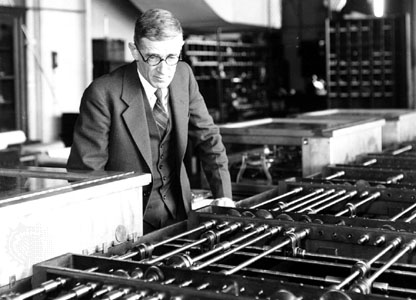
    Bush

    Vannevar (pronounced “van ee var”) was a flinty no-nonsense New Englander
    who was an organizational and mechanical genius who as a professor at MIT
    developed a remarkable analog computer that greatly advance computation
    capacities for solving differential equations. 
    This was in the 1930’s, and even after creating an improved
    electromechanical version of the machine still chose the wrong way to go in the
    soon-to-materialize digital computer revolution.  During WWII Bush was one of the most
    important Americans in the war effort, overseeing the entire scientific effort
    of the U.S.—an
    enormous effort dispatched beautifully (and successfully).  His importance in this regard is difficult to
    overstate.

    But right there at the end of the war, when he was organizing a still-secret
    effort of controlling the spread of atomic weapons (before Hiroshima), Bush was also thinking about the
    future of the organization of human knowledge and memory.  And published it, too, in the popular Atlantic magazine in July 1945. (It was
    republished in a shortened version a few months later in September—it remains
    to this day, according to an editor at Atlantic, one of the most
    often-requested reprints) where it reached a reading audience of millions.  The article, “As We May Think”, outlined his
    idea for a device he called the MEMEX1 (“memory” and  “index”), which compressed and organized all
    that its user could remember and whatever information would be obtained in the
    future via electromechanical apparatuses, and available with associative tracking
    between the microtext frames.  So all
    manner of book and papers and reports and newspapers and images would be
    microphotographed and stored in a beautifully-indexed mechanical retrieval
    system where it would live with the information of others.  There was also the possibility of real-time
    textual additions to whatever it was that was retrieved, the genetic precursor
    of hypertext.  Bush’s thinking has been deeply
    recognized (and also by the creators of the internet) as the intellectual
    grandparent of the modern internet. 
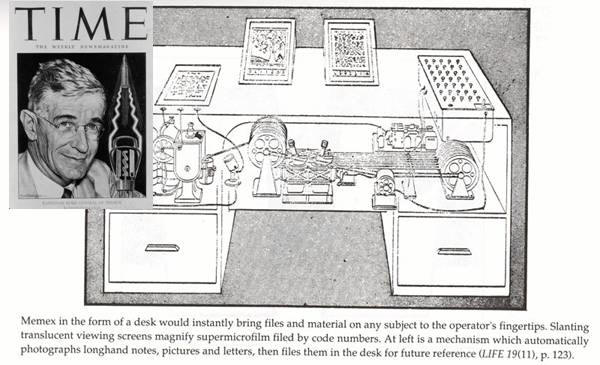
    Bush Memex

    I just thought on this day that the man who saw more clearly into the future
    on advanced global communication and societal memory should be remembered on a
    day when his grandchild came into being.

    Notes:

    1. According to Bush, “the MEMEX is a sort of mechanized private file and
    library…. It uses methods such as microfilm storage, dry photography, and
    analog computing to give postwar scholars access to a huge, indexed repository
    of knowledge-any section of which can be called up with a few keystrokes.”
     Wardrip-Fruin, Noah and Nick Montfort,
    ed (2003). The New Media Reader. p. 35. The MIT Press

    The physical plant of the MEMEX:  “A
    memex consists of a desk, where on top are slating translucent screens on which
    material can be projected for convenient reading. Within the desk were
    mechanisms that stored information through microphotography. Most of the memex
    contents are purchased on microfilm ready for insertion. On the top of the
    memex is a transparent platen. When a longhand note, photograph, memoranda, and
    other things are in place, the depression of a lever causes it to be
    photographed onto the next blank space in a section of the memex film, dry
    photography being employed.”  Manovich, Lev. “As We May
    Think”, The New Media Reader and
    wiki on The Memex. 

  • Fabulous Victorian Technical Attempts at the Future Commonplace

    JF Ptak Science Books Post 733  Blog Bookstore

    ===blog==aug 28==floating device


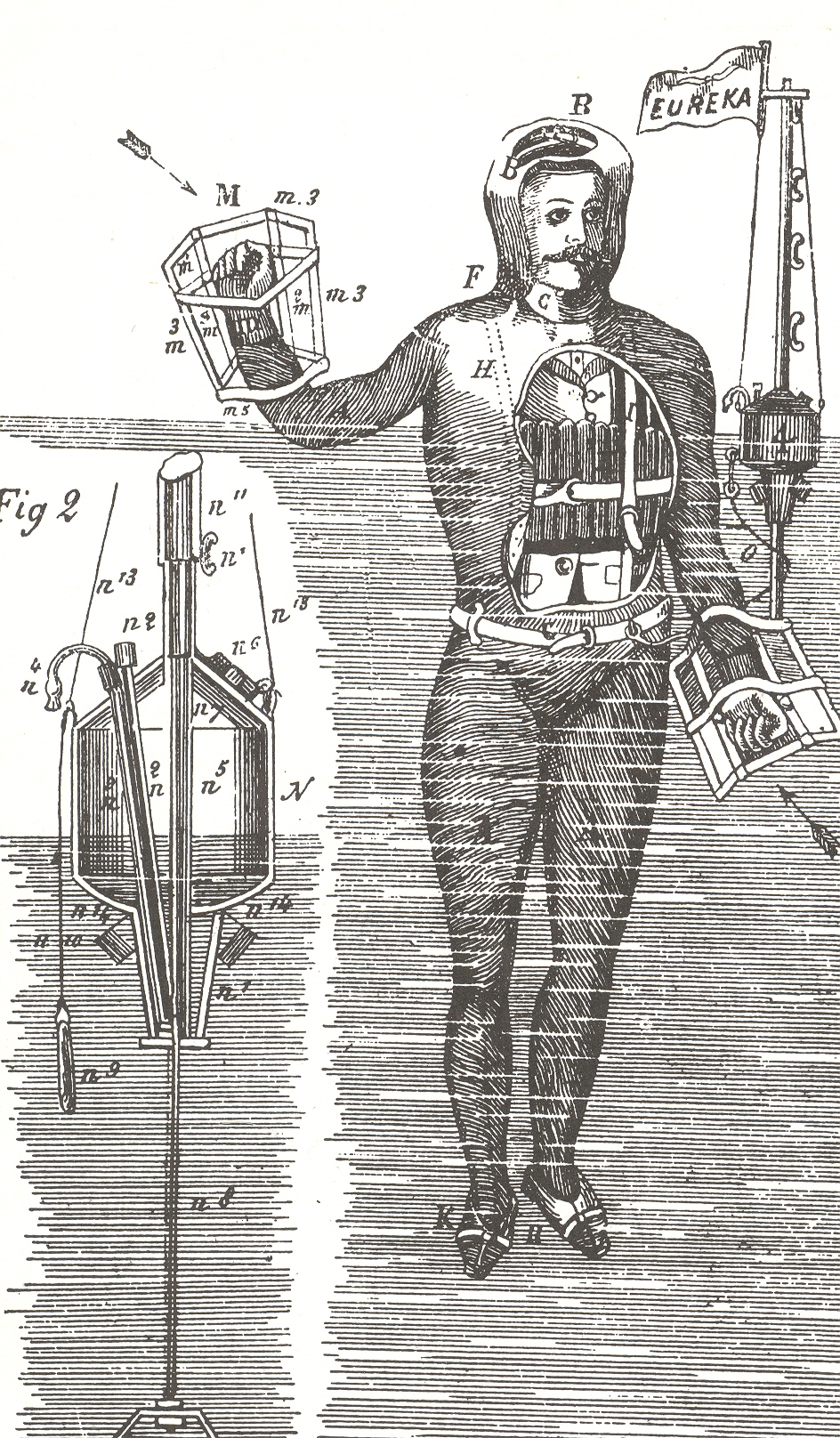
    [Source: Scientific American, July 11, 1869; also [The full description of the apparatus (as seen in the American Phreonological Journal, September, 1869) can be read in the continued reading section, below.]

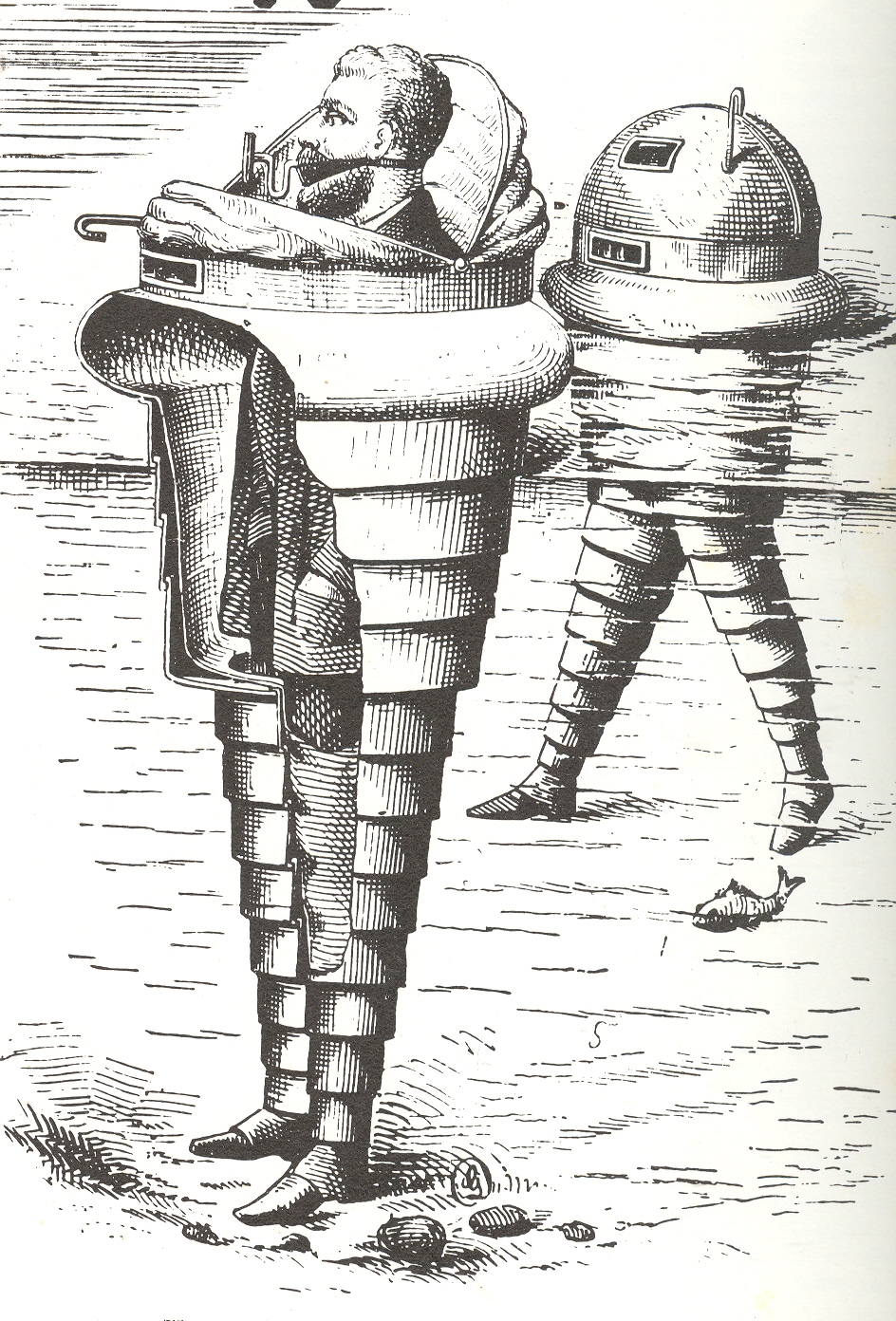
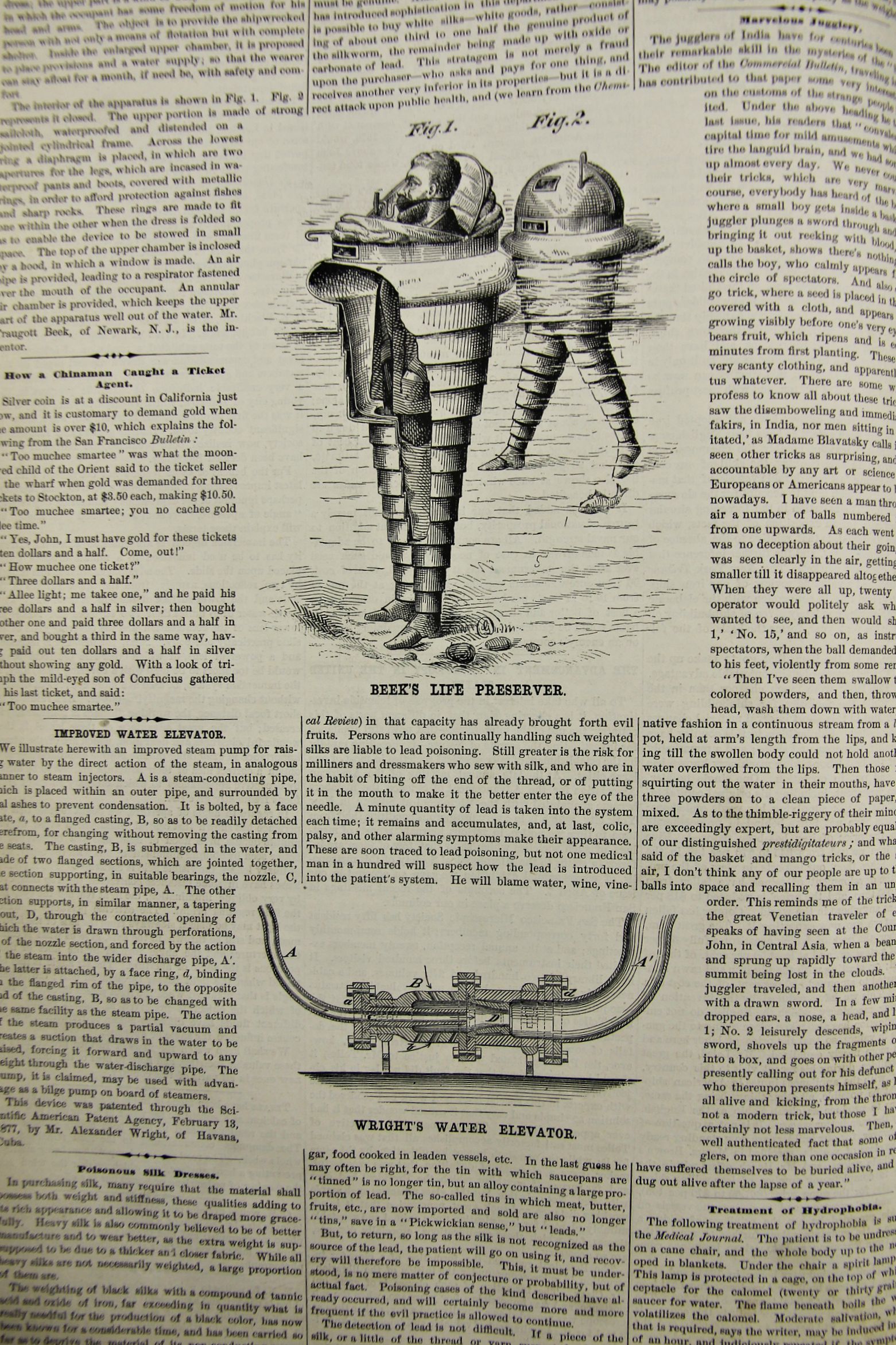
    And so in 1869 came this odd Victorian appeal to a frosty blend of survivability and entertainment.  The fellow in this woodcut was decked out in the very latest lifesaving apparatus for making one’s waxed-mustachioed way through disaster. The surviving member donned a very resistant, very heavy suit made of rubber, including a helmet (of some sort), all of which was made to make the wearer impervious to cold or heat./ Under the rubber suit was a floatation/buoyancy undersuit which seems to fit snug around the wear’s waistcoat.  It looks as though the whole of the suit would increase the mass of the wearer by something like one-third.  Most intriguing here is the little companion buoy (complete with a “Eureka” flag), which was outfitted with water, food, “reading material so that he may read the news to pass the time of day”, cigars, a pipe and tobacco, plus torches.  Evidently, this was to keep the person afloat, alive, and entertained for days on end. 

     [Source: Scientific American via Google Books]

    This magnificent 1877 non-SteamPunk telescoping india-rubber screw, invented by Trauggott Beek (of Newark N.J.), is supposed to be waterproof, so that the wearer could put it on over evening clothing (as is the case in this illustration) and enjoy a spin in the surf before contemplating other Victorian nighttime reveries.  It was said that the wearer could stow away a month’s worth of food in the suit, somehow–I don’t see how this could be, especially if there was a month’s worth of water, which would like fitting in the suit with another (larger) person.


    ===blog==aug 28==fswimming device

    [Source: Scientific American, May, 1877, issue #18.]

      Beek's life preserver

    ·Posted by :

    ·in:

    —

  • Inventions Ill-Advised: Bicycle Malapropisms in Edwardian England, 1901-1906

    JF Ptak Science Books LLC  Post 241

    Blogcircus_bike
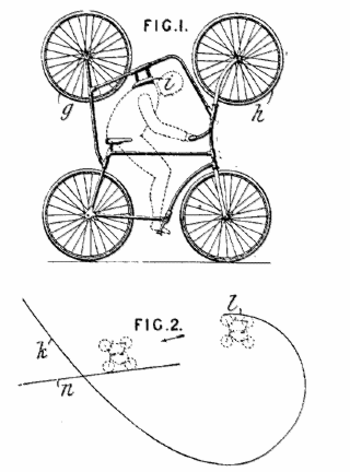
    I know that this invention by Karl Lange (1904, left) may or may ever come in “handy”,
    but, well if you were a circus performer it might be another story. The whole thing looks so improbably
    heavy  and unwieldy to me that it couldn’t possibly be of any use, though it is a
    thing of beauty. All one really needs to complete this picture is another rider seated on the inverted bike waiting for their turn.

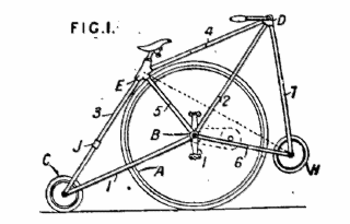
    Marshall Rigby’s
    machine (1901, below right) looks more like a geometry problem than anything else, but
    really intended to make the not-so-early-by-any-means larger-wheel velocipede
    easier to get on and get off. Why bother
    keeping the big middle wheel is anyone’s guess.
    Blogbikerigby

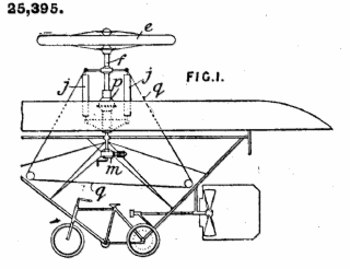
    Frederick Simms’s (1906, below left) bike-powered bike-opter doesn’t look like it could
    move forward let alone fly.

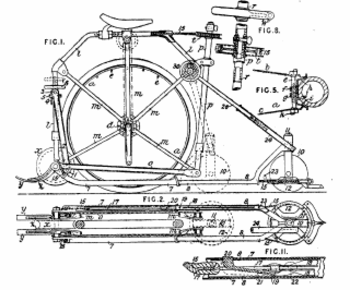
    Sayer’s “Improved Cycle Or Other Vehicle” (1905, below right) has a
    telescoping wheelbase and seat, and has brakes that can be adjusted so that
    they are automatically applied “at a predetermined inclination in the road”. It also has wheels “that may be readily
    adapted to rails”, though what rails and to where those rails might be going is
    again a mystery. Also a mystery here is how power is transmitted—I can’t tell
    how the thing is made to go, though it is a pretty drawing.
    Blogbikesimms

    Blogbikesayer

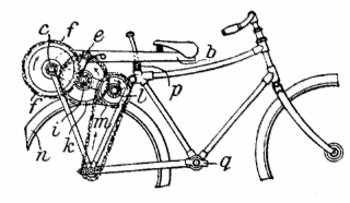
    Lastly for tonight is the bouncing bike of Herr Adolf Ernst Anton Mueller (1902, below),
    who came up with the idea of powering a bike from the “up and down motion” of
    the rider’s weight, thus doing away with pedal. He doesn’t provide a rest for the feet, which might make the bouncing a
    little difficult. Also, Lt. Mueller was writing from the
    Military Barracks of Grandenz (Germany)
    and was an officer in the Kulmer Infantry regiment, making me wonder if he was
    thinking in terms of regimental displays of bouncing German soldiers on bikes…

    Blogbikemueller

    Abstracts for the British patents mentioned above (from the British Patent Office), in their original format, retaining all of the juices and flavors of Edwardian engineerese:

    Lange, K. April 15, 1904.  Bicycles
    adapted for use by gymnasts and acrobats. -A cycle for use in performing the
    feat of looping the loop in circuses &c., on the mutilated loop k, l, n,
    has a second cycle attached above the rider’s head, which enables him, on
    leaving the part l, to complete the journey, head downwards, on the upper
    wheels g, h. The upper cycle may have more than two wheels, and other padding
    besides the cushion i.

    19018038. Rigby, M. April 19. Unicycles; safety wheels and supports;
    steering- mechanism; driving-mechanism; frames.-A unicycle comprises a large
    wheel A carrying on, or connected to, its axle B a frame consisting of forked
    members 1, 2, 3, 5, 6, 7 and a single member 4 arrange:! as shown. A socket E
    connecting the members 3, 4, and 5 carries the saddle-pin. Safety-wheels C and
    H, one of which may be replaced by a pair, support the rider when at rest or when
    steering. The wheels C and H may be mounted in pivoted forks which are actuated
    by a spring so as to keep the wheels in line. Rigid handles D enable the cycle
    to be steered when the wheel H is in contact with the ground, but, if desired,
    the wheel H may be mounted in a steering-post actuated by pivoted handles. The
    wheel A may be driven either by simple cranks, as shown, or by suitable
    treadle, crypto, or chain gearing. Either of the members 5, 6 may ba replaced
    by a member connected to the socket E and the axle of the wheel H. A bridge J
    serves as a step in mounting.

    25,395. Simms, F. R. Dec. 6. Gyroscopic apparatus.-For driving a gyroscopic
    wheel e on an aerial machine by a motor m in such a manner that the aeronaut
    can vary its inclination by pulling cords q, the driving-shaft f is made in two
    lengths connected by a ball-and-socket joint p. The two lengths are pressed
    together by springs j with sufficient force to cause the rotation of the motor
    to be transmitted to the wheel by the friction of the joint.

    18,699. Sayer, R. C. Sept. 16. Motor road vehicles; locomotive tramway
    vehicles. -Relates to a cycle or vehicle which has a variable wheel base,
    brakes automatically applied at a predetermined inclination of the road, and
    wheels that may be readily adapted for running on rails. The frame comprises
    struts m, radiating from the axis of the wheel a, tubes l, rods o, and a forked
    tube p. The steering-wheel 10 is mounted in a fork the stem 11 of which is
    fitted in a socket on the ends of the members 8 of the telescopic parts 7, 8 of
    the frame (and on and on)

    26,453. Mueller, A. E. A. Dec. 3. Body motion, propelling by.-The rider
    stands upon the foot-rests q, and, by the weight of his body, depresses the
    saddle, which is attached to a lever b, pivoted at its end c to the frame. The
    downward movement of the lever b causes a spring pawl e to actuate a
    ratchet-wheel f. The motion of the ratchet – wheel is communicated through wheels
    i, k, l to the chain-wheel m and thence to the hind wheel n, so that the
    bicycle is propelled forwards. The pressure on the saddle is then released, and
    the saddle is restored to its normal position by a spring p, when the cycle of
    operations is repeated.

    ·Posted by :

    ·in:

    — —

  • Inventions, Wrongly Inspired: the Game of Death, the Game of Life, and the Game of Life & Death

    JF Ptak Science Books LLC  Post 238

    Like everyone else, I’ve played the fine Milton Bradley board game Life, piling in blue kids and pink kids, getting a house and a mortgage, sweeping the family over plastic hills and Prussian blue waters (well, not really), all in the one-way race to the big white plastic house at Millionaire Acres.  There was make-believe Graves_gamecash,a fun spinning device that made a cool plastic-y noise, and of course the vaguely 1960 Lincolnesque convertible car with six holes in it.  It was fun and almost never provoked a fight.

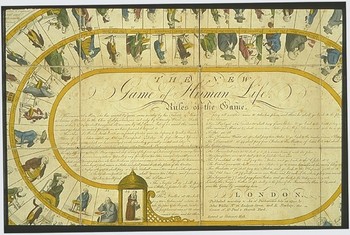
    There’s also the 18th century precursor (shown below) to the Milton Bradley game (which actually first appeared in a  rudimentary form in 1860), which was a more subtle form of the progress of life, taking us from baby to bones. On a completely different plane there is the great John Conway’s (ca. 1970) AI/cellular automata Game of Life; and on still another, different level is the semi-evolutionary mega-life mega-death game by Sims creator Will Wright, called Spore.

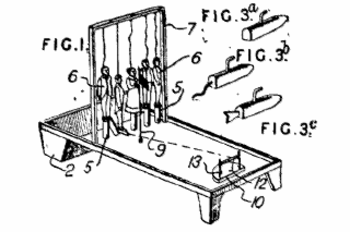
    Different from all of the entries above though is  this sweet toxicity of an invention by Eugene Edwin Graves and William Edwin Brown (called, simply, incongruously, Graves and Browns Improved Game), which was patented in 1902.  It was really a Hang ’em Higher game, with players shooting a marble or other projectile from one end of the playing field to the other, with the intent of knocking the stool out  from under the condemned person’s feet, who stand there with their head in a noose, a marble away from infinity,  awaiting their just reward to be delivered by children..  I’m not a gaming expert, but I imagine that the genre of games calling for children to hang condemned criminals would be mighty sparse.(I’ll have to consult with my friend and wooden board games expert Andy Archie of Asheville on this.)  I can just now hear the  faint glee of the kids as they rock loose  the stool, sending their criminal’s-name-to-be-determined  swinging into  space.   I’d rather not have my kids playing this one; somehow, in someway, splitting apart the universe at its belly in Spore doesn’t seem quite as gruesome as the Graves game.   

    It is slightly interesting to note that there is at least one woman among the condemned. (The last woman hanged in England would be103-pound Ruth Ellis,  who went swinging in 1955.) Simpsons_life_2

    The abstract of the British Patent Describing the Graves and Brown Game (the original patent illustration found above):

    Abstract of GB190201860  1860.

    Graves, E. E., and Brown, W. E. Jan. 23. Games
    played with projectors and projectiles.- In the arrangement shown in Fig. 1, a
    board, provided with a pocket 2 at one end, is fitted with a gibbet 7, to which
    are connected model figures 6, standing on supports 5. A projector 10,
    consisting of an elastic cord 12 stretched on supports 13 carried by a base, is
    adjustably pivoted on the table, and serves to throw projectiles of the form
    shown in Figs. 3<a>, 3<b>, 3<c> along the board or through
    the air, so as to knock

    Game_of_life

    \the supports 5 into the pocket 2, leaving the figures
    suspended. Flags 9 may be placed on the board. The gibbet may be dispensed
    with, the figures themselves being knocked into the pocket. The projector may
    consist of a trough-shaped piece fitted with an elastic band, which engages a
    slot in the rear end of a conical projectile. To enable two players to use the
    game simultaneously, the parts may be duplicated, the projectors being arranged
    at opposite ends, or in opposite corners of the same ends, and the pockets
    being opposite the projectors.

    ·Posted by :

    ·in:

    —

  • Inventions, Wrongly-Inspired: a Magnificent Chord and Gov. Palin’s “Clean” Coal

    JF Ptak Science Books LLC   Post 237

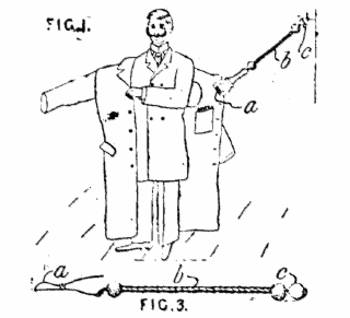
    In the category of wrongly-inspired inventions comes this masterpiece from a G. Tilsen. whose idea for using a chord (as shown in figure 3) seemed to spawn for him an entire empire of possibilities.  (Seems to me a little like patenting a stick and your hand for the use of making a hand sun dial AND for turning the stick around  so as to be able to draw things in the dirt, and so on.  Tilsen believed that if he had this chord and a place to attach it to the thing transformed into an  apparatus to  put on/taker off coats, hanging up a hat, “keeping a coat collar turned up”, for “suspending a muff on a person”, and other stuff.  Sometimes in intellectual bait-and-switch you call something by another name and it becomes new/improved/different.  For example, among the many supra-creative insights last night by Gov. Palin one referenced the use for “more clean coal” for the daily national energy intake.  Arsenic was removed from coal some time ago, which made it “clean” in that there wasn’t any arsenic in the coal smoke anymore.  Coal still releases CO2 which perhaps isn’t considered to be “dirty” anymore.  (Well, its a clear gas, isn’t it? We won’t get into the Bush administration’s Dickensian allowances for coal-burners to escape new upfitting and scrubbing rules. )  It just goes to show the causal observer that it doesn’t take much for a stick to be a sundial, an elastic chord to be a apparatus for putting on a coat, and for coal to be “clean”. 

    Coat

    From the British Patent Office, Abstract of Patent GB190200448, in all of its deep Edwardian splendor:

     #448. Tilsen, G. Jan. 7. Appliances for facilitating
    putting-on of garments; suspenders for articles of dress; overcoats.-Relates to
    a portable appliance for facilitating the putting- on and taking-off of
    overcoats, furs, coats, mantles, and like garments, but capable of being
    utilized also for other purposes, such as for enabling an overcoat to be hung
    up and taken down from a coat hook even when the coat hook is full, for
    replacing a broken suspensory tab, for hanging-up a hat, for keeping a coat
    collar turned up, for holding-up the skirt or train of a dress, and for
    suspending a muff on the person. The appliance consists of a cord b, Fig. 3,
    having a clip a at one end and a ring c at the other. Its general manner of use
    is shown in Fig. 1, but to form a suspender for enabling an overcoat to be hung
    up on a coat hook which is full of garments or to enable an overcoat to be
    taken from a hook on which it is overlaid with other garments, the cord b is
    passed through the tab of the coat and the ring c is gripped by the clip a, and
    the overcoat is hung up by the suspensory loop thus formed. The collar of an
    overcoat can also be retained in position when turned-up by winding the cord
    round the collar and then gripping the cord with the clip.


    ·Posted by :

    ·in:

    —

  • The Art of Writing in the Dark: a Fire-Lit Alphabet,1808

    JF Ptak Science Books LLC, Post 265

    Blog1sept_6_writing_in_dark515

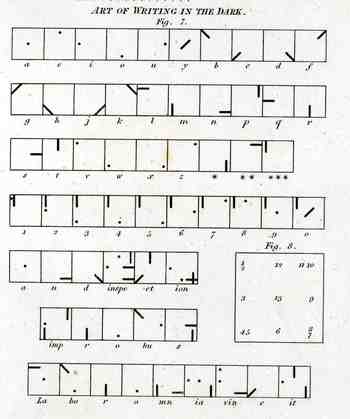
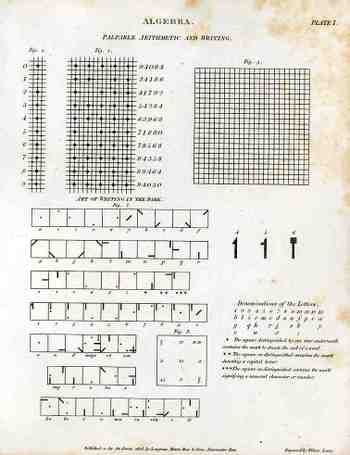
    This curious illustration appears in forty-five volume Cyclopedia of  Abraham Rees (published 1795-1820), displaying a system for communicating over distances at night.  When this part of the Cyclopedia was printed in 1808, the electrical telegraph was still 37 years away from coming into being–45 years from being somewhat well-used.  Before this time (visual) communications over long distances at night were limited to just these sorts of means–lighted semaphores, hand-held torches, that sort of thing.  Signaling at sea at night was somewhat different at this time and didn’t include anything remotely close to the alphabet.  So the rather complex system that we see at left is extremely uncommon–it seems also very cumbersome to put into effect.  Unfortunately I don’t have the text volume that would explain then entire system and implementation, so I’m going to guess that there was a large, powerful light source that was covered by a tight, black, covering tablet that would eliminate nearly all light leakage.  The symbols for each letter of the alphabet (and numerals) would be cut out from another tablet that would fit over the face of the light source, placed between the blank and the light.  To transmit a letter the user would then simply remove the blank covering tablet to reveal the light broadcast by the hole or slit in the tablet underneath.  The blank would then be placed back, a new tablet for a new letter placed underneath, and the process would begin again:  blank (dark); letter (light); blank (dark); letter (light), and so on to the end of the message.   I guess the distance at which these symbols could be seen would be dependent on light source, atmospheric conditions, ad so on.  The way that the letters are made into symbols seems to me very intelligent, so that you distinguish the differences from an appreciable distance.  I like it–its an elegant idea.  (Well, maybe it didn’t work in this manner, but it seems to make sense to me.)

    The image of the full sheet:

    Blog1sept_6_palpable514