JF Ptak Science Books LLC, Post 265
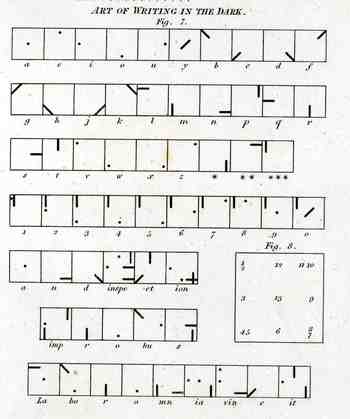
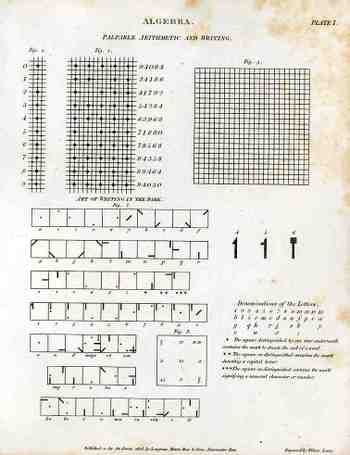
This curious illustration appears in forty-five volume Cyclopedia of Abraham Rees (published 1795-1820), displaying a system for communicating over distances at night. When this part of the Cyclopedia was printed in 1808, the electrical telegraph was still 37 years away from coming into being–45 years from being somewhat well-used. Before this time (visual) communications over long distances at night were limited to just these sorts of means–lighted semaphores, hand-held torches, that sort of thing. Signaling at sea at night was somewhat different at this time and didn’t include anything remotely close to the alphabet. So the rather complex system that we see at left is extremely uncommon–it seems also very cumbersome to put into effect. Unfortunately I don’t have the text volume that would explain then entire system and implementation, so I’m going to guess that there was a large, powerful light source that was covered by a tight, black, covering tablet that would eliminate nearly all light leakage. The symbols for each letter of the alphabet (and numerals) would be cut out from another tablet that would fit over the face of the light source, placed between the blank and the light. To transmit a letter the user would then simply remove the blank covering tablet to reveal the light broadcast by the hole or slit in the tablet underneath. The blank would then be placed back, a new tablet for a new letter placed underneath, and the process would begin again: blank (dark); letter (light); blank (dark); letter (light), and so on to the end of the message. I guess the distance at which these symbols could be seen would be dependent on light source, atmospheric conditions, ad so on. The way that the letters are made into symbols seems to me very intelligent, so that you distinguish the differences from an appreciable distance. I like it–its an elegant idea. (Well, maybe it didn’t work in this manner, but it seems to make sense to me.)
The image of the full sheet: