A Daily History of Holes, Dots, Lines, Science, History, Math, Physics, Art, the Unintentional Absurd, Architecture, Maps, Data Visualization, Blank and Missing Things, and so on. |1.6 million words, 7500 images, 4.9 million hits| Press & appearances in The Times, Le Figaro, Mensa, The Economist, The Guardian, Discovery News, Slate, Le Monde, Sci American Blogs, Le Pont, and many other places… 5000+ total posts since 2008.

Category: Travel

  • A World of Untranslatable Colors and no Color Vocabulary (1638)

    JF Ptak Science Books  Post 2837
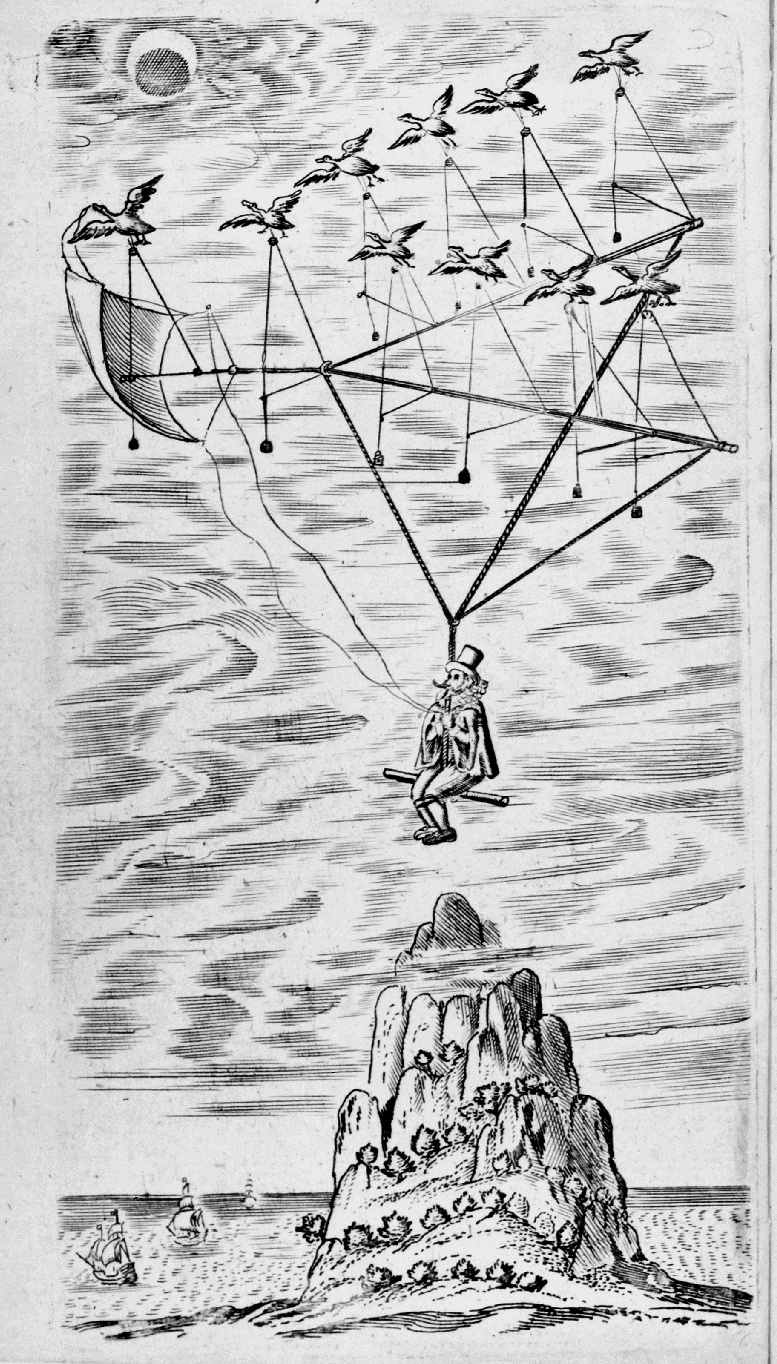
    Godwin (1)There was something that caught my eye as I paged through an online copy of Francis Godwin’s The Man in the Moone or A Discourse of a Voyage Thither by Domingo Gonsales (1638), something beside this work being about the first English language trip to the Moon. There were other earlier trips made to our friendly neighbor before Godwin (whose work was published posthumously) like the late Greek Lucian first century ACE).  And there were contemporaries who wrote in other languages, like Cyrano and Kepler (Somnium, 1638); Aphra Behn’s farce (The Emperor of the Moon 1687) and Margaret Cavendish  (The Blazing World 1688); and John Wilkins (The Diversity of a World in the Moon, (1638) to name a few…and then there’s the wide world of the plurality of worlds, like the wonderful Fontenelle…and of course later there were trips to the Moon made by Verne and Wells, and so on.

    Godwin’s book is short and quick, deceptively simple but not so—there’s a bit of introduction where we are shown a little bit of the influence of Galileo’s Sidereus (1610), and the frontis depicts the flying machine by which the intrepid traveler, Senior Gonsales flies off to the Moon. This is a craft powered by a sort of wild swan, which struggles mightily to free itself of the Gilbertian great magnet, but once free of that, the “flight” took twelve days. Our traveler may also be the first one to get to the Moon by accident: he flees a fiasco in which he kills someone in a duel winds up in St. Helena, and then has a problem with the British fleet off Tenerife, from which he flies off again with his bird machine…he hadn’t intended to go to the Moon, but that is what happened.  

    Here’s what I found so interesting: once he gets there, Gonsales tries to describe clothing and—even more fascinating—he tries to find words for colors that he has never seen before. Marvelous.

    “[T]heir colour and countenance [was] most pleasing, and their habit such, as I know not how to expresse. For neither did I see any kind of Cloth, Silke, or other stuffe to resemble the matter of that whereof their clothes were made; neither … can I devise how to describe the colour of them ….

    It was neither blacke, nor white, yellow, nor redde, greene nor blew, nor any colour composed of these.

    But if you ask me what it was then; I must tell you, it was a colour never seen in our earthly world, and therefore neither to be described unto us by any, nor to be conceived…. Only this I can say of it, that it was the most glorious and delightfull, that can possibly be….”

    And that, I’m afraid, is where I left off. As I’ve said elsewhere on this blog I only give each one of these post an hour’s time maximum, and after my fumbling around in the Godwin, I’m about at my limit. This much-studied book deserves a lot more than what I can give it here in 700 words, but this will have to do for now, for me. The bottom line here is that I don’t think that I’ve ever read anything by anyone before, say, 1920 and the real birth of the sci fi genre (with which I’m am not very familiar) that tries to describe a color that was without description. 

    [Image source: Wikipedia Commons.]

    Oh, before I go, Godwin also introduces us to the imaginary language of the Lunarians, which he describes as being beautiful, and very expansive, as the vocabulary can change given its tone. (He also notes that only one language is spoken on the Moon, which he credits as an advantage over the terrestrial polyglot.) This is also part of a long history of imaginary languages in early literature (for example, More’s Utopia and Rabelais’ Gargantua…)  The Lunar world is a Utopia, and evidently part of that blissful state is maintained by trading out ill-behaved Lunarian children with well-behaved children of Earth. 

  • Birds of a Feather: Flying and Perpetual Motion Machines (1848)

    JF Ptak Science Books  Quick Post

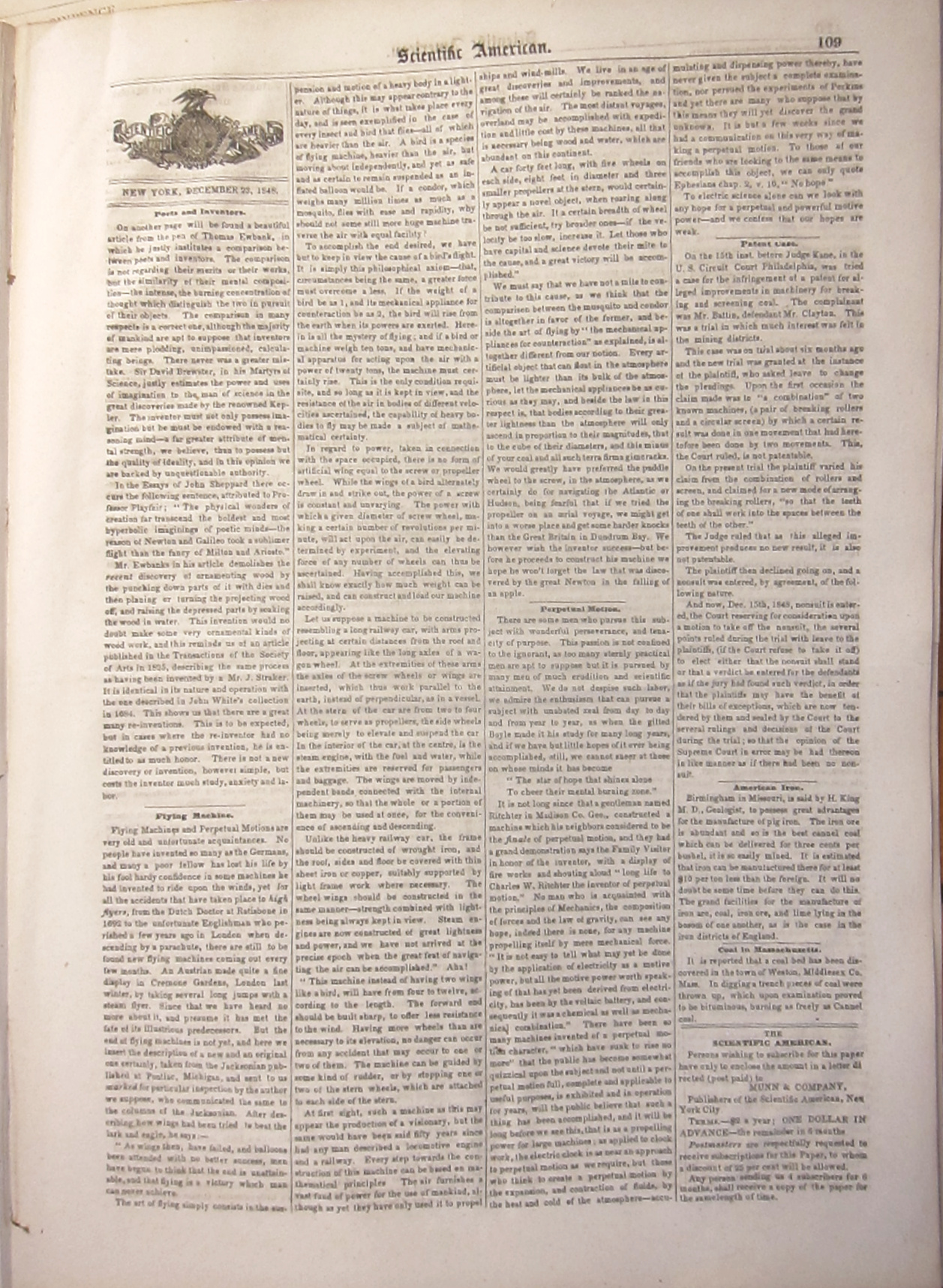
    Sci Am 1848 flying machineHere’s a wonderful and short editorial comment from the Scientific American on the possibilities of human flight, coupled with the observed fruitless pursuit of perpetual motion machines.  There wasn’t much hope expressed in flight, but “the end of flying machines is not yet” and the author shares a vision for one possible flying machine, which was a huge, steam-driven, wrought iron 40′ x 8′ design with between four and twelve wings. No mention is given of its weight. 

    “Flying Machines”, in Scientific American, December 23, 1848, vol 4, #14.

    “Flying Machines and Perpetual Motions are very old and unfortunate acquaintances. No people have invented so many as the Germans, and many a poor fellow has lost his life by his fool hardy confidence in some machines he had invented to ride upon the winds, yet for all the accidents that have taken place to high flyers, from the Dutch Doctor at Ratisbone in 1692 to the unfortunate Englishman who perished a few years ago in London when descending by a parachute, there are still to be found new flying machines coming out every few months.”

    “But the end of flying machines is not yet, and here we insert the description of a new and an original one certainly, taken from the Jacksonian published at Pontiac, Michigan…”

    “As wings then, have failed, and balloons been attended with no better success, men have begun to think that the end is unattainable, and that flying is a victory which man can never achieve. The art of flying simply consists in the suspension and motion of a heavy body in a lighter. Although this may appear contrary to the nature of things, it is what takes place every day, and is seen exemplified in the case of every insect and bird that flies—all of which are heavier than the air.”

    “Let us suppose a machine to be constructed resembling a long railway car, with arms projecting at certain distances from the roof and floor, appearing like the long axles of a wagon wheel. At me extremities or these arms the axles of the screw wheels or wings are inserted, which thus work parallel to the earth, instead of perpendicular, as in a vessel. At the stern of the car are from two to four wheels, to serve as propellers, the side wheels being merely to elevate and suspend the car. In the interior of the car, at the centre, is the steam engine, with the fuel and water, while the extremities are reserved for passengers and baggage. The wings are moved by independent bands connected with the internal machinery, so that the whole or a portion of them may be used at once, for the convenience of ascending and descending.”

    “This machine instead of having two wings like a bird, will have from four to twelve, according to the length. The forward end should be built sharp, to offer less resistance to the wind. Having more wheels than are necessary to its elevation, no danger can occur from any accident that may occur to one or two of them. The machine can be guided by some kind of rudder, or by stopping one or two of the stern wheels, which are attached to each side of the stern. At first sight, such a machine as this may appear the production of a visionary, but the same would have been said fifty years since had any man described a locomotive engine and a railway. Every step towards the construction of this machine can be based on mathematical principles The air furnishes a vast fund of power for the use of mankind, although as yet they have only used it to propel ships and wind-mills. “

    “A car forty feet long, with five wheels on each side, eight feet in diameter and three smaller propellers at the stern, would certainly appear a novel object, when roaring along through the air. If a certain breadth of wheel be not sufficient, try broader ones—if the velocity be too slow, increase it.”

    “We however wish the inventor success—but before he proceeds to construct his machine we hope he won’t forget the law that was discovered by the great Newton in the falling of an apple.”


  • Chicago Underground: the Hard Contrast of Work Underground and the Harsh Light of David Lynch (1943)

    JF Ptak Science Books  Quick Post

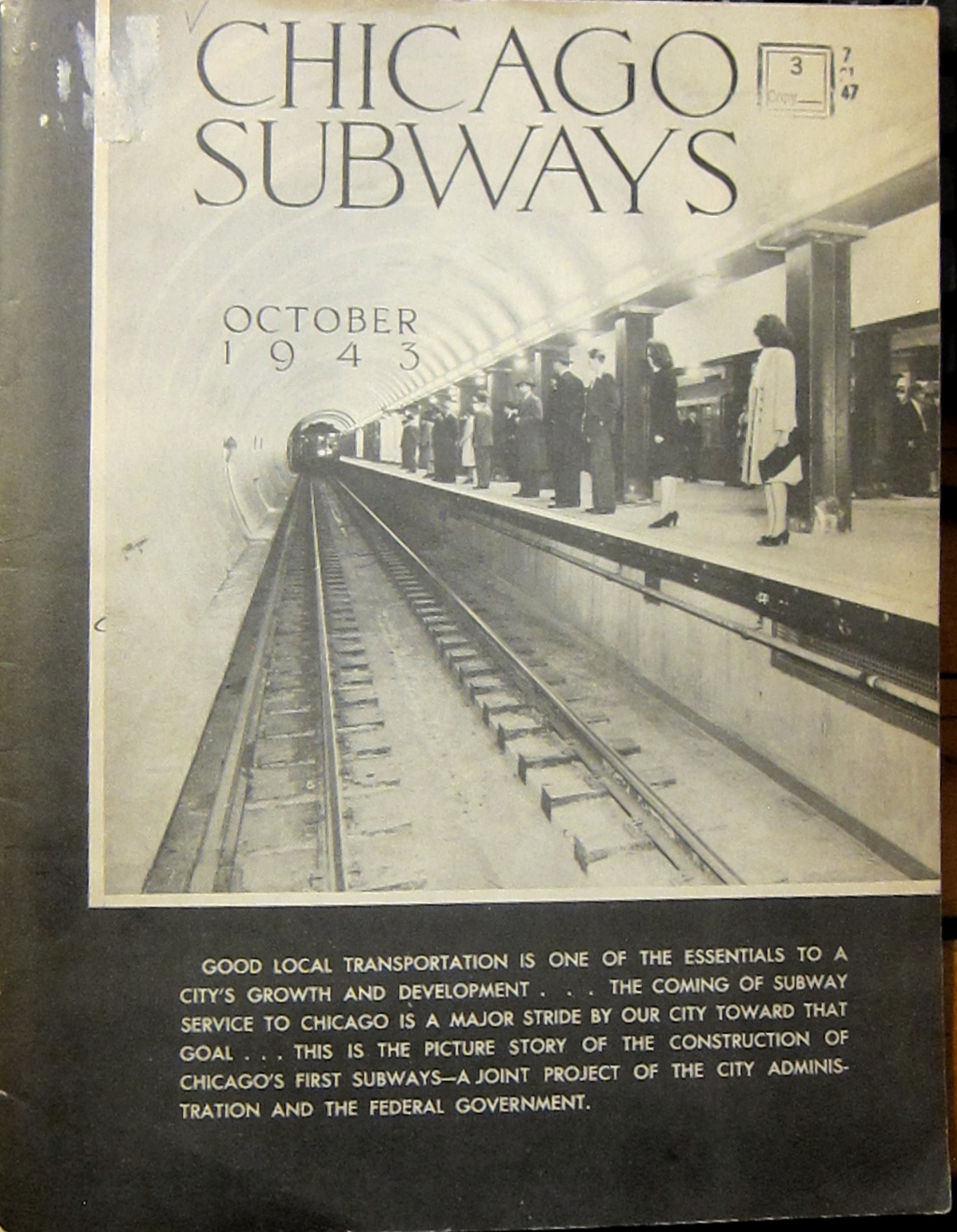
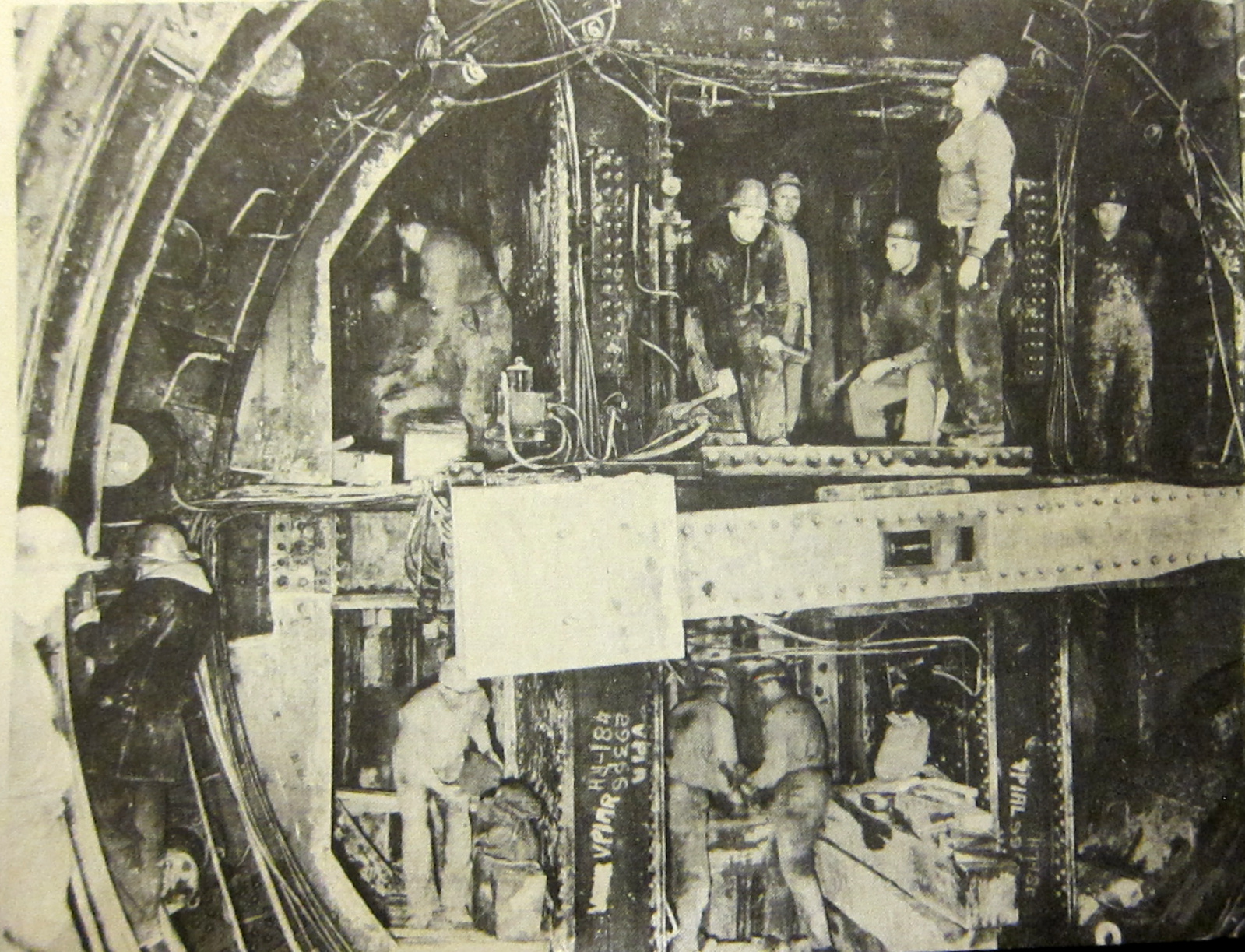
    Chicago subways 1943 coverRight at the start here I’d like to say I know nothing about the Chicago subway system–I would however like to share this little gem on it that I just found. The pamphlet looks unexceptional except for the date, which caught my attention because it is the month/year that the subway opened. The pamphlet also looks like it is a serial of some sort, but it isn’t–it just has a bad title. When I checked it out in WorldCat I was surprised to find that I couldn’t find it, even after a few adventurous searches, thinking that I was just asking the wrong questions of the enormous database…but the results held, and for some reason, the pamphlet just isn’t recorded in being in the many thousands of libraries using WorldCat. It is slim–only 31 pages long–but once you get beyond the first few pages of laudatory photos for the movers and shakers the work takes on a semi-documentary air, with some compelling images, which were another surprise. (The big exception to this flavor was the cover which features some very-regularly-spaced riders waiting for the train, giving the whole image a pod-people feeling.)  

    The photos of the workers show a familiar scene of men working in the cramp quarters of caissons and tunnels, not that much changed in a hundred years:


    Chicago Subways in tunnel _1_

    ·Posted by :

    ·in:

    —