A Daily History of Holes, Dots, Lines, Science, History, Math, Physics, Art, the Unintentional Absurd, Architecture, Maps, Data Visualization, Blank and Missing Things, and so on. |1.6 million words, 7500 images, 4.9 million hits| Press & appearances in The Times, Le Figaro, Mensa, The Economist, The Guardian, Discovery News, Slate, Le Monde, Sci American Blogs, Le Pont, and many other places… 5000+ total posts since 2008.

Category: Atlas of Dead Ideas

  • “Whether Slavery was Right or Wrong…” On the Future of the Freed Slaves in the U.S. (Nashville, 1867)

    JF Ptak Science Books  Post 2528–expanded 

    De Bow’s Review in 1867–in the dire straights of the antebellum South, in the doom and despair of the just-finished war–lashed out like a wicked Alex Jones conspiratorial wingnut against the Northern states and anyone who comforted them.  Published in Nashville, all I have of the magazine presently is this loose issue for November 1867, and in spite of the energetically positive view depicted on the cover of the magazine had little to do with what you found in the writing inside.  

    De Bow175

    The leading article is an odd one, yelling about Great Britain manufacturing the cause of anti-slavery in the United States, which pretty much is made abundantly clear in the title,  “Black Republicanism, the Dupe and Agent of British Policy in Respect to American Interests”. The “scheme of so-called Negro Emancipation…is a British Invention” crushing the U.S. which “suffered immeasurably” under the Abolition Program, “the fatal deadfall of the abolition trap“, all of which in the end will “crush the innards out of the “Black Republican Yankee”.  It was the Brits according to the writer of this article who FORCED THE UNITED STATES TO ABOLISH SLAVERY” [caps in the original]. 

    ·Posted by :

    ·in:

    —

  • “The Perfect Smoke Column”—the New Miracle of Electronics, 1952

    JF Ptak Science Books  Quick Post
    Electronic cigarettesLiggett & Myers, the producer of Chesterfield cigarettes, sounds the triumphal blast of “the greatest cigarette improvement in thirty years” in this LIFE magazine ad from 1953. It was all made possible by SCIENCE and the sacred mysteries of electronics, which helped create the “perfect-smoke-column-from-end-to-end”, which doesn’t sound all that appetizing though I guess it was if you were a lazy or distracted ciggie consumer. To prove the claim we see a model with perfect un-ciggied teeth with an inset of electronic machinery in the background, which made it look as though the stuff was being produced by the machine.

    The machine doing the great scientific deed was the AccuRay. It was a measure and control system produced by Industrial Nucleonics (beignning their industrial life in 1912 as a steam power supply systems company), which ensured that the cigarettes would be the same, million after million, each being the same length and with the same mount of tobacco. “Scientific miracles never cease”, said the Liggett & Myers people, and I guess the stained proof was in the smokey pudding.

    It may have been all about the burning, as a cigarette that doesn’t need to be drawn on to keep it lit means that it will burn itself out in the allotted time even if you just lighted the thing and kept it in the ashtray. Better burning meant more cigarettes consumed, and so on.

    And by the way Industrial Nucleonics was sold in 1987 to a perhaps more appropriately-named Cumbustion Engineering, at least so far as cigarettes were concerned.


  • The Encouragement of Insanity (1877)

    JF Ptak Science Books  Quick Post

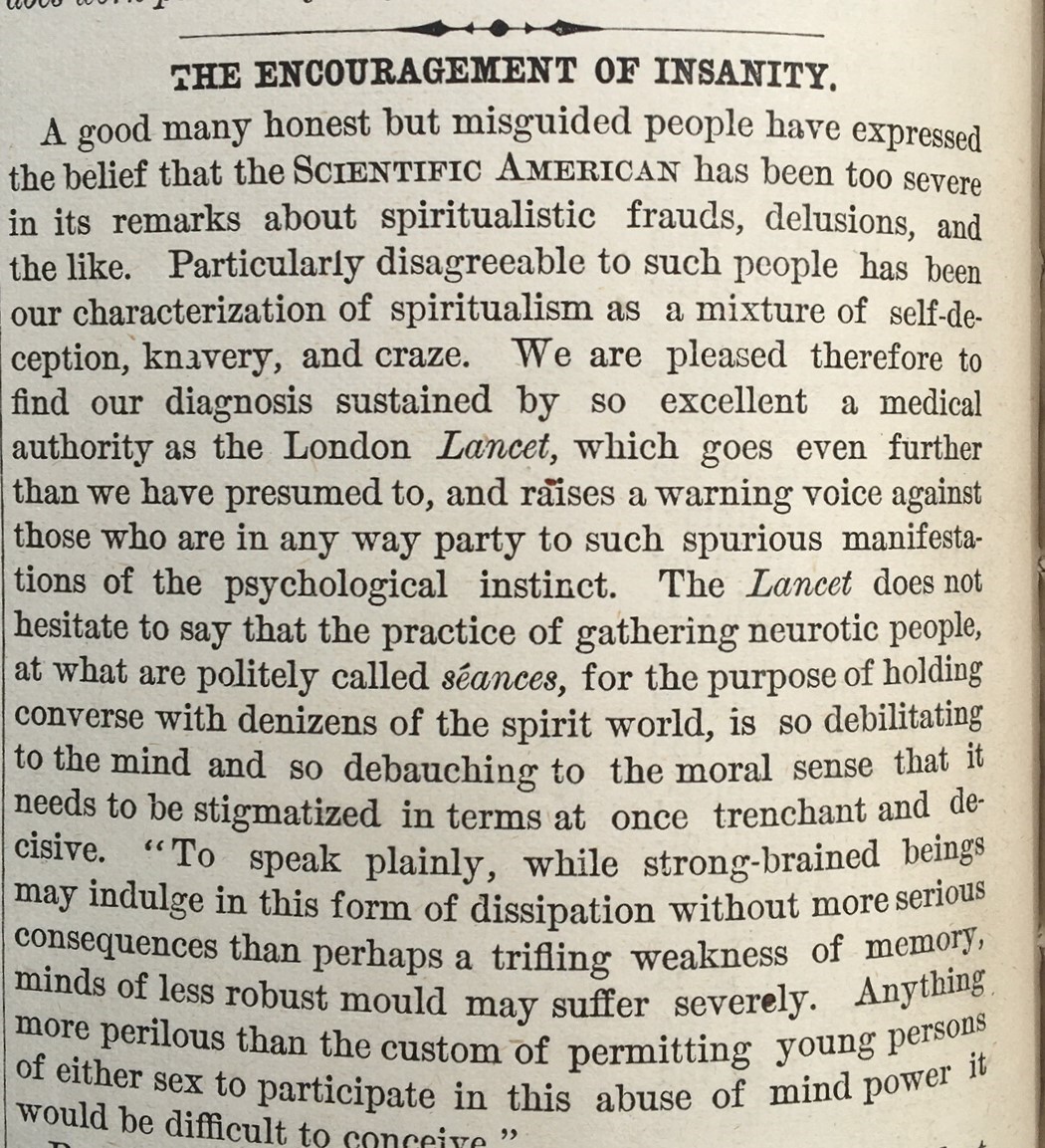
    IMG_2195Well. The Scientific American (1913) delivered quite a blow against the current “craze” of spiritualisms and seances, which they characterize as a mixture of “self-deception and knavery”.  They had no room for it whatsoever, and let their readers know it. These practices were “symptoms of mental degradation that will cast adrift principles…and elect to run riot in vain imaginings and idle conceits”. The editor also brought The Lancet on board in the condemnation of the Spiritualism racket, quoting the great medical journal saying that the talking-to-the-dead racket was “debilitating to the mind and so debauching to moral sense it needs to be stigmatized in terms at once trenchant and decisive”.  An Edgar A. Poe vicious book review this is not, though they do communicate their displeasure with the whole racket in very forceful words.


  • An Educated Fly–Scientific American, 1898

    JF Ptak Science Books  Quick Post

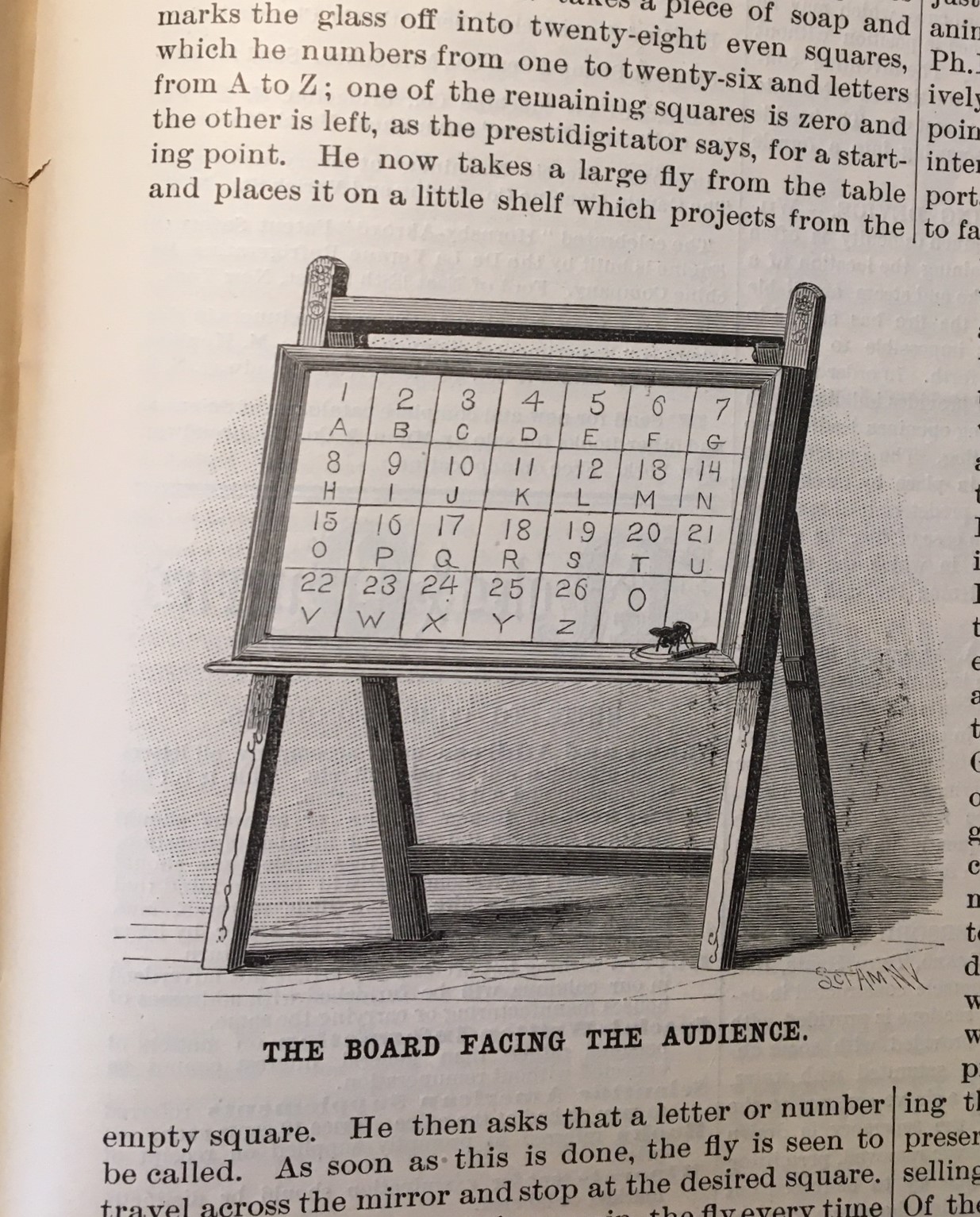
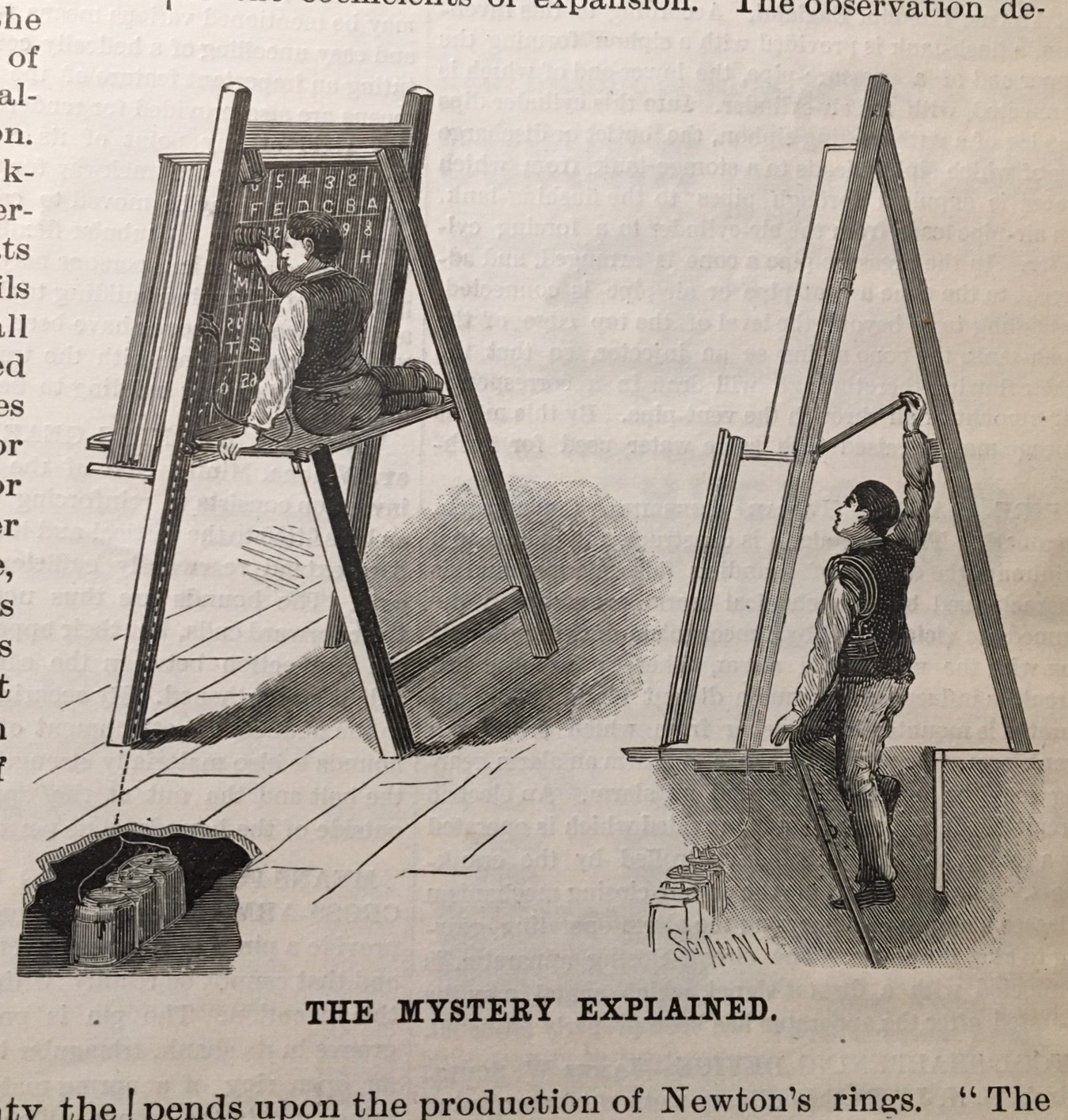
    Sci Am 1898 fly _2_How could you see an article heading of “An Educated Fly” and not share the secret?  I don’t know, and so I am performing a bit of due diligence, sharing the story from Scientific American from 3 September 1898. There really isn’t that much to tell, and the title is probably better than the story: the large tablet is placed on a stage in front of an audience, with a pitchman telling some sort of warm-up story to create interest among the crowd; a fly of some sort (whether a model or a real fly pinned or tied to something, I don’t know) and placed on a little shelf beneath the board. The ringmaster would ask a question, and the fly move around and alight or somehow make it known as to its selection of the numbers/letters on the grid. The trick is revealed in the image below–after the blackboard on its pedestal is shown to the audience front-and-back, it is positioned over a trap door on the stage, where a confederate would rise up and position themselves inside the pedestal and operate the device holding the live/inanimate fly. That’s it. After the tricks were performed, the inside man would escape through the trap door, the pedestal would be wheeled out to display that it was empty, and that was that. Old trick, new fly. 

    Sci Am 1898 fly _1_


  • “Flying Saucers” (1952)

    JF Ptak Science Books  Quick Post

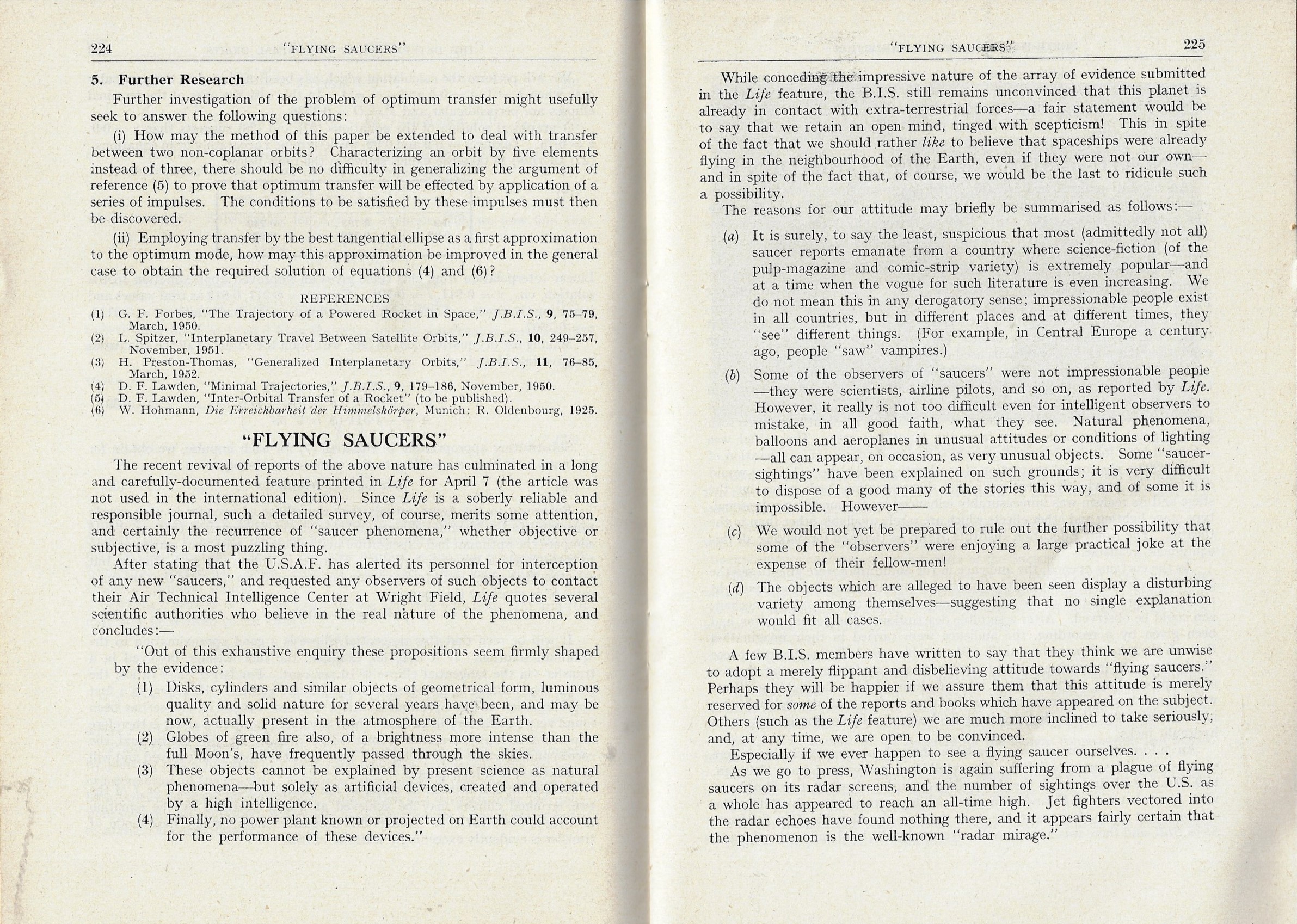
    I want to spend only a few minutes on this subject as I have just now come upon a nicely-written and logical response to the “flying saucer” issue in the pages of the Journal of the British Interplanetary Society1 for 1952.  Rather than discuss it I’m just going to reproduce the two pages of the piece below.  I did bend to curiosity a bit here and checked out “flying saucer” and “U.F.O.” in the Oxford English Dictionary, just to get a sense of how quickly they came into being following the hysteria of 1946.  Turns out that the BIS is no stranger to the term, the OED listing it second in usage back in 1948, back when the word still had its new-car-smell, though as you can see it hardly registered so with the members of the Society.

    “Flying saucer” n.: the fanciful name given to various unidentified disc- or saucer-shaped objects reported as appearing in the sky.

    • 1947   Times 8 July 4/4   During the past fortnight reports that dish-like objects, nicknamed ‘flying saucers’, have been seen travelling through the air at great speed..have come from the United States and Canada.
    • 1948   Jrnl. Brit. Interplanetary Soc. 7 199   I haven’t examined the details carefully, but the ‘flying saucers’ bear all the hall-marks of mass-suggestion.
    • 1953   D. Leslie & G. Adamski Flying Saucers have Landed i. i. 13   Ever since the cliché ‘flying saucer’ was coined, the greatest and most exciting mystery of our age has been automatically reduced to the level of a music hall joke.

    “U.F.O.”, n.: An unidentified flying object; a ‘flying saucer’.

    • 1953   D. E. Keyhoe in Air Line Pilot Oct. 9/3   The UFO was estimated to be between 12,000 and 20,000 feet above the jets.
    • 1956   E. J. Ruppelt Rep. Unidentified Flying Objects 13   UFO is the official term that I created to replace the words ‘flying saucers’.

    [Click for a cleaner and larger image]

    Flying saucers BIS 1952


  • An “Analog” Telephone (1878)

    JF Ptak Science Books  Quick Post

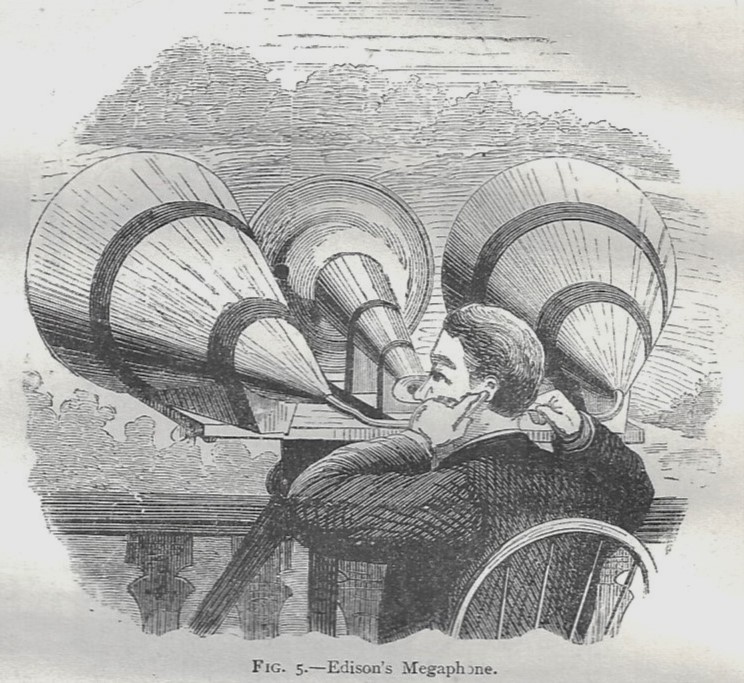
    Long-distance audio communication pre-telephone looked a little like this, brought to the world by Thomas Edison. What we’ve looking at here is a fellow positioned between a megaphone and listening devices–used in concert, they may have been able to communicate with a similarly-encumbered person a mile or two away (absent hills and dales and trees and buildings and so on…). All of this technology is very old: for example, the famous “Horn of Alexander” going all the way back to, well, Alexander the Great, who was said to be able to communicate by voice with troops ten miles distant. Athanasius Kircher also wrote about Old Tech in this department in his Ars Magna (1646) and Phonurga Nova (1674). It is interesting that Edison was tinkering around with this in the year following Bell’s telephone.  
    Nature 1878 Edison mega_2_

    There were at least several different versions of this scene, usually featuring one or two or four other people–this one comes from Nature of 24 October 1878 (the first version seeming to be in Scientific American of 24 August 1878),. 


  • An Apparatus for Inhaling Thorium (1904)

    JF Ptak Science Books   Quick Post

    Thorium inhaler

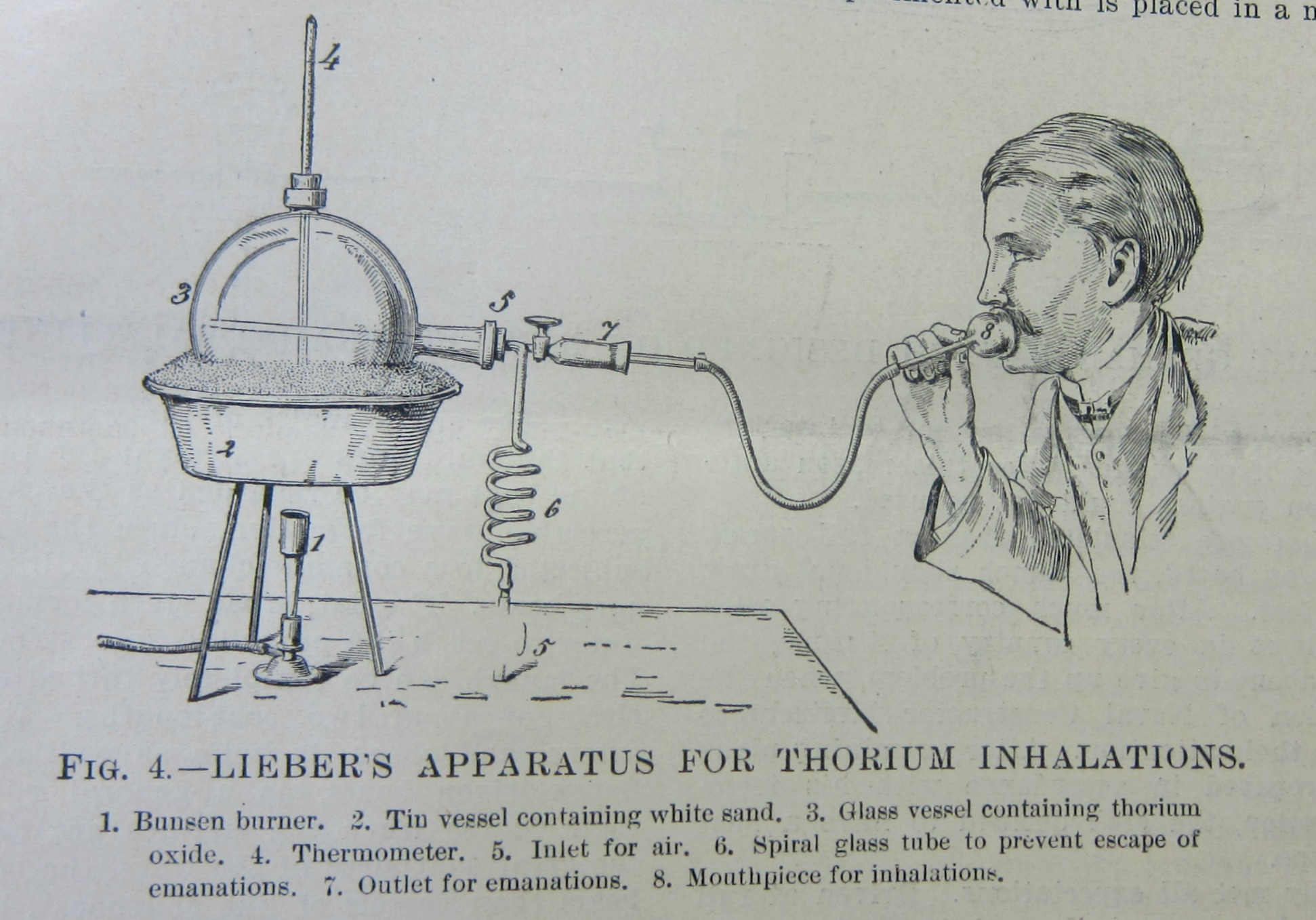
    In researching the highly-unexpected mage of a thorium inhaler found in Scientific American for 1904 and trying to find out why someone would inhale the radioactive and toxic gas (discovered by J.J. Berzelius in 1829), I found an article with three transporting sentences that lifted themselves from the page:

    “Small glass tubes containing radium bromide are placed
    within accessible mucous cavities, i.e., mouth, vagina.”

    “Radium and thorium continually emit gases, which gases
    themselves give out on their own account rays exactly
    similar to the rays from radium and thorium themselves.
    Hence a thorium inhaler is now used, by which these gases
    are inhaled.”–The Journal of the British Homoeopathic Society, vol XII, new series, London 1904.  

    Of course the scientific and medical world was trying to figure out what applications could be made with the new discoveries of Roentgen and the Curies and Becquerel and all, but even with the modern lens looking backwards it still is a bit of a wincing experience to read about these applications.

    Pressing on from the quacky homeopathy journal I found  another in the Medical Record which more fully explained the apparatus and treatment:

    “Thorium in TubercuIosis.  Dr Soddy of London and Professor Rutherford of Montreal have suggested the use of thorium inhalations for tuberculosis. Certainly from its antiseptic and antifermentative actions it would appear to be a desirable agent to apply directly to the tissues affected in the fight against the tubercle bacillus.”

    [Note: M. Curie and Gerhard Schmidt determine and demonstrate that thorium is radioactive in 1897-8; Soddy and Rutherford discovered thorium X in 1902.]

    The note continues:

    –Medical Record: A … Journal of Medicine and Surgery, edited by George Frederick Shrady, Thomas Lathrop Stedman; New York, William Wood,  1904, Volume 65, page 128. 

    Another short description of the work of the inhaler:

    “The procedure leaves in the lungs a fine film of radio active matter which in turn produces the phenomenon of induced radio activity in the same parts which may last for one or two days. This is shown by the patient after inhaling thorium emanations exhaling on a photographic plate which produces the ordinary effects on the silver salts…”–Mihran Krikor Kassabian,Röntgen Rays and Electro-therapeutics: With Chapters on Radium and Phototherapy, New York, 1907, page 508.

    That is a tough go.

    The Wiki article on thorium has this to say about more than standard/casual exposure to thorium: “Natural thorium decays very slowly compared to many other radioactive materials, and the alpha radiation emitted cannot penetrate human skin. As a result, owning and handling small amounts of thorium, such as those in a gas mantle, is considered safe, although usage of such items may pose some risks. Exposure to an aerosol of thorium, such as contaminated dust, can lead to increased risk of cancers of the lung, pancreas, and blood, as lungs and other internal organs can be penetrated by alpha radiation. Exposure to thorium internally leads to increased risk of liver diseases.”

    It is not known to me how much of a dose of thorium was intended for the user of this cure.


  • The “Reactionary Lifter” and a Fist of Blood, 1872

    JF Ptak Science Books  Quick Post

    This design screams out –yes, the “outside scream”–for attention of some sort.  It is a five square inch ad crowded into a crowded 140 square inch page in a supplemental section to Harper’s Weekly, August 3, 1872.  The circular part is less than two inches in the original but it commands the big page, and is about the only thing your eyes can focus on until the ad is at least acknowledged and/or read. 

    Blood of life455

    The ad is for the “Reactionary Lifter”, an uninspired and slightly cumbersome name for an exercise apparatus that was made of hydraulics and pull-me devices that used the person’s own weight to exercise against.  The machine itself doesn’t seem that interesting, though the price does. At $100 it would take the average machinist or a similar skilled job probably a year to save a hundred dollars while making $10/week and then removing expenses, so this exercise machine was a significant expense. There is no mention of a price in the Harpers placement, which I guess was a good move so as not not frighten off the casual reader. 

    In any event, I liked the graphic.


  • Note on Life on the Rings of Saturn and the Plurality of Adams & Eves (1859)

    JF Ptak Science Books  Quick Post

    I’ve been reading through the notes and bibliography of Michael Crowe’s  excellent  The Extraterrestrial Life Debate, 1750-1900  and decided to post a few of the early-modern scientific speculations on extraterrestrial life.  The first is from Hollis Read’s (1802-1887) concentrically-connective theo-explanations/celebrations of life in the universe, The palace of the Great King : or, The power, wisdom and goodness of God, illustrated in the multiplicity and variety of His works  (New York, Scribner, 1859). It is published in the same year as On the Origin of Species…, and takes a decidedly different theological spin on interpreting Nature. It does take a very interesting turn on page 224 though (not the probably-misprinted page 160 as Crowe notes) where Read speculates on intelligent life elsewhere, and winds up on the Rings of Saturn, which would have no doubt delighted Kurt Vonnegut. 

    In some sense Read buries his speculations on life on the rings, occurring in the middle of a paragraph in the middle of the book, and seems not to go any further with it.  He says that there are 28 billion square miles (on both sides) of the rings (“588 times the whole habitable portion of the earth”), which he feels could support a population of 8 billion, which he said is 10,000 times that of the earth.  It seems he just extrapolated the population/density of the Earth to that of Saturn’s rings to get that figure–I should point out that “billion” here actually means “trillion”, which was one custom of the day, so the 10k number Read came up with is more-or-less accurate.

    There really isn’t a reason given from I’ve read in Read for the possibility of life on Saturn’s rings, except that the beauty the rings must be fitted for something other than “waste and desolation”.  I’ve wondered about the theological issues about Life Elsewhere in natural law theo-scientific books like this–like, well, what about Adam and Eve?  Had they been present would they have been so just here on Earth, or would they have been better off on the rings?  Or are there Adams and Eves wherever they are needed? Or–to paraphrase an old story–would it have been Adams&Eves all the way down?  It seems as though that may have been a tricky question to answer…

    • [Source: full text of the Read book is available via the Internet Archive from the University of California, http://catalog.hathitrust.org/Record/006524997]


    Hollis Read Satrun  Life _a_


    ·Posted by :

    ·in:

    —

  • Robot Boots without the Robot–German Coal Mining Iron Boots, 1920

    JF Ptak Science Books   Quick Post

    This post is from the “Oh Sweet Mother of Neptune” series, because that is that you say out loud when you see pictures like this.  

    German boots269

    Found in the January 1920 issue of Illustrated World is this photograph, illustrating yet another mysterious and bad turn of the many hard angles found in the Treaty of Versailles.  The worker with a pick is a coal miner, and yes, he is wearing galvanized iron boots.  

    It turns out that the Nuderlansitz coal mining region was flooded after the war, and after the draining came more water and a lot more mud. Seeing as there was a severe rubber shortage in Germany at the time, and that coal miners needed to mine, the suggestion pictured here were these galvanized iron boots.  

    No note is made in regards to the weight of the boots.

    ·Posted by :

    ·in:

    —