A Daily History of Holes, Dots, Lines, Science, History, Math, Physics, Art, the Unintentional Absurd, Architecture, Maps, Data Visualization, Blank and Missing Things, and so on. |1.6 million words, 7500 images, 4.9 million hits| Press & appearances in The Times, Le Figaro, Mensa, The Economist, The Guardian, Discovery News, Slate, Le Monde, Sci American Blogs, Le Pont, and many other places… 5000+ total posts since 2008.

Category: Atlas of Dead Ideas

  • A Note on Hitler and Women, 1933

    JF Ptak Science Books   Quick Post

    I was reading in The Nation, 19331, and stumbled upon the article “German Culture in Exile”, which was poking through the brittle blocks of Hitler’s newly National Socialistically crumbling society.  What caught my eye in particular was this note about the role of women, which although I knew about this still put it all in a different light: 

    Nazi women351

    This was all quite different from the experience  of women in the Weimar society (1919-1933) where the new democratic experience resulted in numerous advances not the least of which was the right to vote.  Nazis in–women, out.  Except, really, for the home and hearth and reproductive part, substantially different from women comprising 35% of the workforce in 1925.   And just for the serendipitous aspect of it I checked out Mein Kampf on the Internet Archive: I did a text search and found only 22 mentions of “women” and eight for “woman”; on the other hand “men” occurs 2839 times, and “man” 2773.  Does this mean something?–well, yes.  But the question about what it means is quite something else, the answer to which I am not privy. But it does seem to support something obvious in and of itself.  


  • Big Science 1886–Moving Big Stuff

    JF Ptak Science Books   Revisiting/expanding an earlier post from 2009

    Blogbig_sciencefitz In 1982 Werner Herzog, in what may have been a weirdly fashioned and irresistible death-wish effort, released a very difficult film that he wrote and directed:  Fitzcarraldo.  It is a spill-over-big, magnificent film about a would-be ice-making rubber baron bringing an opera house into the trans-Andes, trying to make his way into the dense forest in a huge rear-paddle steamboat on the Amazon to stake a claim in exploiting leased lands filled with rubber trees  The problem faced by Fitzcarraldo (played by the probably-insane Klaus Kinski–just see Herzog’s 1972 Agiurre, Wrath of God and you’ll know what I mean) is that his path is blocked by unnavigable rapids–he can however reach his destination by hauling his very large ship up and over a mountain to get to a more pliant river and then to his goal.  Herzog actually does this for the film–no digital anything here–in what is one of the most glorious things I’ve even seen in the movies.  He really does have native people clear a path up and over a mountain, and they DO haul this ship up and over.  It really, truly, is magnificent. 

    The story is partially based upon the adventure of Carlos Fermín Fitzcarrald, who in 1890 attempted a similar feat, though with a much smaller vessel, and who also dismantled the craft (?!) to haul it overland.

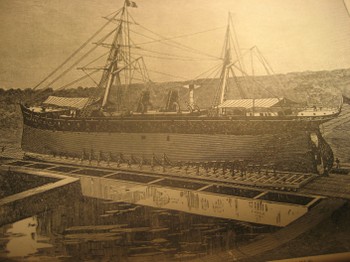
    Blogbig_sciencefitzcarraldo    The bigger and deeper back-story though is the effort–mainly by Elmer Cotherell and James Eads–to build a combination railroad ship canal across the Tehuantepec isthmus in Nicaragua.  The idea of moving across central America rather than taking the enormously long route around the tip of South America and up again is hundreds of years old.  The Cotherell/Eads plan, begun in 1870’s and alive in the early ’80’s, was really the first feasible (and workable) initiative.
    Blog_big_large_ship
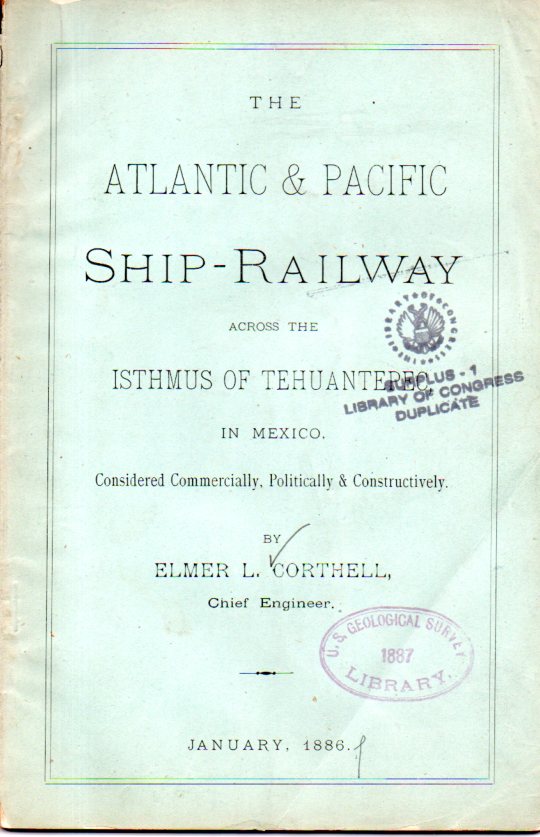
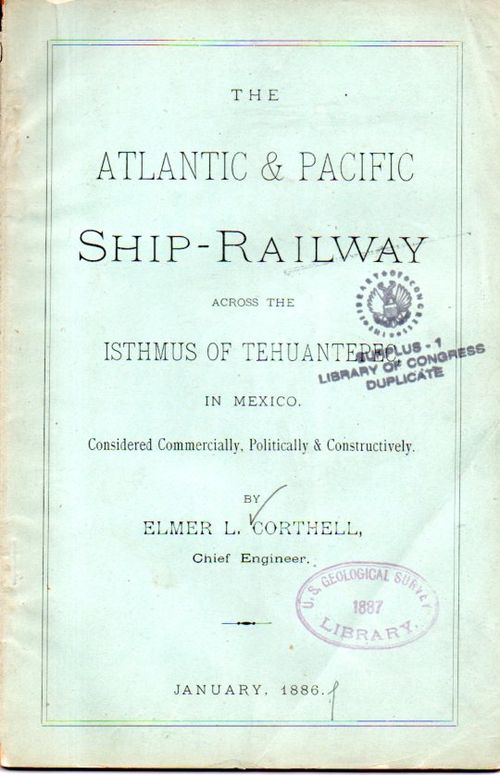
    It would have been a gigantic undertaking, and even though it was much longer (130 miles or so)  than the more-favored Panama location for the canal, it seemed more workable as there would be less digging and no need for a lock/canal system as required at Panama. The plan was outlined in the pamphlet below, and printed in 1886.  (This pamphlet is available for purchase at our blog bookstore.)
    Corthell161

    The French began a doomed attempt at conquering Panama shortly before this.  Ferdinand de Lesseps tried to build a canal in 1880, but the organization and general construction plan was truly inferior; also, the sanitary and medical conditions were irreproachable, with the French losing perhaps 22 thousand men in the failed process to disease (mainly malaria).  (The United States would lose 5,609 workers while building the Panama canal, on land granted as a payback for “helping” Panama release themselves from Columbia.)
    Blog_big_closeup
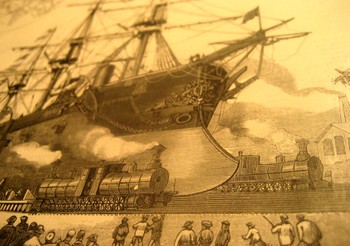
    The Cotherell/Eads (who by the way was a master builder perhaps best known for his inspired masterpiece of a bridge at St. Louis) plan called for hauling the ships up and out of the water in a short canal and placing them on an enormous floating roundabout; the roundabout would then be raised, and the ship place on huge cradles borne upon vastly augmented railway lines.  Once on the cradle, the ship would be pulled and pushed by a team of four large locomotive teams which were in turn composed of two large engines.  Happily aboard, the ship would then be taken on the extended, expanded wide and augmented rail 130 miles overland and dumped into the Pacific.

    It was evidently not a workable deal all the way around, though, as the U.S. decided on the new Panama to works its engineering miracle

    Blog_big_big_closeup .There is something pleasing though about the Ship Railway, though, something that appeals to the little bit of Mr. Herzog in me.  Perhaps it was the appraisal of the very stiff-lipped Sir Edward Reed–who was the former master engineer for the British navy and consultant to Eads—that makes it all so irresistible.  “It would be best to avoid a very high rate of speed” when hauling the massive ocean-going and heavily laden cargo ships.  Indeed.


  • The Mother of all Furnaces

    JF Ptak Science Books   Quick Post

    Siemens furnace066

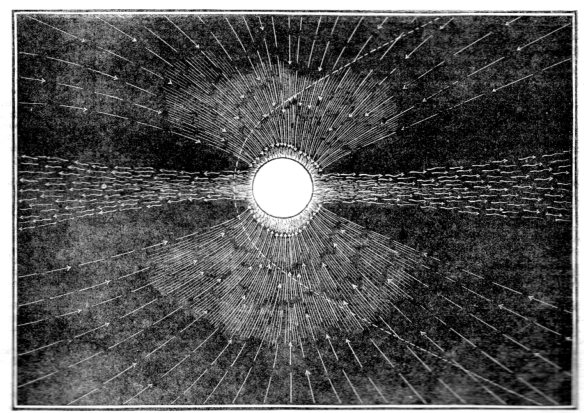
    Sir William Siemens (1823-1883) was an important inventor who had an even larger genius for the application of his ideas, mostly in the fields of heat and electricity and power.  He occasionally strayed into the pure sciences, the work of which was sometimes fruitful and sometimes not. The illustration below is from an idea of the second variety, something where he applied his work in the regenerative furnace to the conservation of solar energy.  It was an adventurous and unworkable, although the illustration he used to illustrate a paper on the subject (in Nature, 9 March 1882) was drop-dead beautiful.  

    ·Posted by :

    ·in:

    —

  • The Kraken, 1813

    JF Ptak Science Books  Quick Post

    Pd---W-9 Sole Prop023
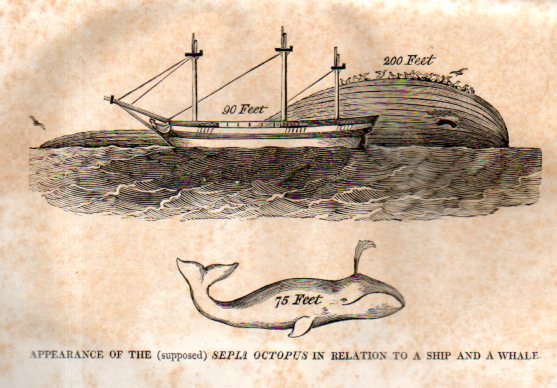
     In the History of Real Monsters the Kraken occupies an elevated spot–that’s what made me sit up a bit while browsing an issue of The Medical Repository of Original Essays and Intelligence Relative to Physic, Surgery, Chemistry and Natural History… for 1813. The “natural history” part comes well down the title page, but lurking their in the back of this slim volume, after articles on spotted fever, and the winter epidemic of 1812-1813, and the varia of medical and surgical correspondence, came this article on the Sepia Octopus.  This was a report sent in by the editor of the journal, Samuel Mitchill, on the sighting of the beast by a Captain Merry of the ship Niagra, sighting “A large lump” on the sea, and determining on closer inspection that it was a colossal polypus, 200’x30′.  There are many other sightings told, and then Mitchill gets down finally to identifying these creatures as the legendary Kraken (naming Pliny as an original source). 

    I’d love to reproduce the article, but the pamphlet is fragile, and the pages were never separated at teh top.  I did however find an associated article from 1846 that addresses the idea of the Kraken  [The Eclectic Magazine: Foreign Literature, Volume 8, edited by John Holmes Agnew and Walter Hilliard Bidwell, May to August 1846]:

    ·Posted by :

    ·in:


  • Atlas of Dead Ideas. Q: When is Israel Not So? A: When it is Great Britain (1929)

    JF Ptak Science Books   Quick Post   Daily Dose from Dr. Odd 
    Follow Me on Pinterest

    Anglo-saxon739There was a Bible-studying group headquartered in Haverhill, Massachusetts whose inspiration/idea  interpreting the true nature of what was “Israel” according to bits and pieces in the Old Testament, and which found something to be radically different from what was seen to be  the case.  The pamphlet documents that the place we think of as Israel is not really so, and that the country best fitted to these OT statements was actually Great Britain.  There are many reasons for this and they get mistily presented in the pamphlet Restoration of Kingdom Administration the Anglo Saxon Responsibility (published by the Anglo-Saxon Federation of America in 1929), but it is rather too much and tedious and tiresome to get into the milky details, except to say that Israel as was currently recognized could not be so unless they adopt the Christian faith.  And so on. 

    The address of the organization put it on Merrimack Street in Haverhill, a block away from the river–the four story building now has it middle floor obscured by some teal 1950’s architectralolypse facing, and the bottom floor is now a dollar store (with redundant signs) with a sandwich board out front (captured by the Google car) reading “Design Perfume on Sale Beauty Supply”.  I’m sure the store is necessary and fills a need, but it is a long way and many years from redefining the concept of Israel. 


  • God’s Atomic Bomb: the Divine, the Infinite, and its “Gift” of the Bomb, 1946

    JF Ptak Science Books  Post 234

    Blogsept_2_atomic_bomb_god481

    I’d like to say that this was a class-of-its-own sort of work, but as it  goes this is hardly the case.  If I cared a little I guess I could establish a collecting sub-category in the nuclear fission–atomic–nuclear weapon collection for the popular belief that god ordained and transmitted the atomic bomb.  There are at least five other pamphlets like this floating around in the store, and I am certain that there must’ve been dozens of other grabby little publications like this proclaiming Almighty Influence in the creation of the atomic bomb.  I can understand the reasoning behind the power grab:  the bomb ended the war a week after its second use, sparing the lives, perhaps, of a million soldiers (American and Japanese) and years of societal/infrastructure rehabilitation by eliminating the need of an American invasion of the Empire.  So the denominator was simply the “saved (American) lives” part. 

    Blogsept_2_atomic_bomb_god_2482

    Again, I can understand how this felt in 1945/6, but I still feel that getting the suspected creator of the universe involved in the making and use of the bomb was ill-advised.  The author of the first pamphlet reached back into history and credited god with simple solutions to complex situations:  employing the more modern political technique of controlling language in the Tower of Babel case (wher he also said that since Babel was only 105 years after the flood that Noah was still alive, and that certainly Noah “would’ve voted ‘No’” for the building of the tower); and using “Johnny Snowflake” to stop the “non-satanic” Napoleon from reaching “Britain’s doorstep (and obviousy not the Soviet Reds).  Bennet also  credits god with giving “Dr. Currie” (sic) the genius to “split atoms” in 1896. 

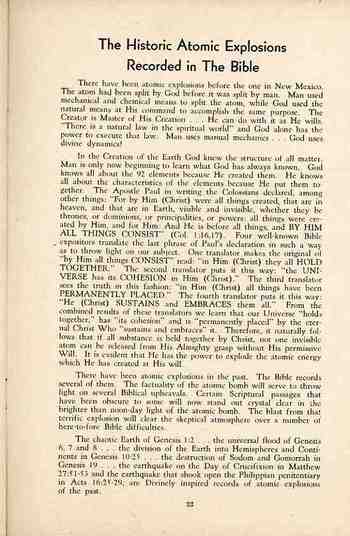
    The second pamphlet uses the atomic weapon a little more figuratively.  The author, Mel Morris, published this in 1945, which means he must’ve worked a little feverishly to pump up his bible prophesy and history to include the new atomic weapon to replace whatever else he had been using as a prophecy for end of times.  (As it turns out, “God’s Atomic Bomb” was more tempest and disaster in the bible, and not (whew!) the bomb itself.  Though as we’ve learned from scientologists and the sort-of creative mind of Ron Hubbard, a civilization came to the earth thousands of years ago and pummeled it with “atomic bombs” and other nastiness, polluting humans for milennia to come.  But that’s another story–suffice to say that Morris found many dozens of examples of “God’s Atomic Bomb” being used in the deep biblical past, and that the use of the real atomic bomb in 1945 was pre-ordained, and not without its figurative historical counterparts.  I’m not sure why any of this was necessary outside of proving to some small minority that these preachers could at least be contemporary and topical. 

    Blogsept_2_atomic_bomb_god_2txt483