A Daily History of Holes, Dots, Lines, Science, History, Math, Physics, Art, the Unintentional Absurd, Architecture, Maps, Data Visualization, Blank and Missing Things, and so on. |1.6 million words, 7500 images, 4.9 million hits| Press & appearances in The Times, Le Figaro, Mensa, The Economist, The Guardian, Discovery News, Slate, Le Monde, Sci American Blogs, Le Pont, and many other places… 5000+ total posts since 2008.

Category: Atlas of Dead Ideas

  • Upset in the Belly, Insanity and Murder: a Southern Interpretation, 1831

    JF Ptak Science Books  Extending Post 647 (from 2009)  Blog Bookstore

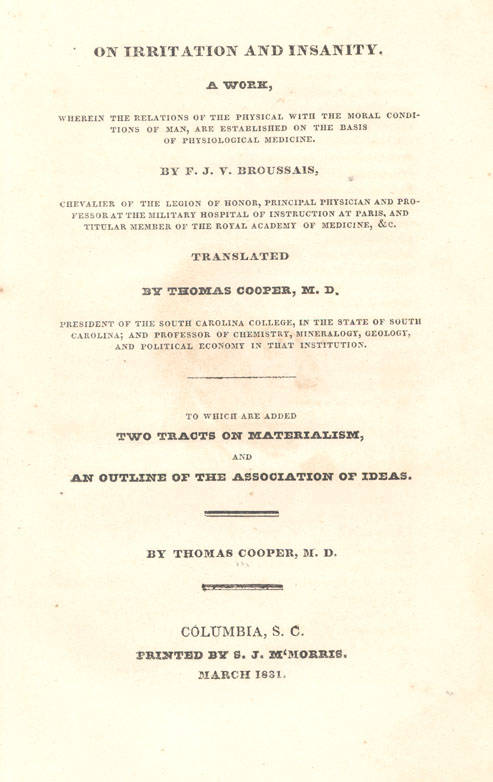
    Thomas Cooper, a merry, upper-educated intellectual called “a learned and talented mapcap” by none other than John Adams, wrote from his secure chair at South Carolina College a translation of a rather individual effort in explaining insanity’s connection with moral outrages.  The work, published in Columbia (South Carolina) is called On Irritation and Insanity … to which are added Two Tracts on Materialism, and an outline of the Association of Ideas, was written by Francis Joseph Victor Broussais (1772-1838) and introduced an unusual, foreign approach to the connection between sanity and malevolence.  Brousssais’ work may not have required such attention. 
    Blog--June 12--broussais


    He wrote, for example:

    “The causes of this morbid state consist always in irritation of the trisplanchnic apparatus, and especially in that of the stomach, acting on the brain. [Italics mine] This last viscus, may be such, by its normal constitution, as to give a propensity to cruelty ; but in the morbid state it is a sense of uneasiness perceived through the whole splanchnic apparatus, comprehending the brain itself, which renders ideas of murder predominant in spite of reason. This horrible perversion may be considered, as well as that of suicide, as a species of chronic anger or hatred, which impels the individual sometimes against himself, sometimes against other men or against inanimate objects. We have already considered it under a subacute form in furious mania ; but in the modification in which we now describe it, it is entirely chronic and apyretic. In fact it may be extremely obstinate, and conceal itself under the appearances of calm, of joy, of benevolence, until the lunatic finds the opportunity of executing his horrible project.”

     I can see these words being written by candle light.

    • Full text via Google books, here: http://tinyurl.com/ocyezpb

     James Cowle Prittchard early on dispensed with M. Broussais, writing  in his A Treatise on Insanity and Other Disorders Affecting the Mind (published by Haswell, Barrington, and Haswell in 1837, just six years after the Cooper translation) states:

    “Such is M. Broussais’ theory of these phenomena. It must be allowed that various irritations, and especially those in the digestive organs, often give rise to irritability of temper; but that any such state as that .which M. Broussais has described is a cause, and even the principal cause, of moral insanity, and in particular of that intense excitement of malevolent propensity which leads to murder and suicide, is a position which, before it can be admitted, requires proof; and no such proof has been afforded by the ingenious writer who has advanced this hypothesis. It must be confessed that this subject is as yet enveloped in obscurity.”

    As it turns out Broussais recommended courses of bleeding, diet, soothing drinks, applications of cold and mild purgatives to treat insanity.  This went somewhat against the established regimen of treatment (but of different philosophical and theoretical approach to the idea of insanity) of Benjamin Rush, who practiced all of the above but of harsher application and with more force.  Broussais at  least advocated a more temperate approach to bleeding, that it not be “severe”, and that the strength of the insane not be completely diluted by massive exposures to dunking and the cold.  The translator Cooper, however, disagreed with the milder treatments, establishing for the record that the hotter and harsher  temperatures of the South required harsher and colder treatment. From page vi of Cooper’s [reface we read: “The Southern climate of the United States , seems to require more bold and decisive practice, than the Northern climate of Paris or London : then, to us, the therapeutics of Broussais, Begin, Coster, &c. appear feeble; but the principles, founded on the physiology and pathology of the tissues, are undeniable and universally applicable.”

    Such was the spirit of the day.  Broussais is not even a shadow, today:  he tried to establish a connection between gastrointestinal distresses and insanity, and that was seen as futile even by immediate contemporaries. Cooper survives because of his far reach into many disciplines–his treatment of Broussais, well, is memorable for his appeal to treat the insane differently in courts of law because of what he viewed as their diminished capacities.  

    ·Posted by :

    ·in:


  • Robot Boots without the Robot–German Coal Mining Iron Boots, 1920

    JF Ptak Science Books   Quick Post

    This post is from the “Oh Sweet Mother of Neptune” series, because that is that you say out loud when you see pictures like this.  

    German boots269

    Found in the January 1920 issue of Illustrated World is this photograph, illustrating yet another mysterious and bad turn of the many hard angles found in the Treaty of Versailles.  The worker with a pick is a coal miner, and yes, he is wearing galvanized iron boots.  

    It turns out that the Nuderlansitz coal mining region was flooded after the war, and after the draining came more water and a lot more mud. Seeing as there was a severe rubber shortage in Germany at the time, and that coal miners needed to mine, the suggestion pictured here were these galvanized iron boots.  

    No note is made in regards to the weight of the boots.

    ·Posted by :

    ·in:

    —

  • Killing the Dead Poe, 1849

    JF Ptak Science Books   Post 2534

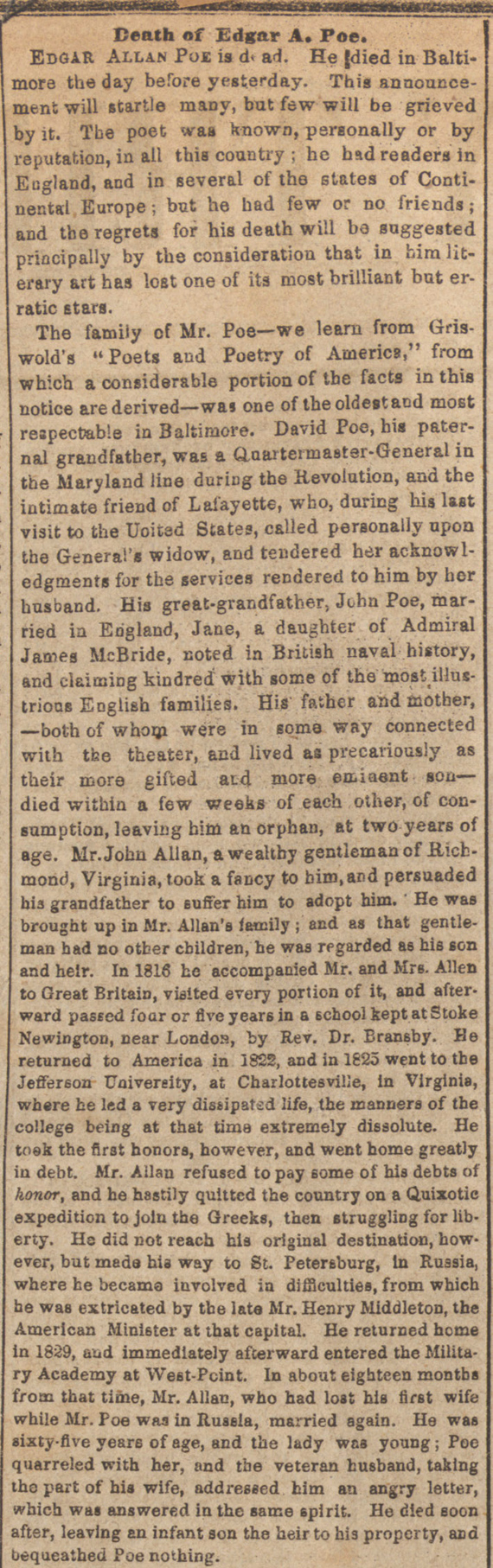
    Carl Sandburg (whose house is about 5 miles from here) wrote a long, light-but-heavy, airy three-volume biography of Abraham Lincoln that is said to have killed the president, again. Rufus Griswold, a once semi-friend of Edgar Allen Poe, became a bitter enemy whose hatred of the man extended pathologically deeply far into Poe’s death.  There are stories of cross-loved interests, and competition over a job, and the biggest (or more representative) thing–Poe’s lukewarm review of Griswold’s genre-twisting collection of American poetry, for which Poe was paid by Griswold, a bribe producing a coercion of Griwold’s work. Poe was evidently never forgiven for that, and probably never forgiven for being legions smarter and far more talented than Griswold–and for all of these real or imagined ills Griswold drove a stake through Poe’s eye in this very nasty obituary.  It was signed with a pseudonym, but it was soon discovered that Griswold was the author.  

    The obit is a diatribe, pure and simple, a revenge piece that pulled Poe from his grave and killed him again. You can tell that the long column will cleave Poe in two by the end of the second and third (short) sentences: “He died in Baltimore the day before yesterday. This announcement will startle many, but few will be grieved by it”.  You know at that point that whatever comes to follow will offer a rough ride, which indeed it was.  There’s a lot of stuff about his personal life, including a long an meandering section on his stepfather—and not one mention of anything that he wrote.  

    Griswold clawed his way into the heart of Poe’s remains like a meth addict tracking down a ten dollar bill under a soda machine, and proceeded to defame Poe and his life via forged letters, and thus creating Poe the madman/street-crawler/drug-addicted alchie who was a friendless and betraying  and brutal to anyone he knew. It took a while for Griswold’s crimes against Poe to be uncovered, but the damage was done, and life force thief Griswold was safely tucked into his own dirt nap.  No one deserves that sort of treatment, least of all Poe.  In the end the truth was outed, with Poe recognized as himself again, with Griswold becoming the pathological necro-killer.  

    Poe obitt


    [Image source: Awesome Stories,  https://www.awesomestories.com/asset/view/Poe-Obituary-by-Rufus-Griswold, reprinting the obit as it appeared in the New York Tribune, October 9, 1849.]


  • One of the Many Mona Lisas of Early Flying Machines

    JF Ptak Science Books  Quick Post

    Flying macine 1885214

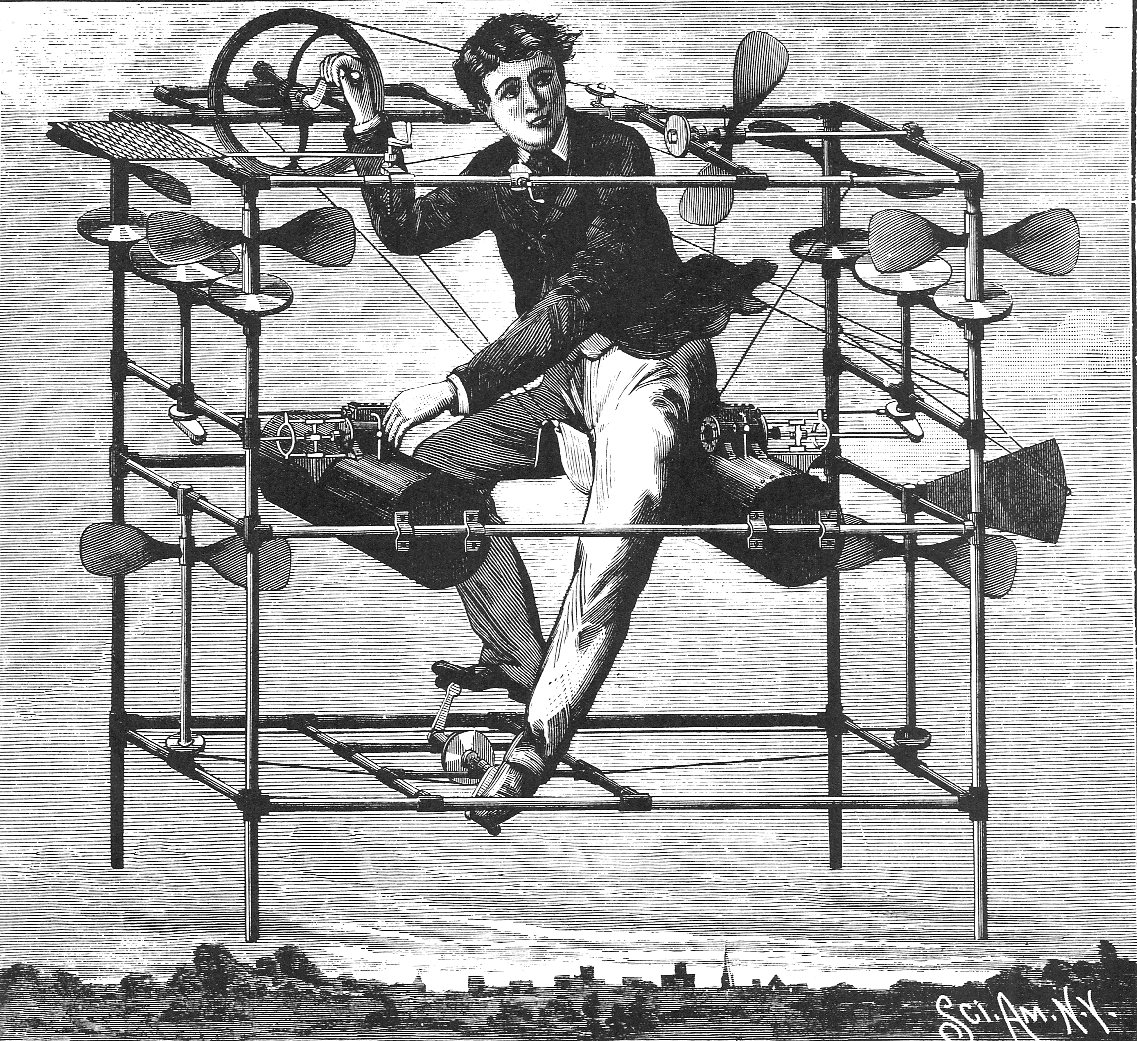
    I’m pretty sure that I’ve only written a plural of “Mona Lisa” a few times before in my history of writing–and that in reference to the real one, when it was stolen by Vincenzo Perugia (and company?) in 1911. (My guess is that it was stolen on demand for a collector and then offered for sale to a number of other underworld-y collectors who were sold fakes–at that point, what could they do (?) given that they couldn’t exactly report the swindle to the police.) For me there are some iconic image of flying machines that made the news in the pre-Wright Brothers era, and I would consider the one here to be one of them.

    It was designed by W. Ayres and happily and nattily appeared in the pages of the Scientific America (1885). It seems to have been a kind of helicopter/ornithopter, partially human powered and partially powered by compressed air that would run a generator that would run the little propellers situated around the aircraft.  The frame of the craft was made of 1/4″ steel tubes, though there is no indication of their thickness. Given that there’s something like 40 feet of this pipe superstructure, I’m going to guess that the pipe was a pound/foot; then given the weight of the pilot, and the other bits and pieces, this antique drone would have to work very hard to lift its 200′ payload.  The (May 9th) article states that there is enough power generated to lift that 200 pounds, but…

    In any event, I really like the image.  


  • “The Fatal Deadfall of Abolition”–Threatening the Newly-Freed Southern Slaves, 1867

    JF Ptak Science Books  Post 2528

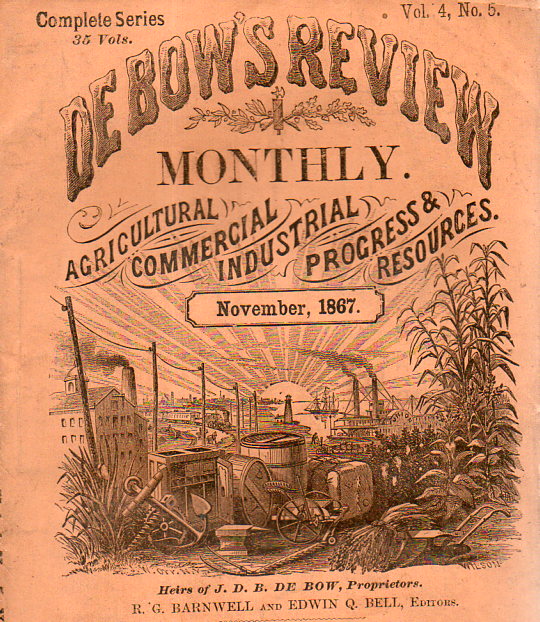
    De Bow’s Review in 1867, in the dire straights of the antebellum South, in the doom and despair of the just-finished war, lashed out like a wicked Alex Jones conspiratorial wingnut against the Northern states and anyone who comforted them.  Published in Nashville, all I have of the magazine presently is this loose issue for November 1867, and in spite of the energetically positive view depicted on the cover of the magazine had little to do with what you found in the writing inside.  

    De Bow175

    The leading article is an odd one, yelling about Great Britain manufacturing the cause of anti-slavery in the United States, which pretty much is made abundantly clear in the title,  “Black Republicanism, the Dupe and Agent of British Policy in Respect to American Interests”. The “scheme of so-called Negro Emancipation…is a British Invention” crushing the U.S. which “suffered immeasurably” under the Abolition Program, “the fatal deadfall of the abolition trap“, all of which in the end will “crush the innards out of the “Black Republican Yankee”.  It was the Brits according to the writer of this article who FORCED THE UNITED STATES TO ABOLISH SLAVERY” [caps in the original]. 

    ·Posted by :

    ·in:


  • Color Blindness and Color Correction

    JF Ptak Science Books  Quick Post  

    “For this condition, I will prescribe, for your information, a marvelous cure, the result of my experience in such cases. Take a precious stone we call sapphire. Powder it most thoroughly in a metal mortar and store it in a golden vase. Put a little into the patient’s eye every day and he will soon be cured “– from the Medieval medical text De Oculis, by Benevenutus Grassus, Stanford University Press, 1929, page 58. 

    Color wheels106

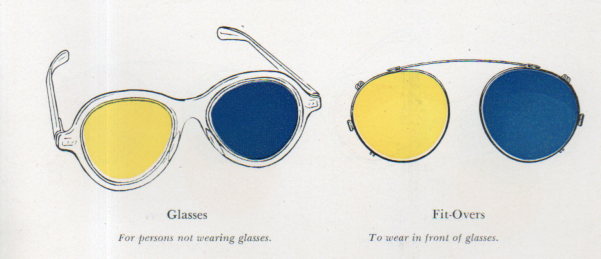
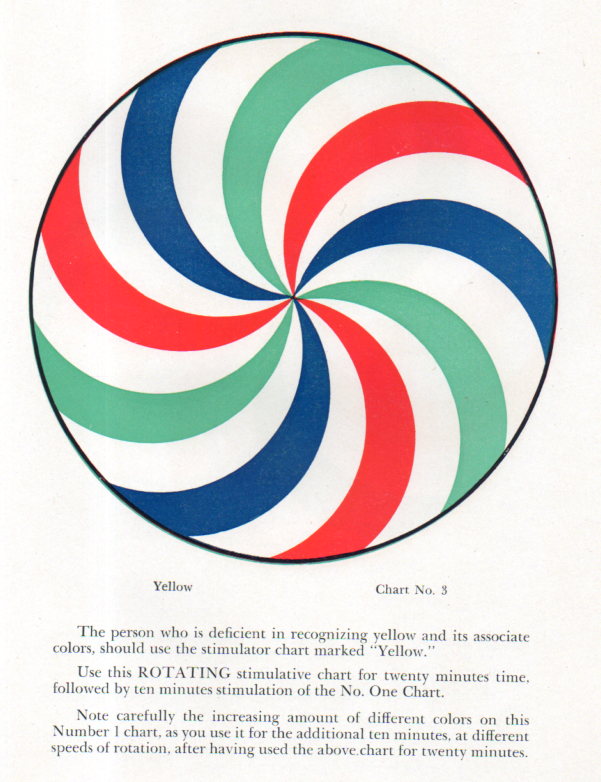
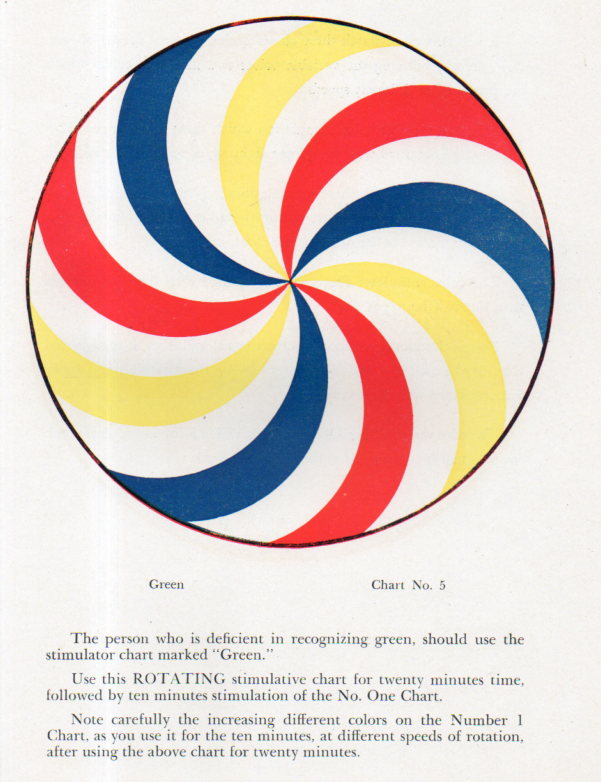
    Admittedly I was more interested in the illustrations in this work1 than the text, mainly (and obviously) because the images are so striking. The text is in its way a pre-scientific attempt at ‘curing” color blindness, which is a genetic disorder.  The color wheels (“variable speed rotary color vision stimulator”) were intended to be rotated to produce different color senses for “color vision stimulation”–it could be used to determine whether or not color vision was being “improved”.

    Most of the work was a sales vehicle for Dr. Newton’s color blindness color regenerators, or whatever, all of which could be obtained from his office in Oakland.  I guess Dr. Newton was trying, but…


    Color wheels103


  • Hitler Youth Diary for Girls, 1937

    JF Ptak Science Books  Post 2502

    Hilterjunge diary008There’s a bookcase in the house that has a top shelf for small books, most of which I haven’t written about, though there is a clutch of them that have gotten some exposure here on the blog, with most of them being unused diaries, and most of those being Nazi-oriented.  I’ve wondered about the people who would have sat down with those things blank-ish books, thinking about scheduling their time, or recording events, and then deciding not to. Maybe they didn’t want to be reminded of Nazi holidays and/or the birth of Hitler, or the right of duty and the proper way to respond to current events based on the policies of the NSDAP. The diaries are all pretty much like-new, and aren’t even all that old in the scheme of things, though their distance in time doesn’t match their distance in historical “space” (so to speak). 

    This diary was for German girls who were members of the Young Girls League (Jungmädelbund), which in the German stratification of Nazism was part of the League of German Girls (Bund Deutscher Mädel), which in turn operated under the broader gender-divided organization of Hitler Youth.

    It is difficult as a father of two daughters–one of whom is of the correct age to have been using this diary had circumstances been enormously different–and it is painful to imagine her looking through these pages, at the red-letter days and inspiration photographs, filling in the book and responding to these enormous and not necessarily subtle social pressures.

    “Wir folgen!” states the cover of the diary, and it meant it. “We follow”. 

    Hilterjunge diary009

    The book itself is not-at-all-fluffy, and pretty adult, set up with five days per page, and with plenty of Nazi propaganda and history. Al of that occupies the first 157 pages; from there to page 220 is a textual review of Hitler Youth philosophy, plus stories of brave young party members, twelve pages of explanation of rune symbology, maps, diagrams, and the like. 

    Liberally sprinkled throughout the diary section are many quotes by Hitler and other party sub-luminaries.   For example, opening to the two pages covering December 20-27, we see nothing for Christmas except for its lonely date. Right next door, on the 26th, there is a note marking the day for the death of  Dietrich Eckart–he was one of the founders of the Deutsche Arbeitspartei which became the NSDAP, and was one of the leaders in the Putsch of 1923, jailed in Landesburg with Hitler, though he was released early to die of a heart attack in Bertschesgaden that same year. (I’m sorry that I know that much about such an inferior person, but I do.)  On the page opposite is a note stating that Hitler was released from prison on that day, December 20, 1924, to begin his work again. It is a homely two pages.

    There are also a few loose quotes for the writer Hans Baumann, who became a significant nationalist figure in the indoctrination of German youth via his many works for children. Mr. Baumann’s work was not-so-pretty, and after surviving years on the Eastern front and imprisonment he somehow rose up again to become a popular international writer of childrens books and a winner of several awards, all in spite of his great popularity among the National Socialists.  He died in 1988. 

    Oh–and this note for April 13, noting that on that day in 1932 “S.A., S.S., H.J, verboten”, referring to the Weimar government banning the S.A., S.S. and Hilterjunge (H.J.) .

    And of course February 24 for the 1930 death of  Nazi martyr Horst Wessel, and at the bottom of the same page as long quote from the odious Alfred Rosenberg. 

    On and on it goes. 

    The book was published by Eher-Verlag (Franz Eher Nachfolger GmbH), which was the central publishing arm for the Nazi Party, and which published, well, pretety much everything, including Mein Kampf, from 1925 to the end.  The building at Thierschstrasse 11 in Munich still stands, a piano company occupying the ground floor now. 

    ·Posted by :

    ·in:


  • Outsider Effort on the Gases of the Cosmos, 1883

    JF Ptak Science Books  Post 2488

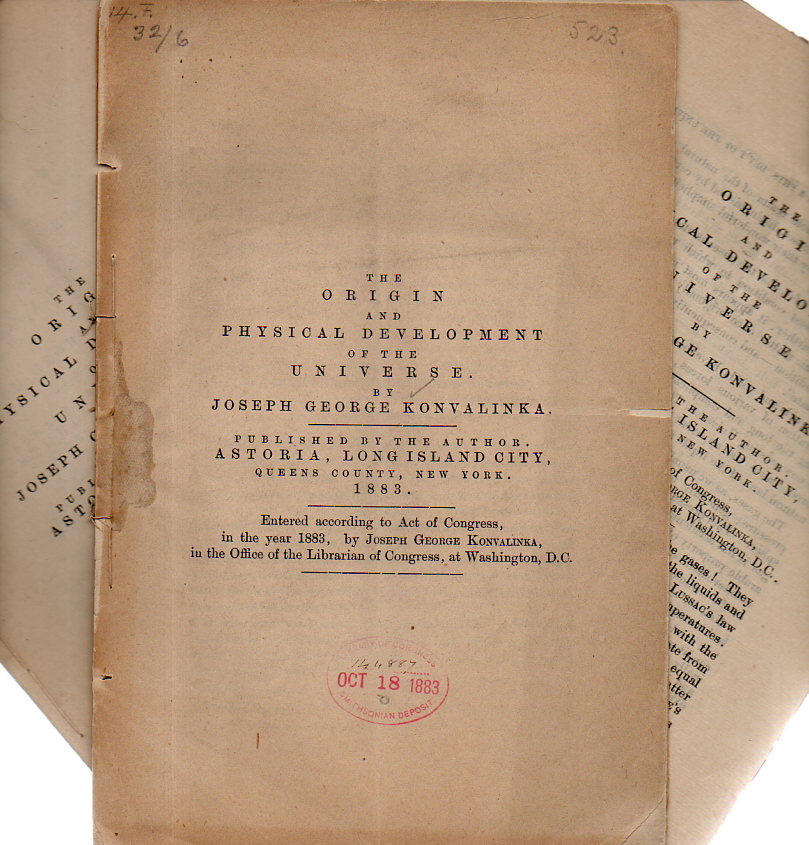
    I was researching a writer named Joseph George Konvalinka, who was the author of an Outsidery slimery called, The Origin and Physical Development of the Universe (1883). We travel through his interpretations of our physical stuff, and find that he was a curious man who seemed to be interested in his fair chunk of creation. Unfortunately his observations are not terribly clear, and he was willing to write about many of his conclusions before coming to any that were well-formed or supportable by scientific evidence. 

    Konvanlinka 3173

    For example, in section–which is actually a paragraph–on “Sun-Spots” describes the Sun as “not standing still” but “travels in a certain direction within the space of our solar system”, which is not a very scientific thing to say.  On the origin of “organic life” on Earth, the author asks himself the question and responds by not answering, but says that “all of mankind, which forms the basis of organic life, makes but a very thin cover upon the dead barren crust of Plutonic rocks” that form a “thin crust” on the surface of the Earth. And then something happens with carbon, hydrogen, oxygen, and nitrogen–which the author identifies as “all gases”–and they make vegetables and animal life.  

    And so on it goes. The interesting thing is how much ground Konvalinka covers in the fourteen pages of the pamphlet–and the curious thing is that I happen to have three copies of this semi-non-existent work, one for each eye and a spare. And for as thoughtful as he is, it seems to be almost entirely a self-contained gedankenexperiment, free from outside influence, and nearly entirely free from reference.  He wrote an earlier work in the 1860’s, and was still writing in the 1890’s (in a series referenced as his scientific memoirs), which includes a long section on aerial aviation and a proposal for a flying machine. Unfortunately he claims that flight was “a mystery” and described birds as floating in the air, which isn’t a good thing to have as a basis for understanding flight.  But he does offer several succinct and well-annotated patent-like drawings of his flying machine, which happened to be very squat, very heavy, and human powered.  

    Reading his work gives me the impression that he was an autodidact who I assume did not have the chances at an advanced education or perhaps access to the books necessary to understand physical systems that could have helped him form better foundations for his ideas. He wrote in interesting areas–and managed to have the finished efforts printed–and I can’t help but like the man because of his active mind.  


  • The Evil of Mixed Marriage (1927)

    JF Ptak Science Books    Quick Post

    • [Please be aware that there were 75 blog posts and another 30,000 words made on this blog in June, 2015–check them out by going to the Recent Posts block at right]

    With the SCOTUS decision on marriage equality from two days ago it may be interesting to see another version of what used to be seen as restricted/unnatural unions that were demeaning to the concept of marriage. 

    Marriage, evil165

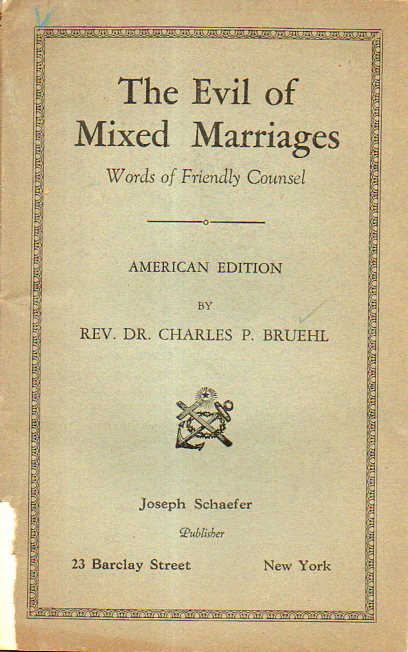
    Back when this work was published in 1927, the “evil” and “mixed” part of this marriage wasn’t about same-sex unions, or interracial (the former assignment of illegality overturned only in 1967)–this was a mixed marriage of Catholic and non-Catholic.  The pamphlet (which was passed by the Censor Librorum and printed with the imprimatur of the Archbishop of New York) .

    The pamphlet states that a “mixed marriage is not a matrimonial union between Christian and non-Christian. Such unions are usually abhorrent to Catholics, though in these days of rampant mammonism…lose their repugnance  for what is so contrary to the Christian sentiment and barter their divine birthrite [sic] for earthly gain”.  The author writes that marriages of this type are “exceedingly rare” and need not gain his attention.

    “Technically a mixed marriage is a marriage between a Catholic and a baptized non-Catholic”–that means the other types of mixed marriages are so completely contrary to church teachings that they not even be discussed.  This was only 88 years ago, and it makes me wonder what the stern opponents of marriage equality will think of their opinions and beliefs 20/40/60 years hence? 


  • “Visionary” Highways with Non-Visionary Engineering (1938)

    JF Ptak Science Books   Post 2480

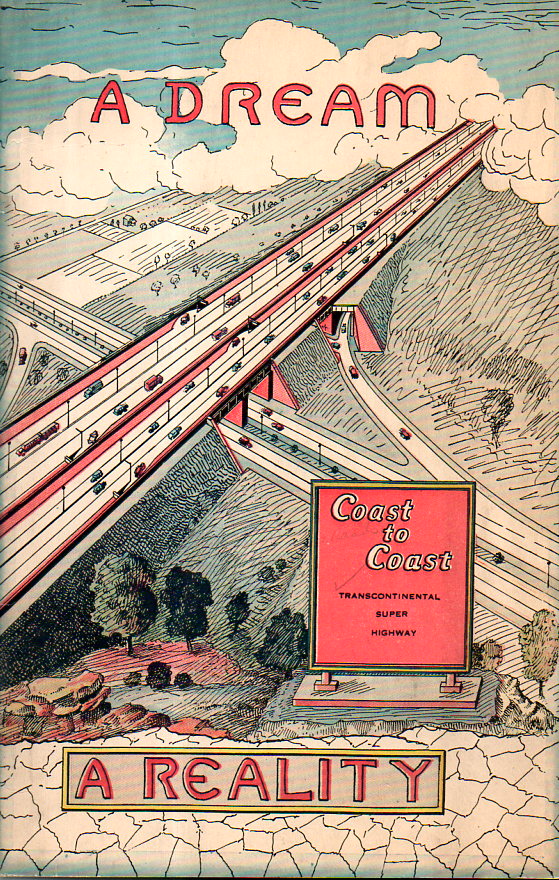
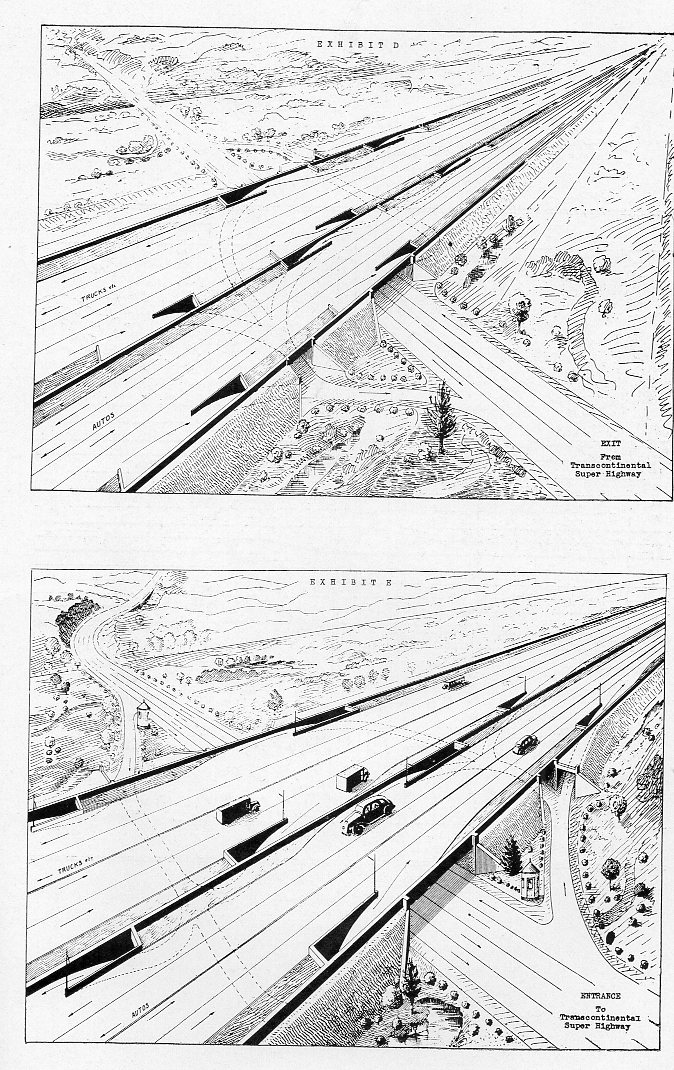
    I thought that I had mentioned this pamphlet before–mainly because of its provocative cover art–but no.  It comes from the bookstore’s collection of many hundreds (a thousand?) of unusual book/pamphlet cover art.  “A Dream, a Reality” and/or “Coast to Coast Transcontinental Super Highway” isn’t actually the title of this work even though they are on the cover; it is mostly a caption for an interior image though it somehow percolated topside.  The real title is The Highway of Tomorrow made Possible by the Ideal of Today, which gets to the subject of the work even though it is slightly unwieldy. It is difficult to say who wrote this though Mr. T.E. Steiner (“Sponsor”, of Wooster, Ohio) and which somehow found its way to a fourth edition in its two years of existence, published and promoted in undoubtedly small numbers by the “Transcontinental Stream-Lined Super Highway of the United States of America” in 1938.

    Highway visionary120

    This is all about super-highways, and mainly replacing the old roads with four new roads that are as straight as straight could be. A map of the proposals features one line of the highway is straight from San Francisco to Boston; another from Laredo, Texas (!) direct to International Falls, Minnesota (!);  a third not-straight shot from Boston-Allentown-near-Valdosta Ga-Miami; and another from near-Valdosta to Cleveland. A schematic of this map though drops near-Valdosta for Jacksonville, and has the Boston-Miami route further east to include NYC and D.C., which are omitted from the map.  Ah, well.

    • This item is available for sale at the blog bookstore, here.

    I think that the author–an accomplished “business man” was was the head of a “manufacturing company” in Ohio and a coal company in West Virginia (and “employer of labor”) –was not much of an engineer, because the plan ignores topography and the highway design itself is pretty bad, especially the parts on exit/entrance (which the author takes particular care to note are separately copyrighted (?)) bits, which are killers. 

    Highway visionary121

    In any event, the super highway extending into the clouds on the cover is all I’m here for.  Mr. Steiner no doubt attracted some attention for the project because of the enormous pork and public works potential, what with the building of 6,000 miles or whatever of an 8-lane highway, which is billions of square feet of paving times some multiplier.  So a lot of money would be spent, which means, well, a lot of possible interest–after all, it did get so far as a hearing before the Committee on Roads, U.S. House of Representatives, on May 18, 1937.

    This no doubt was a “visionary”proposal of some sort, though the engineering aspects of it were more imaginary than anything else.