A Daily History of Holes, Dots, Lines, Science, History, Math, Physics, Art, the Unintentional Absurd, Architecture, Maps, Data Visualization, Blank and Missing Things, and so on. |1.6 million words, 7500 images, 4.9 million hits| Press & appearances in The Times, Le Figaro, Mensa, The Economist, The Guardian, Discovery News, Slate, Le Monde, Sci American Blogs, Le Pont, and many other places… 5000+ total posts since 2008.

Category: mathematics, logic

  • The Beauty of a Hexadecimal Tonal System (1863)

    JF Ptak Science Books  Overall Post 5145

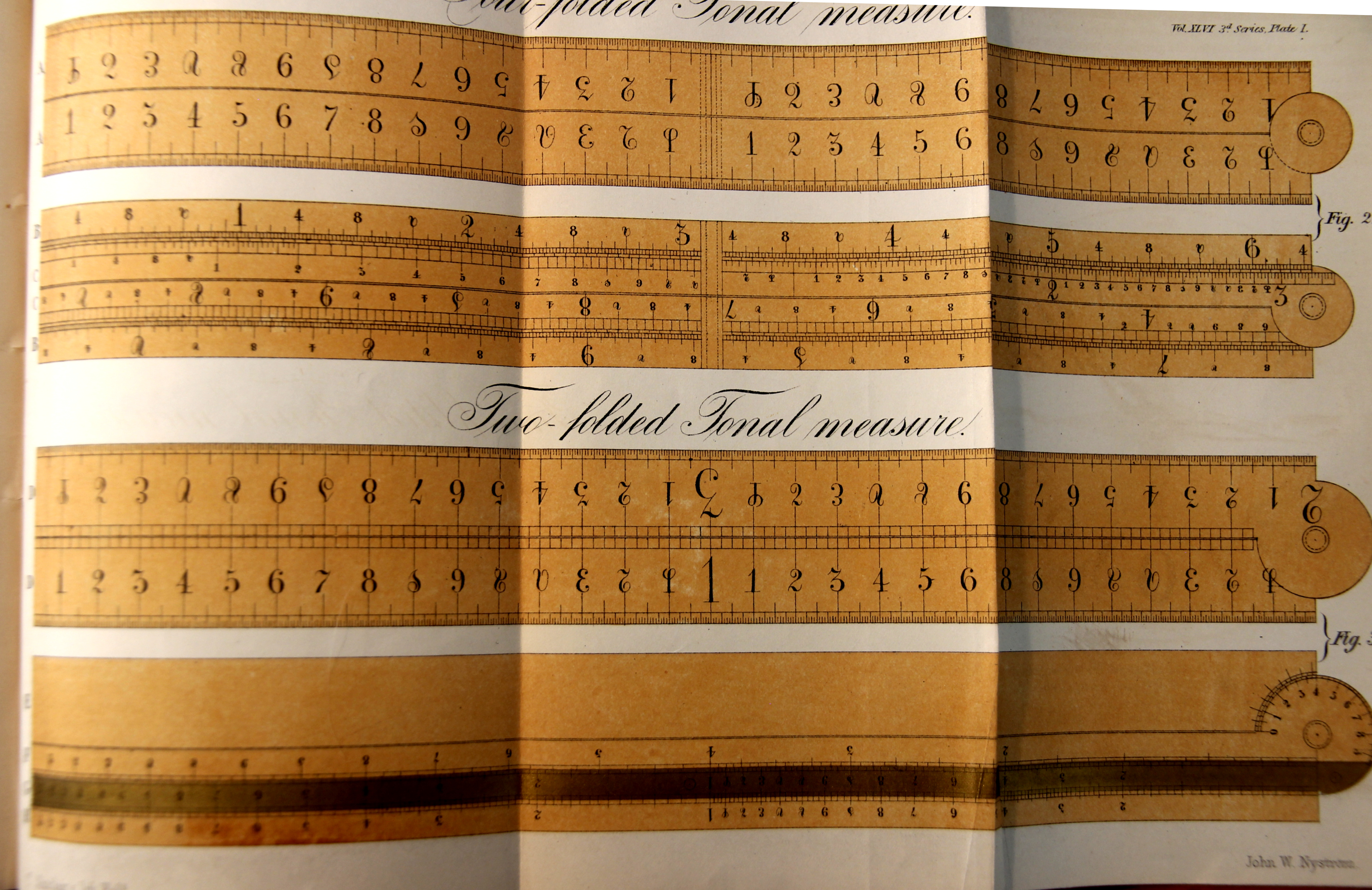
    John Nystrom’s  “A New System of Arithmetic and Metrology, called the Tonal System”1 (1863) is a very early entry in the history of the application of the hexadecimal system.  Nystrom’s plan included converting to a hex arithmetical system, and then expanded the idea to the calendar, musical notation, geography, time—an overall shift in metrology. His idea did not extend to calculators, and his name does not seem to be referenced by any of the modern compsci folks (with the major exception of Donald Knuth). Probably base-16 was not employed in programming until, I guess, around the early 1960’s. All that said, this is still a remarkable paper. ALSO: the paper is illustrated with a beautiful color-highlighted folding plate of divider-like instruments that translated hex to denary.

    Nystrom 1863 _3_


  • Crazy Cubes, Baseball Cannons, Logic, the 4th Dimension, and Monkey Bars.

    JF Ptak Science Books   (Older post #2248 from July 2014 expanded)
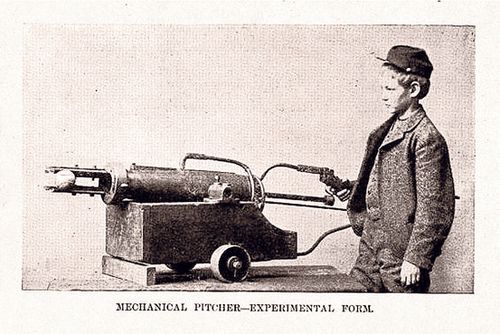
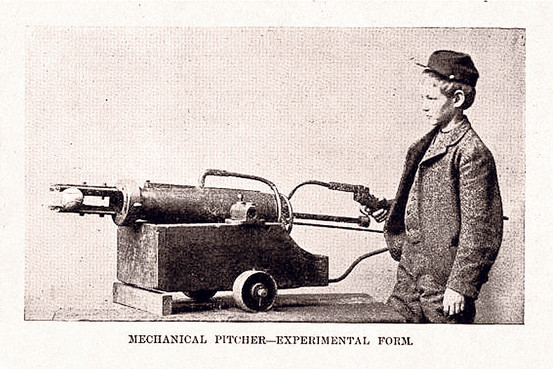
    Hinton cannon[Image source:  Joshua Robinson, “A Machine Before its Time”, Wall Street Journal, June 21, 2010. See below.]

    Somewhat Zelig-like, Charles Howard Hinton (1853-1907) is a sort of shadowy Oxford-educated figure who turns up in the beautiful Jorge Luis Borges’ works, and who married one of  George Boole’s daughters1, and who was a great and very early visualizer of geometries of higher dimensions, and who was the coiner of tesseract, and the inventor of a baseball pitching machine, and a practical joker, and a sci-fi writer, and who deserved an obituary in the New York Sun by the masterful Gellett Burgess2, and who seemed to keep one step ahead of everyone and himself.

    He was also the creator of “crazy cubes”.

    There are many standard-bearers in the history of modern art who probably owe something to Hinton, who published his ideas on the fourth dimension (illustrated!) just at the time when this idea was in it trial runs in the artwork of the modern age.

    And so do baseball players—or at least those at Princeton, where he introduced his machine which evidently was used there for several seasons. The pitching gun really was a cannon, the baseball loaded into the thing with an appropriate cartridge to shoot the ball at pitcherly speeds, which he described it in Harper’s Weekly for March 20, 1897. It was capable of varying speeds, had an adjustable breech, and was capable of throwing a curve. (How Hinton got to Princeton is interesting and a mystery, both; he was an instructor of math in England until he was charged and convicted of bigamy in 1886, whereupon he took his first wife and four (?) sons to Japan to teach in Yokohama for a while, then yadda yadda yadda he starts teaching at Princeton in 1893.)

    Hinton was into a lot of things, with a very inquisitive mind, and very smart. And so he bounced here and there in his careers, from position to position. David Toome, in his fine The New Time Travelers: A Journey to the Frontiers of Physics (2010) gently and wonderfully describes Hinton (in his relations to the exterior world of work) as “buoyant” (page 29).

    In any event, Hinton seems not to have patented the thing, so far as I can determine in 10 minutes of patent searches.

    The cannon seems to have excited a bit of baseball scifi3 in itself, adding to Hinton’s other pleasures.

    In a longer and better article than mine, Joshua Robinson writes in the Wall Street Journal about  Hinton’s machine and the near-roboticized future of baseball:

    “…(I)n 1896, the Los Angeles Times called it a “Frankenstein.” One Washington Post columnist worried it would ring in an age of robots ruining the national pastime—this was a long time before anyone was worried about steroids.

    “There would be the base-burning, high-pressure, anti-friction catcher,” he wrote, “and the shortstop made of aluminum and rivets and filled with cogs, cams, valves, shafts, and belting.”

    Hinton’s pitcher was an interesting idea, but ultimately it proved to be too cumbersome and slow to be of any sustained use. Plus, as Robinson points out, after the cartridge was fired there was a puff of smoke, which caused occasional consternation and confusion for those standing in front of the canon. And ducking. 

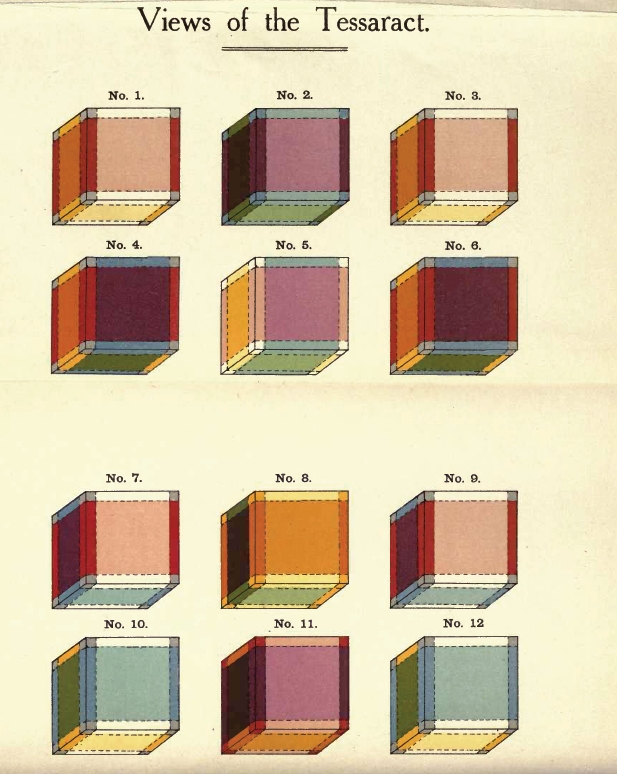
    And the so-called “crazy cubes”?  That moniker is my own creation. These were simply (really not so) creations by Hinton that he said would help people visualize his four dimensional world, as Rudy Rucker (see below) describes as “points moving around in three dimensions might be imagined as successive cross-sections of a static four-dimensional arrangement of lines passing through a three-dimensional plane…”  Evidently the cubes helped many people experience a more internalized world of fantastic difference, some stating that the cubes drove some people insane. Of course they were just colored cubes, pretty in themselves–though the problem of visualization was fairly knotty.4  
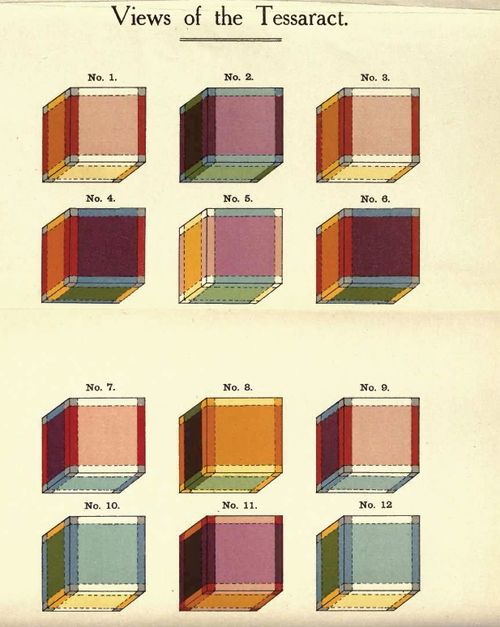
    Hinton tesseract[Source: The Fairyland of Geometry, a Cultural History of Higher Space, 1869-1909, here.]

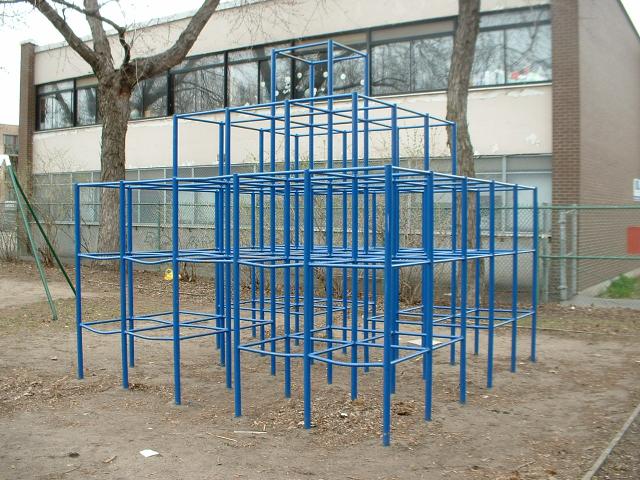
    It MUST be pointed out that there is a very steely concretized example of the Hinton tesseract that is still around, brought into existence by one of Hinton’s sons. Sebastian Hinton (1887-1923) was a lawyer in Chicago who hit on an idea of bringing his father’s work somewhat into the hands of the public-at-large–specifically, into the hands of children, who would be able to play and climb and swing in Charles’ fourth dimensional idea.  He applied for a patent in 1920 which was granted in 1923:

    Jungle gym


    [Image source: Wiki Commons.]

    The “Junglegym”5. 

    Notes:

  • Delambre’s History of Greek Mathematics (Almost) in English (1811)

    JF Ptak Science Books   Quick Post

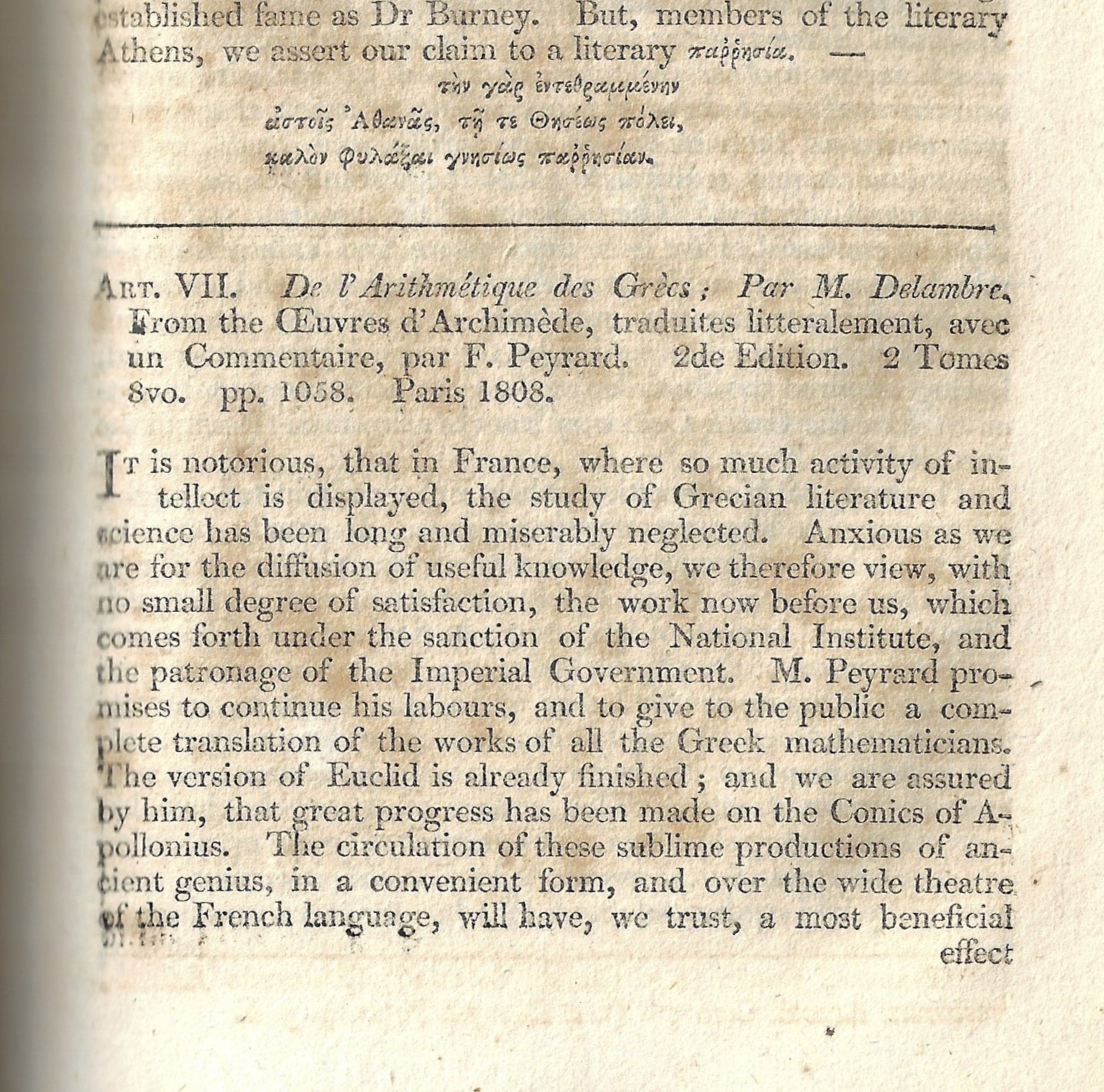
    Edinburgh Review 1811 delambreI found the following while strolling through a volume of teh Edinburgh Review for 1811. The ER was an excellent “magazine, with much in common with the New York Review of Books and The Times literary Supplement–it was meant for a mass audience of careful readers, and performed critical reviews and examinations of newly-published major works. Analysis was done on 40-60 books per year, spread out over about a thousand pages, so there was a lot of space dedicated to each work.  What I’m sharing here is the mathematician Jean-Baptiste Delambre’s (1749-1822) contribution to Francois Peyrard’s (1760-1822) Oeuvres d’Archimède, trad. littéralement, avec un commentaire, par F. Peyrard,…. suivies d’un Mémoire du traducteur sur un nouveau miroir ardent. et d’un autre Mémoire de M. Delambre sur l’arithmétique des grecs... Delambre’s contribution, “De l’Arithmetique des Grecs”,  ran on pp 569-601 in this 1058pp work, and so far as I can find has not been translated. The review occupies pp 185-214 in this volume of the ER, and is in English, so I thought there may be some history/maths folks out there who would like to read it. The image at left is from the copy here; the full text link is provided by Google Books.  

    Full text:  https://babel.hathitrust.org/cgi/pt?id=uc1.b2972985;view=2up;seq=196  (The text clears up with a one-level zoom.)

    ·Posted by :

    ·in:


  • Chess, Dante, 4 Trillion kg Wheat, and a Bad Pun (1877)

    JF Ptak Science Books  Post 2903

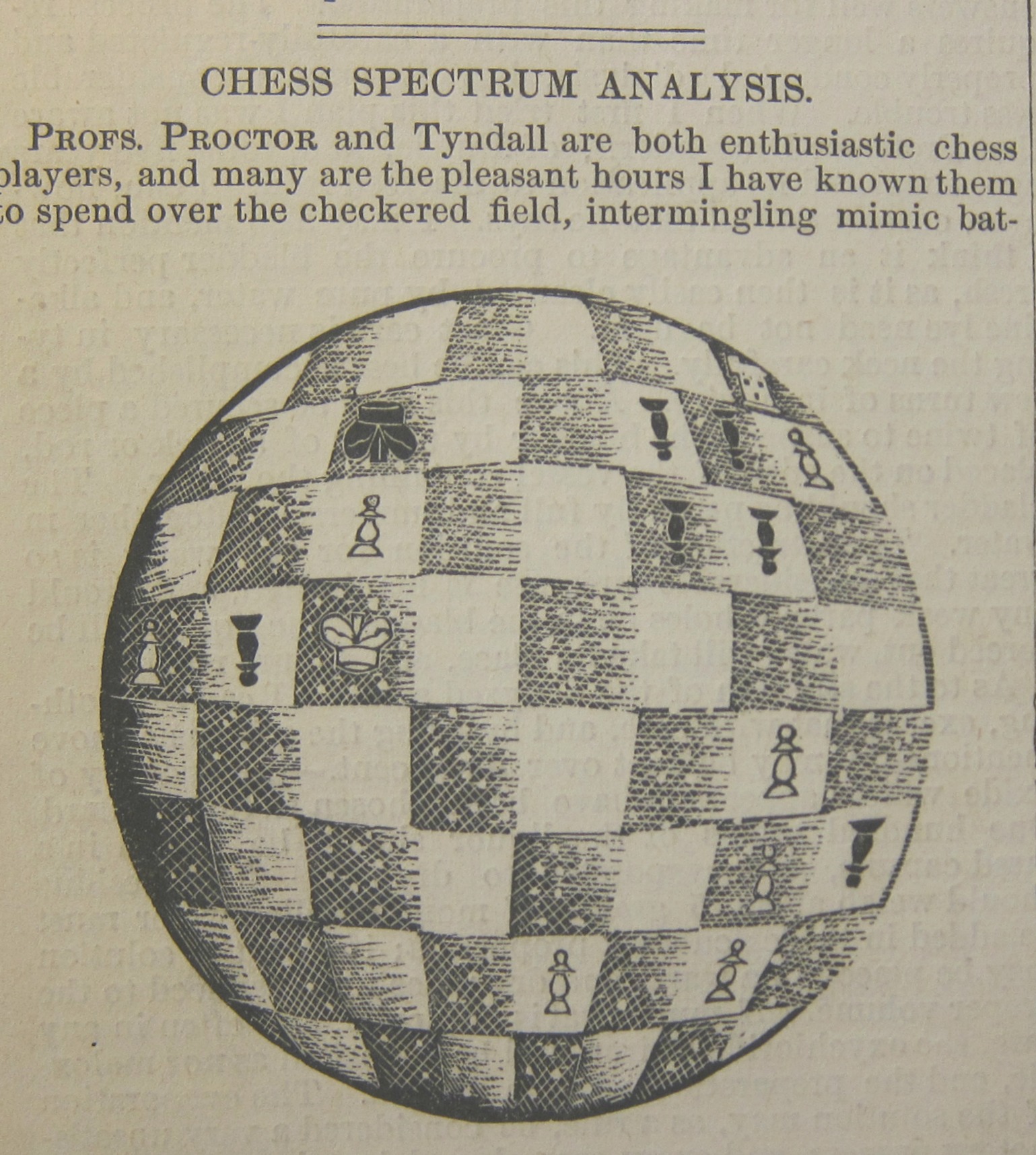
    Chess sphereAs is often the case in looking through the early-ish issue of Scientific American, I usually find much more than what I was originally looking for, finding a lot that I had no idea that I needed to find, mostly because I had never heard of them before. And so grazing though the 1877 volume of the Scientific American Supplement I found in the weekly chess review in the back of each issue an extraordinary image and title:

    I was tempted to add “Pre-Escherian” in the title to this post, but that would put the thing way over the top–but that is what came to mind first, a polished gazing ball with an interesting perspective. This was meant to illustrate an imaginary dialog between two astronomer-chess players (Richard A. Proctor and John Tyndall, though Tyndall’s interests were spread far and wide and deep and then not so much in astronomy), both of whom had made contributions to astronomical spectroscopy.  Further into the short article there was a little discussion of Dante and sunspots, which I was not aware of, though when I went looking for that reference I did find the following chess quote in Paradiso (Canto XXVIII) with our Poet in the ninth heaven:

    “So sparkled then those circles all and each And every spark did more and more abound, In fiery light and so their number grew, Beyond the chess board’s doubling problem’s bound”

    And another translation

    “And after she had finished with her speaking,  The circles all around began to sparkle,  Like red-hot iron shooting off bright sparks.  Each sparkle stayed within its fiery ring, So many that their number runs to more, Millions than the redoubling of the chessboard.”

    Moving on from the sunspots mentioned in the SA article, it has been pointed out by many that in the quote above that Dante may be referring to an earlier chess story, told at least by the 12th century, where the inventor of the game of chess agreed to give it over to the king if the king paid him in grains of wheat based upon the chess board, starting with one grain in the first square and then doubling the amount until the last square is reached. The big surprise for the king who agreed to this payment was a very fine lesson in the  quick-as-a-bunny doubling sequences: you’d move from 1 to 2 to 4 to 8 to 16 to 32 to 64  to 138 to 276 just in the first rank, 56 more squares of doubling to go, until you summed them all up on square 64 and find yourself with the number  18,446,744,073,709,551,615, which is a big number. Bigger still if you consider that this is in terms of wheat, and I figured the weight of that wheat to be about 4 trillion kg, 4 trillion being about the equivalent of stars in 40 Milky Way galaxies. 

    Even though the article was very heavy in the discussion of some real games, and light in the inclusion of our astronomers and their conversation, everything winds up and out in a whimsical fashion, with a discussion of Gutenberg and spell-check.  The author tells us:

    “It would take but little argument to show that a mere oversight of Guttenburg’s [sic] proof-reader made the world believe the moon was composed of cheese instead of chess”.

    And so it goes.  19th century astronomy/chess humor, as whacky as it gets.  

    ·Posted by :

    ·in:

    —

  • Huxley and the Inelegance of Mathematics (?)

    JF Ptak Science Books  Quick Post

     This is the lovely response by the great mathematician J.J. Sylvester to Thomas Huxley’s muckety comment on the lack of imagination in the mathematical sciences.  Huxley’s remarks were made at a meeting of the British Association for the Advancement of Science, stating that (mathematics) “is that study which knows nothing of observation, nothing of induction, nothing of experiment, nothing of causation”. This quote is taken from Sylvester’s quick and elegant responses in two articles in Nature, December 30, 1869 (pp 231-3) and January 6, 1870 (pp 261-3), as “A Plea for the Mathematician” and “A Plea for the Mathematician II”, part of which is reproduced below. “For Sylvester, the ability to be able to imagine  what the experience of space would be like in dimensions other than three is sufficient to establish the empirical basis of geometry–the three-dimensional Euclidean is not the science of space in general, but the science of the space of our experience.”–Fact and Feeling: Baconian Science and the Nineteenth-Century Literary ...by Jonathan Smith, pp 181-182.

    I don’t know what the story was re maths with Darwin’s Bulldog. 


    ·Posted by :

    ·in:


  • An Attempted Glorification of the Hexadecimal (1863)

    JF Ptak Science Books  Post 2812

    I found a very unusual paper1 in the Journal of the Franklin Institute for 1863 promoting moving from base-10 to base -16…for almost everything. It was written by John Nystrom2, an engineer who practiced across several fields and wrote textbooks about more. (Including in this very volume, where he contributes two other papers.) The paper in mind is a very early entry in the history of the application of the hexadecimal system. Nystrom’s plan included converting to a hex arithmetical system, and then expanded the idea to the calendar, musical notation, geography, time—an overall shift in metrology. His idea did not extend to calculators, and his name does not seem to be referenced by any of the modern compsci folks (with the major exception of Donald Knuth3). Probably base-16 was not employed in programming until, I guess, around the early 1960’s. All that said, this is still a remarkable paper. Also: the paper is illustrated with a beautiful color-highlighted folding plate of divider-like instruments that translated hex to denary.

    The Nystrom ideas did not take hold, and it seems that he was a bit cranky about the idea of its not being accepted, perhaps because it was left to the hands of people who just couldn’t see its value. He ends his book of 1862 with the following few observations:  “If the Arabic notation employed in our present decimal arithmetic had been suggested to Moses when he wrote the ten commandments on Mount Sinai he would surely have made similar remarks as that made on the tonal system that such curious looking characters could not be understood by his people….My manuscript on the tonal system has been sent to a great many places for publication. The Franklin Institute thought it would have a very serious effect on the number of subscribers of their journal. The Smithsonian Institute would not publish it because they had so much of the same kind before. The US Coast Survey stated they would publish it if recommended by a member of Congress. And lately the Society of Philadelphia has rejected it perhaps on the remarks herein replied to but Mr D recommended its publication.”–John William Nystrom, Project of a New System of Arithmetic, Weight, Measure and Coins: Proposed ...(1862)  

    As for me, I just don’t understand what he was driving for, or at.  

    Notes

    1. John Nystrom, “A New System of Arithmetic and Metrology, called the Tonal System”, pp 263-275, 337-348, 402-407 (concluded), and illustrated, including a folding plate. In Journal of the Franklin Institute, third series vol 46 overall vol 76, July-December 1863, 432pp.

    2. “John Williams Nystrom (Swedish: Johan Vilhelm Nyström) (1825–1885) was a Swedish born, American civil engineer, inventor, and author. He served as an assistant Secretary and Chief Engineer of the United States Navy during the American Civil War. Nystrom received many patents for inventions such as a marine steam engine, a refrigerator, and calculating machines…Nystrom is most notable for his proposal to switch from decimal to hexadecimal as defined in his 1862 publication titled . In 1859, Nystrom proposed a hexadecimal (base 16) system of notation, arithmetic, and metrology called the Tonal system. In addition to new weights and measures, his proposal included a new calendar with sixteen months, a new system of coinage, and a hexadecimal clock with sixteen hours in a day.”–Wikipedia

    3.  “…a prominent Swedish-American civil engineer named John W. Nystrom decided to carry Charles XII’s plans [radix-8 arithmetic] a step further, by devising a complete system of numeration, weights, and measures based on radix-16 arithmetic. He wrote, “I am not afraid, or do not hesitate, to advocate a binary system of arithmetic and metrology. I know I have nature on my side; if I do not succeed to impress upon you its utility and great importance to mankind, it will reflect that much less credit upon our generation, upon our scientific men and philosophers.” Nystrom devised special means for pronouncing hexadecimal numbers; for example, (C0160)16 was to be read “vybong, bysanton.” His entire system was called the Tonal System, and it is described in J. Franklin Inst. 46 (1863), 263–275, 337–348, 402–407. A similar system, but using radix 8, was worked out by Alfred B. Taylor [Proc. Amer. Pharmaceutical Assoc. 8 (1859), 115–216; Proc. Amer. Philosophical Soc. 24 (1887), 296–366].–Donald Knuth, The Art of Computer Programming section 4.1 (which is in volume 2). 

    A last note on the Nystrom calculator: “In an article of Scientific American the device was hailed as the most important one ever brought before the public. Despite all of the accolades however, it was never widely accepted, and no more than 100 devices were ever produced. This may have been because the cost (there were $10, $15, and $20 models, a huge sum in 1850s), or because the instrument was never well advertised or marketed. –history-computer.com


  • From the Department of Blank, Empty, and Missing Things: Mathematicians (1934)

    JF Ptak Science Books  Quick Post

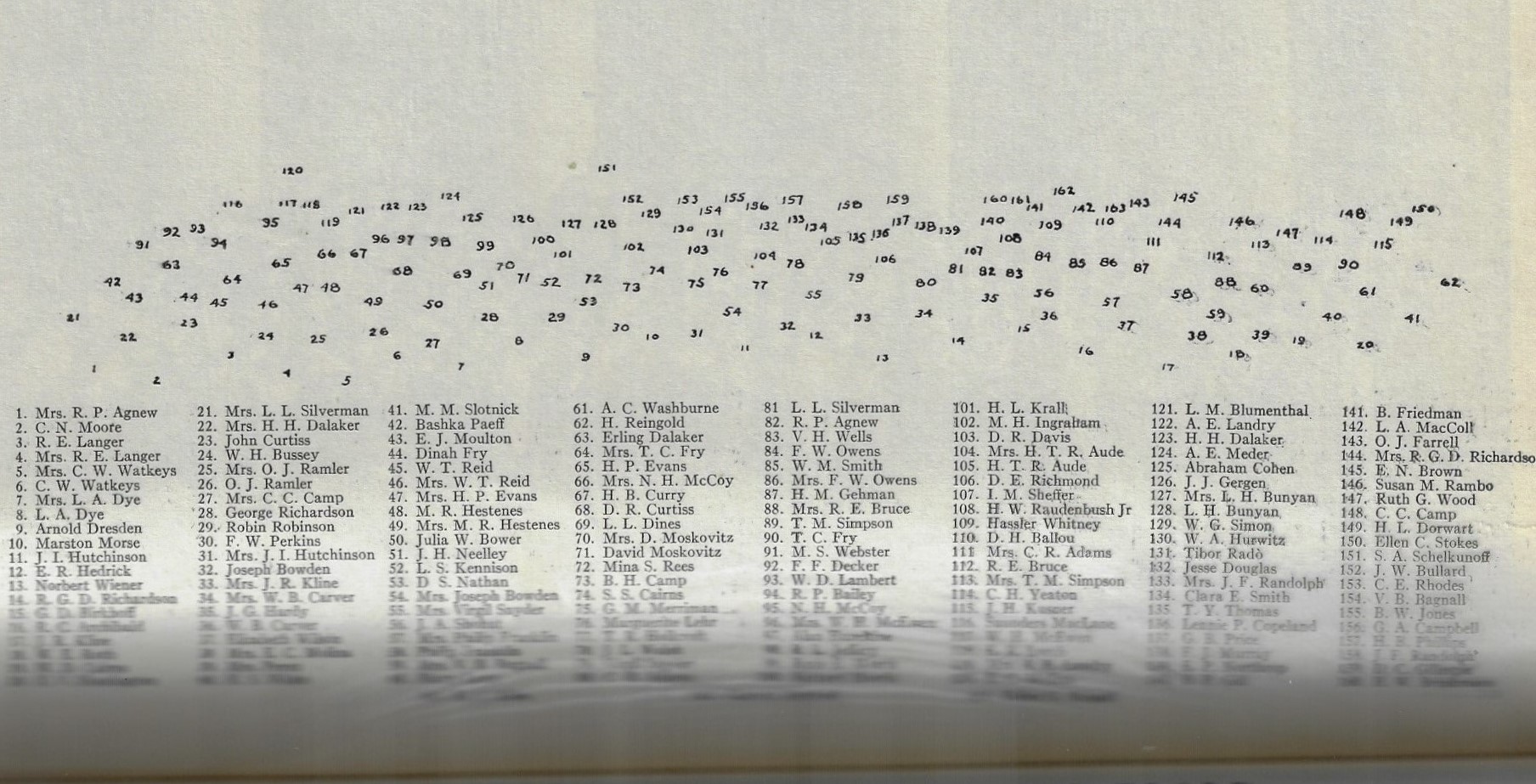
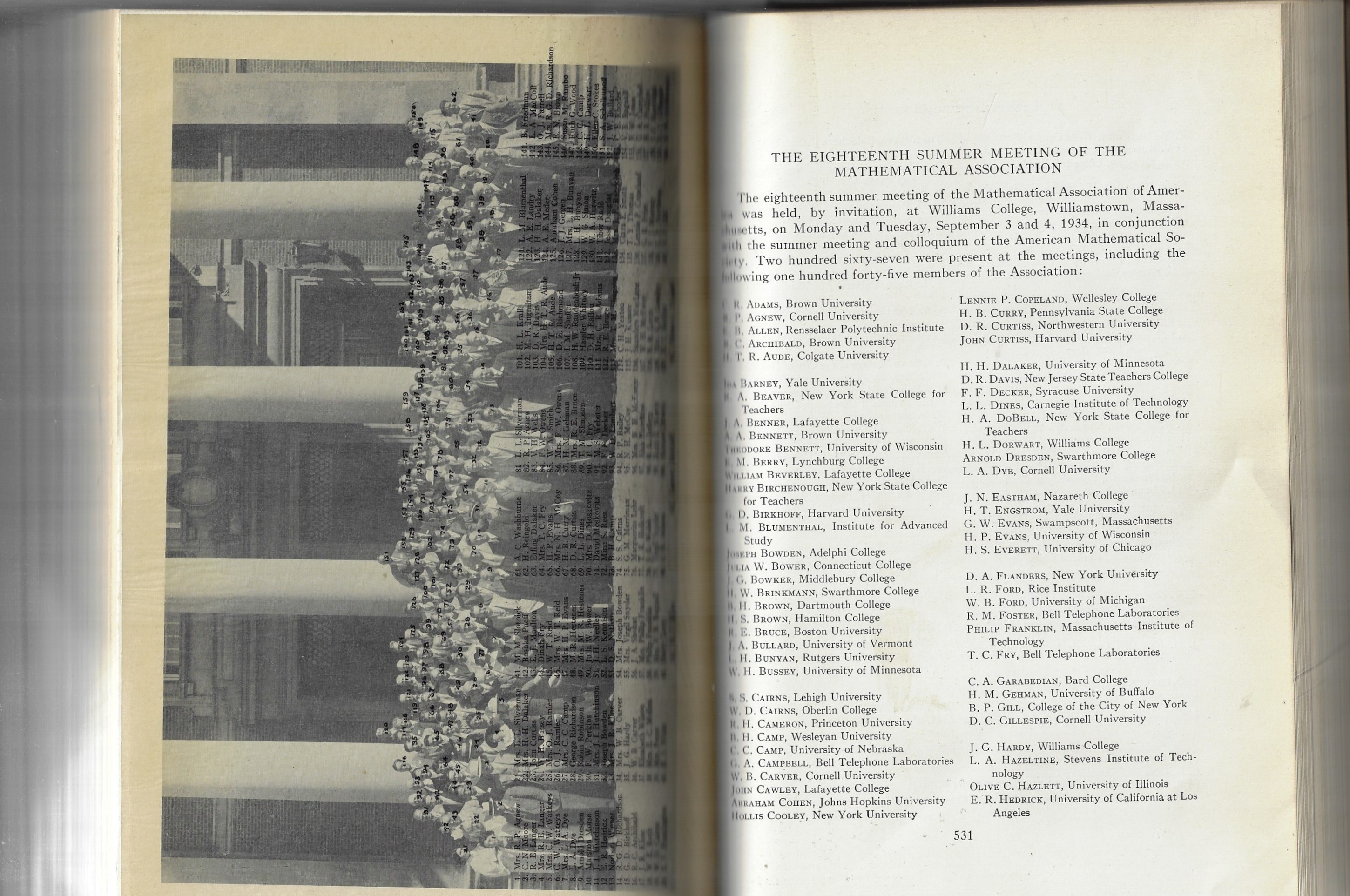
    There is a longish thread on this blog about Blank, Empty, and Missing Things: faces, ethics, beginnings, ends, causes, effects, insight, wisdom, clouds, blood, smoke, rain, depth, height, and so on.  There are also several posts that look a lot like today’s entry–one was for astronomers, and another for mining execs from the 19th century, which was a particularly peculiar image because the head outlines had no faces though most did have moustaches and beards.  Today’s bit is for mathematicians attending the 18th summer meeting of the Mathematical Association of America in 1934, and I found it somewhat ironic that there would be no outlines of the bodies at all, just numbers. Perhaps this is more appropriate than ironic.  In any event, here’s the glassine overlay:

    American MAth Monthly 1934 group photo _2_ blank

    [Source: American Mathematical Monthly, volume 41, 1934.]

    And the two page spread with photo and the glassine in place:


    American MAth Monthly 1934 group photo _2_ blank


  • The Art of Arithmetic–Numbers on a Stick Calculator, 1936

    JF Ptak Science Books   Quick Post

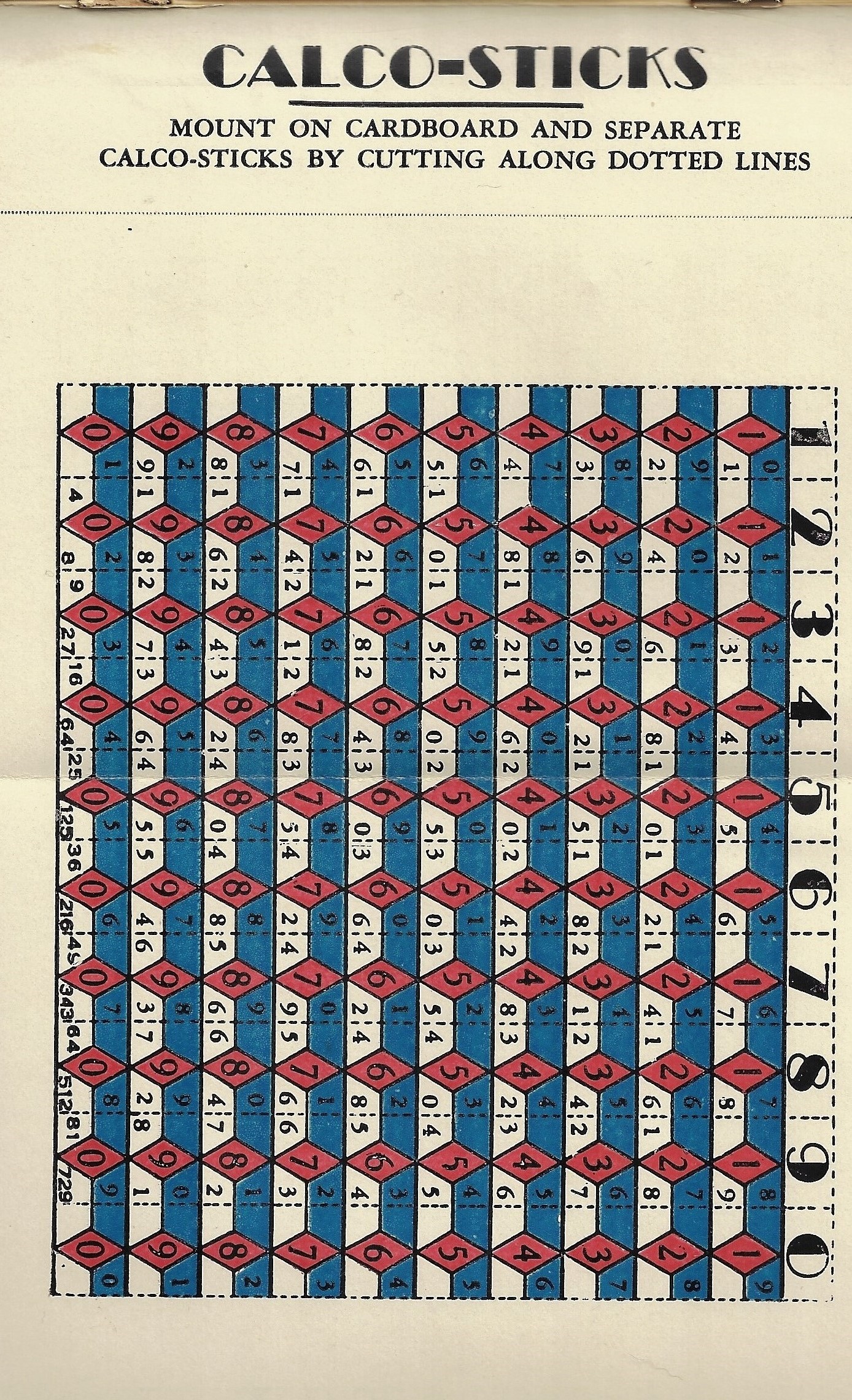
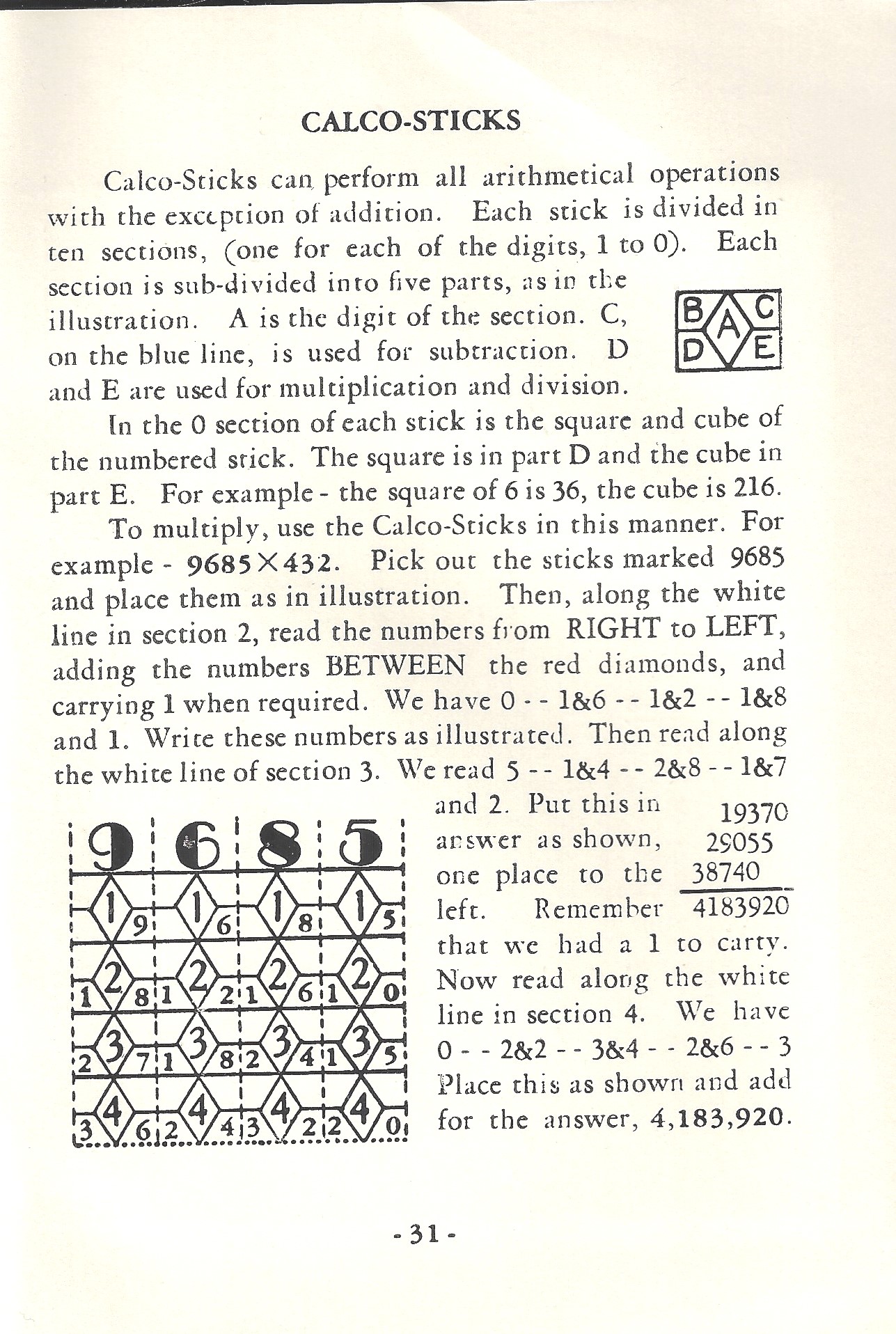
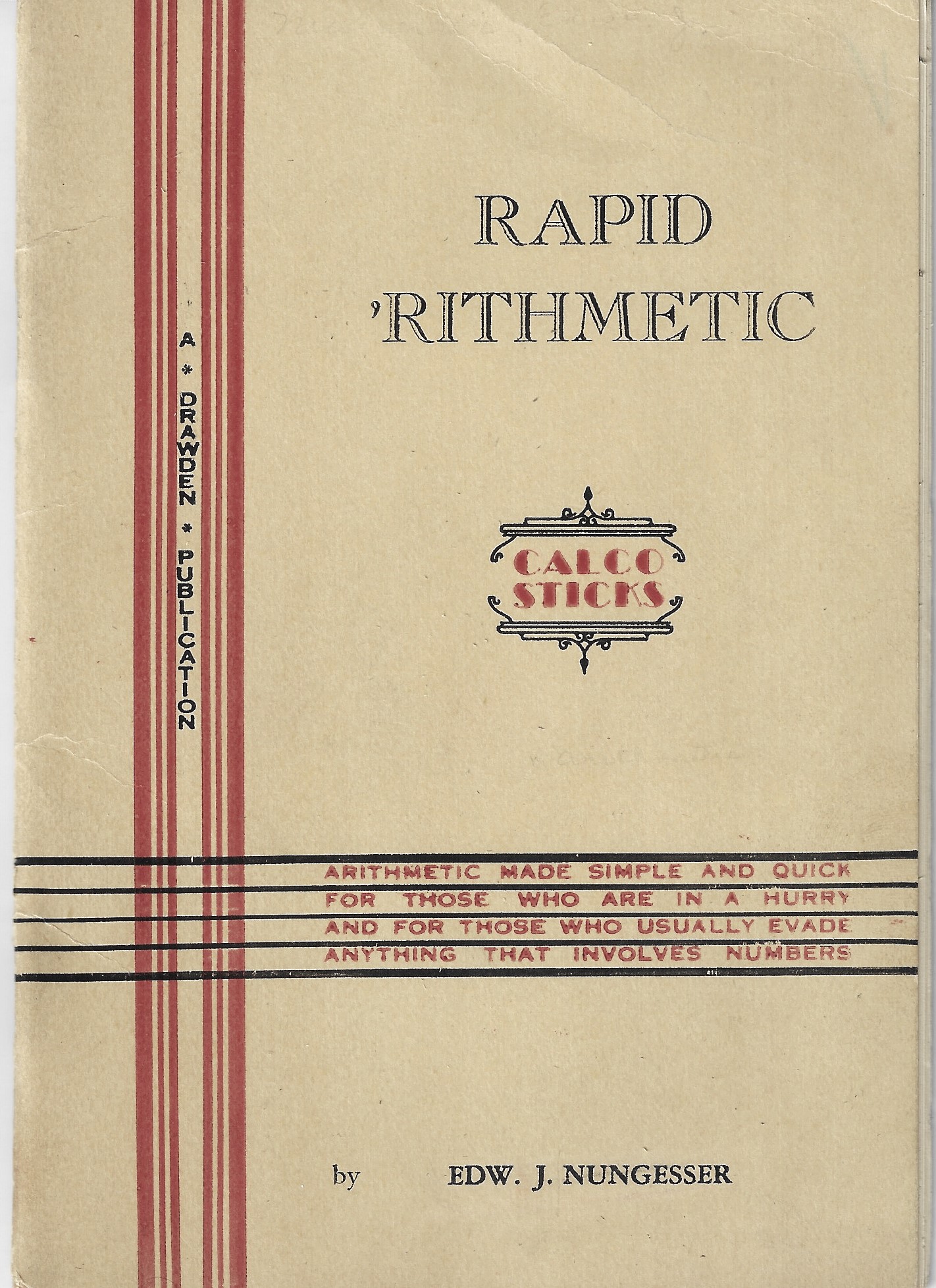
    Here’s your chance to download a DIY cardboard reckoner. I think it would be much more satisfying to do the arithmetic by hand, or use your phone-device, or just call up The Internet and ask it to divide some number y by some number x, but that’s not the point. Making it would certainly be a pleasure of some sort because the Napier-like sticks/bones are such a lovely assemblage. And of course all hats off to the person who created the thing to begin with–and I assume that person to be the author of the little pamphlet in which the calco-sticks are found. Edward J. Nungesser published Rapid ‘Rithmetic/Calco Sticks (Arithmeic Made Simple and Quick for Those who are in a Hurry and for Those who Usually Evade Anything that Involves Numbers). It was published by Drawden Publications of 7 W 44th St NYC in 1936, and is a pocket-sized 5″ tall and 32pp thin. In any event, I really like this little guy, and I think Mr. Nungesser did a fine job. (I tried to find references to him but came up empty; for an instant I thought his name but be a pseudonym (“No Guesser”) but I’m pretty certain that this is not the case. Also there is no sign of it at all on WorldCat/OCLC.)


    DocFile (5)

    And the instructions:

    DocFile (6)

    And the wonderful cover:

    DocFile (7)

    ·Posted by :

    ·in:


  • A Great Mental Calculator (1856)

    JF Ptak Science Books   Post 2739

    George Parker Bidder (1806-1878) gave a lecture (without notes) explaining to the audience at the Institution of Civil Engineers in 18561 his interior practices and habits in performing absolutely prodigious and complex arithmetical feats entirely in his head. He was among the first tier of performing human calculators (like Zerah Colburn, b. 1804) mental calculations enchanted large audiences from the stages, answering seemingly impossible questions with accuracy and speed. It is in the 1856 paper (which Martin Gardner refers to as “historic2” and “valuable”) that he relates some of the practices which clarify his process–for example, one large element was that he would keep one fact in his head at a time, until it was finished, and then move on. Of course for people who did not have anything even remotely resembling this impossible ability, the information is interesting, though I have no idea how useful it may be…unless you were already a savant, that is.  Some things are just not to be known by mere mortals. Like the probably-apocryphal story of someone asking Hans Bethe how Richard Feynman had solved–on his feet–some impossible something, and Bethe responds: “First he thinks very very hard….and then he gets the answer”.) Something like that. 

    In any event, here’s the article, reproduced by Devonshire Perspectives website. My own copy is in a tightly-bound volume from the proceedings, and no doubt I would have broken the spine trying to copy the thing. That said, if anyone wants to buy this volume, it is for sale–this is a book selling site, sorta, after all.  

    The full lecture by Bidder:

    https://www.devonperspectives.co.uk/georgebidder/OnMentalCalculation.pdf

    Notes:

    1. Bidder, George Parker. “On Mental Calculation”, in Minutes of Proceedings of he Institution of Civil Engineers with Abstracts of the Discussions, volume XV, Session 1855-6, London, published by the Institution,  pp 251-280 in the 534pp volume. 

    2.  Gardner, Martin. “Mathematical Games”, in Scientific American, 216/4, April 1967, p. 117. 

    Also, I found an interesting biographical treatment of Bidder:

    • Bidder, George Parker. Mental Arithmetic. A short account of George Bidder, the celebrated mental calculator: with a variety of the most difficult questions, proposed to him at the principal towns in the kingdom, and his surprising rapid answers, etc. by George Parker BIDDER Rapid Calculator and Engineer., 1821

    It seems as though there was a separate edition of this 1856 lecture tens years later, published by Clowes:

    • Bidder, George Parker, and Institution of Civil Engineers (Great Britain). On Mental Calculation. Edited by Charles Manby. London: Printed by W. Clowes, 1866.

    And another printing somewhat later:

    • Bidder, George Parker. On Mental Calculation. London: Printed by W. Clowes, 1886.

    ·Posted by :

    ·in:


  • A Beautiful Regression, and then Some (1877)

    JF Ptak Science Books   Quick Post

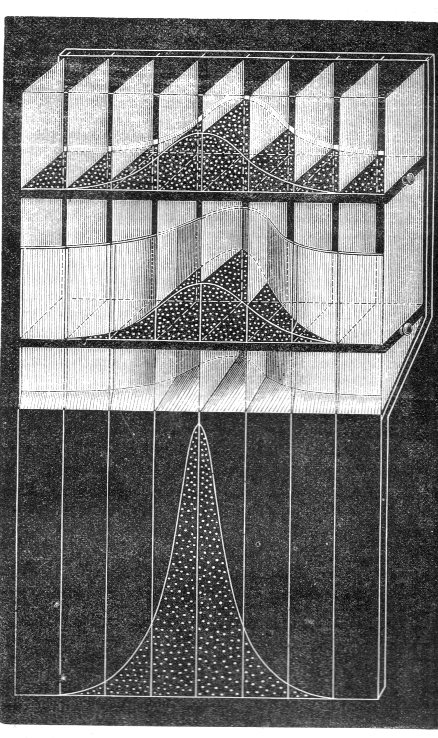
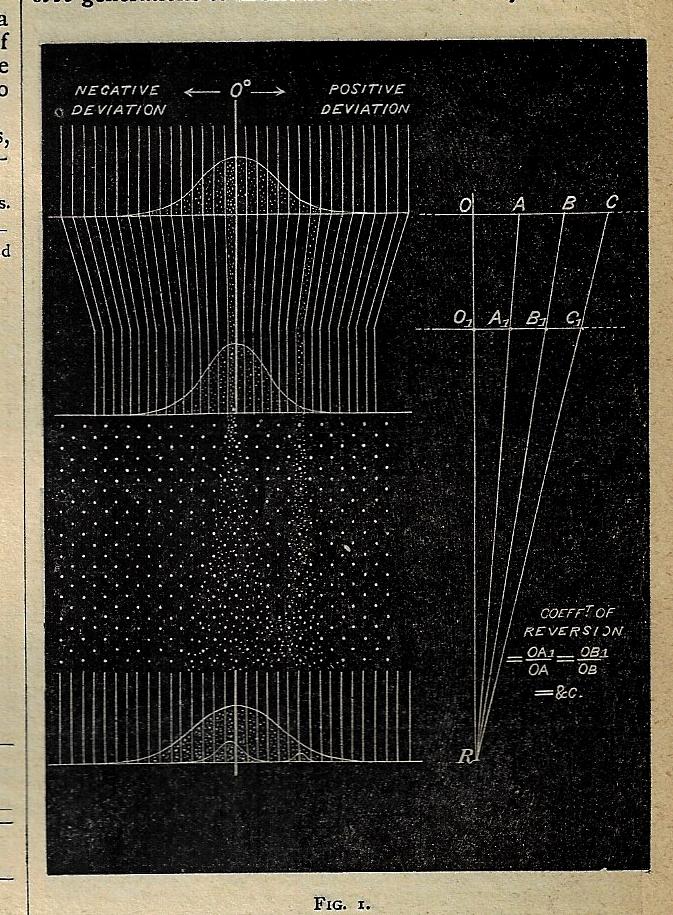
    This beautiful bit of data visualization was a significant development in the history of statistics and was employed in pioneer Sir Francis Galton’s “Typical Laws of Heredity, III”, which appeared in Nature magazine on April 19, 1877.  

    Galton707[Image: Francis Galton, “Typical Laws of Heredity, III”, Nature. p 513, April 19, 1877] 

    Tis follows on the heals of the first paper in this series, earlier in the month of April, 1877:

    Galton 1877 regression _1_

    This contribution by Galton is the “first major step in the development of correlation and regression analysis” according to Judy Klein’s Statistical Visions in Time: A History of Time Series Analysis, 1662-1933, (page 131). She continues: