A Daily History of Holes, Dots, Lines, Science, History, Math, Physics, Art, the Unintentional Absurd, Architecture, Maps, Data Visualization, Blank and Missing Things, and so on. |1.6 million words, 7500 images, 4.9 million hits| Press & appearances in The Times, Le Figaro, Mensa, The Economist, The Guardian, Discovery News, Slate, Le Monde, Sci American Blogs, Le Pont, and many other places… 5000+ total posts since 2008.

Category: mathematics, logic

  • Hilbert’s Problems

    JF Ptak Science Books   Quick Post

    This is just a short bibliographic note on David Hilbert’s great paper of 1900–this a result of trying to figure out where a particular French translation occurred in the history of the printing of the paper.  

    The paper in question is David Hilbert  “Problemes Mathematiques“ , printed in Paris  by Librairie armand Colin (28 Fevrier 1901, 12e annee, No. 4) in the publication Revue generale des Sciences pures et appliques. This is a revised printing of the 2nd printing of Hilbert’s “great problems” speech (taken from The Archives of Mathematics), in which the he famously posed his 23 problems.  “The Problems of Mathematics” was delivered to the Second International Congress of Mathematicians in Paris and outlined major issues of math

    “…which would challenge mathematicians to solve fundamental problems in the maths for years to come.   It was a speech full of optimism for mathematics in the coming century and he felt that open problems were the sign of vitality in the subject:  The great importance of definite problems for the progress of mathematical science in general … is undeniable. … [for] as long as a branch of knowledge supplies a surplus of such problems, it maintains its vitality. … every mathematician certainly shares ..the conviction that every mathematical problem is necessarily capable of strict resolution … we hear within ourselves the constant cry: There is the problem, seek the solution. You can find it through pure thought… Hilbert’s problems included the continuum hypothesis, the well ordering of the reals, Goldbach’s conjecture, the transcendence of powers of algebraic numbers, the Riemann hypothesis, the extension of Dirichlet’s principle and many more. Many of the problems were solved during this century, and each time one of the problems was solved it was a major event for mathematics”.–A Century of Advancing Mathematics by Paul Zorn, pg 321.

    It seems as though this is the second of the early printings of this classic (though third if you include an earlier and truncated French translation):

    • Hilbert, “Mathematische Probleme”, lecture held at the Paris ICM 1900, Nachrichten von der Koniglichen Gesellschaft der Wissenschaften zu Gottingen (1900), HEFT 3,  making this the third quarter of 1900), pp 253-297; revised version in Archiv der Mathematik und Physik 1 (1901) 44-63, 213-237, and [58:3, pp. 290-329]
    • The first English translation (by Mary W. Newson) in Bulletin of the American Mathematical Society, 8 (1901) 437-479
    • French translations by L. Laugel (with corrections and additions) in Compte rendu du deuxieme congres international des mathematiciens tenu `a Paris du 6 au 12 aout 1900, E. Duporcq, ed., Gauthier-Villars, Paris, 1902, pp. 58-114; (fragments).L’Enseignement Mathematique 2 (1900) 349-354. 
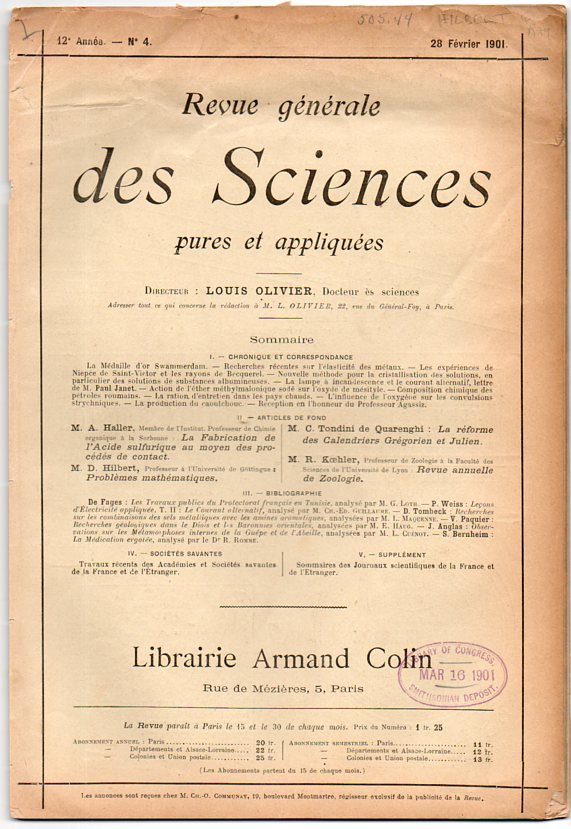
    Hilbert poblem417

    ·Posted by :

    ·in:


  • A Euclidean Proof of the Parallelogram of Love (1879)

    JF Ptak Science Books   Quick Post

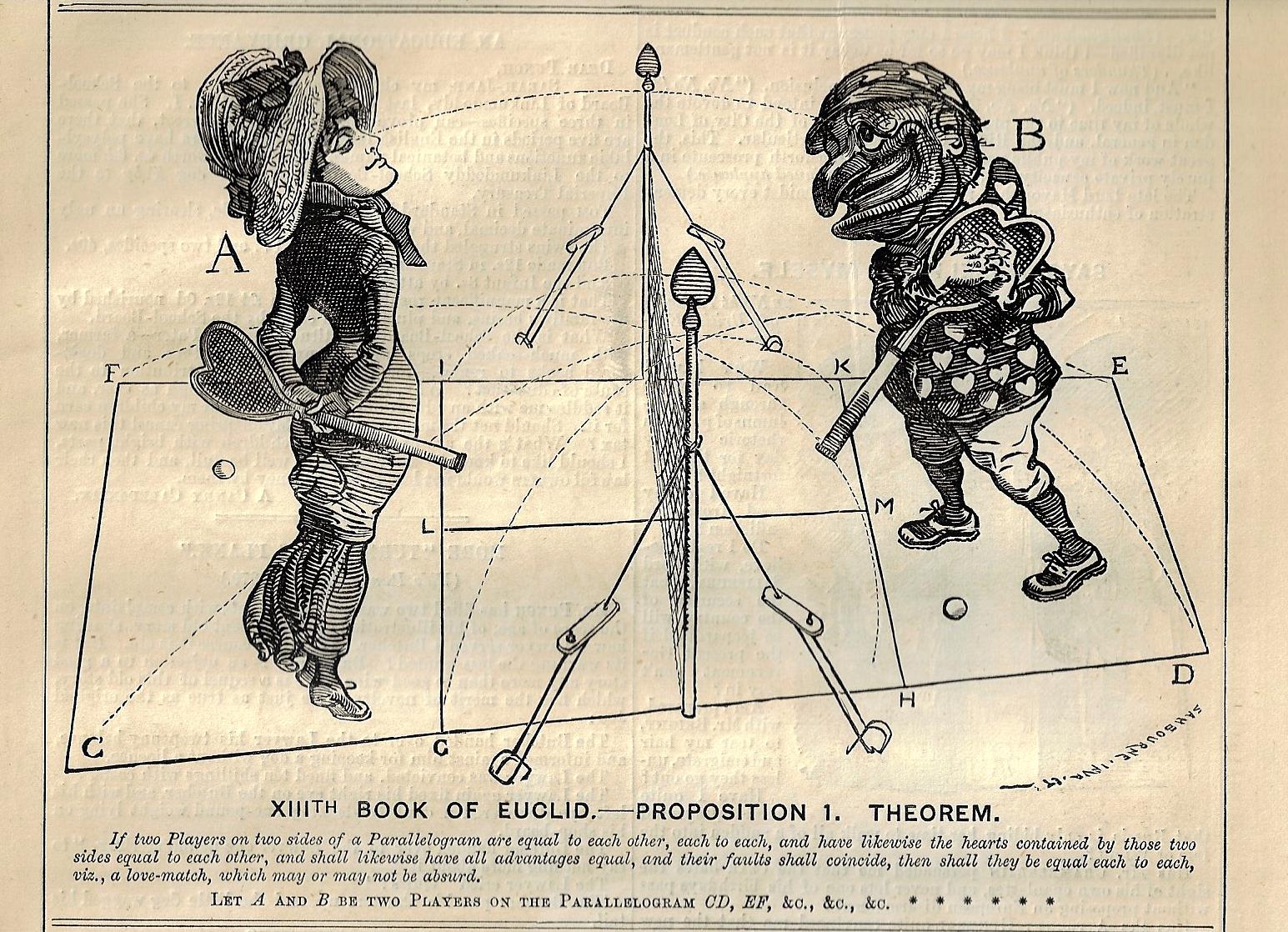
    I don’t encounter “love” and “Euclid” together very often outside of “I Heart Euclid” tee shirts and mugs and such, but what we have below is a satirical/comical proof of the existence of love (within limited contexts) employing a parallelogram and Euclid. The cartoon (from Punch, printed in London in 1879) has nothing really to do with Euclid, though it does lay the 13th book, proposition 1, of his Elements (“If a straight line is cut in extreme and mean ratio, then the square on the greater segment added to the half of the whole is five times the square on the half”) on top of things.  The court (as in “courting”) for the two players actually doesn’t look much like a parallelogram, though if it is a standard tennis court, it must be a rectangle and so a parallelogram, the odd shape a result of a cartoon drawn in probably two hours with a little bit of distortion in the perspective. The lady is coy-ish, and Mr. Punch–dressed in a heart-drench tunic and clearly removed from our mortal coil–is definitely feeling something for the young lady, as we can plainly see with the various lines connecting them.  And of course Mr. Punch is clearly a prize in anyone’s estimation.

    I guess some of this must have to do with the contemporary tennis craze, as this issue of Punch hosts a number of cartoons regarding seemingly everyone at play with tennis. that part of the point tally is the score “love”, the cartoonist didn’t have to go far to spread Euclid on top of the geometric situation.  

    Punch Parallelogram of Love

    ·Posted by :

    ·in:


  • Naming Numbers and Pieces of a Dollar (1836)

    JF Ptak Science Books  Quick Post

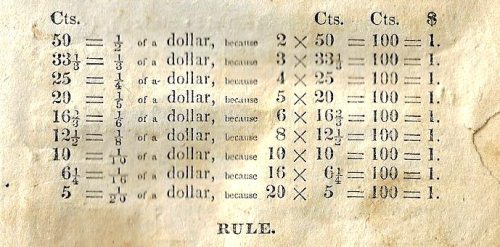
    I’ve posted a couple of other bits about the wonderful book by Roswell Smith (Practical and Mental Arithmetic on a New Plan...which was published in Hartford in 1836) here and there, as this elementary text is really chock full of interesting insights into early 19th century life in the U.S. as well as some good, logical approaches to arithmetic. It is a small book, about five inches high, and mine is particularly worn from use–its paper cover with the title page imprinted on it is half gone and mostly illegible, and is smooth to the touch from (I guess) constant handling.  I particularly like this breakdown of components of a dollar, divided into nine sections instead of four–the dollar buying quite a bit in 1836, including the purchasing power of five copies of the Smith book.  

    Math pieces of a dollar


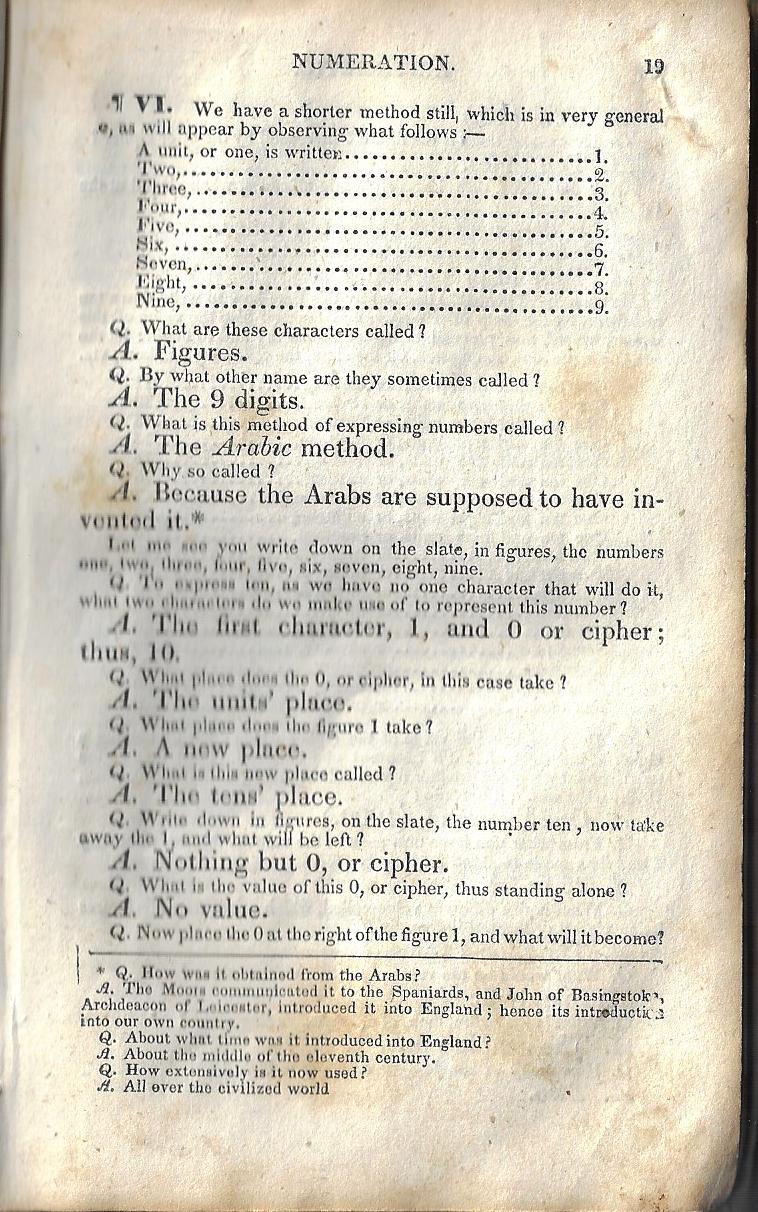
     And this fine chart, nineteen pages into the work, addressing about the most basic bits of arithmetic, being numbers:


    Math basics


    ·Posted by :

    ·in:


  • A Note on Venn and his Diagrams (continued)

    A Note on Venn and his Diagrams

    JF Ptak Science Books   Post 1952 from 2013, expanded

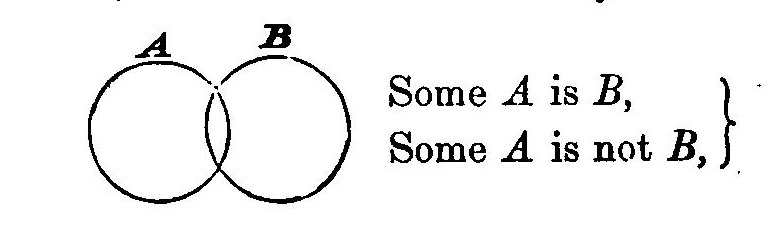
    It seems so unlikely that the Venn diagrams took so long to appear, that it hadn’t been Aristotle’s Diagrams, or Cartesian Diagrams; rather, these elegant creations–about a different way to represent propositions by diagrams– belong to Mr. Venn’s invention in 1880. Mostly. It was in that year that these famous more fully-developed diagrams first appeared in a paper entitled “On the Diagrammatic and Mechanical Representation of Propositions and Reasonings“ in the Philosophical Magazine and Journal of Science.  They seem so beautiful, and so simple, and so powerful, and so elegant. So necessary.  And so why-did-they-take-so-long-to-appear, so obvious.  In a way, they are in that category of The Great Obvious Invention, in a similar vein to Mr. Luke Howard first classifying the names of clouds  in 1803.  Sometimes things are not obvious until they are.  

    Venn diagram
    [Source: Internet Archives, John Venn, Symbolic Logic, 1881]

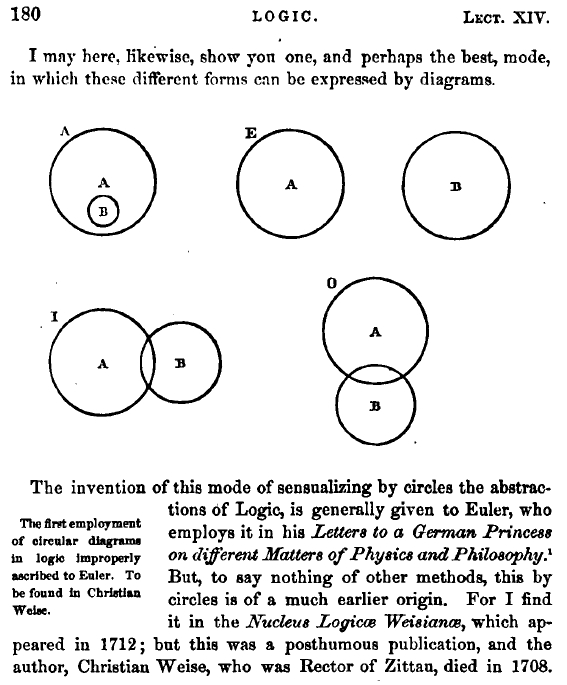
    Well, almost.  The diagrams did mostly make an appearance earlier–though not in the Venn form–in the work of Christian Weise (d. 1708) and then in that of Leonhard Euler  (1707-1783), that according to the great William Rowan Hamilton, explained in his work Metaphysics and Logic (1858-1860). But the final form seems to be that of Venn.  

    Hamilton’s work appears so:

    Euler diagram

    They also appeared in the Proceedings of the Cambridge Philosophical Society, volume 4, 1880, in his article “On the employment of geometrical diagrams for the sensible representation of logical propositions” in which he discusses the history of the diagrams, including the Hamilton history.  Venn also includes this beautiful logic template of Bolzano:

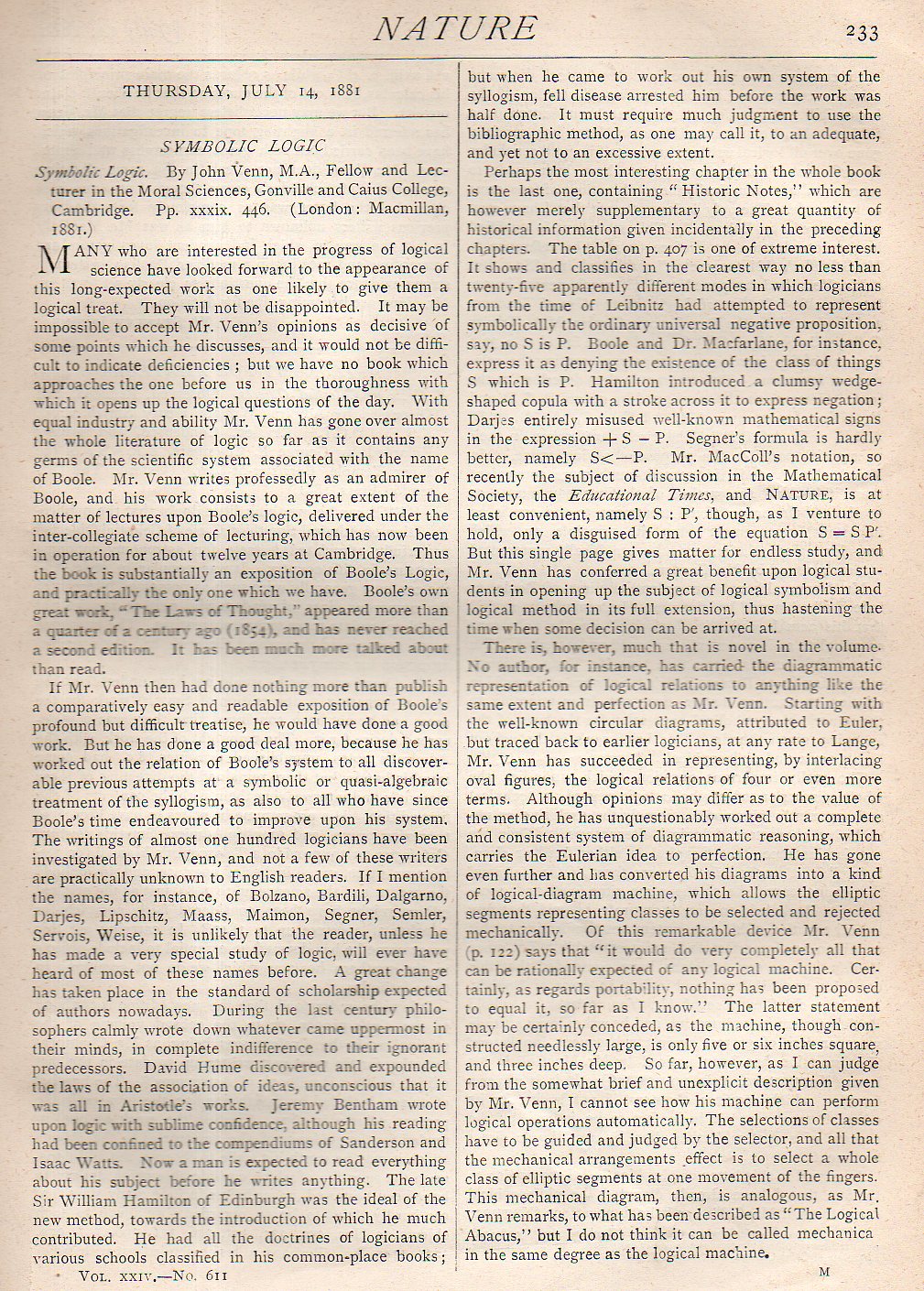
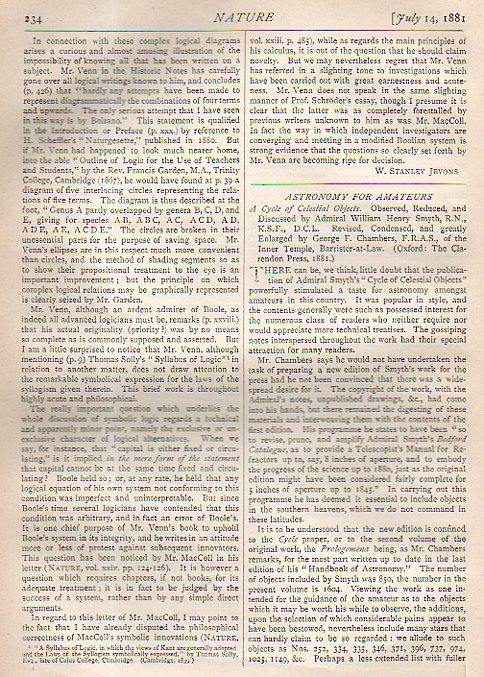
    All of this brings us back to where I silently started,  finding  a wonderful book review of the 1880 Venn Symbolic Logic, and that appeared the following year in the journal Nature on 14 July 1881. The review is by one of my favorite 19th century figures, the inimitable W. Stanley Jevons, and is reproduced below.


    Venn nature954
    Venn nature955


  • The Square of Art: the Beauty of Square Roots (1833)

    JF Ptak Science Books   Post 2640    

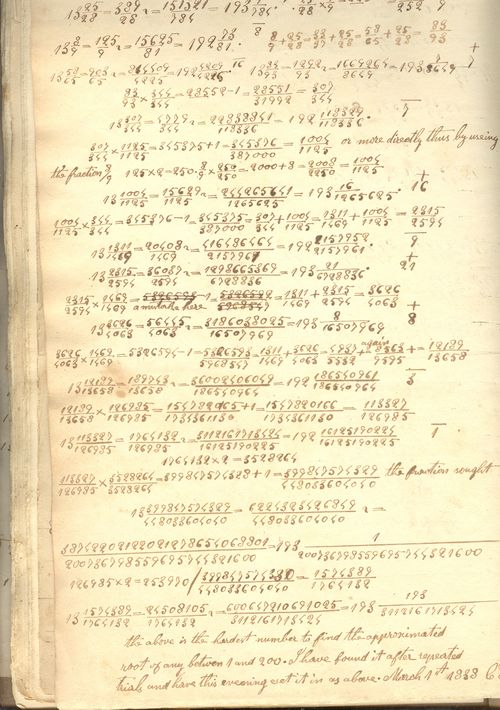
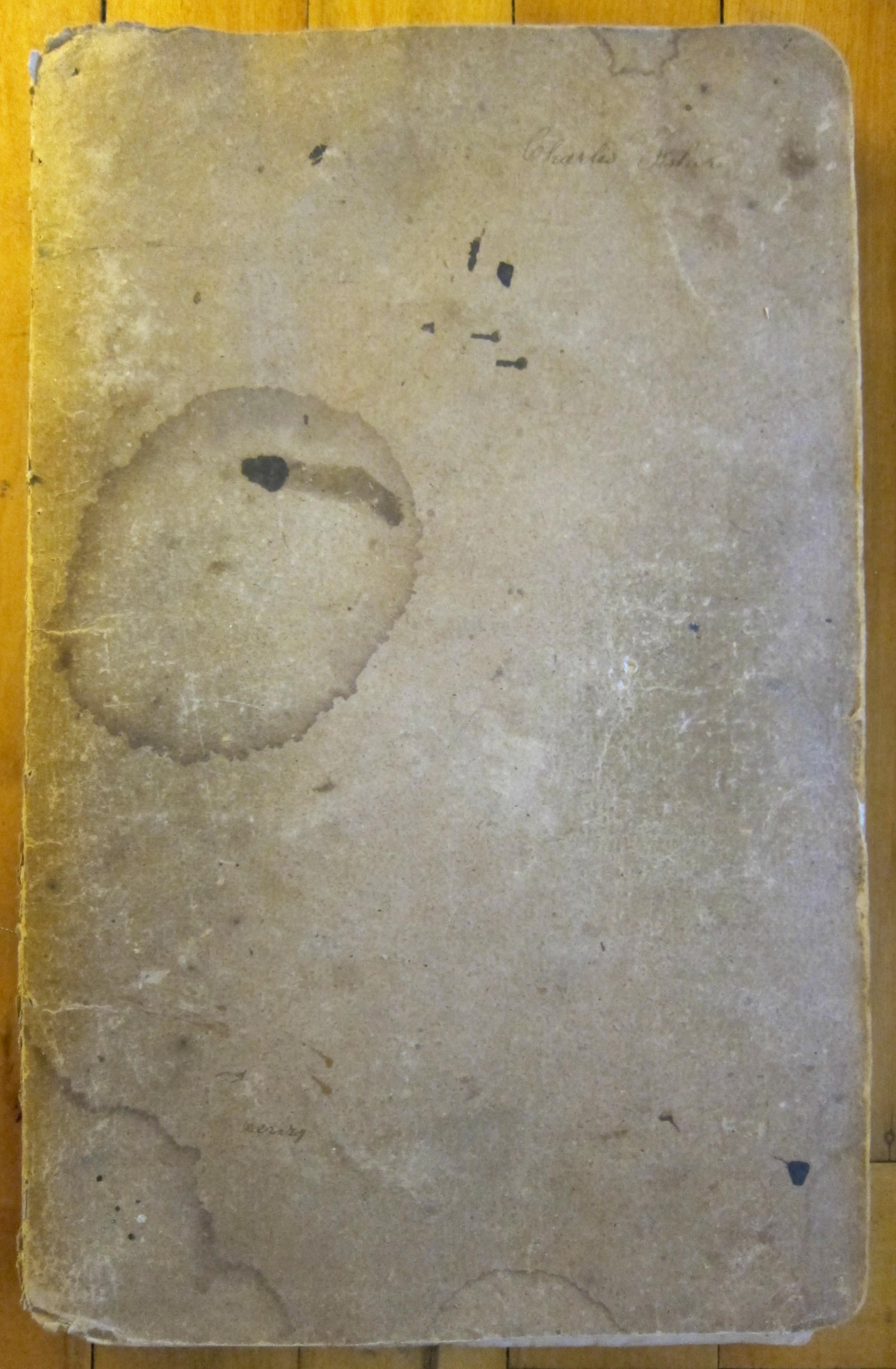
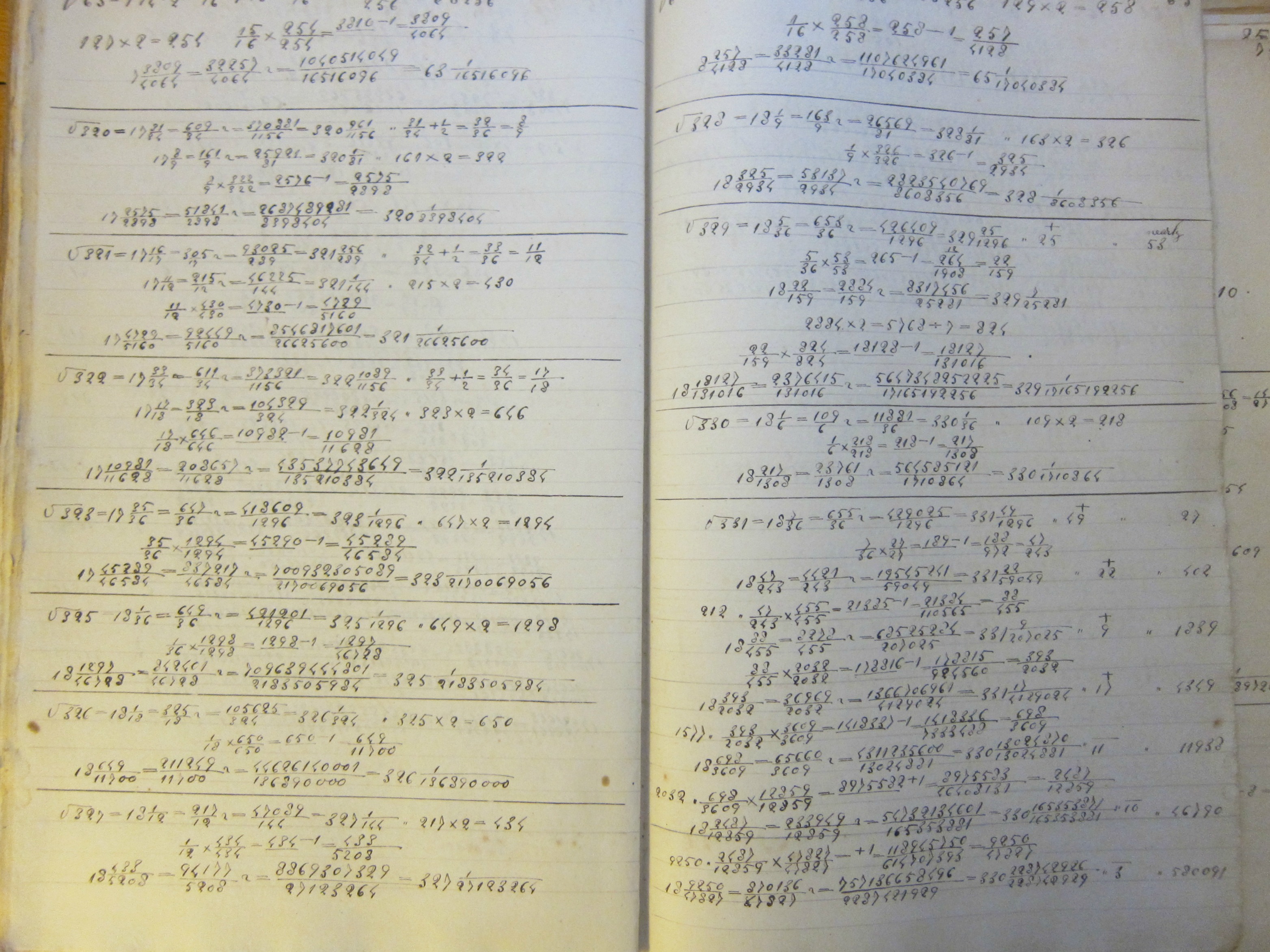
    I’m returning to this earlier post, expanding it some, and correcting it a little–usually that comes with a fresh eye to something old and done. The work on hand is a mathematics manuscript by a man named Charles Fisher. It is an impressive  collection of work on square roots, from √2 to √628.  It is 13.5 x 8.5 inches and  160 pages long–it is all gathered together in separate quires, the text now just floating inside the original binding, which is very thick paper wrappers that have been handled so much that it feels like leather.   Most of the manuscript is still bound, though several “signatures” are now loose within the binding. It is a good, solid copy in spite of what I just wrote–and it is a definite work of art.  

    The book is paginated according to the sq rt that Mr. Fisher was working on, so the first page is page 2 for √2. Also, the work figuring the square roots of 2 through 196 takes place on the top half or portion of the first 80 leaves, at that point he turns around and starts on the first leaf again, working out his answer for √197 (and √198) on the first page (or page 2) and so continues to the end of the book again, ending up at 628. The square roots seem pretty complete through the 400s and then gets very spotty after that, for whatever reason Mr. Fisher leaving some numbers alone. So far as I can determine the work is complete in itself.  

    Square root 1

    The (seeming)  author of this manuscript, Charles Fisher, evidently took a solitary pleasure in calculating the square roots of numbers from 2  to 628  not bothering to write down the 24 perfect squares to 576.  (The sqrt being r2 = x for every non-negative real number x.) From the few bits that I have checked the man seems to have done a good job back there in the 1830’s.   (Note: we’ll deal with square root of  3 at another time…)

    I cannot determine where this book was written or who Mr. Fisher was.  There is a transcription in the last leaf of the book of a community meeting dedicating people to building a meeting house in “Wertham” (?) near “Cumberland’, and that something like the minister or preacher would be shared with the local Baptist Church or something like that, and signed in January 1767.  Fact is though that there is at least one contemporary date in the work and that is 1833 for figuring the √193.  

    Square root 2

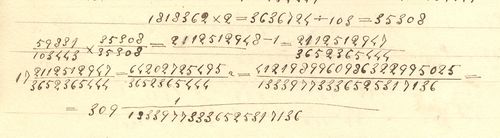
    Fisher’s work is pretty elegant.  Take for example his solution (and proof) for the square root (hereafter sqrt(x)) 309,

    which the calculator living under this page says is 17.578395831246947    Mr. Fisher’s answer is 17 10/17 = 799/17=89401/989=309 100/989, and after some more involved arithmetic comes t the lovely proof number of   

    4121989960986322995025 /13339773336525317136 or

    309.00000000000000000007496379247

    Which is getting pretty close. 

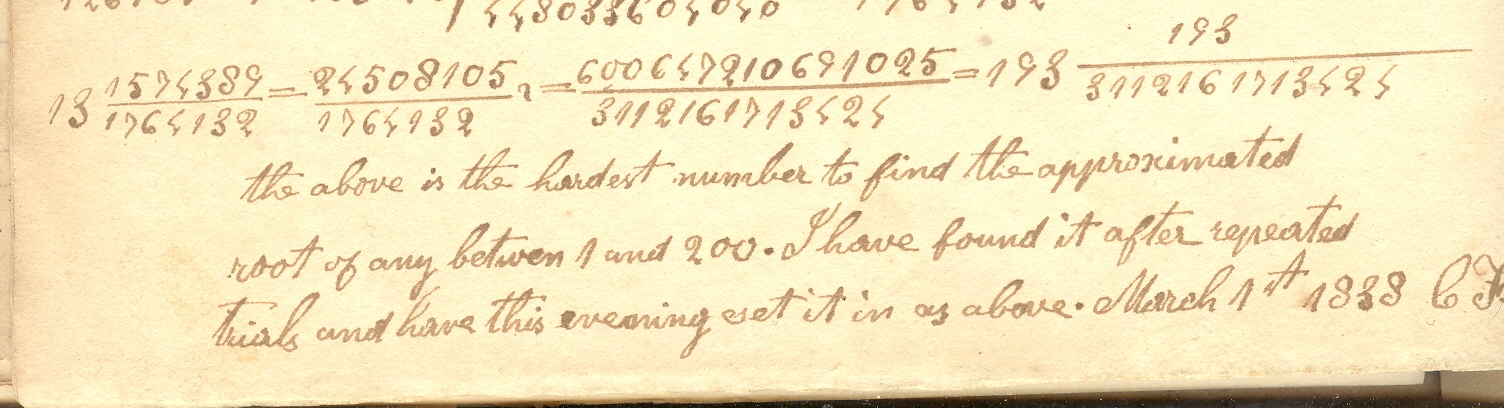
    The only note that Mr. Fisher makes on his calculations is for the sqrt(193), which he notes as “the hardest number to find the approximate root of any between 1 and 200. I have found it after repeated trials and have this evening wrote it in as above. March 1st, 1833. CF.”  (This may actually be 1838–I think it is dependent on interpretation.)

    Square root 3

    The lovely cover of the work:

    Math ms sq rt cover _2_

    And a double-page sample of the work:

    Math ms sq rt _1_

    ·Posted by :

    ·in:


  • A Coy Zeno, Without Paradox

    Zeno detail 2

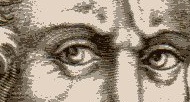
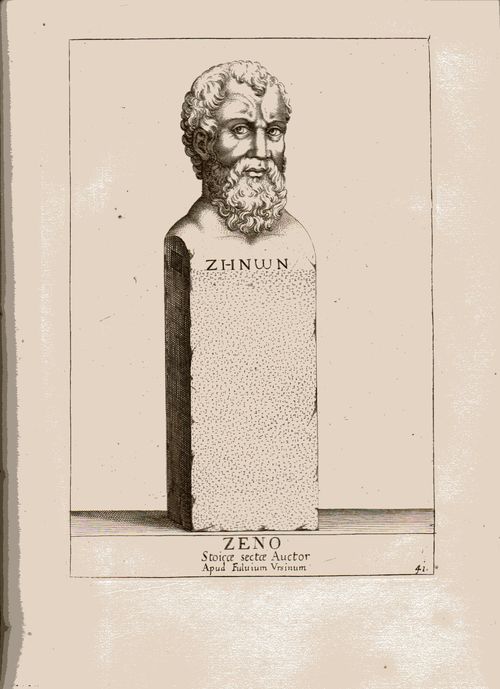
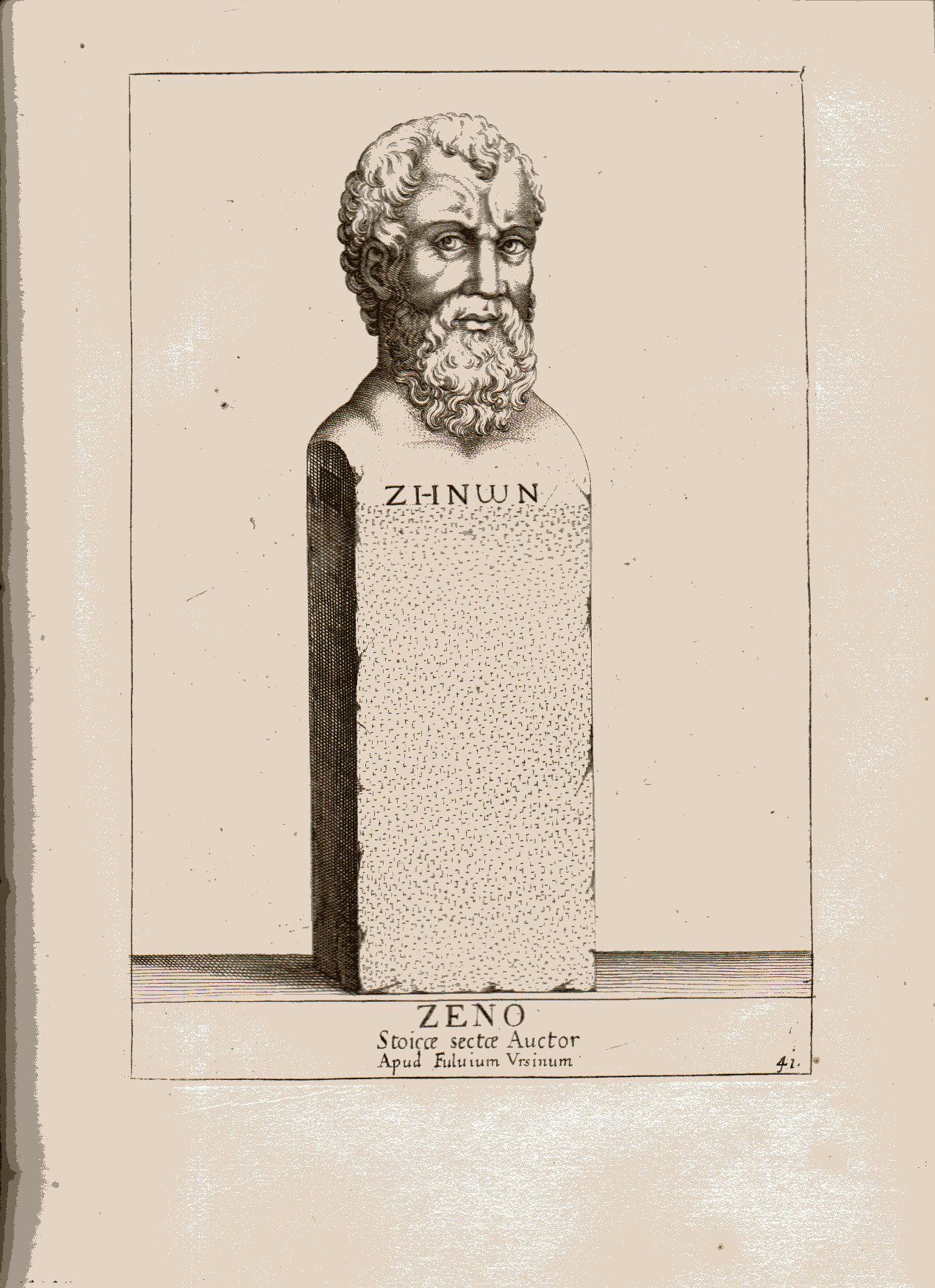
    Zeno portraitThis fine engraving of Zeno of Elea (490-430 BCE) was printed in 1739  and appeared in Veterum Illustrium Philosophorum, Poetarum, Rhetorim et Oratorum Imagines…by Jo. Petri Bellorii, and published in Rome.  It is a fairly large image for a portrait like this, measuring 8.5×5″inches on a sheet 13×9″, engraved on a very heavy and thick paper.  

    From the Stanford Encyclopedia of Philosophy:

    “Zeno of Elea, 5th c. B.C.E. thinker, is known exclusively for propounding a number of ingenious paradoxes. The most famous of these purport to show that motion is impossible by bringing to light apparent or latent contradictions in ordinary assumptions regarding its occurrence. Zeno also argued against the commonsense assumption that there are many things by showing in various ways how it, too, leads to contradiction…” More here: http://plato.stanford.edu/entries/zeno-elea/

    It is a little curious to me that in Augustus de Morgan’s wonderful A Budget of Paradoxes that there isn’t a single hit for Zeno in the 150 mentions of “paradox” in the work, though that is probably due to my “looking around” more than anything else.  

    Full text for that here at Project Gutenberg: http://www.gutenberg.org/files/23100/23100-h/23100-h.htm

    ·Posted by :

    ·in:


  • Found Art–Geometry, ca. 1775

    JF Ptak Science Books   Quick Post


    Math art345

    Source: unknown (perhaps Thomas Simpson, Elements of Geometry…?)

    Math art342


    ·Posted by :

    ·in:


  • On the Affordability of the Pleasures of Science

    JF Ptak Science Books  Quick Post

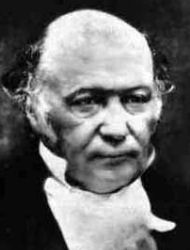
    I don’t know how many of you have carried the collected works of physicists or mathematicians–it seems to be a special moment, having someone’s output for their working lives right there in your hands. Some formats of some collected works are just too big and cumbersome (the many small volumes for an early edition of Galileo or the massive 20+ volumes for Huygens), but the Sir William Rowan Hamilton (1805-1865) volumes seem to be perfect, and finely representative somehow of a fine man and excellent mathematician.  So I was saddened to see this about him and his not being able to afford his F.R.S. in a stumbled-upon section of August de Morgan’s  (1806-1871) A Budget of Paradoxes (David Eugene Smith’s second edition of Sophia de Morgan’s edited first of 1872):

    Hamilton1“This distinction, this mark set by science upon successful investigation, is of necessity a class-distinction. Rowan Hamilton, one of the greatest names of our day in mathematical science, never could attach F.R.S. to his name—he could not afford it. There is a condition precedent—Four Red Sovereigns. It is four pounds a year, or—to those who have contributed to the Transactions—forty pounds down. This is as it should be: the Society must be supported. But it is not as it should be that a kind of title of honor should be forged, that a body should take upon itself to confer distinctions for science, when it is in the background—and kept there when the distinction is trumpeted—that the wearer is a man who can spare four pounds a year. I am well aware that in England a person who is not gifted either by nature or art, with this amount of money power, [30]is, with the mass, a very second-rate sort of Newton, whatever he may be in the field of investigation. Even men of science, so called, have this feeling. I know that the scientific advisers of the Admiralty, who, years ago, received 100 pounds a year each for his trouble, were sneered at by a wealthy pretender as “fellows to whom a hundred a year is an object.” Dr. Thomas Young was one of them. To a bookish man—I mean a man who can manage to collect books—there is no tax. To myself, for example, 40 pounds worth of books deducted from my shelves, and the life-use of the Society’s splendid library instead, would have been a capital exchange. But there may be, and are, men who want books, and cannot pay the Society’s price. The Council would be very liberal in allowing books to be consulted. I have no doubt that if a known investigator were to call and ask to look at certain books, the Assistant-Secretary would forthwith seat him with the books before him, absence of F.R.S. not in any wise withstanding. But this is not like having the right to consult any book on any day, and to take it away, if farther wanted.” –Page 30 (with the italics in the original), from the full text via Project Gutenberg: http://www.gutenberg.org/files/23100/23100-h/23100-h.htm

    [Hamilton portrait source: http://www.hamilton2005.ie/]

    ·Posted by :

    ·in:


  • A Coy Zeno, sans Paradox

    JF Ptak Science Books  Quick Post

    Zeno detail 2


    Zeno189This fine engraving of Zeno of Elea (490-430 BCE) was printed in 1739  and appeared in Veterum Illustrium Philosophorum, Poetarum, Rhetorim et Oratorum Imagines…by Jo. Petri Bellorii, and published in Rome.  It is a fairly large image for a portrait like this, measuring 8.5×5″inches on a sheet 13×9″, engraved on a very heavy and thick paper.  

    From the Stanford Encyclopedia of Philosophy:

    “Zeno of Elea, 5th c. B.C.E. thinker, is known exclusively for propounding a number of ingenious paradoxes. The most famous of these purport to show that motion is impossible by bringing to light apparent or latent contradictions in ordinary assumptions regarding its occurrence. Zeno also argued against the commonsense assumption that there are many things by showing in various ways how it, too, leads to contradiction…” More here: http://plato.stanford.edu/entries/zeno-elea/

    It is a little curious to me that in Augustus de Morgan’s wonderful A Budget of Paradoxes that there isn’t a single hit for Zeno in the 150 mentions of “paradox” in the work. Full text for that here at Project Gutenberg: http://www.gutenberg.org/files/23100/23100-h/23100-h.htm

    If you’d like to own the original, check out “Zeno” in the blog’s bookstore:https://historyofideasblog.com/books/2014/05/catalog-1-2014-physics-math.html


    ·Posted by :

    ·in:


  • Can You Find the Ancient Death Ray of Death? Symbolism in the Garden of Mathematical Sciences (ca. 1670)

    JF Ptak Science Books   Post 2689

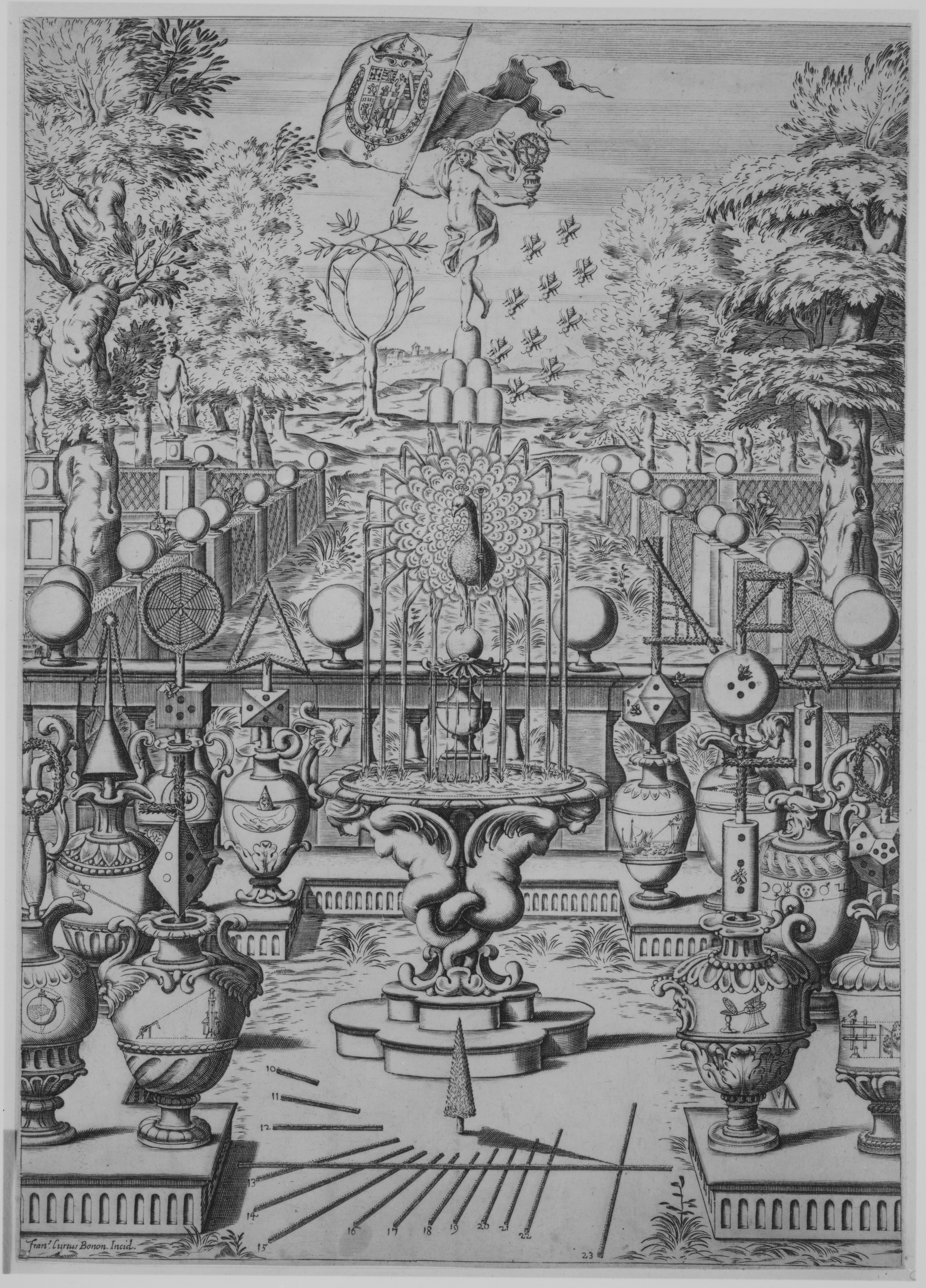
    Mathematical Garden Curti[Image: Metropolitan Museum of Art, http://www.metmuseum.org/collection/the-collection-online/search/359981?rpp=30&pg=1&ft=mathematics&pos=15]

    This fine allegorical image is the creation of Francesco Curti (1603-1670), and according to the Metropolitan Museum of Art it is called “The Garden of Mathematical Sciences”, and was printed ca. 1660.  There’s a lot of objects in this print, and it seems that perhaps most of them have a scientific application.  It is an interesting exercise to identify them–I’ve found quite a few, though not all, how many can you identify? 

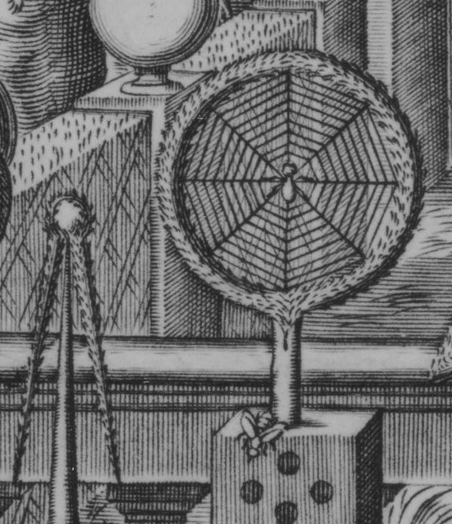
    In the garden there are a geometrical spider, bees, proportional dividers, sundials, anamorphic images, the eye of god in a peacock display, Mercury, Archimedes’ death-ray mirror, navigational instruments, and no doubt much more, displayed and semi-hidden. For example, I think this is the well-known “geometrical spider” (middle far left), as seen in Mario Bettino’s Apiarium philosophiae mathematicae (Bologna, 1645):

    MATHEMATICAL garden spider

    Then there’s this classic image of the peacock, which through the history of Christian art has come to represent the concept of activity, resurrection, immortality–it has been used as a representation of Christ (in paintings like Fra Angelico’s great circular nativity painting, for example).  In the Curti print, the peacock is holding a staff with an eye in it, which is probably that of god; the peacock stands on one leg, balanced with the eye staff, while the rest of the symbolism is filled by having an ever-flowing fountain flow from its feathers. 

    There are no doubt more to be found–there’s the timepiece in the foreground, numerous outlines of scientific instruments as garden plants, a demonstration of the optics of convex and concave lenses, and others.  Have a look!  Follow the link to the Metropolitan and open the very expandable image. (SOme answers, below)