A Daily History of Holes, Dots, Lines, Science, History, Math, Physics, Art, the Unintentional Absurd, Architecture, Maps, Data Visualization, Blank and Missing Things, and so on. |1.6 million words, 7500 images, 4.9 million hits| Press & appearances in The Times, Le Figaro, Mensa, The Economist, The Guardian, Discovery News, Slate, Le Monde, Sci American Blogs, Le Pont, and many other places… 5000+ total posts since 2008.

Category: mathematics, logic

  • 1 Inch=$370 Million: a Great Height of Graphical Representation of Quantitative Data

    JF Ptak Science Books  Post 1227

    0 ebay 13 graphs268[Click image to enlarge; both original images are available for purchase from our blog bookstore.]

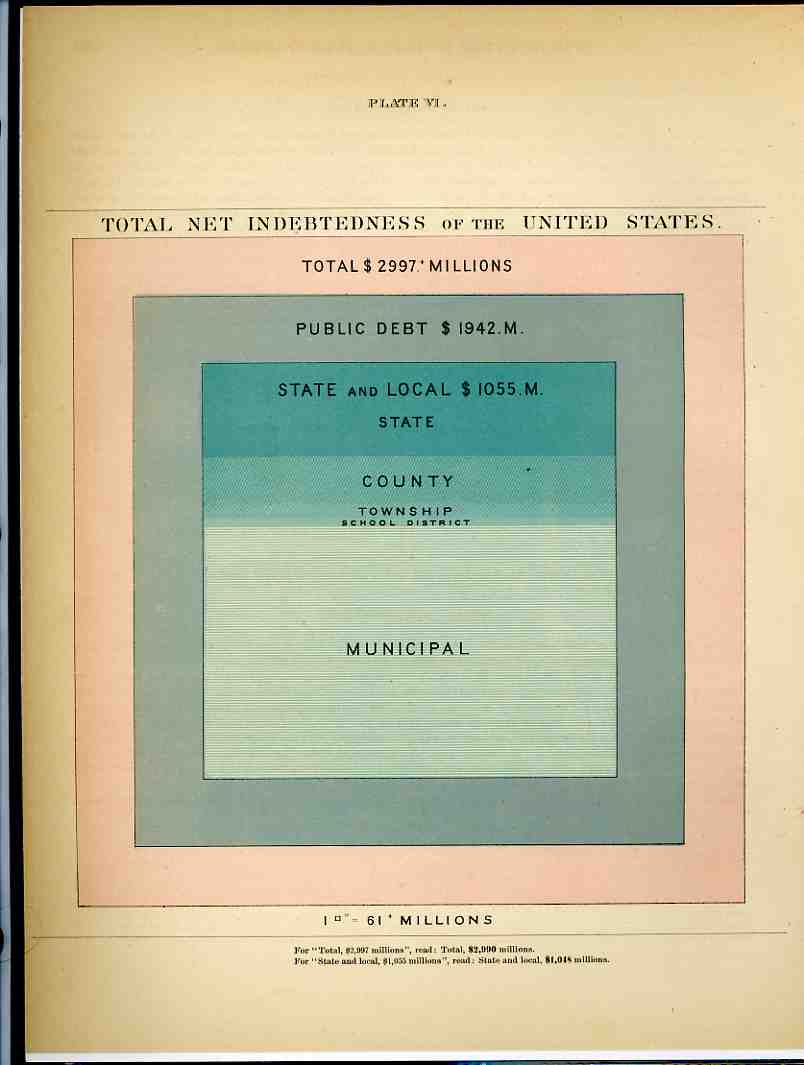
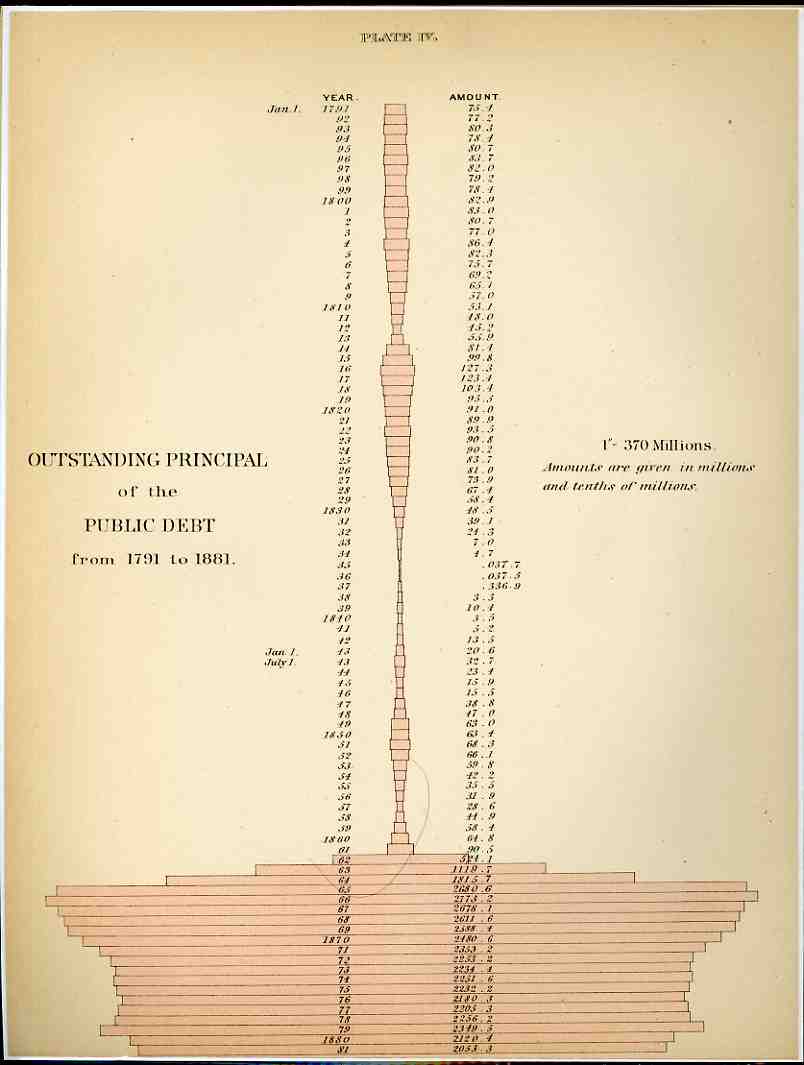
     It isn’t often that you see money represented by dry measure, but that’s what happened here in these two examples from the fantastic Walker Statistical Atlas ( Statistical Atlas of the United States based on the results of the tenth census 1880 with contributions from many eminent men of science and several departments of the government Comp. under the authority of Congress by Francis A. Walker, M. A., superintedent of the tenth census … and published in 1884).  What we see here is a history of American federal indebtedness from 1791 (when the public debt stood at 75.1 million dollars) to 1881 (about 2 billion).  Using the CPI (consumer price index) as a factor to translate that number in 2008 dollars (or so), the 2 bil grows to about $40 billion (a nickel then is about a dollar now). The interesting part of the legend–and what drew me to this graphic even before its somewhat unique shape–state “1”–370 millions”, that is one inch of pink horizontal bar stands for about $370,000,000, and the last bar on this graph is about 6 inches long, which, adjusted for inflation, would now be about 10 feet long. .That said, the really interesting part comes next–if we use this measure to graph a horizontal bar for the American debt as it stands in 2008, it would pink a pink bar that was about a HALF MILE long to express our 10(+) trillion dollars of debt.  OR, somehow, the old debt of 1881 would be about 1 story of a house, while the 2008 version would be up one side of the Empire State Building and down the other (and yes that includes the aerials).  I don’t know how to put this comparison in context, the differences are so staggering. 

    0 ebay 13 graphs269
    After having popped a neuron or two trying to get my head around that one, we’ll further confuse the situation with the second chart, which shows the total net indebtedness of the U.S. in 1881 in terms of square inches; or, at the bottom of it all, a 7×7 inch square represented the entirety of the $3 billion owed out.  49 square inches. Working backwards this time, our $10 trillion (or $10,000,000,000,000.00 writ large) adjusted back to a CPI value in 1881 would have covered about 88 PAGES of the atlas or 9,000 square inches.  Again, the numbers are just almost too big to mean anything. 

    We, as a country, owe one hell of a lot of money.

    And yes there are many different ways of trying to figure out what one 1881 dollar “means” in terms of 2008, but the CPI is the most simple to use and least argumentative and at least gives a pretty good idea of scale.  It would be more useful to try and establish the degree of difficulty  of turning the corner on the debt in 1881 compared to doing that today, but this is just a late-night post at the end of the week, and I don’t have a good clue about how to try and measure that bit simply.


  • The Most Important Menu in Computing History? Johnny von Neumann, Herman Melville the NORC & the MOBIDIC

    JF Ptak Science Books  Post 1202

    “There is no mystery about these machines[computers]. The mystery is how the human brain has been able to develop them. These devices are merely small tools which men have devised to help them do a better job.“–Thomas J. Watson, chairman of the board of IBM, 1954
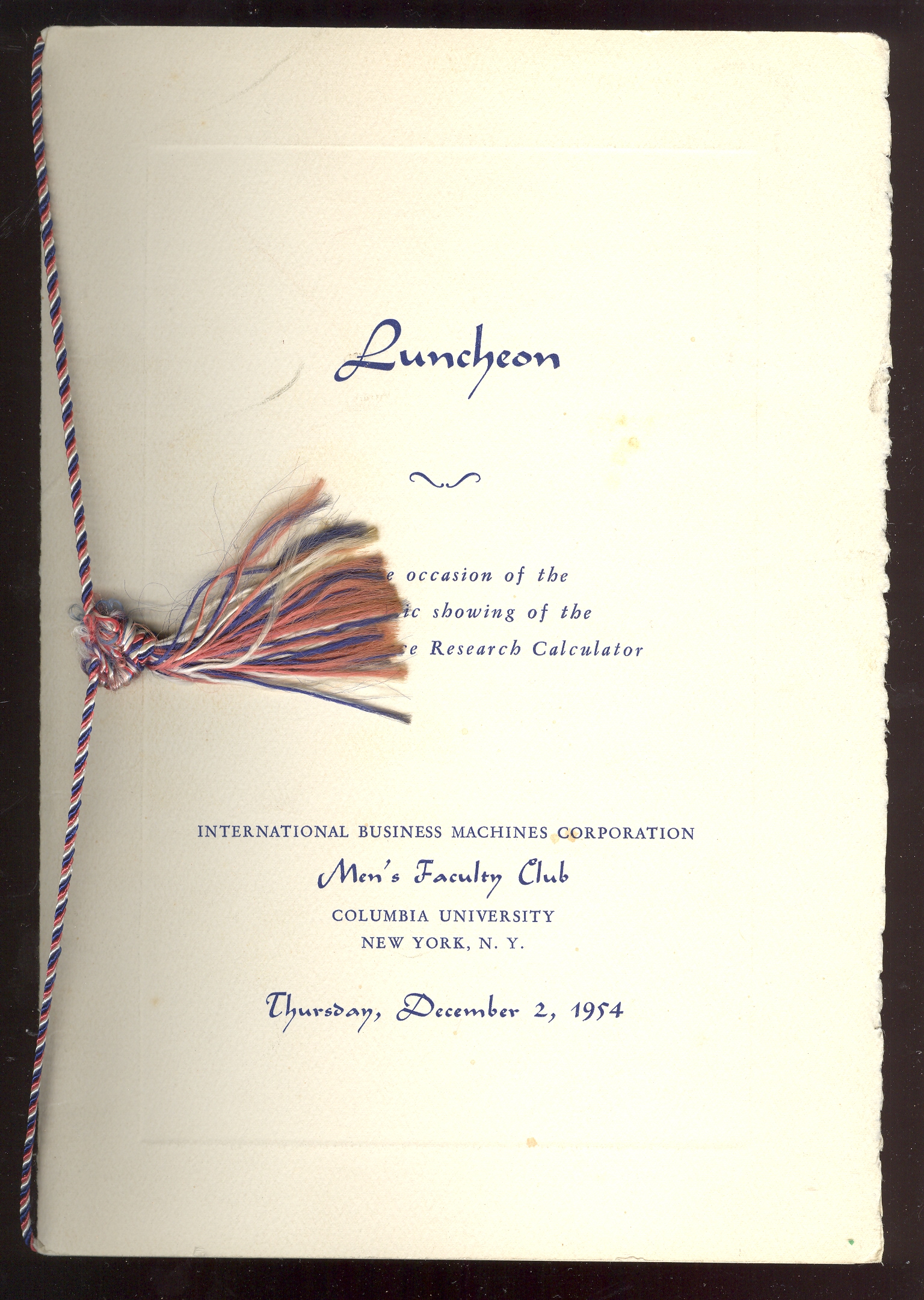
    Here is something that one doesn’t get to say very often:  this is perhaps the most important menu in the history of computing1. And if there’s another menu out there of the same or greater significance, then I offer that this is perhaps the most important menu tassle in the history of computation–that seems safer.

    In the history of odd bits of historic computeriana ephemera, this tassle joins the ranks of other one-percenters, like this:  the world’s first portable computer had a gun rack.  This was hardly a laptop though it was portable, and very well lived up to its Herman Melville-inspired acronym:  MOBIDIC.

    The Mobile Digital Computer was intended to be a transistorized van-mounted computer used to store and route data as part of the U.S. Army’s Fieldata system.  The machine was indeed built and deployed by 1959–as were the MOBIDIC A,B,C,D,E and 7a by the early 1960’s–and it was a successful component, even though the overall network was not successful.  Fieldata was supposed to integrate all manner of information and distribute it to battlefield recipients. My friend (Dr.)  Carl Hammer (1914-1904), who I knew from being in the neighborhood in Georgetown, was a delightful man who had long and significant history in the development of the modern computer.  He told me one afternoon–stopping in to visit on his constitutional–in his sly and amusing way about working on the MOBIDIC while he was at Sylvania. (He had just finished heading up Remington Rand’s UNIVAC European Division before going to Sylvania.) Anyway he started his story about the MOBIDIC by telling me that it was the world’s first portable computer (sitting in a 42-foot-long semitrailer) and that it had gun racks.  The reason for the gun racks was simple–if something was made by the U.S. Army, and it had wheels, then it had to have a gun rack.  Case closed.
    Norc--von n groupNow let’s get back to the NORC.

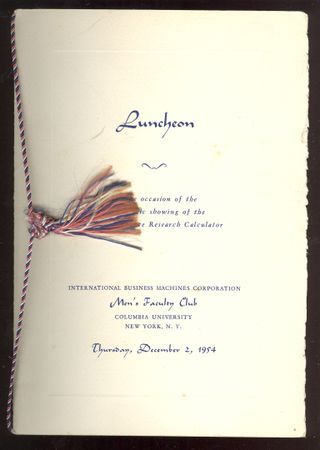
    [This item is available for purchase at our blog bookstore.]

    This is the luncheon menu for the dedication of the NORC “Calculator” (the Naval Ordnance Research Calculator) a computer which was constructed principally with IBM parts and built at the Watson Scientific Computing Laboratory at Columbia.  The NORC was the world’s first supercomputer, and the most powerful computer on the planet for about ten years (from 1954 to 1963, until it was surpassed by Seymour Cray’s CDC 6600 in 1964). 

    The NORC was an astonishing accomplishment, difficult to summarize simply, really, though a very good example is that provided by Dr. Paul Herget, the director of the Cincinnati Observatory.  Dr. Herget used the NORC in 1956 to make precise calculations of the earths orbit for the 1920-2000 period.  Dr. Herget said: “We used nine hours of running time and completed more computations than had ever before been done at one time in the history of astronomy.’”

    Outside of celebrating the accomplishment of the NORC, the luncheon was also  important for the remarks of the principal speaker, John von Neumann.  Von Neumann of course was perhaps the most expansive mind of the century–a thinker of phenomenal proportions and the father of the modern computer.  His brain was impossibly big.  Impossible. 

    During the luncheon von Neumann made prescient and extraordinarily wide remarks on the future utility of the computer.  Some of the highlights (from the entire address, included below):

    –it is now “practical and feasible” to forecast, with the NORC, the weather for an entire hemisphere thirty or sixty days ahead

    –calculation of the tidal motions of all the oceans, the marginal movements near the continents as well as the main motions of the oceans

    –the hydrodynamics of the earth’s fluid core

    –“In the statistical field, dealing with matters which are not wholly mechanical, such as troop operations and logistic operations which involve purely accidental factors like the prevailing weather during the operation, command decisions which have not yet been officially made can be stipulated and various solutions for various alternatives calculated. This has been done before on a minor scale but it takes too long to do on a large scale. “In this field the importance of NORC is enormous…”

    –in the first four hours of operations the NORC  performed more work than any calculator of ten years ago has performed in its entire lifetime. He termed this performance “completely fantastic; I doubt if it has ever been done before.”

    Norc--von n group menu

    The last section of von Neumann’s comments that were made at the dinner:

    “The last thing, which is very important, is said in fewer words, but I think that it is none the less important. And it is this: In planning new computing machines, in fact, in planning anything new, in trying to enlarge the domain of parameters with which one can work, it is of course customary and very proper that one should consider what the demand is, what the price is, whether it will be more profitable to do it in a bold way than in a cautious way, and so on. This type of consideration is necessary — the world would very quickly go to pieces if these rules were not observed in 99 cases out of a hundred.

    “It is terribly important that there should however be one piece in a hundred where it is done differently.

    “And that one uses the definition which Dr. Haven (?) pointed out 20 minutes ago, namely to occasionally do what the U. S. Navy did in this case and what IBM accepted in this case: to write a specification essentially to build the most powerful machine that is possible in this day with the present state of the art. I just hope that this will be repeated very soon and will never be forgotten.” Source.  

    It may be the last statement that is the most important–pressing those of the present and future to perform.

    Notes:

    1.  The importance of this menu was described to me in a lovely and painterly fashion for the first time by P.J. Mode.

  • How Long is the Coastline of Great Britain?

     JF Ptak Science Books  Post 1193

    [This pamphlet may be purchased from our blog bookstore site, here.]

    This is the first of a few short essays of the idea of pre-historic appearances of important ideas. I use the word “pre-historic” in its literal sense—that is, these papers were published before the concepts that they discussed were recognized and published, later, in more complete form and of course to greater fame. One will certainly be Gregor Mendl’s paper (Versuche über Plflanzenhybriden ) published in the obscure Verhandlungen des naturforschenden Vereines in Brünn, (Brno), and to be resurrected at the hands of Gregory Bateson thirty-odd years later to much acclaim. Another example is Vannevar Bush’s “As We May Think”, published in The Atlantic Monthly in June 1945, and which was a now widely recognized definite intellectual precursor to the construction of what we know  today as the Internet.

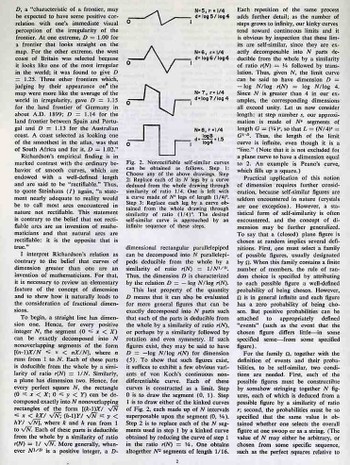
    Blogmandelbrot217_2Right now, though, I’d like to look at the pre-birth of fractals in Benoit Mandelbrot’s precursor (1967) paper (and in a weird, probably not-correct way, scooping himself) to his more famous effort of 1975, in which he coins the term and fully describes “fractals”, showing the measurement of the coastlines behave like a fractal over a range of measurement scales.
    The seminal paper, How Long Is the Coast of Britain? Statistical Self-Similarity and Fractional Dimension, published in Science magazine in 1967, is an introduction to the concept of fractals (which Mandelbrot would name later in 1975). The kernel of it all is found in the Lewis Fry Richardson graphs and more so in the small illustration on page three of the paper—the peek into the future world of fractals, seeing a fractal before it was named so.

    Richardson (a kind of Jevons, or Marey-like American figure on the history of 20th century science) did some very good thinking about the elusive nature of naming such a thing as the lengths of coastlines and other natural constructions: namely he determined that their measured length was dependent upon the scale of measurement. That is to say the measured length, L(G), is ruled the scale of G, approximating the function as L(G)=M(G)1-0 

    Mandelbrot moves on to discuss the coastline in terms of it being a self-similar object, which is something that is nearly exactly similar to a part of itself, or the whole having the same shape of one or more than one of its parts, and regresses. 


    ·Posted by :

    ·in:

    —

  • Nazi Propaganda–the Big Lie and Germany Surrounded, 1933

    JF Ptak Science Books  1174

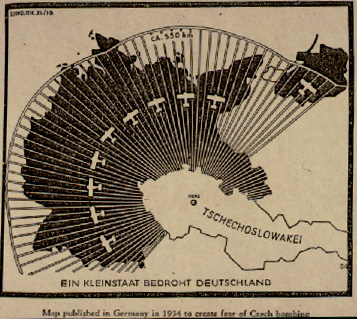
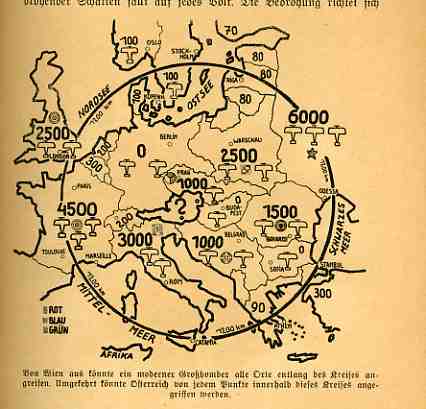
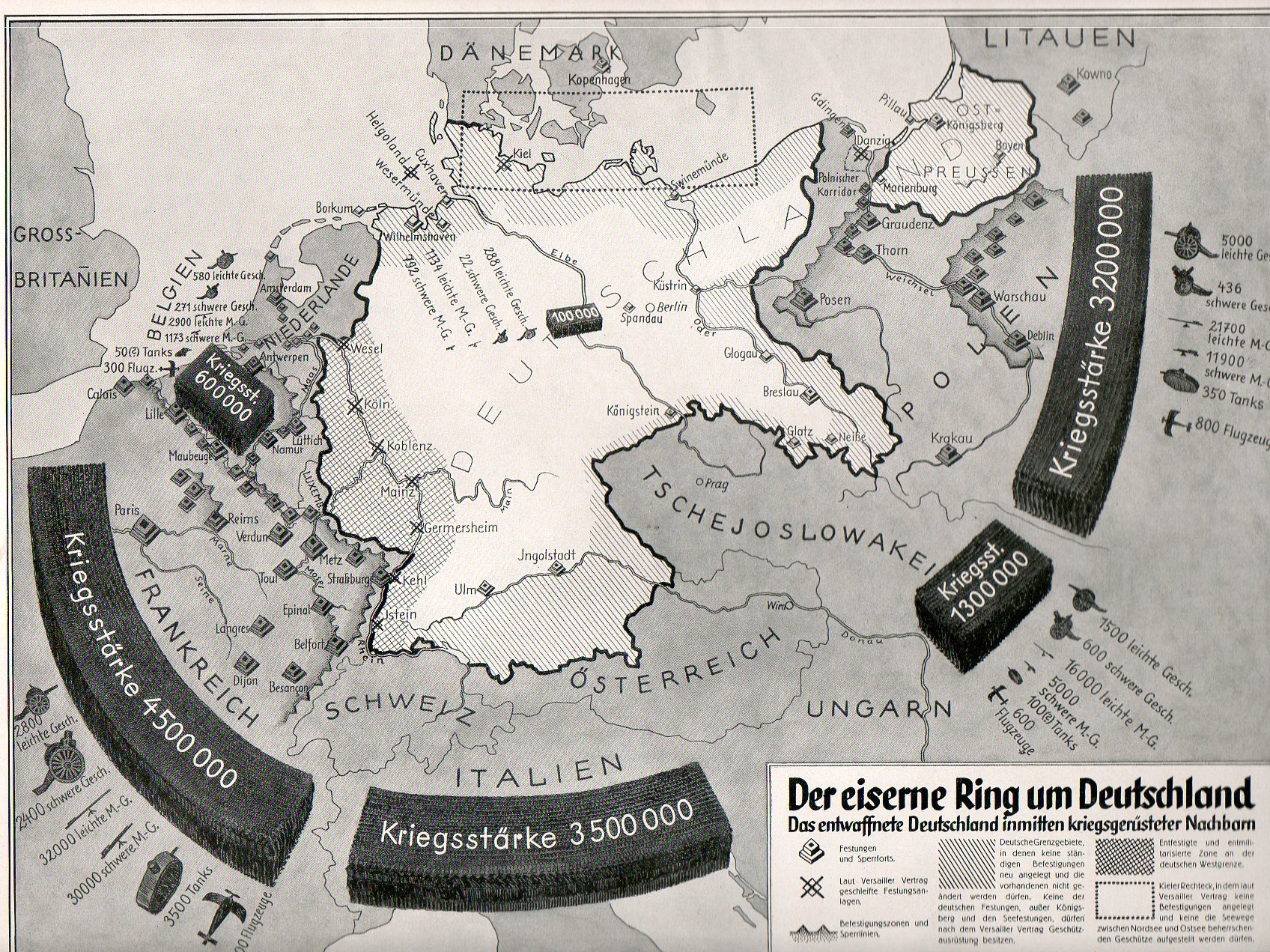
    The newly-elected NSDAP government lost little time in putting forward a case to the German people that the Treaty of Versailles left Germany in a defenceless postion, surrounded by forboding armies and air foprces of its neighbors, the forces of France, Italy, Czecholovakia, Belgium and Poland forging a tight and formidible strangelhold on the weakened Germany.  This image comes from the late November 1933 issue of the Illustrite Zeitung1 (Leipzig), and its relates to the casual and general reader the de-militarized and tenuous situation of the country–its design is effective enough so that the voice of he illustrations is well heard even if no on actually bothered to stop and read its legend–it was all about threat and impending doom, and the words for those emoptions weren’t necessary in this artwork.

    Nazi Prop surrounded538

    Campaigns like this were a first step in the Nazi consolidation of the public spirit, attempting to unify the population under Hitler and the NSDAP by presenting a threat so common that it could not help but to draw everyone into the big tent.  This was a simple message of natural survival, a wide threat to the German state, a threat that was so simple and so devastating and so opaque that there would be virtually no resistence to unifying against it. (J.W. WHeeler-Bennet wrote about this in his superb and still-classic book The Nemesis of Power, the Germany Army in Politics, 1918-1945, published in 1954.)

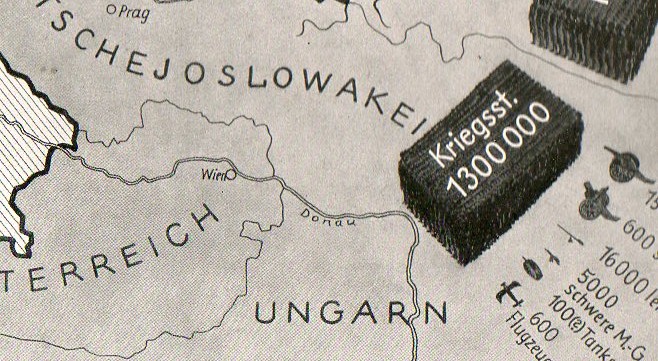
    Here’s another example from about the same time, again showing the devastating effects of imagery–this displays the non-existent threat from Czechoslovakia:

    Blog jan 3 czech air


    And another, showing the encircling imagery again:

    https://historyofideasblog.com/a/6a00d83542d51e69e20120a7a04f7a970b-pi

    Getting back to the first image–curiously Great Britain and Russia don’t make the Enelmies Liest here, though in 1933 they certainly loomed as an enemy as much as any other.  (Well, perhaps not neessarily so for the Soivet Union, but close.)

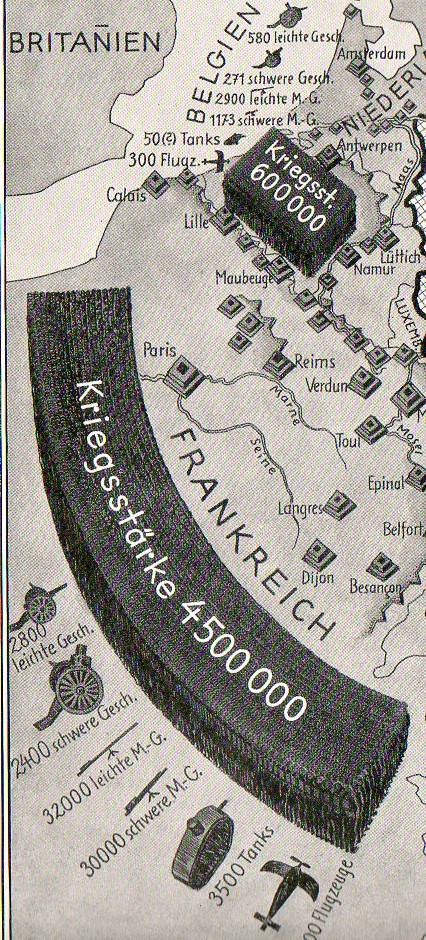
    Someone who actually read the article and looked closer at the full-page ilustration would see the details of t he European threat, like this for France (and Belgium), with bloated figures for WWI-era ordnance and an extremely effectively articiulated represntation of what was seen as the standing army:

    Nazi Prop surrounded france539

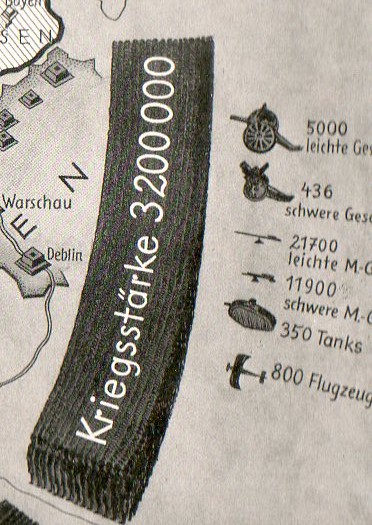
    And this for Poland:

    Nazi Prop surrounded poland542

    And of course, Czechoslovakia: Nazi Prop surrounded czech541

    Among other things the signing of the Treaty of Versailles in 1919 limited the German armed forces to less than 100,000; limited the Navy to 15,000; prohibited the manufacture of submarines, armed aircraft, tanks, armored cars, Maxim guns and of course poison gas. There was assignment of guilt, heavy reparations (in what today would translate into something like a half-trillion dollars, without though translating buying power), and much more that was aimed at keeping Germany vanquished if not somewhat pastoral.  Many have seen the Treaty as being the bridge and greatest impetus to WWII, an opportunity lost and squandered by the Allies–maybe so. A year after the end of the incredibly violent and ripping four-year onslaught in which millions were killed and so much destroyed it would’ve been difficult for all parties to the Treaty to have a great forward vision in how to best deal with Germany.

    The Treay did provide a unifying front for Hitler; the Nazi Party using choice aspects of it in hearts-and-minds propagandizing methods like the one above:  the military restrictions were true, but the portrayed threat of attack from Poland and Czechoslovkia and Belgium and Italy and even France were part of the building of the Big Lie.  The “Big Lie” was something that Hitler identified in his 1925 Mein Kampf, and then used in his own terror campaigns–it is a lie so colossal and so impudent, so fantastic, that it is perceived as being true because no one would lie so gigantically.  As  George Orwell put it in his 1948 novel 1984, the Big Lie was “…to tell deliberate lies while genuinely believing in them, to forget any fact that has become inconvenient, and then when it becomes necessary again, to draw it back from oblivion for just so long as it is needed….”  The perception of imminent threat was one of the starting points for the Big Lie; the mechanics and people behind the manufacture of the invasion, of the Treaty of Versailles, of the German economic meltdown, and so on was already laid down in Hitler’s ridciulous book, and much of that lay at the feet of the Jewish people. 

    But first the Nazis needed to address the issue of their entirely weak and vulnerable military position by proposing the threat from much of the rest of Europe, this in order to rail against Versailles and break the German obligations to non-militarism.  The foundations for rebuilding the German war machine started in earnest in 1933; by 1935 most of the restrictions of Versailles had been broken, and Germany (which in 1933/4 had bene secretive about it) had gone public with its new obligations to itself (introducing the Luftwaffe to the rest of the world in March1935).  Reactions from the Allies to generating the new war machine were weak, and Germany rolled right into WWII. 

    Notes:

    1. I’ve written many times here about the Illustrirte Zeitung–it was basically the German equivalent of the Illustrated London News, Paris Match, and LIFE magazine, a better, mid-level weekly magazine that was well-written, very-well illustrated, approachable and affordable to folks of nearly all classes.  It was an expedient way of sending across the government’s message from te beginning of the Nazi ouccpation of German politics.


  • Mathematical Art: “The End of Simple Multiplication”, 1814

    JF Ptak Science Books  Post 982

    Mar 22 end of multipiplication det

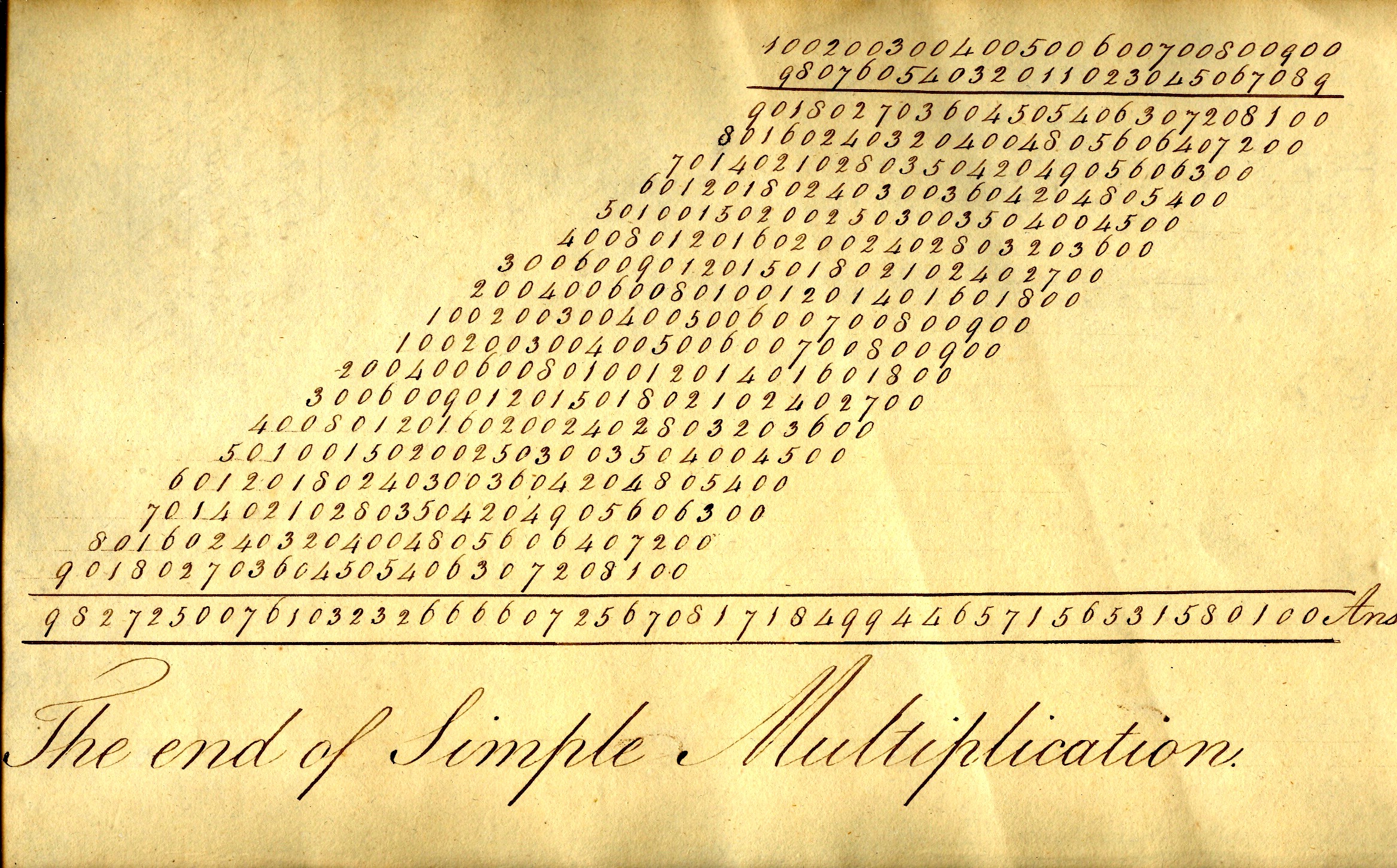
    I found this fabulous example of multiplication in a student’s workbook, written out in 1814.  Undoubtedly the sub-title, “the end of Simple Multiplication” was not intended to imply the literal end of multiplication (though the thought does invoke some interesting bits of fiction), just the result. It is simply a gorgeous object.

    Mar 22 end of multipiplication


  • A Short Look at Fifths and Fives: Joltin’ Joe, Legal Sausage and the Structure of Mathematics

    JF Ptak Science Books LLC  Post 925 

    I’m going to take a drive through five
    fifths—all of which don’t come close to making a whole—to get to my ultimate
    destination, a ribbon of numbers circling the earth.

    In
    American lDimaggioaw, “taking the fifth (Amendment)” allows you the prohibition of
    incriminating yourself, giving the supposed ability to look innocent whole not
    saying anything about anything for fear of legal repercussions, though this
    sausagey implosion from guilt seldom looks pretty. 

    There’s
    the fifth column (as in Hemingway’s play by this name), the
    not-fourth-but-fifth force, the musical perfect fifth of highest consonance,
    the Keplerian nestling of the five Platonic solids,  Beethoven’s Fifth, a fifth of (good) scotch,
    the fifth cardinal direction (the center), the five books of the Torah, the
    five pillars of Islam, the worst categorization of hurricanes and tornadoes, living
    in the fifth Mayan world, the fifth Fibonacci number, and on and on.

    And
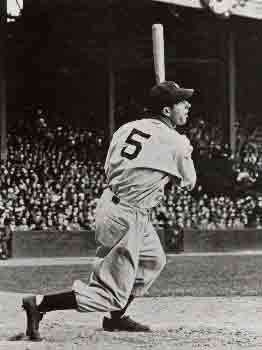
    aside from being the number that Joe DiMaggio wore on his pinstripes, it is
    also the number of the  Euclidean postulate that called to all those who were
    interested in the possibilities of the postulate not being so—that there exists
    as perfect a non-Euclidean system as there is for the Euclidean.  The fact of the matter is that this calls
    into question the foundation, the very basis, of mathematics.  Or used to.

    Blog feb 1

    All
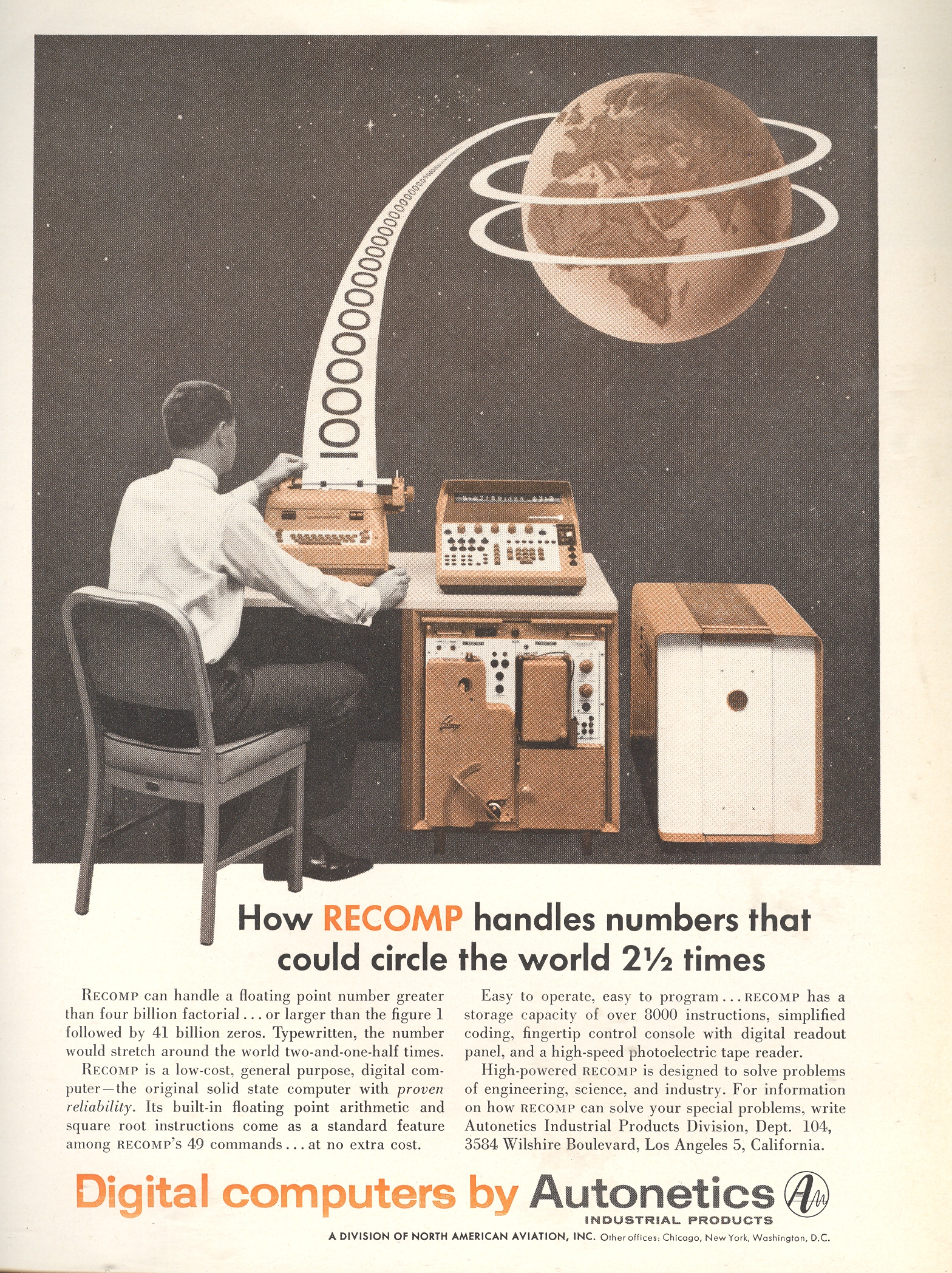
    of this was brought into mind by this 1957 ad for the RECOMP computer produced
    by Autonetics.  The image of a sheet of
    numbers circling the earth1, the product of digital computation, suggested
    structure, mathematical imperative and solidification of numbers.  But the point of this was the bottom line:
    what was the point, and for that matter, what was the point?  They were hardly physical things floating in
    space, but ideas (except of course in the worlds of Flatland). 

    Euclidean
    structure was the infallible, rigid, predictive, explanatory structure and the
    most accurate descriptor of physical space. 
    This had certainly been the case for fifteen hundred years or so, or at
    least until the struggling fifth postulate of Euclid’s Elements became really, well,
    unwieldy.  More to the point, the axiom,
    the parallel postulate axiom, wasn’t as self-evident as the first four, and
    wasn’t provable from the other nine of the first ten axioms.  And so came the unbelievable question, what
    if the fifth postulate wasn’t true?  What
    if there were other geometries—non-Euclidean geometries—that were as provable
    as that of the Master?  The possibility
    of relegating the understanding of nature and the physical surroundings to
    something other than the existing geometry was simply, positively,
    extraordinary. 

    The
    origins for this movement away from Euclid started with Girolamo Saccheri (his
    book published in 1733 but not “discovered” for its non-Euclidean importance
    for another 150 years) Georg Kluegel (1763), Johann Lambert (Theorie der
    Parallellinien,
    1766) and Adrien-Marie
    Legendre (1752-1833, who was sort of in a similar boat with Saccheri in that
    his work wasn’t actually published until after that of the next two
    mathematicians); and coming to a point of real invention in the work of Nikolai Lobachevsky (1792-1856) and Janos Bolyai3 (1802-1860). (It would be
    incorrect to credit these last two men [plus Gauss] with the creation of
    non-Euclidean geometry given the longish and complex history of its
    development.)

    This
    work brought into question the way in which the world was seen, and the very
    foundation of recording visualized space. 
    This is all much messier than had been planned (so to speak) by almost all
    previous mathematicians, questioning the very foundations of mathematics.  The orderliness of the earth-circling numbers
    doesn’t seem to be quite as they were, but as Henri Poincare stated, the “new”
    system isn’t anything better or worse, just different,  a new and more convenient way of looking at
    things4.

    Notes

    1. To be honest about it, the
      foundations of math bit didn’t suggest itself right away.  The first thing I thought when looking
      at what this paper trail was supposed to represent—a string of numbers 41
      billion zeroes long—didn’t look right. 
      Given the size of the numbers coming out of the “printer” there
      would need to be five times as many rings around the earth.  But when you read the text the numbers
      are supposed to be “hand written”. 
      Therefore if you assume the numbers to be less than an inch high
      and with no spaces in between, then this 2.5 times around the earth works
      out to be accurate to the number of inches in the circumference. 
    2. Still earlier work is found
      in the work of  Omar
      Khayyam
      ‘s Discussion of Difficulties in Euclid, John
      Wallis
      and Nasir
      al-Din al-Tusi
      … among others.
    3. Bolyai’s work—published as an
      appendix to his father’s work on the foundations of geometry—was privately
      reviewed by the great and impossibly smart Carl Gauss, who gave it a backhanded
      series of compliments while at the same time saying “I thought so…”  Which was true, evidently, as it looks
      as though he was working on the problem beginning in 1799.
    4. “If geometry were an
      experimental science, it would not be an exact science. it would be
      subject to continual revision … the geometrical axioms are therefore
      neither synthetic a priori intuitions nor experimental facts. They are
      conventions. Our choice among all possible conventions is guided by
      experimental facts; but it remains free, and is only limited by the
      necessity of avoiding every contradiction, and thus it is that postulates
      may remain rigorously true even when the experimental laws which have determined
      their adoption are only approximate. In other words the axioms of geometry
      (I do not speak of those of arithmetic) are only definitions in disguise.
      What then are we to think of the question: Is Euclidean geometry true? It
      has no meaning. We might as well ask if the metric system is true and if
      the old weights and measures are false; if Cartesian coordinates are true
      and polar coordinates are false. One geometry cannot be more true than
      another; it can only be more convenient.” –from:  M J Greenberg, Euclidean
      and non-Euclidean geometries: Development and history.
      (1980).

  • The History of the Internet: Remembering Vannevar Bush and the Memex (1945)

    JF Ptak Science Books LLC  Post 812  Blog Bookstore

    On this day, which may or not be the 40th anniversary of the
    first use of the internet (and the 80th anniversary of the collapse
    of the stock market of ’29, and Lucy A’s anniversary of her birth) it might be
    good to remember an earlier version of the internet and the semi-invention of
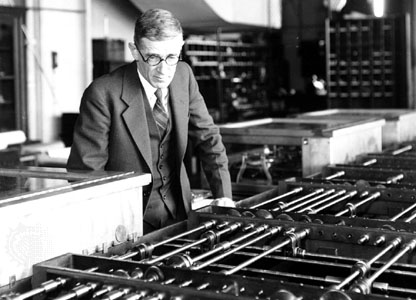
    the concept of hypertext: the MEMEX machine of the under-remembered Vannevar Bush. 

    Bush

    Vannevar (pronounced “van ee var”) was a flinty no-nonsense New Englander
    who was an organizational and mechanical genius who as a professor at MIT
    developed a remarkable analog computer that greatly advance computation
    capacities for solving differential equations. 
    This was in the 1930’s, and even after creating an improved
    electromechanical version of the machine still chose the wrong way to go in the
    soon-to-materialize digital computer revolution.  During WWII Bush was one of the most
    important Americans in the war effort, overseeing the entire scientific effort
    of the U.S.—an
    enormous effort dispatched beautifully (and successfully).  His importance in this regard is difficult to
    overstate.

    But right there at the end of the war, when he was organizing a still-secret
    effort of controlling the spread of atomic weapons (before Hiroshima), Bush was also thinking about the
    future of the organization of human knowledge and memory.  And published it, too, in the popular Atlantic magazine in July 1945. (It was
    republished in a shortened version a few months later in September—it remains
    to this day, according to an editor at Atlantic, one of the most
    often-requested reprints) where it reached a reading audience of millions.  The article, “As We May Think”, outlined his
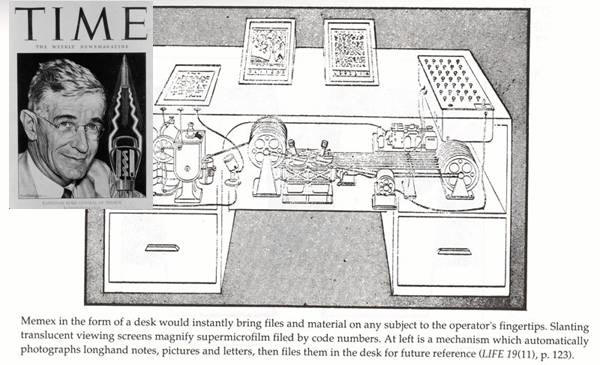
    idea for a device he called the MEMEX1 (“memory” and  “index”), which compressed and organized all
    that its user could remember and whatever information would be obtained in the
    future via electromechanical apparatuses, and available with associative tracking
    between the microtext frames.  So all
    manner of book and papers and reports and newspapers and images would be
    microphotographed and stored in a beautifully-indexed mechanical retrieval
    system where it would live with the information of others.  There was also the possibility of real-time
    textual additions to whatever it was that was retrieved, the genetic precursor
    of hypertext.  Bush’s thinking has been deeply
    recognized (and also by the creators of the internet) as the intellectual
    grandparent of the modern internet. 

    Bush Memex

    I just thought on this day that the man who saw more clearly into the future
    on advanced global communication and societal memory should be remembered on a
    day when his grandchild came into being.

    Notes:

    1. According to Bush, “the MEMEX is a sort of mechanized private file and
    library…. It uses methods such as microfilm storage, dry photography, and
    analog computing to give postwar scholars access to a huge, indexed repository
    of knowledge-any section of which can be called up with a few keystrokes.”
     Wardrip-Fruin, Noah and Nick Montfort,
    ed (2003). The New Media Reader. p. 35. The MIT Press

    The physical plant of the MEMEX:  “A
    memex consists of a desk, where on top are slating translucent screens on which
    material can be projected for convenient reading. Within the desk were
    mechanisms that stored information through microphotography. Most of the memex
    contents are purchased on microfilm ready for insertion. On the top of the
    memex is a transparent platen. When a longhand note, photograph, memoranda, and
    other things are in place, the depression of a lever causes it to be
    photographed onto the next blank space in a section of the memex film, dry
    photography being employed.”  Manovich, Lev. “As We May
    Think”, The New Media Reader and
    wiki on The Memex. 


  • Big Mathematics 1816: Manuscript Notes and Found Math Art

    JF Ptak Science Books LLC  Post 757  Blog Bookstore

    In my science bookstore business one of my principle interests is antique manuscript notebooks in the sciences.  It is a pleasure to see someone working through a problem, or finding what the writer thought to be the most interesting point in a lecture on a particular subject, and to read the occasional doodles and see the timely gloss every now and then.  I’ve had notebooks from an advanced and very careful student for a course given by the great Robert Bunsen that was filled with hundreds of pages of what the master was trying to communicate to his pupils.

    ++00++ 9.16 math

    There’s also a  series of notebooks from the spectacular period of Cornell physics history (1948-1949), including 6 notebooks of classes with Richard Feynman, including several hundred pages from his 1948/9 course in advanced quantum mechanics, which included (a very early) use of the Feynman diagrams.  The thing that makes these observant, advanced notes taken during Feynman’s classes have more than a pedagogical interest (which is substantial and enough on its own)—they have a capacity to show the logic behind the man’s thinking and how he presented his ideas over a period of some months.  Also, and curiously, notebooks like these seem to have not survived. 

    Then there’s the notebooks taken by the team of Charlotte and Fritz John when they were pursing doctoral degrees at Goettingen (1929-1933), until forced to leave with the enforcement of the Nazi laws against non-Aryans.  Goettingen happened (and happens) to be the seat of a long, great mathematical heritage, home of Felix Klein, Emmy Noether, David Hilbert and Bernhard Riemann (among many others).  The notebooks—some two linear feet of them—represented four years of advanced interactions with some of the finest mathematical minds in Germany.  I was told by Mrs. John that they were required to take such full notes—but let me tell you, these notebooks were typed transcriptions of the daily handwritten notes, compiled over the course of a class, and then bound.  They are beautiful, and go far beyond my concept of “required”.  Mrs. John told me the story of the class notes that she and Dr. John took while taking a course with the great Hermann Weyl (who had taken his doctorate under the iconic David Hilbert, and who was also forced to flee Goettingen because his wife was Jewish):  everyone of course was required to take extensive notes during the day and work on them during the night, turning them in the following day for appraisal.  She told me that she still vividly remember placing their notes on a long wooden table at the front of the class, and then picking that set of note up the next day.  After a month of this, she, said, they became convinced that Weyl was not looking at the notes at all, as everything seemed always to be in the spot that they left it in.  One week they decided to see if the notes were being moved, and placed a hair carefully on the interior page, reasoning that if the notes were reviewed, the hair would be gone.  For a week, the hairs stayed in place.  “And so, what did that mean to you?” 

    ++00++ 9.16 math block

    Mrs. John replied that it really didn’t mean anything, and that they continued to do the notes as they would, and leave them on the long wooden table.  They never slacked off (which I can fully imagine).  She said that they did it for themselves, of course, but also they did it for Dr. Weyl, fully expecting that the day that they missed handing in their notes would be the day that they were looked for by Dr. Weyl.  Plus they were studying with a famous and fabulous thinker, and did not want to disappoint themselves or their instructor. 

    I do enjoy the historic or significant material like this, but I also quite the naïve, homegrown, elementary manuscript attempts by children at doing math or understanding physics.  Cipher books have always been a little hard to find in my field, wit many of them (I think) winding up in the genealogy area), and they just don’t seem to be very much on the findable side of things anymore. 

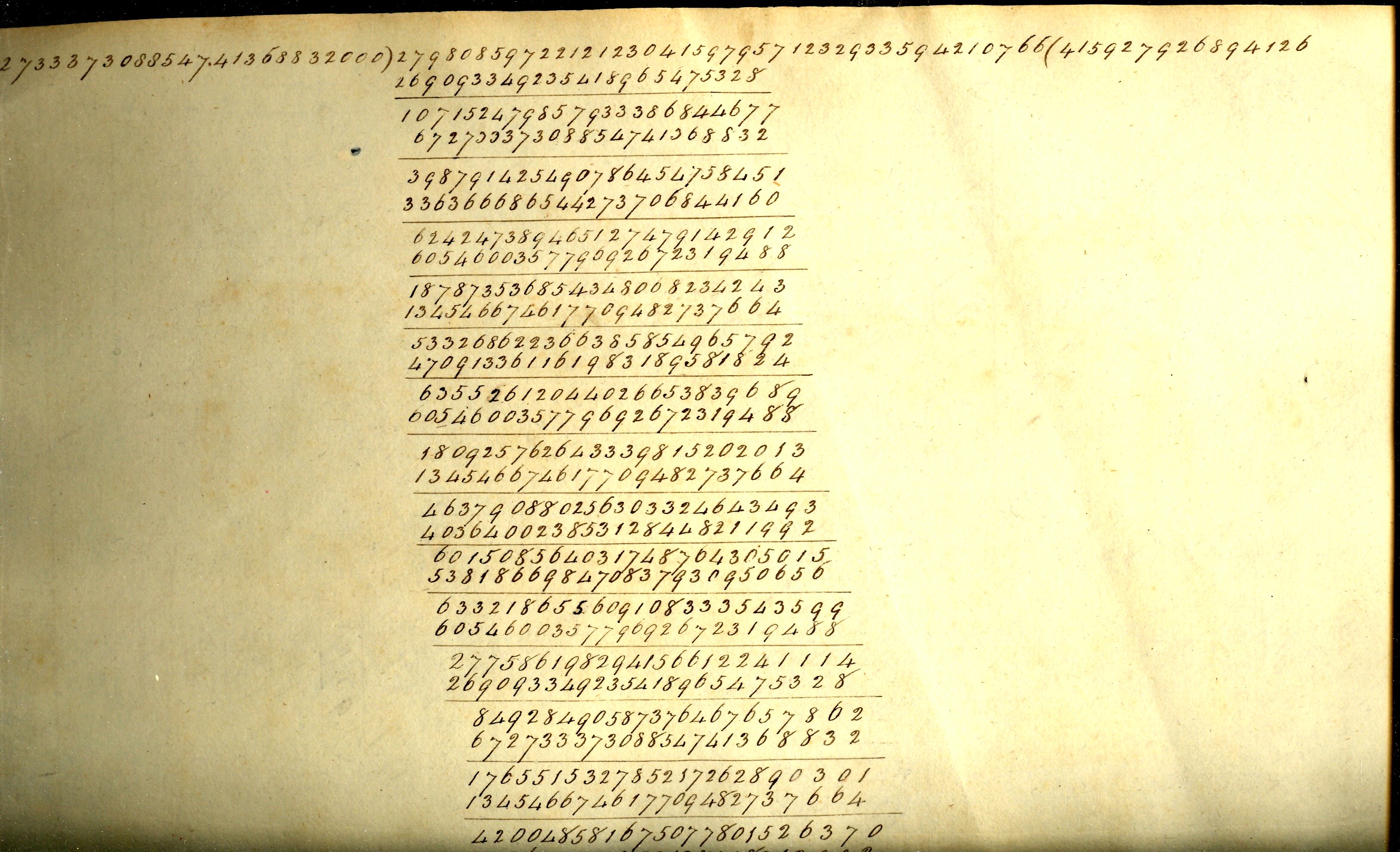
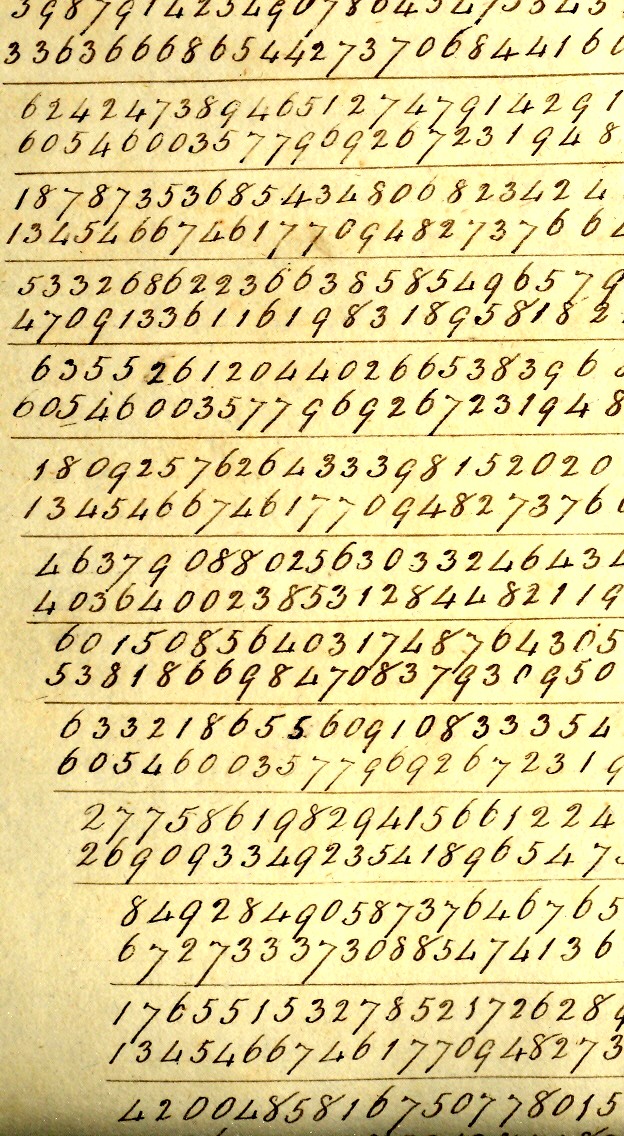
    The example I’ve reproduced here are from an anonymous (but dated 1818) work on different elementary areas of mathematics.  What makes this special to me is the precision of the penmanship and the extreme effort that is being used for a simple display of division.  It would certainly convey the message if the author had used two five-figure numbers to display division rather than these enormous, never-to-be-encountered numbers. 

    ++00++ 9.16 math string

    Surely there were pages and pages of scrap used to get to this point as the operator machined his numbers down, showing us the result rather than the real process.  But what is left to us in this effort is a thing of considerable beauty—the found art of practicing elementary math. 


  • Ludwig Wittgenstein’s Adventure in Aeronautics, 1911

    JF Ptak Science Books LLC  Post 751  Blog Bookstore

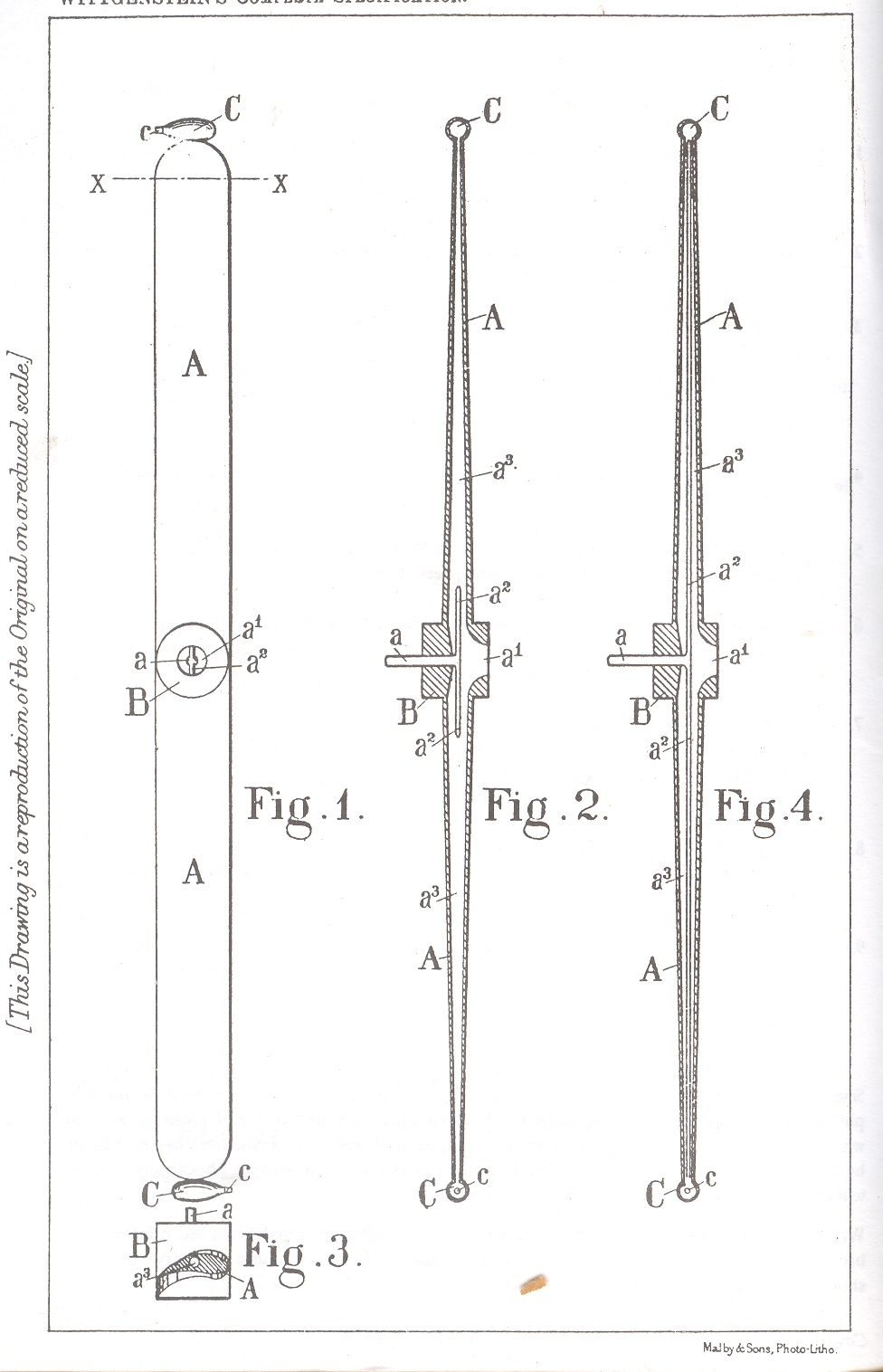
    +()+wittgenstein prop The Austrian Ludwig Wittgenstein (1889-1951) was one of the
    20th century’s most gifted and influential philosopher-logicians,
    though he started his advanced educational career in an aeronautics program at Manchester, in England.  And by “though” I mean a very soft “though”,
    as the engineering students educated in Germany were commanded to have a
    wide intellectual calling, including heavy backgrounds in mathematics and
    physics.  He came to Manchester
    to pursue a career as aeronaut and engineer, which is  a little odd because following its initial
    great exploits in flight in the mind-19th century, England certainly was not a hotbed
    of activity for flight in the first (“flight”) decade of the 20th century.  Be that as it may, he went to Manchester, pushed by the
    great influences in the work of Ludwig Boltzmann and Heinrich Hertz. He also received nourishment for his interest in mathematics, leading to a deeper pursuit in the foundations of mathematics, all of which fueled his developing study away from aeronautics and engineering.

    And it was here at Manchester
    that Wittgenstein patented his innovative approach to propulsion—a sort of powered series of ejectors that were attached to the ends of the blades
    of a propeller.  The image that accompanies
    the patent application is here, above, and entitled “Improvements in Propellers
    Applicable for Aerial Machines”, dated 9 September 1911.  This was admittedly an early period in the
    development of aviation—especially in England—and although an interesting
    product it was not very practicable, though a design similar did appear on helicopter rotors in the 1950’s.    

    It was not so practicable that Wittgenstein pursue a career
    as an aeronaut—within  a year of the
    publication of his patent, he was on his way to Cambridge to join Bertrand Russell
    (who had just published the20th century’s most difficult-to-read work in logic
    in the Principia Mathematica) and
    begin his work in philosophy. 

    It is fitting in a way that Wittgenstein had this
    background, as he described his philosophy of language in terms of projective geometry...

    Notes:

    1) Legend for the patent image: Fig. 1
    is the gaseous or vaporized fuel inlet; a1 is the air inlet. Fig. 2 and Fig. 4 are alternative methods of fuel flow to the combustion
    chamber C. In Fig. 2 fuel is mixed with the air just after both emerge from
    the hub
    .

    2) I’ve read that Wittgenstein was very deeply influenced by the following passage from Hertz’ Principles of Mechanics:  “When these painful contradictions are removed, the
    question as to the nature of force will not have been answered; but our
    minds, no longer vexed, will cease to ask illegitimate questions” If I squint a little I can see the seeds of the Tractatus in there. 

    3) For a real treatment of this invention of Wittgenstein’s see the article at the Royal Society.

    4) Also see Ian Lemco’s Wittgenstein’s Aeronautical Experiments 

    5) “My propositions are elucidatory in this way: he who understands me
    finally recognizes them as senseless, when he has climbed out through
    them, on them, over them. (He must so to speak throw away the ladder,
    after he has climbed up on it.) He must surmount these propositions;
    then he sees the world rightly.”–Wittgenstein’s Tractatus, 6.54

    6) See Klagge’s online biography and philosophical history of Wittgenstein

    ·Posted by :

    ·in:


  • The Color Blind Geometer and the Color-Coded Euclid

    JF Ptak Science Books Post  315

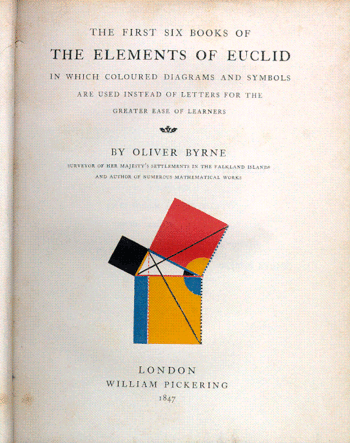
    Here’s a bit of a reach, a very-long-distanced connection, between to unrelated items sharing a similar design and operating at the zenith and nadir of color theory.  The first work is the great and nearly unusable work by Oliver Byrne on the first six books of Euclid (The First Six Books of Euclid in which coloured diagrams and symbols are used instead of letters for the greater ease of readers…, printed at the Chiswick Press by C. Whittingham for WIlliam Pickering in 1847).  The book is, well, unusual and probably not at all useful.  Bryne replaced all of the algebraic notation, identifying letters and almost all of the descriptive text with color and color codes, leaving Euclid mysterious, hidden, awkward, impervious, and, yes, beautiful.  as a matter of fact this work presages the cubists (and especially Piet Mondrian) by 60 years, and all by accident. 

    1blog_oc_t10_euclid_color_blindness Blogeuclide_byrne_2

    Augustus De Morgan, mathematician and logician, wrote a very highly critical book A Budget of Paradoxes in which he describes hubbub, fakirs, frauds, perpetual motion machines, squaring the circle efforts, millstones and other useless books in the maths, and in here he sniffily dismisses Byrne’s work. At best, to De Morgan, the Byrne book is “curious”. But useless and curious, as I have seen many thousands of times, does not mean that it can’t be attractive and beautiful, and the Byrne book is probably the leading candidate in the Bad & Beautiful category..In Victorian Book Design McLean calls the Byrne book “…one of the oddest and most beautiful books of the whole century…a decided complication of Euclid, but a triumph for Charles Whittingham [the printer]”.  (I should point out that the Chiswick press returned to Euclid again in 1893, publishing Gilbert Redgrave’s address on Erhard Ratdolt, who was the first scientific printer in history and also the first publisher of Euclid in 1482. See HERE for the digital record of Redgrave.)

    Curiously the Pythagorian theorem illustrated on the title page of Byrne’s book seems at a fast glance to appear on the front cover of Phillip S. Newton’s Color Blindness, Suggested Aids for Correcting 1946.  It really isn’t all that close except by fleeting recognition, but close enough to stop me in my tracks, to make me think of where my copy of Byrne was and put them side by side.  Curious doubly because in Byrne’s case color is used exclusively in place of numbers and words and is totally and completely dependent upon it. In Newton (who also has the same name as Sir Isaac, author not only of the Principia but also the second-best book of the 18th century, Opticks) we find the confusion of color and plans to correct the color vision, and in a twisty way, on the opposite end of the interests of Byrne.