JF Ptak Science Books LLC Post 812 Blog Bookstore
On this day, which may or not be the 40th anniversary of the
first use of the internet (and the 80th anniversary of the collapse
of the stock market of ’29, and Lucy A’s anniversary of her birth) it might be
good to remember an earlier version of the internet and the semi-invention of
the concept of hypertext: the MEMEX machine of the under-remembered Vannevar Bush.
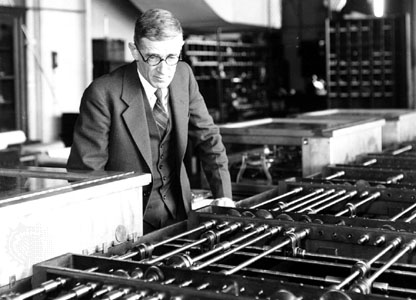
Vannevar (pronounced “van ee var”) was a flinty no-nonsense New Englander
who was an organizational and mechanical genius who as a professor at MIT
developed a remarkable analog computer that greatly advance computation
capacities for solving differential equations.
This was in the 1930’s, and even after creating an improved
electromechanical version of the machine still chose the wrong way to go in the
soon-to-materialize digital computer revolution. During WWII Bush was one of the most
important Americans in the war effort, overseeing the entire scientific effort
of the
enormous effort dispatched beautifully (and successfully). His importance in this regard is difficult to
overstate.
But right there at the end of the war, when he was organizing a still-secret
effort of controlling the spread of atomic weapons (before
future of the organization of human knowledge and memory. And published it, too, in the popular Atlantic magazine in July 1945. (It was
republished in a shortened version a few months later in September—it remains
to this day, according to an editor at Atlantic, one of the most
often-requested reprints) where it reached a reading audience of millions. The article, “As We May Think”, outlined his
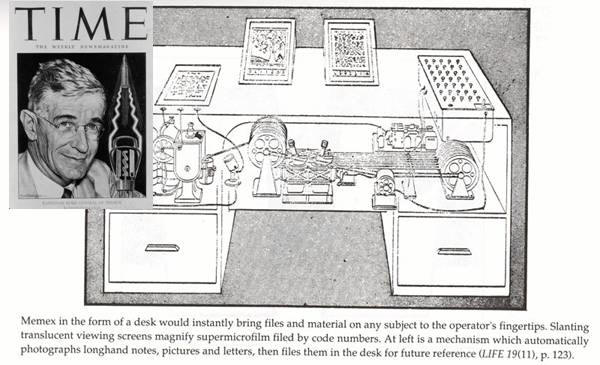
idea for a device he called the MEMEX1 (“memory” and “index”), which compressed and organized all
that its user could remember and whatever information would be obtained in the
future via electromechanical apparatuses, and available with associative tracking
between the microtext frames. So all
manner of book and papers and reports and newspapers and images would be
microphotographed and stored in a beautifully-indexed mechanical retrieval
system where it would live with the information of others. There was also the possibility of real-time
textual additions to whatever it was that was retrieved, the genetic precursor
of hypertext. Bush’s thinking has been deeply
recognized (and also by the creators of the internet) as the intellectual
grandparent of the modern internet.
I just thought on this day that the man who saw more clearly into the future
on advanced global communication and societal memory should be remembered on a
day when his grandchild came into being.
Notes:
1. According to Bush, “the MEMEX is a sort of mechanized private file and
library…. It uses methods such as microfilm storage, dry photography, and
analog computing to give postwar scholars access to a huge, indexed repository
of knowledge-any section of which can be called up with a few keystrokes.”
Wardrip-Fruin, Noah and Nick Montfort,
ed (2003). The New Media Reader. p. 35. The MIT Press
The physical plant of the MEMEX: “A
memex consists of a desk, where on top are slating translucent screens on which
material can be projected for convenient reading. Within the desk were
mechanisms that stored information through microphotography. Most of the memex
contents are purchased on microfilm ready for insertion. On the top of the
memex is a transparent platen. When a longhand note, photograph, memoranda, and
other things are in place, the depression of a lever causes it to be
photographed onto the next blank space in a section of the memex film, dry
photography being employed.” Manovich, Lev. “As We May
Think”, The New Media Reader and
wiki on The Memex.