A Daily History of Holes, Dots, Lines, Science, History, Math, Physics, Art, the Unintentional Absurd, Architecture, Maps, Data Visualization, Blank and Missing Things, and so on. |1.6 million words, 7500 images, 4.9 million hits| Press & appearances in The Times, Le Figaro, Mensa, The Economist, The Guardian, Discovery News, Slate, Le Monde, Sci American Blogs, Le Pont, and many other places… 5000+ total posts since 2008.

Category: Uncategorized

  • Mathematical Exercises and Found Art

    JF Ptak Science Books

    In my science bookstore business one of my principle interests is antique manuscript notebooks in the sciences.  It is a pleasure to see someone working through a problem, or finding what the writer thought to be the most interesting point in a lecture on a particular subject, and to read the occasional doodles and see the timely gloss every now and then.  I’ve had notebooks from an advanced and very careful student for a course given by the great Robert Bunsen that was filled with hundreds of pages of what the master was trying to communicate to his pupils.
    ++00++ 9.16 math

    There’s also a  series of notebooks from the spectacular period of Cornell physics history (1948-1949), including 6 notebooks of classes with Richard Feynman, including several hundred pages from his 1948/9 course in advanced quantum mechanics, which included (a very early) use of the Feynman diagrams.  The thing that makes these observant, advanced notes taken during Feynman’s classes have more than a pedagogical interest (which is substantial and enough on its own)—they have a capacity to show the logic behind the man’s thinking and how he presented his ideas over a period of some months.  Also, and curiously, notebooks like these seem to have not survived. 

    Then there’s the notebooks taken by the team of Charlotte and Fritz John when they were pursing doctoral degrees at Goettingen (1929-1933), until forced to leave with the enforcement of the Nazi laws against non-Aryans.  Goettingen happened (and happens) to be the seat of a long, great mathematical heritage, home of Felix Klein, Emmy Noether, David Hilbert and Bernhard Riemann (among many others).  The notebooks—some two linear feet of them—represented four years of advanced interactions with some of the finest mathematical minds in Germany.  I was told by Mrs. John that they were required to take such full notes—but let me tell you, these notebooks were typed transcriptions of the daily handwritten notes, compiled over the course of a class, and then bound.  They are beautiful, and go far beyond my concept of “required”.  Mrs. John told me the story of the class notes that she and Dr. John took while taking a course with the great Hermann Weyl (who had taken his doctorate under the iconic David Hilbert, and who was also forced to flee Goettingen because his wife was Jewish):  everyone of course was required to take extensive notes during the day and work on them during the night, turning them in the following day for appraisal.  She told me that she still vividly remember placing their notes on a long wooden table at the front of the class, and then picking that set of note up the next day.  After a month of this, she, said, they became convinced that Weyl was not looking at the notes at all, as everything seemed always to be in the spot that they left it in.  One week they decided to see if the notes were being moved, and placed a hair carefully on the interior page, reasoning that if the notes were reviewed, the hair would be gone.  For a week, the hairs stayed in place.  “And so, what did that mean to you?” 
    ++00++ 9.16 math block

    Mrs. John replied that it really didn’t mean anything, and that they continued to do the notes as they would, and leave them on the long wooden table.  They never slacked off (which I can fully imagine).  She said that they did it for themselves, of course, but also they did it for Dr. Weyl, fully expecting that the day that they missed handing in their notes would be the day that they were looked for by Dr. Weyl.  Plus they were studying with a famous and fabulous thinker, and did not want to disappoint themselves or their instructor. 

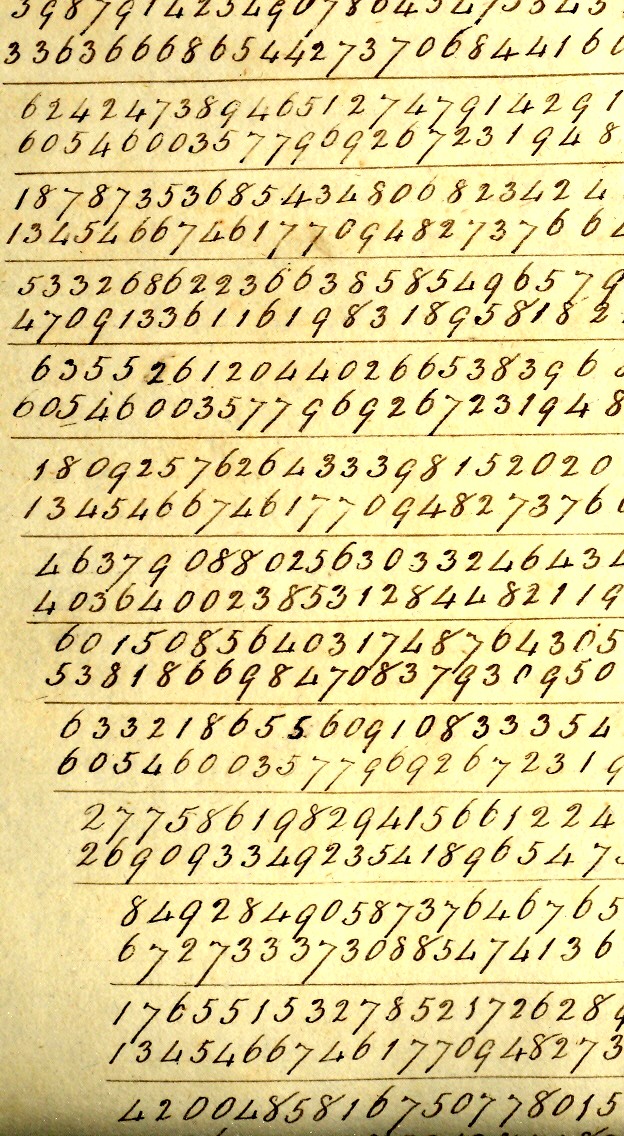
    I do enjoy the historic or significant material like this, but I also quite the naïve, homegrown, elementary manuscript attempts by children at doing math or understanding physics.  Cipher books have always been a little hard to find in my field, wit many of them (I think) winding up in the genealogy area), and they just don’t seem to be very much on the findable side of things anymore. 

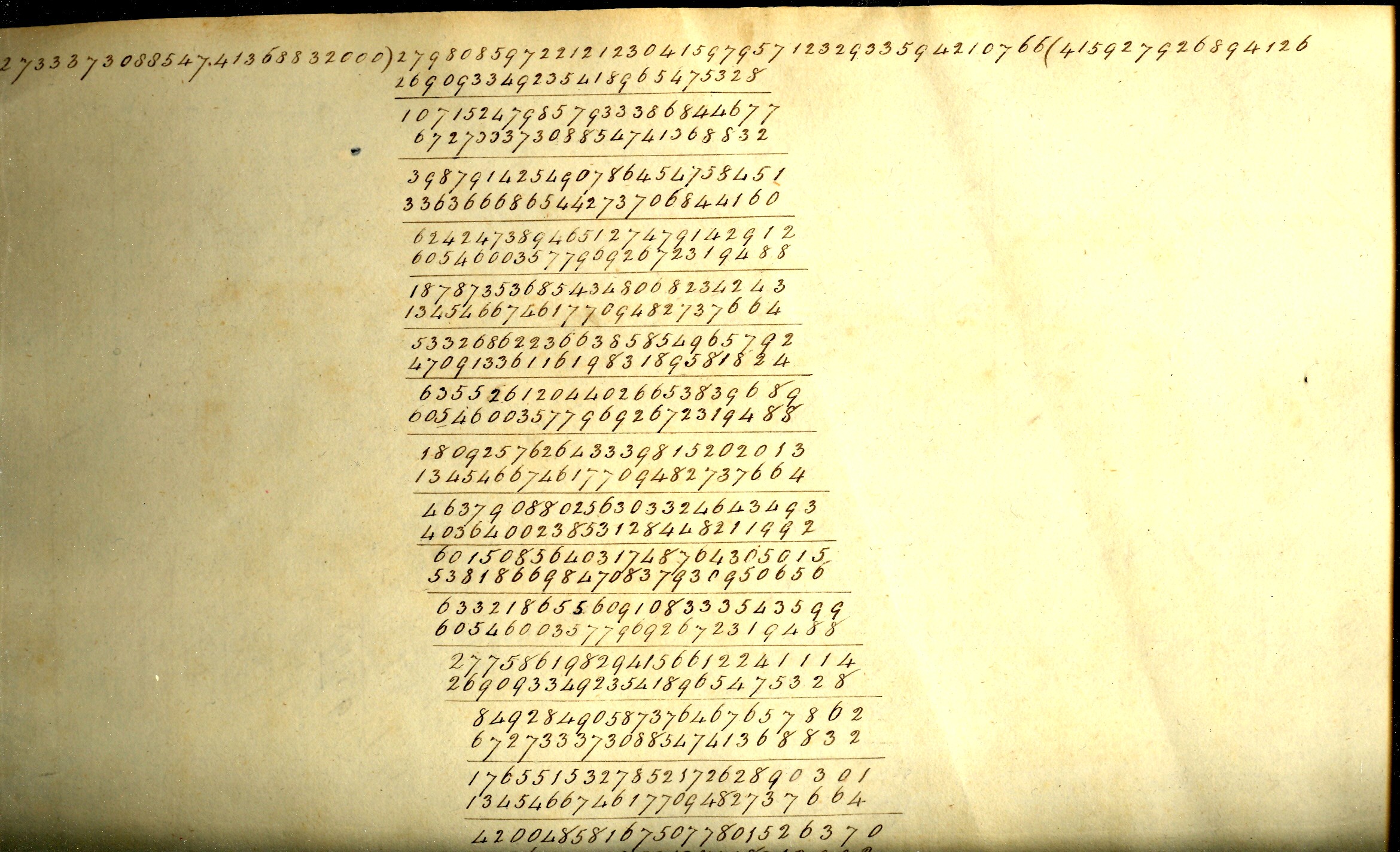
    The example I’ve reproduced here are from an anonymous (but dated 1818) work on different elementary areas of mathematics.  What makes this special to me is the precision of the penmanship and the extreme effort that is being used for a simple display of division.  It would certainly convey the message if the author had used two five-figure numbers to display division rather than these enormous, never-to-be-encountered numbers. 

    ++00++ 9.16 math string

    Surely there were pages and pages of scrap used to get to this point as the operator machined his numbers down, showing us the result rather than the real process.  But what is left to us in this effort is a thing of considerable beauty—the found art of practicing elementary math. 
    ·Posted by :

    ·in:


  • Glass Globes, Light, and Volcanoes (1898)

    JF Ptak Science Books  Quick Post

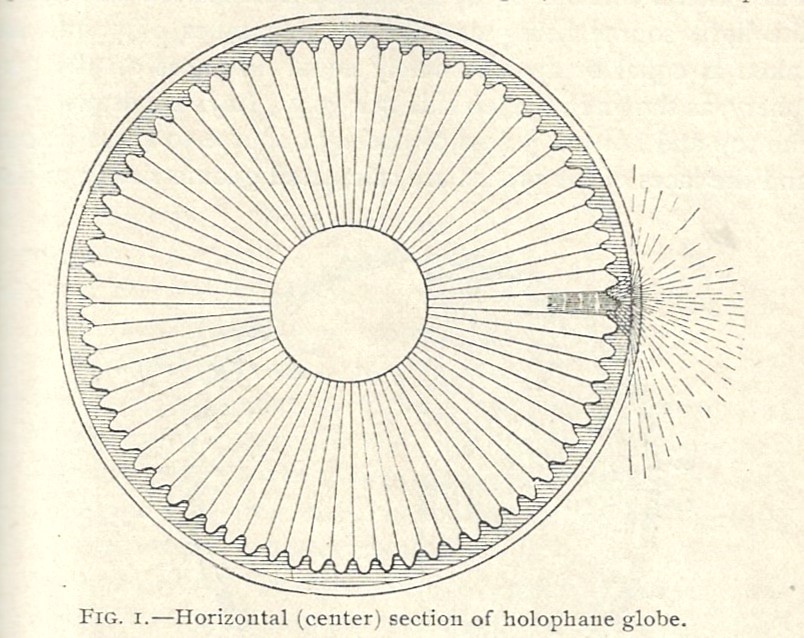
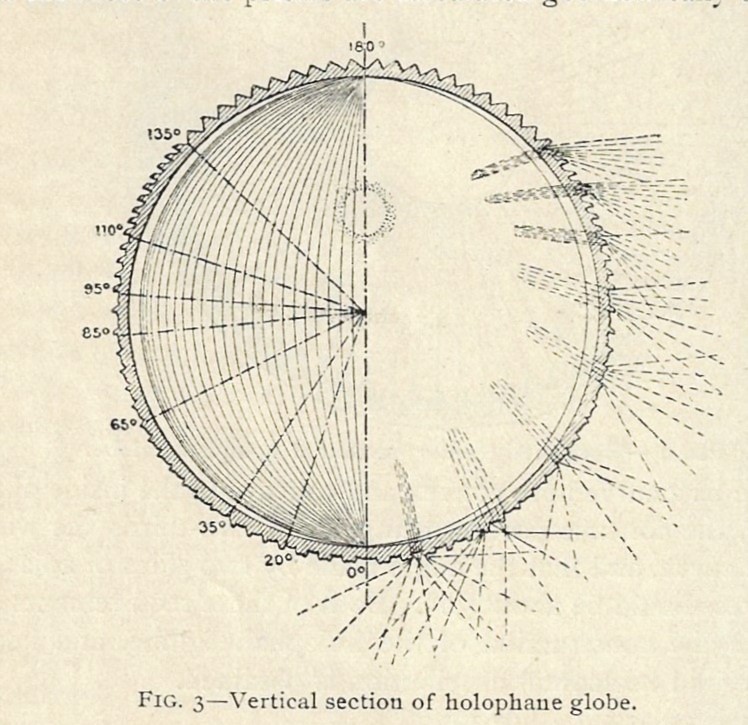
    I happened upon these lovely technical drawings –in plan and cross section–of the newly-patented Holophane Globe. The inventors and coiners of the Holophane were French scientist Andre Bondel and the Turkish Spiridion Psaroudak who patented their illuminating globe in the U.S. in 1896 (and five other countries between 1893-1895). It was designed with inverted and excised cuts in the glass dome to refract and reflect the interior lighting source, and successfully illuminated more area with “less light waste” than most other globes. Not only was the design effective, but the effects were also pretty, as were the schematics of the globe.  (The profile and plan remind me of some early engravings and woodcut of the interior of the Earth showing the sources of volcanic action…or in the case of our not-recently-mentioned friend Athanasius Kircher, the source of water.)

    • Source: “The Holophane Glass Globes for Effecting the Better Diffusion and Distribution of Artificial Light”, Journal of the Franklin Institute, vol 145, April 1898. The article is a technical review of the glass globe and wound up being highly favorable, awarding the inventors the John Scott Legacy Medal for their invention, “…for [the invention] of a globe that secures much better diffusion and more satisfactory distribution than any other globe…” 


    JFI 1897 Holophane _1_ JFI 1897 holophane _2_

    ·Posted by :

    ·in:


  • Rare Document Announcing the Retrieval of Fallen Soldiers of the Bataan Death March (1945/6)

    JF Ptak Science Books   Overall Post 5140

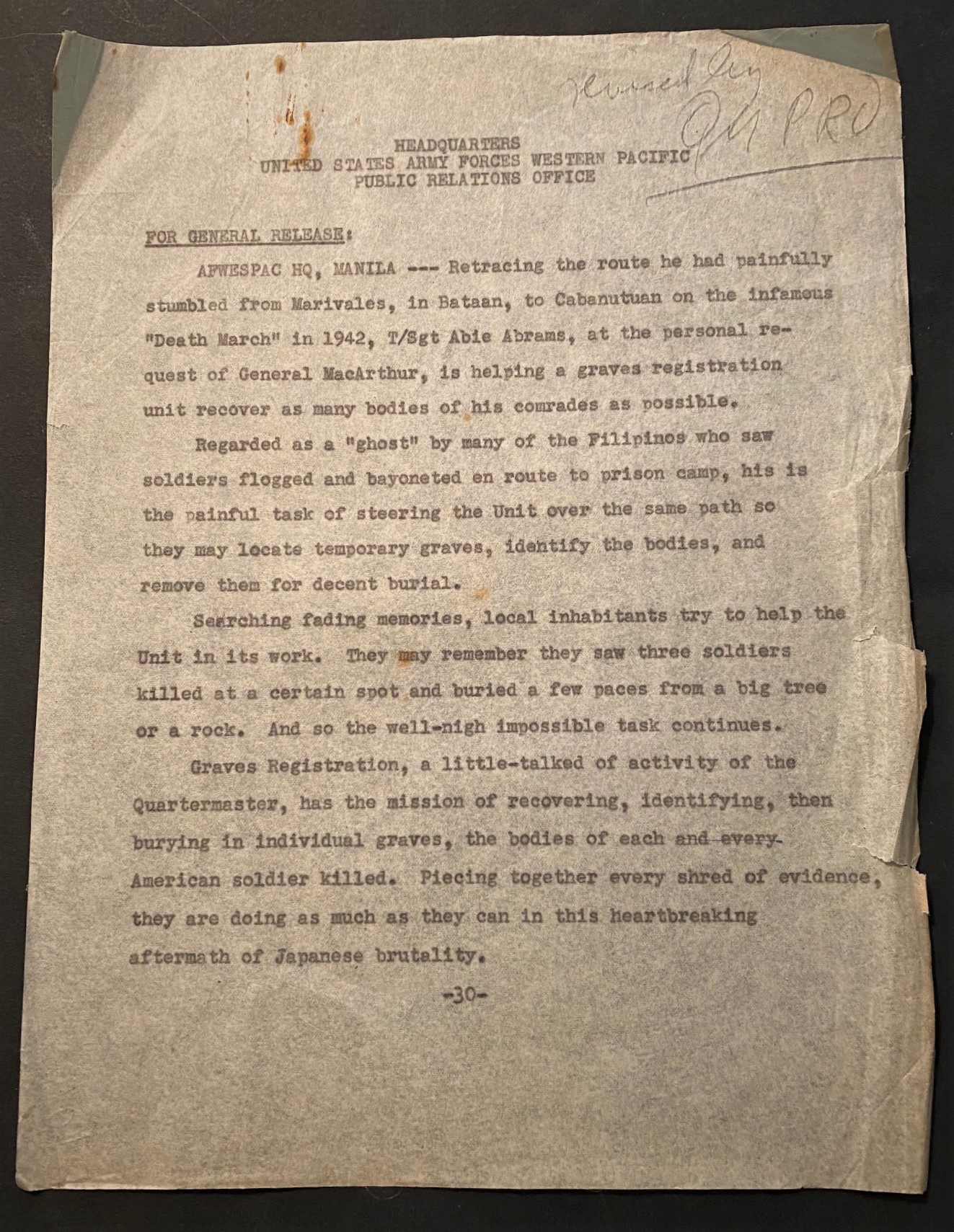
    IMG_6143This short announcement1–a carbon copy of a press release from the US Army Forces Western Pacific, Public Relations Office–while only reaching 150 words or so, establishes a very compelling and passionate statement on a terribly cruel episode of the Pacific War in WWII—the recovery of bodies of souls lost in the Bataan Death March of 1942. General MacArthur evidently personally requested T/Sgt Abie (Abraham?) Adams accompany Graves Registration (“a little-talked of activity of the Quartermaster”) to aid “…in the mission of recovering, identifying, then burying in individual graves, the body of each American soldier killed”. Adams–“regarded as a ‘ghost’ by many of the Filipinos who saw soldiers flogged and bayoneted en route to prison camp”–has “the painful task of steering the Unit over the same path so they may locate temporary graves…”

    In any event this is probably a unique item and may be of interest to those interested in the war in the Pacific, so I reproduce it here.  (In brief searches I’ve not been able to find any mention of it online, nor of Sgt. Adams.)

    • I’m fairly certain that this is not necessary but here anyway is a quick summary of the event from Wikipedia: “The Bataan Death March …was the forcible transfer by the Imperial Japanese Army of 60,000–80,000 American and Filipino prisoners of war from Saysain Point, Bagac, Bataan and Mariveles to Camp O’Donnell, Capas, Tarlac, via San Fernando, Pampanga, where the prisoners were forced to march until they died. The transfer began on April 9, 1942, after the three-month Battle of Bataan in the Philippines during World War II. The total distance marched from Mariveles to San Fernando and from the Capas Train Station to Camp O’Donnell is variously reported by differing sources as between 60 and 69.6 miles (96.6 and 112.0 km). Differing sources also report widely differing prisoner of war casualties prior to reaching Camp O’Donnell: from 5,000 to 18,000 Filipino deaths and 500 to 650 American deaths during the march. The march was characterized by severe physical abuse and wanton killings.”–Wikipedia

    Notes:

    1. (Bataan Death March) Headquarters, United States Army Forces Western Pacific, Public Relations Office.

    [Dateline] AFWESP HQ, Manila (Army Forces, Western Pacific). 11″X8.5″, single sheet, carbon copy from typed original. Undated, ca. 1945/6.

    Provenance: Lt. David Katcher, correspondent/writer in the public relations office of the U.S. Army Headquarters of the Western Pacific (GHQ USAFPAC), working for U.S. Commissioner to the Philippines, Paul V. McNutt. Later Mr. Katcher would becoming founding editor of Physics Today

    ·Posted by :

    ·in:


  • The “Aye Aye”, Newt Rings, and the Chromatic Octave–Compelling Bits from “Nature” (1870).

    JF Ptak Science Books   (Really) Quick Post

    I was writing a bit on the C.G. Foster paper on Fizeau’s experiments on Newton’s Rings, found in an early volume of the great journal Nature (volume 2, June 9, 1870)  In tidying and finishing up, I recorded some of the other interesting-looking (and sounding papers in that weekly issue, and found a minor treasure trove of imaginative and provocative titles for minor papers and notes. They’re delightful, really, and are some good examples for what was the major intellectual foundation of the journal, which was to be scientific of course and just a bit fringe-popular. I imagine to the Victorian mind that much if not all of this slim weekly would’ve been consumed on receipt.  That said, here are some of these beautiful little efforts, spread out over a very tightly packed twenty pages:

    • “The Aye Aye”
    • “Carp and Toads”
    • “Anticipated Destruction of the Cheesewring”
    • “Lefthandedness”
    • “The Chromatic Octave”
    • “The Color of the Moon by Day and Night”
    • “What is a Boulder?”
    • “Scandanavian Skulls”
    • and of course, “The New Australian Mud Fish”.

    Seriously–how could these be refused?


    ·Posted by :

    ·in:


  • A Call to Arms to the French Youth of Occupied France by the Communist Party of France (1944)

    JF Ptak Science Books  Post 2891


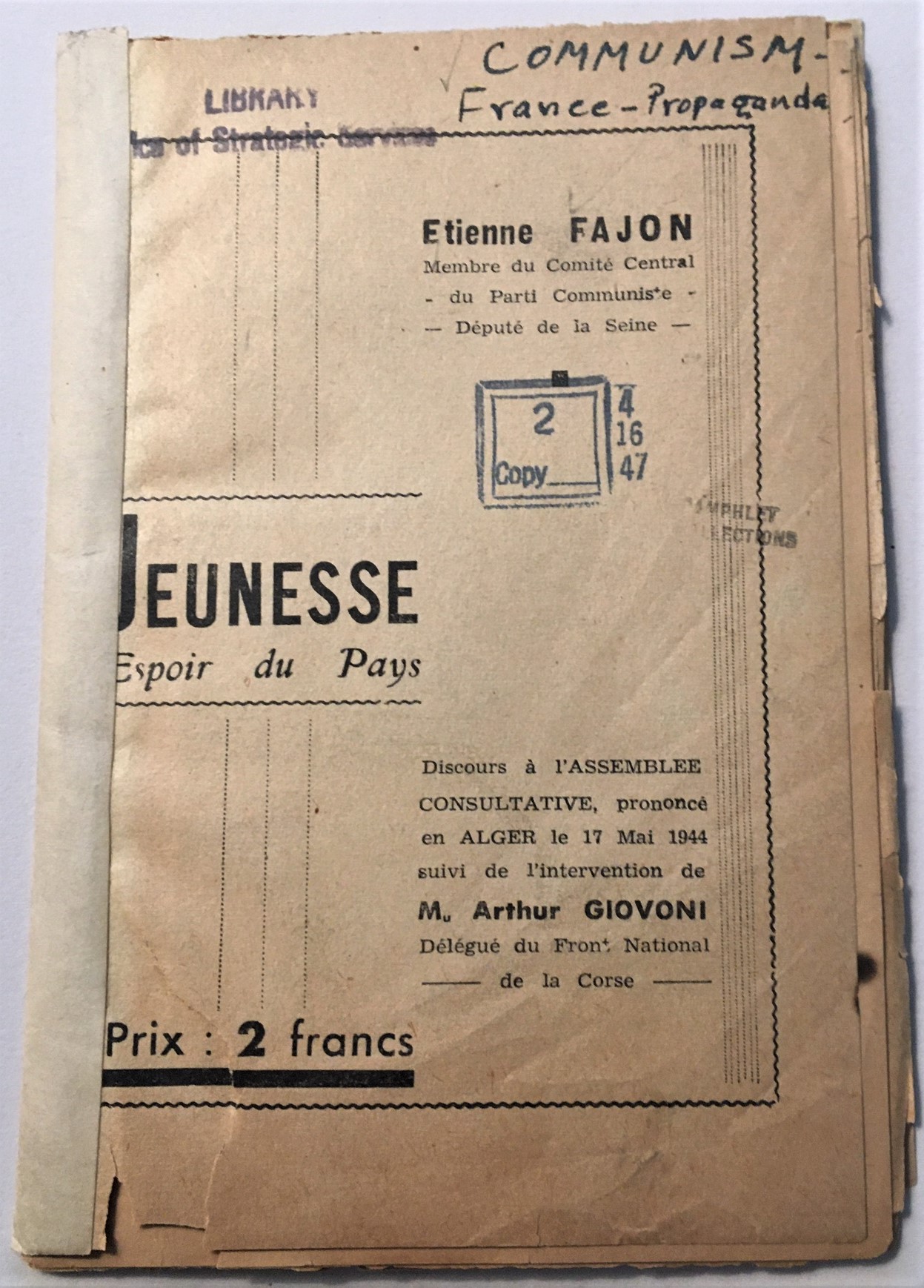
    IMG_2032Someone at the OSS was in a rush to classify this 1944/5 pamphlet as French “propaganda”. Etienne Fajon and Arthur Giovani, and others were responsible for the pamphlet in question, Jeunesse, Espoir du Pays. It was a published meeting of the French Communist “Assemblee Consultative” meeting in Algeria in July 1944. I don’t know exactly when or where it was printed but my guess is that it was before July 1945 in Algeria. It was printed on newsprint and offered out as an important but ephemeral piece, which is why, I think, it is unknown in WorldCat.

    The cataloger at the library of the OSS (the precursor to the CIA) labeled this “COMMUNISM—France-Propaganda”, which it is overall, though what it is first, I think, is a call to arms. And that clarion call is very directly aimed at the youth of France, which the Communist Party saw as being directly under attack by the Nazis.

    The writers here established that “combat over slow death” was the approach to take, there in 1944.  It was their belief that the French children and families were being destroyed by Hitler, and that all needed to combat this. People were supposed to fight for their children, who were being malnourished and starved by the Nazis, indoctrinated by Nazi schools, and having their life will drained from them.  People were supposed to rise up with the support of the Communists and whoever else was available, and by all means necessary. From what I read, this was pretty string stuff.

    Here’s a selection of what they were talking about:

    (Section header: Helping Youth to Fight)

    “We all want to save the French youth that the enemy is trying to destroy. All that, there is only one way: to help young people in France to defend themselves against the enemy, to strike him, to hasten his defeat.”

    “..the rations granted to the French, from January 1943, were equivalent to the death of one in five individuals. No fight could cost our young generation so dear.”

    “Helping French youth to fight that means: Replace certain wait-and-see or stupid broadcasts on our radio with specific advice to young workers to organize the sabotage of enemy production and transport with minimum risk and maximum efficiency

    “…develop the struggle of prisoners and deportees in Germany who are, in their vast majority, young people doomed to death. Our radio must give directives for escapes, for sabotage, for all forms of struggle • in enemy territory. Above all, to urgently send by all means, to young soldiers without uniform, small arms, ammunition, clothing, instructors.

    ·Posted by :

    ·in:


  • The Library of the Future (ca. 1960)

    JF Ptak Science Books  Quick Post

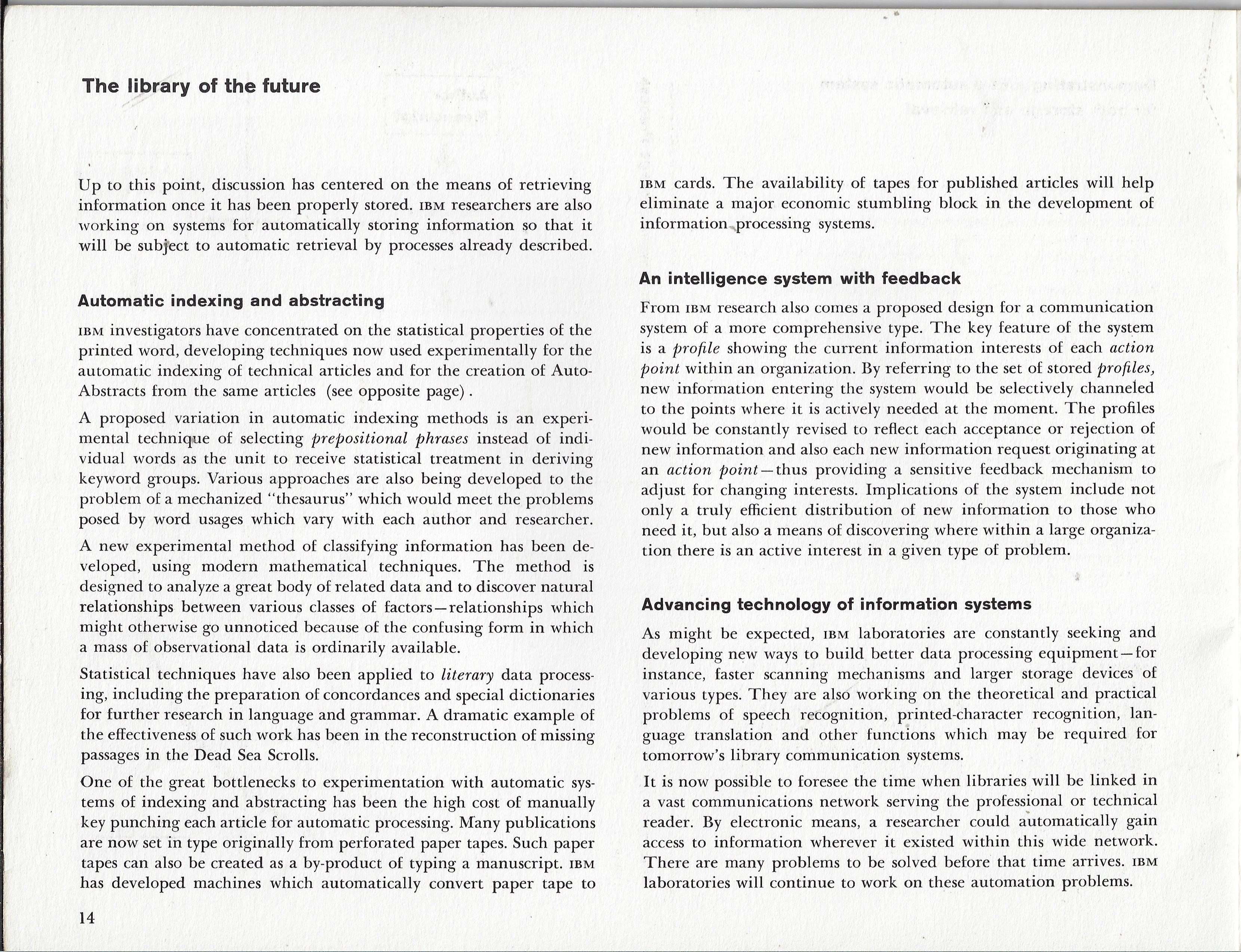
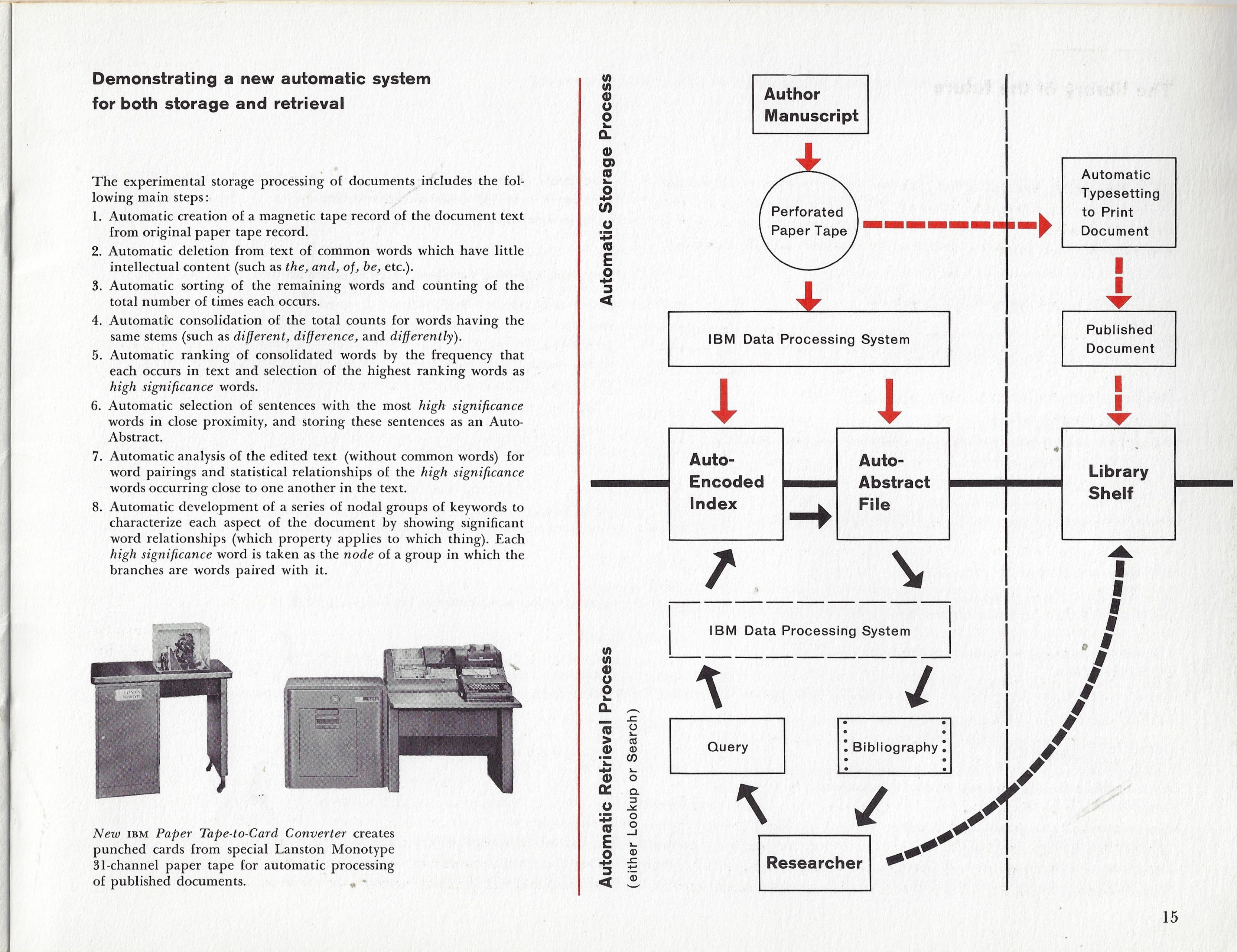
    The oblong pamphlet IBM Information Retrieval was published around 1959/1961 (this is an early evergreen pub with no date but the bibliography cites only 1957 and 1958 “recent” works)  and is a visual/expressive/schematic summation of the current state of affairs in info storage and retrieval delivered in a step-by-step presentation, concentrating on library applications. The main IBM machine at use here is the RAMAC (unnumbered) which made its first appearance in sales in 1956. This is a far more realistic (and existent!) peek at the possibilities of the control of information than the Bush MEMEX (1945, etc.), though of course it wasn’t nearly as far-reaching as Bush envisioned, and didn’t actually deliver the text to the end user, though it did deliver a great deal else, maintaining massive amounts of data in a usable format. It is a fairly scarce document, so I reproduced the small section on “the library of the future” which we are well passed, probably by 1975. 

    • This is another example of something I’m just in the early stages of attention–when the time of effectiveness of what was reckoned to be part of the future and a great innovation turns out to have a very short lifespan and becomes outdated relatively quickly.  

    IBM Info retrieval _2_

    IBM Info retrieval _2_

    ·Posted by :

    ·in:


  • J. Robert Oppenheimer on the Economics of Atomic Bombing (1945)

    JF Ptak Science Books  Post 2811

    On the heels of the sale of a letter [https://historyofideasblog.com/thesciencebookstore/2013/03/william-shockley-on-the-economics-of-atomic-bombing-1945.html] written by transistor pioneer and then mega problem child William Shockley on the economics of atomic bomb a friend told me about a potentially similar account by J. Robert Oppenheimer. Leaving the modern racist Shockley behind in this post for time consideration, the Nobelist (sharing the 1956 award with co-workers Walter Brattain and John Bardeen), the man wrote an appraisal on the monetary aspect of conventional vs. atomic attack for one of the Vannevar Bush groups in 1944/5. It may seem pretty harsh—especially when he came out with the unsurprising finding that the economics of the situations were firmly positive for the use of nuclear weapons—but it was a job that someone had to do, somewhere, and Shockley turned out to be that person, probably to the surprise of very few.

    Oppenheimer is a different story. Philosophically conflicted and occasionally torn, the man who announced himself as the “destroyer of worlds” while still bathed in the light of the successful atomic test shot in the Jornada del Muerto also contributed some thought to this issue. The original reference to this was told to me to be in Scientific Information Transmitted to the United Nations Atomic Energy Commission…June 14, 1946, a set of seven slender volumes prepared under the direction of the always-present Bernard Baruch. The reference came in the first volume (which also has a short and simple and brilliant 18-page history by Richard Feynman and Robert Bacher of atomic energy and the building of the atomic bomb) in a paper by Philip Morrison in which he records a one-line quote of Oppenheimer’s overall assessment of the dollars and cents of atomic bombing. The Oppenheimer quote was referenced to its source in a Congressional special report on atomic energy published a few months earlier in 1946, and there he speaks for about one page on these explosive economics.

    As I said it is far easier finding this thinking in Shockley—but for Oppenheimer as disagreeable as this thinking might’ve been, it was still a pertinent question and one that needed to be researched and answered, and I believe Oppenheimer did just that, with no extra-emotional attachments to the issue. It was an issue/problem/question, and the scientist answered it.

    So for the general interest I’m reprinting Oppenheimer’s testimony on this one aspect of the use of the atomic bomb, which you will find below.

    • The source: Hearings before the Special Committee on Atomic Energy, United States Senate, 79th Congress, first session, pursuant to S. Res. 179, A resolution Creating a Special Committee to Investigate Problems Relating to the Development, Use, and Control of Atomic Energy. Part 2: December 5,6,10 and 12, 1945. USGPO 1946.

    “Senator Hart [Thomas C. Hart of Connecticut]. Doctor I think perhaps you may be misunderstood at one point on account of brevity.

    You said that atomic weapons can be cheap instruments of devastation and then explained it briefly.

    I think it would be better for purposes of the record if you expanded that.

    Dr Oppenheimer. Well I have seen a figure I don t know whether it is a reliable figure but it is surely not a crazy one that it has cost us in this war $10 a pound to deliver explosive on the enemy. I am unable to give an accurate cost figure on atomic weapons partly because I don t know and partly because if I did know it I would be prevented by that knowledge from saying it but I think that I can say that even taking account of the in some ways diminished effectiveness of concentrated bombing it is somewhere between 10 and 100 times cheaper to deliver atomic weapons which is simply in terms of the area destroyed it is 10 or 100 times cheaper.

    I don t know if it is 10 times or 30 times and this will depend on policy but it is an enormous factor. It is not a trivial change.

    Senator Hart. Cheaper for instance than TNT?

    Dr Oppenheimer. That is right and I am using a figure which may well be criticized but which is I believe the figure used by Army Ordnance for over all cost of delivering a pound. You can see what that means if you take a round figure of 10,000 tons as a possible effective equivalent for an atomic bomb. That is 20,000,000 pounds which is $200,000,000. Now without revealing any secrets I can say that an atomic bomb and the equipment for delivering it is not going to cost that by an enormous factor.

    Senator Hart. But those large TNT bombs which are the usual comparative figure though the destruction in any one point any one small area is by no means as great it is sufficient and is spread over a wider area is it not?

    Dr Oppenheimer. I used a somewhat conservative figure of the 10,000 tons rather than the actual equivalent in part to take this into account. The actual atomic bomb releases more energy than this.

    Senator Hart. But it is true that the comparison as is usually made is a little faulty because of the respective areas involved?

    Dr Oppenheimer. What I would say is this and I will be somewhat sharper about it if you wish. For the equivalent tonnage the factor of cost will be more than 100. For equivalent area it will be somewhere between 10 and 100 and that is to try to take account of this effect which you mentioned. Of course if you want to knock out three houses somewhere you will not use an atomic bomb.

    Senator Byrd [Harry Flood Byrd, Virginia]. Doctor, when you spoke of destroying the stock pile of bombs would that mean too destroying the organization and the factories that made the bomb?

    Dr Oppenheimer. In the first place I did not speak of destroying it. I was asked about it.

    Senator Byrd I understood you to say that if you had faith in other nations you would then favor the destruction of the bombs we accumulate during this period before we can ascertain what other nations are going to do.

    Dr Oppenheimer I would say this country should do for the problem of atomic armament what we expect other nations to do If we expect them and are convinced that they wish not to arm atomically then I think that we should not arm atomically and if we want to keep the plant some place. I think we should have that plant completely open and should allow the representatives of the powers with whom we are dealing to know as much about what we are doing as we would want to know about their plants…”

    ·Posted by :

    ·in:


  • “Smoking and Longevity Statistically Associated with Impairment of Life Duration” (1938)

    JF Ptak Science Books  Post 2706

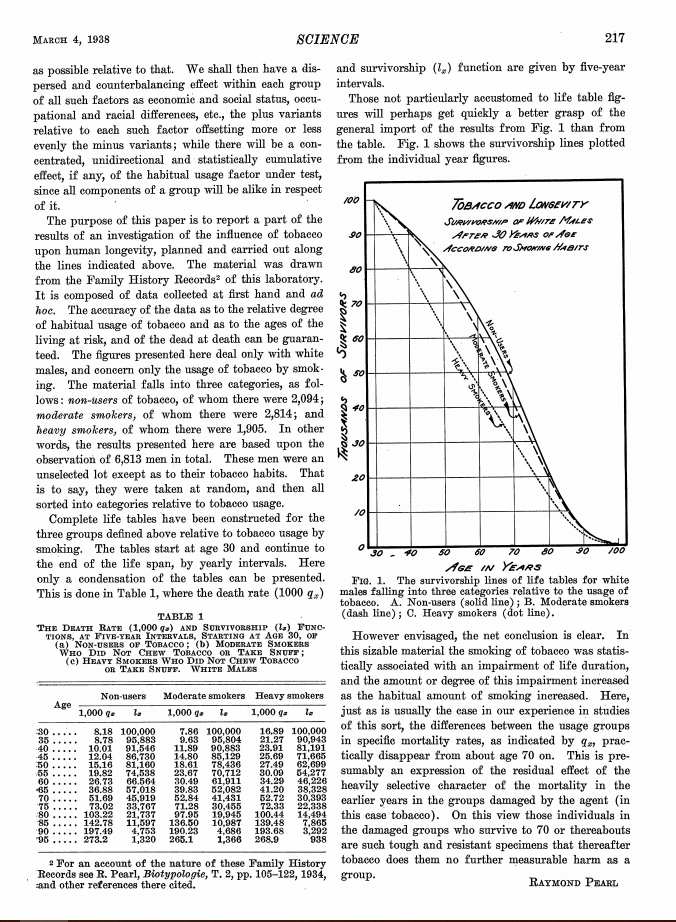
    Raymond Pearl brought to the readers of Science in 1938 what seems to be the first scientific study1 on the effects of smoking tobacco on longevity, announcing that “smoking of tobacco was statistically associated with an impairment of life duration” The work has been described as a classic in epidemiology:

    • “Despite his often provocative pronouncements, the proof that Pearl provided that smokers are prematurely killed by the effects of tobacco must be recognized as one of his most important achievements in epidemiology. In fact, Pearl’s 1938 article in Science describing the premature death of smokers was the first significant piece of data on the link between tobacco and longevity.”–Goldman, I L, “Raymond Pearl, smoking and longevity”, in Genetics, 11/2002, Volume 162, Issue 3 https://www.genetics.org/content/162/3/997

    Pearl certainly had a way with turning a long and tumbling and turgid phrase—you can almost see him crafty his long wide-tired sentences and chuckling through them, gravity of the subject or not.

    He starts the paper off with a rather longish statement about the vast majority of human beings consuming things that they really don’t need to consume, and that some of these controllable non-essentials may cause them some harm:

    “In the customary way of life man has long been habituated to the routine usage of various substance and materials not psychologically necessary to continued existence: he writes. “Tea, coffee, tobacco, opium and the betel nut are statistically among the more conspicuous of such materials…all of them contain substances of considerable pharmacologic potency if exhibited in appropriate dosage”. Pearl states that even with heavier usage of these products that the long-term negative effects of usage does not outweigh the benefits of use “in the opinion of vast number of human beings”.

    • “Purely hedonistic elements in behavior, which are present in lower animals as well as in man, have a real importance…there are undoubtedly great numbers of human beings who would continue the habitual use of a particular material they liked, even though it were absolutely and beyond any question or argument proved to be somewhat deleterious to them”.

    Pearl smokingHe doesn’t say anything about people being addicted to any of these things.

    In the next page or so he describes the study and the numbers (though we don’t learn in this paper what the difference is between his “heavy” and “moderate” smoker categories), establishing with a strongly accusatory graph that there is a bulbous result in shortened lifespan for heavy smokers aged 30-70-ish.

    He concludes in this short two-page paper that after the subjects in his study turned 70 that “individuals in the damaged groups…are such tough and resistant specimens that thereafter tobacco does them no further measurable harm as a group”. There’s nothing here about the “why” or “how” of death, just that it occurs.

    So there it is, the first measure of tobacco use and shortened lifespan. This was the first step in the long climb to the very public introduction of the killing nature of the tobacco habit, which entered its modern phase in 1964 after considerable battles with those in the business of producing the deathsticks.

    1964 was 55 years ago and fortunately great strides in research and education have been made. The tobacco menace has been extinguished now that we’ve learned beyond all question the great horrors it brings, everyone worldwide knowing that smoking tobacco will kill you, and in very nasty ways. Humans have learned something, and this is one extremely preventable mode of death that we’ve managed to eliminate.

    Oh, wait a minute…

    Notes:

    1. Raymond Pearl, “Tobacco Smoking and Longevity”,  Science, vol 87, no. 2253, March 4, 1938, pp 216-217.

    ·Posted by :

    ·in:


  • Edgar Allan Poe: Time and Space in “Marginalia” (1844)

    JF Ptak Science Books  Quick Post

    “We appreciate time by events alone. For this reason we define time (somewhat improperly) as the succession of events; but the fact itself — that events are our sole means of appreciating time — tends to the engendering of the erroneous idea that events are time — that the more numerous the events, the longer the time; and the converse. This erroneous idea there can be no doubt that we should absolutely entertain in all cases, but for our practical means of correcting the impression — such as clocks, and the movements of the heavenly bodies — whose revolutions, after all, we only assume to be regular.”

    ·Posted by :

    ·in:


  • The “Beneficial Exercise” of Walking the Trail of Tears (1838)

    JF Ptak Science Books   Post 1387 (from 2011, extended)

    • I’m revisiting this post again as I’m going to send off the book that provided its source, and before it goes, I wanted to make sure of the damning quote found below. For some reason when you google the quote there are just 10 hits: my earlier post, a 1910 history of Oklahoma, Helen Hunt Jackson’s A Century of Dishonor: A Sketch of the United States Government’s Dealings from 1880, and then seven U.S. government doc/serial sites with the full text of the volume. Why this quote is not more widely known is a mystery to me. 

    The “Beneficial Exercise” of Walking the Trail of Tears (1838)

    “…strong men, women, boys and girls, not only capable of marching twelve or fifteen miles a day, but to whom the exercise would be beneficial.”  —General Winfield Scott, military leader in charge of the removal of the Cherokee nation, 1838, on the benefits of enforced marching of men, women and children over an 800-mile course.

    Most people are familiar with the story of the Trail of Tears, the epic tragedy of the “removal” of a class of people—the Cherokee Indians in this case—from their homes in the east to a new land appropriated for them in Indian Territory (present-day Oklahoma). (In the Cherokee language, the event is called Nu na da ul tsun yi (the place where they cried), another term is Tlo va sa (our removal).) The Cherokees were given the ultimatum to leave their homes in Georgia, Texas, Tennessee, Alabama and North Carolina, doing so in the period from 1836 to 1839—the first part of the exodus was prompted by the U.S. Government but not necessarily enforced. The later part, however, in the spring of 1838, was absolutely enforced, with General Winfield Scott arriving on the scene with 7,000 U.S. Troops to round up the last of the remaining Cherokees and take them—by force if necessary—to Indian Territory.

    Cherokee Scott 1838

    There were approximately 12,0001 Cherokees left in the east by the time of Scott’s arrival—by the time their enforced march to the west was completed, around 4,000 Cherokees would be dead.

    The ease with which this re-settlement was partially removed from the broader moral and ethical implications of marching 12,000 men, women and children an 800 miles west in the fall and winter of 1838/9 was accomplished with abstract language in the government reports describing the affair.

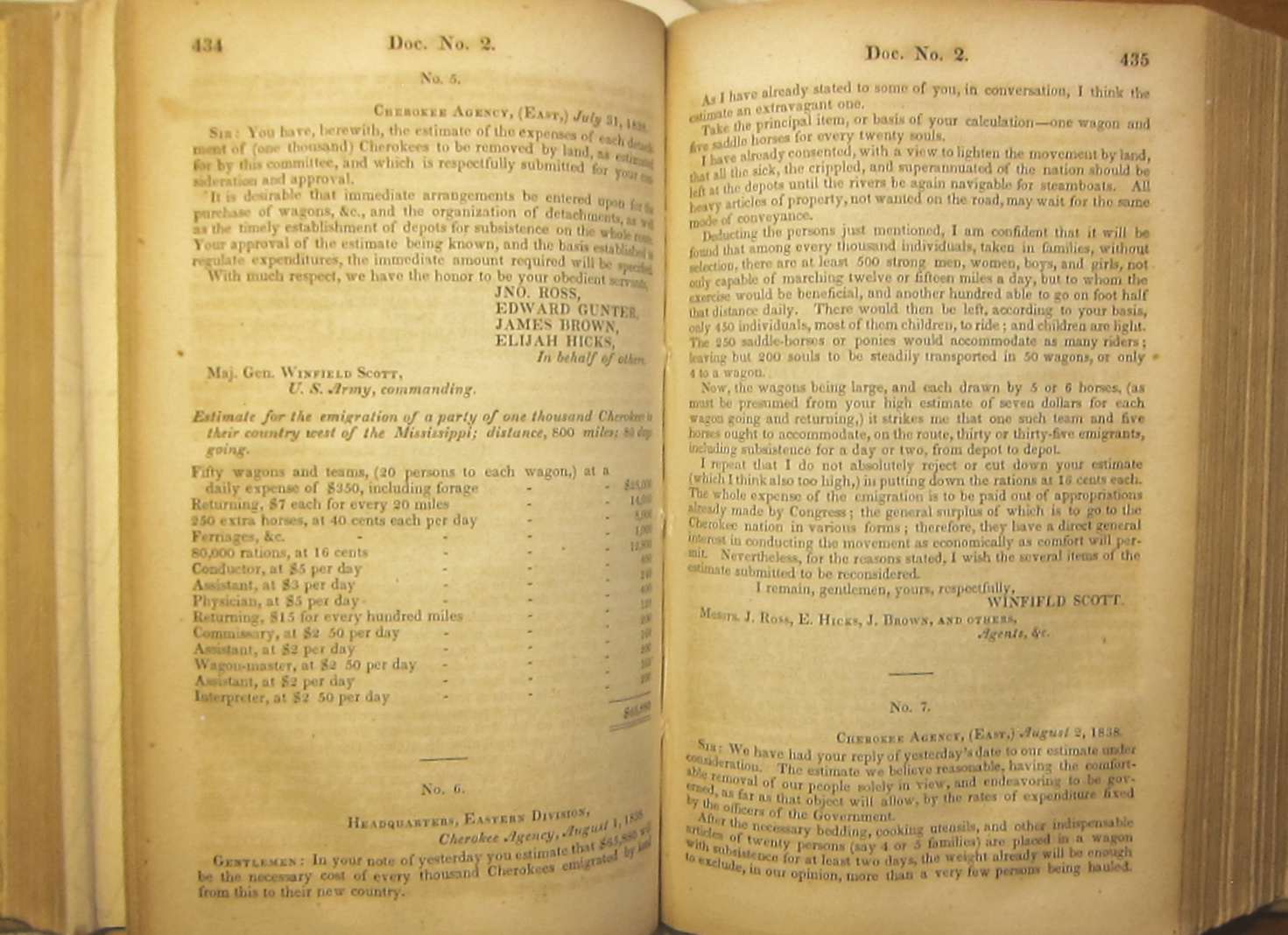
    For example, smothered in the thousand pages of the executive documents printed by Thomas Allen for the U.S. government of the 25th Congress, 3rd session, 1838 of  nine documents printed in volume one is document #2, “Message of the President of the United States to the Two Houses of Congress….”, and in there resides a 94-page section called “Report of the Commissioner of Indian Affairs” (occupying pp 410-506), and in that section is the compelling sub-document, “Emigration of Indians”. It is there that we find the clinical appraisals of the government efforts to scoop the Cherokees up and deposit them far west. For example, we are told that “(an) aggregate of 18,000 Cherokees…have ceased to live east of the Mississippi during the Spring, Summer and Autumn”, this after General Winfield Scott had “collected them”. Removing an entire Indian tribe had been a simple matter of that tribe no longer living there anymore, having been “collected” by the Army and “emigrated” to points west.

    The “collection” part is told elsewhere and often and more brilliantly than I can relate here—it is the material of a deep national tragedy. Suffice to say presently that 16,000+ people were herded together at bayonet and gunpoint, given scant opportunity to collect themselves, and then brought together in concentration camps to await the arrival of the last of their tribe. After that, most were marched in stages to Oklahoma, through bad weather of all descriptions—from drought to rain to high heat and bitter cold—sometimes encamped in stockades to wait for river levels to rise and fall, allowing dysentery and other diseases to come into the population and take hold. 4,000 people would die along the way–each mile would wind up killing five  people, one death per every 1,000 feet.

    The section on the emigration of the Indians is alternately heart-breaking and infuriating. There is a series of correspondence between John Ross, representing the leadership of the Cherokees, and General Winfield Scott, regarding the mechanics and monetization of removal. The Cherokees at this point make every attempt to accommodate their pending future with dignity and humility, acquiescing on almost all government points in what I think were the hopes of gaining a few extra necessities for the people making the trip. Generally, the requests were rejected. Coffee and sugar were at one point presented to Scott as a necessary—Scott refused, saying that the disbursements for the removal had already been made, even though all of the monies were coming from government funds allocated to the Cherokees for the lands they were having stolen on the heals of their exit.

    Another particularly infuriating example of misogynistic governmental neutral-speak—a towering example, really, an incredible, unspeakably-wrong statement—occurs on page 435 in a letter from Scott to John Ross et alia. In response to a request from Scott for extra wagons to help transport the young and the old and possessions and food, Scott refuses. He refutes the estimated expense of $65,000 per every 1000 Cherokees for the entire trip of 800 miles (over 80 days), regarding the estimation of this need as “extravagant”:

    “As I have already stated to some of you in conversation I think the estimate an extravagant one. Take the principal item or basis of your calculation one wagon and five saddle horses for every twenty souls. I have already consented with a view to lighten the movement by land that all the sick the crippled and superannuated of the nation should be Heft at the depots until the rivers be again navigable for steamboats. All heavy articles of property not wanted on the road may wait for the same mode of conveyance.”

    He continues to his incredible statement quoted above:

    “Deducting the persons just mentioned I am confident that it will be found that among every thousand individuals taken in families without selection there are at least [of the 1000-person figure quoted above] 500 strong men women boys and girls not only capable of marching twelve or fifteen miles a day but to whom the exercise would be beneficial and another hundred able to go on foot half that distance daily. There would then be left according to your basis only 450 individuals most of them children to ride and children are light. The 250 saddle horses or ponies would accommodate as many riders leaving but 200 souls to be steadily transported in 50 wagons or only 4 to a wagon.”3

     And just to set the record straight on this, we are talking about 800 miles of marching, in weather good and bad, over a period of many months (and sometimes extending to a year).

    There were allocated 50 wagons and teams for the journey for all of those thousands of people, the teams costing $28,000 in rent for the entire journey, ironically paid for by the Cherokees. The sugar and coffee which had not been provided for in the original rations list and which were excluded, would’ve raised the cost of the average daily ration allowance a few cents too many, exceeding the 16 cents per day/person for the journey.

    This of course was not the only Indian “removal”, not even the only removal for this year—it was the stage of affairs for many dozens of tribes over the course of two centuries, revisited and replayed and reprise d over and over again, with different actors, different agents, different tribes and different places—all with the similar result. (For example, even among just the Five Civilized Tribes, the Choctaw were the first to be removed in 1831, then the Seminoles in 1832, the Creeks in 1834, the Chickisaw in 1837, and then the Cherokees in 1838.)

    As awful as Scott’s correspondence reads to me I am reminded that among the general staff it was Scott who was seen as sympathetic to the Indians’ plight, that it was Scott who was ostracized for being too accommodating. This may have actually been the very best that the U.S. Government could offer, which is utterly tragic. 

    Notes:

    1. In the fall of 1835, a census was taken by civilian officials of the U.S. War Department to enumerate Cherokees residing in Alabama, Georgia, North Carolina, and Tennessee, with a count of 16,542 Cherokees, 201 inter-married whites, and 1592 slaves (total: 18,335 people).  The total number of deaths  for the Removal is much studied and debated–estimates range from 2,000 to 6,000 people. 

    2.  Message From the President of the United States to the Two Houses of Congress, at the Commencement of the Third Session of the Twenty-Fifth Congress, page 434 for both quoted phrases.

    3.  Ibid, Page 435.

    ·Posted by :

    ·in: