A Daily History of Holes, Dots, Lines, Science, History, Math, Physics, Art, the Unintentional Absurd, Architecture, Maps, Data Visualization, Blank and Missing Things, and so on. |1.6 million words, 7500 images, 4.9 million hits| Press & appearances in The Times, Le Figaro, Mensa, The Economist, The Guardian, Discovery News, Slate, Le Monde, Sci American Blogs, Le Pont, and many other places… 5000+ total posts since 2008.

Category: Uncategorized

  • The Cost of Convict(ions) 1826

    JF Ptak Science Books  Quick Post

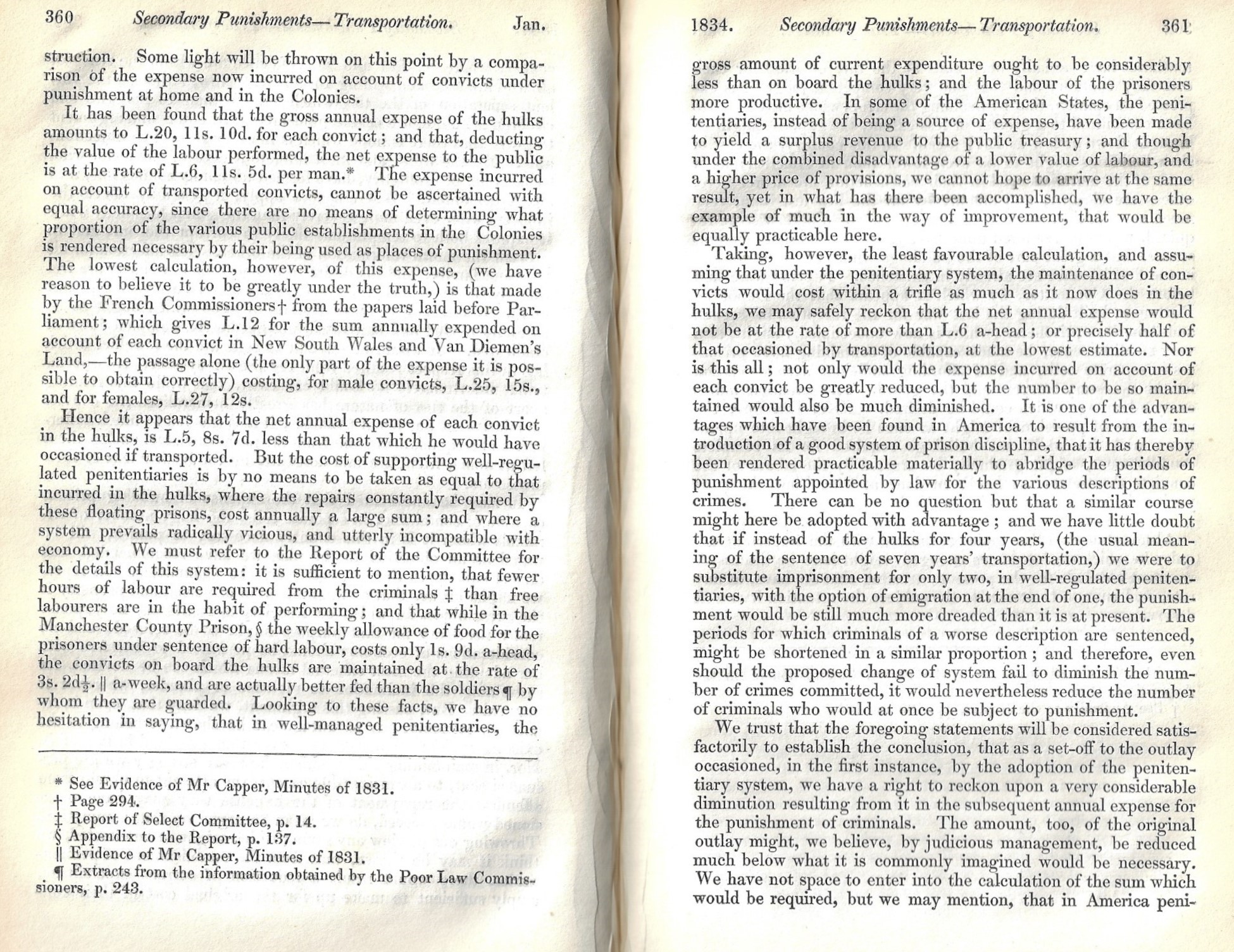
    I found the following bits of information while grazing through a volume of the Edinburgh Review for 18261–I don’t really have a place for this to go, so I thought to share it as-is, the article striking some keen interest for me. 

    What the writer seems to be saying here is that if there was greater discipline in British prisons as in America there would be a net loss of convict time served and thus a savings per crime.  Rather than pay for four years of some sort of punishment and discipline that if done correctly (more aggressively) the effort could be accomplished in only two, “the punishment would be still much more dreaded than it is at present”.  “It has been found that the gross annual expense of the hulks2 amounts to L.2o,  less work done by the convict to a net cost of “L.6, 11s. 5d. per man.”

    There was also the option of spending a year in prison after which you could opt out for the remained by being transported to Australia, which has the added cost of 25-pounds per male prisoner (27 for females) for the cost of passage alone, plus 12 pounds annual expense per convict.

    Should the number of crimes not fall as a result of the new punishment system, the writer believes that the number of criminals imprisoned would because of reduced sentences with a higher concentration of penal threat (whatever that might be). The bottom line seems to be the bottom line in this report.  
    Convict cost

    Notes

    1.  The source: “Appendice stir les Colonies Penales, ct de Notes statistiques. Par MM. G. de Beaumont et A. de Tocqueville. SJ.”, with “Thoughts on Secondary Punishments, in a Letter to Earl Grey. By Richard Whately, D.D., Archbishop of Dublin” and with  “Reports from the Select Committee on Secondary Punishments, together with the Minutes of Evidence, and an Appendix of Papers,” . .pp 336-362. This is mostly it seems a discussion of “transportation” to Australia and the relative cost of convict-keeping there vs. “the hulks”.  

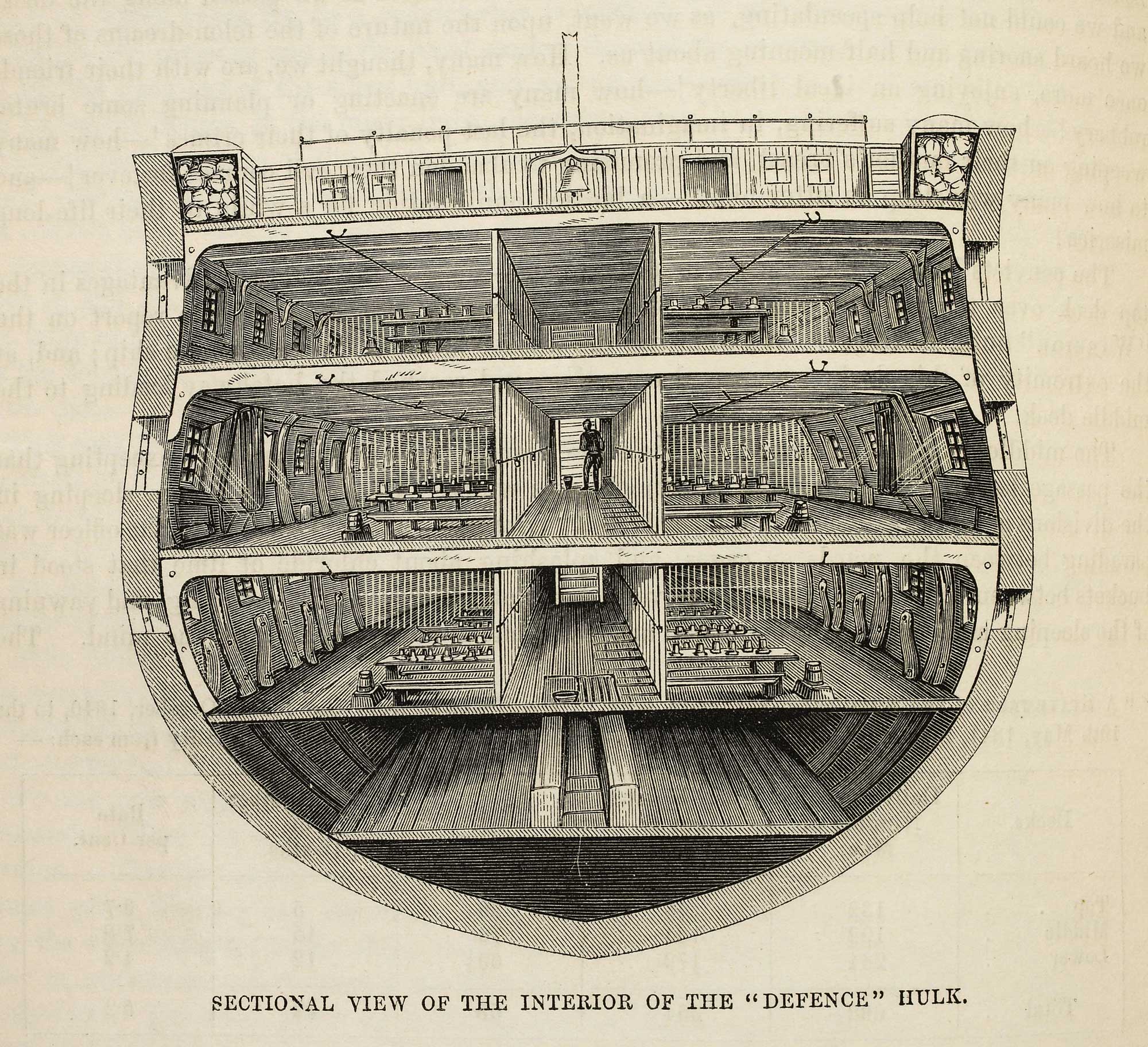
    2.  Even though the following reference is from much later than the narrative above, the image does give a good idea of one of the “hulks”–it appears in Henry Mayhew’s The Criminal Prisons of London, printed in 1862. It is found on the British Library site, along with a three-minute reading of what life was like in the hulk, which was a decommissioned ship, stripped down, and made to hold x-number of prisoners. Comfort was not a concern. 
    Hulk

    Source:  http://www.bl.uk/learning/timeline/item102904.html

      

    ·Posted by :

    ·in:


  • “Why Must the Agony of the Jewish People be Prolonged? (1944) An episode in the Abandonment of the Jews in WWII

    JF Ptak Science Books    

    Goldstein _1_543 detail

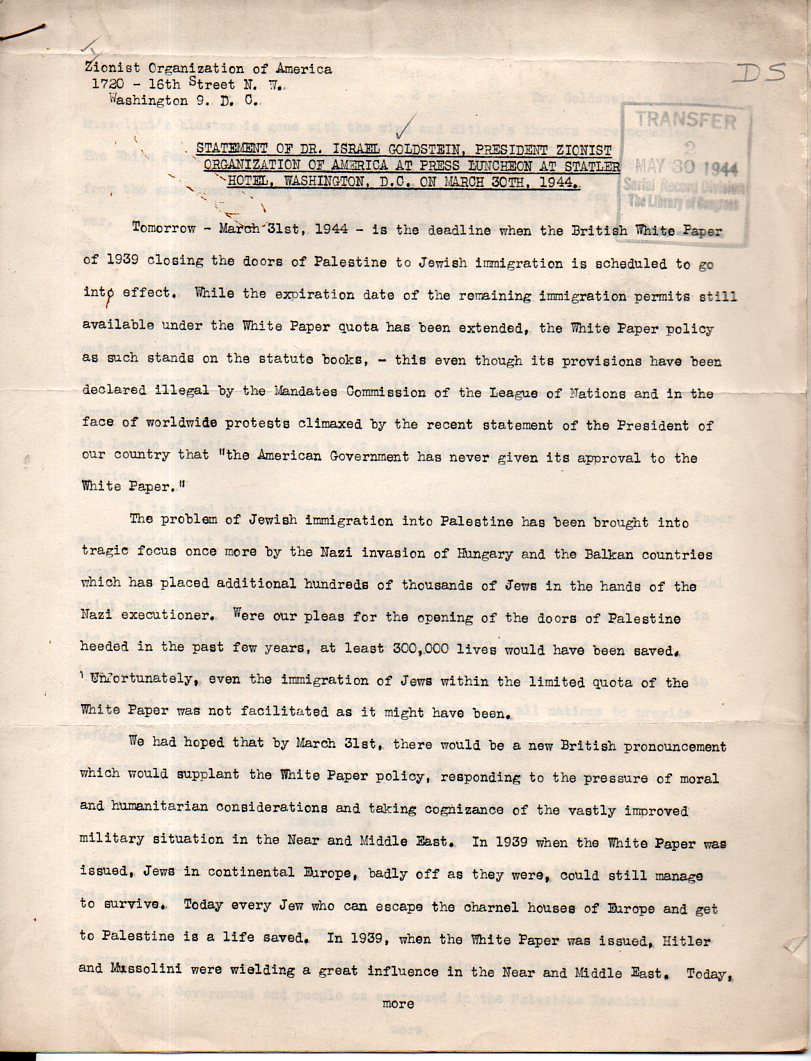
    This quote is from a speech by (Rabi) Israel Goldstein1 as head of the Zionist Organization of America appeal and was made in 19442 addressing the British White Paper of 1939 on Palestine and allowing Jews to immigrate to escape “the hands of the Nazi executioner” in Europe. Among many other things the White Paper limited Jewish immigration to 75,000 for 5 years (1939-1944) with limits of further immigration to be determined by the Arab majority. “Were our pleas for the opening of the doors of Palestine headed in the past few years, at least 300,000 lives would have been saved. Unfortunately, even the immigration of Jews within the limited quota of the White Paper was not facilitated as it might have been” wrote Goldstein. 

    There is a long and complicated history to the White Paper but suffice to say that while millions of Jews were being slaughtered in Europe the restrictive White Paper remained in place, which meant that the haven for escape to Palestine was largely closed relative to the numbers of people needing to be saved, and that at the end of the war there were still 3000+ visas that hadn’t yet been granted. Goldstein makes the case for the extreme peripheral usefulness of the Paper in 1939, but in 1944 when the Axis influence in the Middle East was  extremely minor adhering to the white Paper was a tragedy: “if the White Paper was unwise and unworthy then, it is more shameful and baseless now”3.

    The Provisional Council of Israel’s first constitutional act [in 1948] was a Proclamation that “All legislation resulting from the British Government’s White Paper of May, 1939, will at midnight tonight become null and void.”–Wiki on the White Paper of 1939. 

    Goldstein hoped for a change in the policy–there would be none. 

    I’ve reprinted the speech below.

    Notes:

    1.  Israel Goldstein (June 18, 1896 – 1986) was an influential Jewish leader in the U.S. and worldwide as a Rabi (and head of the New York Board of Rabis), head of the Jewish National Fund (elected in 1933), head of the Zionist Organization of America (elected 1943), and one of the founders of Brandeis University.  The full text of the publication–which was printed sometime between March 30, 1944 and May 30, 1944–is included below.  I can find no mention of the communication online.  

    2.  The speech was printed in 1944 and evidently is very uncommon: (Israel Goldstein), Statement of Dr. Israel Goldstein, President Zionist Organization of America, at Press Luncheon at Statler Hotel, Washington, D.C., on March the 30th, 1944.  Offset printed by the Zionist Organization of America, 1720 16th St, NW, Washington DC. 11″x8.5″, 4 leaves. 

    3. Goldstein wrote in his memoirs that the rules and restrictions of the White Paper on Jewish immigration were being “rigidly and brutally enforced”. —My World as a Jew: The Memoirs of Israel Goldstein, Volume 2, pg 47.

    [“Like another black curtain about to be rolled down upon the last hope of escape, the White Paper of 1939 ominously threatens to close all further migration to Palestine,”–Judge Morris Rothenburg, Jewish Telegraphic Agency, http://www.jta.org/1943/09/13/archive/dr-israel-goldstein-elected-president-of-zionist-organization-of-america]

    Goldstein _1_540

    ·Posted by :

    ·in:


  • A First Book about Books about Books

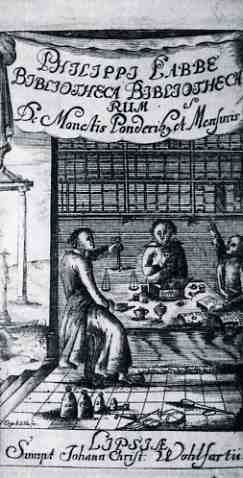
    Bibliography of bibliographiesPhillippe Labbe (1607-1677), a contemporary of the savant’s savant, Athanasius Kircher, and who was himself a prodigious polymath, produced this fantastic piece of scholarship, the Bibliotheca Bibliothecarum…accedit bibliotheca nummaria.  He was a member of the Society of Jesus, like Kircher (which whom he also shared similar birth and aeath dates, Kircher’s being 1601-1680); and was born in the town of Borges, France, which gives him an almost invisible connection to one of the 20th century’s most imaginative/flexible writers in the great blind librarian of Argentina.  This book, published in Leipzig in 1682 as the second edition of the 1662 first,  is the earliest extant work of bibliography of bibliographies (it also has a very useful work on numismatics, as we can see from the last part of the title.)  Gathering the data necessary to produce this work was a prodigious undertaking–Labbe needed to have had access to fine libraries to assemble the data, then of course he needed the brain to handle all of the disparate and erudite areas of learning, and then be smart enough to organize it all.  This was an enormous accomplishment in 1682–with the stuff that Labbe had floating around in his brain and the reasonable aspect of disseminating it, Labbe would’ve been a National Treasure to whichever country he would call “home”. 

    I haven’t seen the title page of this book for many years, and my memory of it had these three bibliophiles holding drinks in the air–but I’m wrong, unfortunately.  The scholar on the left is weighing something, the scholar o the right is pointing to a book, and I not exactly sure what scholar-middle is doing.  One thing for certain though is that these men are not drinking.  Somehow I’d’ve preferred a few rounds with all of that scholarly/scientific bric-a-brac strewn on the table, but it was not to be. 

    Some of Labbe’s selected works include:

    • Trirocinium Linguæ Græcæ etc. (1648)
    • La Géographie royale (1646)
    • De Byzantinæ historiæ scriptoribus, etc. (1648)
    • Concordia sacræ et profanæ chronologiæ annorum 5691 ab orbe condito ad hunc Christi annum 1638 (1638)
    • Bibliotheca antijanseniana (1654)
    • Bibliotheca bibliothecarum (1664)
    • Sancrosancti Oecumenici Tridentini Concilii . . . canones et decreta (1667)
    • Sacrosancta concilia ad regiam editionem exacta

    ·Posted by :

    ·in:


  • Photographic Incunabulum, 1839-1841

    JF Ptak Science Books 

    “Photogenic Drawing” followed by “Photogenic Drawings”1 The first paper gives an account (taken from the London Mechanical Magazine), occupying pp 263-4, of the Daguerre process; the second, pp 264-5, gives an account of the Fox Talbot method as it first appeared in the British Association/Athenaeum.

    These I believe are among the earliest of U.S. journal references for  two of the earliest photographic processes—the Fox Talbot method was much different from the Daguerre though much less known and certainly underappreciated as it was arguably the superior.

    • “This early period of photography cannot be passed over without mention of the name of Henry Fox Talbot of England He was a man of many sided scientific character and an independent investigator in the photographic field prior to Daguerre’s discovery and therefore not inspired by it to investigation. In 1839 January 31st he read a paper before the Royal Society entitled “Some Account of the Art of Photogenic Drawing etc” embodying a practical process on paper based on the abandoned process of Wedgewood and Davy which he improved and also completed by fixing the pictures although imperfectly…”–, JFI, Dec 1899, vol 148, p 4 11.

    Then, in the September issue of 1839 come the following three contributions: “Invention of Photogenic Drawings”, p.208, from Mechanic’s Magazine; “Light Drawn Pictures”, pp 208-9, Mechanic’s Magazine;“The Daguerrotype Explained”, pp 209-210 (“A.D.B.”, Alexander Dallas Bache).

    And then, a month later in the November issue, comes a Daguerre: “Practical description of the Process called the Daguerreotype, which consists of the spontaneous reproductions of the images of natural objects, in the Camera Obscura…”

    ·Posted by :

    ·in:


  • The Mountain Spirit, 1917

    JF Ptak Science Books  Quick Post

    This is a minor but very compelling addition to the “History of Lines” series on this blog–an advertisement for Daimler-Benz, reminding people that they not only made automobiles, but also were making contributions to the war effort in the design and production of aircraft engines. The work is labeled “Der Berggeist”, which is “Mountain Spirit”, which in German (and Swiss) folklore is depicted as an old man with a white beard, and then sometimes too (evidently) as a giant, and Mountain Monk, who lived in the mountains and in the mines of mountains. There’s a reference to the Berggeist in the 1980 edition of The German Legends of the Brothers Grimm, vol I, page 317.  We see that the Benz cars and aircraft are making their ways easily around the Mountain Spirit, who at times is depicted as a difficult and contentious entity. 

    [The ad appeared in Die Kunst, Monatshefte fuer Freie und Angewandte Kunst, Munchen, October, 1917.]

    Ads Benz 1917 Mountain HEad

    ·Posted by :

    ·in:


  • Taking Stock of The Machine in 1932–Were They Masters or Slaves?

    JF Ptak Science Books  Post 2769

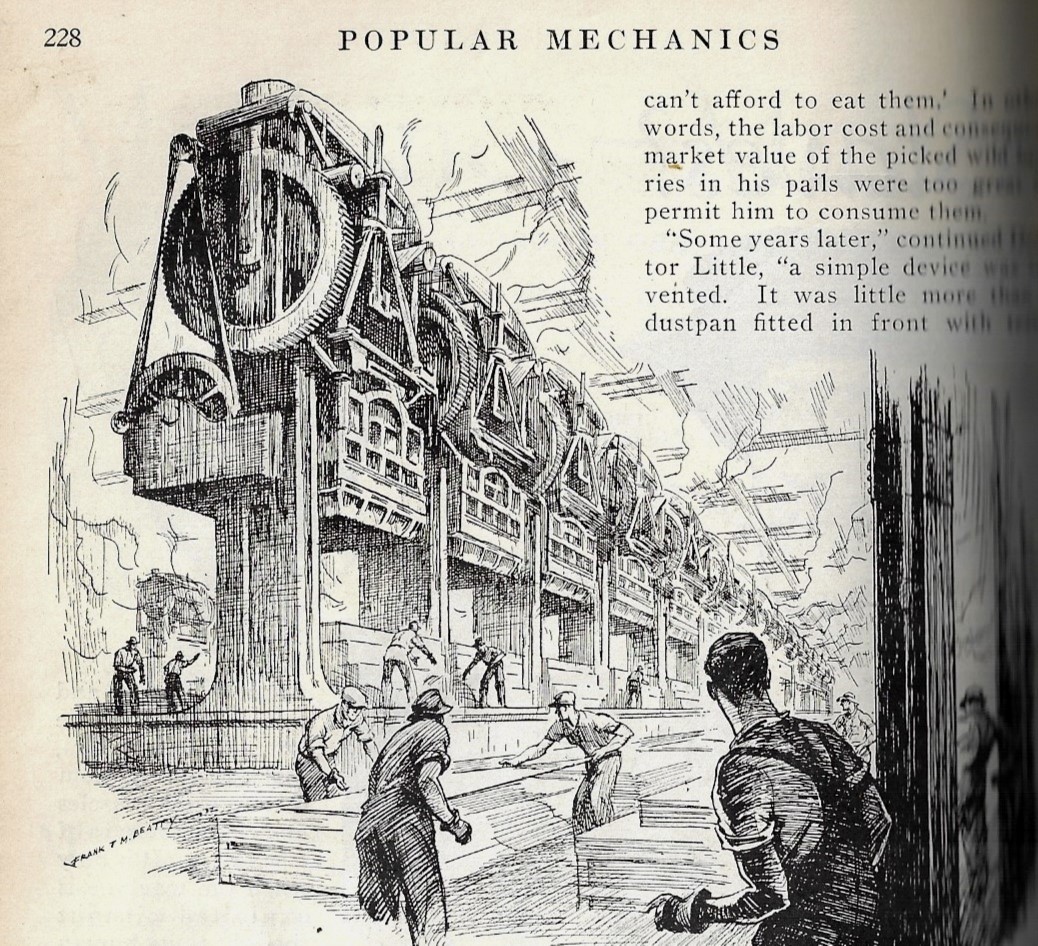
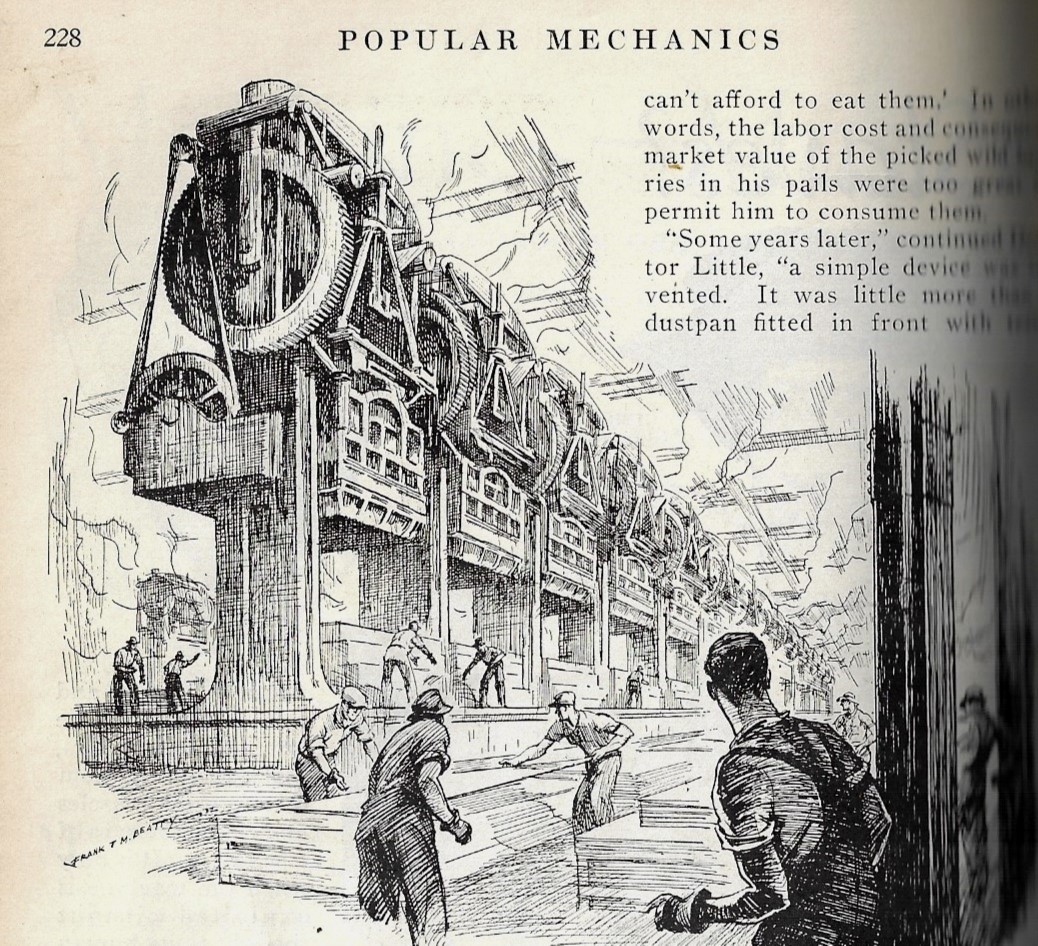
    Pop Mech 1932 Machines Slaves or Masters steam hammerThis unexpected and somewhat philosophical article on the social standing of The Machine appeared in Popular Mechanics in 1932. A standard-bearer for oil and sawdust, sparks and steam, Popular Mechanics was much more interested in DIY than sitting deep in the leather chair to have a long think on the cultural implications of the stuff of the Machine Age. It spoke more about how to manufacture a bolt more so than why one should do so. 

    “Machines–Masters or Slaves?” is the name of the article and it really does ask the question, and in the present tense. It is easier to imagine having this discussion about the machines of our future–or rather in the machines’ future, because it is conceivable that beyond the Singularity that over the course of the next century of five that “machines” may not have much of a need for humans. In any event, five leading techie lights give their assessment of who-rules-whom back there in 1932. 

    One of the unexpected assertions (and unfortunately unexplained) belongs to Raymond Fosdick from the Rockefeller Foundation Machines, who said that machines have “fastened” themselves on every detail of our lives”  and then  “they have called into being millions of people who might otherwise had not been born”.  He says that machines have reached into every part of the world, “for hundreds of millions they are the sole means of support. Stop the machines and half the people in the world would perish in a month”, where he is probably talking about mechanized food production and delivery. 

    Another surprising summation came from Dr. W.E. Wickenden (Case School Applied Science) along these lines: if somehow all and every machine were discontinued and removed and all of their duties were transferred “back into human muscle” to do the job that “we should need at least five billion human slaves” to carry on the work. 

    At this point co-development of machine and human was not an issue, though it would be and famously so in about 18 years. Machines still stood on their own, and the product of human-machine communication and advanced interaction was still the stuff of the newly-burgeoning field of science fiction.  The great question posed by Alan Turing, “May not machines carry out something which ought to be described as thinking but which is very different from what a man does?” (in “Computing, machinery and intelligence.” Mind LIX (236),  433–460)  will have a lot more to do with the future of “machines” for us now and in the future than was ever expected of the “us” of 1932. 

    Another contributor, William Green, president of the A.F.L., took stock about some of the costs of machines: as wonderful as they were, they cost people their jobs, and lists some of the human costs of mechanization. “In the manufacture of razor blades, one man can now turn out 32,000 blades in the same time needed for 500 in 1913. In the machine shops one man with a gang of semi-automatic machines replaces twenty-six skilled mechanics”.  He didn’t mention the Luddites, a secret group bent on preserving jobs decimated by automation by going out and destroying the machines replacing humans. The term is used differently today-often meaning someone who prefers and older tech or non-tech alternative to a tech instrument; that, or simply not knowing some technical subject. The original use was in relation to labor practices, standing against machines that would rob people of their livelihoods. For example, the handweaver population n England stood at 240,000 in 1830 to 43,000 in 1850 after the introduction of the mechanization of stocking and spinning frames, which made for 207,000 not-satisfied people. Anyway the Luddites set out to curtail the replacement of workers by machines and the making of unfair profit by the owners of the means of production, though they didn’t get very far.

    Of course the replacement of workers by machines would continue on the scale of an order or two of magnitude, until finally the machines themselves were replaced by other machines operated more cheaply in other countries.  

    Ultimately the author comes down on the side of the machine as slave rather than the human, because “as an instrument of exploitation or profiteering the machine is doomed by common sense”, “the veiled splendor of the moral vision” in the ‘unending future of the machine”, whatever that means. The machine was a servant of humankind, lifting us from “drudgery”, into a “greater leisure for the exercise of the free spirit”.  No doubt this is all giveth/taketh–I wonder how far into the future it all becomes taketh/giveth?


    ·Posted by :

    ·in:


  • Naming Things: a Note on the Winds

    JF Ptak Science Books  Quick Post

    Its curious how there were so many names for something that was invisible though its effects were instantly understood, compared to not naming something so visible but whose effects were not as well understood as the former. I’m talking about the wind and clouds.  Winds and clouds I should say–it is so easy to write in terms of the singular with wind whereas one would never do so with clouds.

    Also the visual vocabulary for depicting winds that aren’t directly associated with a cloud (say, a tornado) are extremely difficult to depict unless you are showing direction and severity. Another obvious exception would be depicting the mythological wind gods, of which there are many and in some cases the wind gods are paired with thunder gods (as with numerous Asian examples, see https://en.wikipedia.org/wiki/List_of_wind_deities#Aztec_mythology for a quick list). And its not like winds are easily represented as wind in art, though again it seems to me that for early works prior to say 1700 its feels to me like Chinese/Korean/Japanese artists are more interested in the subject than others. When I try to imagine the wind and to some degree its effects in art I come up with Andrew Wyeth’s blown curtains, a windy (?) van Gogh “Starry Night”, the great wave of Hokusai, Turner’s Rain/Steam/Speed, and Homer’s nautical scenes (and the nautical genre in general). It is a different story for books with “Wind” in the title–there are no doubt hundreds (Gone with, Name of the, Shadow of the, Reap the, Paint the, Before the, Written on the, and so on). Perhaps the wind is a little bit like the quark of art, in that it is a confined environment but it is observable, and measurable…which I guess makes it nothing like the quark, except that it is “difficult”. 

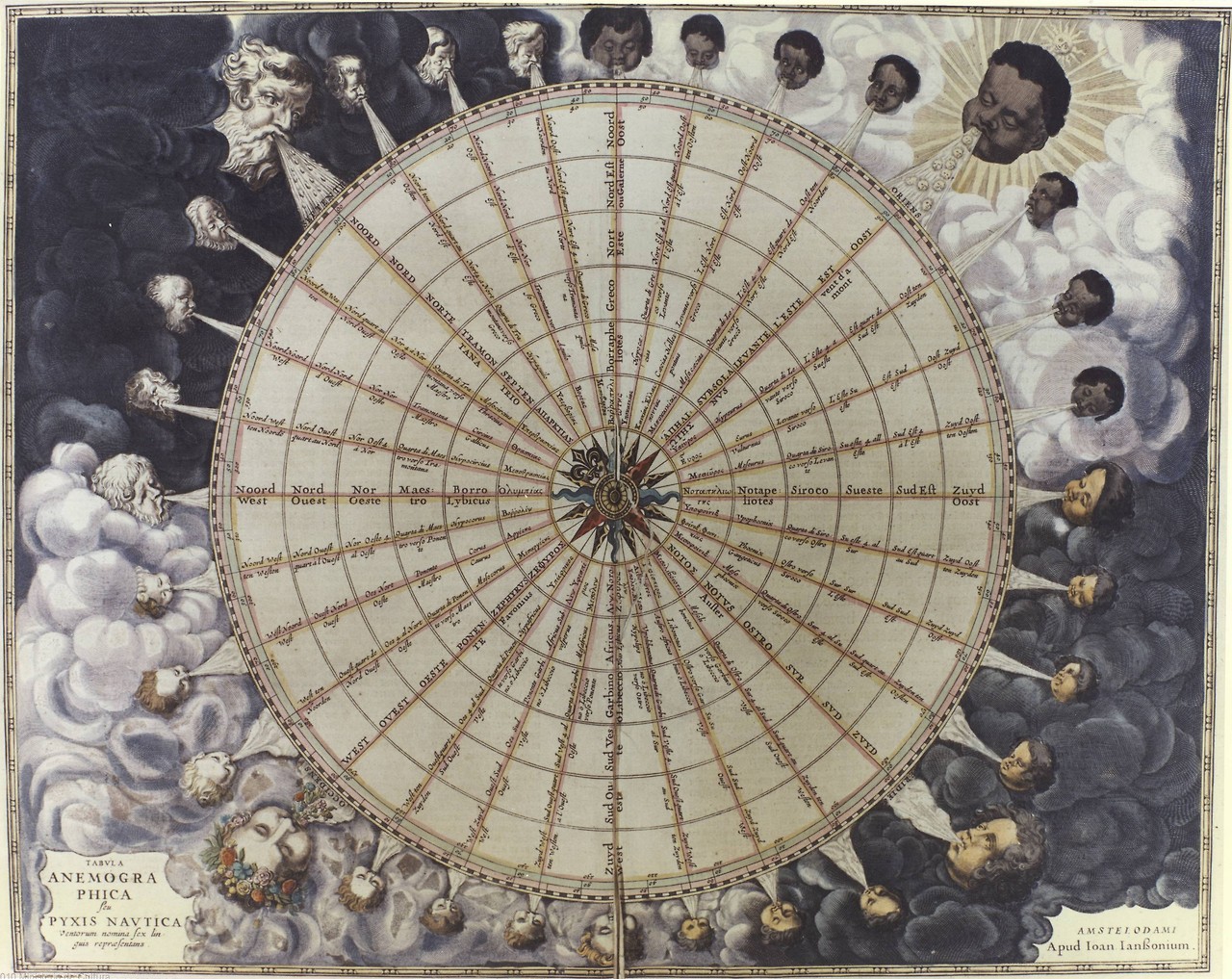
    In any event, following up on post from a while ago on the names of the winds ( https://historyofideasblog.com/thesciencebookstore/2012/04/chasing-the-squamish-the-fremantle-doctor-and-naming-the-wind.html) I wanted to share this great display of information, Jan Jansson’s volvelle/chart of the 32 winds from the fifth volume of his monumental Atlas Major, which was published in 1650.  (Jansson, “Tabula Anemographica seu Pyxis Nautica Ventorum nomina sex linguis repræsentans”. Amsterdam, c.1690.  Image via Bibliodyssey .)


    WInds Jansson


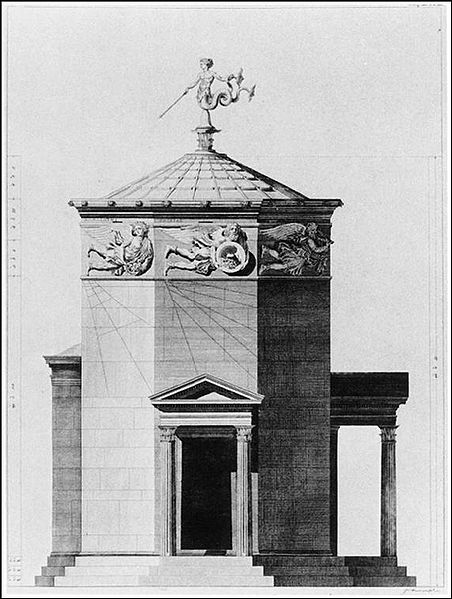
    A monumental, three-dimensional form of wind identification exists in Greece, a marble Roman clocktower (an horologion) with a wind vane at the top, along with eight symbols of the associated gods of the winds (the Anemoi)  that the vane depicts: Boreas (N), Kaikias (NE), Eurus (SE), Apeliotes (E), Notus (S), Livas (SW), Zephyrus (W), and Skiron (NW).

    WInds Athens


    ·Posted by :

    ·in:


  • Meeting the Pretercomputer and the Pseudo-Computer (1956 and 1963)

    JF Ptak Science Books   Post 2767

    In just a few minutes of browsing in a pile by the desk last night I came across three terrific titles of papers, two of which used terminology I had never encountered before. The papers were on “pretercomputers” and “pseudocomputers”, with a third using familiar terms in a very unfamiliar pairing, “uneconomical robots”. Finding all three from two slender sources within that time frame was a real eyebrow-raiser.

    The first work was found in a loose issue of  the Journal of the Association for Computing Machinery  (April 1956, vol 2/no. 3, pp 65-73): Robert Perkins’ “EASIAC1, a Pseudo-Computer”. It seems that the EASIAC (EASy Instruction Automatic Computer) was developed to make it easier for a newbie to program a computer, or at least easier to program compared to the MIDAC ( Michigan Digital Automatic Computer) with which it was associated.  (The MIDAC was developed by the  Willow Run Research Center of the Engineer­ing Research Institute, U Michigan, the first digital automatic computer in the Midwest.)

    Next in the pile was a 1963 issue of Cybernetica2, and the first title in that issue leapt from the page: C.K. Gordon, Jr.’s “In defense of the Search for the Pretercomputer”. Gordon seems to be looking for foundations of some next level of computer (“preter”=”praeter”, Latin for “beyond”, or past what is normal), writing on machine thinking, and “awareness”, and an approach to expression of thought by a computer in a “preter-linguistic response”(?).  I rushed to the conclusion of the paper where the author states that ”much mathematical groundwork has been laid in logically demonstrating the constructibility of certain types of automata” citing work by Burkes, Culbertson, Kleene, Minsky, McCulloch/Pitts, Turing, Uttley, von Neumann, and others. He also points out the “construction of a number of rudimentary devices, showing their learning behavior and a remarkable degree of adaptability” by Ashby, Chapman, Miner, Pask, Shannon, Uttley and Walter.

    Checking out the bibliography for this paper I found this delightful-sounding title of what I think is a semi-famous work by James T. Culbertson, “Some Uneconomical Robots”. The paper was published in Shannon and McCarthy’s Princeton Studies series Automata Studies, which unlike the other two papers mentioned in this post was at least one that I had seen before, a noteworthy effort in a volume of noteworthy efforts.  (Culbertson also wrote a paper called “Hypothetical Robots” in 1952, plus The Minds of Robots (1963, U of Illinois), in which he makes a philosophical case for there being some at least low-level consciousness in everything, and therefore the same is true for machines.)  I’ve determined that I don’t have this volume of the Princeton series, nor can I find it (yet) online, and although there are some strong references to the paper I haven’t yet found much to tell me of its contents, though I did find Herbert Keller (in his “Finite Automata, Pattern Recognition and Perceptrons” in the JACM in 1960) describe it as arithmetic and “fanciful”. 3 I realize I’ve said nothing yet about the Culbertson, but my time allowed on this post–like the robo-cops tracking down Robert Duvall’s character in THX-1138–has run out. I’ll return to this post and extend it shortly.

    Readers of my post this morning may be thinking these papers are far less extraordinary-sounding than I found them to be, especially finding them in such rapid succession. I don’t do all that much work in the history of computers, so to a more-general history of science person like myself these titles were captivating, burnished with a deep golden hue of possible whimsical and sci-fi interpretations…the possibilities there are endless.  It was a funny little adventure that was populated with many extensions and absorbing titles that begged to be pulled out-of-context. They seemed on one hand to be the stuff of speculative history of the future material–except of course they were far more “real” than that. 

    ·Posted by :

    ·in:


  • On Possibly Rejecting the Telephone for the Ugliness of Telephone Wires (1885)

    JF Ptak Science Books  Quick Post

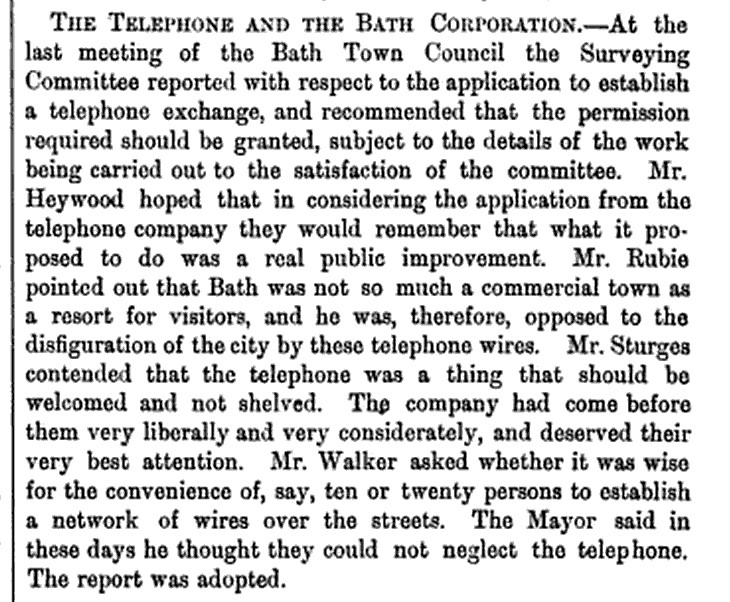
    Vast throngs of people have resisted technological innovation/improvement/invention one way or anther, from the rejection of the printed word because it would badly influence the spoken word tradition; to the telegraph, which would impact the facility and beauty of letter-writing; to the telephone, which would adversely impact the telegraph and become an assault on privacy, and so on. Some of these complaints were real and valid; others, not so much so. Today I found another episode in this sort of thinking, this time relating to possibly rejecting the telephone in terms of aesthetics–and that being the complaint of  the ugly nature of telephone wires and their impact on a cityscape. The city here was Bath, 1885, and the town leaders were considering a proposal by a telephone company, not all of whom were in favor of the relatively new (1876 for all intents and purposes) invention. 

    • “…Heywood hoped that in considering the application from the telephone company they would remember that what it proposed to do was a real public improvement. Mr Rubie pointed out that Bath was not so much a commercial town as a resort for visitors and he was therefore opposed to the disfiguration of the city by these telephone wires. Mr Sturges contended that the telephone was a thing that should be welcomed and not shelved.” 

    In any event, the mayor of Bath said that the telephone should not be “neglected”, and decided to establish the telephone exchange. And so:

    Telephone 1886 The Engineer

    [Source: The Electrician, 25 December, 1885.]

    ·Posted by :

    ·in:


  • Beautiful and Complex Interfaces (1880s)

    JF Ptak Science Books   Quick Post

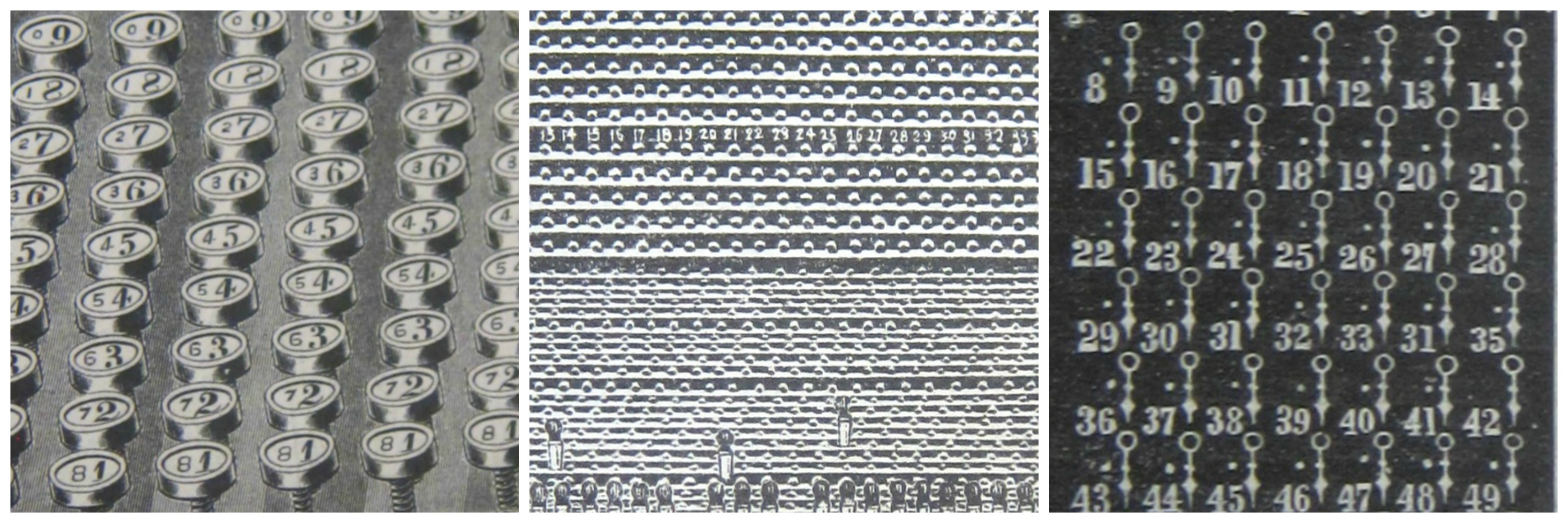
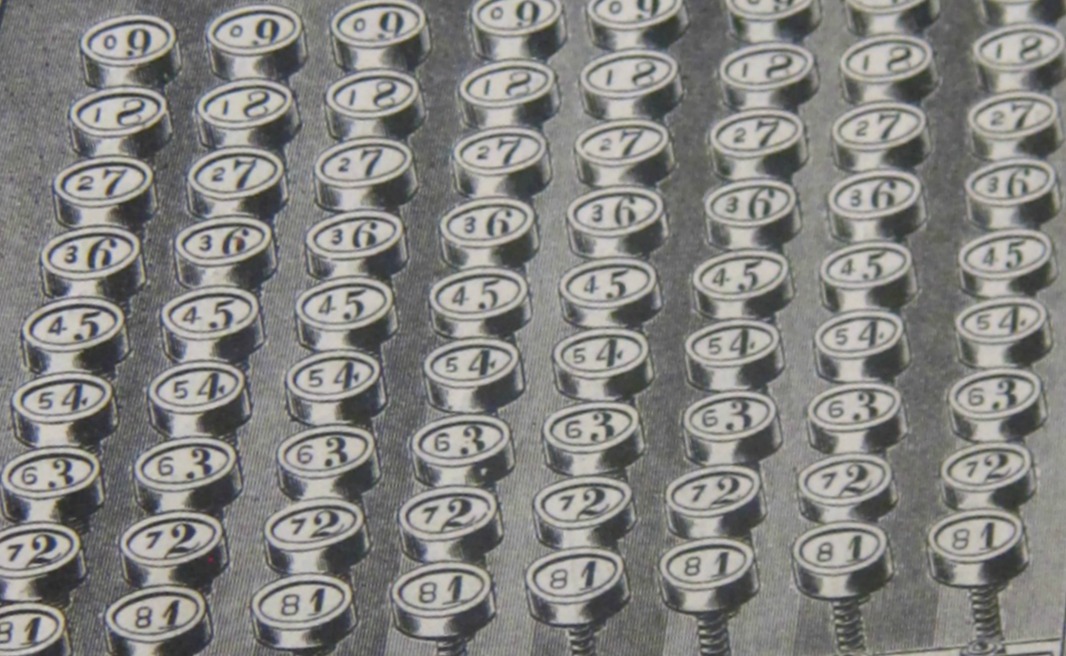
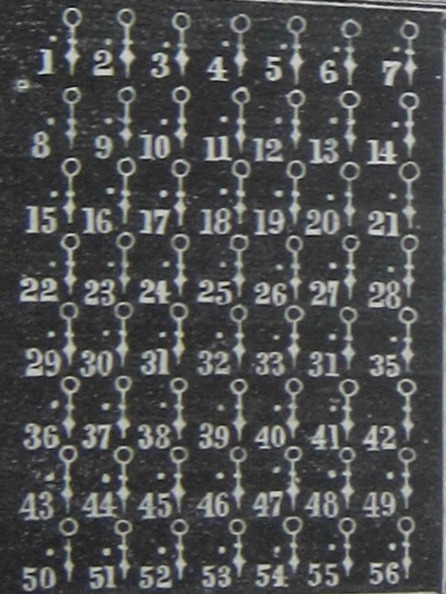
    There’s a certain gravitational attraction for the user/machine interface of 19th century tech that is highly–pardon me–attractive. All I want to do here in this simple post is share a few of these that I bumped into yesterday while on the search for 1880s calculating devices, one of which appears below. The three detail images below display some of the beauty of these machines and the point at which they come into contact with its operator. First, the keys for a very early image of Dorr E. Felt’s “Comptometer” calculating machine (1885); the second is a detail of Stabler’s Single Call telephone exchange (1884), and the third the business end of an electric bell display cabinet, also from 1884.  (The full images are displayed below along with their sources.)

    Collage interface
    Telephone signal system electrical world super detail

    Comptometer detail super


    Electrical bell electrical world detail


    From the front page of Electrical World for March 8, 1884:

    ·Posted by :

    ·in: