A Daily History of Holes, Dots, Lines, Science, History, Math, Physics, Art, the Unintentional Absurd, Architecture, Maps, Data Visualization, Blank and Missing Things, and so on. |1.6 million words, 7500 images, 4.9 million hits| Press & appearances in The Times, Le Figaro, Mensa, The Economist, The Guardian, Discovery News, Slate, Le Monde, Sci American Blogs, Le Pont, and many other places… 5000+ total posts since 2008.

Category: Uncategorized

  • German Interior Design Catalog, 1907

    JF Ptak Science Books  Quick Post

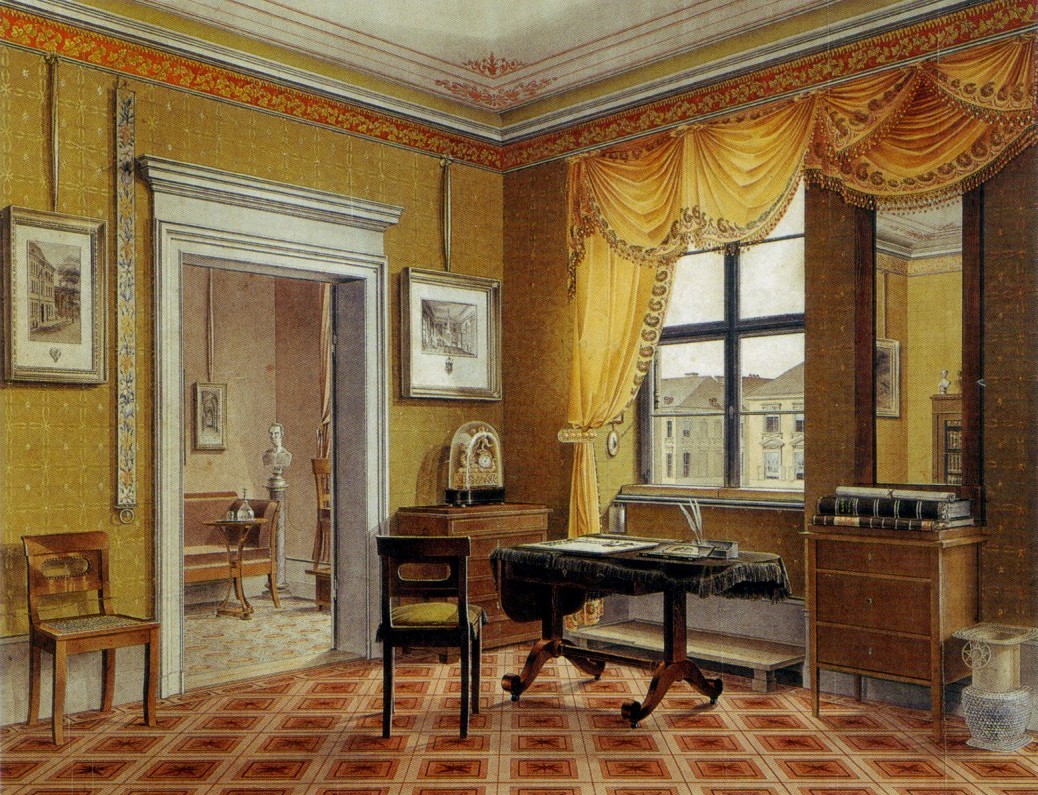
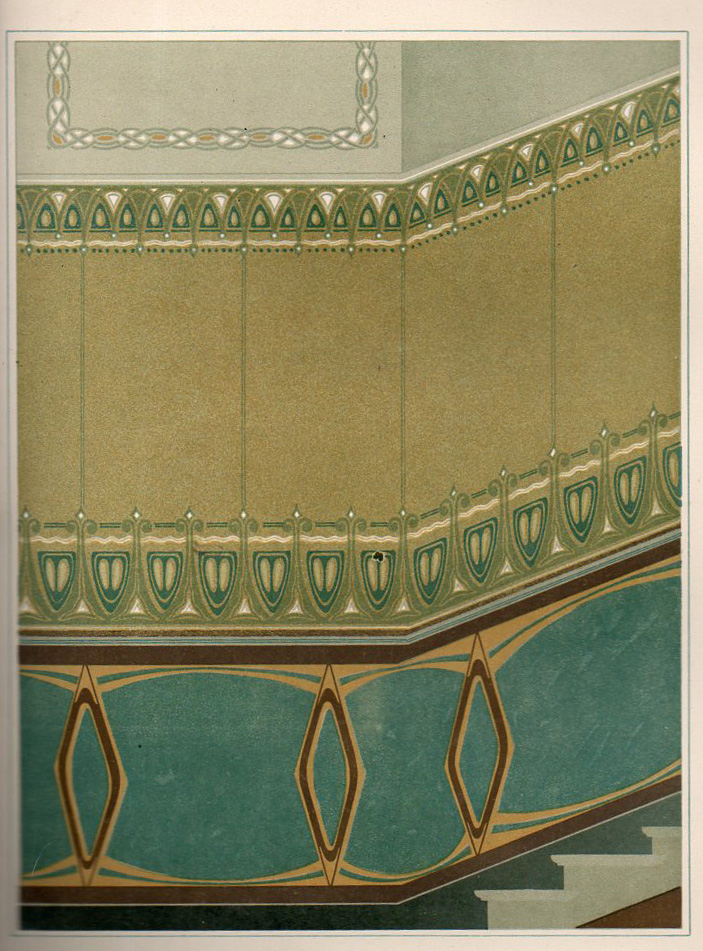
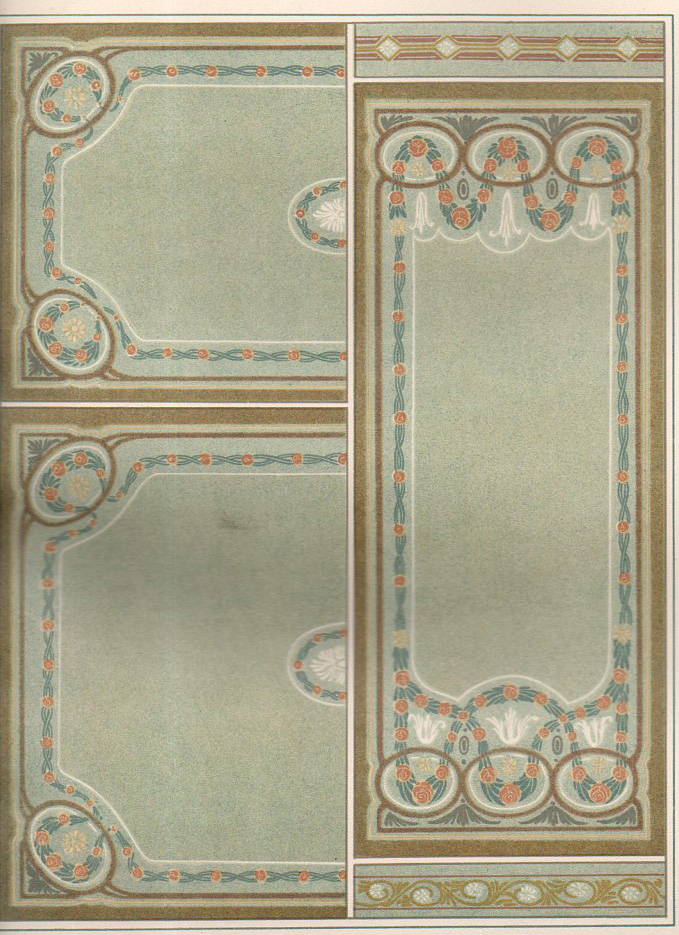
    This beautifully illustrated 1907 German book1 seems to me to be a sales catalog for a company selling flat-masks, or templates, through which desirable and somewhat complicated (or at least complex) nay be produced.  A customer could leaf through this book of 60 designs which are arranged according to room type, and perhaps, if the fancy struck, could purchase the sheets and instructions necessary for the job to be done.  For example, plate #44 (Reggie Jackson’s number in the great summer of 1977), the “Pause mit Hilfsschablone” (its identifier in the “Preisliste” and offered at 10 Marks) is meant to decorate a wall for a stairway. 

    Jugendstihl361

    The great bulk of the designs are those for ceilings, and ceiling corners, as well as for wall designs and the small bits that run slightly above the floor and the wall (I’m sorry, but I don’t know the technical term for this).

    In any event it is a very surprising work to find–for me, at least–to see someone selling the possibilities of such advanced design motifs in a simple, order-it-from-our-catalog format.

    Notes:

    1.  Paul Steuer.  Malereien fuer Flachenschablone und Pinseldruckmanier in modernem und Biedermeier-Stil, published by the Otto Baumgaertel publishers, Berlin, in 1907.  Only two copies of this work are found in WorldCat, at the Staatsbibliothek zu Berlin and another in the Wissenschcaftliche Staatsbibliothek in Mainz. 

    Jugendstihl365


    http://upload.wikimedia.org/wikipedia/commons/a/a0/Zimmerbild_83.jpg


    ·Posted by :

    ·in:


  • A Tough Place to Work: in a Box, Submerged, Digging out Dirt from a River Bed (1873)

    JF Ptak Science Books   Post 2686

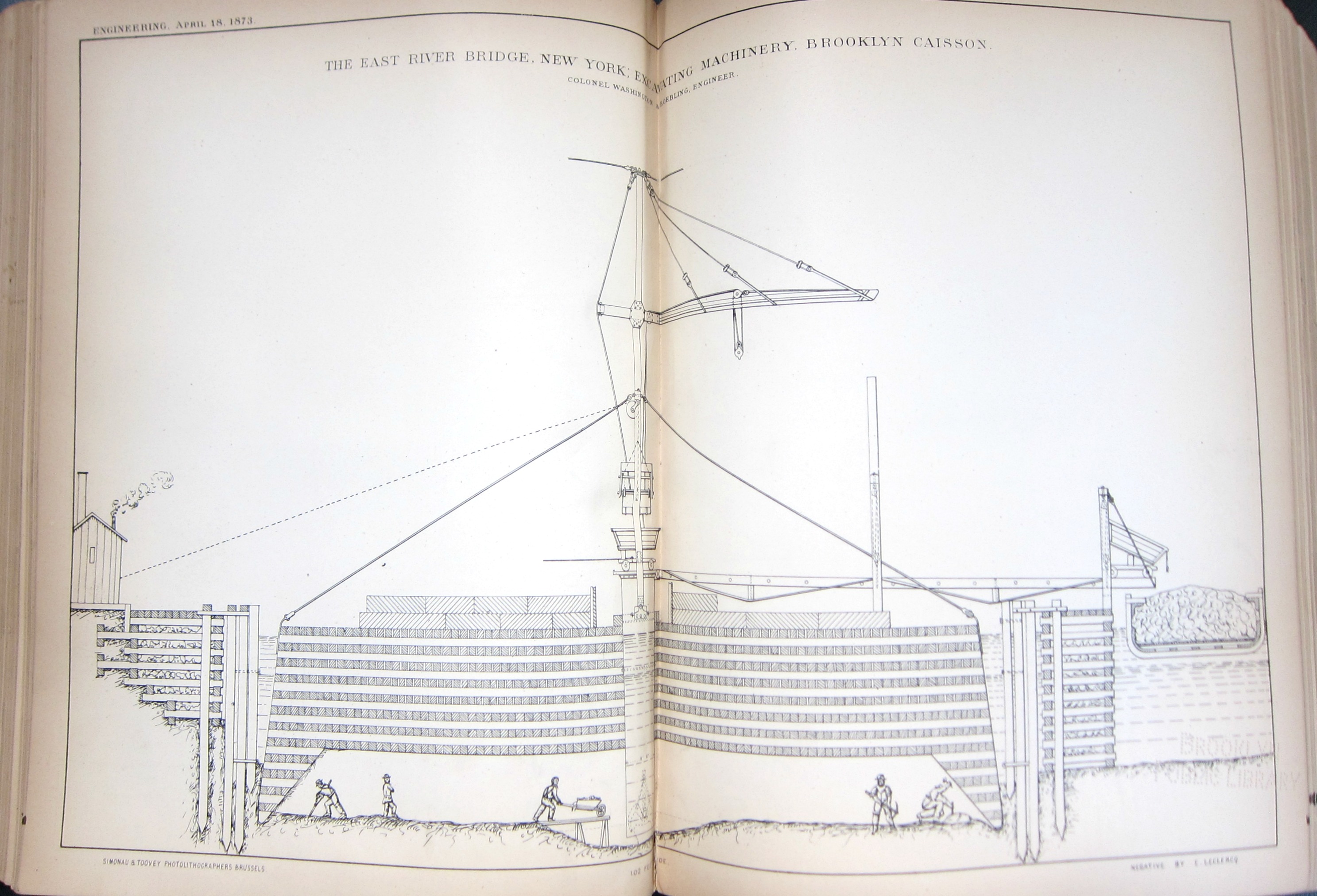
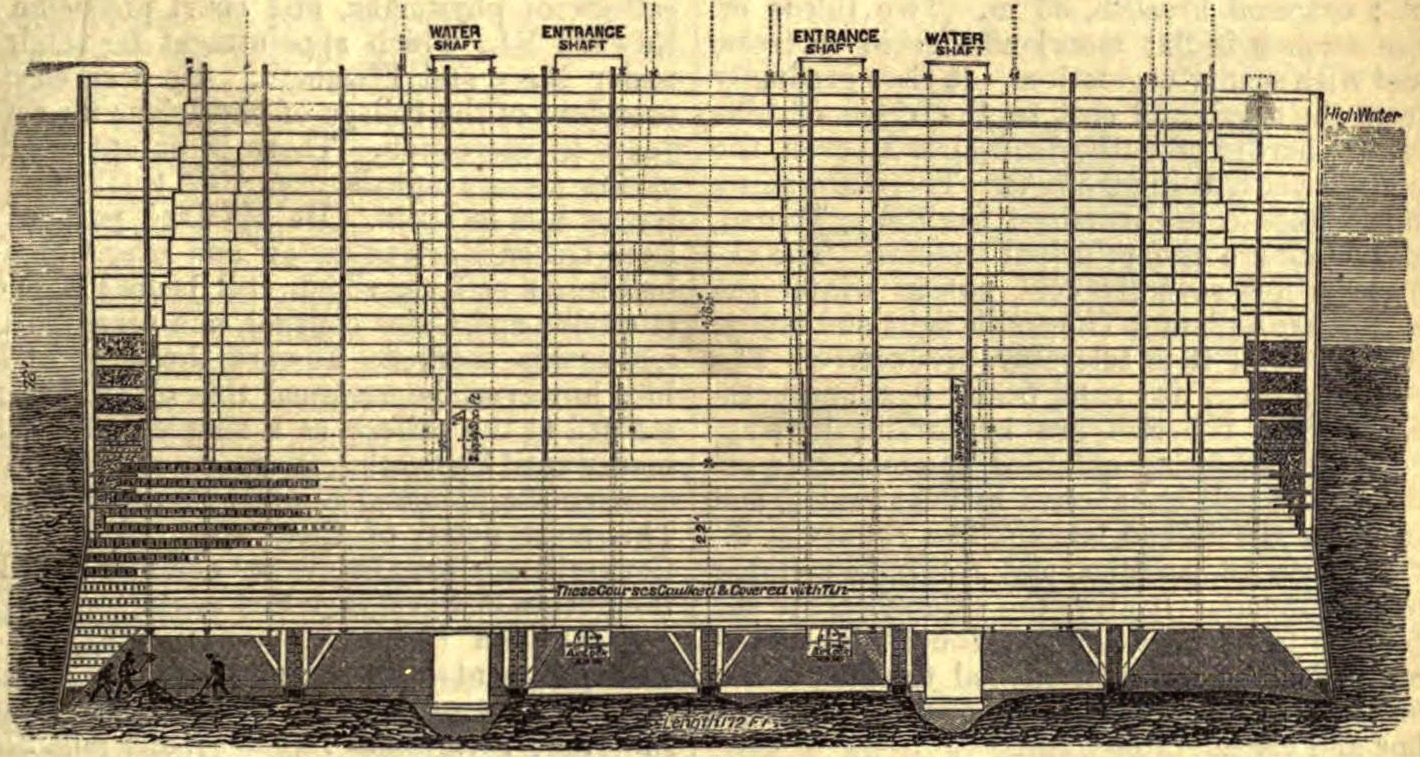
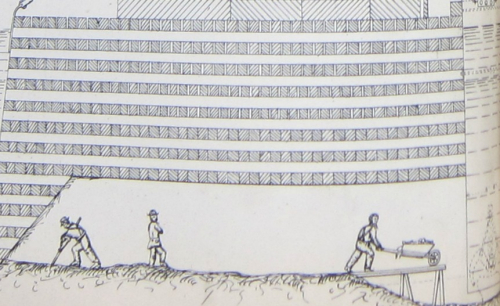
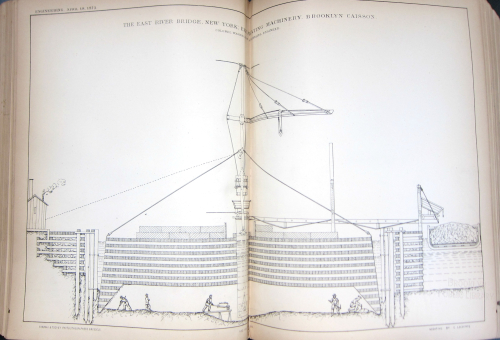
    Well, this was just one King-Hell tough place to work. Not only were the conditions cramped, and the air not-good (and occasionally deadly), and dark, and humid, but the work itself was hard. The guys in the detail of this woodcut below were sweating away in an inverted box on the riverbed of the East River (NYC) with thousands of tons of stuff on top of the box. The box was actually a caisson1–a nicer French word  (“case” or “chest”) for the box–and it was a designed object for bridge construction for establishing solid footings for massively heavy towers under water. So the deal was the the caisson is a box upended, sunk down to the river bed, with space enough for men to work in in the free space in the caisson bottom. There would be air shafts and elevators to pull out excavated earth, and as the workers dug down, the caisson would sink, and with each movement enormous blocks of granite would be placed on the top of the caisson to help it sink further.  And so this would be the process, digging down through a silty river bottom, pulling out the very heavy muck (having just done some little bit of work on a lake bottom I can tell you that the mud is extremely thick and heavy and difficult to maneuver), the caisson moving down as the earth was removed, continuing the process until bedrock was reached. And then, it was all filled in, more weight was added to the top of the caisson, until that special engineering sweet spot was reached that allowed you to start building the bridge’s towers from which the bridge span would be suspended. 

    The work in this case shows the progress on the building of the East River Bridge, soon to be called the Brooklyn Bridge, in 1873, four years into the making, designed by an immigrant, John A. Roebling. The Bridge would be finished ten years later in a titanic task the story of which is beautifully told in David McCullough’s Brooklyn Bridge (1980).

    This was a very difficult job and absolutely vital job, not the least of which was the problem of decompression sickness, which affected many dozens of workers, and which was hardly understood. All for $2/day, which was a little better than standard pay for laborers (and equal to about $60/day in 2017 dollars so far as I can reckon, which is sorta/kinda minimum wage for 2008.)

    So here they are, the guy on the right is hauling the muck to an elevator shaft at right (more visible in the full version of the woodcut, following), while another fellow shovels, and a third man strands there surveying the scene with arms folded in a pose recognized world-wide at construction scenes.  The little squares above them show 12x12xX lengths of cut lumber, on top of which stone would be placed, 
     

    Brooklyn Bridge Caisson Engineering 1873

    This is the full image from the massive (nearly 20 pounds) wrist-busting volume of Engineering for 1873:
    Brooklyn caisson large engineering 1873


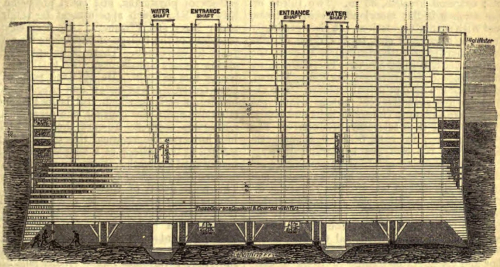
     Another image, this from The American Cyclopedia, showing the caisson at a more developed stage, and feeling that much more suffocating:
    Brooklyn Bridge Caisson wikimedia

    [Woodcut/drawing illustrating caisson used by W. A. Roebling in the construction of the Brooklyn Bridge. The American Cyclopædia, v. 3, 1879, p. 557 (Fig. 2).]

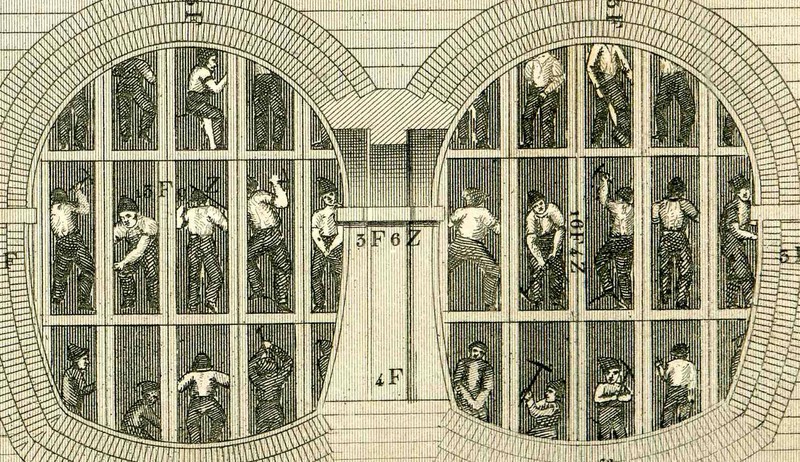
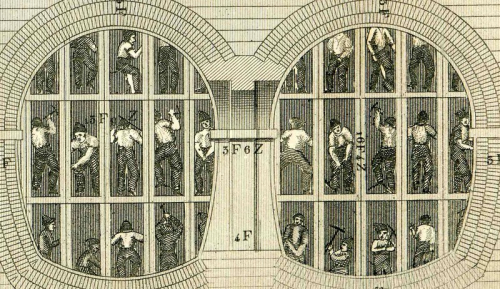
    I can’t help but include another image of a hard place to work, this one for the Thames Tunnel (from my post here: https://historyofideasblog.com/thesciencebookstore/2012/08/beautiful-technical-illustration.html)
    Tunnel detail thames

    Notes:

    1. “Caisson:  in architecture, a panel sunk below the surface in soffits or ceilings. In civil engineering, the term is applied, first, to a hollow floating box, usually of iron, which serves to close the entrances of. docks and basins; and second, to a box-like structure used in constructing or sinking the foundation of piers under water. Of the latter there are at least three different varieties: the ordinary, the bottomless or open, and the inverted, which includes the pneumatic. 1. The ordinary caisson is a large box with bottom and sides, made of timbers or planks, in which masonry is built and sunk to its desired position under water.”–The American Cyclopædia, v. 3, 1879, p. 557
    ·Posted by :

    ·in:


  • Another Antiquarian Man Ray Rayograph (1872)

    JF Ptak Science Books   Quick Post

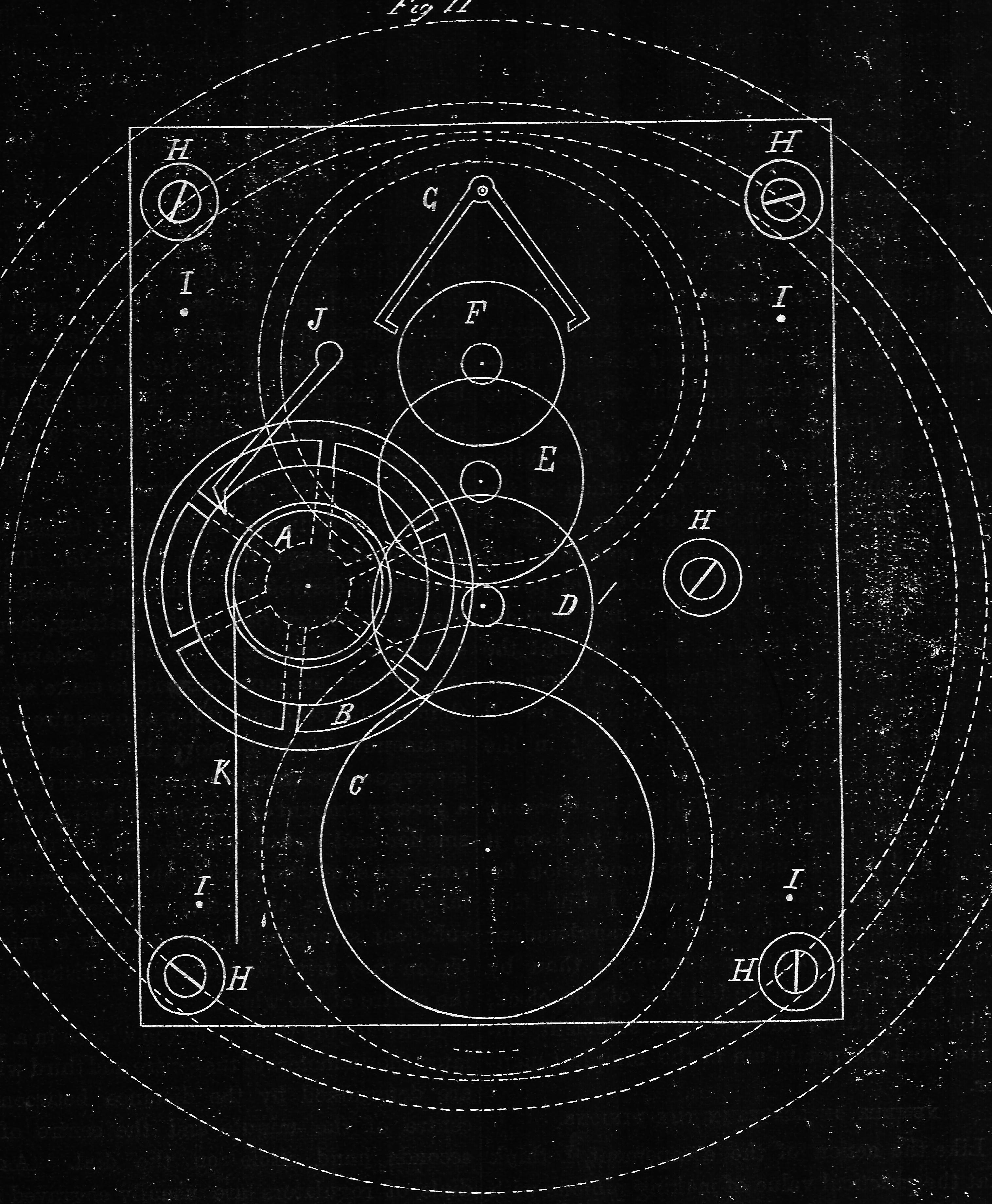
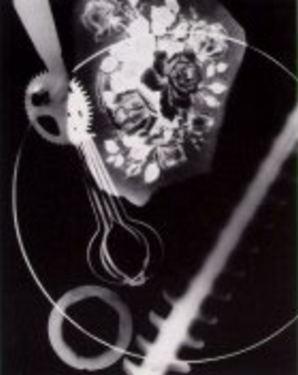
    Earlier on this blog I posted about a prehistoric (man)rayograph, using a negative of an engraving from 1810 to stand alongside a modern rayograph–today though I found an engraving int eh same category but already in negative.  This one is from the American Horological Journal (volume 4, November 1872) and bears more than a passing resemblence to the modern avant-garde photographer’s x-ray work–or perhaps I am pushing teh envelope on their relationship. Bottom line, though, is that the technical aspects of these clockworks are artistic visions in themselves, even when completely out of context (even as lovely as they are in context). 

    https://historyofideasblog.com/thesciencebookstore/2012/06/a-prehistoric-rayograph-a-proto-example-of-man-ray-from-1810.html

    American horology

     And a rayograph:

    Man ray ograph

    ·Posted by :

    ·in:


  • Extreme Results of an Extremist Populist Presidential Candidate (1872)

    JF Ptak Science Books   Quick Post

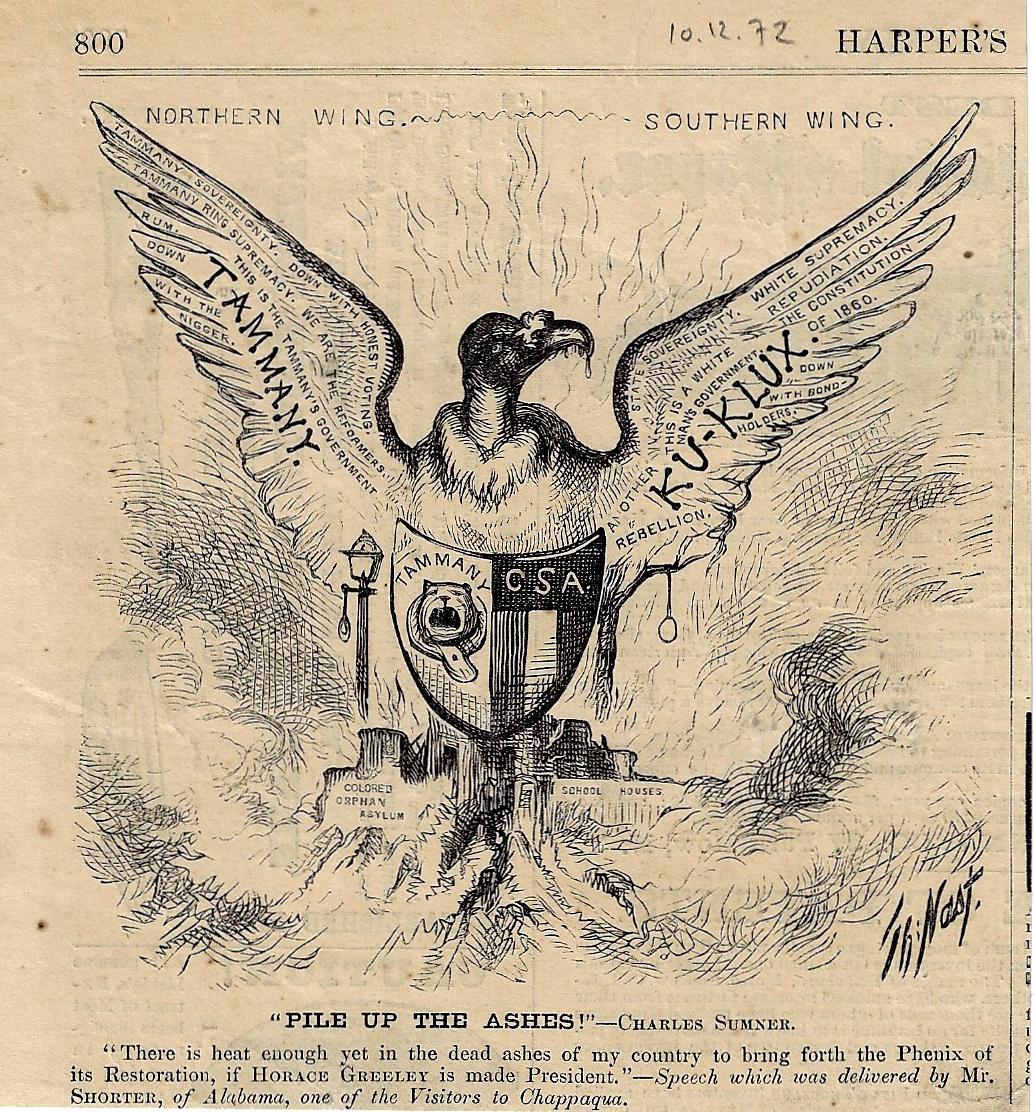
    So thought the great Thomas Nast, who in his enormous endeavors at Harper’s Weekly drew this political statement as a small corner-filler for the weekly issue of October 12, 1872. The fear for him was the resurrected Phoenix of Tammany Hall and the K.K.K. as a result of electing Horace Greeley to the presidency of the U.S., and he was no effort in making his statement with any nod to the subtle. We can clearly see the characteristics of each group emblazoned on the wings of the Phoenix–less visible in the background are the ruins of the “Colored orphan asylum” and “school houses”, targets of the despicable Klan. The election was only weeks away at this point, and Greeley was running as a splinter Liberal Republican, and was trounced by Ulysses Grant in the electoral college. As it turns out, Greeley would be dead three weeks later. 

    Nast 1872 CSA Tammany

    ·Posted by :

    ·in:


  • Shooting an Eclipse in Turkey, 1894

    JF Ptak Science Books   Quick Post

    Astronomy shooting an eclipse

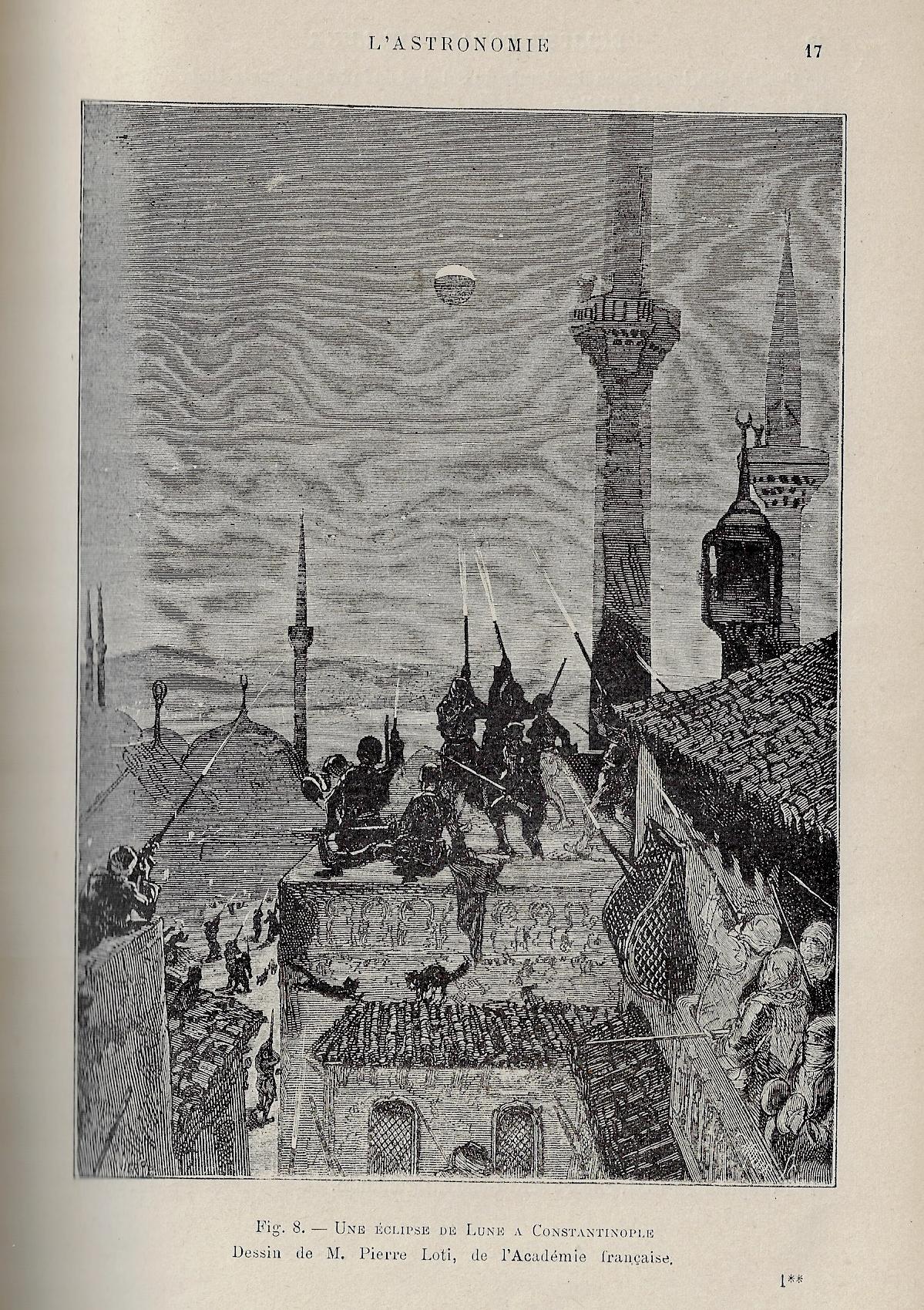
    I came across this interesting image in L’Astronomie, revue mensuelle d’Astronomie Populaire, published in Paris in 1894, and edited by the  profoundly busy Camille Flammarion. The description and image is credited to the French author/adventurer Pierre Loti, and it describes the Turks of Constantinople shooting at the Moon (” Les Turcs tirent des coups de feu sur notre satellite”) in observance of the the fight of light versus darkness exemplified no doubt by the constellation Draco, the dragon, or Ouroboros, or serpent consuming itself, or some such.  During an eclipse it was believed going into the dim past that Draco was consuming the sources of light, and that in order to stop it from doing so observers would make as much noise as possible to scare the thing away.  Loti notes that this practice probably  has been observed since the time of The Prophet, though it is probably older than that.

    I’ve never seen an image depicting people shooting at the Moon with rifles (there are some famous examples of this with the first motion picture version of Verne’s From the Earth to the Moon) and so I’m sharing it–perhaps someone out there will help with the deeper interpretation of what is going on.  

    • “L’une des dernières éclipses de Lune a été l objet d une observation d un genre spécial à Constantinople par M Pierre Loti l élégant auteur de Madame Chrysanthème, auquel nous devons le dessin fort original reproduit ici. Les Turcs tirent des coups de feu sur notre satellite pour le délivrer du Dragon qui le ronge antique dragon astrologique qui a laissé des vestiges dans les signes astronomiques modernes mêmes nœud période draconitique etc. La dernière éclipse a sans doute été l objet d une cérémonie du même genre chez les disciples de Mahomet….”–Populaire Astronomie, pg 17.


    ·Posted by :

    ·in:


  • The First Church for Animal Rights (1921)

    JF Ptak Science Books  Quick Post

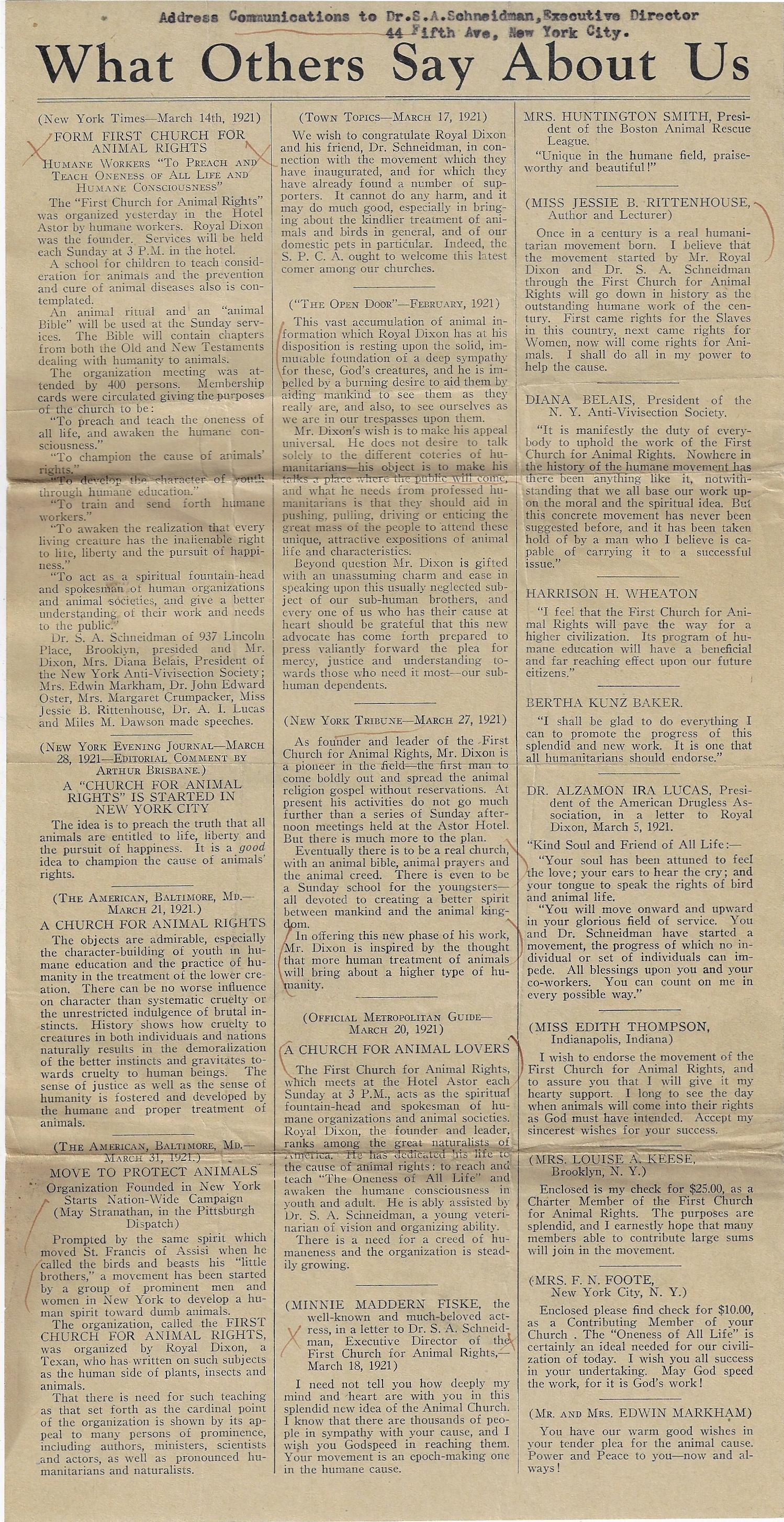
    This broadside comes announces  “Humane Workers to Preach and Teach Oneness of all Life and Humane Consciousness” in the formation of a church dedicated to equal rights for humans and animals, and so far as I can tell it is a rare application of the idea of church for all living things.  “The First Church for Animal Rights was organized yesterday in the Hotel Astor by humane workers. Royal Dixon was the founder. Services will be held each Sunday at 3 P.M. in the hotel.” so states the broadside.  Mr. Dixon (1885-1962) blazed an interesting path to this point (in 1921) in the formation of this church; he was a former actor, and then a curator of botany at the Field Museum in Chicago, a staff writer at the Houston chronicle and writer in general (The Human Side of Plants (1914),  The Human Side of Birds (1917), The Human Side of Animals (1918)), and then on to the great cause of animal rights.  

    The church seems rather a radical thing, to my eye, and especially for the times. Not only was there a church, but also “A school for children to teach consid­eration for animals and the prevention and cure of animal diseases also is contemplated.” Also from the broadside:

    • “An animal ritual and an “animal Bible” will be used at the Sunday services. The Bible will contain chapters from both the Old and New Testaments .The organization meeting was attended by 400 persons.”

    The listed objectives of the church:

    • “To preach and teach the oneness of all life, and awaken the humane consciousness.”
    • “To champion the cause of animals’ rights”
    • “To train and send forth humane workers.”
    • “To awaken the realization that every living creature has the inalienable right to life, liberty and the pursuit of happiness.” 
    • “To act as a spiritual fountain-head and spokesman of human organizations and animal societies, and give a better understanding of their work and needs everyone.”

    ANimal kindness


    In spite of what seems to be an initial success, I can find nothing else about a second meeting of the church.

    ·Posted by :

    ·in:


  • “Look Out!” (1939)

    JF Ptak Science Books   Quick Post

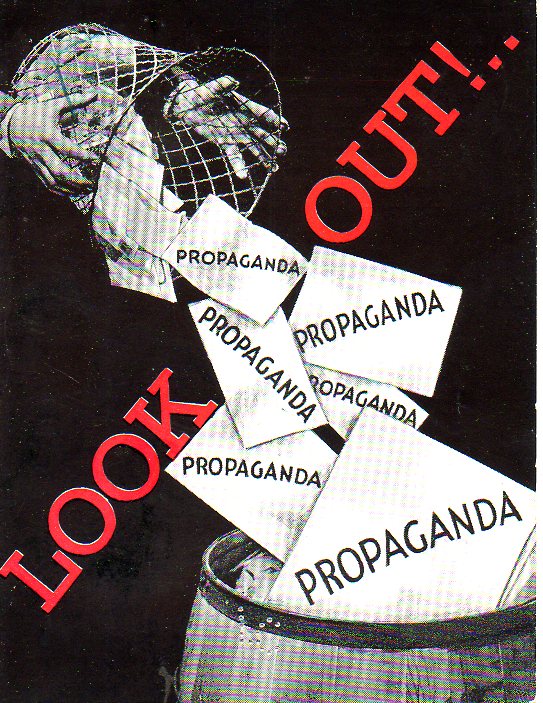
    Look Out! (a WARNING ABOUT PROPAGANDA), Common Sense Talk.  This was published by Men of America in 1939, and is a slight, six page publication.  

    Striking design! And a scarce little bugger! 

    Propaganda Look Out202

    ·Posted by :

    ·in:


  • Ghost Vision and the Coming of T.V. (1850)

    JF Ptak Quick Post

    Joseph Plateau, “On a New and Curious Application of the Permanence of Impressions on the Retina”, in Philosophical Magazine, volume 36, January-June 1850, pp 434-436; followed immediately in a much longer paper, “Second Paper on a New and Curious Application of the Permanence of Impressions on the Retina”, pp 436-452, with two plates.

    Plateau

    From: An Annotated Bibliography of Flicker Fusion Phenomena…1740-1952, by Carney Landis, p. 

    PlateauPlateaun (1801-1883) was the inventor of the Phenakistoscope in 1829, and contributed often (especially with considerable papers in 1835 and 1836) on the issue of persistence of vision. Here he writes of that and the flicker effect, which is the optical illusion in which individual sequential units of images are viewed as a continuous motion of images, which is a trick of the visual system and makes such this as the movies and cartoons and animated shows possible.  It is a terrible irony that this great writer on physiological optics would be blind or nearly so by the 1840’s, this a result of an experiment conducted requiring him to stare at the sun for nearly half a minute.

    “Plateau studied in great detail the phenomena of accidental colors and irradiation, both of which he considered as arising from a similar cause related to the persistence of the image on the retina. Accidental colors are those that appear after staring for some time at a colored object and then at a black surface, or closing one’s eyes and pressing one’s hands over them. An image of the object appears, usually in complementary color and slightly diminished in size. Plateau’s results include his discovery that accidental colors combine both with each other and with real colors according to the usual laws of color mixture. In irradiation luminous objects on a dark background appear enlarged, a factor clearly of interest to astronomers, among whom the question of the extent of the enlargement was causing controversy. Plateau showed that enlargement occurs regardless of the distance from the object and—explaining the varied experiences of the controversialists—that the mean amount of enlargement from the same source varied considerably from one individual to another.”–Dictionary of Scientific Biography

    Also in this volume: J. Locke, “On the Phatascope”, pp 453-457, “instrument for giving single vision with two eyes” (–Living pictures; their history, photoproduction and practical working. With a digest of British patents and annotated bibliography, Henry Hopwood, 1899.)

    Among the many other articles in this volume is William Fishburn Donkin’s “On the Geometrical Interpretation of Quaternions”, pp 489-502. (See Alexander MacFarlane’s Bibliography of Quaternions..., 1904, full text here: http://ow.ly/kFRy304gfVD

    Notes:

    • See The History of Discovery of Cinematography timeline, which is especially interesting for the pre-1850 entries http://precinemahistory.net/1850.htm


    ·Posted by :

    ·in:


  • The Heights of the Himalaya Mountains, 1819

    JF Ptak Science Books   

    Offered below is a highly interesting and diverse volume of  The Quarterly Journal of Science, Literature, and the Arts, edited at the Royal Institution of Great Britain, published by John Murray for the Royal Institution, London, 1819; volume VI; illustrated with three engraved plates and a folding map; contained in the volume of iv, 402.  Bound in half-calf with calf tips, and marbled boards. Nice copy. $350

    • “Height of the Himalaya Mountains (pp 51-75), signed “H.T.C.” with a 12×9” folding map.

    This is a wonderful story on the early mapping of the Himalayas, including the work of Capt. WIlliam Webb, who identified the highest mountain peak in the world in 1817.  The map that accompanies the article is mostly blank, with teh exceptions of rivers, a few establishments, and a series of peaks enumerated with Roman numerals. In this case, the peak XIV is identified, rising to 25,643 feet. It is today known as Nanda Devi, located approximately at 79.30 E. Long and 30.30 N Lat.  The peak today is the second highest in India and 23rd highest in the world.

    “A list of many lofty peaks of the Himalaya mountains, measured by him, has appeared in divers publications. It agrees, so far as it goes, with the ampler information contained in a Memoir of his survey officially furnished by him. The Memoir, which bears date 30th Nov. 1817, supplies further measurements of more than two hundred elevated positions, geometrically taken for inaccessible heights -. either barometrically or geometrically, for accessible stations – and in
    both methods, for twenty of those stations. It explains the mode in which the whole survey has been conducted, and these measurements executed…”

    “ From 1816-1820, William Web spent five lonely years surveying Kumaun (he determined the height of Peak XIV or Nanda Devi as 25,669 feet, just 24 feet higher than today’s measurement)..”.–https://www.himalayanclub.org/hj/65/3/the-great-game-of-mapping-the-himalaya/

    And this: “so far as our knowledge extends, the highest mountain in the world.” Its local name was Nanda Devi and for the next 30 years, while expeditions into the central Himalayas from Tibet and Nepal remained impossible, Nanda Devi reigned supreme as the world’s highest mountain (its height is now established at 25,645 feet/7817 m)–http://imagingeverest.rgs.org/concepts/imaging_everest/-288.html

    Other noteworthy articles include

    • “On M. Stromeyer’s new Metal, Cadmium. In a Letter from J. G. Children, Esq. to the Editor. . .” (On the essential element, Cadmium.)
    • “An Hypothesis to account for the variable Depth of the Ocean.” A terrific piece of thinking on measuring the semi-immeasurable in 1818. 
    • “Pitcairn’s Island. From the Voyages and Travels of Amaso Delano. Boston, 1817.”
    • “An Account of some Experiments made on the Body of a Criminal immediately after Execution, with Physiological and Practional Observations.” by Andrew Ure, M. D.  Again, another endlessly interesting article….


    ·Posted by :

    ·in:


  • Anti-FDR Cartoon Book, 1944

    JF Ptak Science Books   Quick Post

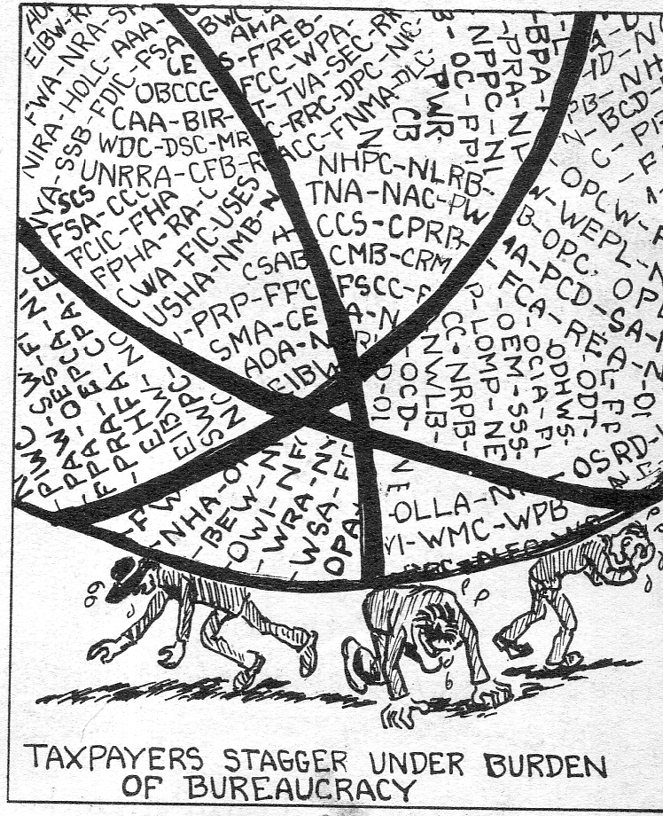
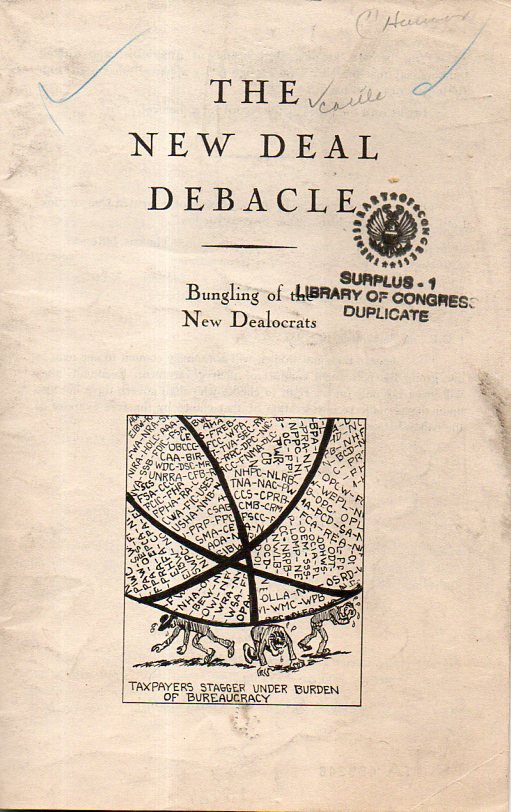
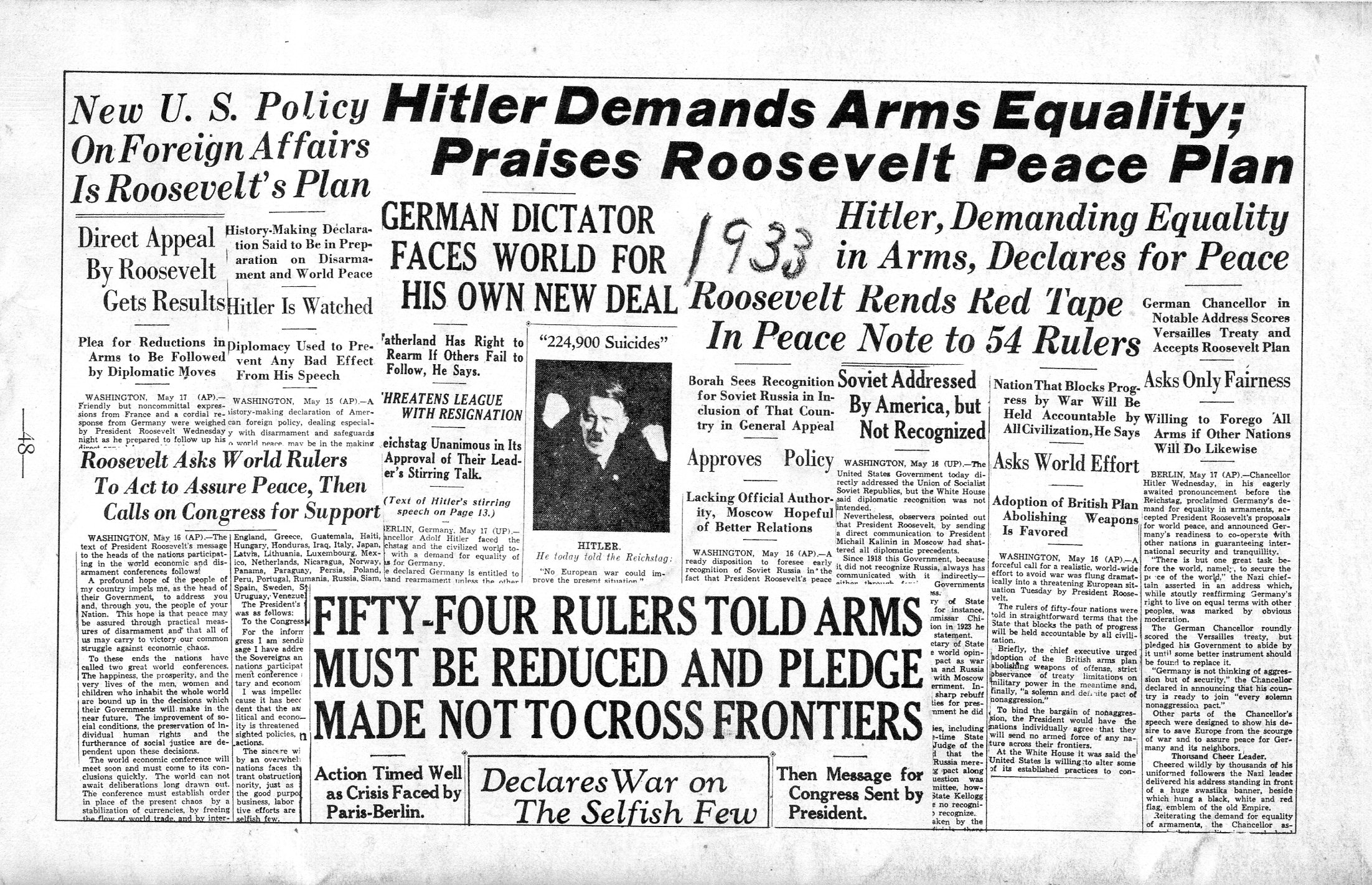
    It takes all kinds, as this pamphlet clearly if not not cleverly shows. There was some opposition to FDR as he went for his fourth term as president in 1944–by the summer of that year the outcome of WWII had swung positively towards the Allies, the Depression was broken, and for fighting in a world war the U.S. was in pretty good shape. There was of course opposition to his re-election, though in hindsight it is hard to see the why of the question, even including the unprecedented fourth term following the unprecedented third term. But the man was doing his job: he had basically saved the country and now was winning the war.  Even though FDR trounced Thomas Dewey in that election, it wasn’t as though a sizable percentage of U.S. citizens hadn’t had enough of him: FDR received 53% of the popular vote, won 36 of 48 states, and slammed the electoral college 432-99.  Still, there were only 3 million votes separating Roosevelt from Dewey in the popular vote (25 mil-22 mil), which seems odd, as it feels particularly uncomfortable thinking of Thomas Dewey heading the U.S. war effort for the closing two years or so of the war. Lincoln crushed the lead-footed Gen’l McClellan in the electoral college in 1864, and wound up beating him handily in the popular vote–but given the stature of Lincoln at that point, one might have expected him to pull more than a 10-point difference over the field commander who felt he never had enough troops, but he didn’t. Anyway, this pamphlet–written by Melissia Castle with cartoons by Pearl Porterfield–took long and myopic aim at the New Deal, trying to crush the enthusiasm for FDR.  I can’t find anything on Ms. Castle, and can only find a possible little bit for Ms. Porterfield (as a studio hairdresser and colorist to Marilyn Monroe and Jean Harlow, though I am not sure if this is the correct Pearl Porterfield)–the book itself also seems to be pretty much nowhere, so it looks as though it probably was published to little effect.   

    New deal debacle613

    New deal debacle612

    And the confusing back cover: 

    New deal debacle614

    ·Posted by :

    ·in: