A Daily History of Holes, Dots, Lines, Science, History, Math, Physics, Art, the Unintentional Absurd, Architecture, Maps, Data Visualization, Blank and Missing Things, and so on. |1.6 million words, 7500 images, 4.9 million hits| Press & appearances in The Times, Le Figaro, Mensa, The Economist, The Guardian, Discovery News, Slate, Le Monde, Sci American Blogs, Le Pont, and many other places… 5000+ total posts since 2008.

Category: Art

  • Art & Artists as Wartime Magi–Making Things Disappear, 1918.

    JF Ptak Science Books   Quick Post

    Its a little difficult to think of Ellsworth Kelly, Jacques Villon, Grant Wood, Laslo Moholy-Nagy and Thomas Hart Benton as painters-for-war.  But its true, and true for many of hundreds of other artists in the 1915-1918 era. Its not as though they were in the trenches gunning down the enemy or lobbing hand grenades into the swirling gun smoke. They werecamofleurs, camouflage1 experts, artists employed as magicians, Wartime Magi, employed/drafted to make ships and such disappear. 

    WWI Photos camouflage _1_

    Ever since it was (sort of) first noticed in 1915 that designs odd to the environment, stark geometric patterns and such, were capable of fooling the eye, people with  design capacity were pressed into service, rendering offensive and defensive instruments of war optically semi-impervious with variations of the then-five-year-old modern nonrepresentational art. That must’ve been a very odd position to wake up to every morning. 
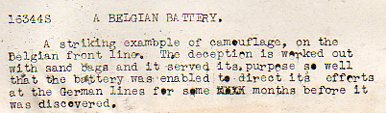
    WWI Photos camouflage _2_

    Of course the idea of camouflage in the animal world is probably 250 million years old–animals and insects have been blending into their environment for eons, and I’m sure too that early hominids did their fair share of walking behind brush.  But the idea of hiding great amalgamations of very heavy metal with paint is really quite modern.

    In this photograph, the camouflage is more a more futuristic conception of art than the abstract and cubist approaches that were taken during the war, this looking more like assemblages of found material more than anything else.  And, according to the text that accompanied the photograph (which comes from 1918, from the Underwood & Underwood news photo service agency), the camouflage–empty sandbags thrown on a barbed wire fence) successfully concealed a gunnery emplacement for months on end. 

    Notes

    1. A fine bibliography on camouflage appears here, at Leonardo Online.

    • The definition of “camouflage” from the Oxford English Dictionary shows that it is a young word, in English:
    • (n) The disguising of any objects used in war, such as camps, guns, ships, by means of paint, smoke-screens, shrubbery, etc., in such a way as to conceal it from the enemy; also, the disguise used in this way; freq. attrib.
    • 1917    Daily Mail 25 May 4/4   The act of hiding anything from your enemy is termed ‘camouflage’.
    • 1917    Daily Mail 16 July 5/3   The King paid a visit to what is called a camouflage factory.

    • 1922    C. E. Montague Disenchantment viii. 108   A French aerodrome across which the French camouflage painters had simply painted a great white high-road.
    ·Posted by :

    ·in:

    — —

  • Found-Abstract Art in Acoustics (with a Nod to Duchamp)

    JF Ptak Science Books  Quick Post 

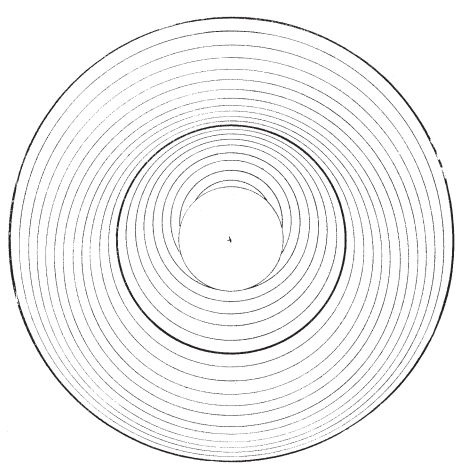
    Just yesterday I posted on Found-Abstract art  (https://historyofideasblog.com/thesciencebookstore/2018/10/found-art-in-electrical-hardware-1885.html) in a cross section of a conduit of telephone wires from 1885. Just now in research a bit on Tesla I found the following diagram for a classroom demonstration in acoustics (appearing in Nature, 11 February 1892) which could easily be added to a list of unintentional/unrecognized pre-Abstract Art art. If you varied the disks in black and white and motorized the whole thing you could imagine it another decade in the future as a work by Duchamp. As it is, it is an ingenious piece of thinking (the whole article follows):

    FOUND ABSTRACT ART 1892 nATURE CIRCLES

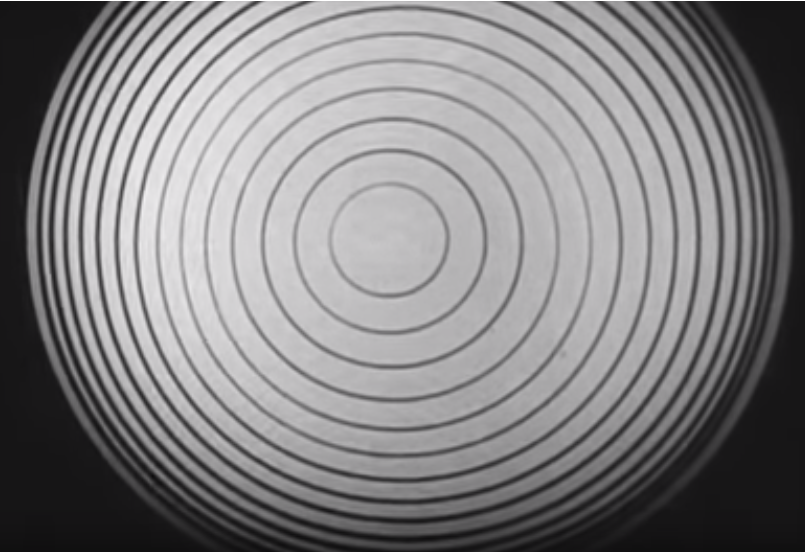
    And one still of many from Mr. Duchamp’s “Anemic Cinema”, 1926: 

    Duchamp circles

    For a video of the film: https://youtu.be/dXINTf8kXCc

    Also a nice piece on Duchamps optical experiments from Hyperallergic: https://hyperallergic.com/323582/duchamps-spinning-optical-experiments/


  • Found-Abstract Art in Electrical Hardware (1885)

    JF Ptak Science Books  Quick Post

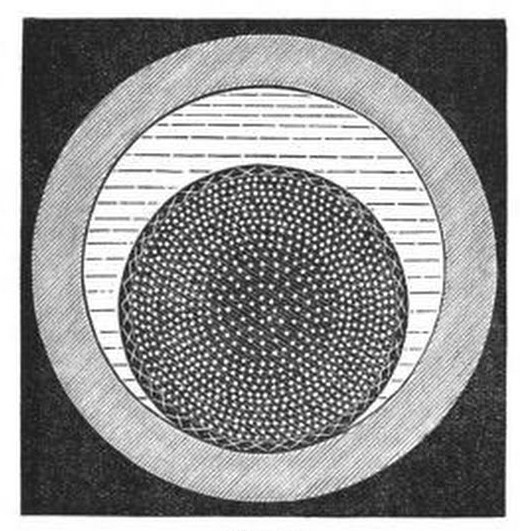
    I like this cross section as a piece of Found-Art–pre-nonrepresentational art, but it appears about 25 years too soon. It could be classified as “art” after Mr. Kandinsky makes an appearance…but we might have to look not very closely at the work of Whistler, Turner, Constable, and some others who came very close to abstract art but not quite…and we’ll also have to overlook some wide swath of Asian art (some quite ancient). 

    The actual element here is a cross section of a piece of 2.5″ pipe half-stuffed with 420 telephone lines, and belonged in 1885 to the Metropolitan Telephone Company of New York.  (“The dark shading shows the pitch filling the box around the pipe. The light ring next the pitch represents the wrought iron pipe inside of which rests the cable showing the ends of the copper wire surrounded with the insulating oil which fills the pipe full at all times.”–The Electrician, November 13, 1885)


    Electrical wires telephone electrician 1886

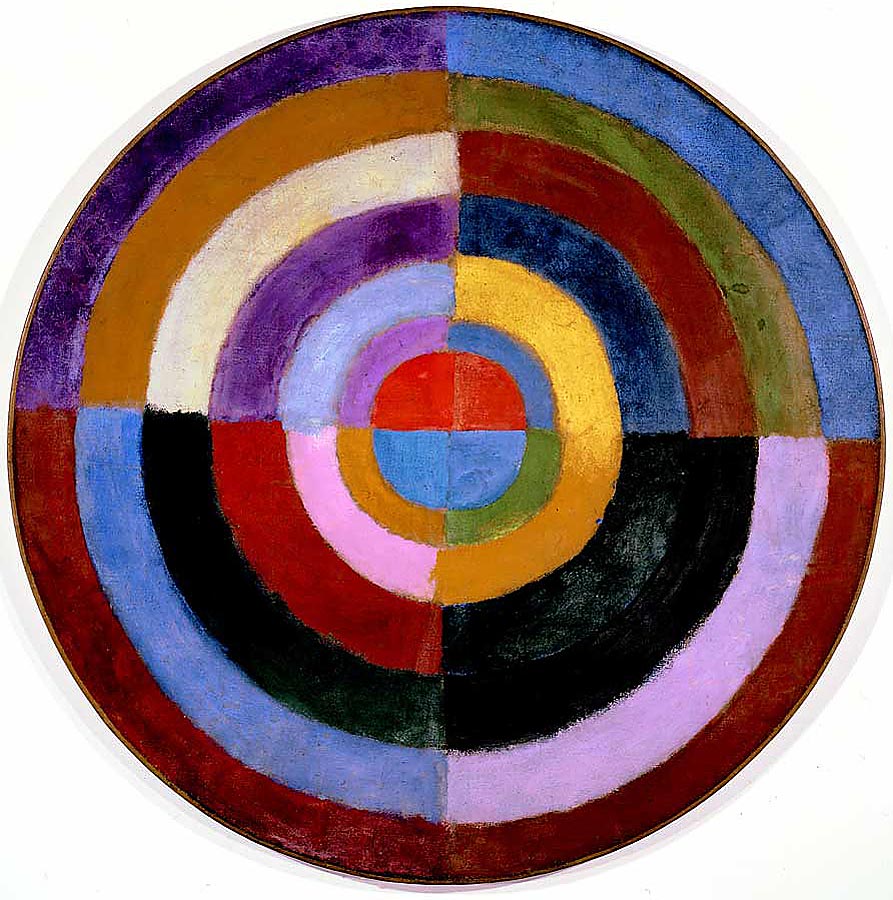
    And just conversationally I’ll include Robert Delaunay’s  1913 Premier Disque:

    Delaunay _1913 _Premier_Disque _134_cm _52.7_inches _Private_collection

    [Robert Delaunay, via Wikicommons]

    ·Posted by :

    ·in:

    —

  • Found-Art in Scientific Journals–“Mechanical Engineers” and Endless Chain Haulage, 1870

    JF Ptak Science Books   Quick Post

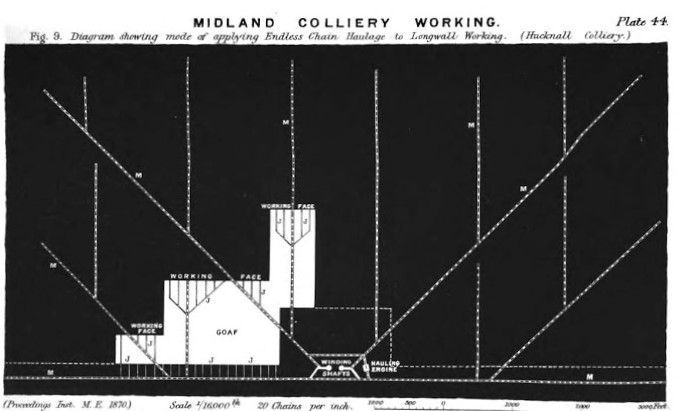
    I do believe that the engineering journals–particularly those from the 19th century–hold great promise for “Found-Art”:  these are images out-of-context whose whole or components are attractive from an artistic sense that was generally not regarded as “artful” until the creation of non-representational art in 1911. After all, art is the West spent a millennium or two trying to represent nature as closely as possible to what the eye perceived. (If you use 2000 years as a starting point for this discussion, it is remarkable, in a way, that perspective was (re-?) discovered in the West for fully two thirds of that time.) In any event I’m not going to get into a big discussion of all of that in this post, as the Found-Art business appears numerous times on this blog and I’ve chatted on about it there–so if you want to read that discussion just search “found-art” in the google box at right and have at it. For now, all I want to do is share the latest find, which comes from the Proceedings of the Institution of Mechanical Engineers, 1870, and published in Birmingham, in the article on hauling coal from Hucknall Colliery, Notinghamshire.  The seems like it might be a cross-section but I’m fairly well certain that it is a plan of some of the mine’s workings, the straight lines being the constructed and the future rail lines for the coal buckets that hauled out the chiseled-away coal. It is extraordinary, really, to think about all of this happening 600′ down, powered by steam, in the dangerous choking/exploding dark.

    [Note: this image becomes much sharper when you click and expand it.] 

    Mechanical Eingeers Proc 1870 Coal mine


  • What Happened to Good Artists with Bad Vision Before Spectacles Were in General Use?

    JF Ptak Science Books   Post 2728

    Eyeglasses-detail[Johannes Reuchlin, Augenspiegel...1511]

    What happened to art in the period before Impressionism that was made by people who needed glasses and didn’t or couldn’t wear them?  The answer is obvious because, I think, nothing quite like that exists in galleries or public collections:  people who painted but had poor vision were probably/simply told that they couldn’t paint.  If a far-sighted person without corrective specs attempted to paint a sunset over a forest, and painted it exactly  as they saw it, and were doing this in 1787, there work undoubtedly would have been rejected as utterly failing in realism.  On the other hand, the result of their work may have been beautiful collections of forms and colors capturing the essence of the forest and the sunset, but they would have been 50 years shy of the JMW Turner time, and 70 years or whatever shy of the Impressionists.  

    A person with poor or disturbed vision who tried to paint during this time would have been roundly scooted out of the palace of correct painting, though they could have been inspirations to generations of Barnett Newmans and Jasper Johns and Clyfford Stills and Wassily Kandinskys.

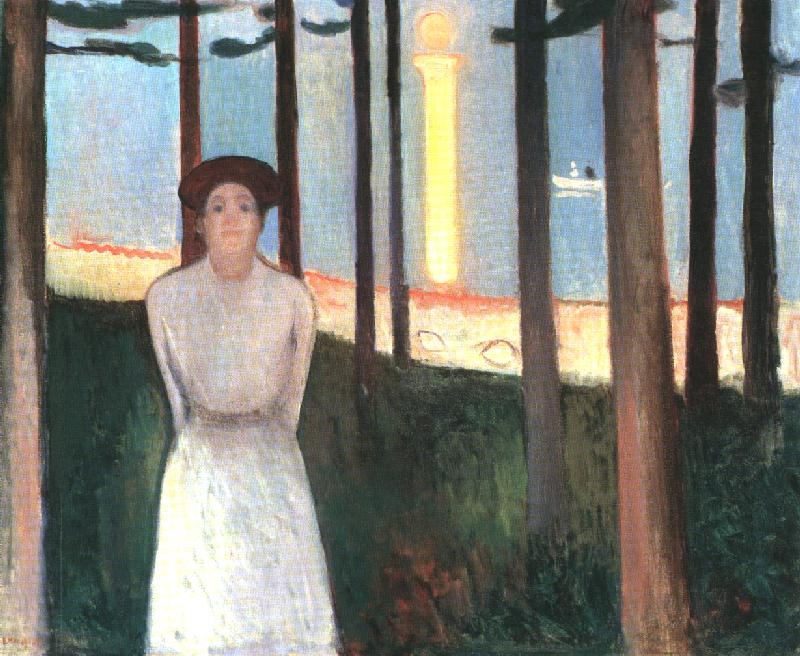
    All this said, does something like Edvard Munch’s The Voice (1893) start to look a little “different” if you imagine a far-sighted artist at work without their glasses?

    Munch--the-voice-1893

    [Image source: https://www.britannica.com/topic/The-Voice-painting-by-Munch]

    Or a vision-impaired person producing Les Alpilles (1890) instead of a visionary Van Gogh?

    Van gogh les apilles

    [Image source: https://www.vangoghmuseum.nl/en/collection/s0417M1990]

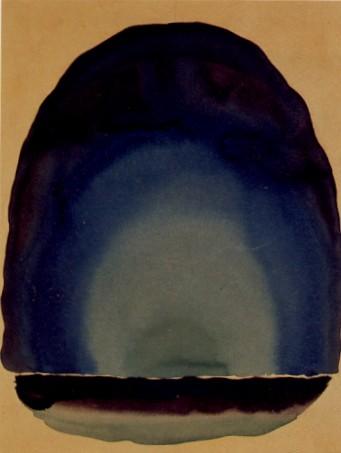
    Or a macular degenerating issue producing a painting like Georgia Okeefe’s Light Coming on the Plains III (1917)?

      Okeeffe_light_coming_up_on_the_plains_iii

    [Image source: www.alpheus.org/unfolding-the-art-of-georgia-okeeffe/]

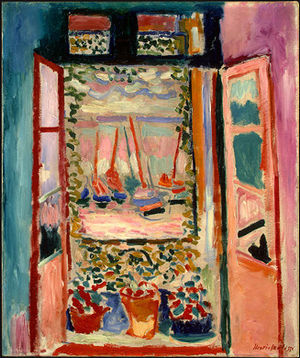
    Or a half-blind artist painting Matisse’s The Open Window, Collioure (1905), simply painting exactly what they saw?  

    Matisse

    [Image source: https://en.wikipedia.org/wiki/The_Open_Window_(Matisse)]

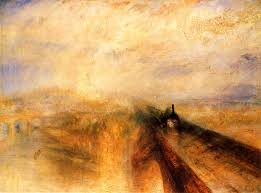
    I don’t think of revolutionary artworks in terms of their common ophthalmologic varieties–I just wanted to make a point about what happened to all of that artwork that was no doubt produced by people with impaired vision before the Impressionists and Fauves and non-representational artists came into being.  I wonder if those who received J.M.W. Turner (as with, say, Rain, Steam, Speed–the Great Western Railway, 1844) so badly so early on in his career and so early in the History of Disappearing Details wondered whether he had a visual issue, or not?  Turner rain steam speed

    [Image source: https://www.wga.hu/html_m/t/turner/2/205turne.html]

    And in a way, similar to the probably non-existent vision-challenged art of the past is the Robot art of the future–or at least the robot art of what was described by P.K. Hoenich in his article “Robot-Art, the Hopeful Monster” that appeared in two part in the journal Cybernetica in 1963 and 1964.  It was with high hopes that I started reading this article wanting the author to address robots-making-art in the future.  After all, my friend George Widener, who is a fabulously gifted artist,  directs some of his fantastically involved calculating/numerical artworks to the interests of his robot-collectors of the future–given this case, why (if the robots are collecting) wouldn’t they also produce art themselves?  And why, if given the legions and multitudes of robots of the future couldn’t they produce every recorded piece of art that has ever existed and then insinuate development and trends and institution and all of the other gifts of the singularity and produce all of the works of art that will ever be produced?

    Well, Hoenich turns out to be describing “robots” of  mostly a very different sort, whether he uses the term “monster” in his title or not.  He was broadly addressing a style of art that is produced by externally-controlled structures (mostly), and his particular brand was a mobile-like device with art bits whose movement was powered by the wind…and also used found spectra and sunlight.  It was not what I was hoping for, the vision of robots-at-the-easels/keyboard/whatever remaining unfulfilled. 

    Still it was an interesting read, mostly in laying Hoenich in a continuum of similar artists whose “robots” were the wind (as for example with a Calder) or Nicolas Schoeffer (with spectacular luminodynamics) or Mohly-Nagy (with a combo of light and movement) or Arp (with chance painting) and maybe even Pollock. I guess even Duchamp could be included in a category like this if you considered his work to be governed by selective, found chance, a sort of choice-chance, for his Readymades. 

    So in a way these artworks were made by “robots” insofar as they were produced by not-exactly the artist but with external assistance.

    “Squinting with Art” perhaps could have been the title of this post–squinting at your landscape to see it with semi-non-representational vision, and squinting at the titles of other works to make their possibility more appealing to what you ‘d like to see. 

    ·Posted by :

    ·in:

    —

  • Crystallograhic Found Art in the Annalen (1915)

    JF Ptak Science Books  Quick Post

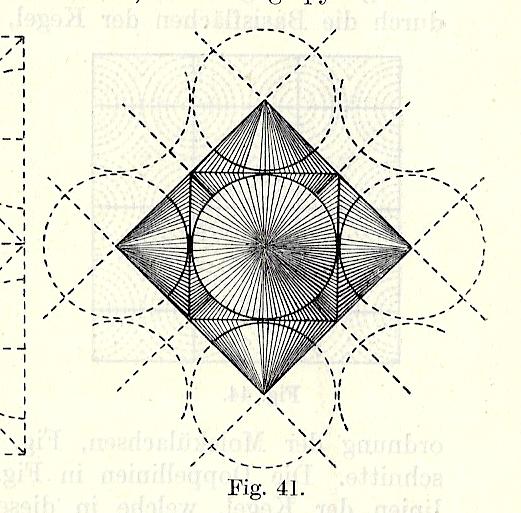
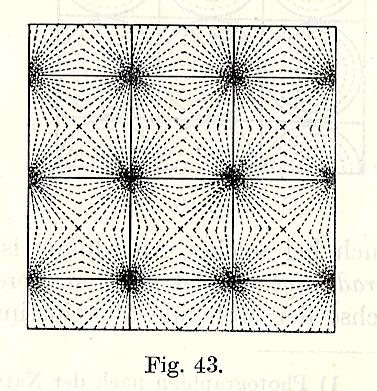
    There is much that goes on in the pre-eminent German physics journal Annalen der Physik  (begun in 1799 and still going strong) beyond the consideration of “Found Art”–actually, everything that goes on there is beyond that consideration. Unless of course you happen to be flipping through the thing and find something that attracts your attention for its pure artistic inventiveness, which of course is almost entirely out of context.  The article in question is Otto Lehmann’s “Die Struktur schleimig-kristallinscher Flussigeiten”, and appeared in the journal in October 1915. (It would be in the Annalen months later that Einstein would publish his great paper on General Relativity theory and also there where he set the world afire in 1905.) Lehmann’s 45-page paper is illustrated with 92 figures, some of which are out-of-context stand-alone beauties:

    Art in the Annalen 1915 _1_


    Art in the Annalen 1915 _2_

    ·Posted by :

    ·in:

    —

  • The Robot Lunar Adam and the Cosmologonaut Jean Perdrizet

    JF Ptak Science Books    Post 2574

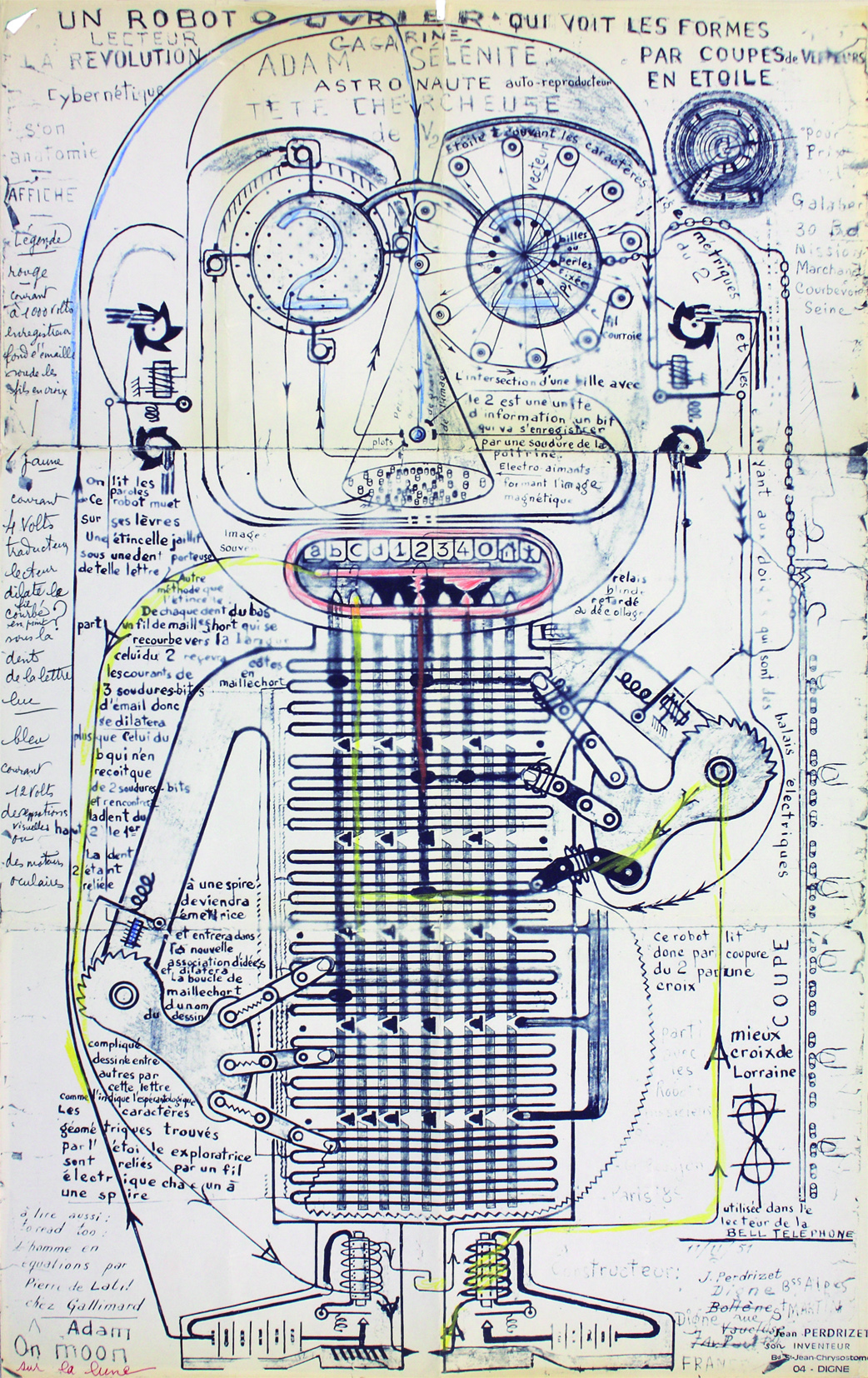
    “L’histoire de la science du XXe siècle n’a pas retenu le nom de Jean Perdrizet” is the lovely opening remark on a terrestrial-based sidereus nuncius/sidereal messenger post–that the name of the Art Brut/Out Brut inventor, Jean Perdrizet, has not been remembered as part of the history of science of the 20th century.  And of course there is really no scientific reason for the basis of this memory to be formed, as M. Perdrizet is thinking well outside the confines of the generative envelope, making drawings of interesting and fantastic things, like the forceful  Selenite Adam/Adam-of-the-Moon/Cosmologonaut.  

    I guess it is interesting to note that the first half of his name uses the word “perdre” and/or “perdu”, which translated is “lose/lost”, though I think this only has some extended application to his effect on the sciences rather than his art.  Perdrizet (1904-1975) did stay in contact with scientific agencies (like NASA) throughout his career, though they did not stay in contact with him.  His work is beautiful in its way and begs to be investigated closely–any time an artwork can accomplish that, then it has certainly succeeded.

    • Source of opening quote and image: http://www.officiel-galeries-musees.com/galerie/galerie-christian-berst/exposition/jean-perdrizet

    Adam on Moon

    There are of course scientific elements in the Perdrizet works that are correct–and it is tempting to use the word “but” here–though the artist decided to transcend the confines of the sciences in pursuit of something more, well, interesting.  Perdrizet’s educational and limited vocational background in civil engineering forms more of a springboard than a foundation for the flow of his ideas.  

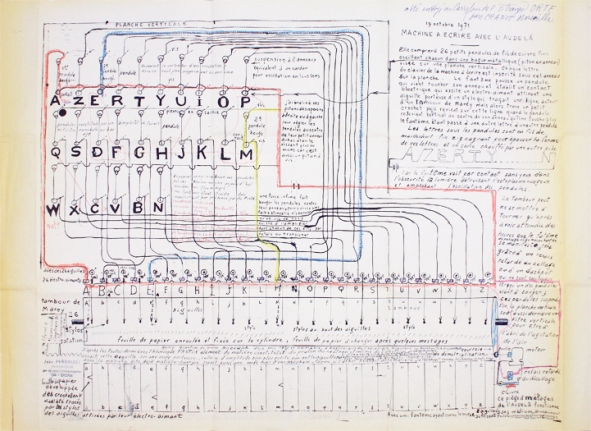
    Here’s another example of Perdrizet’s work (there’s a lot more all over the interwebs), a machine to “communicate with the beyond”, to “capture the invisible” as the writer of the  Savatier blog eloquently states:

    Perdrizet


    [Image source: Savatier blog, here: Savatier ]

    Apparently Perdrizet made blueprints for conducting communication with the spirit world–but so did Thomas Edison, or so he said. Edison’s statement on his ‘invention” was made in drollery and his own brand of ‘fun”; perhaps Perdrizet did so, too.  

    A good podcast by Susan Owensby on RFI on Perdrizet: http://www.english.rfi.fr/culture/20120212-jean-perdrizet-s-fantastic-machines

    And this interesting video:

    ·Posted by :

    ·in:

    —

  • Striking Graphic: 1879

    JF Ptak Science Books   Quick Post

    Black Hand149[Source: Harpers Weekly, February 9, 1879]

    B.K. Bliss and sons came up with this idea to distinguish their ad, the one among many, on a full 16″x11.5″ page of Harper’s Weekly. The original is 1.75×2.25″, so it is rather small, but it swims sort of free and clear on the page of 30+ advertisements because of its high contrast. 


  • Concentration, ca. 1572.

    JF Ptak Science Books  Post 2482

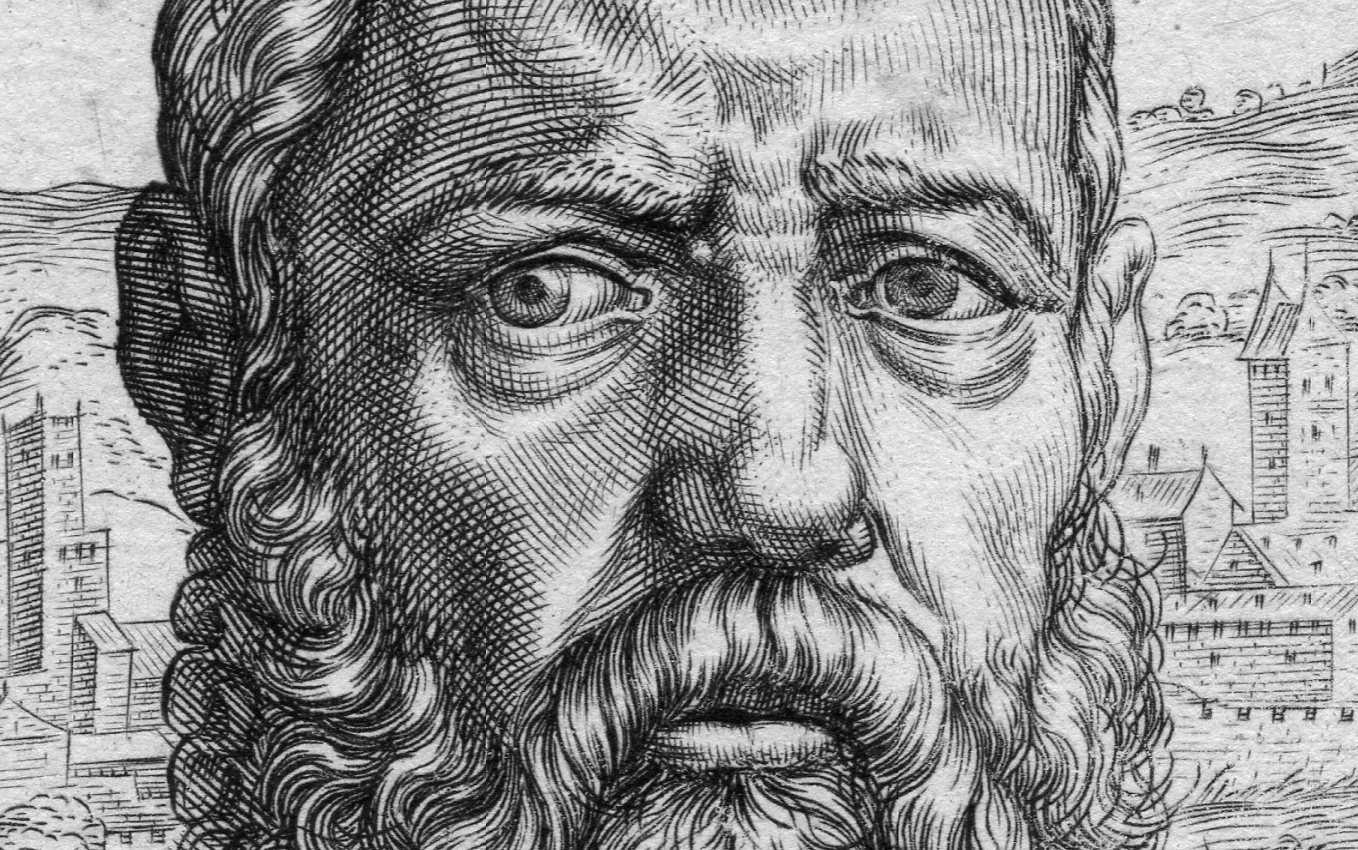
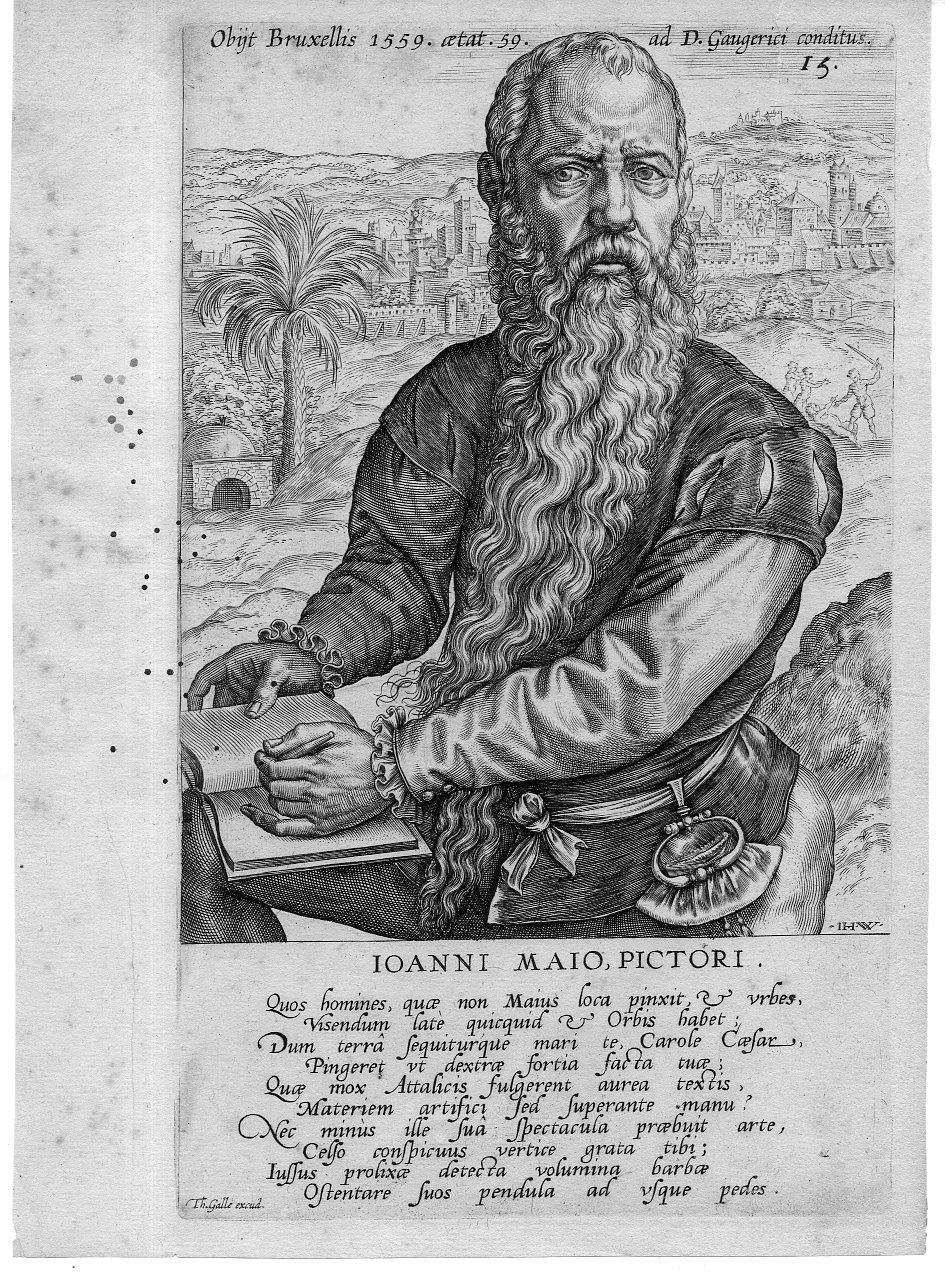
    Ioni Maio130

    This engraved portrait of the very striking Jan Cornelis Vermeijen (also “Vermeyer”, and here known as “Ioanni  Mao”) appears in Dominicus Lampsonius (Latinised form of Dominique Lampsone) Pictorum Aliquot Celebrium Germaniae Inferioris Effigies and published by Volcxen Diericx (1570-1600 fl).  (The first edition was published in 1572, and I believe that this image appeared somewhat later in the century as there are some differences in the text around the image.) Diericx was the  “widow of Hieronymus Cock , who took over his business ‘Aux Quatre Vents’ after his death in 1570. She and her new husband, Lambrecht Bottin are mentioned together by Plantijn at the head of a list of printmakers and print sellers in Antwerp, which was assembled between 1577 and 1580. Since the death of Hieronymus Cock in 1570 to her death in 1600 all the prints published by her have the sentence Aux Quatre Vents without the name of Cock”.–British Museum online. 

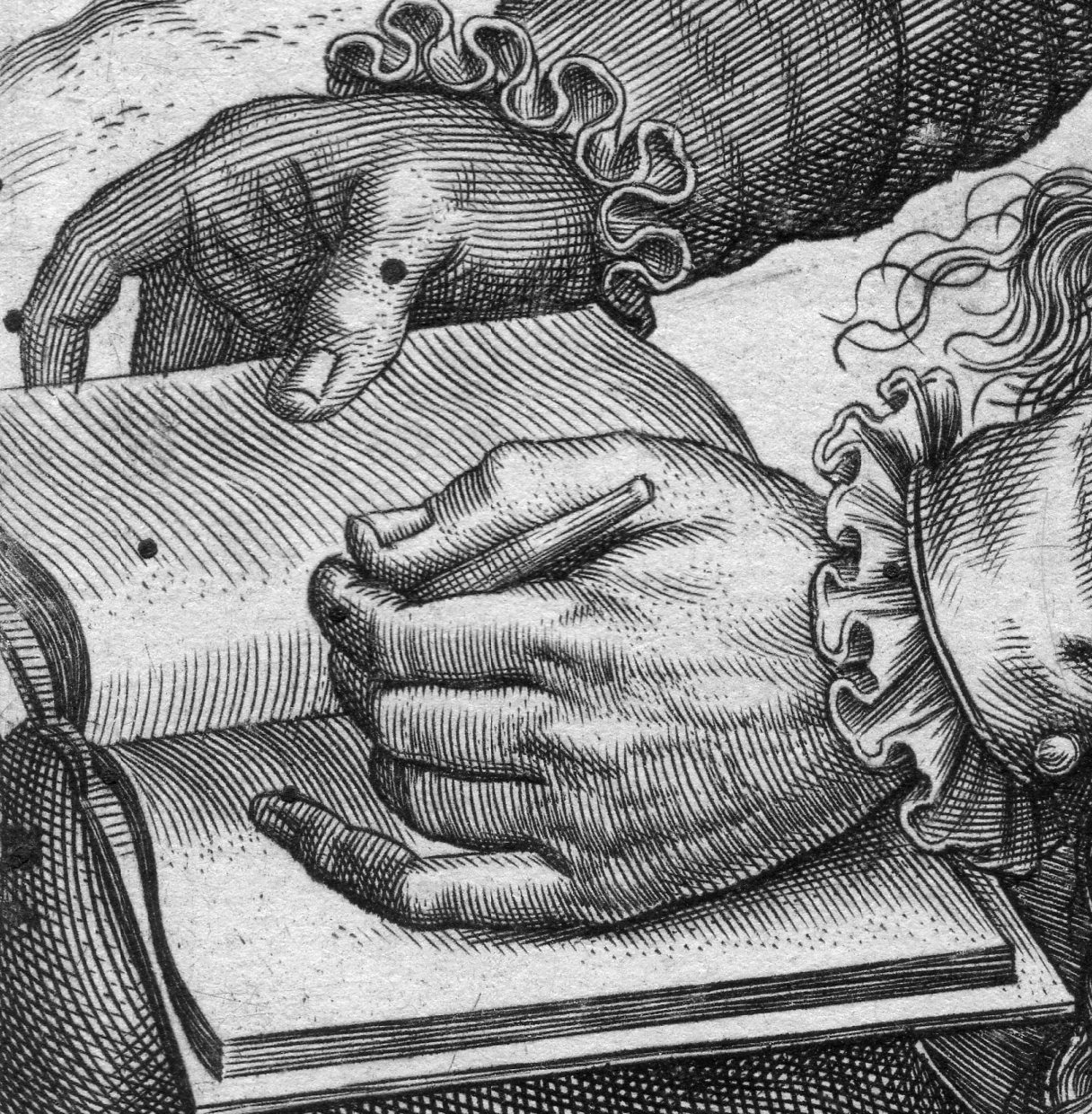
    I’ve long liked this portrait of Cornelis Vermeijen (ca. 1500-1559), I think mostly for his hands and for the ultra-concentrated bit of concentration that is going on in his eye/forehead conversation.  Even though I ‘ve owned this for a long time I’ve never known about the placement of the palm tree over Jan’s left shoulder or the murderous attack going on over his right. 

    The work was executed by Theodore Galle (signed in the plate at very bottom-left) after the engraving by Jan Wierix (1549-1620, who signed his name “I H W” in the bottom right of the portrait.  The other Dutch artists comprising the illustrations include The artists included in the book are (in this order): “Hubert van Eyck, Jan van Eyck, Hieronymus Bosch, Rogier van der Weyden, Dirk Bouts, Bernard van Orley, Jan Mabuse, Joachim Patinir, Quentin Matsys, Lucas van Leyden, Jan van Amstel, Joos van Cleve, Matthys Cock, Herri met de Bles, Pieter Coecke van Aelst, Jan van Scorel, Lambert Lombard, Pieter Bruegel the Elder, Willem Key, Lucas Gassel, Frans Floris, and Hieronymus Cock.” (Wiki)

    Ioni Maio129

    • The original is offered for sale at the blog’s bookstore, here. 

    Ioni Maio131

    Ioni Maio132


    The legend reads “Quos homines quae non majus loca pinacit et urbes Visendum late quicquid et Orbis habet Vum terra sequiturque mari te Carole Caesar Pingeret ut dextrae fortia facta tilt 6 Quae mox Attalicis fulgerent aurea teactis Materiem artifici sed superante manu Nec minus ille sua spectacula praebuit Celso conspicuus vertice grata tib…”


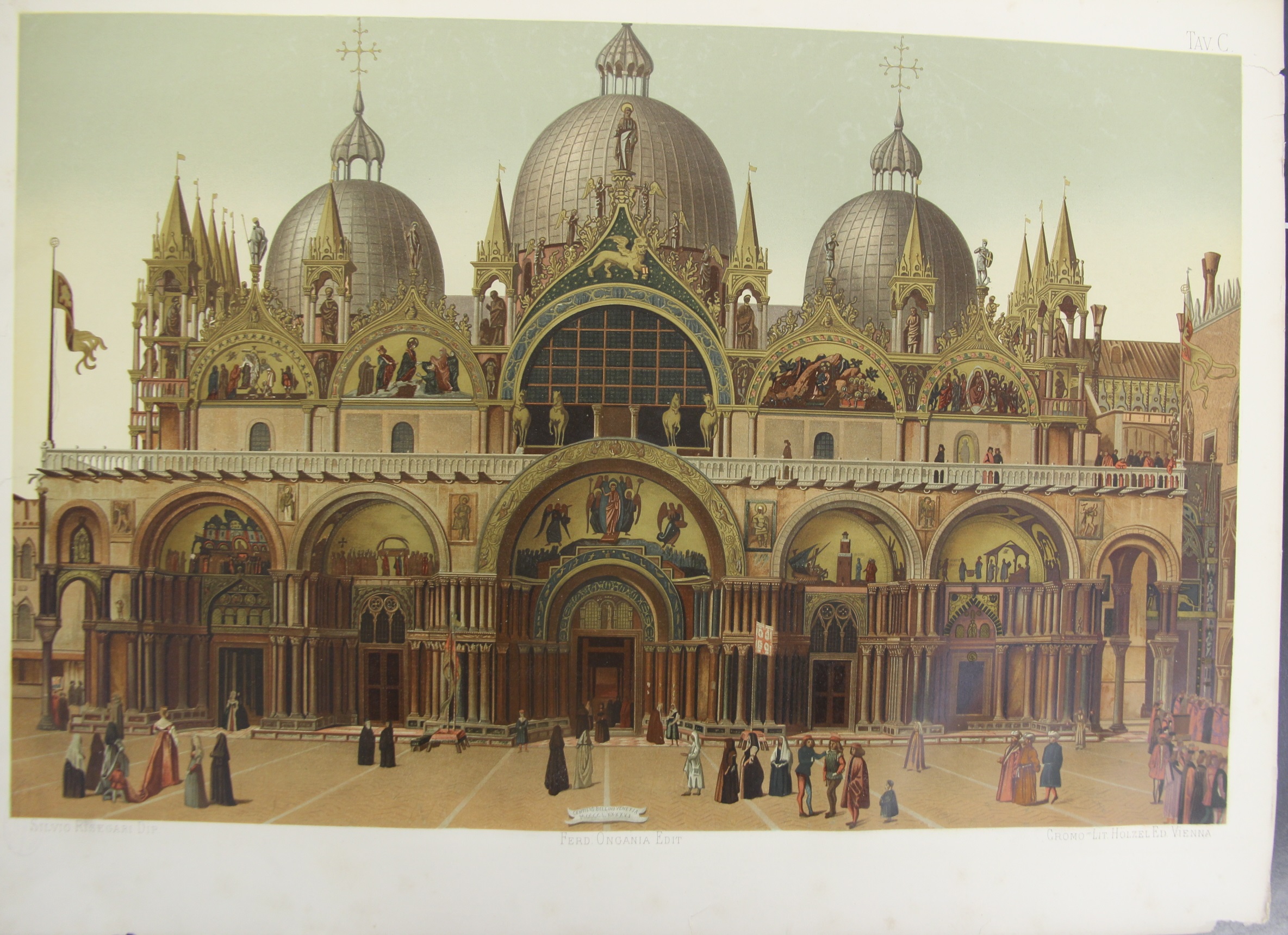
  • Lavish Chromolithographs of the Mosaics at Basilica San Marco (1886)

    JF Ptak Science Books Post 2479

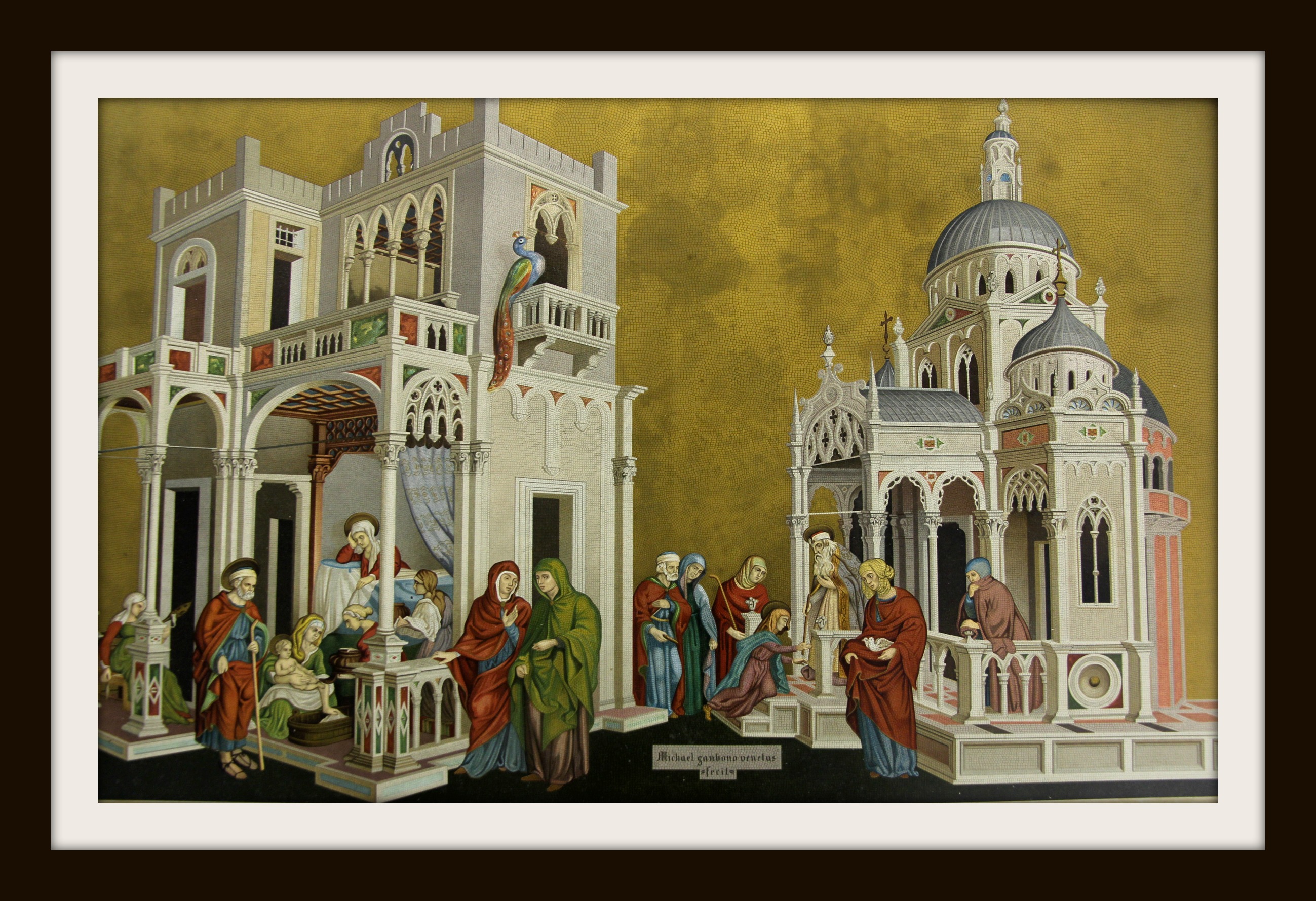
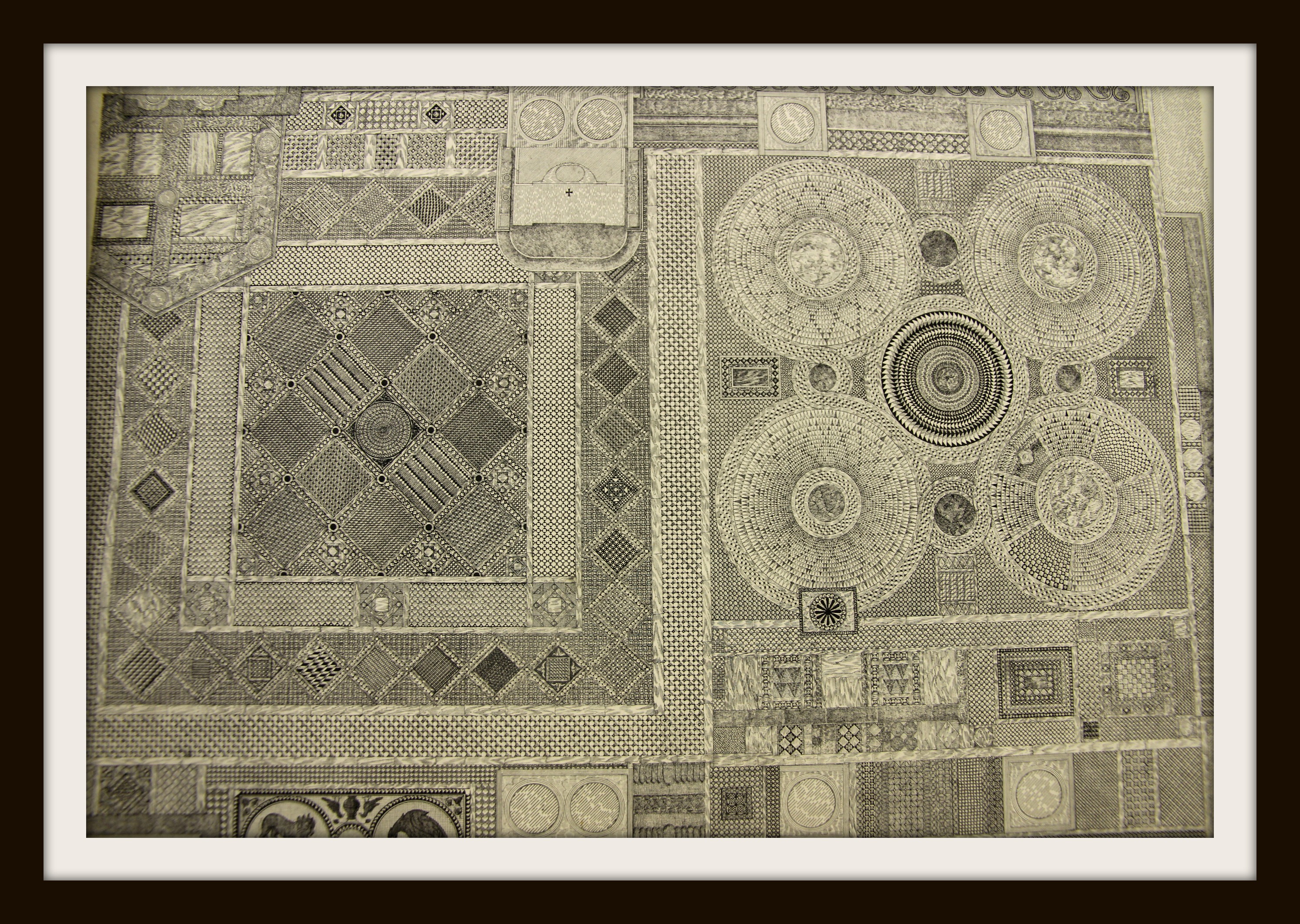
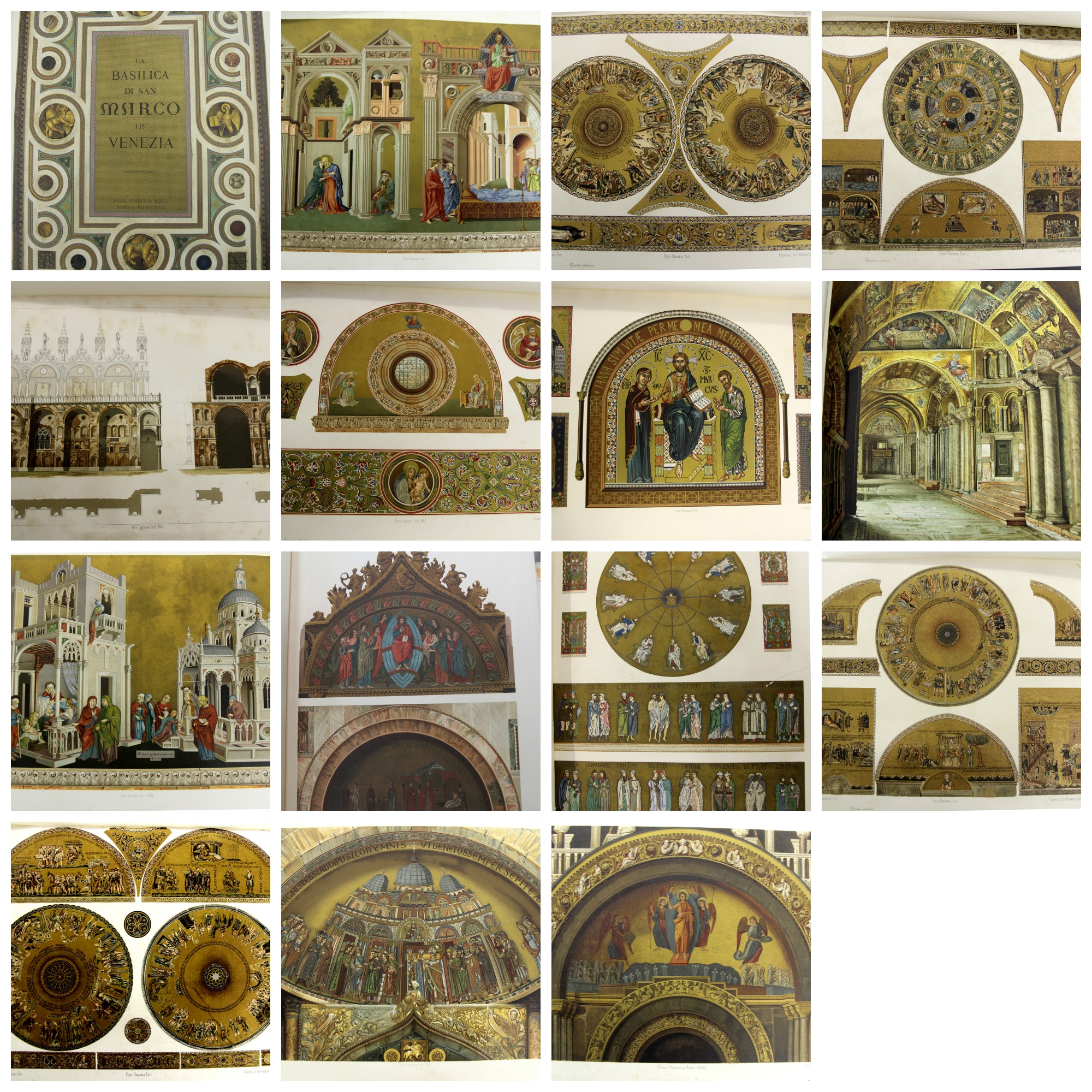
    • [The originals are large–27×21″ or so–and files average about 2 meg; so in this program when the images are reduced so much much of the detail gets removed; however, all the detail is gloriously back when you click in to each image to expand.  Also just scroll below for a full lineup.]

    Ongania 10 framed

    Ongania Mosaic 1 frame


    Ongania litho collage 4x4

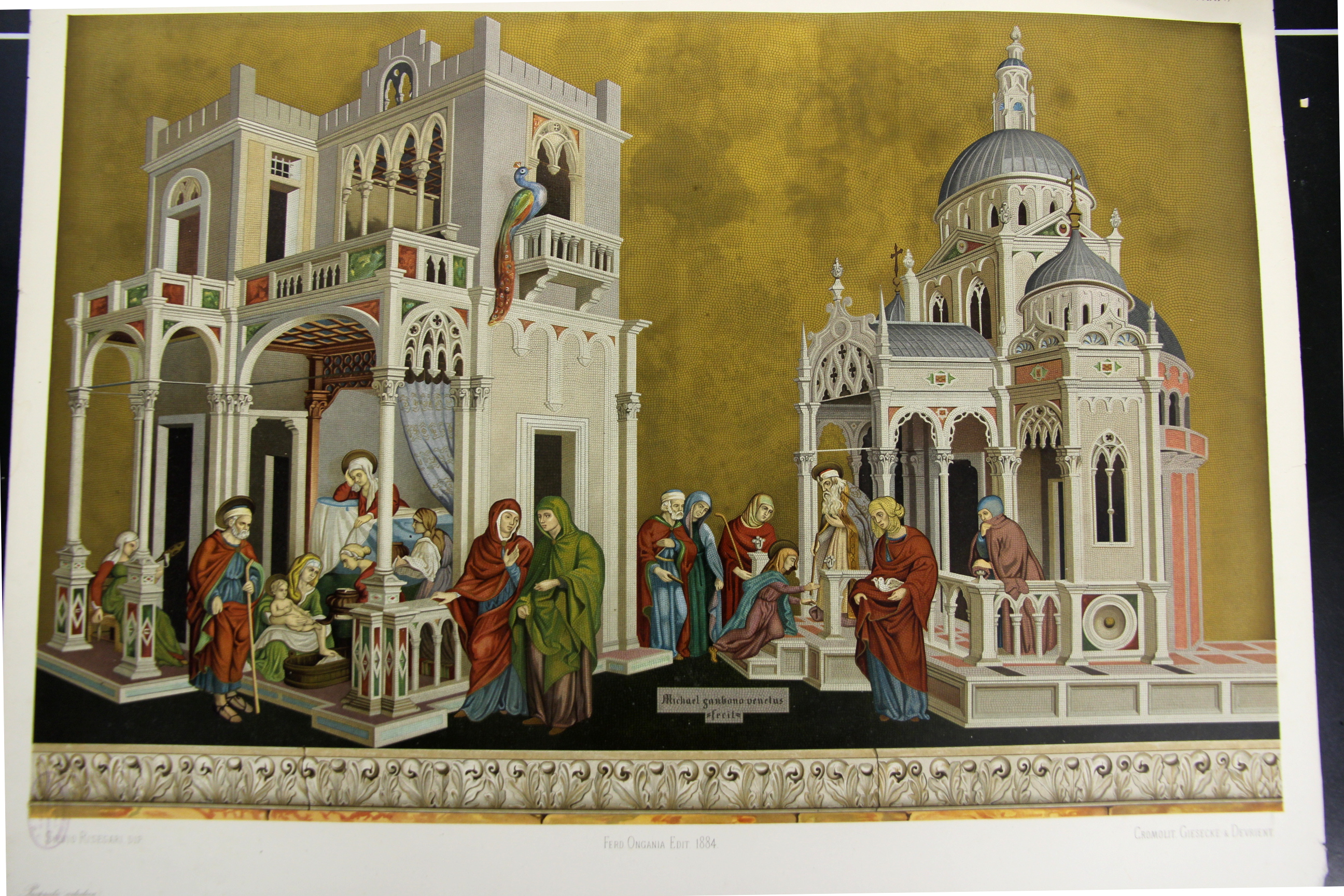
    The chromolithographs and engravings featured on this page appeared in the massive La Basilica di San Marino du Venezia, published by the prolific Ferdinand Ongania in 1886.  It is an exhaustive study of the iconic building, the publication being known chiefly I think for its very large and sumptuous chromolithographs of the building’s architecture, art, and endless detail. It forms two volumes of an overall monumental 12-volume epic, though these images comprised volumes that were complete in themselves.

    The images (again, they are large at 27×21″, 68x53cm, and are packed with detail) are printed on a  very thick paper that will now crack if you try the double-fold test, so although the paper is stable you do not want to bend it, though you wouldn’t want to do that, anyway.  Each sheet has a protective paper guard attached to it on the left side, covering the entire image–the reason why you may see a shadow along one long side is just from the rolled-back protective sheet not getting completely out of the way.  Also all of the margins are not necessarily included in the photos–there were certain limitations in making the photographs, and some margins just didn’t make it entirely into the picture.

    So I decided to post these pictures to the interwebtube because there aren’t any others there–perhaps the images will be useful to someone.  (Also they’re all for sale, so if you’d like one, just ask.) 

      Ongania 10

    Ongania 21

    ·Posted by :

    ·in:

    —