A Daily History of Holes, Dots, Lines, Science, History, Math, Physics, Art, the Unintentional Absurd, Architecture, Maps, Data Visualization, Blank and Missing Things, and so on. |1.6 million words, 7500 images, 4.9 million hits| Press & appearances in The Times, Le Figaro, Mensa, The Economist, The Guardian, Discovery News, Slate, Le Monde, Sci American Blogs, Le Pont, and many other places… 5000+ total posts since 2008.

Category: Art

  • A Short Note on Forks and Art

    JF Ptak Science Books LLC   Post 791   Blog Bookstore

    I was on my way to something else when I stopped to look at
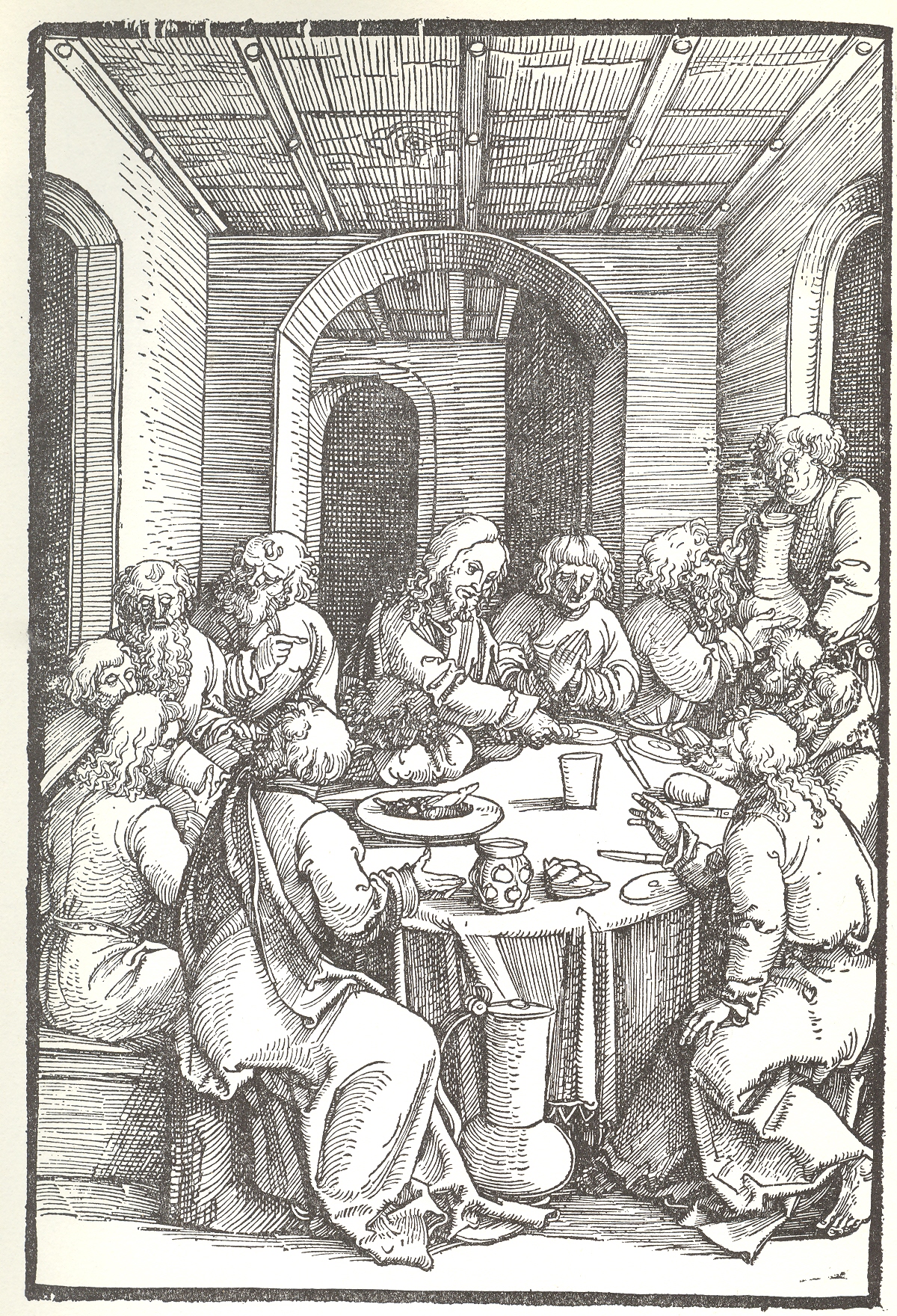
    this engraving by Ulrich Pinder, his last supper, the Speculum passionale, published in Nuremberg in 1507.  It has a nice perspective, an interesting ceiling,
    and a crowded table with very little on it in the way of food.  And no forks. 
    Knives—yes of course—and big containers of some sort of liquid, but no
    forks.  As it turns out, the fork really
    hadn’t made a strong appearance in northern Europe until the end of the
    century, brought back evidently from travelers in Europe.  The first appearance in a painting, in
    another Last Supper, I believe, occurs at least by 1599.
    + fork

    I know, there’s no spoons either, but they had been around
    for a long time, and just didn’t make an appearance on this table for reasons
    unknown.

    “I observed a custome in all those Italian Cities
    and Townes through which I passed that is not used in any other country that I
    saw in my travels, neither doe I think that any other nation of Christendome
    doth use it, but only Italy. The Italian, and also most strangers that are
    cormorant in Italy, does alwaies at their meales, use a little fork when they
    cut the meate . . . their forkes being for the most part made of iron or steel,
    and some of silver, but these are used only by gentlemen. The reason of this
    their curiosity is because the Italian cannot endure by any means to have his
    dish touched by fingers, seeing that all men’s fingers are not alike cleane.
    Hereupon I myself thought to imitate the Italian fashion by this forke cutting
    of meate, not only while I was in Italy,
    but also in Germany, and
    often-times in England
    since I came home.”
    Thomas Coryate, Coryat’s Crudities (1611)
    See:

    Forbes, R. J. “Food and Drink,” Charles Singer,
    et. al. eds. A History of Technology. Oxford:
    Oxford University Press, 1956. Vol. II: The
    Mediterranean Civilization and the Middle Ages, c. 700 B.C. to c. A.D. 1500
    :  page 126.

    Braudel, Fernand, Civilization and Capitalism 15th-18th
    Century
    , vol. 1: The Structures of Everyday Life: The Limits of the
    Possible
    , London:
    Collins, 1981:  page 209.

    ·Posted by :

    ·in:

    —

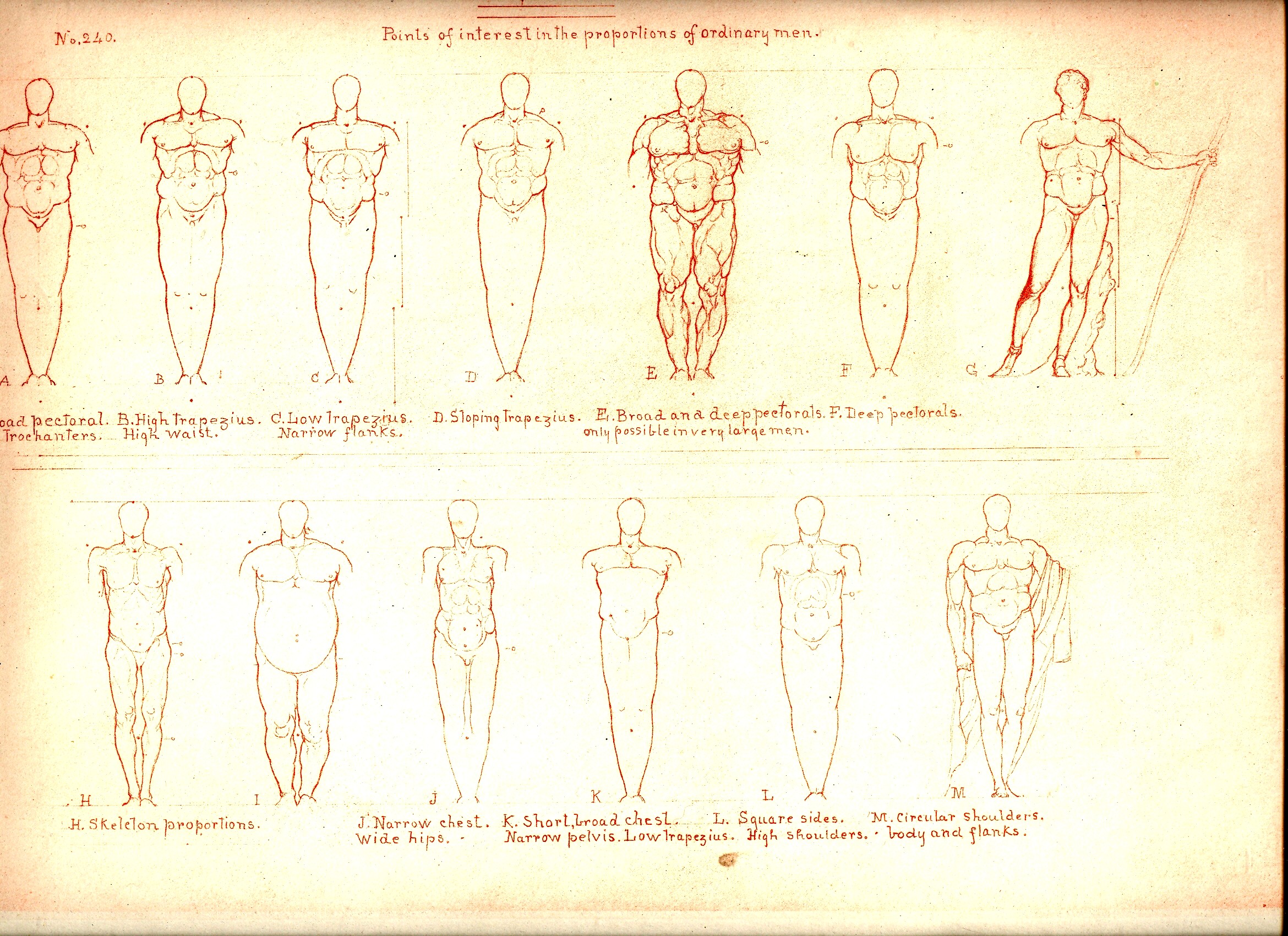
  • Dadaist Images in 19th Century Prints: William Rimmer’s Artistic Anatomy, 1877

    JF Ptak Science Books LLC  Post 667

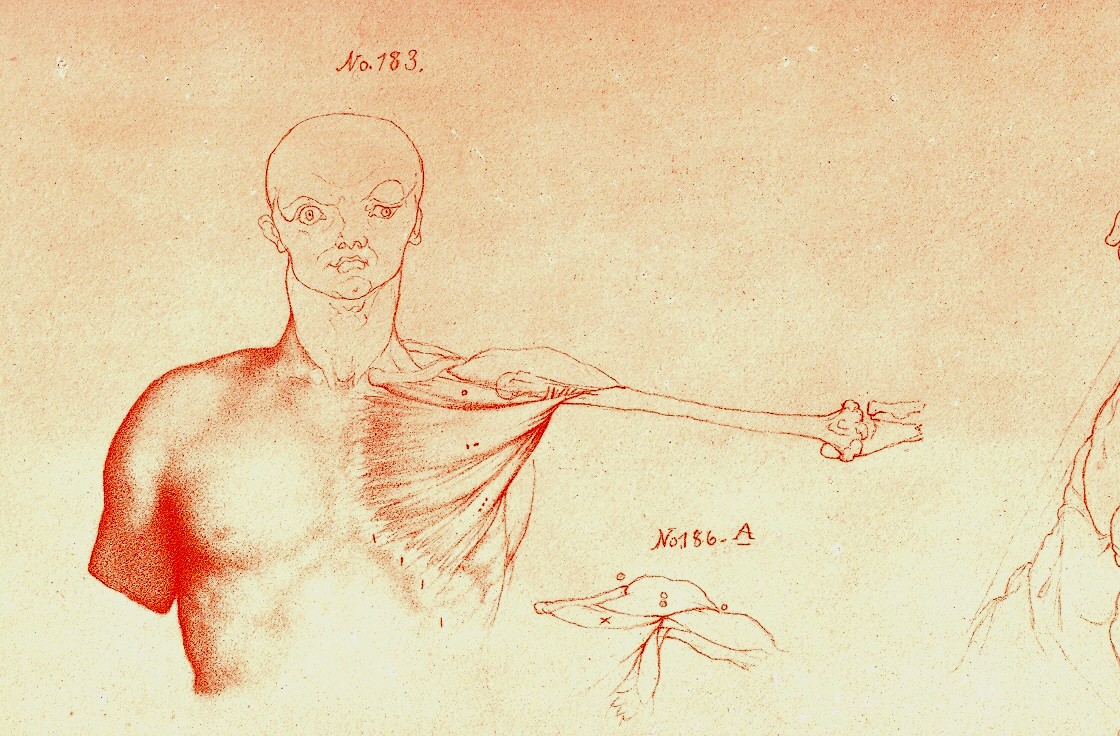
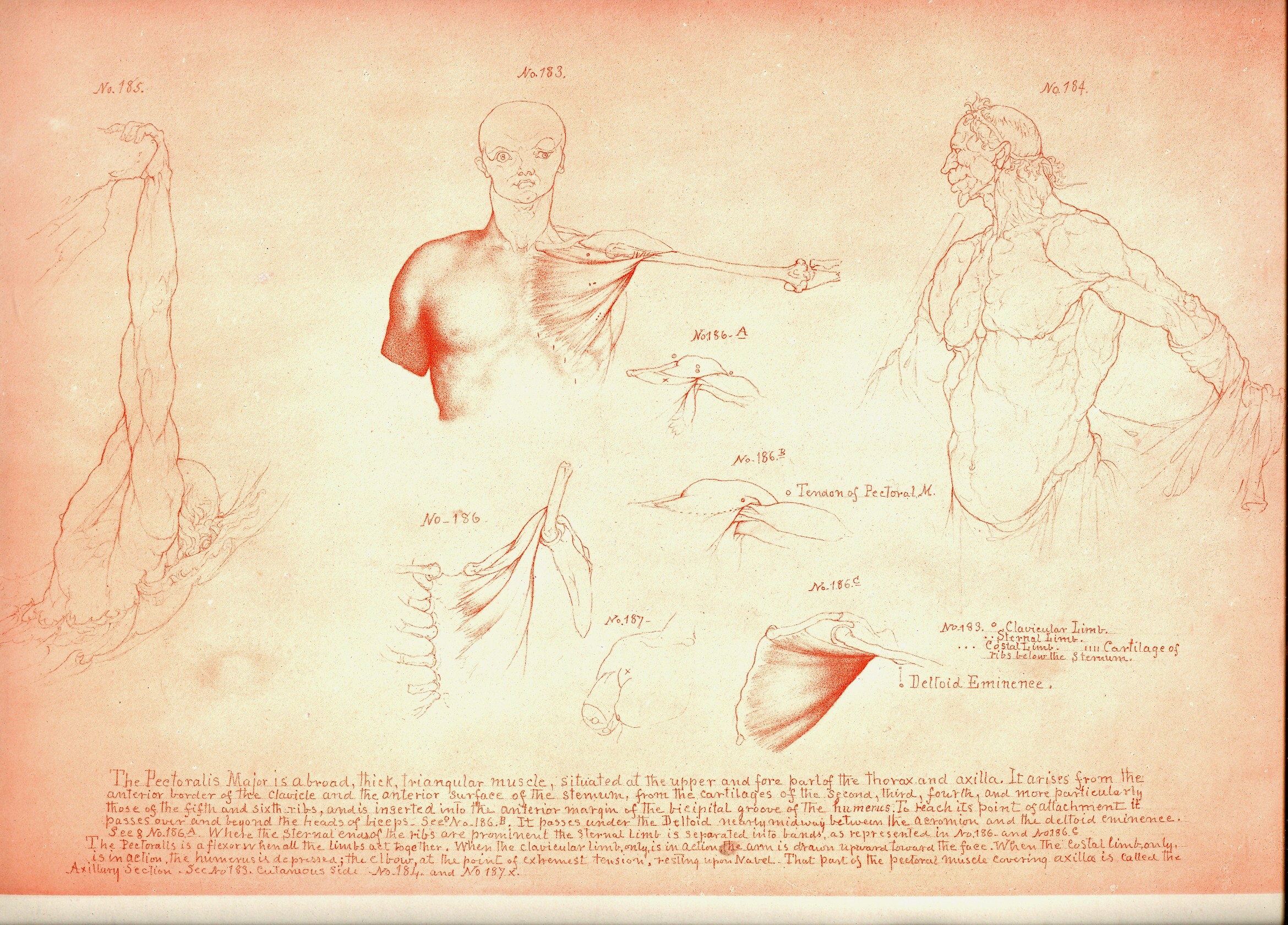
    Blog==June 29--rimmer pecs det Looking at old prints sometimes reveals more
    than just their own history, simple or not: 
    there are, from time to time, subtle bits of otherness that creeps into
    the image, if you allow yourself the time to see it.  And sometimes looking at images of the past
    reveal a little of the future, or the possibility of the future.
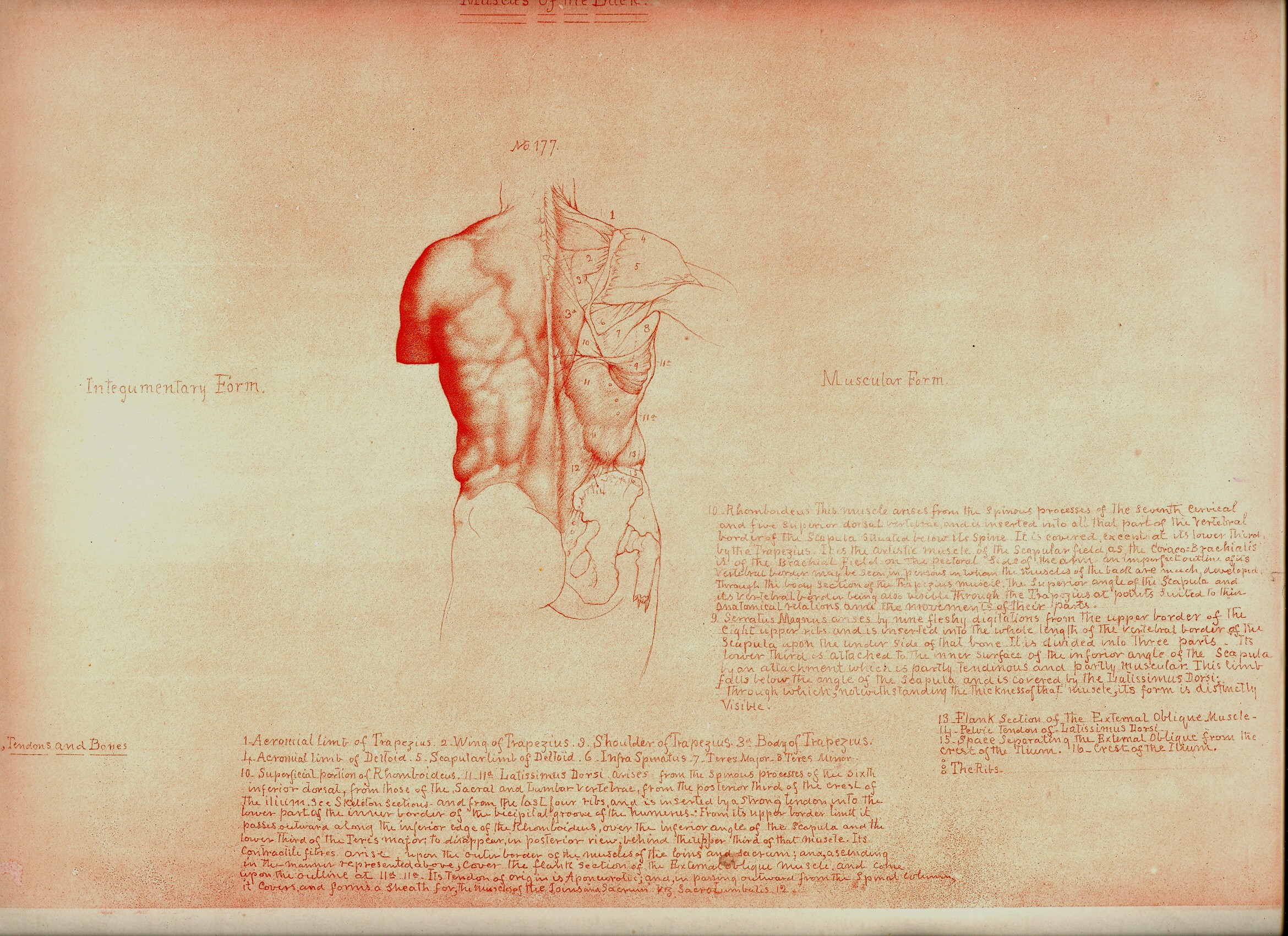
    Blog==June 29--rimmer pecsBlog==June 29--rimmer backdet

    I wrote a little about this in the odd
    art/color textbooks of the pre-Kandinskian Emily Vanderpoel , about whose color
    theory I still understand not at all, though the images that she produced as
    illustrations to these bizarre theories are stunning, pre-modernist, and unintentional
    creations.

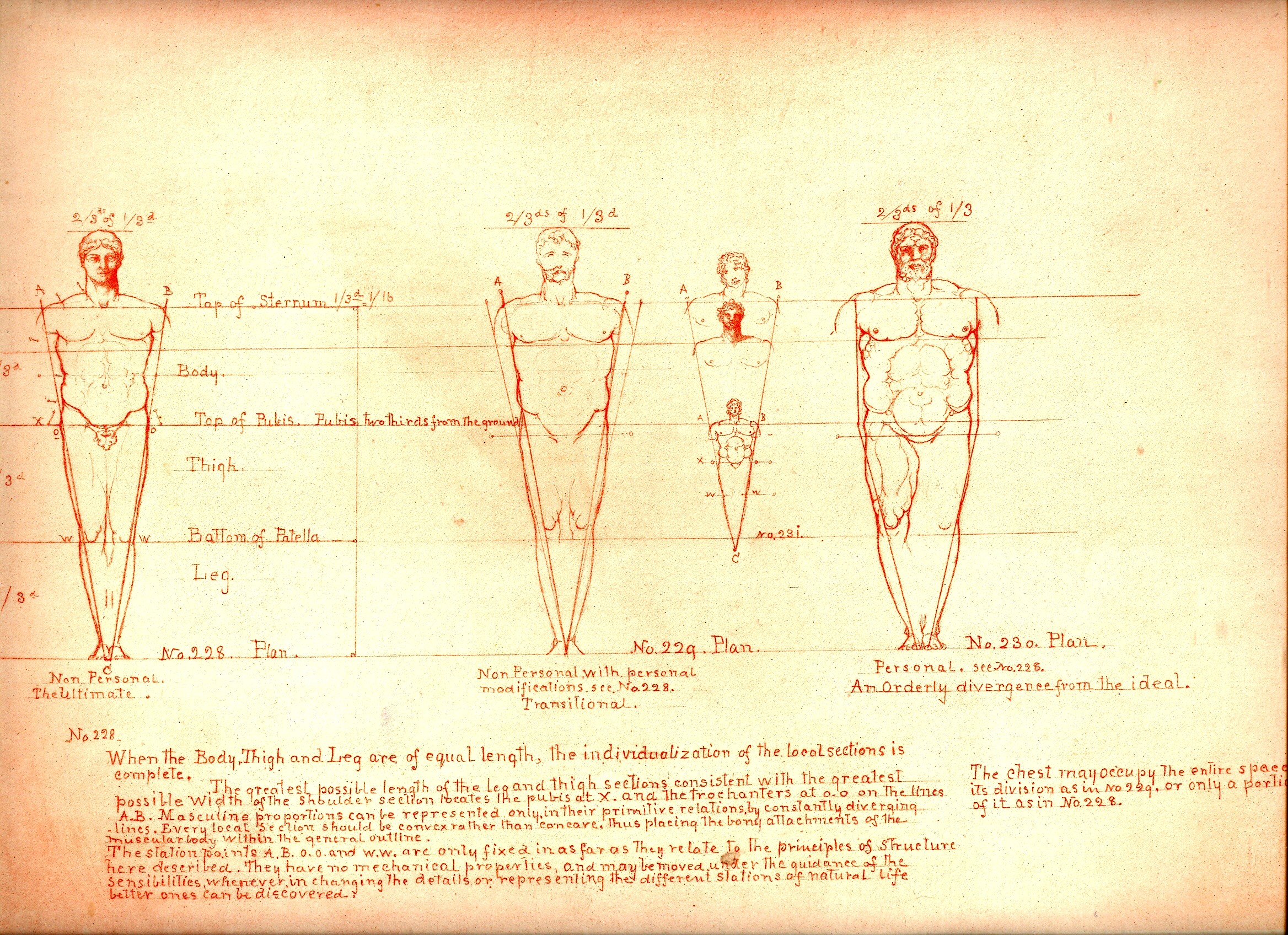
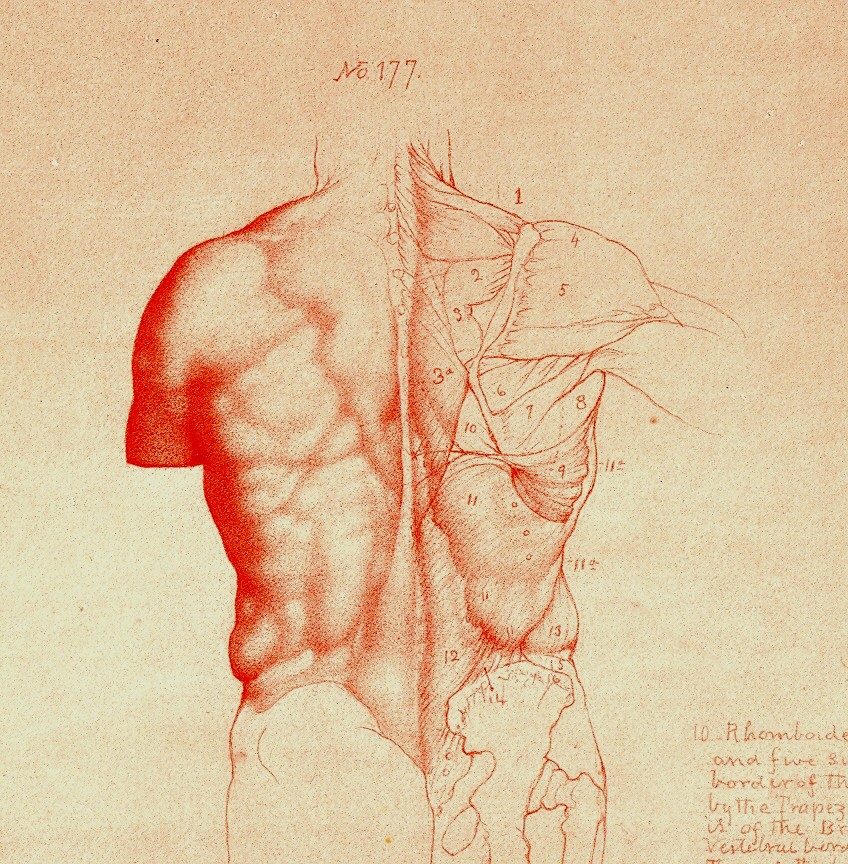
    William Rimmer’s (1816-1879) Art Anatomy (1877 and subsequent
    printings) is another such adventure. 
    Rimmer was a very accomplished artist, and was also a fine
    anatomist.  He was very concerned and
    interested in what happens to the skin, forced into action by all of the stuff
    underneath it.  He pursued the movement
    of muscle, and bone, and the interplay of the two, and produced a wonderful
    exponent of artistic anatomy. 

     And inside
    of these images is something else, sometimes. 
    There is an undoubted Leonardoesque quality to many of his drawings, the
    figures appearing with deft lines and interesting shadings, many times

    Blog==June 29--rimmer back

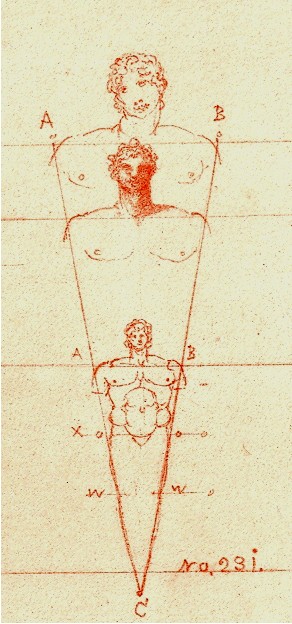
    surrounded by the author’s notes and explanations  But there’s also something else—some of the
    images are just, well, a little bizarre given the time in which they were
    executed.  Some of the details are
    positively modernist, begging to be identified as a 1920’/1930’s creation, or
    Dadaist, or something—just not 19th century.  I’ve included some further examples below

    Blog==June 29--rimmer little man .

    Blog==June 29--rimmer muscle


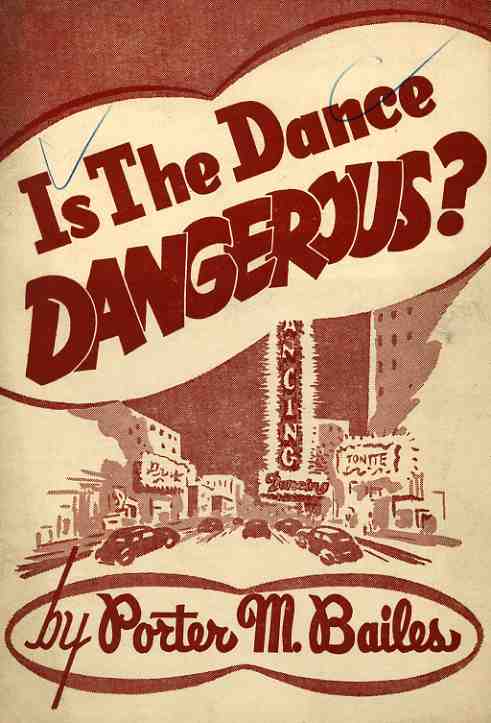
  • Is Dance Dangerous? The Naive Surreal Collection, Part 8.

    JF Ptak Science Books LLC  Post 477
    0 blog jan 20 dance danger391 In the history of questions, this  (“Is the dance dangerous?”) certainly must rank in the bottom tenth percentile.  Or at least I hope it does.  The question is the title of this small pamphlet, written by Porter Bailes (of the First Baptist Church of Tyler, Texas) in 1947, a work which is part of my Naive Surreal collection.  “If it’s doubtful, it’s dirty” is the major maxim that floats it way through this work, and proceeds to attacks it subject of “the”dance on its unholy, immoral, unnatural, imprudent, prayer-defeating nature. 

    “Can any one stretch the imagination as to think of Jesus as being congenial and at ease in the atmosphere that the dance creates? No! Dancing is not to the glory of god. It never made anyone feel the nearness of god.  It robs us of the desire to pray. A dancing foot and a praying knee are not found long on the same limb.”

    And also:

    “There are many fine people who dance.  They are fine not because they dance, but in spite of the dance.”

    And:

    “The dance does not involve any moral requirements.  The more lewd the people are, the more proficient they may become. The gestures of the dance demand lewdness.” 

    Lastly:  “the tine of the dance makes it dangerous. Its hours are unearthly and abnormal”

    And lastly last:  ” The position of the dance make it dangerous.  For two normal people to place their bodies in the close personal contact that the modern dance demands and not have impure thoughts and unholy emotions stirred, would be very unnatural.  In truth, it is against all the known laws of human nature.”

    This is last just for my examples:  there are 20 pages of this.  It is remarkable that, in this highly restrictive and judgmental work,  the paper is allowed to bend. 

    And not to be outdone, the author tells us that 97% of professional gamblers “attribute their habit to the practice of playing cards at home”.  “The risk is too great, young people” Pastor Bailes tells us, “for you to start gambling–even at home”.  He began to warm to this subject but I guess was saving this subject for later.


  • Original Reflections: unique experiences with mirrors: Van Eyck & Brunellesci

    JF Ptak Science Books  Quick Post

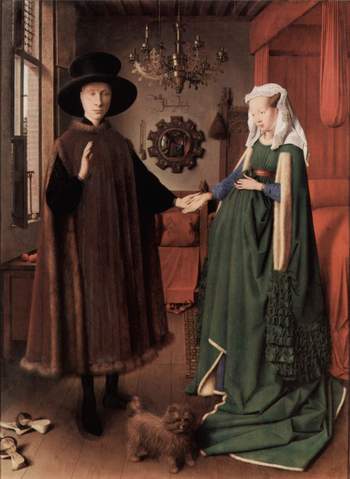
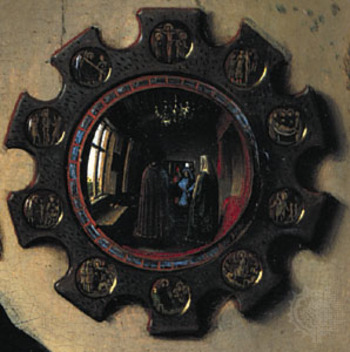
    I was thinking about writing a short post on van Eyck and settled on his painting of this newly married couple–The Arnolfini Marriage, painted in 1434, depicting the union of Giovanni Arnolfini and Giovanna Cenami, who married in Bruges in that year–and the very unusual image of the scene as reflected in the convex mirror directly behind the couple. It is a wonderful painting of course, lusciously and richly colored–the observer, though, is brought instantly to the mirror. And in that reflection is what is seen from behind the couple as well as what the couple is seeing–in a sense, a 180-degree view of the room (if we considered the painter’s perspective towards the couple as 90-degrees). It is one of the first times that a mirror is used in this fashion and is also offers a great instruction on the newly-rediscovered perspective. (The inscription above the mirror, which is surrounded by ten scenes from the life of Christ, reads “Jan van Eyck was present”–and probably was literal, as we see the painter himself reflected in a tiny portrait…along with another man, who may also have been involved with the wedding).

    Vna_eyck_mirror_big

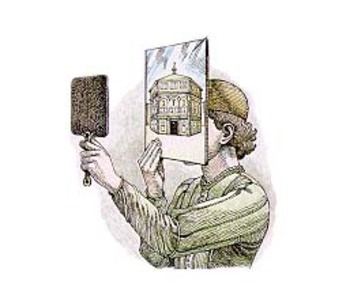
    As a matter of fact, it is just 30 years earlier that Filippo di  Ser Brunellesci (1377-1446) used mirrors as a tool in “creating” the first paintings in linear perspective in modern times–and he uses the mirrors in such a way as to compare what he was seeing in front of him, rather than using them to gain a sight-line for things that he couldn’t see. But they did in a way do just that. Brunellesci set his position inside the unfinished Santa Maria del Fiore (Florence), and used the apparatus (pictured here from the linked website) to record the facade of San Giovanni de Firenze (better known by its subsequent name, the Florentine Baptitstry, as all Florentine Catholics
     were Baptized there well into the 19th century) which was opposite his position across the Piazza del Duomo. He effort was a panel which was finished between 1407 and 1410, and which is now lost to time and space.

    Van_eyck_mirror_2

    It should be noted that the Baptistry, an 8-sided figure (with another, triangular, form added later; and 8-sided to represent the octava dies, the “eighth day,” the day of the risen Christ, which would be outside the scope of time and measurement) was decorated with colossal, fantastically beautiful doors, some of which were created by none other than Ghiberti, another (slightly later) master of linear perspective.

    Van_eyek_brun

    (The image above is taken from the very useful site which goes into good detail about the Brunellesci pin/peephole experiment.)


    ·Posted by :

    ·in:

    — —