A Daily History of Holes, Dots, Lines, Science, History, Math, Physics, Art, the Unintentional Absurd, Architecture, Maps, Data Visualization, Blank and Missing Things, and so on. |1.6 million words, 7500 images, 4.9 million hits| Press & appearances in The Times, Le Figaro, Mensa, The Economist, The Guardian, Discovery News, Slate, Le Monde, Sci American Blogs, Le Pont, and many other places… 5000+ total posts since 2008.

Category: Art

  • Beauty in Shades of Gray of Stellar Spectra, 1863

    JF Ptak Science Books  Quick Post

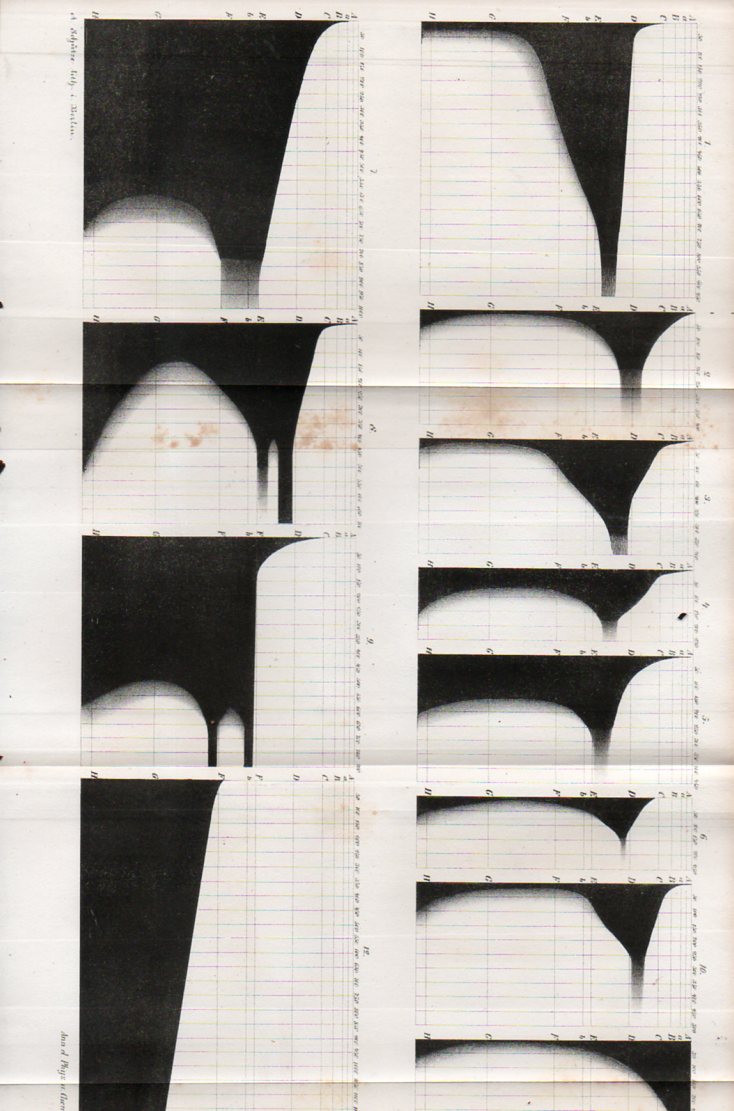
    This very quick posting is made in relation to a book just posted to the blog’s bookstore (Gustav Kirchhoff’s  “Zur Geschichte der Spectral-Analyse under der Analyse der Sonnenatmosphaere”(On the history of spectral analysis and the analysis of the solar atmosphere)–or at least in relation to another object in the 1863 Annalen der Physik volume.  And that other object is this, this beautiful series of diagrams illustrating “Ueber das Verhalten einiger Farbstoffe im Sonnenspectrum” by J. Haerlin, on elements in the spectrum of the Sun that appeared in teh same volume, tucked away at the end of the journal–art in science.

    Grayscale133


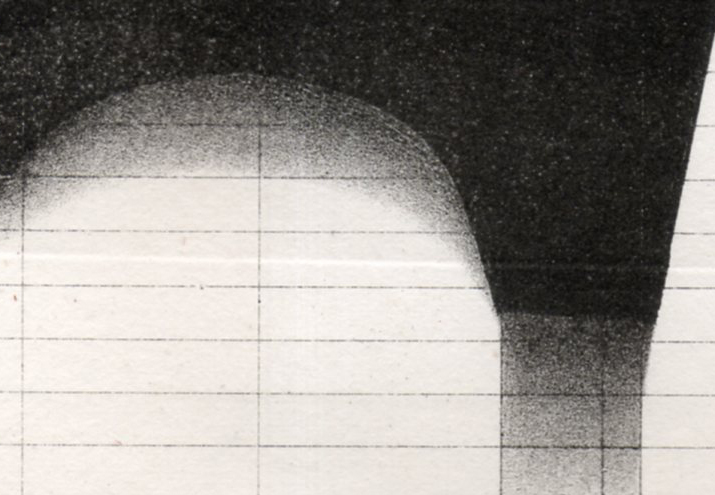
    And this, a bit of detail into the grays:

    Grayscale134


  • Anguissola and her Game of Chess, 1555

    JF Ptak Science Books   Quick Post

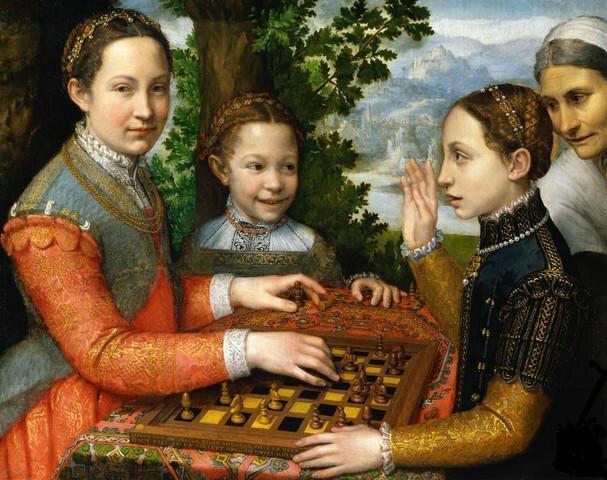
    “Anguissola has shown greater application and better grace than any other woman of our age in her endeavors at drawing; she has thus succeeded not only in drawing, coloring and painting from nature, and copying excellently from others, but by herself has created rare and very beautiful paintings.”–G. Vasari

    Chess game
    Sofonisba Anguissola is recognized as one of the leading women painters of the Renaissance, an interesting humanist who succeded in the face of restraint of prejudice.  She had great talent, obviously, and it seems as though that she gave a certain life to happy, common expressions in her subjects.  But what I focused on her in this chess game was how the player on the left got her bishop into the position at H1 with her pawn at G2. And why is the black square at H1?

    Also this:

    In his Libro de Sogni published in 1564, Lomazzo presents this following imagined conversation between Leonardo da Vinci, representative of modern painting, and Phidias, the artist from Antiquity:

    “I bring to your attention the miracles of a Cremonese woman called Sofonisba, who has astonished every prince and wise man in all of Europe by means of her paintings, which are all portraits, so like life they seem to conform to nature itself. Many valiant [professionals] have judged her to have a brush taken from the hand of the divine Titian himself; and now she is deeply appreciated by Philip King of Spain and his wife who lavish the greatest honors on the artist.”–An imaginary conversation between Phidas (representing the deep antiquity of art) and Leonardo da Vinci (as representative of the modern).  As seen in Giovanni Paolo Lomazzo (1534-1594), a busy mannerist painter and author of at least six books, including early and significant art criticism, in his  Libro de Sogni (1564, “The Book of Dreams”.


  • Curious Cuts: Books in Bosch

    JF Ptak Science Books    Quick Post

    Bosch cure of folly book detail
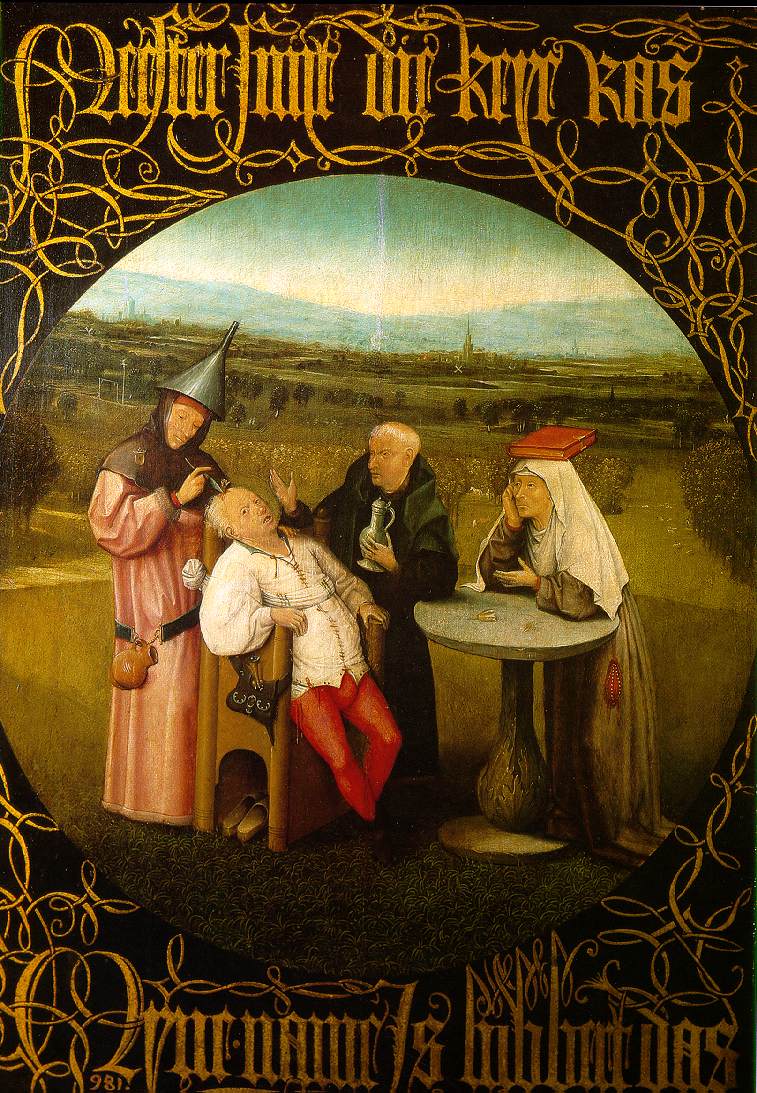
    Books are a favorite symbol, a venerable icon, a useful tool for developing ideas in Renaissance paintings.  They do sometimes make unusual appearances, this time–and not too unexpectedly–in the work of Hieronymus Bosch.  The painting, Cutting the Stone, (also called The Extraction of the Stone of Madness or better yet The Cure of Folly) was completed by Bosch in 1494 and lives today in the Prado. 

    Bosch cure of folly
    Bosch was at the very least a very curious character, hardly a man of his time–he seems difficult for us to place in the 15th century given the extraordinary range of his deep imagination.  He seems to be more a man of the modern times rather than one of the Renaissance.  I mention that the painting is in the Prado, finding its way there from the collections of Spanish sovereigns, who collected Bosch as a deeply Christian painter who depicted the travesty of sin and moral neglect rather than his own deep fantasy.

    Bosch cure of folly brain
    The scene is described by the inscription above and below it:

    Meester snyt die keye ras
    Myne name Is lubbert Das

    (in English: “Master, cut away the stone
    my name is Lubbert das”).

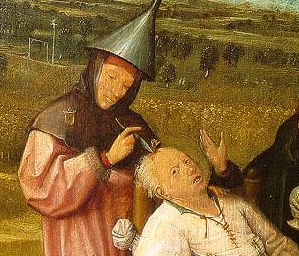
    The man in the chair, the man undergoing some sort of cranial/brain surgery is an everyman of sorts, a Dutch Everyman Fool named Lubbert (translated to “castrated dachsund”)..  A charlatan medico stands and removes symbols of lunacy and foolishness from his brain, images of flowers standing for the fool’s stone of long folklore.  The medicine man wears an inverted funnel for a hat, a symbol for emptiness, nothingness.  Likewise his purse is stuffed with straw, another iconic display of greed compounded and gaining nothing at all. 

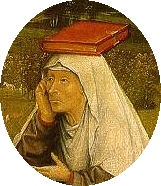
    But what I am attracted to right now in this painting is the woman on the right balancing a book on her head.  It seems to me to be a very rare case of a Renaissance image of  a book displayed in this manner–usually books are simply held and are symbols of learning or wisdom or piety.  In this case, the woman is just part of the general folly which is the concern of the quack surgeon, a closed book (impossibly?) balanced in tribute to the craziness before her, perhaps hoping for the words to seep through the pages and into her own head. 

    There are a number of other images of this operation, which was in its way a standard procedure for the relief of insanity, or depression, or lunacy, or basically of any mental complaint or “error”, which can be found (along with description) on the bioephemera blog, here. 

    For example, there is this scene of mass extraction of the stones of madness by Peter Brueghel (painted ca. 1550)

    Bruegelmadness.jpg

    Its a pretty miserable scene.

    Again, I’m really just after the book in the Bosch. 


  • History of Lines, #17: the Artist Painting the Negative, Camille Corot, 1874

    JF Ptak Science Books   Post 1584   [Part of the History of Lines series]

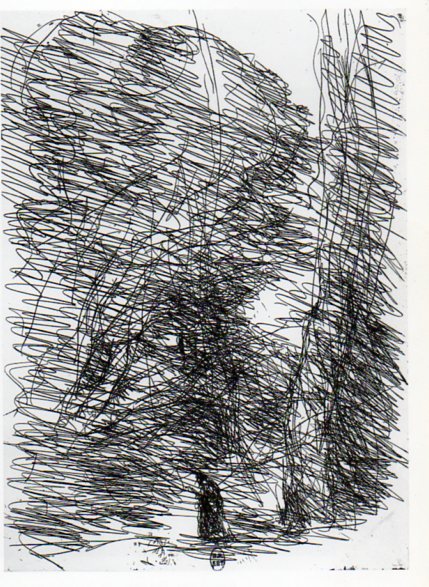
    Corot657 An interesting appearance of lines in art that seemingly crosses several disciplines and chronological development is Jean-Baptiste Camille Corot’s The Dreamer and the Large Trees (1874).  It is vivid artwork full of motion, expressing itself in an impressionistic sense that seems almost more abstract expressionist than mid-early Impressionist. (As an Impressionistic work it would be well into the second decade of the movement; if Abstract Expressionist, it is three decades early.)  It is a brusque, almost savage portrayal of a somber person in a deep wood, though the lines that is is composed of say anything but that. 

    The print was made via the cliche verre process1–Corot used a semi-photographic medium in which there was no camera, as it was the artist who drew the negative, who created the image from nature without a lens and without a camera body (thus eliminating lensless photography like pinhole), drawing directly on the medium (which in this case is glass, insinuated by the cliche) and then exposed/printed onto a photo-sensitive paper (the verre).  The artist is in a sense making a photograph directly of the image in their mind, recording it on the medium, and then printing it from there. 

    Of course there are other important lines in the history of art: Vincent Van Gogh Starry Night (1889), Giacomo Balla, Street Light (1909), Umberto Boccioni States of Mind (1911), Michael Larionov’s Rayonist Painting (1913),   Robert Delaunay Windows, (1912), Roberto Crippa (1921-1972), Jackson Pollock (1912-1956, particularly Number 1, 1948), and any numbers of works by Barnet Newman.  And of course the Cubists: Braque, Gris, Picasso, and the rest; the Constructivists like Malevich, and on and on into the sunset.  But the reason I’ve chosen Corot is because of the unexpected, wildish impressionist qualities that seem so far out of place, even with the movement. 

    Notes:

    1.  Cliche Verre was quite popular with French artists of this period, used by Theodore Rousseau, Charles Daubigny, Charles Jacques, Francois Millet and others.  The process itself appeared very early on in the history of photography, being described in Robert Hunt’s technical manual on artistic photography as early as 1841, two years after photography’s beginning.

    The images:

    ·Posted by :

    ·in:

    — — —

  • History of Holes: the most Famous Hole in Art?

    JF Ptak Science Books  Post 1583   [Part of the History of Holes series]

      Holes--brunelleschi2_large

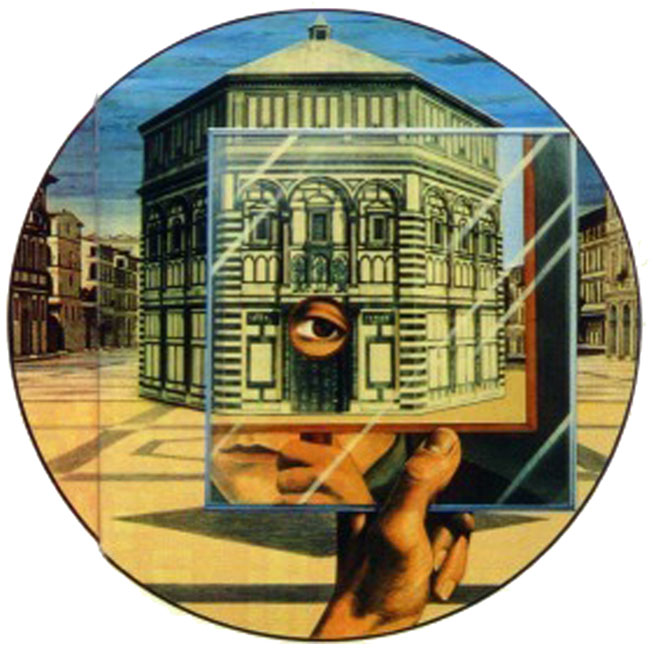
    Filippo Brunelleschi is most often credited–from Vasari to Kemp–as the modern discoverer of linear perspective (or re-discoverer in the eyes of Samuel Edgerton Renaissance Rediscovery of Perspective, 1975 or John White, The Birth and Rebirth of Pictorial Space, 1987).  The Greeks most certainly had mastered some aspects of perspective as is in evidence in their surviving architecture (though not artwork remains exhibiting this), but Brunelleschi for all intents and purposes1 discovered it for the rest of humanity. 

    Edgerton remarked that the discovery “marked an event which ultimately was to change the modes, if not the course of Western history”, with one reason for this magnitude being that technological and architectural ideas could be far more easily intellectually-transmitted as societal property rendered in perspective than had they not been issued so.  (I wonder, for example, if this might have been the reason why there was no Chinese technological renaissance during the Renaissance–because the idea of linear perspective was not adopted until relatively late, meaning that transmitting complex technical ideas was far more difficult.)

    Brunelleschi employed a brilliant method to capture the depth of his scene–in this famous case, the Baptistery in

    peepshow.gif

    Florence.  Employing this method helped the architect to understand the mathematical principles of perspective and to become its earliest master. 

    Perspective is the romance of balance and the mathematics of proportion, at the center of which is the vanishing point, an interestingly-named point of departure and similarity, where parallel lines not parallel to the image plane appear to come together, in an early singularity.  So it is this great and famous hole helping to establish a great and famous dot (which I guess could make an appearance of its own in this blog’s series on The History of Dots). 

    Perspective c

    Another famous hole that comes a little later (a hundred years or so later) belongs to Albrecht Durer (The Painter’s Manual, 1525)

    http://www.oneonta.edu/faculty/farberas/arth/Images/ARTH_214images/Durer/durer_perspnude_large.jpg

    where Durer illustrates the artist at work using a perspective device along with a vielo. 

    There are other holes in the history of art to be sure, but these are perhaps the most significant ones that appear in the Renaissance–there are others in architecture, for example, but my thinking is that the Brunelleschi hole takes precedence.  Other interesting and significant holes begin to appear a little later on, for the development of peep machines, and the camera obscura, and then of course photography, but they will come in a later post. 

    Notes: 

    1. Earlier though not complete efforts were made in Alhazen’s Perspectiva, c. 1000 A.D., Roger Bacon’s Opus Majus, c. 1260 A.D., John Pecham’s Perspectiva communis, c. 1270 A.D..,  and Alberti’s  Della pittura (1435).

    Another perspective machine of Durer: 

    ·Posted by :

    ·in:

    — —

  • A High Achievement in Obstetric Art, 1781

    JF Ptak Science Books   Post 1473

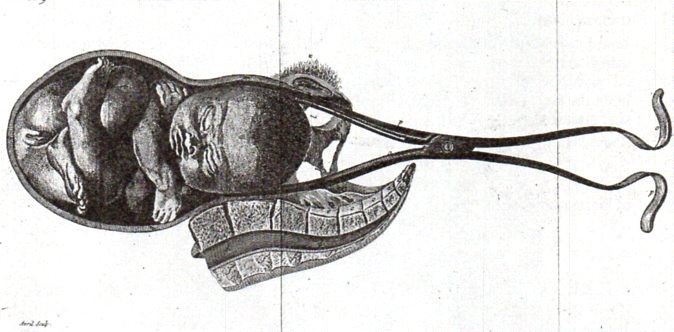
    Anatomy bauldeqocue483

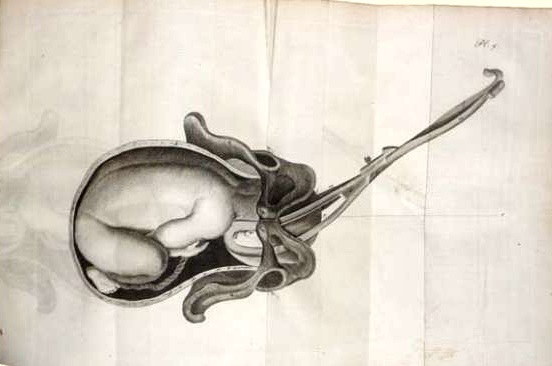
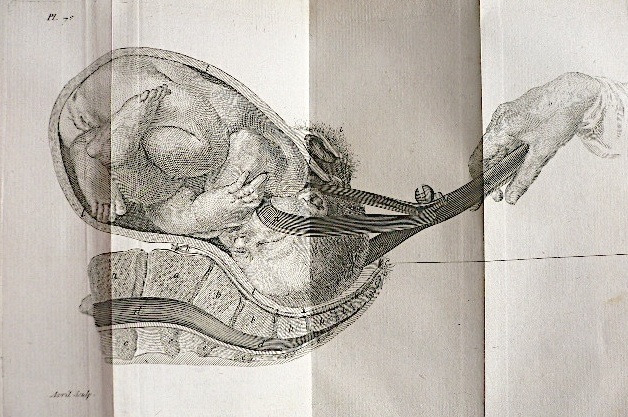
    One of the great thinkers in the history of gynecology was Jean Louis Baudeloque, whose 1781 book L’Art des Accouchemens was perhaps one of the most significant works in the history of obstetrics. This work was important not only for its great clarity and ease of explantion and control of its subject, but also for the exceptional illustrations.  I find them incredible not only for their spectacular detail but also for their control of blank space, a feat not easily accomplished…and I think a somewhat courageous approach to illustration during this era.

      Baudelocque

    For example, in the accompanying engravings (all of which are second generation and so are not nearly as sharp as the originals), we are left with a detailed image of only what was necessary for the explanation in the text, a terribly modern approach to illustration and clarity, so much so that it seems almost impossible that the image was made more than 230 years ago. 

    Baudelocque 2

    Obviously the representation and the subject matter give away the age of the image, but certainly not the design or placement.

    Note:  It should also be pointed out that chief among Baudeloque’s contributions was his teaching career, during which he would instruct upwards of 150 pupils per year (mainly at the Ecole de Sante) in clear and precise terms on his approach to obstetrics, not the least of which was in the use of instruments such as the foreceps and pelvimeter, a distribution of a very useful information base which seemed to have spread exponentially as his students went out into the midwifery field. 


  • Black Soils of the Renaissance (from the Things-out-of-Place Department)

    JF Ptak Science Books   Post 1471

    It is interesting to see things as they aren’t, particularly when the time things were being what they weren’t was a long time ago.  An example of this appears in an earlier post here about the use of red skies in Renaissance painting, which was something completely unexpected to me, a spectacular use of beauty found in an alternatively beautiful place, a reminder of why it looks so odd to us to see a clock running backwards.

    Why does a clock run clockwise, anyway?  It seems to me that most other things that go ’round seem to do so “counter clockwise”, and seeing a clockface with the hands sweeping themselves backwards ticking off the minutes and hours seems antithetcal, even though the same function is being performed–its just happening in a slightly different manner. 

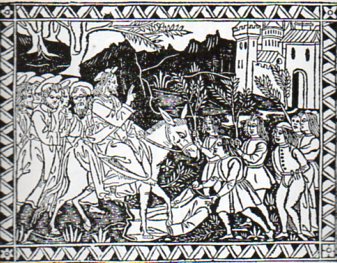
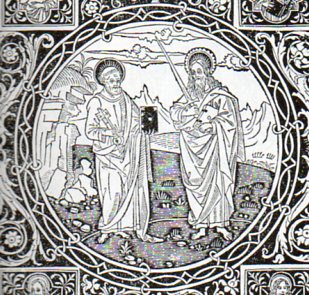
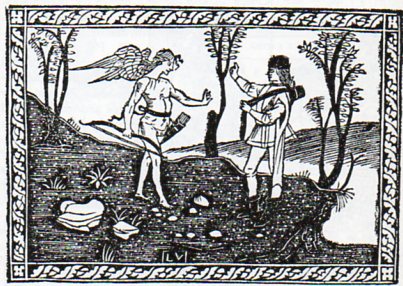
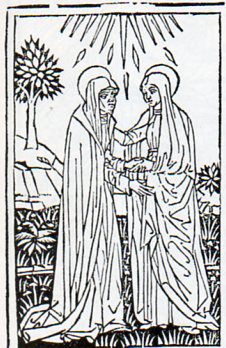
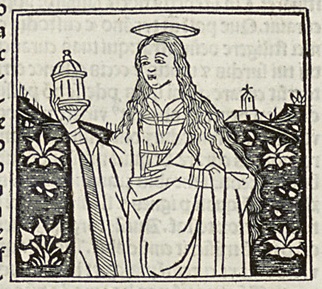
    And so to the question of the ground.  If skies can be red, why not the ground black?  Especially in wood engravings that are 500 years old?  No reason for it not to be so, especially when you’re working in black ink and nothing else but the suggestion of open, unused white spaces, with no midtones.  And once you think about it a little, the use of black as a ground color makes perfect sense, differentiating it from the sky. Its just that we don’t think of the ground in that way, and so when it appears it seems quite out of place its a bit of a shock–but then we get over it, nearly instantly. And so the fortress of normalcy fails.

    Here’s a few examples of Black Soils of the Renaissance.

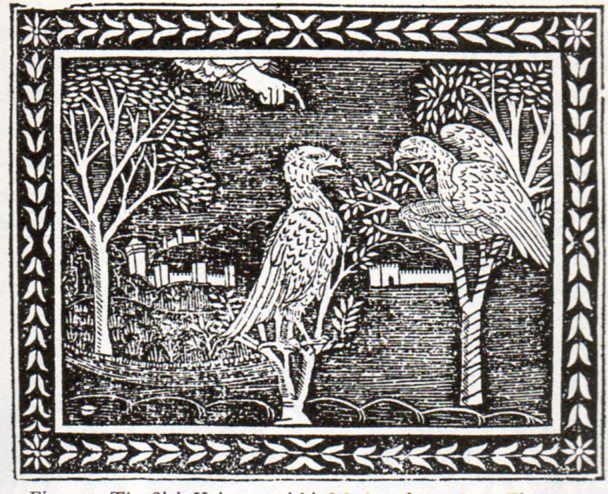
    “The Sick Vulture and his Mother”, from Aesop,  Vita Esopi, printed in Florence, 1508:

    Black soil 1471
    “Christ entering Jerusalem”, from Bonaventura, Meditazioni sopra la Passione, printed in Florence, about 1494.

    Black soil 2472
    Detail of the frontispiece to Epistolo e Evangelii, printed in Florence in 1495:

    Black soil 3473
    Frontispiece to Frederico  Frezzi, Il Quadriregio, printed in Florence, 1508:

    Black soil 4474
    Christophoro Landinus, Formulario di Epistole, “The Visitation”, Bologna, 1485:

    Black soil 5475

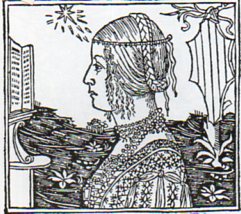
    “Damisella Trivulzia”, image from Giacomo Filippo Foresti, De Claris Mulieribus, printed in Ferrara, 1497

    Black soil 5476 Black soil
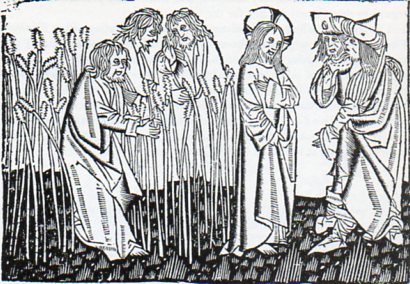
    Ludolphus de Saxonus, Levenons Heeren, “Disciples Plucking the Ears of Corn”, printed in Delft, 1488.

    Black soil 5477

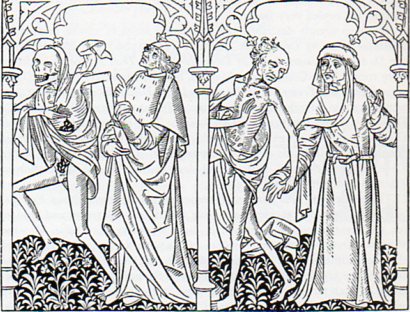
    The Danse Macbre des Hommes, printed in Paris by Couteau and Menard, showing Death visiting the astrologer and the bourgeoise, 1492. 

    Black soil 5478
    There are no doubt many more, but these willl do for now.

    Did anyone mention the Solids in Uccello?


    ·Posted by :

    ·in:

    — —

  • The Other Miracles of 1905–Winsor McCay, Little Nemo and Subversive Dreamscapes

    JF Ptak Science Books  Post 1453

    Okay, to be fair no one has ever had a year like Einstein’s annus mirabilis of 19051 perhaps no one has really ever come close–he defines the incomprehensibly high achievement for a single (less than) 365-day time span. There was other stuff going on in 1905–Ernest Starling2 introduced the term “hormone”, Vagn Ekman produced a beautiful paper on the mathematics of ice drift in the Arctic Sea and the ocean’s responses to different sorts of winds, Eduard Zirn performed the first cornea transplant, Ejnar Hertzprung3 published his famous diagrams, Henry Gruppy empirically established the manner of plant dispersal in the Pacific region4, Maurice Frechet’s groundbreaking work in topology, and Henrui Poincare and Howrd Ricketts and Oswald Veblen and so on. And the Wasserman test.  It was a pretty bountiful year–and this was just in the sciences and maths.

    And then there was the Russian Revolution (of 1905).

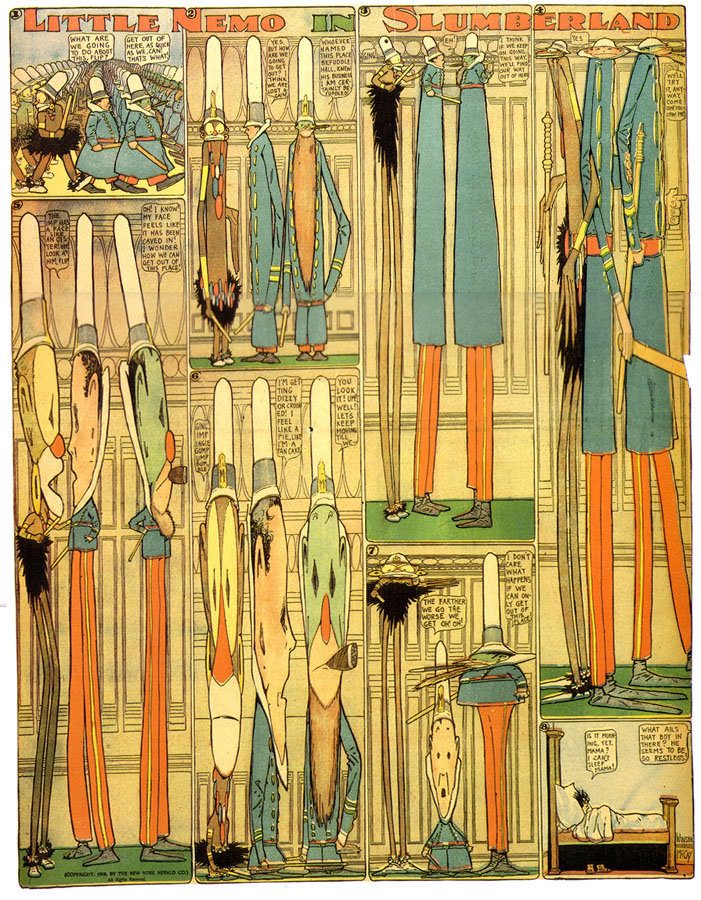
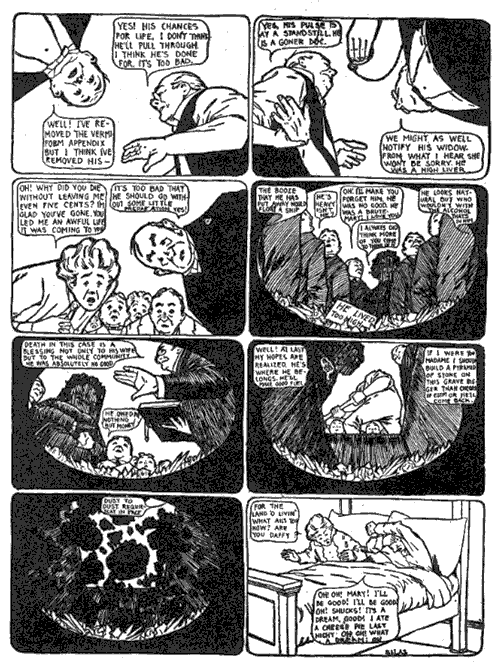
    But also back there in 1905 Winsor McCay was having a terrific year–this was the man who revolutionized the comic strip.  McKay may have been the Einstein of his field, and his work I think may still be the standard bearer for high excellence and creativity.  It was in 1905 that he began his Dreams of a Rarebit Fiend and also the crowning masterpiece of the medium, Little Nemo in Slumberland.  Nothing had really quite been seen like that before, two newspaper strips that were filled with vision and elegance and weirdness and the bizarre, beautiful stories illustrated on one sheet of paper, of great imagination and a wide stretch of subversiveness. They so captivated the readers of the time that McCay went off on illustrative lecture circuits, found movie (in their relative infancy) versions of his work, and performed in vaudeville venues along with Charlie Chaplin and W.C. Fields.

    And then he created the animated cartoon. 

    Here’s a page of Little Nemo:

    Little_nemo_1908
    And another of the Rarebit:

    Rarebit_fiend
    I guess you can get the picture of what McCay brought to the world–examples of his work are all over the web, and have been published in eight (?) volumes of reprints.  This was a particularly sumptuous time for this sort of story telling, but this is not the place to talk about anyone else, not really. (Okay–one very high talent is the seldom heard Rodolphe Topffer, but that’s another story.)

    And a very early Rarebit movie (which takes a little while to get moving):

    And another, this an animated cartoon from 1921–it doesn’t have anything to do with McCay in 1905, I just like its motion, and also because McCay is the father of the animated cartoon:

    Can anyone say “Up”?

    And then of course there’s Gertie, the first animated cartoon:


    Notes:

    1.”Über einen die Erzeugung und Verwandlung des Lichtes betreffenden heuristischen Gesichtspunkt” Annalen der Physik 17: 132–148;  “Über die von der molekularkinetischen Theorie der Wärme geforderte Bewegung von in ruhenden Flüssigkeiten suspendierten Teilchen” Annalen der Physik 17: 549–560; Zur Elektrodynamik bewegter Körper” Annalen der Physik 17: 891–921; “Ist die Trägheit eines Körpers von seinem Energieinhalt abhängig?” Annalen der Physik 18: 639–641.

    2.  “On the Chemical Correlation of the Functins of the Body”, not only defining the term but clarifying the hormone’s function.

    3. Hertzsprung, “Zur Strahlung der Sterne”, with another paper of the same name later in 1907. 

    4.  Observations of a Naturalist in the Pacific Between 1896 and 1899, the second volume, entitled Plant Dispersal, is where (surprise!) he discusses plant dispersal.  But the really cool thing here is that he figured out that there were a lot of seeds that floated here and there in/on the Pacific, going place to place, finding out how long they could stay afloat, and so on.  It was fantastic!


    ·Posted by :

    ·in:

    — — —

  • Spirit-Generated Art, 1871: Far-outside Outsider Art

    JF Ptak Science Books    Post 1402
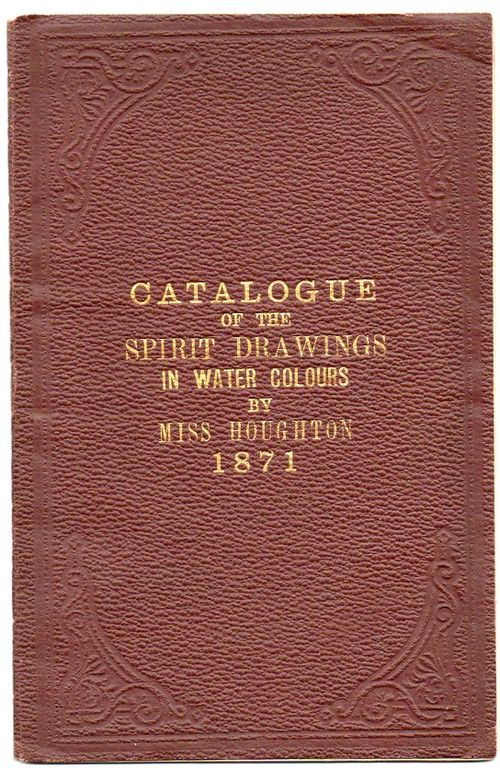
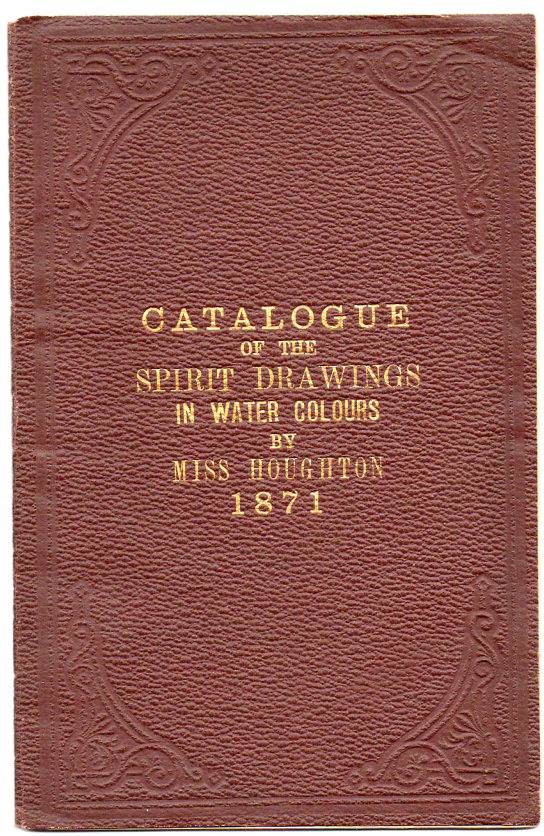
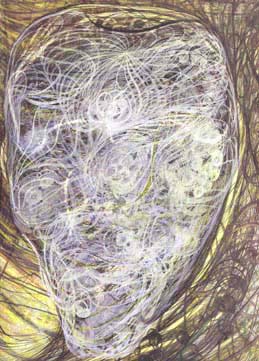
    Houghton219 This slim booklet,  Catalogue of the Spirit Drawings in Water Colours, Exhibited at the New British Gallery, Old Bond Street (London: 1871), offered descriptions of the work of  Georgiana Houghton (b. 1814), an artist who in some way communicated with the spirit world, and allowed her art to be guided by it. She writes in the very first paragraph of her catalog’s introduction, “the execution of the Drawings my hand has been entirely guided by Spirits, no idea being formed in my own mind as to what was going to be produced…”  She explains that the spirits were definitely those of dead people, and after having heard of such possibilities of communication as early as 1859 set out to “obtain mediumship”  by holding hands with her mother at a small table for some months on end waiting for contact–which of course she says happened.  Sundays worked best, “as we should then be less disturbed by evil influences”.   The spirits would communicate at first by table movement, then tapping,  and then through the alphabet by the use of a planchette. So it seems to me that given that she had abandoned her own input in the creative process (even though she had a history of formal art education or instruction), and that the inspiration she received seemed not to be her own, that Miss Houghton was an outsider-Outsider artist, pursuing the spoken artistic needs of others, and then providing her own interpretations of the forms and colors. (We offer the original copy of this catalog at our blog bookstore.)

    It seemed that Miss Houghton was inspired by the spirit drawings of a Miss Wilkinson–it was then that she sought the artistic guidance of a dead artistic sister though without success, and then from a dead brother.  It was the brother who brought her into contact with dead Henry Lenny (“a deaf and dumb artist”) who then guided her hands at first with the planchette, then with a pencil, and finally to watercolors. 

    After ten years of her own spirit drawings, Miss Houghton produced for herself a four-month show at the New British Gallery on Old Bond Street, exhibiting 155 of her works, all exhibited in rented frames for the occasion.  Her reviews seem to have been very-light and  mixed at best,  and for all of her effort and trouble, she sold only one painting,  She did however produce a catalog of the exhibition, which was a great aid to the viewer as the interpretations of the meanings of the forms and colors that Miss Houghton used were written on the backs of the artworks, which were hidden from view by the frames–many of the paintings’ meanings were annotated in the catalog.
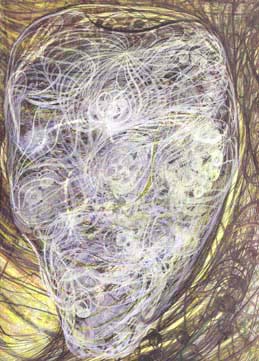
    Georgiana

    Miss Stoughton was hardly alone in this field of representing what seems to have been a very actice after-life of the dearly departed, though it seems that not as many participated in her own brand of automatic representation than other methods of spirit communication.  She did appear at the beginning of what would become a significant culture of spiritualism, with spiritual manifestation, telepathic communication from one person to another and then to the dead, thought transference and  magnetisation.  The evidence of spiritual contact was produced on high levels, not the least of which were seances in which the dead appeared as floating ghosts filled with quiet or phantasmal groans and noises, sometimes luminous, sometimes leaving the medium’s body as colored smoke, sometimes appearing as an electric spark, or an imprint on a photographic plate, or an aural shadow produced in iron filings, or an impression made in clay or other accepting materials2.  They offered possibilities for hope and belief that are no less vigorous than our own today, save for their technological limitations.  (An interesting article, “Proof Positive, the Photomatic Body in fin-de-siecle Science, by Alessandro Violi, can be seen here.)

    There is a very interesting article on Houghton and the exhibition by Rachel Oberter called  “Esoteric Art Confronting the Public Eye:  the Abstract Spirit Drawings of Georgiana Houghton” which was published in Victorian Studies 48.2 (2005) 221-232.  About the pre-Abstract abstract and proto-impressionist work, Oberter says:

    “Given the lack of abstraction within Victorian visual culture, watercolors such as those painted by the artist Georgiana Houghton in the 1860s and 1870s seem shockingly out of place. In her work The Eye of God from 1862, we see a tangle of transparent straight, wavy, and spiraling lines flowing out of the left corner of the paper and up from the bottom edge of the page as white filaments float across the surface. No recognizable forms appear; all that is visible are lines and colors—yellow, sepia, and blue. There is an organic quality to the undulations, a sense of microscopic detail, and a feeling of being in a deep-sea world or otherwise mysterious place. The vagueness of the imagery contrasts with the specificity of the title, which evokes a dense underlying symbolism. Houghton attributed meaning to particular shapes, colors, and directions in her paintings. While her works were abstract, they remained representational.”

    “The most important tools for decoding these works are the explanations that Houghton wrote on the backs of the drawings [above] . These elaborate descriptions provide a key to the symbolism in the drawing, clarify the message of each work, and name the spirit who acted as Houghton’s guide in the creative process. Houghton believed that these explanations were written by the spirits through her hands; they are automatic writings that complement her automatic drawings. The same spirit who inspired the drawing provided the interpretation on the back—the explanations, one could say, came directly from the source.”

    The catalog does give Biblical references for every one of the works, giving at least a location in the Bible for every artwork.  There are occasional (though sparse) longer descriptions of the work, though the great majority give Biblical citations for what each of the paintings represents. 

    Also of interest is Ms. Oberter’s description of the gallery event:

    “…in 1871 she exhibited her works in a more formal venue: she organized an exhibition at the New British Gallery in Old Bond Street in London. The exhibition, entitled “Spirit Drawings in Water Colours,” lasted for four months and consisted of 155 of Houghton’s watercolors. She rented frames for the occasion and hung the watercolors against the walls of the gallery. This arrangement meant that the backs with the explanations would not have been visible. Yet it was still critical for Houghton that she convey this hidden information to her viewers. In her autobiography Houghton recalled: “The chief object aimed at in this Exhibition, was not so much to display the wondrous powers of the unseen intelligences, as to manifest unflinchingly to the world that true Spiritualism is inextricably bound up with the religion of the Sacred Scriptures” (Houghton, Evenings 2: 53). It was not enough for Houghton that the drawings serve as proof of communication between spirits and humans; it was also important that they convey the relationship between Spiritualism and Christian theology, particularly the insights that the spirits give about God and the Trinity.”


     The artwork of Miss Houghton is an interesting blip in the history of Victorian art, and I’m not exactly sure what to say about it.  It certainly occurs during the first wave of Impressionism, and is wholly different from that new art form as well as the high Victorian fashion of the time; it also is entirely non-representational, an abstract art that precedes that revolutionary phase by about forty years.  Its a little puzzling to me, especially since Miss Houghton seems to have escaped virtually any sort of lasting review or critique.  But again Mrs. Stoughton is not alone in the non-representational art field apart from the automatic spirit manifestations–for example, in addition to an enormous literary output, Victor Hugo produced some 4,000 pieces of art, some of which are exceptional examples (to my mind) of non-representational art that came in a period decades before the Kandinsky and the rest.  Here is Hugo’s “Evocation of an Island”:
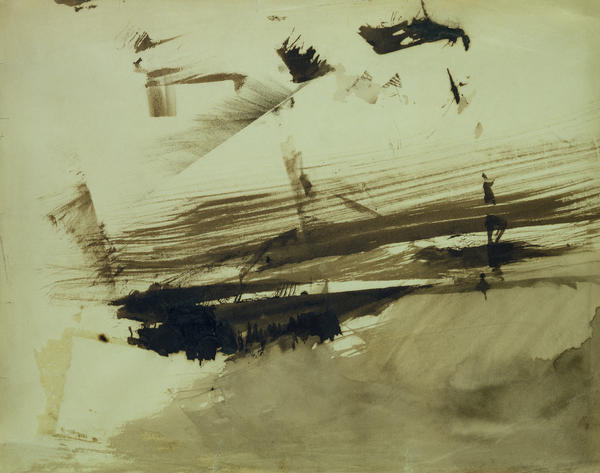
    Evocation of an island Painting  - Evocation of an island Fine Art Print

    He was certainly outside the mainstream of Victorian art, and even well outside that of Impressionism. 

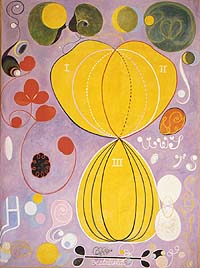
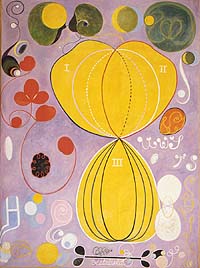
    There was also Hilma of Klint (b. 1862), a woman who like Stoughton also represented the spirit world through her art, and who began painting in non-representational and abstract ways beginning in 1897/8, an example of which is below:
      Hilma klint


    Miss Houghton went on to improve her representation of the spirit world through photography, a very wide selection of her work being available at the Keith De Lellis Gallery, here.

    In the realm of extra-sensical belief, I’m not so sure that these brands of spiritualism would be too much different from any other belief in things that cannot be seen, or heard, or felt in any detectable way, a prayer by any other name.

    Notes:

    1. Our catalog was the property of William Crookes (with his bookplate, and with a signed inscription to him from “Miss Houghton”)  who was an eminent British chemist and physicist and a pioneer in the field of vacuum technology (and remembered now mostly for the Crookes Tubes and his superior approach to experimentation).  He was interested in spiritualism from about the year 1869, pursuing it until his death in 1919.  He was hardly alone in his interests among highly-paced British intellectual elite:  Alfred Russell Wallace, Lord Rayleigh, Oliver Lodge and William James were all extremely interested in the spiritualism phenomenon.  Curious. 

    2.
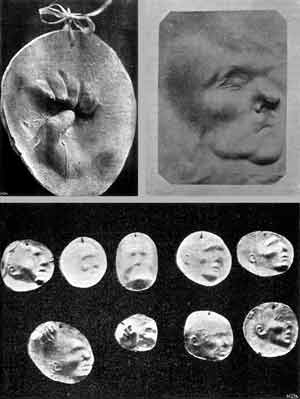
    Imprints of ghost hands and faces
    Imprints of ghost hands and faces produced by Eusapia Palladino, from Bozzano, Ipotesi spiritica, 1903, in C. Lombroso Ricerche…, 1909


    ·Posted by :

    ·in:

    — —

  • An X-Ray of Cubism? Jouffret and Visualizing the Fourth Dimension, 1903 and 1906.

    JF Ptak Science Books   Post 1361

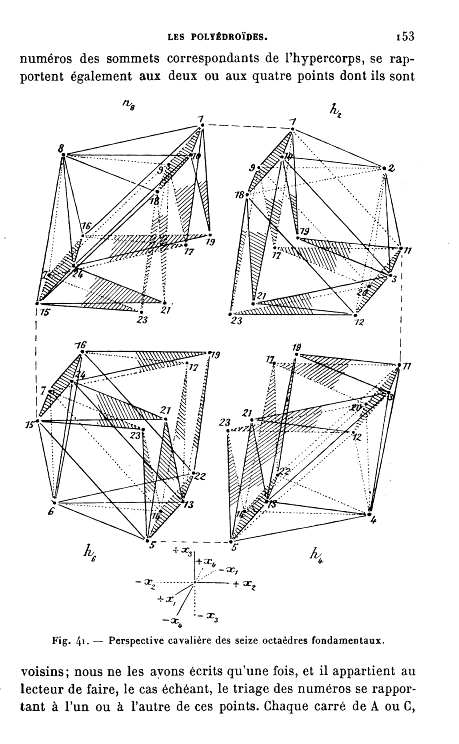
    Is this an X-Ray of Cubism?

    Jouffret

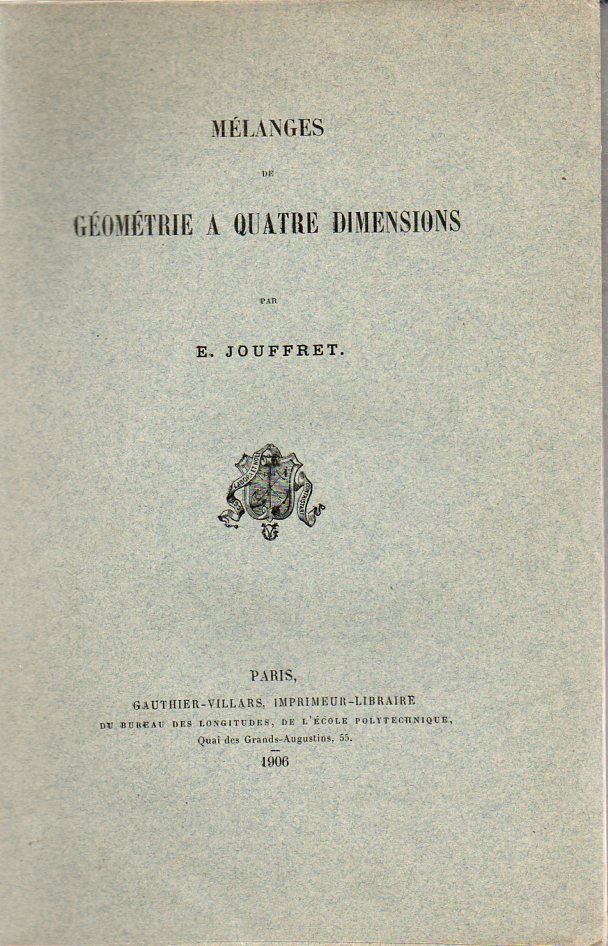
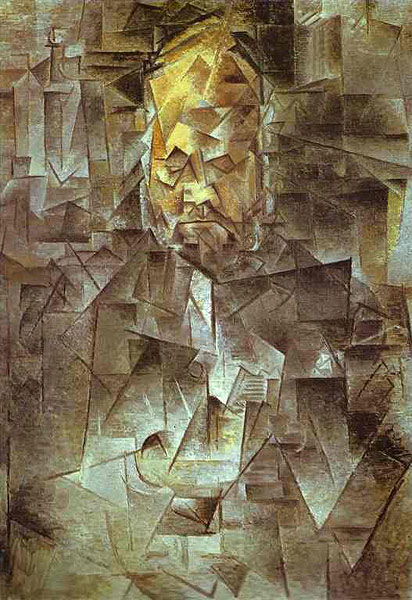
    Emile Jouffret brought an amazing and lovely pair of books to the mathematical dining table, both coming at about the mid-point of a period of perhaps the most sweeping multidisciplinary revolutions in human history.  Published in 19031 and 19062 [and both originals available at our blog bookstore] they both may have had an impact as a visualization tool for the newest movement in art since the creation of Impressionism (1850’s-1870’s): Braque and Picasso’s  Cubism. When you compare the illustrations in the Jouffret books you cannot help but to see a connection to the work of (the morally-lonely) Picasso (and especially in his 1910 portrait of the movement-molding art dealer Ambroise Vollard, below). Georges Braque and the that the two would make in 1906, the first year of the Cubist movement. 

    Jouffret’s 1903 book was hardly the first on the topic, though it may be the first of the major, book-length treatments of the topic, as well as the most  heavily illustrated.  Thinking on the fourth dimension goes back as far as Kant, at least, and the real work begins in the first half of the 19th century.

    The first major3 work arrives with Hermann Grassmann’s “Die Lineale Ausdehnungdlehre” (Theory of Linear Extensions) in 1844 (and the subsequent translations of the work as well as original work by Arthur Cayley); followed by Ludwig Shclafli (1814-1895) “Theorie der vier flachen….” (Theory of Continuous Manifolds, 1852 but not published until 1906), Riemann’s 1854 speech (which was not published until 1867 and which appeared translated by William Kingdom Clifford in Nature in 1873, G.F. Rodwells “On Space of Four Dimensions” (Nature, May 1873),  Dodgson/Carroll‘s  Through the Looking Glass (1872) deep references, Zollner “On Space of Four Dimensions” 

    Jouffret499

    (April 1878 and subsequent publications, and who is referenced in Kandinsky’s [difficult -to-me On the Spiritual in Art of 1912), W.I. Stringham (1847-1909) “Regular Figures in n-Dimensional Space” (American Journal of Mathematics, 1880), and E.A. Hamilton Gordon, “Fourth Dimension”, April 1887, to name some of the major figures.  And then of course comes Edwin Abbott’s Flatland, a Romance of Many Dimensions, by a Square (1884) and Charles Howard Hinton, who published a number of different works beginning in 1880 (“What is the Fourth Dimension?”, 1880 plus Scientific Romances 1884, and The Fourth Dimension, 1904) and lasting through the turn of the century.  There is also H.G. Wells, whose The Time Machine began to appear in parts as early as  1894, though it did appear in the same issue of the  Science Schools Journal as the Hamilton Gordon article, in April 1887, as the “Chronic Argonauts”). Wells’ also approaches the fourth dimension in “The Plattner Story”, in 1896 and The Invisible Man in 1897. Other literary contemporaries of Wells who used the fourth dimension in their work include Oscar Wilde (“The Canterville Ghost”, 1891), George Macdonald (Lilith, 1895), and Joseph Conrad and Ford Maddox Hueffer The Inheritors, (1901)–the most convincing and scientific of all of these literary efforts though lies with Wells. From about this point on–from the time that Jouffret enters the scene in 1903–the fourth dimension has become part of the culture, and a popular culture at that…especially after the Cubists begin their assault on visual representation in about  1906.

    The Jouffret books are beautiful, and very interesting–they would have been better served with a bibliography, which would have been very nice to have–that said, Jouffret does have a fair number of footnotes to earlier work, so it is not as though his work is without attribution.  But it is a very interesting adventure. (Just a note–the fourth dimension and non-Euclidean geometries would get their first bibliography in D.M.Y. Sommerville’s classic  Bibliography of Non-Euclidean Geometry in 1911, which is a must-have for all of those interested in this topic…it is massively packed with all manner of major and minor works as well as obscuriana.  It is not, unfortunately, annotated.)

    1. Jouffret, E.  Traite Elementaire de Geometrie a Quartre Dimensions et Introduction a la Geometrie a n-Dimensions. 

    2.  Jouffret. Melanges de Geometrie a Quatre Dimensions.  Paris, Gauthier-Villars, 1906.  220pp.

    3. Most of the data in this long and winding sentence has been culled from Linda Dalrymple Henderson’s terrific The Fourth Dimension and Non-Euclidean Geometry in Modern Art, Princeton, 1983–most of my references come from the first 45 pages or so of her book, which is the Bible of all modern works on the fourth dimension/math/physics/art.

    Picasso_vollard1910