A Daily History of Holes, Dots, Lines, Science, History, Math, Physics, Art, the Unintentional Absurd, Architecture, Maps, Data Visualization, Blank and Missing Things, and so on. |1.6 million words, 7500 images, 4.9 million hits| Press & appearances in The Times, Le Figaro, Mensa, The Economist, The Guardian, Discovery News, Slate, Le Monde, Sci American Blogs, Le Pont, and many othr places… 5000+ total posts since 2008.

Category: Histories of Smallness

  • The Not-Unbearable Extra-sub-Heaviness of Light (1876)

    JF Ptak Science Books  Quick Post (Overall post 5119)

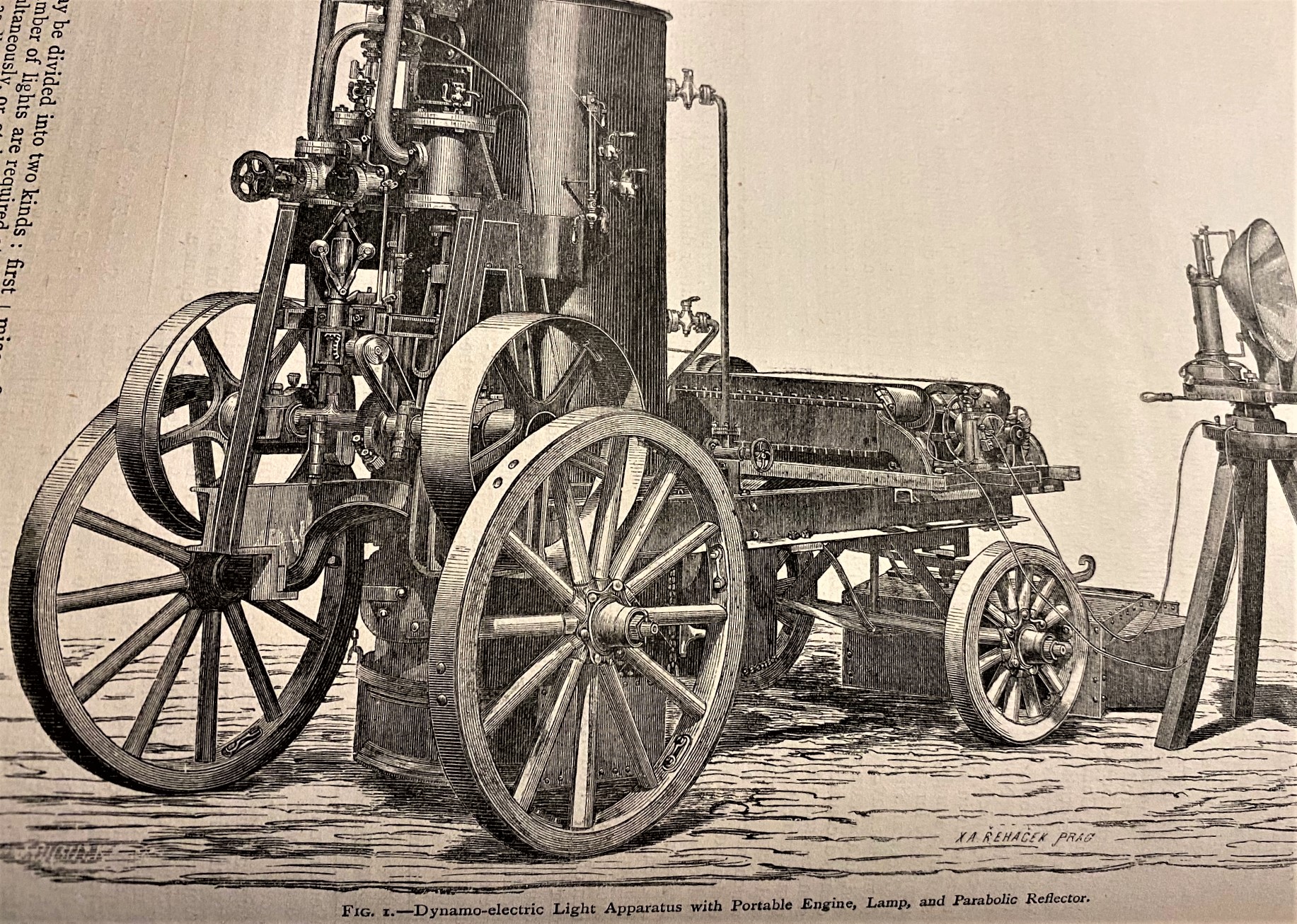
    I thought it would be interesting to share this engraving of a portable electric light apparatus. This does come very early in the modern (post 1850) sense of “electric light”, but, still, even knowing of how early this is in this fiel dit is still a little shocking to see the weight of the engineering and ingenuity in providing mobile electric light.  

    • “THE comparatively infrequent employment of electric light, considering the great success achieved in its production, would at first sight appear to be due to something in the application of the electricity itself. It has been repeatedly and satisfactorily proved that a continuous and powerful light can be produced by electricity, and the question naturally arises, Why is it not more frequently employed for practical purposes?”
    • “For transportation of the Dynamo-electric Light Apparatus is mounted on a wagon, with steam engine, the whole weighing 4,960 lbs. The combination has proved very serviceable on account of its lightness and compactness.”– Siemens’ Electric Light Apparatus. Nature 14, 133–136 (1876).

    IMG_3381


  • The Aching Beauty of a Work on Telephone Pole Marking Systems (1938)

    Books markers coverJF Ptak Science Books  Quick Post

    Over the years I have reported on inspiring and near-perfect minor-major works on minor-minor topics, excellent considerations on the sublime mundane.  These have included efforts from 75+ years ago on the correct method of flagpole painting, zipper repair, maintenance of the reverse of billboards, and the like. Marvelous works exhausting exhausting topics, or seeming so.  How much can you write on the correct way of using a screw, or blasting a stump, or dealing with a puddle of unknown origin? Well, the answer is that quite a lot can be said about these things, especially if you look at the mechanics of the things, or the failure analysis (if there is any)…a lot.  Most of what these pamphlets talk about is the very basics of zipper repair or ladder repair or screen repair–and that is usually communicated over 20-30pp or so. And the remarkable thing is that the information is useful, even if you didn’t have a direct application for it. 

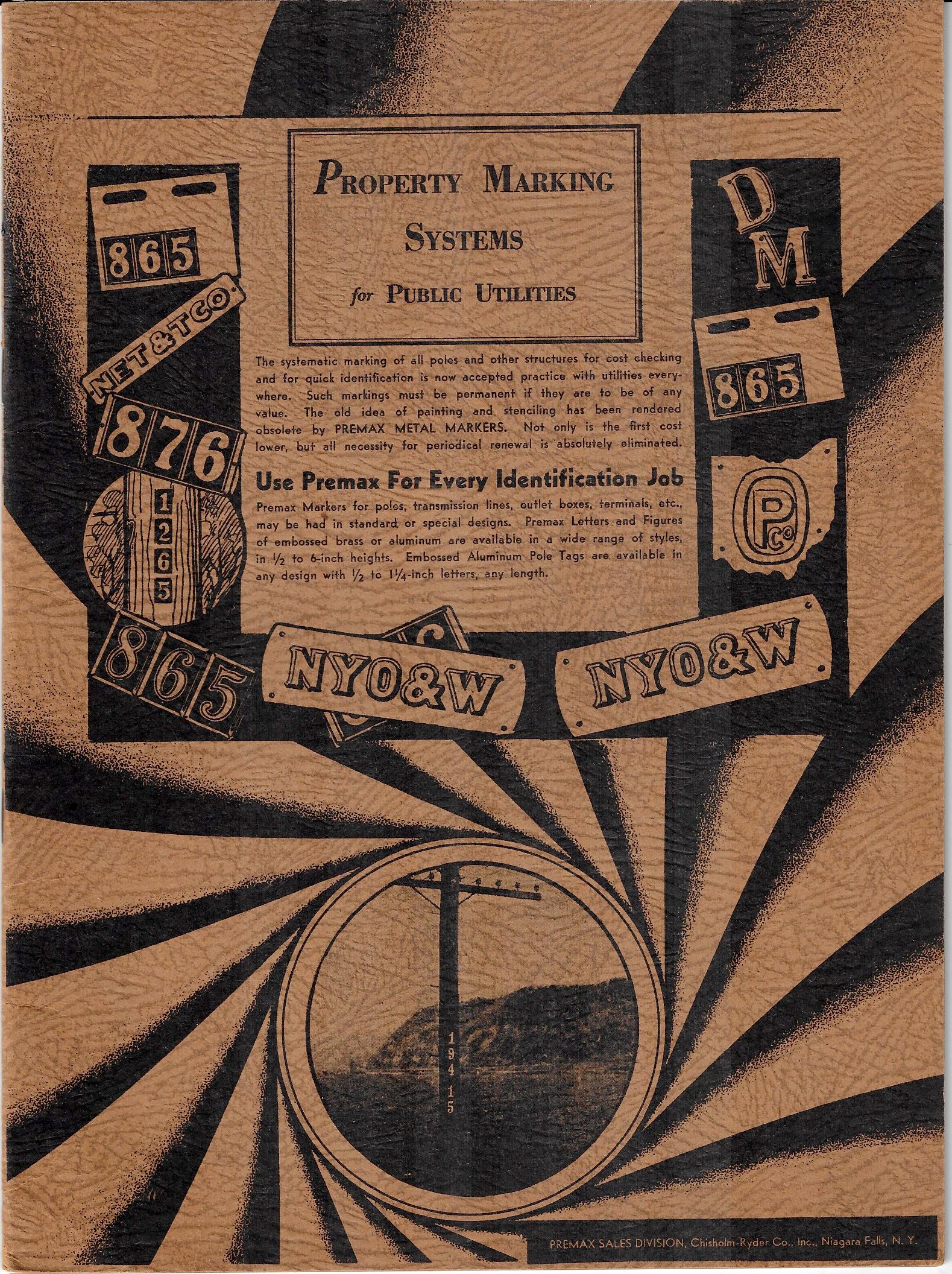
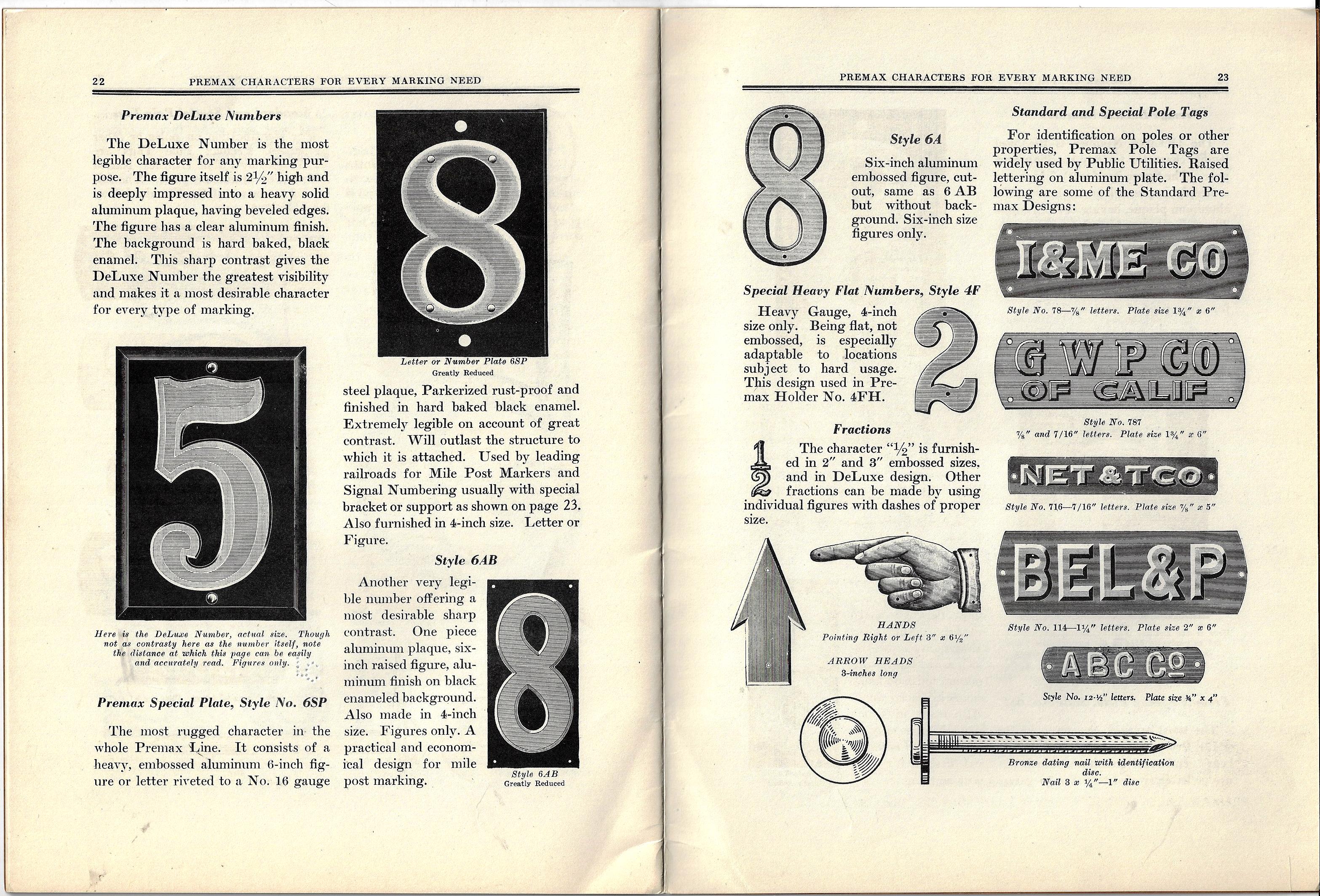
    Today’s installation is a somewhat Dadaist-looking pamphlet on telephone pole marking systems. Is there anyone who hasn’t noticed the found-art pummeled into telephone/utility poles and wondered what the numbers meant? This booklet, far from enchantingly-titled Property Marking Systems for Public Utilities, published by a manufacturer of such numbers and symbols back in 1938, answers these questions and tells the story of how you, too, can mark your poles in an efficient and modern manner.  

    I think the thing is achingly beautiful. 

    I think that if you engage these things as antique paper versions of the endlessly useful  DIY Youtube videos, they take on a higher glory.

    And of course this one to me has a lot of those found-Dada elements…

    Books markers


  • On Finding Pictures of 18th Century Everyday Common Life (1726)

    JF Ptak Science Books     Post 2356

    I’ve written earlier in this blog about the magnificent-ish and often described book by John Comenius called The Visible World…1, which also happens to be the first illustrated children’s book. It was also a book about virtually anything, and everything, and certainly not a book about nothing, because sooner of later Comenius would get to the topic and deal with it, right or wrong.

    The book was originally written in 1676, and translated into English in 1726; in that edition the translator states the purpose of the work:   

    To entice witty children to it, that they may not conceit a torment to be in the school, but dainty/are., For it is apparent, that children (even from their infancy almost) are delighted with Pictures, and willingly please their eyes with these fights: And it will be very well worth the pains to have once brought it to pafs, that fcare-crows may be taken away out of Wifdom’s Gardens…”

    Though much is said of other illustrations in that book (I was drawn to it for the illustration of the human soul) I don’t often see very much at all on the subject of his display of trades–for example, the barber, illustrated below. The trusting bit about these cuts is that it shows a relatively simple image of common working life, which frankly is not terribly common, or at least so with the commentary on the tools of the trade, which are listed in the text and annotated in the image.  It is interesting to see the reference to the comb used to sometimes “curl” the customer; and also the “crisping iron” which is a tong-like device that would be used to further curl the hair.  In the background we see the remnant from an older time, a barber using a “pen-knife” to “sometimes…cutteth a vein”, a practice of balancing the humours, of curing maladies from major aliments to gunshots to dandruff and ingrown toenails–anatomy and the understanding of the body may have progressed a little more quickly than figuring out disease.  This practice lasted in places until deep into the 19th century, and is still used today in  are cases where Dr. House might find something absolutely suited for this procedure, or for the application of leeches, which did much the same thing. (The Brits imported millions of these buggers from France for this purpose, even into the 19th century.) 


     There’s much much more to come in this book–just follow the link to the original at Project Gutenberg. 

    Notes:

    1.  The work itself: John Amos Comenius, Orbis Senfualium Piélus: Omnium Principalium in Mundo Rerun/ &f m Vita АШопит,  translated as Pictura et Nomenclatur, the Visible World, or A Nomenclature, and Pictures of all Chief Things that are int he World, translated into English by Charles Hoof…1726.


    ·Posted by :

    ·in:


  • A Remarkable Chronology of Elusive Definition

    JF Ptak Science Books  Quick Post

     The source for this is a lovely article “Colonial School Books” by Clifton Johnson in the New England Magazine, volume 30, 1904, who sifted and read his way through a number of primers and turned out this work by “Fenning”, which urns out to be Daniel Fenning of the Universal Spelling Book, first printed in 1762.   This turns out to have been a best seller and kin to another British speller, Thomas Dilworth’s New Guide to the English Tongue (70+ editions in American before 1800!), both of which dominated the market until the first American-born speller was written by Daniel Webster in 1783.  In any event Fenning for whatever reason listed historical tidbits, one of which is this chronology, which is slight and charming and, well, a little elusive:


    [I cannot locate the reference for this–it obviously was re-set by someone in a more modern typeface; I’m sorry to say I cannot locate who. It wasn’t me. See HERE for a lexisnexis document on American Primers.]


    ·Posted by :

    ·in:


  • The Tall in the Short of It–the Giants of Microworlds

    JF Ptak Science Books     Post 2318

    I’ve posted a number of bits in this blog about stupendously large and enormously small things, but it is infrequent to find the story of something made exceptionally large in a reduced world.  Perhaps it is normal fare in the science fiction world, but I found the not-obvious but still-obvious making of a giant in microland to be, well, less than obvious.  

    There have been countless stories told of shrinking people, or the discovery of vastly small communities living withing a larger host community, and so on, like the following:

    http://static.flickr.com/67/202348136_833ca3249d_o.jpg

    This is a story by Henry Hasse and it involves a great scientist and the his elixir called “Shrinx” which after it has been injected into his assistant shrinks the man immeasurably, so science-fictionally small, that he has passed through the microscomos and “subuniverses” to the point where he emerges on a primitive place called Earth.  The assistant has traveled from a planet in a solar system revolving around a sun in a solar system in a galaxy in a universe to something small, something sub-atomic, landing in an electron holding within it its own universe. 

    That’s small. 

    And then there is this piece of magnificent ne plus ultra, where we remain in the microworld but where there are also micro-giants.

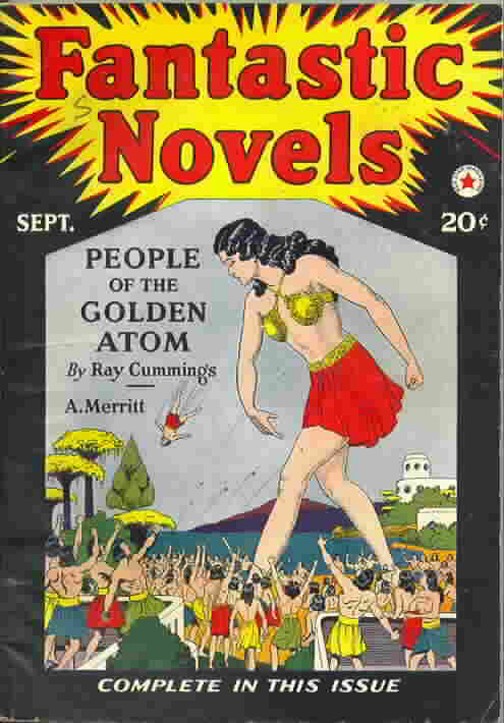
    The cover of Fantastic Novels (1921?) seems to tell a straightforward story, but as it turns out the giant is giant but one living within a world in an atom of a gold wedding ring.

    Man throwing

    Author Ray Cummings (1887-1957) found a nice writing niche for himself in his fictional discovery of a drug that could make people as small as atoms and then, once inside the microworld, could be made as immense as micro-mountains.  The Girl in the Golden Atom was one of a five-part trilogy(?)1 and so far as I can tell, Cummings used the hell out of his original idea.  The prose reads like it is punctuated with invisible periods every fifth word–evidently Cummings was so very busy writing 750 books and short stories that it  left him little time to edit or, maybe, think.

    It was a very nice surprise for me. That said, I can only imagine the giddiness and suspension of (dis-)belief when the mass market readership of Robert Hooke’s Micrographia got a look for the first time on what the small creepy crawlies that lived around them looked like under magnification.  Suddenly the blots and blotches took on real–and sometomes terrifying–forms.  These were basically unseen during their long interactions with human beings, until, suddenly, Mr., Hooke made his investigations and put a face on the unseen microworld and shared it with the General Public. 

    “It is my hope, as well as belief, that these my Labours will be no more comparable to the Productions of many other Natural Philosophers, who are now every where busie about greater things; then my little Objects are to be compar’d to the greater and more beautiful Works of Nature, A Flea, a Mite, a Gnat, to an Horse, an Elephant, or a Lyon” said Mr. Hooke at the end of his 28-page preface to Micrographia in 1665.

    https://historyofideasblog.com/a/6a00d83542d51e69e20120a5ec29c4970c-pi

    [Mr. Hooke’s drawing of his flea, in full and unexpected glory, with as much detail and armor as anything that had ever been imagined–only this thing was real, and common, and lived on you.]

    It may have been a similar shock to those seeing these images for the first time as it was for people to see Galileo’s images of the Moon, or to read him announcing that the perfect sky of Creation was actually not so, and that his telescope revealed ten-fold the number of stars that people could see with only their eyes, and which faith alone could not elaborate. 

    Yes, the incredible shrinking giant woman was a surprise but not on this order, not by a stretch–though it seems to be the world of science rather than scifi that has delivered the most shocking stories of the big and the small. 


  • A Big Popular Statement on How Small Small Is (1883)

    JF Ptak Science Books   Post 2259

    In three issues1 of Nature (London) magazine in 1883, William Thomson (Lord Kelvin)–polymath of a great and inquisitive mind–tried to establish a good reference point for the size of atoms, mainly to establish that their size while being incredibly small were not unimaginably so, and that even objects of this minor magnitude could be approximated and studied.  And he did so with great ease and in a popular general-audience sort of way.

    All told, this was a very good piece of thinking, especially referencing the estimates of Niels Bohr 30 years later, publishing in the Philosophical Magazine (volume 26, pp 1-25, 1913) and calculating the size of an atom at .5 x -10 meters. And even though Thomson is talking about his estimates in terms opf science in a post-Dalton and post-Mendeleyeev world, he is also pre-Stoney, and Roentgen and Curie and Soddy and everyone else, especially pre-atomic-nucleus, and pre-proton (1919/20 with Rutherford and Moseley) and pre-neutron (Chadwick 1932), which are smaller still than the atom. Way smaller.  It is difficult to put into understandable terms on how “small” that small is:  the atomic nucleus is sort of 1/10,000th of the atom, and a proton or neutron smaller still, and then the quark smaller than that, until perhaps it becomes a Seussian exercise with future discoveries showing that after everything is said and done that it is turtles all the way down.  

    But Thomson managed to put an understandable assessment on a very difficult visualization, talking in terms of an atom being “1/10,000,000 or from 1/10,000,000 to 1/100,000,000 of a centimetre in diameter”, or 1×10⁻⁷meters, which is just about the size of a cell nucleus or DNA; that’s in the neighborhood, especially if you look at the smaller number which is 10-8 meters, which starts to close in on the size of the massive carbon atom (10-10), but sorta not so close to the electron (10-12) , or carbon atom nucleus (10-14) or proton (10-15).  Small, hazy stuff indeed, filled with nothing.  On the other hand, if you proceeded in a space vehicle 1014 meters from Earth our Solar System would appear as just another fuzzy splotch in the sky.  1016 meters is about a light year, and then it would taken 10,000 of those “just” to get slightly outside our galaxy.  And then there’s the rest.  

    In any event, Thomson did okay. And as it turns out (as I just now learned) there was an earlier Nature article in 1870 (the inaugural year of the journal) by its editor Norman Lockyer who estimated the size of atoms at just about the Thomson scale.  

    "FOUR lines of argument founded on observation have 
    led to the conclusion that atoms or molecules are 
    not inconceivably, not immeasurably small. I u;e the 
    words " inconceivably" and "immeasurably" advisedly. 
    That which is measurable is not inconceivable, and there- 
    fore the two words put together constitute a tautology. 
    We leave inconceivableness in fact to metaphysicians. 
    Nothing that we can measure is inconceivably large or 
    inconceivably small in physical science. It may be diffi- 
    cult to understand the numbers expressing the magnitude, 
    but whether it be very large or very small there is nothing 
    inconceivable in the nature of the thing because of its 
    greatness or smallness, or in our views and appreciation 
    and numerical expression of the magnitude. The general 
    result of the four lines of reasoning to which I have re- 
    ferred, founded respectively on the undulatory theory of 
    light, on the phenomena of contact electricity, on capil- 
    lary attraction, and on the kinetic theory of gases, agrees 
    in showing that the atoms or molecules of ordinary matter 
    must be something like the 1/10,000,000, or from the 
    1/10,000 000 to the 1/100000,000 of a centimetre in dia- 
    meter."--Thomson, below. 

    Notes:

    1. William Thomson,  The Size of Atoms, I pp 203-205, June 28, 1883; Size of Atoms II, pp 250-254, July 12, 1883; Size of Atoms III, pp 274-278, July 19, 1883, earlier presented before the Royal Institution, beginning February 2, 1883.


  • The Tall in the Short of It–the Giants of Microworlds & the Microscope

    JF Ptak Science Books  Post 2127 

    Follow Me on Pinterest

    I’ve posted a number of bits in this blog about stupendously large and enormously small things, but it is infrequent to find the story of something made exceptionally large in a reduced world.  Perhaps it is normal fare in the science fiction world, but I found the not-obvious but still-obvious making of a giant in microland to be, well, less than obvious.  

    There have been countless stories told of shrinking people, or the discovery of vastly small communities living withing a larger host community, and so on, like the following:

    http://static.flickr.com/67/202348136_833ca3249d_o.jpg

    This is a story by Henry Hasse and it involves a great scientist and the his elixir called “Shrinx” which after it has been injected into his assistant shrinks the man immeasurably, so science-fictionally small, that he has passed through the microscomos and “subuniverses” to the point where he emerges on a primitive place called Earth.  The assistant has traveled from a planet in a solar system revolving around a sun in a solar system in a galaxy in a universe to something small, something sub-atomic, landing in an electron holding within it its own universe. 

    that’s small. 

    And then there is this piece of magnificent ne plus ultra, where we remain in the microworld but where there are also micro-giants.

    The cover
    of Fantastic Novels (1921?) seems to tell a straightforward story, but as it turns out the giant is giant but one living within a world in an atom of a gold wedding ring.

    Man throwing

    Author
    Ray Cummings (1887-1957) found a nice writing niche for himself in his
    fictional discovery of a drug that could make people as small as atoms
    and then, once inside the microworld, could be made as immense as
    micro-mountains.  The Girl in the Golden Atom was one of a five-part trilogy(?)1 and
    so far as I can tell, Cummings used the hell out of his original idea. 
    The prose reads like it is punctuated with invisible periods every
    fifth word–evidently Cummings was so very busy writing 750
    books and short stories that it  left him little time to edit or, maybe,
    think.

    It was a very nice surprise for me. That said, I can only imagine the giddiness and suspension of (dis-)belief when the mass market readership of Robert Hooke’s Micrographia got a look for the first time on what the small creepy crawlies that lived around them looked like under magnification.  Suddenly the blots and blotches took on real–and sometimes terrifying–forms.  These were basically unseen during their long interactions with human beings, until, suddenly, Mr., Hooke made his investigations and put a face on the unseen microworld and shared it with the General Public. 

    “It is my hope, as well as belief, that
    these my
    Labours will be no more comparable to the Productions of
    many other
    Natural Philosophers, who are now every where busie about greater
    things; then my
    little Objects are to be compar’d to the greater and
    more beautiful
    Works of Nature, A Flea, a Mite, a Gnat, to an Horse, an
    Elephant, or a Lyon”
    said Mr. Hooke
    at the end of his 28-page preface to Micrographia in 1665.

    https://historyofideasblog.com/a/6a00d83542d51e69e20120a5ec29c4970c-pi

    [Mr. Hooke’s drawing of his flea, in full and unexpected glory, with as much detail and armor as anything that had ever been imagined–only this thing was real, and common, and lived on you.]

    It may have been a similar shock to those seeing these images for the first time as it was for people to see Galileo’s images of the Moon, or to read him announcing that the perfect sky of Creation was actually not so, and that his telescope revealed ten-fold the number of stars that people could see with only their eyes, and which faith alone could not elaborate. 

    Yes, the incredible shrinking giant woman was a surprise but not on this order, not by a stretch–though it seems to be the world of science rather than scifi that has delivered the most shocking stories of the big and the small. 


  • On Stability and Observation in the Earliest Microscopical Worlds

    JF Ptak Science Books  Post 1967  


    Follow Me on Pinterest

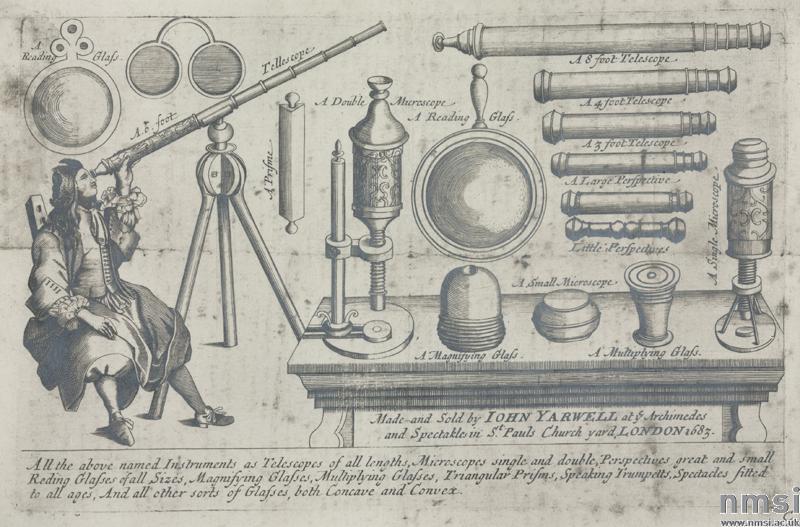
    Instrument seller Yarwell[Image source: Science Museum Group http://collectionsonline.nmsi.ac.uk/detail.php?type=related&kv=8015861&t=objects]

    Instrument seller Yarwell detailI was looking at this trade card for the optical instrumentalist John Yarwell (“Traded at Ye Archimedes & Spectacles in St. Paul’s Church Yard
    (1671-92), North Side of St. Paul’s (1672), St. Paul’s Churchyard
    (1676-96) & Archimedes in Ludgate St.(1697) & Archimedes &
    Crown (1698-1712), all London, England”) and was struck by something a little bit “odd”. For as many times that I have seen early images of compound microscopes I don’t think I’ve ever looked at how the instrument was attached to its stand.  Now that I am seeing it, it is remarkable how efficient and careful the early users were. Basically, the microscope was attached bya hair to its stand–well, not really, but just about. 

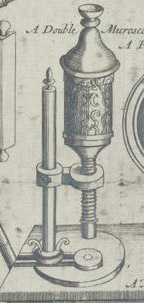
    Yarwell features spectacles, looking glasses, microscopes and a variety of telescopes.  Here’s a detail of a compound microscope from the Yarwell image (left), and it is remarkable how potentially unstable the attachment makes the instrument. Just a slight bit of turmoil, or a bump near a table leg could upset the image. 

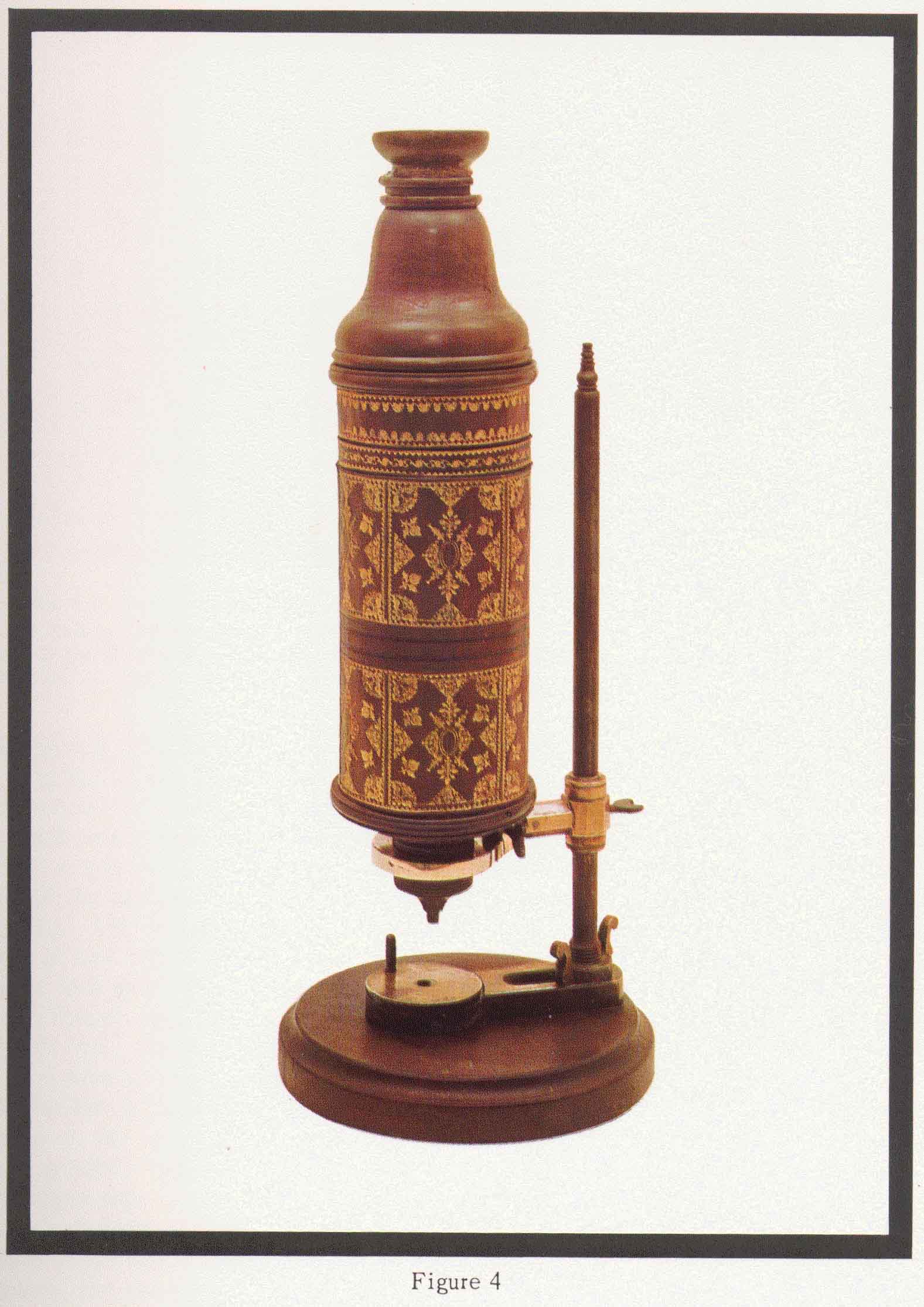
    Take for another example this very famous compound microscope made by Christopher Cock  for the great Robert Hooke (1635-1703):

    Hooke microscope

    [Image of the Hooke microscope via the Billings Collection at the National Museum of Health and Medicine, Armed Forces Institute of Pathology]

    This famous instrument was evidently the one with which Hooke first observed living cells (25 March 1663, nearly 350 years ago) and which he used for the first investigation and of cork and the naming of the “cell” (13 April 1663), and which was the basis for the images gathered for his masterpiece of investigation and exploration, the Micrographia (1665).

    It seems even less stable than the Yarwell instrument.  The astonishing thing about this fish-skin-covered instrument, this gateway to a completely undiscovered miniature world, is that so much of it depended upon such a little bit of engineering…it just seems as though taking the next little step could have been taken for a more basic base, a heavier mount, a more stout connection from stand-to-microscope, just to make the instrument more stable.  But it didn’t happen just then for Hooke, and it evidently didn’t matter. 


  • Visualizing the Normally-Unseen: Roentgen, Marey, Malevich

    JF Ptak Science Books  Post 1775

    Pleasant_1bertha The 1895/1896 issues of Nature magazine are compliantly normal until the first weeks of 1896 when the first of a flood of articles is published about the astonishing discovery of 50-year-old Wilhelm Conrad Röntgen. The English-language popular science journal announcement of his December 28, 1895  “Ueber eine neue Art von Strahlen” (“On a New Type of Ray”), appearing 16 January 1896, began the introduction of a new state of human experience.  His experiments—built upon the work of J. Plucker (1801-1868), J. W. Hittorf (1824-1914), C. F. Varley (1828-1883), E. Goldstein (1850-1931), Sir William Crookes (1832-1919), H. Hertz (1857-1894) and the odious Phil Lenard (1862-1947 and who didn’t die soon enough)—revealed as much to humans as did the experiments and inventions of Hooke and Leeuwenhoek on the invisible worlds revealed by the microscope.  There are more than 150 articles on the Roentgen (and soon to be “X-“) Ray, all published within 12 months of the original announcement, almost all excitedly, trying to comprehend, elucidate, expand, verify, this new world. 
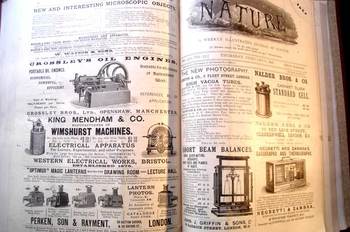
    Blogxraybigads_2 [The news of the discovery is first and most popularly reported in the January 6, 1896 London Standard:  “The noise of war’s alarm should not distract attention from the marvelous triumph of science which is reported from Vienna. It is announced that Professor Routgen (sic) of the Wurzburg University has discovered a light which for the purposeBlogxrayad of photography will penetrate wood, flesh, cloth, and most other organic substances. The Professor has succeeded in photographing metal weights which were in a closed wooden case, also a man’s hand which showed only the bones, the flesh being invisible”. By the end of the month the news was completely absorbed, worldwide.]
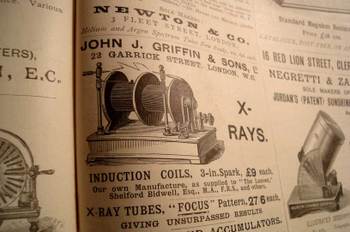
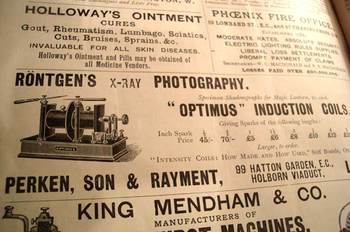
    I looked at the advertising in these issues (my copies of Nature for these decades generally have the original paper wrappers for the weeklies, complete with ad copy), looking for the first time that a Roentgen machine was offered for sale to the general public.  As it turns out, they popped up 12 March 1896 (once), 19 March (twice), and then about once a week for the rest of the year.  A little surprising, I think, a little light to my Monday-morning quarterback’s eye—I expected more; bigger, more, splashier.  But the ads are small and sedate, hardly similar to the discovery they represent. 
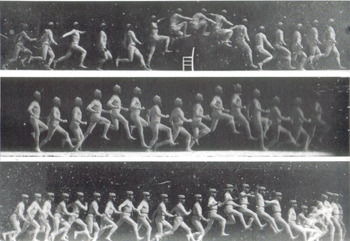
    Blogfeb_22marey The rest of the world, the rest of the advertising world, stayed the same–the Roentgen discovery and the enormous possibilities and promises of his “new photography” lived in their own unique sphere, unencumbered by their sassy new brother.   This mild response seems dimmer still when you compare it to that which greeted other (relatively) simple but still major advancements in the world of photography.  Take for example Etienne Marey, who was a technoid and physician who was able to capture motion of all sorts–he was able to develop a picture so to speak of the movement of blood in the body via his instrument to calculate blood pressure, and he also created a shotgun-style camera that made the Blog_feb_22_nude world’s first high-speed photographs of movement.  And so it cane to pass that in the late 1870’s and early 1880’s people were instantly able to see what a horse looked like when it galloped or what the body did *exactly* when jumping over a chair.  When you couple this with fourth-dimension material one wonders why it took several more decades to bump into these images in the art of 1907+. 
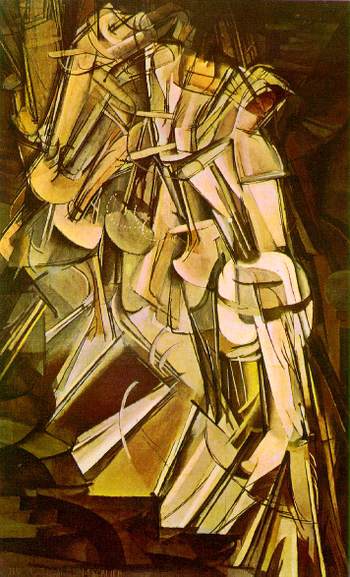
    (Duchamp Nude Descending series, 1915; above, Marey, 1881)

    And what indeed was normal in these pages?  Magic lanterns
    and magi lantern slides appearMagiclantern at all levels; the gorgeous Wimshurst machine gets heavily advertised; the redoubtable Negretti & Zambra advertised all manner of excellent scientific instruments (biographs, thermogrphs.  Nadeer Bros. advertised a pretty standard cell, and the ancient Crossley displayed their “new” oil engines, “suitable for all classes of agricultural work”.  J.H. Stewart was selling their semi-automatic electric arc lamp, while across the page was Newton & Company’s “Newtonian” arc lamps for lanterns (“self feeding and focus keeping”).  Microscopes and prepared slides abound, and Thomas Bolton advertises discretely and effectively for their “living specimens for the microscope”. 
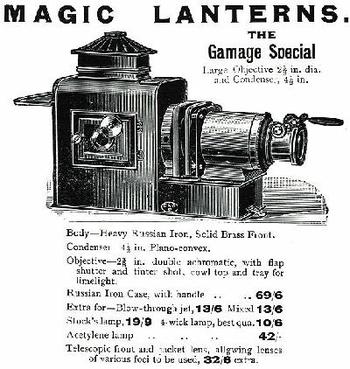
    The Physical Review, the American upstart in the science world advertises that its third volume was available, while its distant cousin, the Psychological Review, advertised its own third volume.  Booksellers seem to take the most space, thank goodness. 

    Blogxrayepps There are a few medical throwbacks:  Epp’s Cocaine takes out occasional tenth-page ads for their “cocoa-nib extract, tea-like” selling its ‘gentile nerve stimulant”.  Right underneath is “Holloway’s Pills”, promising to cure biliousness, sick headache, indigestion, and all (?!) internal complaints.   These are brilliant simple samples of the skeleton of science in world-dominant Great Britain, in a world dominated at that time by H.A, Lorentz, Ernst Mach , Roentgen, Korteweg, de Vries, Bateson, Jean-Baptiste Perrin, Pierre Curie, Zeeman, Becquerel, Joseph Thomson,  Ernest Rutherford, Marconi, Ramsay, Fitzgerald.  And so on. 

    Nothing offered for sale here offered any significant clue to the pregnant world of modernity that was nearlyBlogxray3 there—the world would become ‘modern” almost immediately following Roentgen, with revolutionary, epochal changes in art (in non-representational form more so than Impressionism), theater, literature, music.  Just about everything changed (except politics).  But there is no hint to paradigm shift hidden in the ads, just as they were with the machines selling the promise of Roentgen’s “new photography.  There’s something about the fine glass, superb turning of the screw, and a perfectly oiled gear though that makes this sort of perfection seem so lonely in the world of larger change.  Bertha, Roentgen’s wife, sat for 15 minutes while her husband passed his rays through her hand; she ran from the room once she saw the results, revealing her very bones and no doubt a strong sense of the Blog_feb_22_malevich
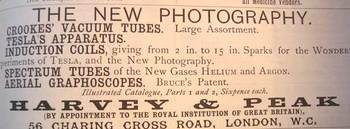

    fragility of life, and the strong presence of death.  Many had the same reaction to the Kandinsky’sBlogxrayad2 shapes and Malevich’s white circles and red rectangles and Ibsen’s drama and Einstein’s dancing dust and the rogue syncopation of jazz.  It is probably a very natural reaction to try and protect established memory—but memory should be more flexible than that, I think, to keep a healthy mind.
  • Nutmeg and the Roundabout Creation of New York City

    JF Ptak Science Books   Post 1705

    IMG_4880

    This may be the earliest image of “New York” as it was–that is “New York” instead of “New Amsterdam”.  From what looks like an extraordinarily bad trade (with 350-year-long hindsight), the Dutch and the English came to terms at the end of the second Dutch-English War (1665-1667)  one result of which traded the small island of Run in the Banda Islands for another small (but not nearly so small as Run) island in North America:  Manhattan.

    Manhattan didn’t have one thing that Run and the Bandas had, though, and that one thing was enormously valuable–nutmeg trees.  From the nutmeg tree came nutmeg and mace; nutmeg was a spice and a supposed medicinal, and traded for more than the price of gold, allowing its producers a phenomenal return on their investment.

    The Bandas were in a remote place removed from remote places in Indonesia.  In the island group–which rose from great depths of the ocean–the total land mass was about 180 km2. Not much, except if they were the only places on Earth producing a commodity in sensational demand. The Dutch kept control of the islands for a long time, and kept their trade in the spices an abject money-maker.  They secured their uncontested control of the island group at the end of that second Anglo-Dutch War with the Treaty of Breda, one section of which had the Brits returning Run to the Dutch in exchange for Manhattan, which was at the time still occupied by the Duke of York, who was the brother of Charles II and who would become James II.  And thus the island became “New York”.

    Due to various reasons–not the least of which was the Dutch murder and export of the un-murdered indigenous population of the Bandas, who were the people who actually best knew how to care and administer the nutmeg trees–the great trade in the spices continued with diminishing effect in the Napoleonic Wars, an unpretty story of much bloodshed and enslavement.

    {Image: “Fort Hollandois de l’Ile de Banda. – Hollands Fort op t’ Eiland Banda.”Original engraving  by J.V. Schley and printed aorund 1750 (39.5×25 cm) for  Antoine Prévost’s Histoire générale des Voyages published in Paris between 1746 and 1770.  The name of the structure was actually Fort Nassau.  The original engraving is available from our blog bookstore, here.]