A Daily History of Holes, Dots, Lines, Science, History, Math, Physics, Art, the Unintentional Absurd, Architecture, Maps, Data Visualization, Blank and Missing Things, and so on. |1.6 million words, 7500 images, 4.9 million hits| Press & appearances in The Times, Le Figaro, Mensa, The Economist, The Guardian, Discovery News, Slate, Le Monde, Sci American Blogs, Le Pont, and many other places… 5000+ total posts since 2008.

Category: Histories of Smallness

  • History of Blank, Empty, and Missing Things: Fission. 1934

    JF Ptak Science Books   Post 1689

    Ida Noddack (1896 - 1978)

    “it is conceivable that the nucleus breaks up into several large fragments, which would of course be isotopes of known elements but would not be neighbors of the irradiated element.“–Ida Noddack, 1934

    Sometimes events and conspire to almost come together, to be very-nearly-there but not so, just this shy of complete, just a little short of being whole–save for inspiration, or insight, or genius.  Such I think is the case of Ida Noddack (and just about everyone else) in the non-discovery of fission in 1934.

    Just for the record, fission is properly discovered by Hahn/Strassmann/Meitner and announced in Naturwissenschaften beginning in 1935 (with “Ueber die kuensrtliche Umwandlunbg des Urans durch Neutronen” in 1935 and culminating in the epochal papers of 1939)–and this the result of a long series of necessary discoveries made by Becquerel, Einstein, Curie, Joliot, Bohr, Chadwick, Compton, Fermi, Frisch, Rosbaud, Wheeler, Alvarez and others. 

    Noddack published her paper–“Uber das Element 93” in Angewandte Chemie (vol 47, pp 653-655) in 1934 (and published in Berlin) which correctly pointed out errors in Fermi’s important two-page 1934 paper on neutron bombardment experiments “Possible Production of Elements of Atomic Number Higher than 92”,  published in Nature 133 (3372), pp 898-899.  She identified as inconclusive Fermi’s identification of transuranic products of neutron bombardment, and stated that the presence of all of the lower elements needed to eliminated along with the heavy radioactive elements.  Noddack (1896-1978) was nominated three times for the Nobel (chemistry) but was passed by–she received recognition for her work, of course, but at the time- (1934) her paper was generally ignored, as it ran counter to some of the basic ideas of physics  Noddack didn’t offer any theoretical help in her observations, and the paper slid almost instantly into obscurity. The breakthrough work on this issue would begin int he next year and ultimately the unthought-of concept of fission would be announced five years later. 


  • An Utter Masterpiece-of-Small: “School Safety Patrol Pioneers”, from the Serendipity House

    JF Ptak Science Books   Post 1678

    (This post would be incomplete unless you also read the post on The History of School Lunches.)

    The best part of browsing books on shelves or in boxes or wherever the physical, non-digital place might be is the surprise, and the best surprise is the truly unexpected surprise.  That is the beauty of browsing, to me, and this is what is disappearing as we replace shelved books with a monitor of some variety, whether it is at home or in the library. The glory of serendipity seems not quantifiable yet–the brain does too much stuff when you unconsciously parse a shelf or case or range of books.  As you walk down an aisle of books, past hundreds or thousands of titles, you are seeing many of them though not necessarily registering them in your conscious experience; but your brain is working on this impulse of data even when your mind is wondering what you were doing at the library in the first place.  When I go to the library, I like to think of it as going to the Serendipity House.

    Blog1sept_15_safety_patrol550

    Finding the unexpected–and sometimes the unimaginable–is a pure joy, whether the found thing is monumental or useful or inspiring or informative or not.  Sometimes it is the very simple satisfaction that a work exists on some very removed topic. 

    If you were to open the Atlas of Reading Experience and tried to find this title on school safety patrols, I imagine that the pamphlet would be represented in a part of the sea that seems very blank, but on micro-inspection it is obvious that there is a planktonesque sea of small islands with small islands off their costs of smaller items, and so on and so forth, resolving more minute detail and more islands, in a fractal world of smallness.

    And somewhere in there would be School Safety Patrol Pioneers.

    I really do love pamphlets like this whose titles make you stop and say “what in the world…?” or some such thing, usually though its just limited to the word “What” followed by a number of exclamation marks.  This get s a little and needlessly more complicated when the exclamation points are combined with question marks, thus : “What!!” looks allot different from “What!!?”, and seems much more interesting, too.  I think that the most sublime pamphlets would resume the full complement of exclamations and questions available for my made-up review, which would be three apiece: “What!!!???” or “What???!!!” or any combination thereof (each of which would hold its on special secret analytical-emotional logic, god help us all), and would be the equivalent of a Perfect 10 or 5-Stars or Four Thumbs Way Way Up.  (I think that the way this works is that the more exclamation points there are the louder you way “what” to yourself, and the more question marks there are the higher one would raise your eyebrows when seeing this for the first time. Maybe we’re knocking on the door of the Visual Arithmetic of Exclamation Points and Question Marks, which seems like a long way to go to judge the imaginary meritocracy of the painfully mundane.) 

    In any event, I think that the (completely) unexpected beauty and idea of this pamphlet is just delectable–kind of like experiencing a superb slice of buttered toast.

    This masterpiece of the forgotten obvious, The School Safety Patrol Pioneers, printed by the  American Automobile Association in 1941 really does pay an homage in shades of white to the great leaders and benefactors of the Crosswalk Warriors.  The great leaders though were not children, I’m sorry to report, but grownups whop dedicated their lives to the concept of crossing the  street safely

    (It sounds like I’m poking fun, but I’m not, really.  What an enormous undertaking it was to write this 20-page effort–really.  Could you imagine trying to research such a topic today?  I can and can’t–it would be an enormous heartache to undertake–unless of course you had this pamphlet in hand.  My mind reels about trying to figure out where to start such a project. Honestly–it would be tough.

    The design of the pamphlet is neat and clean, and very orderly, reporting on some of the leaders of this field, “then” and “now”.  One then-and-now reads” THEN–Supervisor, Physical and Health Education, Philadelphia; NOW–Supervisor of Safety Patrols, Philadelphia”.  More often then not though they read like this:  “THEN–Principal, John Muir Grade School, Seattle; NOW–Deceased.”  I wish the writer had gone into a little more detail on the person’s life before death took command, but all-in-all, this little pamphlet mobilized great, quiet wonders on its depth and efficiency in reporting on the history of crossing guards, and I’d rate it a “What !!?”.

    Now if I could only find something on the history of school hall monitors…


  • Two Gloriously Famous Bugs

    JF Ptak Science Books   Post 1605

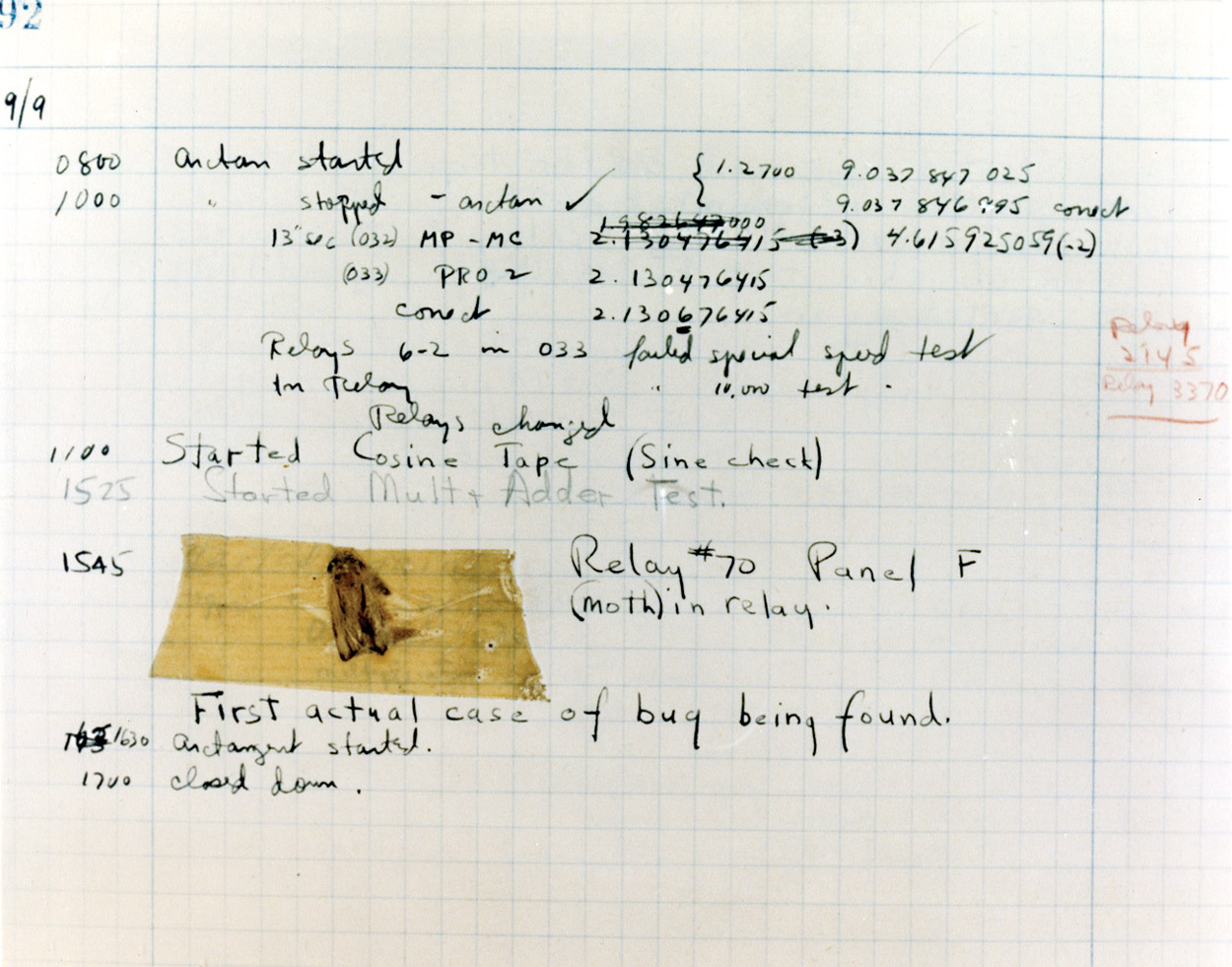
    September 9, 1947, is a big day in the page of The Big Book of Famous Bugs. This one found by Admiral Grace Murray Hopper in relay #70 of panel F of Harvard’s MARK II computer.  It was a 5 cm moth, actually, that was gumming up the works.  Hopper–an integral part of several teams  working on programming the earliest computers–witnessed the event, recorded the finding of the insect, and coined the word “debugging”.  She was an important figure in the history of computation, though Dr. Hopper is remembered by the general audience more for the bug than anything else.

    Grace Hopper Bug

     [Image source: https://yalealumnimagazine.com/articles/2633/you-can-quote-them]

    The other famous bug, perhaps the most famous in the history of science, belonged to Robert Hooke.

    Hooke--flea

    I’ve written elsewhere in this blog about Robert Hooke, and how, if there had somehow and impossibly been no Newton, he might’ve taken Sir Isaac’s place in the popular mind.  He was a tireless, relentless observer and experimenter, who lost little effort in a stranded idea and pursued interesting and problematic questions relentlessly.  More than others too he chased his won glory—minor but long and insistent—the years of which wore thin on many people in the scientific community.  But there were many characteristics of the man that made him not quite so lovable and endearing—not that Newton was any of those things, as he was not, but if you are going to be a secondary luminary to a super nova you’ve got to have something else going for you that the other man doesn’t have—sharing, helpful, greatly generous—to get you into the long pre-dusty pages of history. Also it would’ve helped if Hooke chose his battles with a little more aplomb and ingenuity—the war which began in 1672 with Newton went very badly for Hooke and followed him to the grave (and far beyond). 

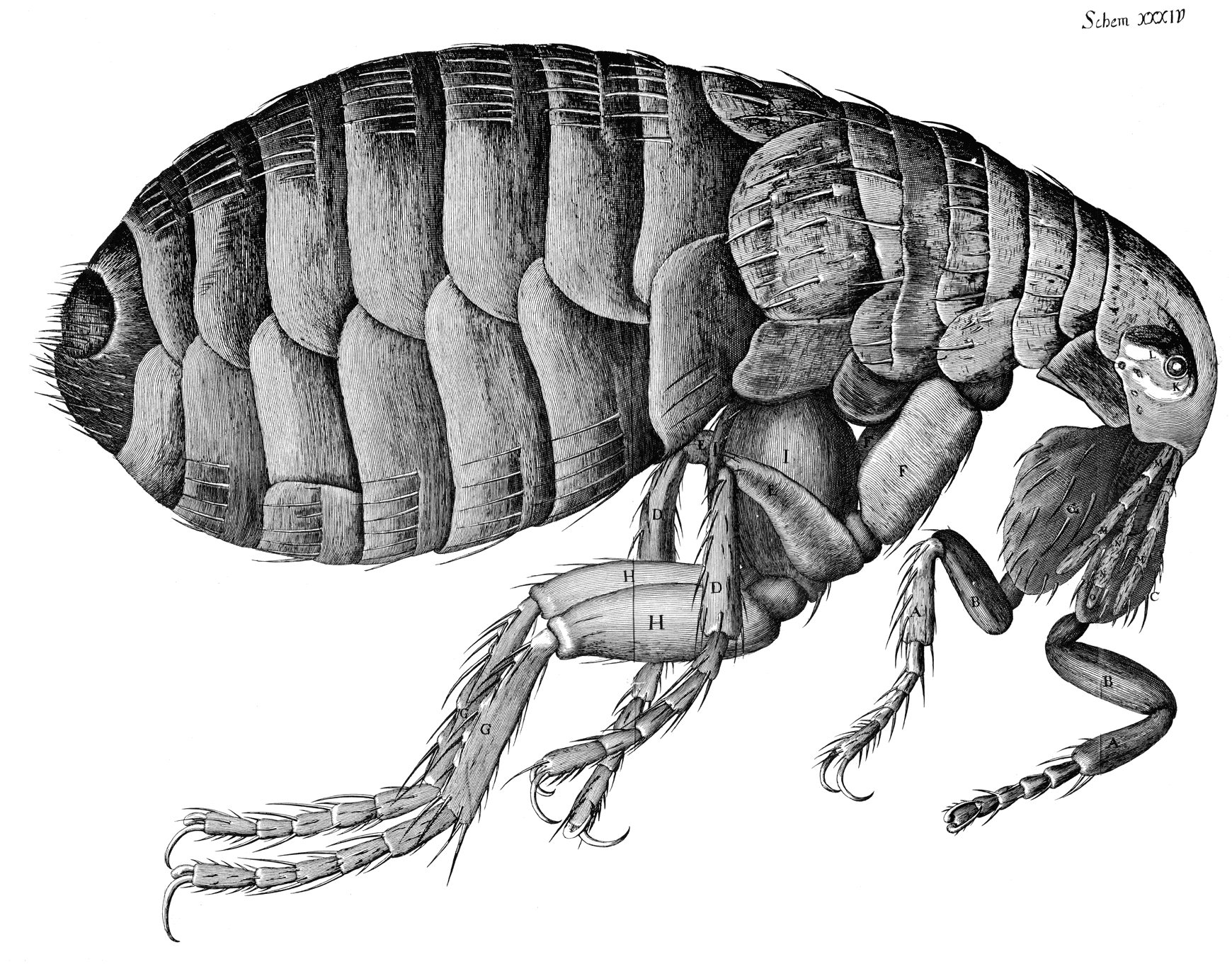
    What I’d like to talk about right now, though, of the many things to talk about concerning Robert Hooke, is the most iconographic image he ever produced, and perhaps one of the most famous scientific images of the 17th century—the flea. 

    The 28-year old Hooke published the results in a gorgeous and revolutionary book, Micrographia (a lovely e-text edition appears at Gutenberg, here) in 1665, which became an instant best seller and highly praised and valued. (Samuel Pepys, perhaps among the shiniest stars whose imprimatur was like a royal blessing, said the book (was) “the most ingenious book that I ever read in my life.”) There is no telling what the people of the mid-17th century thought of seeing such incredible discoveries in the little semi-invisible stuff that made up their normal, daily lives.  The only thing that somewhat equates to this would be if the first images of the Hubble were those of Earth-bound objects whose detail had previously been unknown.  Hooke’s observations and drawings of things like the common flea were just an astonishment—that such a creature of “low order” could have such intricate detail and design was a complete revelation.  The drawings of the fly’s eye, too, was an inescapable wonder, an incredible object to consider as having any detail pre-microscope, and then revealed to have unimaginable design and elegance.

    And so the famous second bug.

    …”it is my hope, as well as belief, that these my Labours will be no more comparable to the Productions of many other Natural Philosophers, who are now every where busie about greater things; then my little Objects are to be compar’d to the greater and more beautiful Works of Nature, A Flea, a Mite, a Gnat, to an Horse, an Elephant, or a Lyon.”—Robert Hooke at the end of his 28-page preface to Micrographia (1665)


  • The Radium Dance, 1898 and 1904

    JF Ptak Science Books   Post 1595

    photo
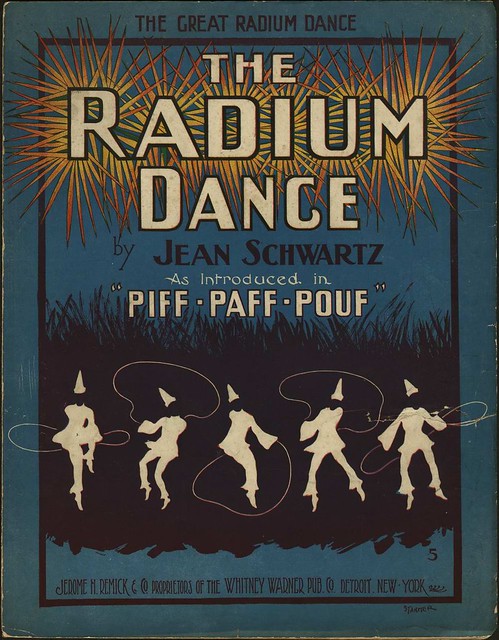
    Jean Schwartz (b. 1878) , composed this number for his (with the collaboration of William Jerome) Broadway (hit!) musical comedy Piff! Paff! Poof!  in 1904,  which sounded like this.
    But the real story–that we’ll deal with later–occurs a few years earlier, in 1898, with a married couple of scientists who made an epochal discovery:
    Curie712
    What was easier for folks to understand was the application of the discovery, just six years after the Curie effort–though it did take a little longer to take hold in the public creative imagination than, say, the discovery of the X-ray, which entered the public mind almost instantly following its discovery in 1895. 

    72dpi JPEG image of: The radium dance; Piff-paff-pouf

    [Source:  Duke University]

    [Source]

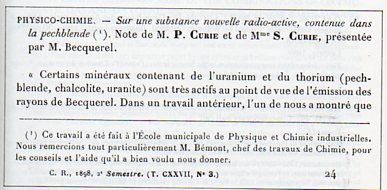
    Perhaps the real Radium Dance occurred for the first time by the people who found the thing, radium, back there in 1898–Marie Sklodowska Curie and Pierre Curie.  They were a happily married couple, beginning their joined life in 1895, vacationing on wedding present money on bikes through the French countryside.  They were soon back to their primary love in physics and chemistry, and inspired by the work of Henri Becquerel, began their assault on radioactivity in the next year.  After several years of effort and laboriously extracting a gram of  pure radium (by 1902) from a ton of pitchblende, they published their efforts in the volume of the great French scientific journal, Comptes rendus…Academie des Sciences (volume 127, in three short articles), announcing their discovery of polonium (after Marie’s country of origin) and radium. 

    The really big Radium Dance would occur the year before the Broadway hit, in 1903, when the Curies and Henri Becquerel were awarded the Nobel Prize in physics1. 

    Notes:

    1. The Nobel Prize in Physics 1903 was divided, one half awarded to Antoine Henri Becquerel “in recognition of the extraordinary services he has rendered by his discovery of spontaneous radioactivity”,the other half jointly to Pierre Curie and Marie Curie, née Sklodowska “in recognition of the extraordinary services they have rendered by their joint researches on the radiation phenomena discovered by Professor Henri Becquerel”.


  • A Child’s Reader on Being a Migrant Farmer, 1940

    JF Ptak Science Books  Post 1549

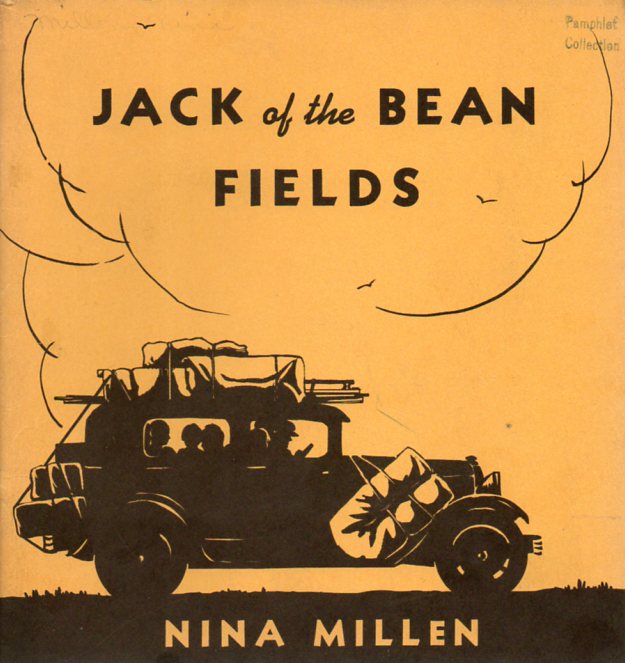
    I hardly expected the story that I found in this little square pamphlet, particularly since I had selected it because of its cover art.

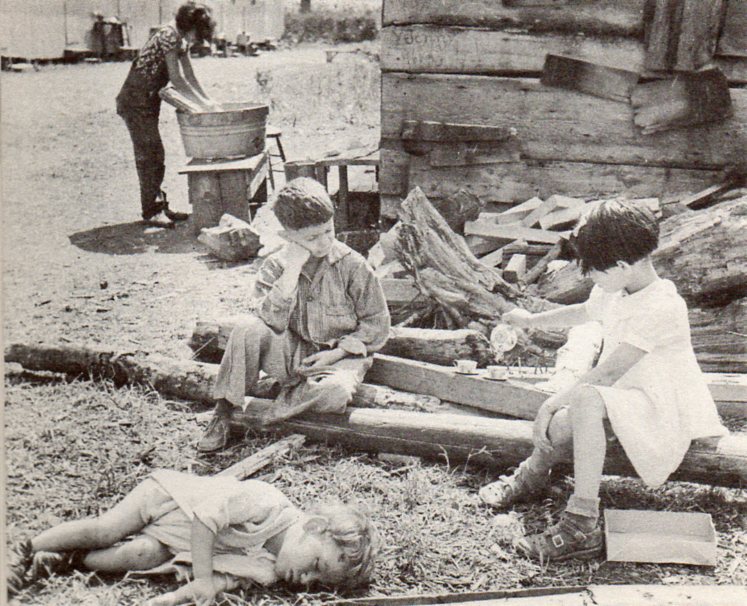
    Jack of the Bean Fields–written by Nina Millen and published by the Friendship Press of New York–turns out to be a photo-essay on one seasonal adventure of a boy named Jack Marco and his migrant vegetable-picking family.  The story starts with the family in a bad way, heading out on the road in a broken car filled with Jack’s mother, father, grandmother and three siblings, out to find a camp where they could find jobs picking early beans. 

    Depression579 As the family fixes the car, Jack heads out to play in the fields, where he finds a book.  We find that–at age 8 or thereabouts–Jack hasn’t been taught to read and hasn’t been to school in years, and the family doesn’t own a single book. The family gets underway, finds a camp, and moves into an empty unit in a series of shanties. They clean the place up, and Jack lays his book on a shelf.  “Now we are settled again” announces Ma.  Wincing.


    Depression580

    In a story that could have been a very maudlin or saccharin affair, it was surprisingly matter-of-fact, eventually telling how community and church groups appeared through the intercession of a camp nurse to help the migrant families, clothe the children, and send them to school. 

    Depression581

    The war was underway, the Depression was on its way out, the economy was beginning to bounce–but then, as today, there were migrant farmers–they just weren’t being displaced by Dust Bowl factors anymore.  But, basically, it was a good story for kids, focused mainly on appreciating what we have and our small gifts, such as family–and the ability to read. 


  • Microworlds in Prints: sub-millimeter Action Figures, ca. 1660

    JF Ptak Science Books   Post 1435

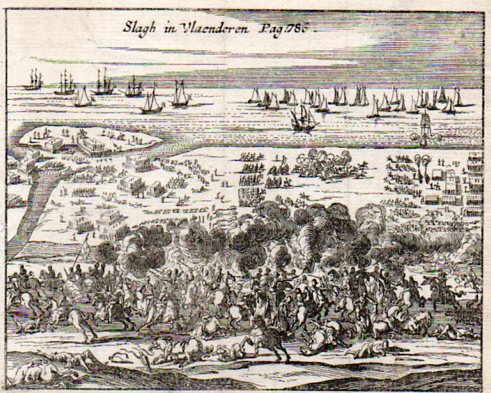
    This small engraving, Slagh in Vlaenderen (Battle in Flanders or thereabouts), is about 3×4 inches, a tiny engraving (on copper, I believe) depicting a large action between what I would guess to be the Dutch, or the army at Flanders, and the Spanish, sometime in the late 15th century to the early/mid 17th century.  There were a number of different years in which this action could have taken place, so I’m not sure what this image actually depicts.  The print was made sometime in the mid 17th century, possibly earlier.  (The original is available for purchase at our blog bookstore.) 

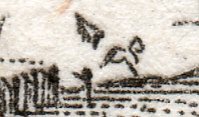
    What attracted me to this print was the minuteness of the figures in the background–the horse depicted here is not a millimeter long in the original, but we can see that the artist took enough care and had the imagination to make the horse run. (There is a long thread on this blog, “Prints–Looking Hard/Deeeply at” that takes a micro cruise along teh surface of large and complex prints into their perhaps seldom-scene embedded small worlds.)

    Flanders battle373
    Ditto for the soldier just to the left of the horse and out of formation–even when you hold the print close, you really can’t see that there’s a figure there unless you use a magnifying glass.  This sample was scanned at 1000 dpi and represents a section of the print that is maybe 8 mm across. 

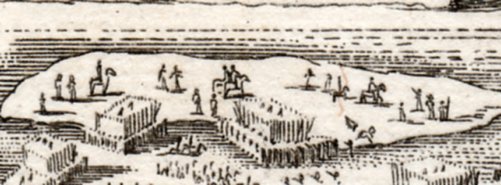
    The next sample shows an island that in the original is about an inch across, and as you can well see the sub-detail from the image above is just a fragment of this detail.

    Flanders battle372

    And the print in all of its glory, appearing on your monitor at about full scale. 

    Flanders battle371

    I am constantly amazed at the precision and care and artistry of these early engravers, and how much they cared to include interesting details that were all but invisible to the majority of its viewers.  But that’s not the point. 


  • Horse Poop and the Stars: Robert Hooke, 1673 (No, it Wasn’t Pegasus)

    JF Ptak Science Books   Post 1097
    Horse constellation Had there been no Newton every school child would know the
    name of Robert Hooke (1635-1703) in its place—he was polymathic, totally
    energized, big-thinking non-sleeping experimentalist and theoretician who
    worked across numerous disciplines (physics and astronomy, to chemistry,
    biology, and geology, to naval technology), not the least of which was
    architecture (having helped Christopher Wren in the design of the new St.
    Paul’s).  Hooke was a superb instrumentalist and inventor who also (for the most part) introduced humanity to the previously-unseen microscopic world (in his gorgeous and revolutionary Micrographia1..) .He was
    an enormous figure who was also never below a fight or argument, and whose
    grasp of his own very considerable accomplishments never seemed to be limited
    by what he had actually done in spite of his own tremendous and prodigious output.  Some people lay the blame for Hooke’s obscurity upon Newton’s great and tireless
    vindictiveness against Hooke, but that’s by far from the whole story of Hooke’s
    troublesome personal legacy.  Not only is
    his portrait not on the coin of the realm (like Newton’s) nor hanging everywhere in the halls
    of academia, but there is no known lifetime surviving portrait of the man, and the exact location of his burying place is not known. He came a little close to Newton’s
    enormity, and in the absence of  Jupiter and Saturn even the Earth starts to
    look a little bit big.among the rest of the planets.

    In addition to high genius and a man largely responsible for keeping together (and moving forward) the Royal Society, Hooke was also a hypochondriacal, meanish, semi-miser prone to receiving insults real or imagined, always very well aware of his place in history of of history’s possible sleights against him, and also prone to vindictive attack if the mood moved him. Newton too could be as sharp as sand in the eye, but he survived as a person, and Hooke sorta didn’t.  I’m not sure why, really, he seems so mostly-forgotten nowadays, priggishly envious idea-appropriating vindictive Despicable Me character or not–his swath of accomplishments was wide and deep as almost anyone else coming out of Britain for 200 years, which should be enough to send a lot of the historical personal detritus into the lost memory bin…but it doesn’t, or something else, but popular history just doesn’t work for the man.

    13_Portrait_of_Robert_Hooke

    Stephen Inwood’s The Forgotten Genius recalls the 1673 letter that Robert Hooke wrote to the Council of the Royal Society, complaining of a new wrinkle in his ever-wrinkling private life:  the garden that had been just outside his rooms had been converted into a “coaching inn and stables”, meaning that there were mounds of festering summertime horse poop within nostrils’ reach.  He wrote to the Council that he needed a new accommodation, to “free himselfe from sitting as he now doth in the suffocating stink of the stables hors dung and Jakes [privy], which hath bin a great cause of his late illness”. [The portrait is supposed to be that of Hooke, which is fine by me–I like this one.  It shows a very thin man under the wig and bulky clothing, clear blue eyes, tight mouth, translucent skins, surrounded by the implements and directions of his thought, not the least of which is the night sky over the sitter’s shoulder.]

    The changes were agreed to, but not quickly, and it was still December 1673 or so that Hooke got his hands on Johannes Hevelius‘ new Machina Coelestis, a book which contained what Hooke saw to be germinal flaws, fatal flaws to the advancement of astronomy–and of course varied affronts to his own innovations in astronomical instrumentation–but which were preventable. By him. Hooke had it within himself to attack anything or anyone, and so it came to be Hevelius’ turn, monumental stature or not. (Newton’s turn would come soon after.)

    Now there is only contrived evidence that the horse dung and suffocating stink threw Hooke over the edge–but I do like the idea of this being the case, and though probably no real historian would go this way, I like to think that it was this High Stink that helped Hooke in his large attack upon Hevelius.  Of course Hooke needed no pushing or prodding from outside sources, even if those outside  sources were already sort of within him.  But I do like the image of his pen and razor-sharp mind fueled by the poop mounds and privies.  

    I can imagine his knuckles turning an easy white as he read the book that charged against his superior optical method of sighting instrumentation for astronomical work, Hevelius clinging to some methods of the 16th century.  They fought, of course, and for the most part it was a lonely (if correct) fight by Hooke, his possible benefactors and allies at the Royal Society  turning out not to be so given personality clashes and such.  But I can imagine the Hevelius, and the knuckles, and the wrongness of it all, all brewing in the stank of late summer swelter of horse dung mounds, filling Hooke’s nostrils and wigs and everything else with a rage for a rage that already existed.

    And here’s a line I won’t very often get to use to close anything out:  the poop couldn’t’ve hurt..

    Notes:

    1. The 28-year old Hooke published the results in a gorgeous
    and revolutionary book, Micrographia (a lovely e-text edition appears at Gutenberg, here) in 1665, which became an instant
    best seller and highly praised and valued. (Samuel Pepys, perhaps among the
    shiniest stars whose imprimatur was like a royal blessing, said the book (was)
    “the most ingenious book that I ever read in my life.”) There is no
    telling what the people of the mid-17th century thought of seeing
    such incredible discoveries in the little semi-invisible stuff that made up
    their normal, daily lives.  The only thing that somewhat equates to this
    would be if the first images of the Hubble were those of Earth-bound objects
    whose detail had previously been unknown.  Hooke’s observations and
    drawings of things like the common flea were just an astonishment—that such a
    creature of “low order” could have such intricate detail and design was a
    complete revelation.  The drawings of the fly’s eye, too, was an
    inescapable wonder, an incredible object to consider as having any
    detail pre-microscope, and then revealed to have unimaginable design and elegance.


  • Found Comix: Female Trouble, 1947 (“When Tears of Shame Smell!”)

    JF Ptak Science Books Post 1062

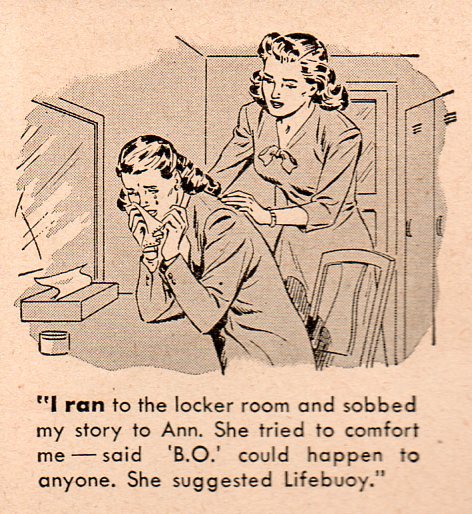
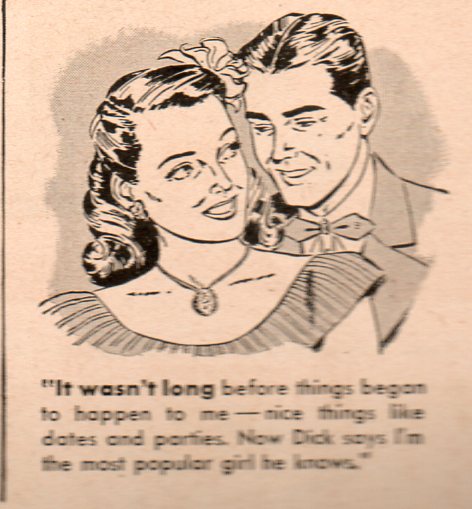
    Female Trouble---Whispered BO 1b147

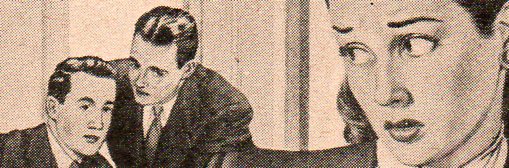
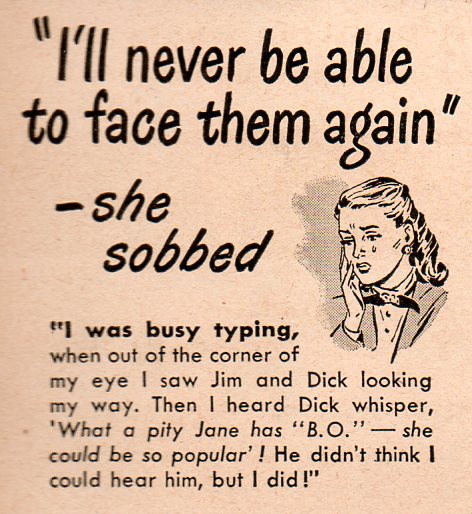
    I’ve posted a few found comix elsewhere on this blog (for example, this magnificent Italian contribution on surviving fire bombs, here), and I guess that I should have been paying more attention to these other bits of comix-driven advertisement marginalia that flits in and out of the pages of mass market weekly journals–they turn out to be pretty interesting and revealing entities.   In today’s case it is LIFE magazine for 9 June 1947, and if subtle, rueful self-awareness images like this were an automobile, this submission would be a jaguar.  It is the blatant story of a private and personal life ruined by whispers of BO, where a woman named Jane is paralyzed by the sly look and not-so-silent pronouncement of sniffy displeasure by a man named Dick.  The woman would scrub up and then somehow land that self-same Dick in the end with her newly perfumed Lifebuoy body, but only after filling bathtubs with her BO-laden tears.  But what a terrible story to tell about such a fragile existence extinguished, all to sell a bar of soap through a comic book tale on the edges of the back pages of a picture magazine.


    Female Trouble---Whispered BO 1146
    Female Trouble---Whispered BO 2148


    Female Trouble---Whispered BO 3149
    Female Trouble---Whispered BO 4150 

    Female Trouble---Whispered BO 5151
    Female Trouble---Whispered BO 5 b152


  • Primitive De Luxe versus Civilized No Lux

    JF Ptak Science Books LLC  Post 992

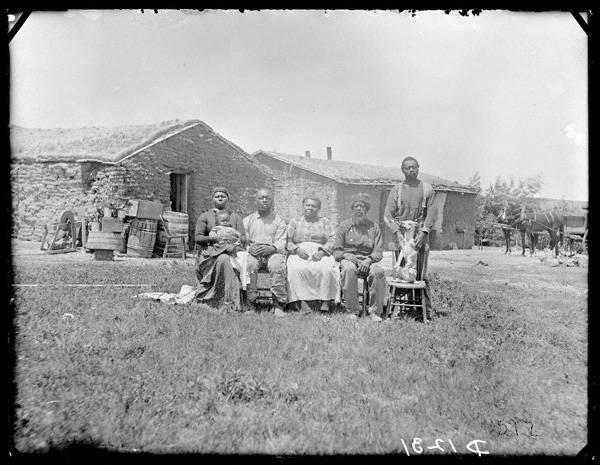
    I’m
    not sure exactly what Solomon Butcher told his subjects when he photographed them
    outside of their frontier houses out there in the Great
    Plains
    in the 1880’s.  His spectacular
    portraits included not only the family of the house, but in many cases, everything
    that the family owned.  Possessions were
    an

    Butcher

    encumbrance making your way across the country in the mid/19th century,
    especially if you didn’t have very many to begin with.  These families—the first generation in their
    mostly sod-built houses—would’ve been farmers scratching out a minimum trade
    and decent subsistence.   City/town goods
    would’ve been not-usual in these circumstances, and evidently whatever it was
    they had of these things wound up outside, displayed around the house and on
    the roof, when Mr. Butcher arrived in his photographer’s wagon. 

    (Who
    was it, I wonder, who came up with the initial idea of displaying all of the
    family’s possessions:  did Butcher set
    out with that idea, or did it happen spontaneously?  I wonder what it was the families thought as
    Butcher was packing up his equipment, his horse fed, his cameras stowed away,
    climbing up onto the driver’s bench.  Did
    they wait until he was a spot on the horizon to put away their things?  Did they gather everything up as Butcher
    gathered up his own material, or did they just wait for the stranger to
    disappear before pulling the family back together? Sitting their surrounded by
    the things that they owned, did these families feel a quiet pride, or were they
    embarrassed have their pictures made together with their frontier opulence? I
    suspect that the idea for display did not begin with the families.)

    On
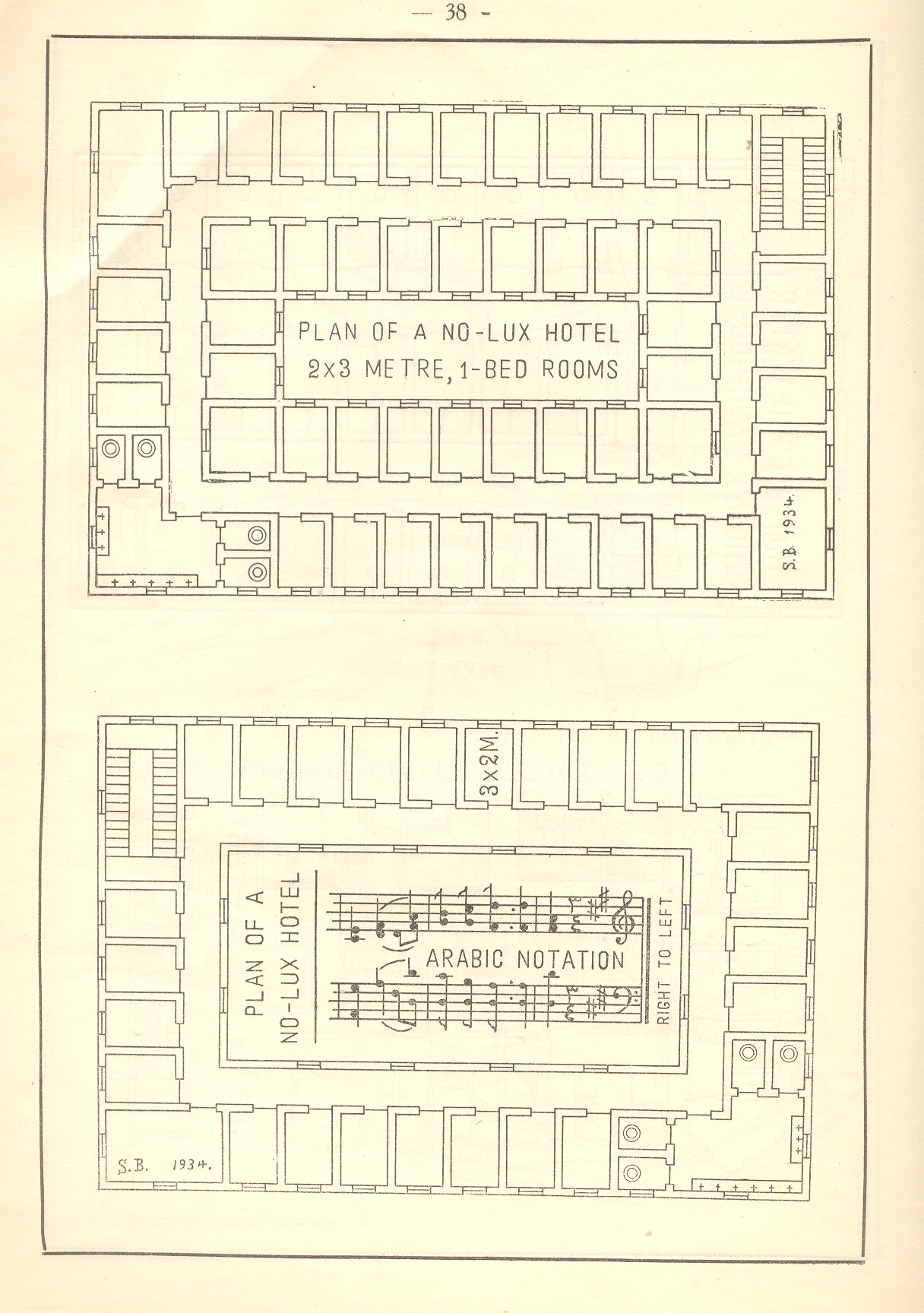
    another part of the luxury spectrum is this floor plan for a “No-Lux Hotel”, a 2×3
    metre/room place for folks to stay cheaply/inexpensively.  There were 50 
    rooms packed into a 36×24 metre footprint,

    Mar 30 no lux

    leaving precious little room
    for hardly anything else, like hallways (which seem very narrow), stairways
    (actually a singular, as there is but one) and bathrooms (one with 8 sinks and
    four toilets per floor). 

    The
    center of the structure seems curiously blank in the top plan.  The bottom one is confounding, a mysterious
    mystery:  why on earth would there be
    musical notation written backwards (via “Arabic Notation”) in the center of the
    plan?  No doubt the architect was on the iconoclastic
    side to have included such a thing; but its inclusion no doubt meant something
    to the author, though it is now lost to his/her dust.  Pity. 

    “Lusux”
    is Latin for something like “extravagance”. 
    “De luxe” appeared in France
    in 1928 or so for the first time to describe this added opulence in a word of
    its own, though there is a certain geology to the idea.  A luxury might well be a spice on a camping
    trip, or a back-up aircraft to the family helicopter.  Perhaps it was an extra sink in a cheap hotel,
    or a violin for the kids in a house that stood by itself in 10-square-mile
    solitude. At least the multi-floored Hotel No-Lux had a stairway.


  • Blank and Missing Things: German Submarine Importance in Graphical Comparison, 1912.

    JF Ptak Science Books  Post 937

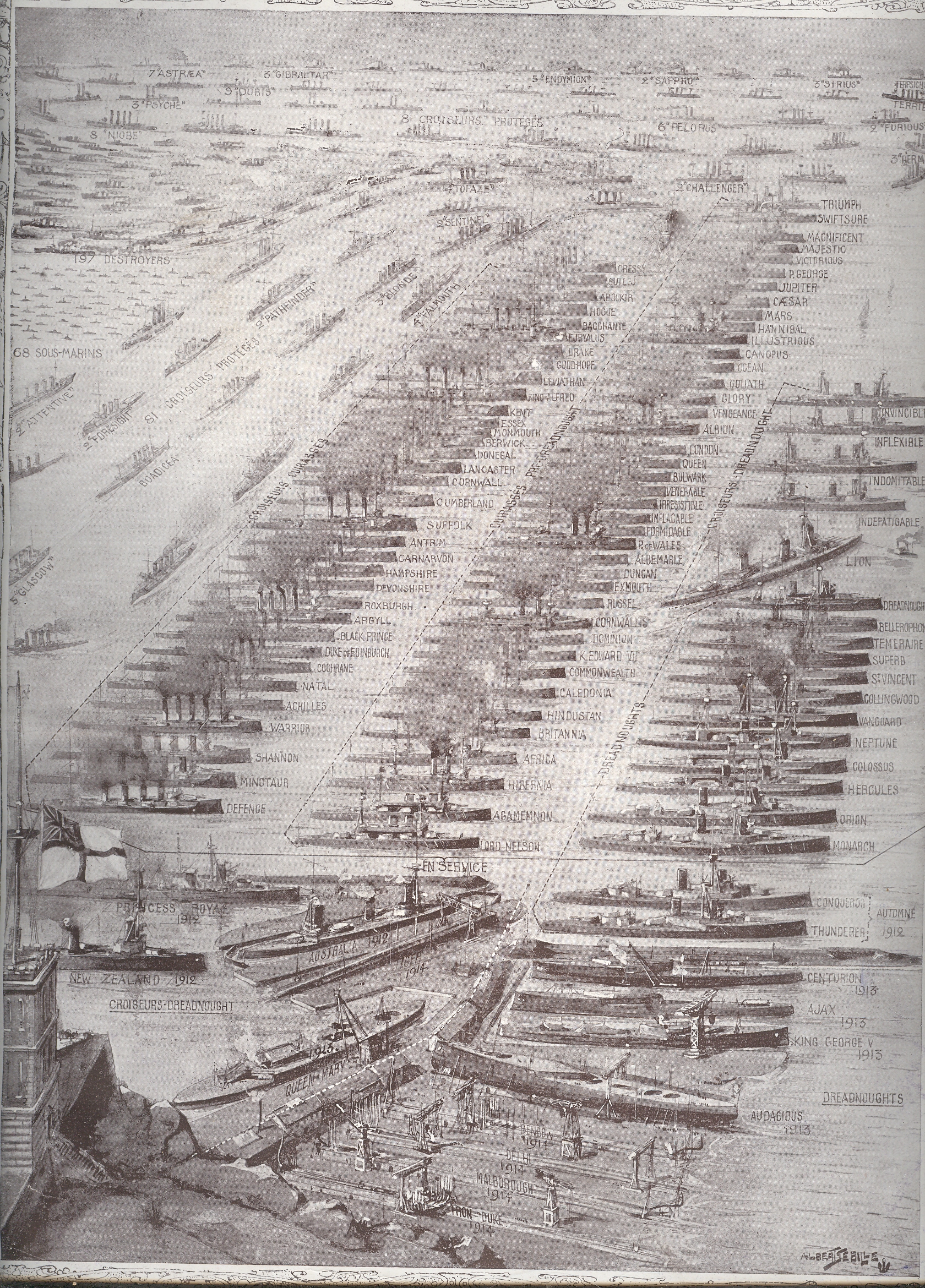
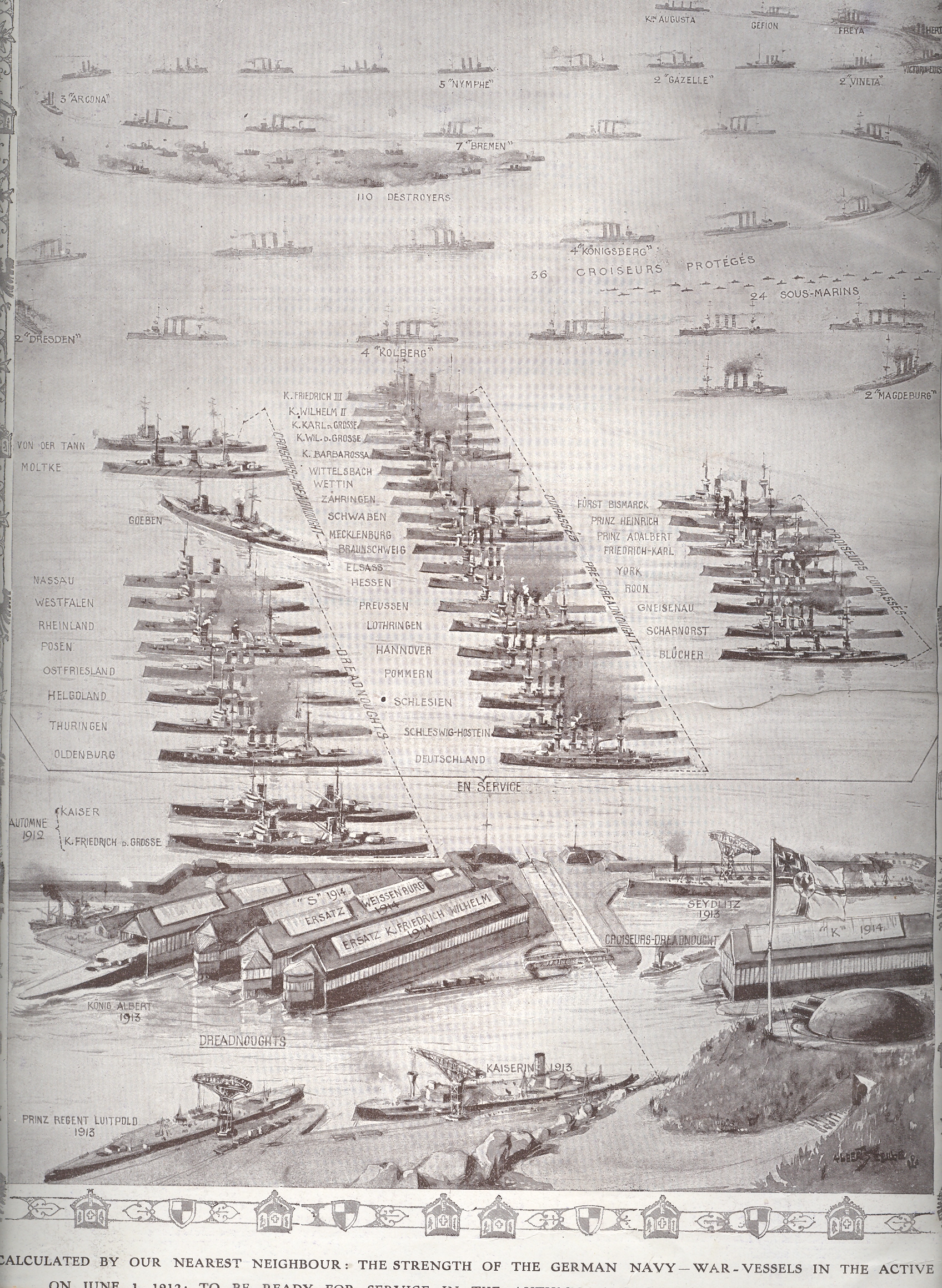
    In the midst of a massive building campaign by Germany and a building-response by England the French journal L’Illustration published these two side-by-side pictorial comparisons of their two navies, which wound up being reprinted in the Illustrated London News soon afterwards in June 1912.  [Royal Navy, left; German Navy right]

    2--brit navy big 2--brit navy germany


    2--brit navy big

    Germany began a rebuilding campaign in 1902 which by 1908/9 was seen by the British Admiralty as a “stab at the heart” of England’s military supremacy, and so the construction wars were undertaken.  It’s a complicated period and a complex race, which I just can’t get into in a short post, so let’s just say that the Brits wound up the winners of the competition  when these images were printed in June 1912.  

    The hidden element of some great importance, a trump card that would  played in just 750 days, would be the small dot-like drawings  labeled “sous marins”. These would be the submarines, and it would be the subs that would be perhaps the most significant aspect of the entire German navy.

    2--brit navy germany

    This was true in spite of what looks like an overwhelming preponderance of subs in favor of the Royal; Navy, where the count was 68 to Germany’s 24.  It was really a question the type of sub, and as it turns out there were only 8 or 9 of the English count that could’ve been considered for blue water ops.

    Germany began the war with 24 submarines in 1914; they recognized the ship’s importance and by war’s end ramped up production, winding up with 351 in total production and with 178 in action in 1918 alone. Of that overall number fully half (178) had been destroyed in combat, with another 11% sunk via other means.  There were more than 12 million tons of Allied shipping destroyed by the German sub forces from 1914-1918 (half of that in 1917). 

    So these two illustrations do portray an overwhelming Royal Navy, but they certainly do not give any hit whatsoever to the coming importance of the German submarine fleet.