A Daily History of Holes, Dots, Lines, Science, History, Math, Physics, Art, the Unintentional Absurd, Architecture, Maps, Data Visualization, Blank and Missing Things, and so on. |1.6 million words, 7500 images, 4.9 million hits| Press & appearances in The Times, Le Figaro, Mensa, The Economist, The Guardian, Discovery News, Slate, Le Monde, Sci American Blogs, Le Pont, and many other places… 5000+ total posts since 2008.

Category: Histories of Smallness

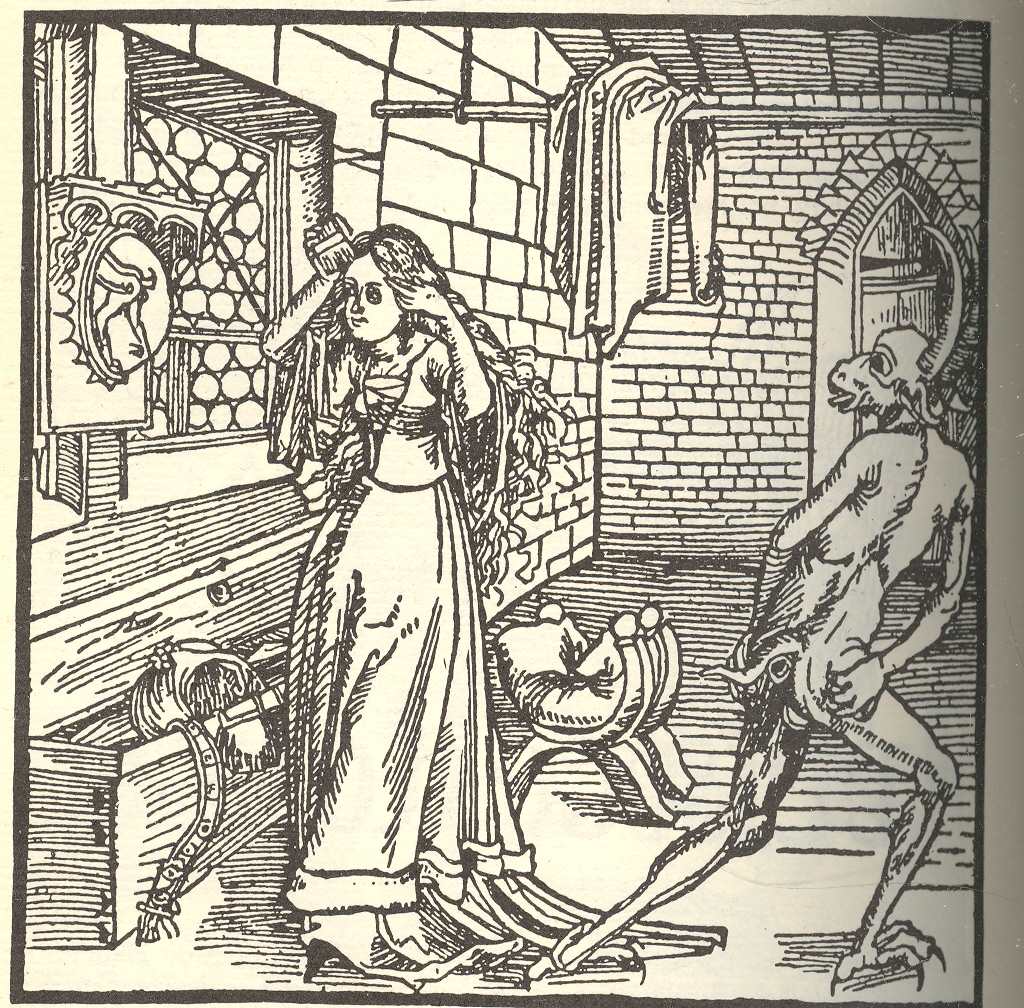
  • The Devil in the Mirror, ca. 1560

    JF Ptak Science Books LLC  Post 817  Blog Bookstore

    There’s plenty of interesting images in the Renaissance and Baroque
    featuring images caught as reflection in a mirror, none more famous I guess
    than Van Eyck’s marriage scene (which I’ve written about several times in this blog, most recently in “Original Reflections: unique experiences with mirrors, Van Eyck and Brunellesci, here).  What is unusual here is that we
    see the Devil in the mirror (actually the devil’s hindquarters), which to my
    experience is very uncommon. Also I thought the phraselet “the Devil in the
    Mirror/Mirrour” was well used and worn, but, as it turns out, it is hardly so,
    though there’s a near-alphabet of things that the devil could be in. 

    Blog 11 01 devil mirror For example, when looking through FirstSearch/WorldCat (a massive catalogue
    of books in libraries world wide and a cataloguing librarian’s best friend) for
    the things that a devil might be in, as in the phrase “the devil in the ____”
    we find the devil in a belfry, book (a Dalton Trumbo novel!), bush, candle, cheese,
    classroom, cross, dark, details, drain, desert, deep blue sun, flesh, fog,
    gateway, hills, junior league, kitchen, Middle Ages, milk, modern world,
    mountain, New World, shape of a woman. 
    The devil in the mirror turns out only to be so in a song. 

    None of this amounts to a hill of 
    ____  (beans, cocoa, molasses,
    moolah, fritos), but I found it unusual that the phrase and the whole
    devil-in-a-mirror idea to be so scarce. 
    Unless he can’t be seen in a mirror….No wait, that’s a vampire

    I know I’m wasting this image with this trivial pursuit when a decent writer would be looking at Satan over the ages, or its virtual non-appearance in the Bible, or the different names of the devil or its infernal helpers, and its other unholy images, or the history of Hell itself., or of the history of guilt, or fear (see Jeff Donlan’s lovely appraisal of Daniel Gardner’s The Science of Fear, which doesn’t really have anything to do with the devil but is a great idea) or temptation, or general unacknowledged dark worry.  I just stuck to the picture. 

    This naturally leads to looking at some antiquarian
    book titles involving devils and the nonsense and hokum that they got into.  Here’s a few lovely examples of titles-as-long-as-opening-paragraphs;
    it seems that the less old they are the less detailed they become.  But I’m probably wrong about that, too. 

    The displaying of supposed witchcraft : wherein is
    affirmed that there are many sorts of deceivers and impostors, and divers
    persons under a passive delusion of melancholy and fancy but that there is a
    corporeal league made betwixt the devil and the witch, or that he sucks on the
    witches body, has carnal copulation, or that witches are turned into cats,
    dogs, raise tempests or the like, is utterly denied and disproved ; Wherein
    also is handled, the existence of angels and spirits, the truth of apparitions,
    the nature of astral and sydereal spirits, the force of charms, and philters;
    with other abstruse matters
    /
     
    Author: Webster, John,
    1610-1682.

    War with the
    devil, or, The young mans conflict with the powers of darkness in a dialogue :
    discovering the corruption and vanity of youth, the horrible nature of sin, and
    deplorable condition of fallen man : also a definition, power, and rule of
    conscience, and the nature of true conversion : to which is added an appendix
    containing a dialogue between an old apostate and a young professor, worthy the
    perusal of all, but chiefly intended for the instruction of the younger sort
    /
     
    Author: Keach, Benjamin,
    1640-1704.

    A Whip for the Devil, or, The Roman conjuror
    discovering the intolerable folly, prophaneness and superstition of the papists
    in endeavouring to cast the Devil out of the bodies of men and women by him
    possest …
    /
     1683

    I find these title strangely satisfying, much like the dime library westerns of the late 19th century with their tow-parter extendo-titles:  Valerie of the Blazing Sands; or, Colonel Ingraham and the Satisfied Sod Buster, a Tale of Woe and Heroism and such.  


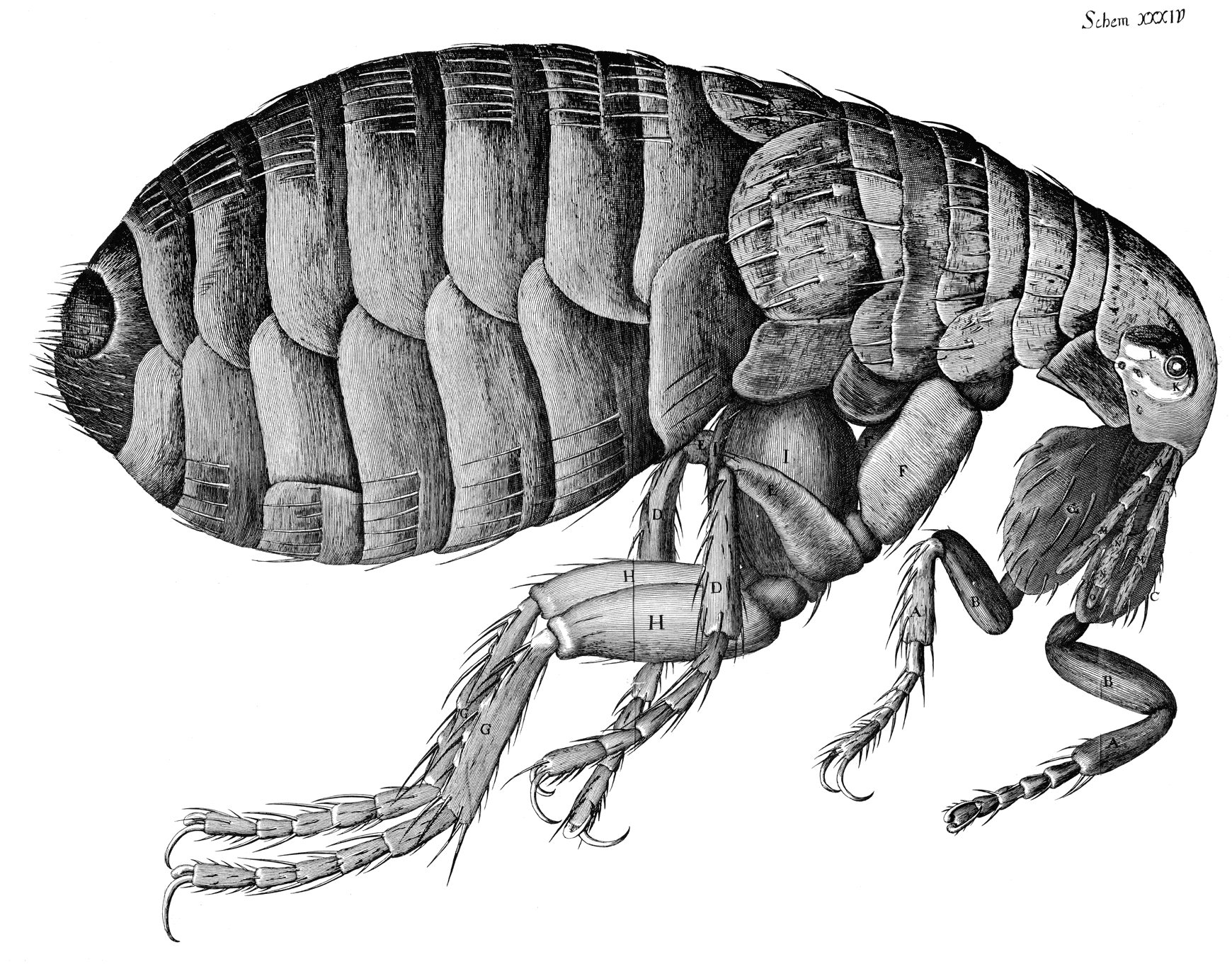
  • The Story Behind the Iconic Image: Robert Hooke’s Flea, 1665

    JF Ptak Science Books LLC  Post 766  Blog Bookstore

    …”it is my hope, as well as belief, that
    these my
    Labours will be no more comparable to the Productions of
    many other
    Natural Philosophers, who are now every where busie about greater
    things; then my
    little Objects are to be compar’d to the greater and
    more beautiful
    Works of Nature, A Flea, a Mite, a Gnat, to an Horse, an
    Elephant, or a Lyon.”—
    Robert Hooke
    at the end of his 28-page preface to
    Micrographia1 (1665)
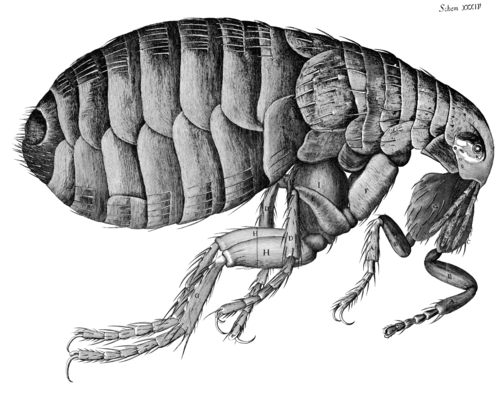
    Hooke--flea

    I’ve written elsewhere in this blog about Robert Hooke, and
    how, if there had somehow and impossibly been no Newton, he might’ve taken Sir Isaac’s place
    in the popular mind.  He was a tireless,
    relentless observer and experimenter, who lost little effort in a stranded idea
    and pursued interesting and problematic questions relentlessly.  More than others too he chased his won glory—minor
    but long and insistent—the years of which wore thin on many people in the
    scientific community.  But there were
    many characteristics of the man that made him not quite so lovable and
    endearing—not that Newton was any of those things, as he was not, but if you
    are going to be a secondary luminary to a super nova you’ve got to have
    something else going for you that the other man doesn’t have—sharing, helpful,
    greatly generous—to get you into the long pre-dusty pages of history. Also it would’ve
    helped if Hooke chose his battles with a little more aplomb and ingenuity—the
    war which began in 1672 with Newton went very badly for Hooke and followed him
    to the grave (and far beyond). 


    What I’d like to talk about right now, though, of the many
    things to talk about concerning Robert Hooke, is the most iconographic image he
    ever produced, and perhaps one of the most famous scientific images of the 17th
    century—the flea. 


    The 28-year old Hooke published the results in a gorgeous
    and revolutionary book, Micrographia (a lovely e-text edition appears at Gutenberg, here) in 1665, which became an instant
    best seller and highly praised and valued. (Samuel Pepys, perhaps among the
    shiniest stars whose imprimatur was like a royal blessing, said the book (was)
    “the most ingenious book that I ever read in my life.”) There is no
    telling what the people of the mid-17th century thought of seeing
    such incredible discoveries in the little semi-invisible stuff that made up
    their normal, daily lives.  The only thing that somewhat equates to this
    would be if the first images of the Hubble were those of Earth-bound objects
    whose detail had previously been unknown.  Hooke’s observations and
    drawings of things like the common flea were just an astonishment—that such a
    creature of “low order” could have such intricate detail and design was a
    complete revelation.  The drawings of the fly’s eye, too, was an
    inescapable wonder, an incredible object to consider as having any
    detail pre-microscope, and then revealed to have unimaginable design and elegance. 


    It turns out that the flea was not the most important object
    that Hooke had in mind with the Micrographic—it
    was part of an overall attempt at making sense of all creation, the bug part of
    the book occupying only a part of the (only) one-fifth of the book’s 246 pages
    devoted to living creatures.  The book
    actually starts with inanimate objects (the needle, followed by a razor, linen, silk, glass canes, flint, and so on), and then works it way through living
    stuff, ending up talking about light and the Moon and the cosmos. 
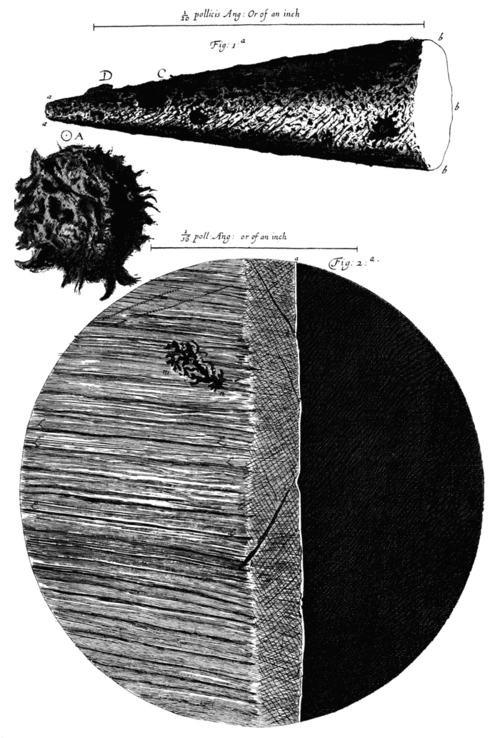
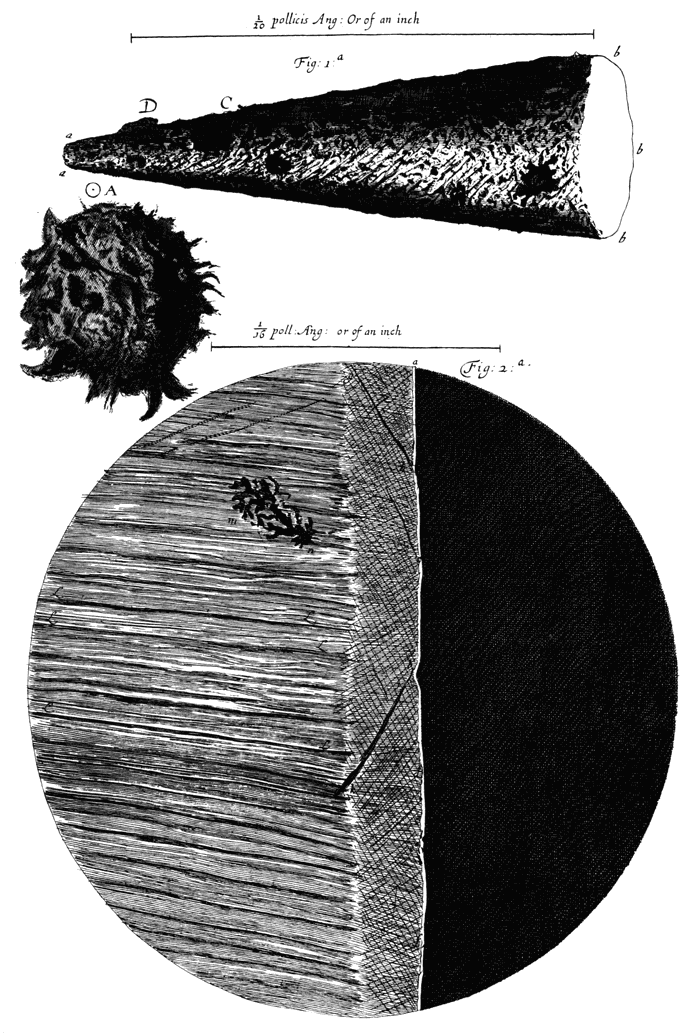
    Hooke--needle

    The opening images of the book are actually
    of the edge of a razor and the head of a needle—under magnification they showed
    a bitter, ragged edge and a nubby, pitted point (respectively)—which would have
    been almost as unimaginable and shocking as the flea….except that the flea of
    course opened possibilities of entire worlds of things alive in our
    semi-invisible environment.  Things
    really weren’t as they seemed to be.


    Hooke’s flea, as spectacular and revolutionary as it was,
    was only a part of the story—the rest of the behind-the-picture narrative lies
    in a much wider and more complex view of all things, living and not,

    in which Hooke tells us we should employ the
    microscope/macroscope to solve disputes in our “wandring senses”. Not bad
    advice at all.


    In the preface to the
    Micrographia Hooke states:

    Thus all the uncertainty, and mistakes of humane actions, proceed either
    from the narrowness and wandring of our
    Senses, from the slipperiness or
    delusion of our
    Memory, from the confinement or rashness of our Understanding,
    so that ’tis no wonder, that our power over natural causes and effects is so
    slowly improv’d, seeing we are not only to contend with the obscurity and
    difficulty
    of the things whereon we work and think, but even the forces of our own
    minds conspire to betray us.

    These being the dangers in the process of humane Reason, the remedies of
    them all can only proceed from the
    real, the mechanical, the experimental
    Philosophy, which has this advantage over the Philosophy of
    discourse
    and
    disputation, that whereas that chiefly aims at the subtilty of its
    Deductions and Conclusions, without much regard to the first ground-work, which
    ought to be well laid on the Sense and Memory; so this intends the right
    ordering of them all, and the making them serviceable to each other…

    He continues with a short outline of how to accomplish this:

    The first thing to be undertaken in this weighty work, is a watchfulness
    over the failings and an inlargement of the dominion, of the Senses.

    To which end it is requisite, first, That there should be a scrupulous
    choice, and a
    strict examination, of the reality, constancy, and
    certainty of the Particulars that we admit: This is the first rise whereon
    truth is to begin, and here the most severe, and most impartial diligence, must
    be imployed; the storing up of all, without any regard to evidence or use, will
    only tend to darkness and confusion. We must not therefore esteem the riches of
    our Philosophical treasure by the
    number only, but chiefly by the weight;
    the most
    vulgar Instances are not to be neglected, but above all, the
    most
    instructive are to be entertain’d; the footsteps of Nature are to
    be trac’d, not only in her
    ordinary course, but when she seems to be put
    to her shifts, to make many
    doublings and turnings, and to use
    some kind of art in indeavouring to avoid our discovery.

    The next care to be taken, in respect of the Senses, is a supplying of
    their infirmities with
    Instruments, and, as it were, the adding of artificial
    Organs to the natural; this in one of them has been of late years
    accomplisht with prodigious benefit to all sorts of useful knowledge, by the
    invention of Optical Glasses. By the means of
    Telescopes, there is
    nothing so
    far distant but may be represented to our view; and by the
    help of
    Microscopes, there is nothing so small, as to escape our
    inquiry; hence there is a new visible World discovered to the understanding. By
    this means the Heavens are open’d, and a vast number of new Stars, and new
    Motions, and new Productions appear in them, to which all the ancient
    Astronomers were utterly Strangers. By this the Earth it self, which lyes so
    neer us, under our feet, shews quite a new thing to us, and in every
    little
    particle of its matter; we now behold almost as great a variety of
    Creatures, as we were able before to reckon up in the whole
    Universe it
    self.

    1. The
    full title of the book: MICROGRAPHIA, OR, SOME Physiological Descriptions OF MINUTE BODIES, MADE BY MAGNIFYING.

  • Odd Images Department: Submerged, Miniature, 19th Century People

    JF Ptak Science Books LLC  Post 660

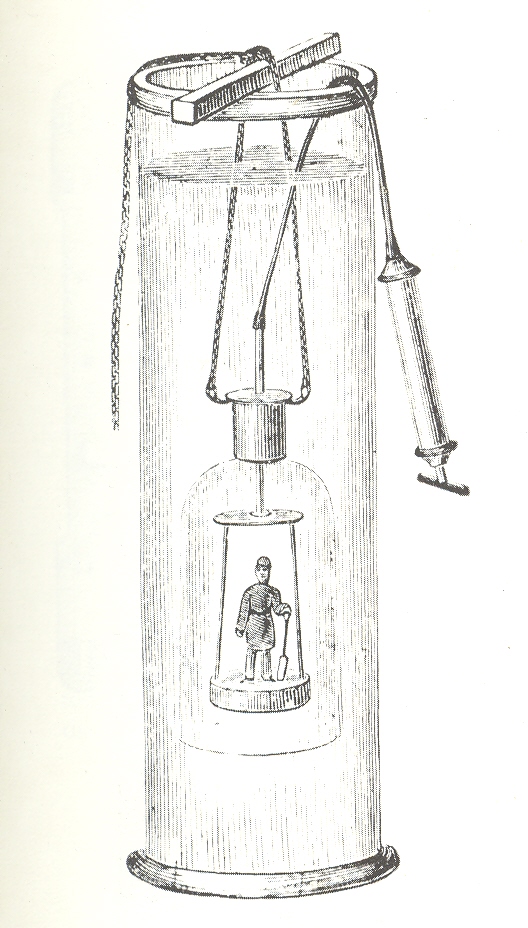
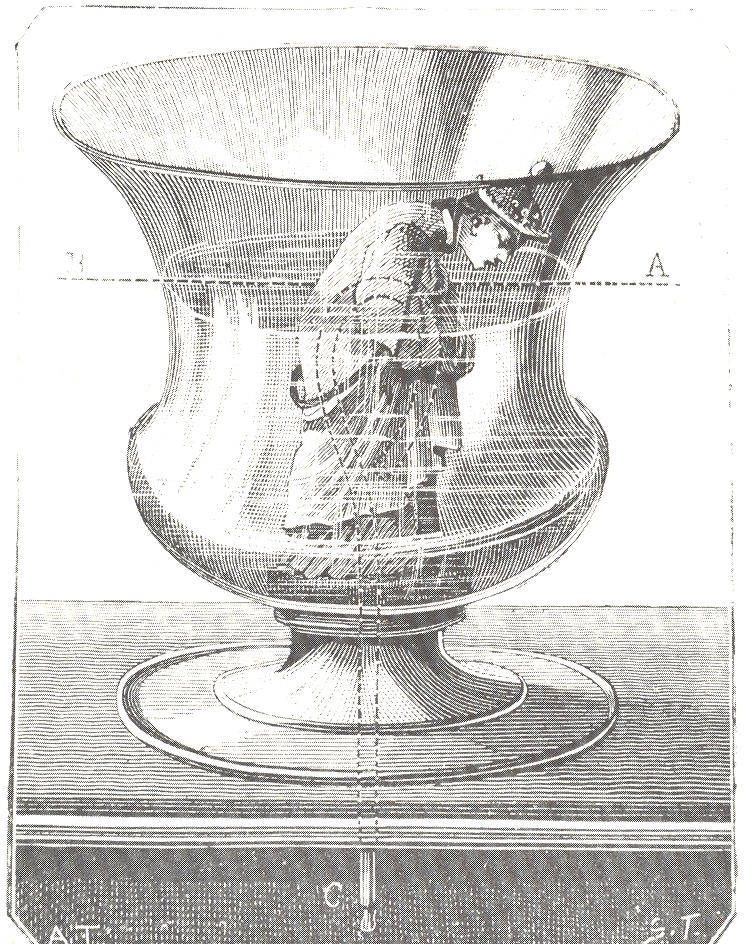
    Blog--june 22--people in glasses diver Oh, all right–these aren’t really miniature people–they just look like it. (And I’ll be interested to see how people come to this post via Google!)  What these images display are physical science laboratory demonstration tools and toys. (People have been swimming in fomalin and formaldehyde for a long time, hundreds of years–but I’m not dealing with the biological preparations today, I’m only after found, out-of-context oddness.)

    This first image, lovely and odd as it seems, is a simple demonstration device showing how a diving bell operates and was manufactured around 1910.  This would’ve been used in a classroom for a three dimensional learning tool , a standard approach to help elucidate phyical principles.  Classrooms would’ve had cabinets stuffed with these sorts of instruments–if the school had any money–and were in vogue for hundreds of years.  In this case we see the worker with his shovel being lowered into water, encased in a glass dome, with a line attached top a syringe which delivers oxygen.  (The image is from the catalog of John J. Griffin & Sons, Scientific Handicraft… London, 1910.)

    Blog--june 22--people in glasses tantalus The second image is a pretty high-end cup of tantalus–a vessel that cannot be filled because of pressure and siphoning and an exit port. It is named for the Greek bad boy Tantalus, who was the son of Zeus and Plouto, and by whose various misdeeds was cast away in Tartarus, the lowest strata of Hades in a place reserved for evildoing evildoers.  Tantalus lived a life of theft and flippant care:  for example, he was the one whom invited to dine with the gods, stole their ambrosia and gave it to the people.  In another example we see Tantalus offering his son to the gods by preparing him, thinnly dicing the boy, and chopping that, serving him to the gods for luncheon–not everyone was fooled, and no one was amused.  Part of his trials in the Underworld gives us the term “tantalzing”:  desire without fulfillment. His position in the afterlife, such as it was, was not pretty: Tantalus was to stand in perpetual hunger in a stream beneath fruiting trees; the water though would prevent him from reaching anything to eat, every time, and forever. . Every time he grew thirsty, the water level would lower itself, and he couldn’t reach anything to drink.  Pretty bad stuff to do for eternity.  This cup was called a Tantalus Cup because it would siphon itself off (through a tube in the bottom of the glass) so that the glass would always only get about half-way filled.  Why a “Chinese-like” figure was chosen for Tantalus, I don’t know. 

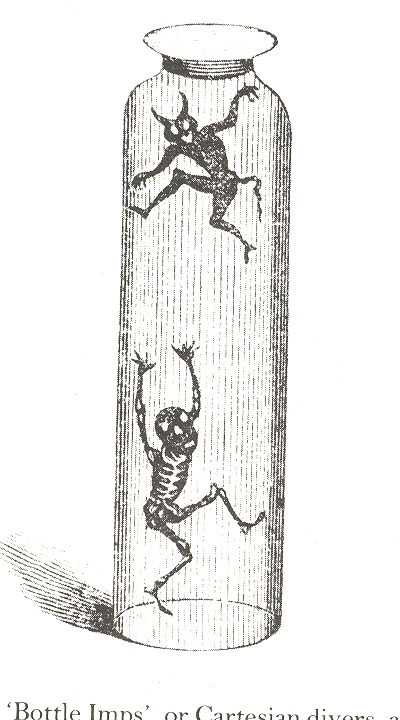
    Blog--june 22--people in glasses imps Lastly is a Jar of Sinking  Imps–I’ve seen this before with Mother/Father figures, regular humans–but this device contains non-humans.  This image comes from Aryton Paris, Philosophy in Sport (1853), and was a scientific toy demonstrating what happens to air-filled items immersed in water (and where they are nearly the same specific gravity as water), when pressure is applied to a rubber bladder on top of the filled jar.  The pressure from the weight applied to the rubber bladder causes the air in the imps to compress; and when the air is compressed, the imps sink to the bottom.  Not exactly hours of fun, unless there was nothing else around,  though I must confess I’ve seen my daughters have long periods of uninterrupted fun with slimmest of found objects….


  • “Our Men Wear Shoes”: Wide Discovery in an Ephemeral Setting

    JF Ptak Science Books LLC  Post 640  Blog Bookstore

    Some Talks on Sugar
    , a nicely printed but thin pamphlet by Clarence
    R. Bitting, published in 1937, looked like a non sequitur of non-interest—until
    I flipped through the thing and found some very unexpected photographs, and then some fantastically unexpected text.  As it turns out, the interior title—Florida Sugar, Past, Present and Future…an
    Address Before the Florida Chemurgic Conference
    — provided a surprise,
    first with the Florida interest, and second with the not-seen-in-my-experience
    word “chemurgic”.  
    Blog--jun 7 sugar shoes

    It turns out that Mr. Bitting
    was the Vice President of General Motors, and was making a push to sell
    chemical fertilizers and such to other growers in the state of Florida  from the
    home-base company of United States Sugar Corporation (of which Bitting was president in 1939).  The USSC was purchased en masse by the exceptionally talented businessman and entrepreneur
    Charles Stewart Mott, who was also the major private shareholder in GM. (Mott’s
    Apple Juice came later after the company became fabulously successful—it was
    one of many other concerns created when USSC began to diversify.  From what I can tell, Mott’s today imports
    most of its apples from China—says
    so write on the bottle.)

    Now all of this had my
    attention.  Following six pages or so
    extolling the company’s successes and advances in cultivating (and draining)
    the Everglades, they got around to talking
    about the 2,500 people who worked for them. The title of that section was “Our
    Men Wear Shoes”. 

    Really?

    The Vice President of General Motors was proud of USSC’s treatment of its workers: 

    “Florida cane-field workers wear shoes; they
    own their own hats
    , and their wardrobe consists of a great deal more than a
    second-hand or third-hand pair of overalls, so that clothing production as well
    as supplying the food requirements of those directly and indirectly employed
    furnishes much additional indirect employment.”(Bold emphasis mine.)

    This really does speak to the
    times, when the manufacturer could be proud to announce that its workers own
    their own hats and shoes. Hats?  Were
    hats rented? 

    It is also remarkable that for
    all of this—the hats, the shoes, the sort of new overalls—that these “cane-field
    workers” were also carrying other incomes on their backs for the people who
    would sell them these few bits of owned clothing and food.  It seems almost impossible that these would
    be laudable traits of the employer—but they were, evidently, because the VP of
    GM saw fit to mention them.  And to me
    this must mean that other  workers, elsewhere, didn’t wear shoes and
    didn’t own their hats.  Staggering,
    really. (My wife Patti just asked what the modern equivalent of this would be. I’m not sure; perhaps the fiction of “poverty line” income, or the wispy promise of the minimum wage? Or is it the floured-up sugar delivery systems that kids get to eat for free at” breakfast” in public school?  Or the last-ditch emergency care effort that is provided for children in direneed of medical assistance, given finally only modest attention along the lines of lifetime neglect? What is it that we are proud of today that will look so stingy and mean  in the coming years? Where is the capacity to help and aid so short-sighted and so under-capacity as in the hat/shoes issue? Its a great question. [See my post on the history of the minimum wage here.])

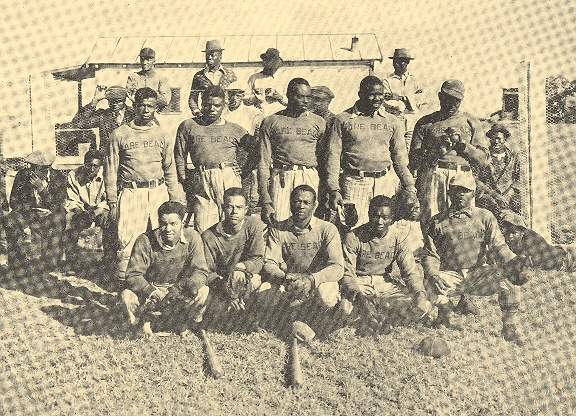
    Blog--jun 7 sugar bb And then the photos.  Pictures of Field Day festivities on acres of
    cleared sugar cane, a tug of war, men working at a conveyor built.  Then the school room and the baseball
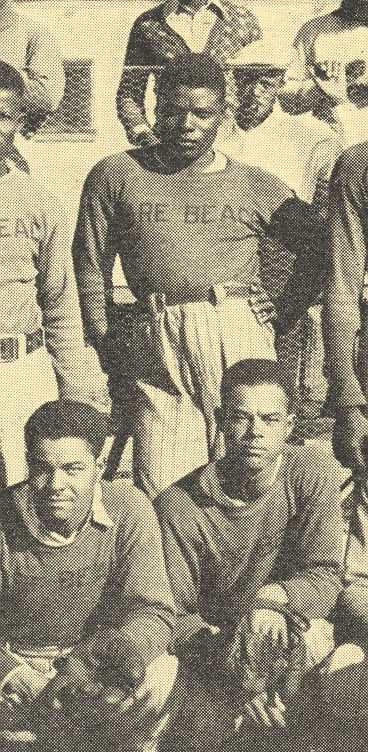
    team. The men in the baseball photo look proud, and ready (and formidable, especially considering how many professional players of the day were lumpy and loose, thanking god that they were wearing form-hiding loosely-fitting wool uniforms). These men were muscular, lean, hard; I bet they could play.

     Blog--jun 7 sugar school

    Blog--jun 7 sugar bb2

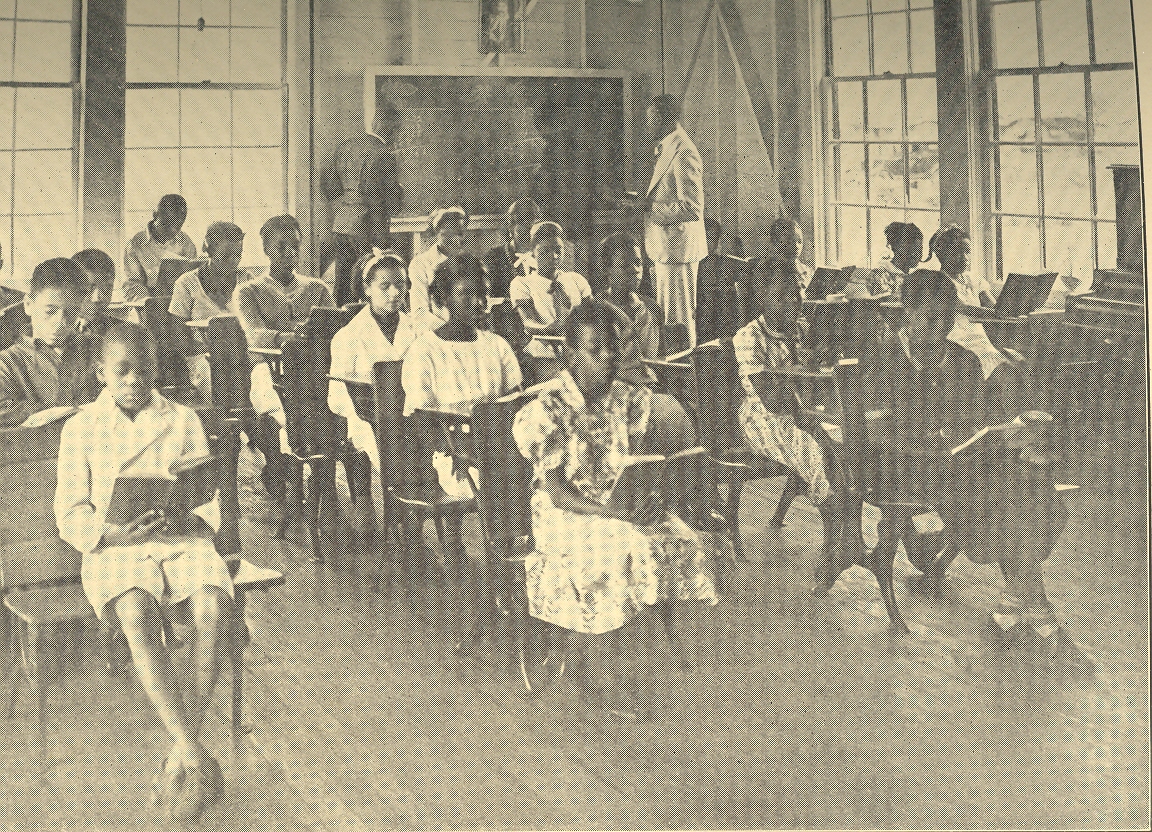
    The children in the airy schoolroom are decently dressed, though the poor kids in the front row have no desk.  And the walls have no interior finish.  I wonder too about the tall boys in the back of the room with their bow-tied and jacketed teacher.  What are they doing with the blackboard in the rear of the room? Was it placed there to show that the kids had a blackboard

    and it needed to be in the picture?  Or is it because this was a one-room affair, with the older children in the back, getting special attention from the teacher who was trying to give age- or capability-relative instruction under slim circumstances? My guess is that since this is 1937 and we’re talking about a company-run school in the Everglades, that the sotto voce undercurrent of thought would be that the children had a room and a teacher, and what more could they want (?)

    The photographs are unintentional monuments
    to the little bit that was given to these thousands of people–so little that
    seemed like so much to the people who had almost nothing, and also, criminally,
    it felt like so much largesse from a company that had infinitely more.

    And all of this from what would seem to be a disposable piece of ephemera–and we haven’t even gotten to the chemical hardware bits and the draining of the Everglades to get to that good cane-growing topsoil….

    *See below in extended reading for Mr. Bitting’s testimony before the Congressional Committee Investigating the Interstate Migration of Destitute Citizens. 

    ·Posted by :

    ·in:


  • A Note on Forgetfulness: London, the City of the Lost (Things)

    JF Ptak Science Books LLC  Post 636  Blog Bookstore

    Blog--June 1--overiew In the panoply of play upon the
    title of this post are many variations. For example, book and movie titles which could  fill  the space in the
    category of “City of
    Lost _____” are Children, Dragon Lace, Souls, Soles, Angels,
    Heaven, Books, Dream and Men.   Filling in
    “The Lost City of _______” are Atlantis, Chernobyl, 
    El
    Dorado
    , Nan Madol,
    Abad,
    Bethsaida, Geraptiku, Trellech, Dvaraka and Uganit.  For “Lost Cities of ____” that were never
    really ever found, and which existed in the imagination and on the printed page
    would include Metropolis, Wonderland, Utopia, Narnia, Fredonia, Eden,
    Yuknapatawpha (County), Oz, Lilliput, Middle Earth (etc.), Slobbovia, Dune and
    Hell. 

    Blog--June 1--corset Then of course there are the
    cities that were and weren’t any longer (though some did come back but without
    its original inhabitants:  the annihilated Jewish ghettos of Europe, Nagasaki, Hiroshima and Nanging
    are just a few that come to mind.  New Orleans seems to be in a different category, partially destroyed
    by benign neglect and arrogant stupidity at the very highest reaches of the federal
    government (and resting in the one man, now thankfully lost). Blog--June 1--toys

    It would be fun to write a history
    of forgetfulness with its companion volume on The Lost., but that has been
    accomplished a number of times, already (see below*).  

    Blog--June 1--chick My post is not an attack upon London or its imaginary lost souls–it really is about lost
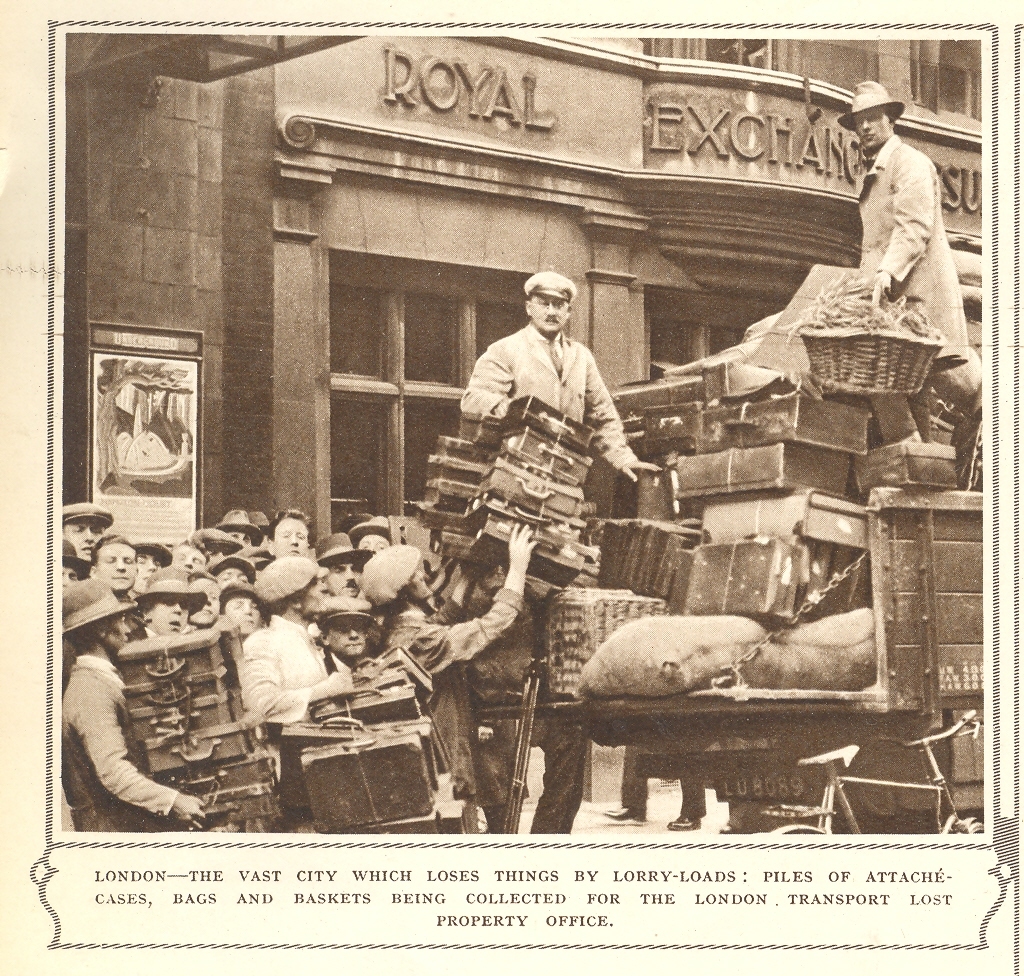
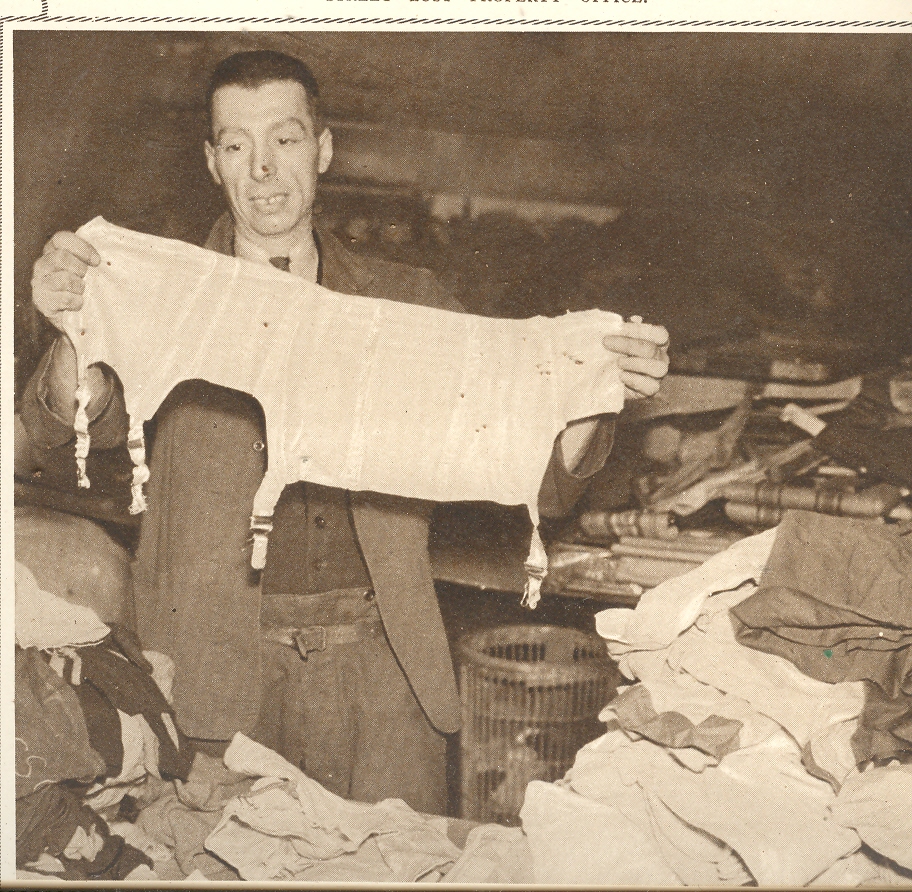
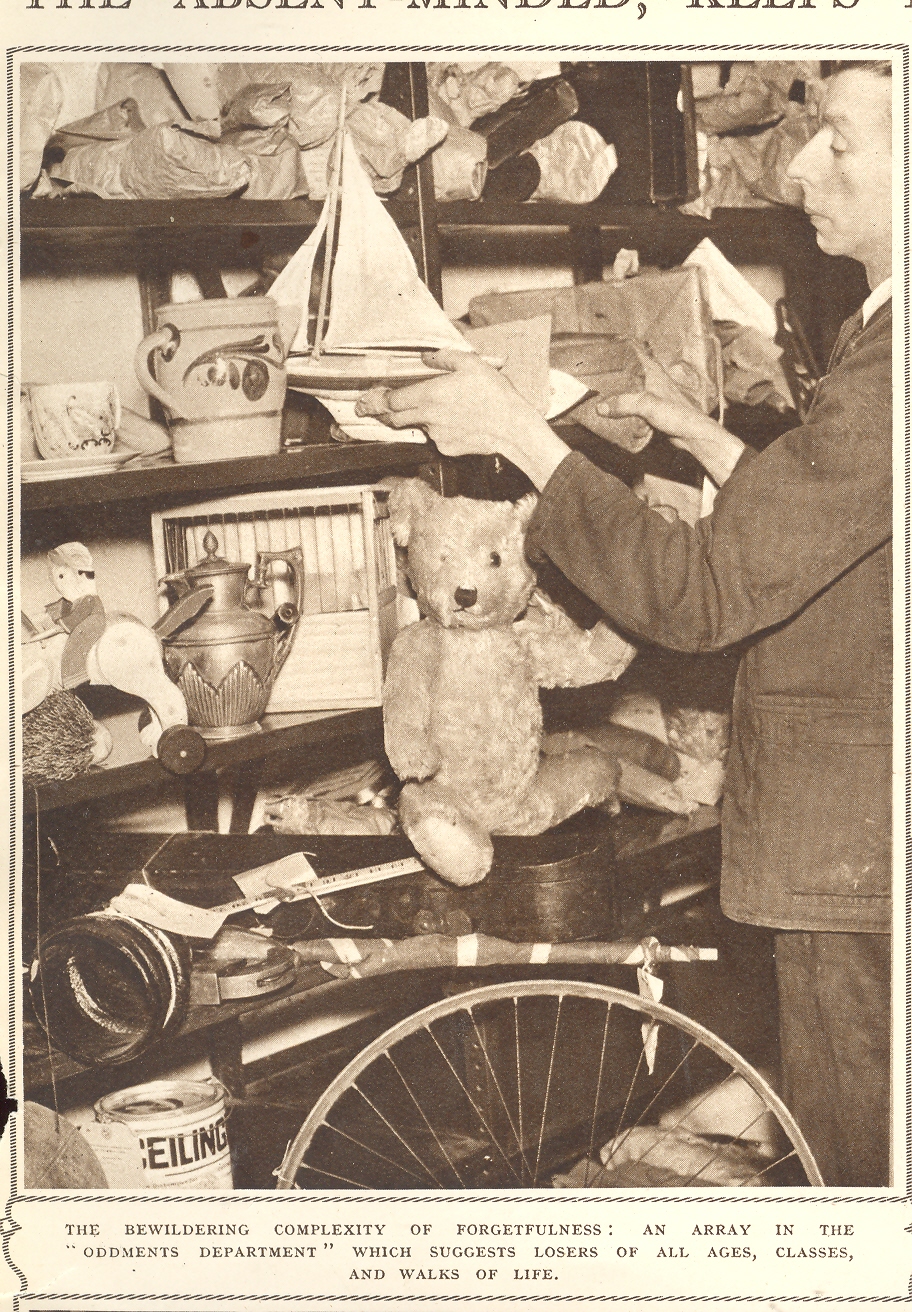
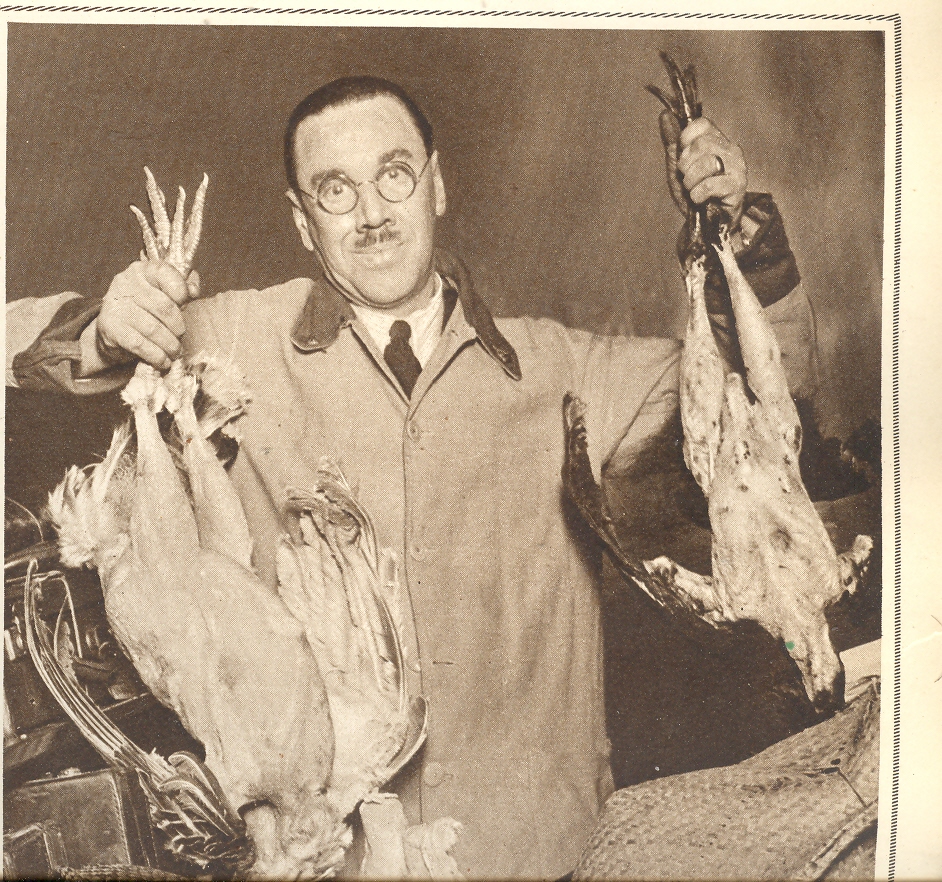
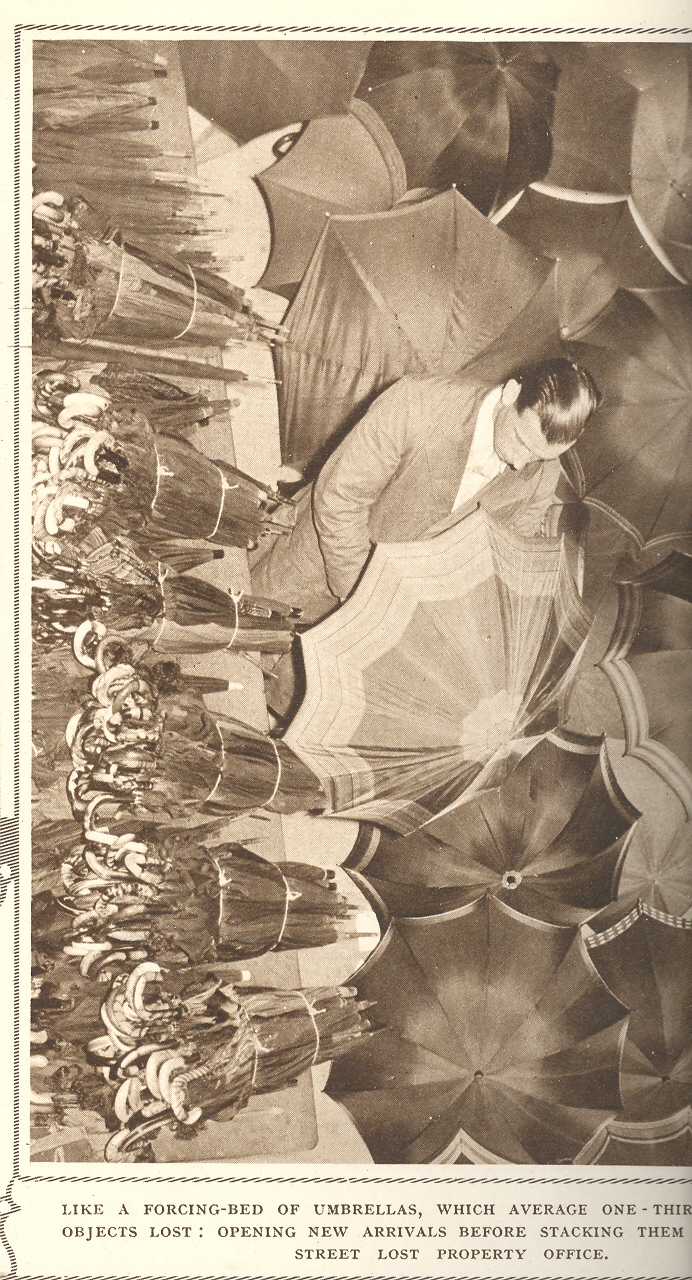
    things.  The images come from a fabulous article from the Illustrated London News of 5 March 1938 called “Forgetfulness by Tons and Thousands; How London, the Absent Minded Keeps Lost Property Offices Busy”. Evidently, in the old days when London Transport were superb, there was a very well orchestrated and
    Blog--June 1--umbrellas detail-orientated staff that collected the lost things of the day found in the Tube, tram depots, buses and lorries; they were gathered and brought to the London Passenger Transport Board at Baker Street, where all of the items were meticulously cataloged and stored, kept for a half year (?!), all registered with the Lost Property Office. Add so aside from the pinch-faced Aubrey Beardsley-fingered man handling the sailboat, and the Floyd the Barber lookalike celebrating the fowl, and the low-belted quizicum inspecting the nether garments, and the slick-haired man inexplicably opening all o the thousands of closed umbrellas, are the following statistical bits on Lost Things Identified for the Year 1937:  49,9999 pairs of gloves; 19,978 single gloves; 33, 361 pieces of clothing; 25,489 attache cases; 24,600 books; 24, 158 pieces of “undefined property in parcels”; 5,805 spectacles; 5,278 keys; 4,005 pipes; and 2307 different pieces of foodstuffs.  All this was just part of a grand total of 348,477 lost things for one year.

    I think it would be fabulous if there was some lost room there at the old Lost Property Office, a place waiting to be rediscovered after the room itself had been lost for the last 71 years. If I had to chose I’d certainly would shout for Mr. Beardsley-fingers–he is,after all, pictured in the beautifully named “Oddments Department”, admiring the “beautiful complexity of forgetfulness” stored there.  Perhaps that room would be filled antique story lines, lost-items-found that were of such an unusual origin that the professionals used to dealing with such things found these to be unclassifiable, tossing them all into a I’ll-Deal-With-it-Later locale.  The material seems like a lock looking for a treasure.

    *Philip Grove’s The Imaginary
    Voyage in Prose Fiction
    (1941); Pierre Versins’ Encyclopèdie de
    l’Utopie, des Voyages extraordinaires et de la Science-Fiction
    (1972);  Alberto Manguel
    and Gianni Guadalupi. The Dictionary of Imaginary Places
    (1980, 1987, 1999)

    ·Posted by :

    ·in:


  • The Invention of Small Things and the Coming of the Internet–Back to the Flea

    JF Ptak Science Books LLC  Post 615  Blog Bookstore

    “A network of such [computers],
    connected to one another by wide-band communication lines [which provided] the
    functions of present-day libraries together with anticipated advances in
    informationstorage and retrieval and [other] symbiotic functions.” —J.C.R. Licklider, 
    his epochal “Man-Computer Symbiosis”, 1960

    There is a famous
    and most likely apocryphal story made famous in Stephen Hawking’s A Brief History of Time where a famous
    “scientist” (I‘ve heard him described as James Jeans, for one and the nicest
    fit, others say Bertrand Russell though it matters not) is confronted by a
    member of his audience during a lecture on astronomy/cosmology.  A woman rises and confronts the speaker,
    determining that what has come to pass as fact regarding the universe is all
    rubbish, and that the Earth was in fact a flat object resting on the back of a
    turtle.  The speaker then asks her what
    the turtle is standing on; she replies immediately of course that it is another
    turtle, and that it is “turtles all the way down”.  It’s a nice story, and bears some resemblance
    to Native American stories of the Earth born on the back of a turtle, of the
    Hindu legend of the Earth being borne by an elephant standing on the back of a
    tortoise, and so on, all the way down. 
    Even Dr. Seuss’ Yertle the Turtle
    can make an appearance in this one.

    1875large

    This came to mind
    thinking about the contribution of (the not-entirely forgotten) John Benjamin
    Dancer (1812-1887) to photography and its relation to the history of the
    Internet.  Dancer was in the immediate
    second wave of the greats of photography following the short first wave of
    Niepce and Talbot and Daguerre, and did come up with a number of very good
    ideas at the birth of photography—one of them in theory is an early foundation
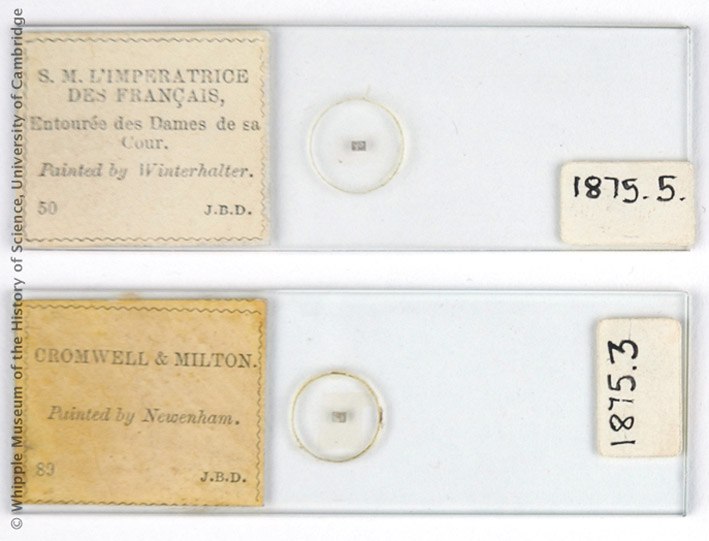
    stone for the technical distribution of data and information.(These two slides are  examples of Dancer’s work and are reproduced from the Whipple Museum of the History of Science, Cambridge.)

    Dancer evidently
    went to work immediately after reading of Daguerre’s 1839 process.  The technical aspects of the Daguerre effort
    were les daunting than they were messy—he found the descriptions “crude and obscure”,
    and proceeded with his own series of experiments, producing a camera some six
    weeks later.  It is interesting too that
    he seemed to have based the camera on a camera obscura:  “being a practical optician the camera was
    one of my own construction, such as I had frequently supplied to artists for
    tracing the outline of views in the camera….”

    He lectured later
    in that same year (1839), showing lantern slides of his accomplishments to
    crowds of up to 1500 people.  His great
    accomplishment was in the field of microphotography—I should say rather that he
    invented the field.  And it is of great
    interest that the first images that he made using the brand new invention of
    the camera coupled with a microscope was that of a flea.  In yesterday’s post I wrote about Robert
    Hooke’s Micrographia and his spectacular discovery of the fineness and detail
    of biological specks like the flea, showing audiences—the world—for the first
    time that these insignificant creatures represented an entirely new,
    just-discovered world, and that they were as tremendously well-developed as any
    other large living thing.  Back to the
    flea, as it were, went Dancer—I have no idea whether he knew he was calling on
    Hooke’s iconic image or not.  But it is
    at least a lovely coincidence.

    Dancer also
    displayed images of documents that he reduced by a scale of 1/160, printing a
    fully-legible copy of a printed document that was only 3mm tall.  The significance of this invention seems to
    have been lost until it was picked up again in 1853 by the great John Herschel,
    who recognized the process as a way to archive significant documents.

     I like it more for its possible impact,
    perhaps, on some of the thinking on the construction of a world-wide
    distribution of knowledge, as a necessary step to get to the stage where
    Vannevar Bush—who was widely acknowledged as being the grandfather of the
    internet at a MIT Conference about a 20 years ago—could theorize about his own
    precursor to the internet–the Memex,
    describing it for the popular audience in the Atlantic Monthly in June*, 1945. 
      Among many other things,
    Bush—who was also, probably, one of the great figures of WWII for his heroic
    role in leading the U.S. scientific and technical war effort and seeming to
    make the correct decisions all of the time—foresaw a means of distributing
    data, more or less instantly, calling on the delivery of microfilmed
    information. Bush, who was also a great engineer and father of one of the
    countries best analog computers (in 1931/33), had the notion for a world wide
    technical distribution of knowledge, but, as he wrote this in 1945 (!), could
    not see far enough into the future development of the digital computer (the
    ENIAC just being born at that time, though it must be pointed out that Bush was
    open to the idea of magnetic storage). 
    His ideas were very far reaching, touching on microminiaturization and
    artificial intelligence, and his ideas even now aren’t so much coyly science
    fiction as they are, well, implemented. 
    There’s a lot of Bush’s memex that are in place today

    So, the turtles and
    wondering about Dancer’s influence in the string of inventions and discoveries
    that gave birth to the www: how far down do these influences go?  The touchstone for the creation of the internet
    is usually seen as being with JCR Licklider (see quote above) in 1960, or with
    Paul Baran or Leonard Kleinrock a year later; but perhaps it is earlier still with
    the implementation of ARPA (set into place immediately after the launch of Sputnik).  Of course none of this is possible without
    computers, so you could work your way back through time to the transistor, to
    Bush, to the Stibitz (Bell)Relay Computer, to Johnny von Neumann, to the thermionic tube (Bush), and then
    all of the support discoveries and inventions that rolled into these, and so
    on.  Back to photography, back to Babbage’s
    plans for his analytical engine, back to the invention of moveable type, to the
    invention of paper, to the creation of libraries, to the general idea of the
    popular distribution of knowledge.  All the
    way down.  But I do think it worthwhile
    to think of Dancer’s contribution in so far as it allowed people to think of
    easier, quicker ways of moving around vast amounts of data and
    information.  And that I think is worth
    remembering. 

    *I’ve also got to
    say that at the same time Bush was writing about the future of intelligence he
    was also at work developing the U.S.  response to the upcoming race in atomic weapons.  He and his team were busy crafting responses
    and policies and the reaction of the Soviets and the sharing of the atomic bomb
    data and all of that, and all before the test at
    Alamogordo. Really, the guy was spectacular.


  • Redefining “the Present”: Bitter Bierce, James Joyce and H.G. Wells

    I do not define time, space, place and motion, as being well known to all.  Isaac Newton, Principia, 1687

    Books--burgess I had some lingering thoughts about my post from two days ago which briefly touched on Joyce’s dreamy Finnegan’s Wake (published in 1939, just two years before the author’s death), which led me to the language-creating, never-endingness of one day in his Ulysses* (1922).  It is also a novel of time, reprocessing its time-units lile old Zeno, finding halves of time in regressive size and in greater numbers, roiling around like fly-swatted mercury; we never do get to the bottom of time although it does slow it down considerably.  It follows a slight but powerful literary history, treating time somewhat like the earlier (earliest?) Poe, and especially like that clock ticking in Dostoyevsky’s Crime and Punishment (1866), where action is laid bar to exhaustive and minute interpretation, waiting for no person. 

    A little later on comes Ambrose (“Bitter”) Bierce, a crummudeonly misanthrope with a razor eye for criticism for everything beyond himself.  My guess is that every other person in the U.S. past the age of 30 has read his Alabama-based “An Occurence at Owl Creek Bridge” (1893) in which a lifetime or so could be lived in the moment that it takes for a man killed by hanging. (I have a feeling that this was a very apt way for Bierce to look at his own life, right up to the moment where he rode into infinity in the Mexican desert.)  The prgoression of time is interrupted to tell the tale, everything taking place in the time that it takes to travel eight feet. What I didn’t know when I read the story for the first time was how unusual, groundbreaking, it was for the distortion of time in this way in literature.  Monet and Impressionism Inc.  were at it for a little from the 1860’s or so, but it seems to me that in literature this fracturing of time was pretty scarce.

    These authors were performing experiments with the vast horizon of time, creating a new space in the very slim spectrum that we call the “present”.  In another way, Proust’s Remembrance of Things Past explores past action in a way that redefines what we can think of as a “normal” present.  Looking forward, too, can have a pulling effect on the present, as we can see in the novels of the future by Jules Verne and H.G. Wells. 

    Time in physics is the orders-of-magnitude incendiary to this discussion–it is the fundamental, measurable scalar unit from which stuff like motion  and energy and fields are derived. Things get really interesting in the history of science once you move through Galileo and Newton and Maxwell and get to the time of Planck and Einstein and Minkowski .  Interestingly, the most significant changes occurring in the treatment of time and the definition of the present come in the period from 1865-1915–a particularly fertile period of revolution and modernity, where nearly every discipline undergoes a radical, fundamental change. Everything except political studies, where the only really new thing to come into the fray at that time was the introduction of the concentration camp during the Boer War.  Everything else changes in remarkable ways:  physics, mathematics, art, music, literature, theater, dance.  Astonishing. SpongeBob-SquarePants-AM-FM_F43403B5

    If I was really clever I would find a way for this post to be circuitous, but I can’t, so I’ll just end by saying that I’m out of time.  

    *I’ve included the first lines of the Joyce novels in the continued reading section, along with a few choice others. 

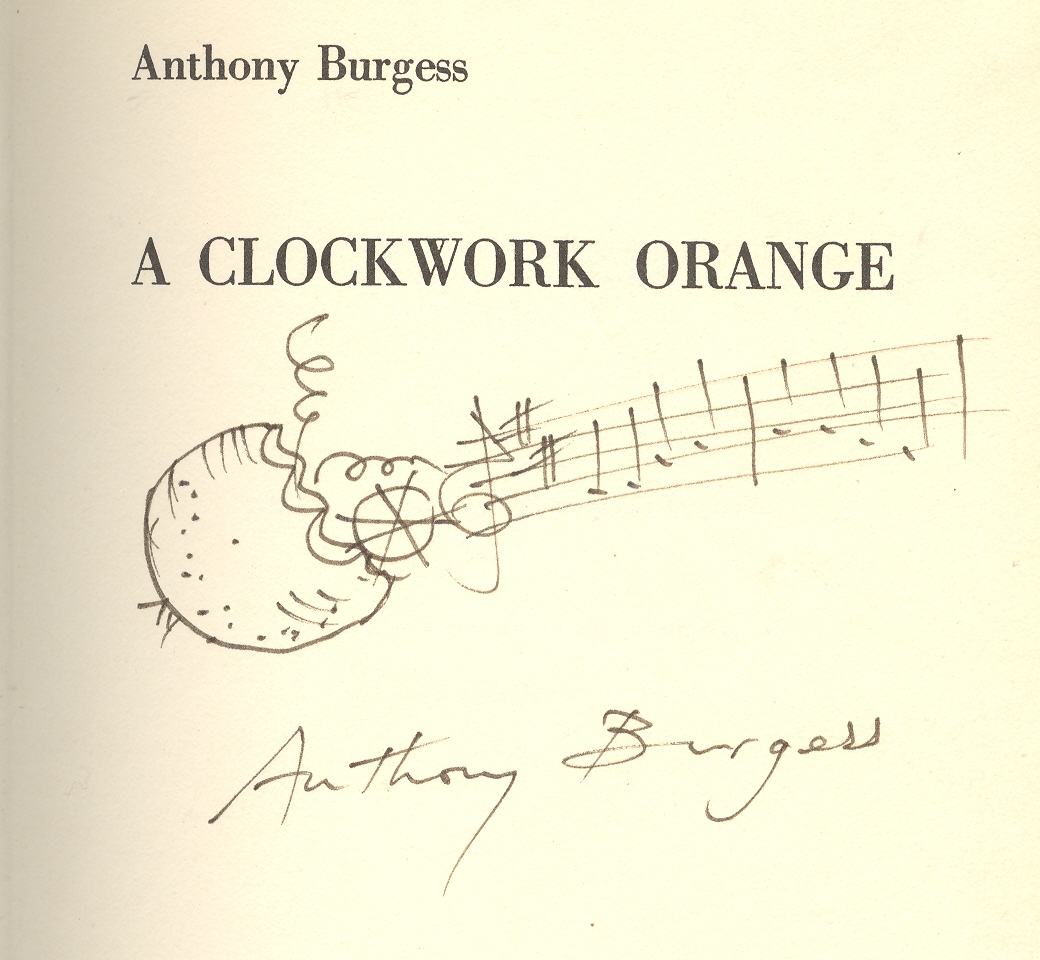
    **For several years in the early 1980’s I read all of Anthony Burgess’ novels, collecting them as well.  I always liked A Clockwork Orange for its dark humor and inventiveness, and for each of  the few times that I met Burgess I had a copy of the book for him to sign.  He was always very gracious, signing my books with appropriate flourishes–with music, or Arabic, or whatever was implied by the subject of the book. The exploding orange is far and away my favorite.


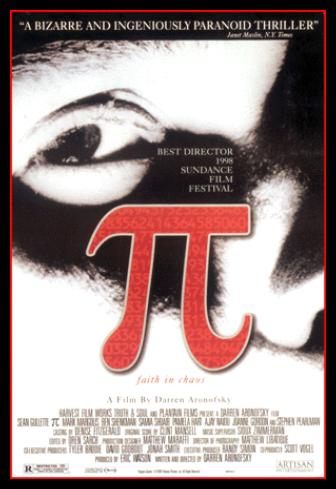
  • Legislating a Change in Pi Day (3.14): When 3.2 was “Almost” Pi, Indiana, 1897

    JF Ptak Science Books  Post 550

    Pi movie poster


    The issue of establishing scientific validity and fact through political and religious machinations, rumination, fascinations and condemnations has a grindingly used, odd history, and little of it comes to much of a good end.  Usually it is just a bad idea, or a wronger-than-bad stinkingly non-idea; that, or something with a sickening wiff of eau de maison funeral perfumery.  I’m not so sure about whether anyone has legislated that a point in space exists, or that non-Euclidean stuff is twisted, or that the world (as in “Earth”) began precisely at 11:11 am (?!) on the first day of the first week of the first month of the first year 4004 BCE.  Biological matters have been taken more seriously in the legislature and courts, at least in my country, than stuff in physics and math—the meaning of death has more or less been legislated, while the whole issue of sustainable “human” life has been battered around for decades (with the last administration’s elephantine approach to things like stem cell research now just being lifted following eight years of abuse).  Many examples begin to emerge when looking deeper into the history of science, especially with the influence of the churches, hammering evidently tender belief systems on top of scientific endeavors.

    The issue with mathematics and the law seems mostly limited to weights and measures and time, which is logical; I’m not so sure about the more ethereal stuff, except for the very famous example of the Indiana pi debacle of 1897.  It was in this that the solemn state legislature was nearly hoodwinked by an amateur semi-mathematician, crank and number cruncher named Edwin Goodwin, who persuaded the people who need to persuaded and had a bill* introduced in the Indiana General Assembly—it basically established that the value of pi be set at 3.2   t his makes not too much sense until you realize that the only good that could come of this tripe is to use it in one of a never ending series of attempts at squaring the circle. 

    The bill of course almost made it all the way through—it started life in the place where it should’ve ended, in the Committee on Swamp Lands, and then blazed its way through Education and eventually passed unanimously by the Indiana house.  Had it not been for the serendipitous acuity of Purdue professor C.A. Waldo—who alerted the state senators about its humbug nature, where the bill was finally shuttled into its everlasting postponement….in the Committee on Temperance. 


    *A Bill for an act introducing a new mathematical truth and offered as a contribution to education to be used only by the State of Indiana free of cost by paying any royalties whatever on the same, provided it is accepted and adopted by the official action of the Legislature of 1897.

    ·Posted by :

    ·in:

    —

  • A History of Smallness, Part 3: Dew and Space (Charles William Wells, 1814)

    JF Ptak Science Books LLC  Post 515

    0 blog feb 13 dew581

    Little things comfort us because little things distress us. Blaise Pascal

    Science is simply common sense at its best. ~Thomas Huxley

    Physics is imagination in a straight jacket. ~John Moffat

    Science does not know its debt to imagination. ~Ralph Waldo Emerson

    Moderation, which consists in an indifference about little things, and in a prudent and well-proportioned zeal about things of importance, can proceed from nothing but true knowledge, which has its foundation in self-acquaintance. Plato

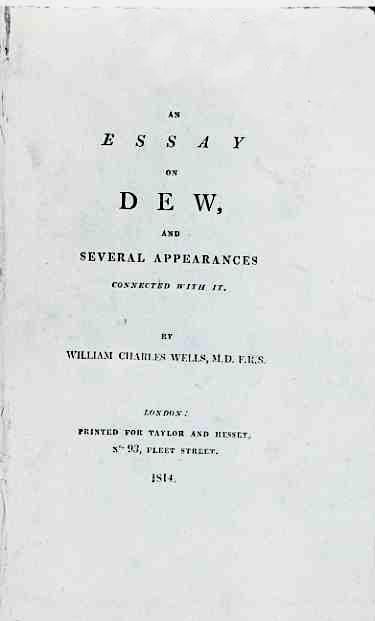
    William Charles Wells (1757-1817), a Charleston-born Londoner who was the physician to St. Thomas’s Hospital from 1800-1817, did one of those great, little experiments (sort of but not really like Charles Darwin crawling around on his imaginarily-sick tummy at Downs watching worms) from which big things were born. The experimentation, lovely and penetrating and elegant, took place over several years from 1812 to 1814, were published in this semi-slender, 146 page tract, which the great Thomas Huxley called “a model of wise inquiry and lucid exposition”. (Actually, 146pp on dew might seem like a lot until you consider what dew is all about.) What Wells so ably exposed about dew was its great terrestrial demeanor–that the movement of dew, its accumulation and dissipation, was due to nothing less than radiation from space, regulated (or interrupted) by the action of the Sun and clouds, ‘introducing a clear view of what is now called the radiation balance of the atmosphere”. (W. Middleton, A History of the Theories of Rain, pp 188-191).  So this is a bit of smallness, something small and seemingly insignificant, leading from its own bit of nothingness into a theory of radiation from space and a theory of the atmosphere, a result almost completely unanticipated.  It is too in its own way somewhat like Robert Hooke re-introducing the often seen and little liked flea–showing people what the flea actually was, under magnification for the first time, showing what sort of world was going on in front of us that was simply just too small to see. 


  • Dr. Seuss and the 236 Words that Changed Reading Forever

    JF Ptak Science Books

    I think that it is difficult to overstate the importance and long-term significance of Dr. Seuss‘ (Theodor Seuss Geisel, 1904-1991, son and grandson of brewmasters) contribution to childhood.  I think that it is impossible to calculate the overall impact of his bringing young people to the joy of reading, and to the familiarization  with the bare mechanics of how to read.  Of course he told a great story, but his books were literally page-tuners—they were simply written with words useful to children, with few words per page, thereby allowing the child to see the pictures, read all of the words, and turn the page, giving them a sense of accomplishment along with enjoying  a fine story.   Perhaps it is the getting-the-kids-used –to-reading that was his most fantastic accomplishment—and something that few others have achieved, measuring by just pure numbers. 

    Blogcathatbook

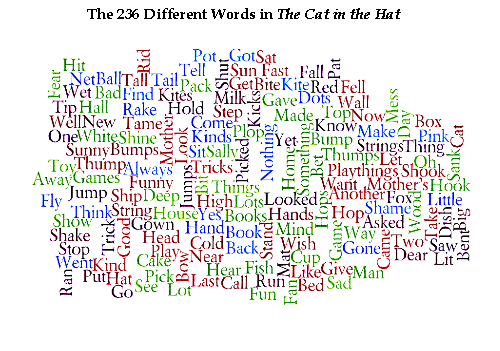
    And the way in which he did this was to artistically use an extremely limited budget of words—Dr. Seuss used precisely 236 different words to write The Cat in the Hat.

    It is certainly true that there have been many sparse, relatively wispy papers in the history of science form which enormous change has sprung..   Pound-for-pound though The Cat in the Hat holds its own. 

    I’ll give the entire list of words below—just have a peek, and try to imagine writing something interesting with just this palette. 

    Wordle--cat in the hat

    It isn’t fair at all to compare this masterpiece with others in different genres, but just to give you an idea of its relative simplicity I’ll quote some numbers taken from an incredible study conducted by Zachary Booth Simpson (“Vocabulary Analysis of Project Gutenberg”).  Simpson’s interpretation is more complex than the story I’ll tell here, but basically he looks at the numbers of words in a piece of literature (for example) and then convenes the number of different words, deducing the actual and then relative density of word usage, which is pretty interesting (and verifies that pit-of-the-stomach feeling about which authors use more words in smaller space). 

    Gibbon’s Decline and Fall seems to lead the way in the absolute number of different words used (43,113!!, which is astonishing), in the 1.5 million word text, while old Uncle Bill uses 4,842 words in the 32,000-word Hamlet—meaning that Measure for Measure (sorry) Mr. Gibbon out-Bills Bill, which I thought was very hard to do.  Other interesting bits are Hugh Lofting’s Doctor Doolittle, who tells the story with 2759 words; Moby Dick, told with a spectrum of 17,227 words; and Les Miserables is painted with 23,334 different words.  The only work that comes close to Seuss in Mr. Simpson’s very considerable list is the New McGuffey Reader, which is really, actually, a tough go, and uses 630 words.

    Unfortunately I do not know about the Dick and Jane readers But they’re no match whatsoever for the Good Doctor.

    So my hat is off and off and off to Theodor Geisel, aka Dr.Seuss—on the anniversary of his anniversary in Seussland, where it is Seussqunetennial every day.