JF Ptak Science Books
I think that it is difficult to overstate the importance and long-term significance of Dr. Seuss‘ (Theodor Seuss Geisel, 1904-1991, son and grandson of brewmasters) contribution to childhood. I think that it is impossible to calculate the overall impact of his bringing young people to the joy of reading, and to the familiarization with the bare mechanics of how to read. Of course he told a great story, but his books were literally page-tuners—they were simply written with words useful to children, with few words per page, thereby allowing the child to see the pictures, read all of the words, and turn the page, giving them a sense of accomplishment along with enjoying a fine story. Perhaps it is the getting-the-kids-used –to-reading that was his most fantastic accomplishment—and something that few others have achieved, measuring by just pure numbers.
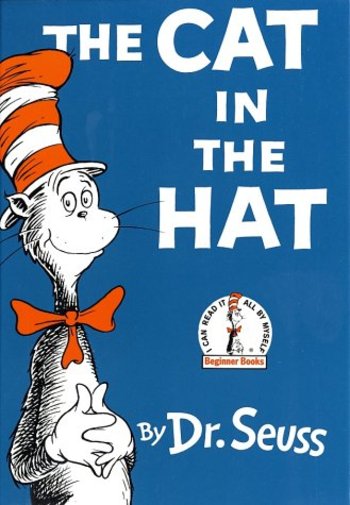
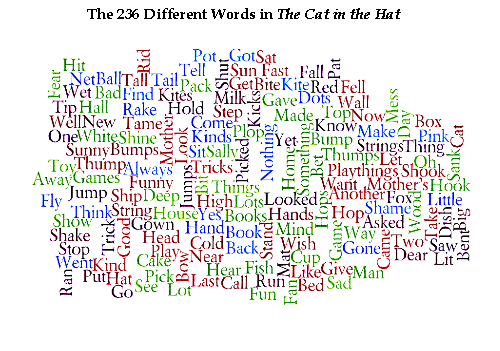
And the way in which he did this was to artistically use an extremely limited budget of words—Dr. Seuss used precisely 236 different words to write The Cat in the Hat.
It is certainly true that there have been many sparse, relatively wispy papers in the history of science form which enormous change has sprung.. Pound-for-pound though The Cat in the Hat holds its own.
I’ll give the entire list of words below—just have a peek, and try to imagine writing something interesting with just this palette.
It isn’t fair at all to compare this masterpiece with others in different genres, but just to give you an idea of its relative simplicity I’ll quote some numbers taken from an incredible study conducted by Zachary Booth Simpson (“Vocabulary Analysis of Project Gutenberg”). Simpson’s interpretation is more complex than the story I’ll tell here, but basically he looks at the numbers of words in a piece of literature (for example) and then convenes the number of different words, deducing the actual and then relative density of word usage, which is pretty interesting (and verifies that pit-of-the-stomach feeling about which authors use more words in smaller space).
Gibbon’s Decline and Fall seems to lead the way in the absolute number of different words used (43,113!!, which is astonishing), in the 1.5 million word text, while old Uncle Bill uses 4,842 words in the 32,000-word Hamlet—meaning that Measure for Measure (sorry) Mr. Gibbon out-Bills Bill, which I thought was very hard to do. Other interesting bits are Hugh Lofting’s Doctor Doolittle, who tells the story with 2759 words; Moby Dick, told with a spectrum of 17,227 words; and Les Miserables is painted with 23,334 different words. The only work that comes close to Seuss in Mr. Simpson’s very considerable list is the New McGuffey Reader, which is really, actually, a tough go, and uses 630 words.
Unfortunately I do not know about the Dick and Jane readers But they’re no match whatsoever for the Good Doctor.
So my hat is off and off and off to Theodor Geisel, aka Dr.Seuss—on the anniversary of his anniversary in Seussland, where it is Seussqunetennial every day.