A Daily History of Holes, Dots, Lines, Science, History, Math, Physics, Art, the Unintentional Absurd, Architecture, Maps, Data Visualization, Blank and Missing Things, and so on. |1.6 million words, 7500 images, 4.9 million hits| Press & appearances in The Times, Le Figaro, Mensa, The Economist, The Guardian, Discovery News, Slate, Le Monde, Sci American Blogs, Le Pont, and many other places… 5000+ total posts since 2008.
At first glance this math teaching tool looks a little on the obvious/antique/useless side, but I think that there are some good points to it in helping small children understand the concept of what a number “is” and relating the processes of addition and subtraction to the relationship of “numbers” to “things”.
And as the inventor points out
and so on…
This certainly seems more beneficial and utilizable than the current practice in my daughter’s third grade class, where a simple subtraction problem is turned into a double addition problem employing a number line, all in the name of teaching the children the concept of “number” and doing away with algorithms. I think that by the third grade, the concept of “number” has been established, though the board of edu-selection might be trying to re-visit a lost point of development somehow.
So with my daughter’s class,take the problem 456-345= ______
This is made intoan addition problem, 345+ ____= 456.
The addition problem is turned into a number line, with 345 on the left far end and 456 on the right.
The children are told to add the requisite bits to 345 to get to a “zero unit” for each place value, and then add those for the solution to the problem.
So: 345+5= 350, 350+50=400; 400=50=450; 450+6+456. Add the 5+50+50+6= 111.
In this confusion a stab at the heart of understanding the concept of “number” has beenb made.
A step back from this would be a wise move to make.
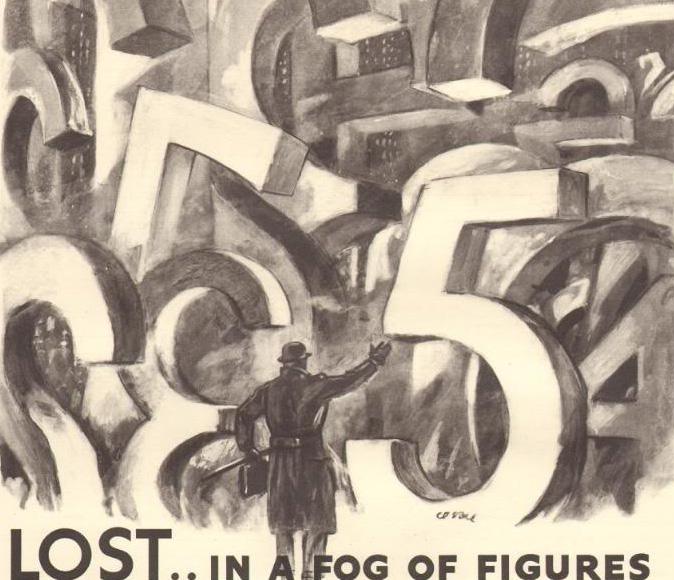
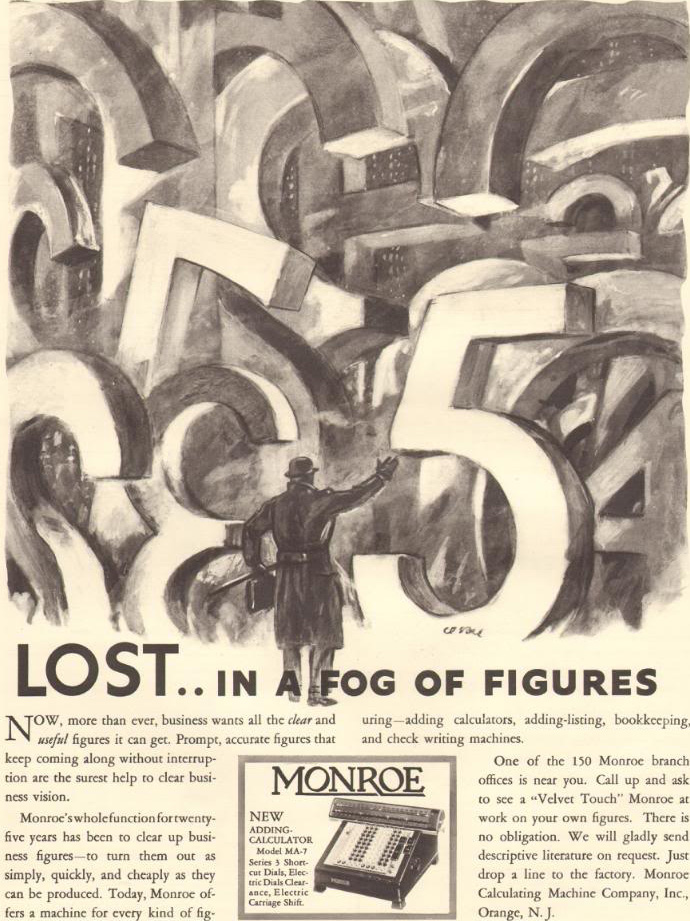
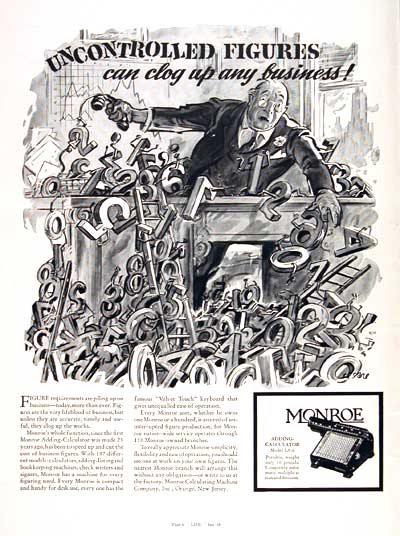
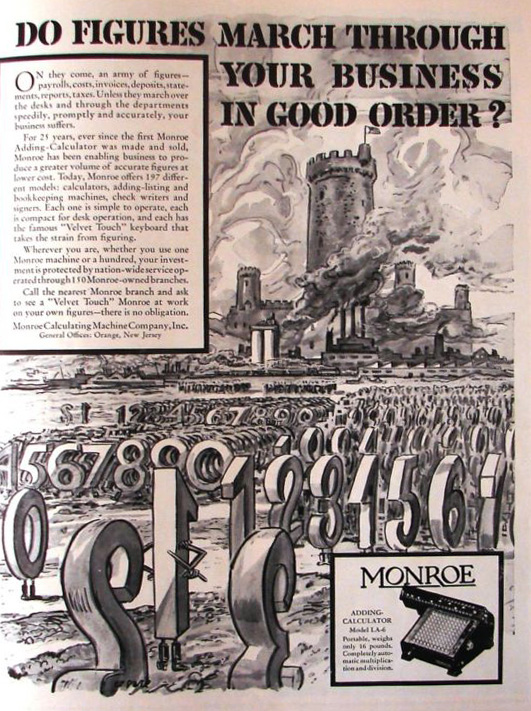
The Monroe calculator must have seemed the same sort of inspired salvation to the 1930’s generation as the hand-held Texas Instruments calculator (with paper feed!) that I saw displayed in a glass-domed pedestal at Barnes and Noble in Manhattan in 1973. Small, compact, and with fantastic calculatign capacity–and expensive. It was in a very real sense a glimpse into the future. For the general, garden-variety Monroe, it certainly offered its users a much smaller, tidier machine than some of the brutes of the decade or two preceding it–make no mistake, there were some big bruising accounting Monroes that were truck busters.
But the Monroes that appeared in these ads from LIFE magazine in the late 1930’s were certainly populist, and easily transportable. And they cost about as much (with some smoke/mirrors adjusting for inflation and etc) in 1937 as the $450 TI cost in 1973. (The TI machine was produced just seven years or so after its first hand-held was introduced–I’m unsure of the 450 price tag, though I think it about correct. The TI SR-50 without a paper trail cost about $150 in 1974.)
Monroe is an old company (begun in 1912) company that produced hand-cranked and electromechanical calculating devices. The Monroe salesman’s handbook that I have here from 1929 shows versions of their machine that were lightweight and versatile (at 38 pounds) to behemoths for insurance companies that were truck-haulable. Monroe became part of Litton before reappearing again on its own, trying to compete in the hand-held market with its own electronic display calculator–a device that cost $269 in 1972. Monroe was basically “done” by the 1960’s.
I think that for most people Texas Instruments is produced hand-held calculating devices–it is of course a vast concern, with a long history that gets catapulted during WWII when the formerly geology-based company gets involved in military electronics. Fast forward, TI created FLIR and MERA, laser-guided control systems for PGMs (laser-guided bombs/precision-guided munitions), launch and leave glide missiles, and so on. IT was also involved in the earliest work in microminiaturization, producing (by Gordon Teal) the first commercial silicon transistor (1954) and the first integrated circuit (by Jack Kilby) in 1958. And so on. Its a big, old company.
And as much as each company was offering a similar god-send to their generationally-distanced mathematician/number cruncher, TI simply didn’t have ads like Monroe. And I’ve always iked to see numbers-on-the-move.
Thinking big thoughts in dreams is generally not a common thing, as anyone who has read their own semi-conscious half-awake memory notes of a dream-based inspiration could attest. But it does happen: Paul McCartney1 dreamed the song Yesterday, Gandhi dreamed the source of non-violent resistance, Elias Howe dreamed of the construction of the first sewing machine, and Mary Shelley the creation of her novelFrankenstein… For good or for ill, William Blake was evidently deeply influenced by his own dreams; on the other hand, Rene Magritte was deeply influenced by dreams but didn’t use any of his own for his paintings. Otto Loewi turned an old problem into not one in a dream, finding a solution to the prickish problem of whether nerve impulses were chemical or electrical (and resulting in the Nobel for medicine in 1935); the fabulous discovery of the benzene ring came to August Kekule in a dream as well. Artists have been representing people in dreams and dreamscapes for many centuries: Durer depicted a dream in a 1525 watercolor, for example, and thousands of artists have depicted famous biblical dreams (Joseph of Pharo) for long expanses of time.
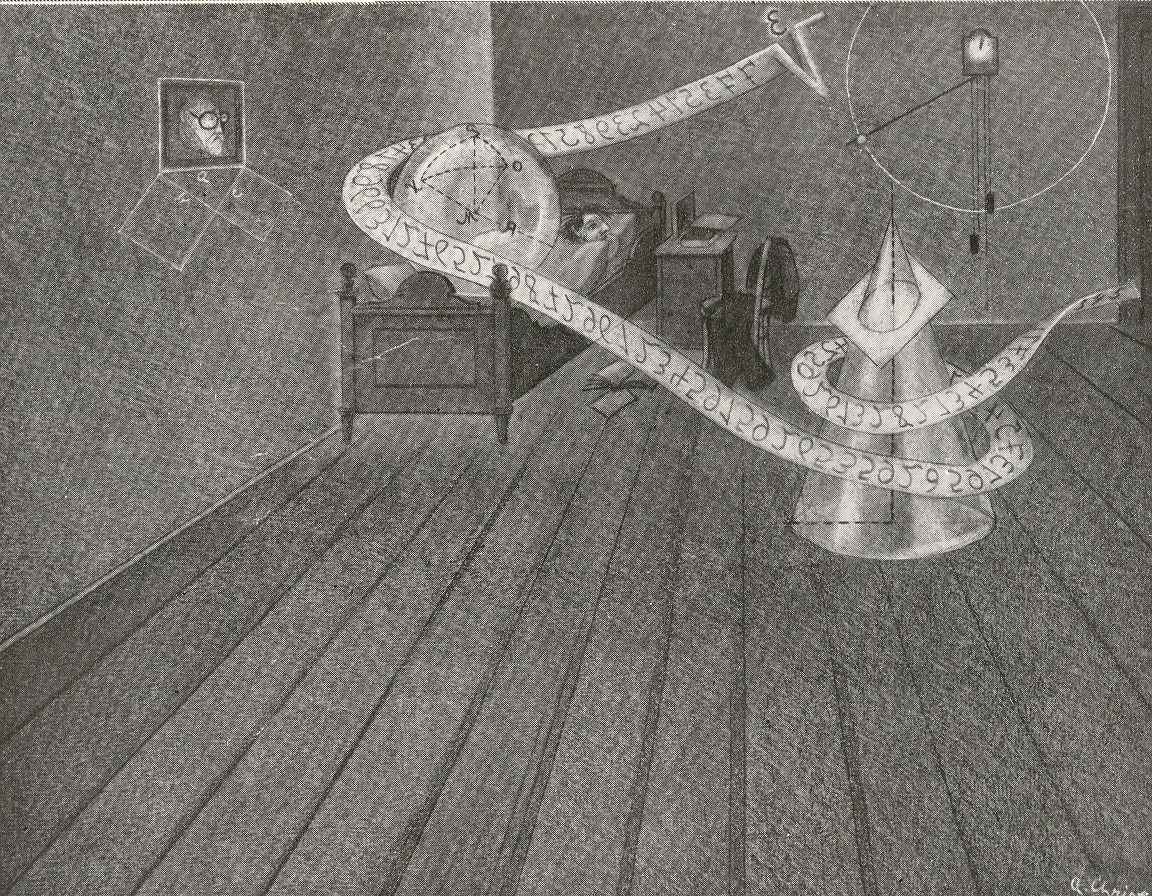
What struck me, though, in this illustration found on the other side of the page of the Illustrirte Zeitung2 (for August 1932) that I used for yesterday’s post about damming Gibraltar and Shakespeare’s memories, was the depiction of someone dreaming mathematical thoughts…or at the very least, dreaming numbers. People have undoubtedly dreamed much in mathematics, but I can not recall seeing illustrations of these dreams.
I’m differentiating here from something like a Poincarean inspiration, or vision, or thunderstrike–I’m talking about drop-dead asleep sleep, dreaming sleep, REM and all that. Also I’m differentiating this from imaging mathematical thought, as in the work of Francis Galton in 1880 in which the subject of mentally seeing the process of mathematics is perhaps first addressed. I wrote a short piece on that here, way back in Post 9. )
The numerical sequence in this dream doesn’t look like anything to me: the backwards radicand doesn’t strike anything common in my head. The geometrical drawing under the portrait in the dreamer’s room though is the impossibly iconic Pythagorean theorem, and there is a nice picture of a conic section in the foreground; but the artist, who improbably signed the work “A. Christ”, doesn’t offer much of math in the dreamscape. Still, it is a rare depiction of someone dreaming about math.
Notes 1. “I woke up with a lovely tune in my head. I thought, ‘That’s great, I wonder what that is?’ There was an upright piano next to me, to the right of the bed by the window. I got out of bed, sat at the piano, found G, found F sharp minor 7th — and that leads you through then to B to E minor, and finally back to E. It all leads forward logically. I liked the melody a lot, but because I’d dreamed it, I couldn’t believe I’d written it. I thought, ‘No, I’ve never written anything like this before.’ But I had the tune, which was the most magic thing!” from Barry Miles (1997), Paul McCartney. 2. this is really a great sheet of paper, coming from issue 4492, pp 518-519. Two pictures of dreams on one side, with three visionary images on the other (the Gibraltar dam, a sub-polar submarine, and a futuristic Indian railway/bridge.
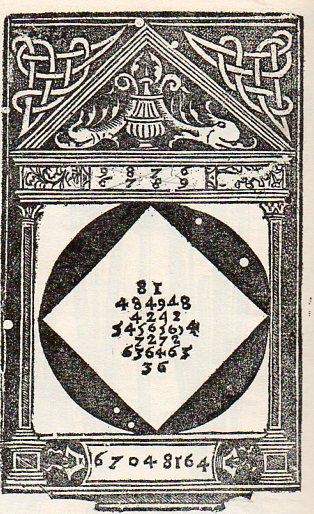
Giovanni Tagliente was many things, though perhaps he wasn’t mathematically inclined, not really. He was however a very capable putting together books and addressing some elementary needs of the working classes that reached out into the mass of the great unwashed offering instructionals on how to do the basics of–in this case– applied mathematics, as with this book, Libro de abacho…1, this edition printed in Venice in 1564. This was a small, pocket-sized book2, a references on how to do the stuff of daily (and not so daily) calculations, and in principle was a concise, Humanist guideline for getting through the daily bits of the calculating and mercantile life.
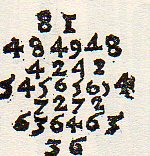
The above image is a woodcut diagram “explaining” how to do multiplication.
To the 21st century eye however the actual explanations of how to conduct Tagliente’s approach to actually “doing” the math might not be so evident. They seems to be inspired acts in helping the reader understand the process, say, of multiplication, though it does appear a little mysterious, and explanations for the actual process are–as the author(s) says–self-evident in the woodcut, and are not elaborated in the text.
I’ve been unsuccessful thus far in determining how the product to the problem of 9876 x 6789 (67.048,164) was reached via adding the individual results of the factors’ multiplications, though seeing the individually parts of the calculation is apparent3 (explained below).
I thought that this would be easier, because it was after all easier once upon a time, at least to people not me.
I think that I get a D+ on this one. All I really wanted to say is that Tagliente’s diagrams are pretty.
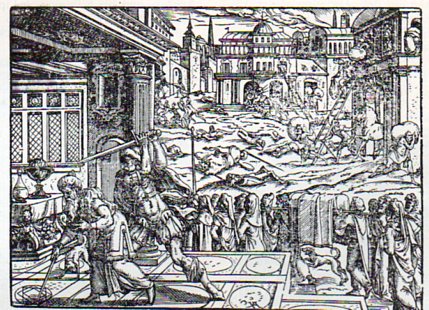
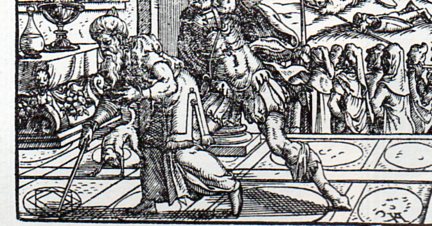
Earlier in this blog there appeared an entry on the death of Archimedes–actually, it was a piece on an image depicting the killing of the great mathematician. It is a pretty gruesome affair, even by the very early 18th century standards under which the engraving was made–gruesome still by today’s standards, what with the man’s head being cleaved laterally in two by the summoned Roman Centurion. I’m not an historian of these images of Archimedes, but I can say that for whatever I am, I have not seen anything quite so graphic dealing with the man’s death.
The usual images of Archimedes coming to his end show him working a problem in his dust/sand/earth “chalkboard”, absorbed to such an extent in his thinking that he doesn’t hear the chaos outside his rooms, and doesn’t sense the approach of the soldier who finds Archimedes unresponsive to his calls and therefore a threat, and so kills him.
[Image source: Titus Livius, Romanae historiae principia, libri omnes. Printed in Frankfurt by Feyerabend, 1578.]
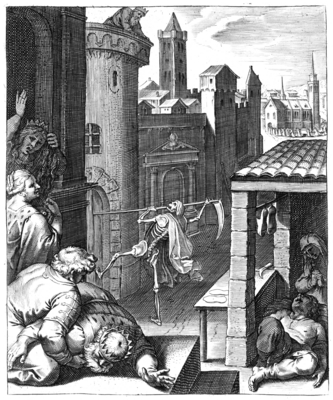
Looking at this image (above) brought to mind another in the history of anticipation–not knock knock knocking on Heaven’s door, but the opposite, and the opposite of that, the opposite of knocking on Death’s door, or at Death’s door: Death knocking at our door.
The title of this emblem–Cunctos mors una manet/death is all that remains–is meant to remind us
of our common foe. It is the work of one of the great engravers of his time, Otto van Veen (teacher of Rubens), and appears (along with next image and 100 others) in his Q. Horati Flacci emblemata. Imaginibus in acs incisis notisque illustrata, printed in Amsterdam in 1607 by H. Verduss.
–All images and most translations courtesy of the splendid work at The Emblem Project/Utrecht, here.–
Part of the legend (which appeared in four languages) of the image leaves us with the following reminders, choice bits on the folly of forgetting our common end:
La terre embrasse tout comme mere commune –Mother Earth embraces us all
Moritur sutor eodem modo ac Rex.–The King died the same as the shoemaker
Death is the thing that sucks the rivers of lives, “Del rico al pobre, del soldado al Papa”, From rich to poor, soldier of the Pope.
and so in image and word telling us that death will seek us out, whether king or shoemaker, rich or poor–and that in the coming end the Earth will take us all. Archimedes didn’t hear that one coming; nor did he care, I think.
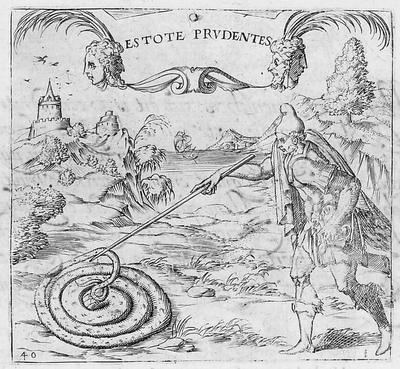
THis last image brings to mind Archimedes’ work in the dust, though the intent of teh emblem (“Estote prudentes” //Be ye therefore wise // Be Cautious) wouold have been completely lost on him.
The legend translates (Thanks to the Emblem Project for this):
When the serpent sees that it is going to be attacked with, Lethal wound, it protects its head with artful care. Here lie the dwellings of the soul, the sanctuary of the truth. Hence comes life that is to be hoped for by every body.
Surely Archimedes could relate to his lines and the expressions of his thought as the dwellings of his soul (if he actually believed in a soul), though I guess you could say that the artful deception of the serpent’s head finally wound up killing him via the Roman soldier.
Letali serpens cùm se videt esse petendum Vulnere, sollicita contegit arte caput. Hîc animæ sedes positæ, verique recessus: (here placed the seat of the soul, in artful covering…) Hinc spiranda omni corpore vita venit
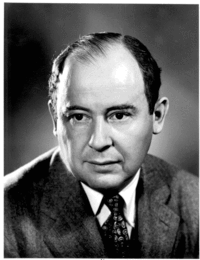
John von Neumann contributed a major piece of prescient thinking in the 1949 volume of Proceedings/Computation Seminar, December 1949, assembled by Cutherbert Hurd of the IBM Applied Science Department. [The entire contents of the volume is available here.] Von Neumann (1903-1957)–perhaps the most advanced mind of the 20th century, a man whose work made the other advanced minds say “how did he do that?”–was a staggering polymath who made contributions in many fields, not the least of which was in the creation of the modern computer. His one-page contribution to this volume was a deep insight into the possibilities of the machine. In 1949. Check out this terrific piece by the great Claude Shannon, “John von Neumann’s Contributions to Automata Theory” here.
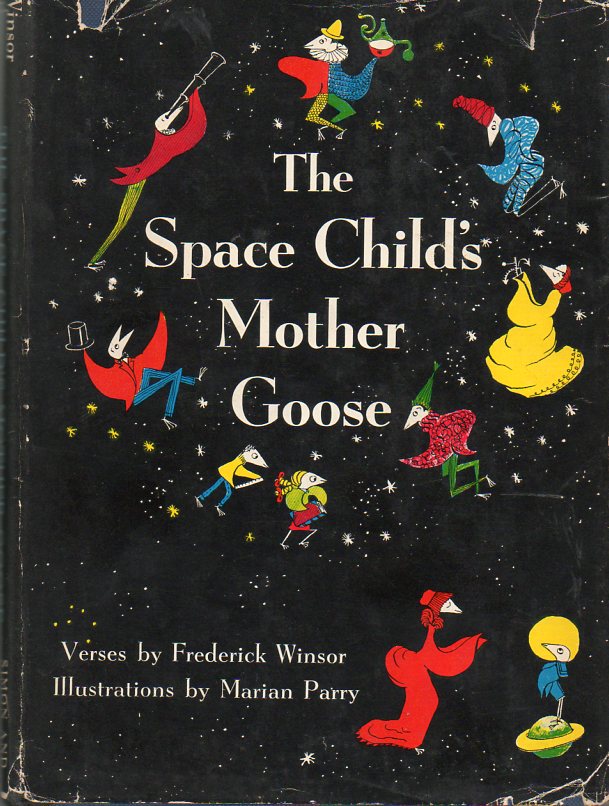
The history of Mother Goose–but real and imagined–is a long and winding story, the blending of the old stories to more modern times almost as odd as the stories themselves. This entry is what I think is the first “Space Age” version of the tales, though mostly it concerns itself with the ideals of Mother Goose more so than the stories themselves.
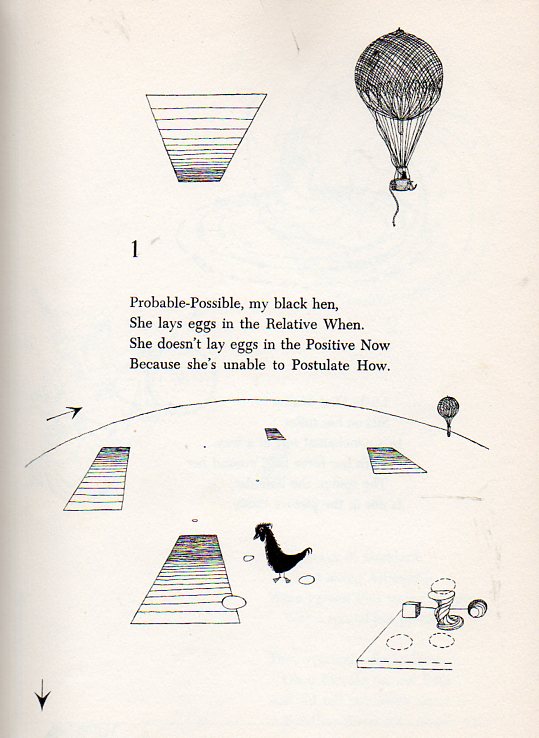
The physics-esque approach to the old idea rests in the verses of Frederick Winsor in his The Space Child’s Mother Goose, printed by Simon and Schuster in 1958, the stories helped along by some fine and tech-intricate drawings by Marian Parry. The poems are occasionally delightful as works in themselves; but when you grade the work on a curve of science poems/funny science, it gets an even higher grade. Let’s face it–there weren’t that many works in this genre in the 1950’s/’60’s, so it gets a little help just for being a friend to the lonesome in the pop-science-poem arena. (The text for the volume can be found here; and if you wanted to own it you may purchase it from our blog bookstore, here.)
Here’s an interesting lead sentence I found in 3QuarksDaily via Salon:
“Karl Marx did not know what we know: he did not know that he was Karl Marx.”
The author suggested that Marx would’ve had a better time in his life had he known what influence he wielded in what he was writing–basically, Karl Marx didn’t know that he was KARL MARX. It is an interesting–and frightening–idea to think of someone laboring like that laboring (as it were) away in relative obscurity, or at least relative to the monumental influence it would come to have.
The real question is not how many people might be in this category of not knowing who we know them to be, but if everyone is in this category at one point or another, and how long it took for them to understand the lasting significance of their work. But for right now I’m interested to know what people think of the following ten science personalities, and to answer (in a simple survey), if they knew the significance of their work.
The survey is simple and fairly straightforward, and asks questions regarding Copernicus, Harvey, Galileo, Einstein, Maxwell, Newton, Turing, Darwin, Lucretius and John Von Neumann.
You’ll have a chance to view the survey results at the end. Thanks!
A metaphorical statement is not often seen in its literal sense, graphically displayed–especially in mathematics. But I did stumble across this example in the 15 June 1885 issue of Punch, or the London Charivari. It was used to illustrate an inglorious poem on an inglorious topic that we don’t need to go into just now, but the tail-piece does exhibit the curious image of being buried by numbers.
JF Ptak Science Books Post 1575 [Part of theHistory of Lines series]
The history of lines is full and rich with symbols, some of which have absolutely nothing to do with the extension of trust and belief and hope and fear–unless you’re a young student studying math or chemistry or physics. One symbol in the maths that seems to have no exact age except to say that it is semi-ancient is the addition sign. (It will be interesting in this series on the history of lines to address the origins of other symbols like the sign for pi, division. multiplication, percent, inequality, equality and so on.)
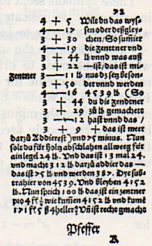
I say “semi-ancient” because the symbol for addition is a hieratic form of the Egyptian hieroglyphic, looking like a capital “A” in a way, without the horizontal crossbar. The earliest appearance of a symbol for addition in Europe was in the 13th century, with the letter “p“, appearing in various forms, as well as the word “plus”, “used in connection with the Rule of False Position”1. The concept also appears as the word itself, as “et”, or “and”, which just so happens to closely resemble the symbol that the concept would become a few centuries later. The earliest appearance of the symbol we would recognize instantly today as an addition sign came in the 1489 book by Wideman, the Behenunde und kuepsche Rechnung (seen above in detail and in full, from the 1532 edition of the work), while the first time the “+” appears in an algebraic equation for the first time 25 years later, in a work by Vander Hoecke.
It is interesting to think of the life of these symbols before they became themselves.
I am not certain of this, but it seems that the first “+” printed in the United States did not occur until the 20th edition of James Hodder’s2Arithmetic3 was printed in Boston in 1719, and this at the press of James Franklin (1697-1735), the fourth child of ten in the Franklin family that included Benjamin (1706-1790). So it is entirely possible that 13-year-old Ben helped his older brother print the first addition sign in the British Colonies.
Notes:
1. D.E. Smith, The History of Mathematics, volume II, p. 397
2. Hodder in 1672 wrote “note that a + (plus) sign doth signifie Addition, and two lines thus = Equality, or Equation, but a X thus, Multiplication,” no other symbols being used.” (Smith p395)