A Daily History of Holes, Dots, Lines, Science, History, Math, Physics, Art, the Unintentional Absurd, Architecture, Maps, Data Visualization, Blank and Missing Things, and so on. |1.6 million words, 7500 images, 4.9 million hits| Press & appearances in The Times, Le Figaro, Mensa, The Economist, The Guardian, Discovery News, Slate, Le Monde, Sci American Blogs, Le Pont, and many other places… 5000+ total posts since 2008.

Category: mathematics, logic

  • Reviewing Wells’ “The Time Machine”, June 1895, in NATURE

    JF Ptak Science Books   Post 1859
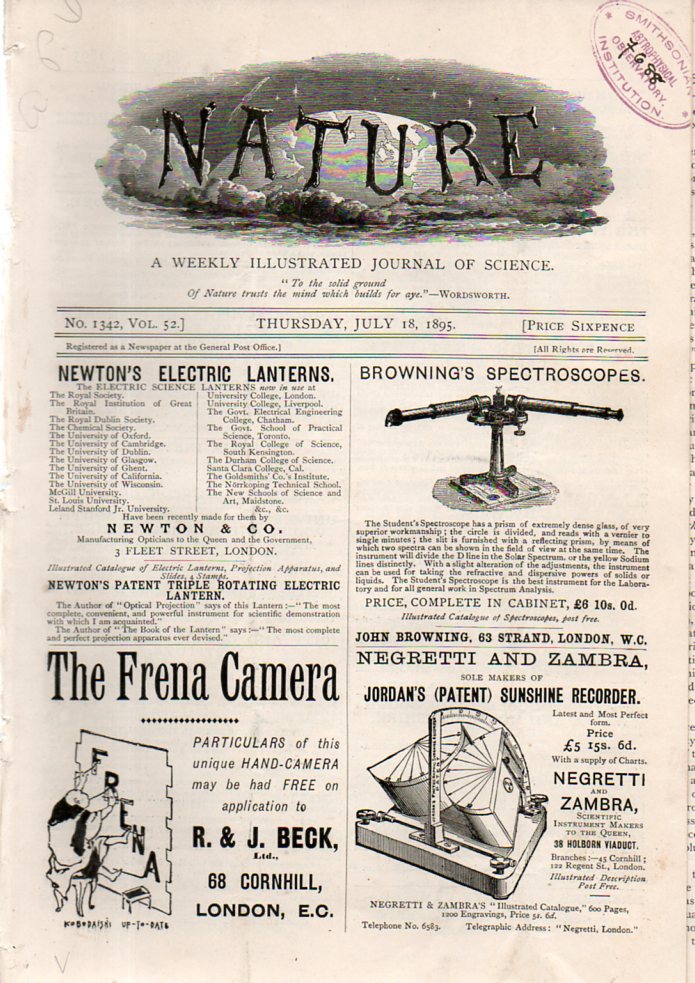
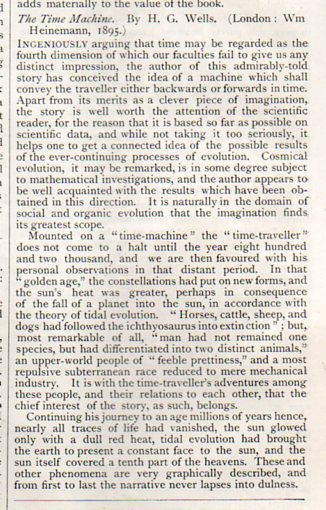
    Wells699I found this interesting 400-word bit in the 18 July 1895 issue of Nature (A Weekly Illustrated Journal of Science) and of course still very much alive and still a great publishing scientific powerhouse.  As Wells’ treatment of time as a fourth dimension was still quite speculative, and his creation of the time machine as we now came from his hands, and as its reception by some literary journals was not very cordial, it is particularly interesting to see the positive review from this science journal.  As reported by Paul J. Nahin in Time Machines, Time Travel in Physics, Metaphysics and Science Fiction (published by Springer Verlag in a second edition in 1999, a graceful book of splendid observations with an introduction by Kip Thorne, Cal Tech’s Feynman Professor of Theoretical Physics), Wells’ book was seen as “hocus pocus”  and a “fanciful and lively dream” by  The Spectator and “bizarre” by the Daily Chronicle.

    Nature’s editors says of the book:

    “…apart from its merits as a clever piece of imagination, the story is well worth the attention of the scientific reader, for the reason that it is based as far as possible on scientific data…”

    “It is naturally in he domain of social and organic evolution that the imagination finds its greatest scope.”

    “From first to last the narrative never lapses into dullness.”

    And so Wells–who had cleaned up and rewritten an earlier version of this book from 1888–received a happy review from one of the leading scientific magazines of the time. It is not because of a wide interest of Wells in the fourth dimension per se that Wells wrote the book, but rather in rattling Victorian sniffy conceits of his day. 
    Wells698
    *Time as the fourth dimension is a concept not much older than Well’s idea, one of the earliest publications of the idea appearing ten years earlier (and written anonymously by “S”) in Nature.  Charles Hinton, the person we most associate with the introduction of the fourth dimension  (or at least so on a popular level) didn’t really establish time as the fourth dimension. (Hinton led a colorful, or at least interesting life–he was a brilliant guy, and also a convicted bigamist who was married to George Boole’s daughter, and creator of an automatic baseball pitching machine. His books on the fourth dimension certainly were influential, and in the estimation of Florence was a contributor to the ideas of the coming modern art movements of the 1890-1910 period.)

    And there were certainly many who came before Wells on the subject of the fourth dimension (though not many on the subject of time as the fourth dimension):  R.C. Archibald wrote on d’Alembert’s (1754) use of time as a fourth dimension (in the Bulletin of the American Mathematical Society for May 1914); Cayley’s “Analytical Geometry of n-Dimensions (Cambridge Mathematical Journal, 1843);  Grassmann’s Die Lineale aus Dehnungslehre (1844); Riemann’s 1854 effort on curved space (translated in 1873 for Nature by W. Kingdom CLifford); Beltrami’s introduction of the pseudosphere in 1868;  J.J. Sylvester (again in Nature for 30 December 1869); Hermann von Helmholtz and his curvature for three-dimensional spaces; and Poincare’s work in 1900, among others.  There is a rich field of these efforts, beautifully investgated for the general reader by Linda Dalrmple Henderson in her classic The Fourth Dimension and Non-Euclidean Geometry in Modern Art (Princeton 1983). 

  • Daily Dose of Dr. Odd: Arithmetic of 1935

    JF Ptak Science Books   Quick Post 

    Arithmetic of 1935 is an interesting book discussing the four prinipal operations of mathematics, though it is not quite Busby Berkeley’s Gold Diggers of 1935.  It is however a very neat and orderly and in some ways exhaustive treatment of its subject, and that it does share with the brilliant choreography of Mr Berkeley. 

    I’ve touched on Mr. Berkeley’s work a couple of other times on this blog:  Bio-Mathematics in Busby Berkeley Musicals (here)  Mr. Mole, the Stationary Busby Berkeley of Mass Crowd Installation Photographs, 1918 (here).

    Daily ose arithmetic of 1935647


  • Mathematical Sticks & Unmagic

    JF Ptak Science Books  Quick Post

    Just a quick post here on patented mathematical tools using long wooden planks in a sliding frenzy to find displayable answers for 19th century schoolchildren and their addition problems.  I know a good set of Napier’s bone could come in very handy (appearing much earlier on than these instruments), but I’m just not sure what kids could learn from using these tools–like any other calculating device, early or late, they have a questionable quidity so far as appreciating the essence of numbers is concerned.   That said, the drawing for the Meyers’ machine is beautiful, and could no doubt lead to a number of short, noir-y stories.

    Source:  Google Patents, here.


  • Inventing Nothing: a Lovely Little Cipher, by Lewis Carroll

    JF Ptak Science Books      Post 1807     Part of the series   The History of Blank, Empty and Missing Things

    Carroll cipher536
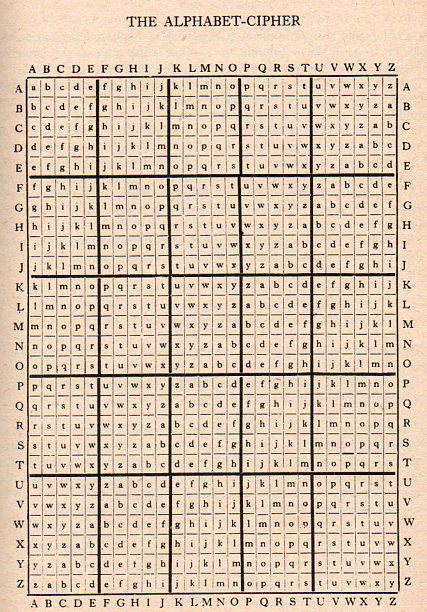
    Lewis Carroll created a lovely, simple cipher in the midst of his Alice and Snark and Logic and Sylvie publications.  It really is just a simple bit of polyalphabetic substitution, bu tit gets the job done.  (Many others have walked this royal road:  Leon Battista Alberti, A Treatise on Ciphers, [De componendis cyfris];  Giovan Battista Belaso, La cifra del Sig. Giovan Battista Bel[l]aso, gentil’huomo bresciano, nuovamente da lui medesimo ridotta à grandissima brevità et perfettione, Venetia 1553 (and also his Novi et singolari modi di cifrare de l’eccellente dottore di legge Messer Giouan Battista Bellaso nobile bresciano, Lodovico Britannico, Brescia 1555); Giombatista Della Porta, De furtivis literarum notis vulgo de ziferis, G. M. Scoto, Neapoli 1563; Galileo Galilei, Intorno a due nuove scienze, Opere, . Vol. VIII, Firenze; Blaise de Vgenere, Traicté des chiffres ou secrètes manières d’escrire, Abel l’Angelier, Paris, 1586; and so on…its a very wide literature, even pre-18th century).  Louis Carroll. Louis “Cipher” Carroll.  Comes sort of goofily close to “Louis Cipher”. Lucifer. Not the case, of course unless you were trying to figure out one of his tricky puzzles.

    Perhaps it is the cipher’s presentation and design and simplicity, its elegance, that I like so much.  It reminds me in some ways of the Henry Holiday masterpiece of nothignness created for Carroll’s Hunting of the Snark–and that of course would be the Bellman’s map, a map of nothing, a map showing nothing at all to the sailors who must follow it and who were all happy that the map had nothing to obstruct their vision of possibility and blank expectation. (I wrote about that in The Most Beautiful Map in the World, here). It is interesting to note that none of the illustrators who followed Holiday chose to illustrate the nothing map with such nothingness as in Carroll–there would be hands on it, or the map would be oblique, or not the central image of the illustration.  Holiday’s map was just that–straightforward, simple, strong).

    I’ve decided to make this a part of the History of Blank, Empty and Missing Things series simply because everything is missing unless you have the missing key–here you have all the parts of the puzzle, and then some, everything that you need to solve it, save for the integral part of ordering.

    From Carrolls’s text:

    Explanation

    Each column of this table forms a dictionary of symbols representing the alphabet: thus, in the A column, the symbol is the same as the letter represented; in the B column, A is represented by B, B by C, and so on.

    To use the table, some word or sentence should be agreed on by two correspondents. This may be called the ‘key-word’, or ‘key-sentence’, and should be carried in the memory only.

    In sending a message, write the key-word over it, letter for letter, repeating it as often as may be necessary: the letters of the key-word will indicate which column is to be used in translating each letter of the message, the symbols for which should be written underneath: then copy out the symbols only, and destroy the first paper. It will now be impossible for any one, ignorant of the key-word, to decipher the message, even with the help of the table.

    For example, let the key-word be vigilance, and the message ‘meet me on Tuesday evening at seven’, the first paper will read as follows—

    v i g i l a n c e v i g i l a n c e v i g i l a n c e v i
    m e e t m e o n t u e s d a y e v e n i n g a t s e v e n
    h m k b x e b p x p m y l l y r x i i q t o l t f g z z v
    

    The second will contain only ‘h m k b x e b p x p m y l l y r x i i q t o l t f g z z v’.

    The receiver of the message can, by the same process, retranslate it into English.

    If this table is lost, it can easily be written out from memory, by observing that the first symbol in each column is the same as the letter naming the column, and that they are continued downwards in alphabetical order. It would only be necessary to write out the particular columns required by the key-word, but such a paper would afford an adversary the means for discovering the key-word.


  • Antique Solutions of the Knight’s Tour, 1750

    JF Ptak Science Books    Quick Post

    Passing through a later and edited edition of Jacques Ozanam (RECREATIONS MATHEMATIQUES ET PHYSIQUES, Qui Contiennent Plusieurs Problemes d’Arithmetique, de Geometrie, de Musique, d’Oprique, de Gnomonique, de Cosmographie, de Mecanique, de Pyrotechnie, & de Physique. Avec un Traite des Horloges Elementaires. Nouvelle Edition, Revue, Corrigee & Augmentee… and published in Paris in 1749-1750) looking for possible expansions on what he wrote on the Knight’s Tour–a chess/math problem where the knight starting at, say, the center position must be moved to touch every square of the  board in 64 moves–I found this little diagram showing the spaces to which a knight may not move:

    It seemed just a little unusual to me–not being a reader of chess literature–to see what seemed the negative of the knight’s movements on a truncated board.  But I guess this is what we calculate and just not entirely “see” while playing. 

    The original problem in the 1672 edition of Ozanam’s Recreations  looks like this (and titled “faire parcourir au cavalier toutes les cases de l’echiquer”):

    Chess ozanam477

    in which the knight starts off life at the top right square (h8) and finishes at f3.  In the 1803 edition of the work it is pointed out that the knight can be started from any square and moved 64 times to accomplish this same feat. 

    Here are four further examples of solutions to the knight problem:

    And as they say, many more are available. 

    A more modern version of the solution, this on a 24×24 grid:

    File:Knightstour24x24.png


  • On “Pretty”, “Beautiful”, and “Elegant” Magic Squares

    JF Ptak Science Books      Post 1800

    Magic squares prob ans475

    “The name Magic Square, is given to a square divided into several other small equal squares or cells, filled up with the terms of any progression of numbers, but generally ah arithmetical one, in such a manner, that those in each band, whether horizontal, or vertical, or diagonal, shall always form the same sum.” –from  the very busy Charles Hutton’s translation of Jean Etienne Montucla‘s edition of Jacques Ozanam Récréations mathématiques et physiques (1694, 2 volumes, revised by Montucla  in 1778, 4 volumes) and the whole thing revised in an English edition of 1844 by the appropriately-names Edward Riddle, and available online at Cornell’s collection of historical mathematical monographs.

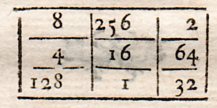
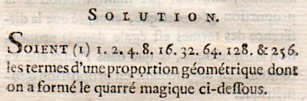
    That was sort of a simple introduction to magic squares, tortured by my note on the quote’s parentage.  Nevertheless, leafing through a copy of Ozanam’s work I found a lovely little (literally speaking, as it is about 1/2 inch by an inch) 3×3 multiplication magic square for the happy sequence of  1, 2, 4 ,8, 16, 32, 64 and 256.  (That means that each of the nine numbers may appear only once, and that the product (4096) must be the same for each column and row).  It is a nice little problem, and I was just surprised to see it in such spare simplicity.

    Magic squares prob474
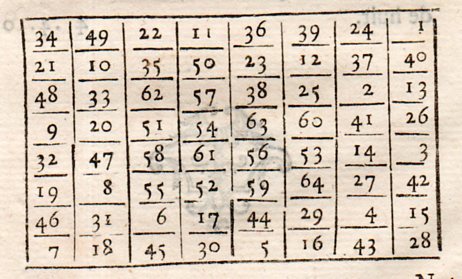
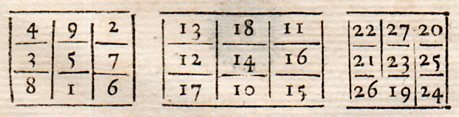
    And since we’re at it slightly, a few pages further on I found this nice series of 3×3 magic squares for numbers 1-25:

    Magic squares prob ans476
    These also are a half-inch (or less) and about two inches long…they’re just very attractive.

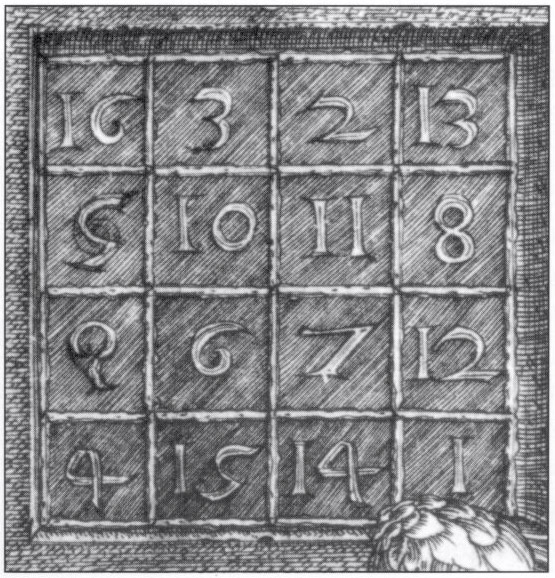
    But I guess I cannot leave the subject of “pretty” magic squares without referencing a “beautiful” one, and this being one of the earliest inclusions of a magic square in Western printmaking, and surely one of the most beautifully-encumbered one in general, from Albrecht Durer’s mega-popular masterwork, Melancholia (printed 1514).  The magic square had been around for at least 2,000 years at this point, starting up evidently in China between 650-1000 BCE before making its way west through the Arab lands and then through India, and finally into Europe around the 13/14th century, and then into art prints with Durer in 1514.

    File:Albrecht Dürer - Melencolia I (detail).jpg[Detail]

    File:Melencolia I (Durero).jpg

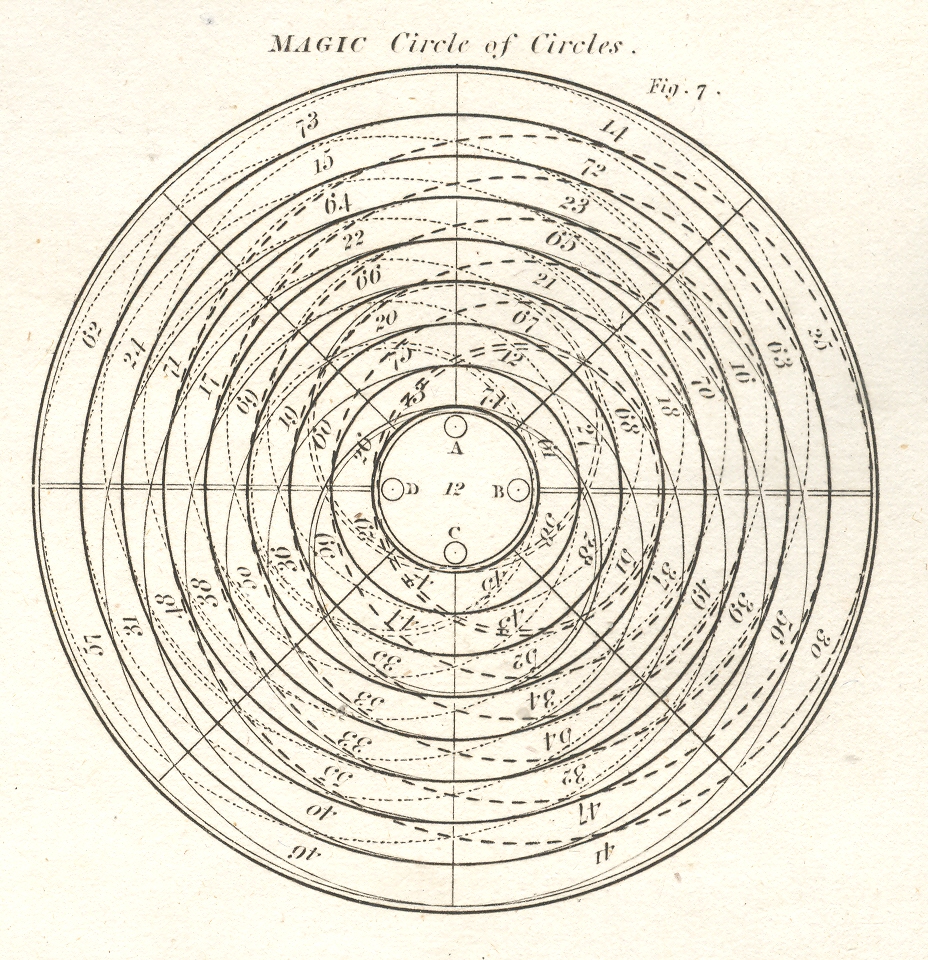
    I doubt that Abraham’s Rees’  “Magic Circle of Circles” (published ca. 1814) is “pretty”, and I’m not so sure it is “beautiful”, but I am sure that it is “elegant”.

    1--logic tree magic circle

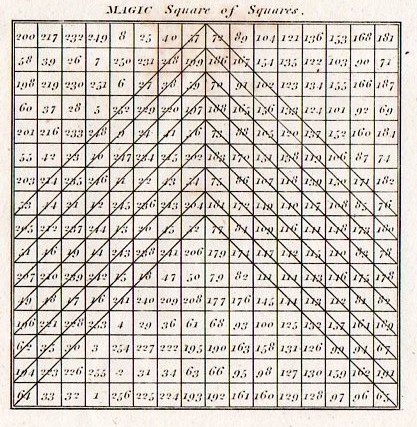
     Ditto his “Magic Square of Squares” (published ca. 1814):

    In any event these are just a few samples that I had close to the top of my head–no doubt there are endless others, but these are some that have attached themselves longest to me (with the exception of the Ozanam, which are new).

    ·Posted by :

    ·in:

    —

  • Alan Turing–Report Card Teachers’ Comments, 1926-1931

    JF Ptak Science Books   Post 1770

    Turing

    Image source:  www.thegalleryofheroes.com

    There is a terrific find on Alex Bellos’ website exhibiting Alan Turing’s “report cards” for his time at the great Sherborne School from 1926-1930 (and which were transcribed by archivist Rachel Hassall), from the time when Turing was 14 to 19 years old. Turing (1912-1954) I think needs no introduction for his importance to mathematics and computing (and code breaking during WWII), and it is very interesting—thrilling even—to see how his instructors were coming to grips with the developing genius. Even at such a school as Sherborne (a very old school with 39 headmasters overseeing the place since 1437) where the teachers were I am sure familiar with gifted pupils, The comments on the reports of Turing’s progressed showed that many weren’t quite sure about what Turing was all about. Obviously Turing as a boy was very gifted, but many instructors reported as many hindrances to his intellectual development as there were advances—more, even.

    Perhaps people at the school didn’t know exactly how to deal with him; perhaps they did, but still at the end of the day Turing had to meet the common standards of the school. Or perhaps not—I really can’t tell from the transcripts presented by Bellos and I don’t know the intricate history of the school. But certainly as time progressed Turing’s abilities were more readily recognized, but early on it seems that his talents didn’t overwhelm his many supposed shortcomings, the faults of the parts larger than the whole of what he could accomplish. In instructors’ comments across all of his disciplines, Turing was “capricious”, “untidy”, “lacking in life”, “need(ed) concentration”, “depressing unless it amuses him”, “careless”, “absent minded”, “un-methodological”, “slovenly”, (made) “mistakes as a result of hastywork”, and so on. He “could do much better” though one instructor felt that “he may fail through carelessness”. All of which may well have been true—from the outside. These statements may have simply been the result of teachers not being able to reach a boy genius, and perhaps the boy couldn’t be reached, at least early on in his academic career.

    The statements in general—especially in the maths—I think are fascinating things. It may be easy to judge some of the remarks as intemperate, the teachers unable to clearly see the genius-in-the-making who (70 years later) we can so clearly see today. I think the remarks need more careful consideration than that, and that is where they become interesting.

    Here are some selection from reports on Alan Turing, 1926-1930, below; a more full list exists at the Bellos site, here.

    Subject: Mathematics

    1926. Works well.  He is still very untidy.  He must try to improve in this respect

    1927. Very good.  He has considerable powers of reasoning and should do well if he can quicken up a little and improve his style.

    ____. A very good term’s work, but his style is dreadful and his paper always dirty.

    ____. Not very good.  He spends a good deal of time apparently in investigations in advanced mathematics to the neglect of his elementary work.  A sound ground work is essential in any subject.  His work is dirty.

    ____. Despite absence he has done a really remarkable examination (1st paper).  A mathematician I think.

    ____ I think he has been somewhat tidier, though there is still plenty of room for improvement.  A keen & able mathematician.


  • Digital “Computers” 1450-1750: Memory and Calculating on the Fingers and Hands

    JF Ptak Science Books   Post 1755


    Bloghands_memory072_2    
    These lovely images weren’t intended to show people living in the Renaissance and Baroque eras how to actually record data on their hands—they were intended rather as templates to show how they could use their fingers and hands for calculating and as memory devices.  Much like Frances Yates has shown us so beautifully in The Art of Memory and how info and data was stored in imagined and compartmented palaces in the mind (relying upon images), the hands were also used as a theatre of memory in addition to extended calculation. 

    These mnemonic devices were necessary—especially during the Renaissance—because of the general lack of and access to affordable vellums or paper and writing instruments.  Having notebooks filled with memoir or history o calculation was generally not something that was happening for even the not-wealthy but not struggling class.  These mental images were used widely in the areas of religion, palmistry, astrology mathematics, astronomy, astrology, alchemy, music, and other such fields. 
    Bloghands_big074_3
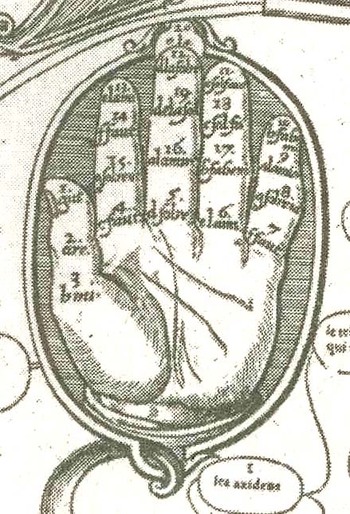
    The first image (from a German manuscript) of the hand-theatre was found and deciphered by Claire Richter Sherman (Folger Shakespeare Theatre) and is religious in nature, an intentional piece of memory for the devoted and for devotions.  The needs of religion were splayed out as the hand was opened and fingers flexed, and working from thumb to pinkie, from finger tip and joint—“do God’s will, examine  your conscience, repent, confess”, and so on, and above all be content with your lowly penitente stature.  If there were 28 of these admonitions or reminders at different points of the hand and you memorized them all, it would be a much simpler time to recall and keep them in order if you merely had to touch a part of your hand where that memory should be to invoke what it was you were supposed to do.  Therefore you could theoretically cast about with your creator with your hands in your pockets—if you had pockets. 

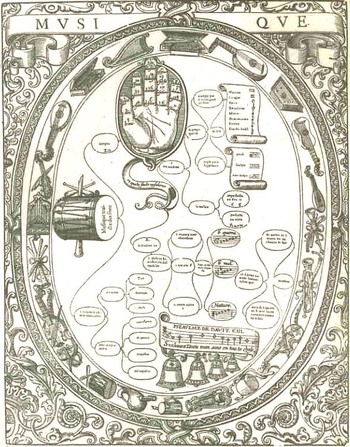
    The next two images (including the enlargement of the hand section) are from a work from 1587 entitled Musique and are attributed to John Cousin the Younger (1522-1597).
    The basic premise for this device—it seems to me—was to be able to order the different chords of 20 different instruments. 
    Bloghands070_2
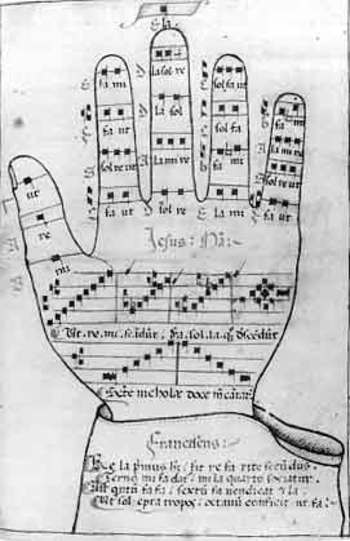
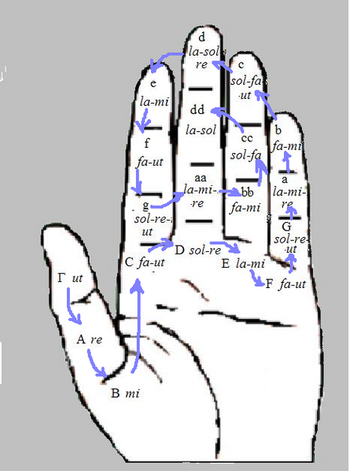
    Another musical hand mnemonic was the Guidonian hand, a survivor of Medieval times, and possibly named after Guido of Arezzo (a musical theorist), and was an aid to singers learning to sight sing.   

    The entry for the Guidonian hand in Wiki explains it use rather well:  “The idea of the Guidonian hand is that each portion of the hand represents a specific note within the hexachord system, which spans nearly three octaves from “Γ ut” (that is, “Gamma ut”) (the contraction of which is “gamut”, which can refer to the entire span) to “E la” (in other words, from the G at the bottom of the modern bass clef to the E at the top of the treble clef). In teaching, an instructor would indicate a series of notes by pointing to them on their hand, and the students would sing them. This is similar to the system of hand signals sometimes used in conjunction with solfege…”
    Bloghands_bodies071
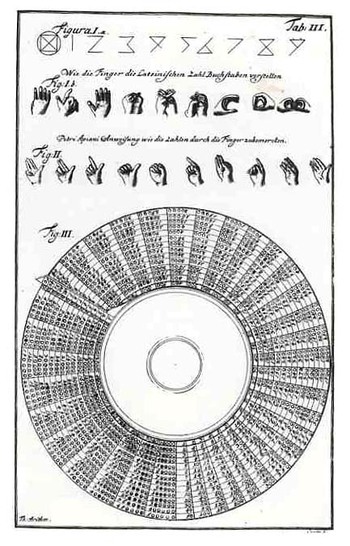
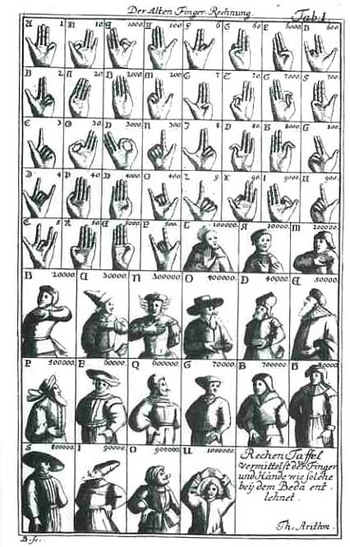
    The final two examples come from Jakob Leupold’s  (1674-1727) Theatrum Machinarum (1724)—this was a complex work involving nine sections and addressed the theoretical  aspirations of engineering (load, flexure, that sort) and its applications to its daily practitioners.  In one section of the book he sought to explain the connections (and correlations) of hand motion and symbolism to the origins of the number systems, carrying it out further still into body language, so that two people conversant in these symbols could talk and bargain between themselves in economic/body terms.  Barbara Maria Stafford, in her Artful Science, Enlightenment, Bloghand_guido

    Entertainment and the Eclipse of Visual Education (1994) points out the long history of this tradition, and that it reached far back into misty time:  Leupold knew that Appian, the Venerable Bede, and Aventinus had been fascinated by manuloquio, or natural language with the hands.  He thus linked counting to a global….medium of prearranged gestures…”

    Bloghandguido_2_2

    ·Posted by :

    ·in:

    —

  • British Science (And a Screaming Zero) in Cartoon, 1865

    JF Ptak Science Books   Post 1728

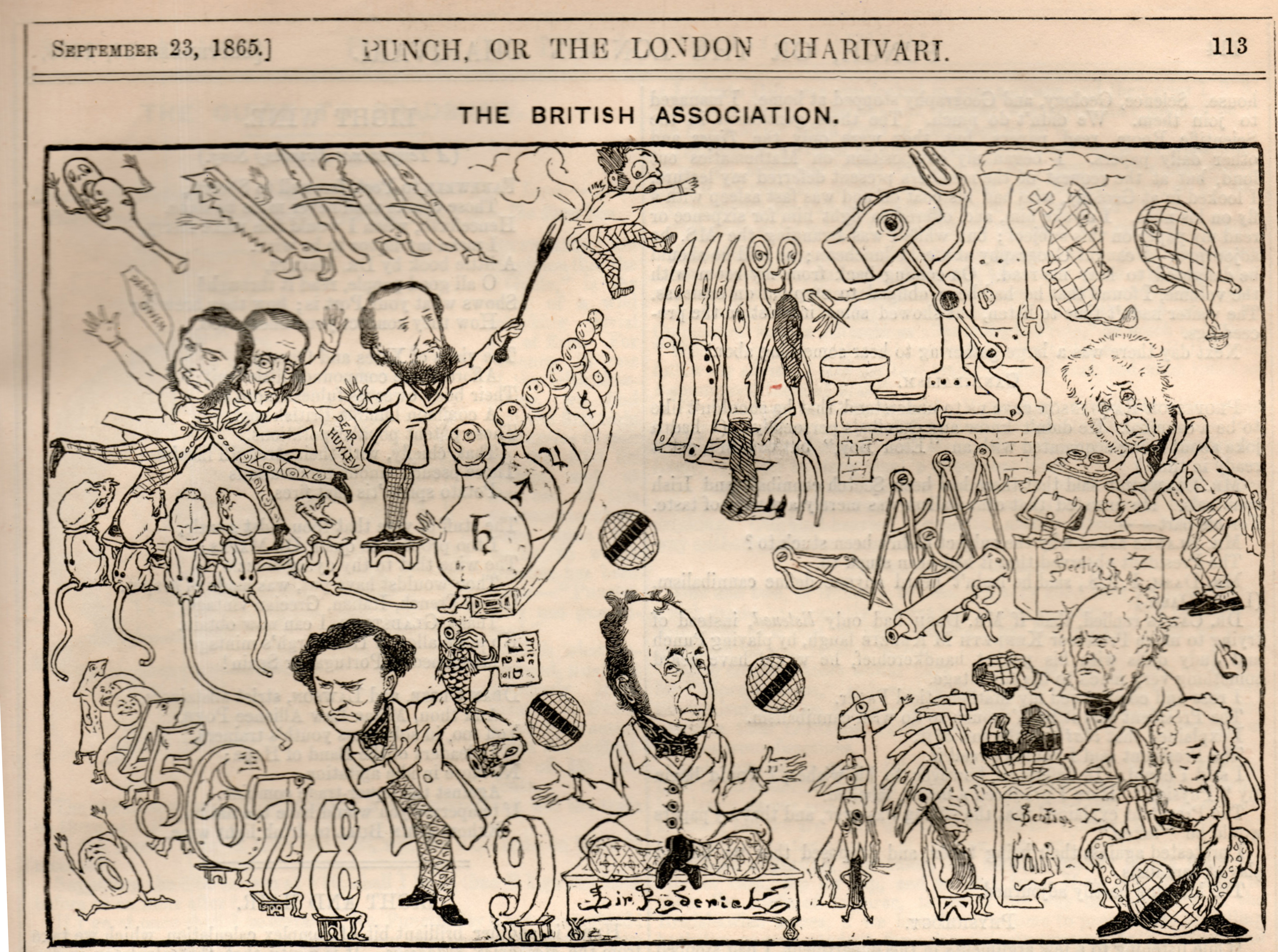
    This fine cartoon appeared in the 23 September 1865 issue (page 114) of the London Punch magazine, poking a little fun at the recent meeting of the British Association for the Advancement of Science, which had just finished its 35th meeting in Birmingham.  Its attendees and contributors read like a “who’s who” of the heights of mid-19th century British sciences (across fields of geology, physics, physiology, chemistry, mathematics, statistics (and economics)):  attending and contributing were JC Adams, Airy, Hooker, Thomas Graham, Wheatstone, Nasmyth, Fairbairn, Murchison, Lyell, Huxley, Thomson, Maxwell, Tyndall and of course numerous others (also including foreign members). 

    Baas 235
    Of the figures I can identify in this image are Thomas Huxley and the not-beautiful Richard Owen at top left, discussing the principles of evolution in front of a small audience of skeletal/fossilized monkeys, and standing to their immediate right waving an instrument over chemical elements may be JAR Newlands. I am not sure who is presiding over the numerals at bottom left, but what attracts me the most is the zero is running away, screaming, from the other numbers seated calmly on tiny stools.  Seated serenely at center juggling earth/spheres in the geologist Roderick Murchison, who appears prominently in the Punch report–I’m less sure about the two other geologists (one placing the Earth-chunk back into the globe, and the other placing a short-handled shovel into another globe, both in front of an audience of geologist’s hammers…are they Charles Lyell and John Phillips?)  Above them may be John Tyndall, working with an optical viewer in front of an audience of dividers and a telescope.  And above the maybe-Tyndall is a steam hammer demonstrating itself to a set of jackknives and cutlery. 

    Punch baas233_edited-1
    The text is pretty interesting in itself, not the least of which is another visit to the squaring of the circle (having just written about this two days ago), which goes like this:

    “A few words on Squaring a Beadle who was arguing in a vicious circle.  Illustrated pugilistically. (A portmanteau to itself, including gloves and change of linen.”

    I should be able to idenbtify these men though I’m afraid I can’t; perhaps I’ll have a little help with them. 

    Notes (including the contents of the volume published in 1866 of this Birmingham 1865 meeting):

    ·Posted by :

    ·in:


  • Is this the Only use of the word “Rabdologia” in the History of Advertising?

    JF Ptak Science Books   Post 1710

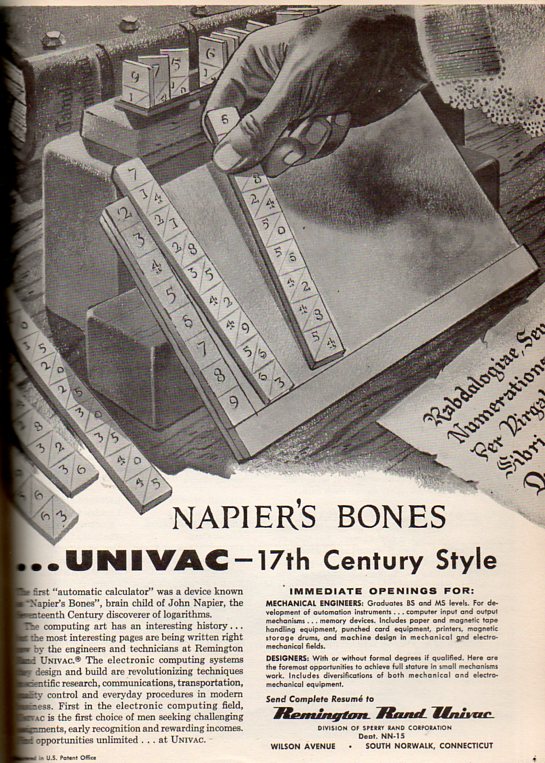
    Well, probably. The ad is by UNIVAC—fives years old at this point—and the lace-cuffed image pushing the virtues of the world’s first commercial computer is that of John Napier‘s abacus, which he wrote about in 1617. The ivory calculating bones/rods method had been seen before in the history of the maths and calculation, but not published, and the idea employed in the elegant calculating device were very old, but Napier seems to have gotten to publish it first. (His work on logarithms is of tremendous importance, far more so than the abacus.)

    Computer ad rabdol159

    The word “rabdologia” belongs to the title of Napier’s significant book (where the title is the abstract): Rabdologia, or, The art of numbring by rods : whereby the tedious operations of multiplication, and division, and of extraction of roots, both square and cubick, are avoided, being for the most part performed by addition and subtraction : with many examples for the practice of the same …

    And I just want to say that since this ad was UNIVAC and it appeared in the November 1956 issue of the early computer journal, Computers and Automation, that the illustration got the “bones” correct. That is, the calculated product is correct.

    The way these rods worked is as follows: in the illustration, the number rod on the extreme left (ranging from 2 to 9) is the multiplier; and the numbers at the top of the other rods represented the multiplicand. So we see that the lace-cuff is multiplying the number “76” (at the top of the two rods to the right) by, say, 7. Simply start writing the answer as follows: take the “2” from the 6 rod for your ending number; then add the numbers on the diagonal directly to the left of the two (4+9=13) and take the 3 and place it next to the two in the tens column, and carry the 1 to the next function, which would be 4+1=5. So the answer: 532.  The bones could do more than this, of course, but for right now I’d just like to point out that the ad folks got this right–plus its nice to see a bunch of numbers used in public display that actually mean something.  [See the Wolfram site for a nice explanation of how the bones work.)

    John Napier’s work in logarithms (published three years earlier in 1614) is the work for all time; the Rabdologia however would have been instantly appreciated by people like his father, who was master of the mint of Scotland. That said, I’ve read here and there that Napier considered his most significant published work to be his  A Plaine Discovery of the Whole Revelation of St. John (1593), in which he practiced a theo-chronometry based in the Book of Revelation that among other things in its 300-pages  predicted that the world would come to an end in 1688. Or 1700.  He evidently considered himself a Theologian first and foremost, and what bothered him most was Pope Clement VIII, who he considered to tbe the anti-Christ–and so complications arose.  Win two, lose one. 

     [I’ve just uploaded Tompkin’s classic/first textbook on the digital computer (High Speed Computing), 1950, to the books for sale section of this blog, here.]