JF Ptak Science Books Post 1800
“The name Magic Square, is given to a square divided into several other small equal squares or cells, filled up with the terms of any progression of numbers, but generally ah arithmetical one, in such a manner, that those in each band, whether horizontal, or vertical, or diagonal, shall always form the same sum.” –from the very busy Charles Hutton’s translation of Jean Etienne Montucla‘s edition of Jacques Ozanam Récréations mathématiques et physiques (1694, 2 volumes, revised by Montucla in 1778, 4 volumes) and the whole thing revised in an English edition of 1844 by the appropriately-names Edward Riddle, and available online at Cornell’s collection of historical mathematical monographs.
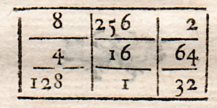
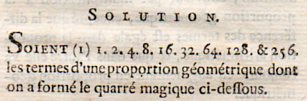
That was sort of a simple introduction to magic squares, tortured by my note on the quote’s parentage. Nevertheless, leafing through a copy of Ozanam’s work I found a lovely little (literally speaking, as it is about 1/2 inch by an inch) 3×3 multiplication magic square for the happy sequence of 1, 2, 4 ,8, 16, 32, 64 and 256. (That means that each of the nine numbers may appear only once, and that the product (4096) must be the same for each column and row). It is a nice little problem, and I was just surprised to see it in such spare simplicity.
And since we’re at it slightly, a few pages further on I found this nice series of 3×3 magic squares for numbers 1-25:
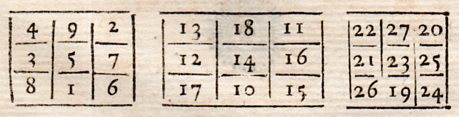
These also are a half-inch (or less) and about two inches long…they’re just very attractive.
But I guess I cannot leave the subject of “pretty” magic squares without referencing a “beautiful” one, and this being one of the earliest inclusions of a magic square in Western printmaking, and surely one of the most beautifully-encumbered one in general, from Albrecht Durer’s mega-popular masterwork, Melancholia (printed 1514). The magic square had been around for at least 2,000 years at this point, starting up evidently in China between 650-1000 BCE before making its way west through the Arab lands and then through India, and finally into Europe around the 13/14th century, and then into art prints with Durer in 1514.
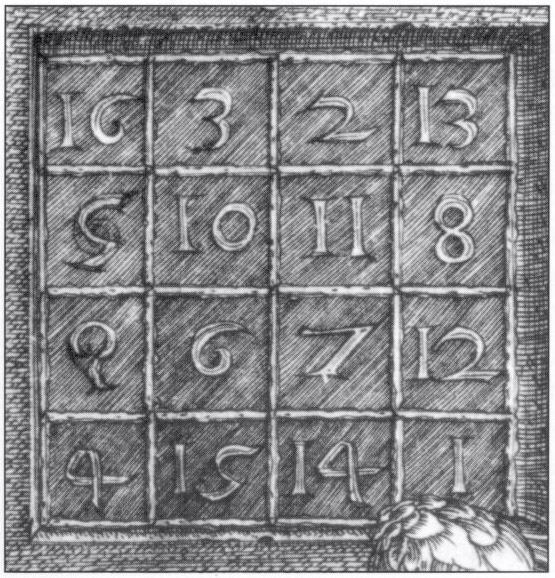 [Detail]

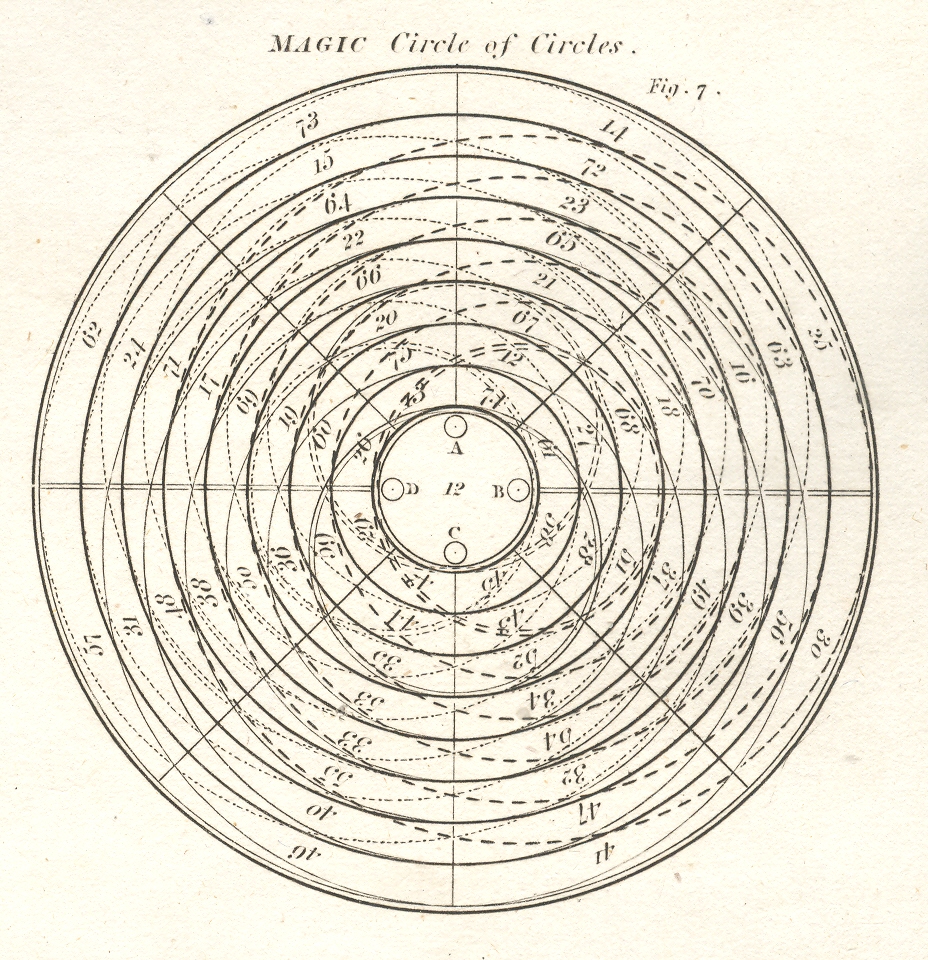
I doubt that Abraham’s Rees’ “Magic Circle of Circles” (published ca. 1814) is “pretty”, and I’m not so sure it is “beautiful”, but I am sure that it is “elegant”.
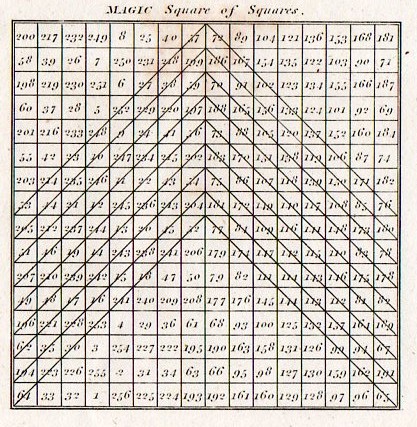
Ditto his “Magic Square of Squares” (published ca. 1814):

In any event these are just a few samples that I had close to the top of my head–no doubt there are endless others, but these are some that have attached themselves longest to me (with the exception of the Ozanam, which are new).