A Daily History of Holes, Dots, Lines, Science, History, Math, Physics, Art, the Unintentional Absurd, Architecture, Maps, Data Visualization, Blank and Missing Things, and so on. |1.6 million words, 7500 images, 4.9 million hits| Press & appearances in The Times, Le Figaro, Mensa, The Economist, The Guardian, Discovery News, Slate, Le Monde, Sci American Blogs, Le Pont, and many other places… 5000+ total posts since 2008.

Category: mathematics, logic

  • Are there More People than Knots? Finding the Structure of Matter in Smoke Rings

    JF Ptak Science Books   Post 1541 (Part of the Series Blank, Empty & Missing Things.)

    Embedding a circle in 3-D Euclidean space is another way of looking at a simple and substantial elements of human activities.  Knots have played a large role in human history over a long period of time–not just for connecting things, or determining speed, but also in design, the appearance of, say, objects that would later be known as  Borronean rings that appear in Tibetan Buddhism (endless knots as keys to infinity) to the Celtic knots (decorating, say, the Book of Kells).

    Gauss did very early work (1)-as is so often the case– on knot theory, as did William Thomson, Lord Kelvin,who visualized atoms as knots in the aether and who was perhaps inspired by P.G. Tait’s experiments on smoke rings (2)  and who in turn had been influenced by  a paper of Hermann von  Helmholtz on vortex-rings in incompressible fluids, and organized the  stability of chemistry around this pricnipal.  In turn  P.G. Tait based his very solid work on knot theory in 1867 on this work of Kelvin and von Helmholtz. .(Kelvin’s theory (3) was rather well received for several decades until it was not, but it did enjoy the support for a time by J.C. Maxwell.  Kelvin was a brilliant man who I think is too often remembered for some of the few hundreds of the millions of words that he wrote and lectured, not the least of which were his pronouncements at the every end of the 19th century on the impossibility of heavier-than-air flight.)   Tait–who also co-authored a very well respected textbook on Natural Philosophy with Kelvin–moved on to firmly establish knot theory and on the elements that makes knots different, formulating tables on how knots form, and in essence believing that he was fabricating a table of the elements. All of this work suffered a fatal blow when the great Michelson-Morely experiment (1887) (4) failed to detect the luminiferous aether. 
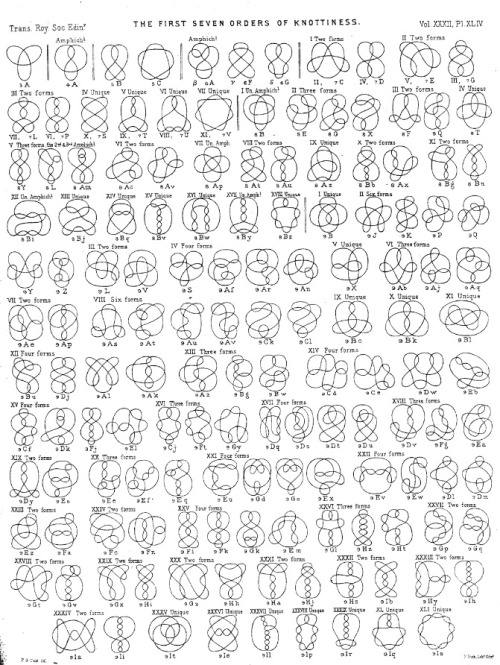
     betonbabe:  P. G. TAIT THE FIRST SEVEN ORDERS OF KNOTTINESS, 1884 … super nerdy blog post #01

    • [The first page of how knots come to be as they appeared in P.G. Tait’s earliest work, though he by necessity kept the investigations to  relatively minimal degree: “We find that it becomes a mere question of skilled labour to draw all the possible knots having any assigned number of crossings. The requisite labour increases with extreme rapidity as the number of crossings is increased. … I have not been able to find time to carry out this process further than the knots with seven crossings. … It is greatly desired that someone, with the requisite leisure, should try to extend this list…”]

    This was the beginning of the tabulation of knots, found in Tait’s beautiful work.  To date some 7 billion tabulations have been identified, a number nearly equal to the of the world’s population. Knot theory has taken shape as an area of study within the field of topology, which was developed in the 1850’s through the 1870’sby Riemann/Listing/Mobius/Klein and then which received its algebraic foundation by Henri Poincare (5) just af ew years after Michelson-Morely and in the same year as Roentgen’s x-ray, 1895.

    Notes

    1.  The Gauss linking integral,1833, carried forward by Johann Benedict Listing.

    2. An interesting modern recreation of the Tait smoke ring experiment can be seen here. See malso: Silliman, Robert H., William Thomson: Smoke Rings and Nineteenth-Century Atomism, Isis, Vol. 54, No. 4. (Dec., 1963), pp. 461–47

    3.  Lord Kelvin, Sir William Thomson, “On Vortex Atoms”, Proceedings of the Royal Society of Edinburgh, Vol. VI, 1867, pp. 94-105. Reprinted in Phil. Mag. Vol. XXXIV, 1867, pp. 15-24.
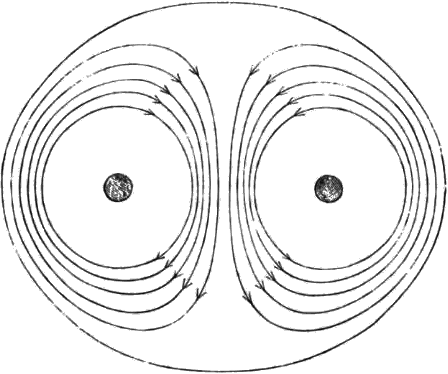
    Cross section illustration of vortex around a ring

    –It was also Kelvin (along with A.A. Michelson) who spoke on the finiteness of physics, with Kelvin in particular stating at a British Association for the Advancement of Science meeting in 1900 that there would be nothing new in physics, and that all that was left was measurement.  I seem to remember a story about one of Einstein’s uncle’s (?) warning him against going into physics because there was nothing left new to do…I can’t remember if this was before or after Roentgen.  In any event, Kelvin’s statement was five years after Roentgen, but it didn’t stop him from making his claim. 

    4. On the Michelson-Morely experiment.

    5.  H.Poincaré, “Analysis Situs”, J. Ec. Polytech ser 2, vol 1 (1895) 1-123.

    –The Journal of Knot Theory and Its Ramifications was founded in 1992, establishing a journal devoted purely to knot theory.
  • A Note on Teaching Math, Unexpected Art, and Picturing Things Differently

    JF Ptak Science Books   Post  1427

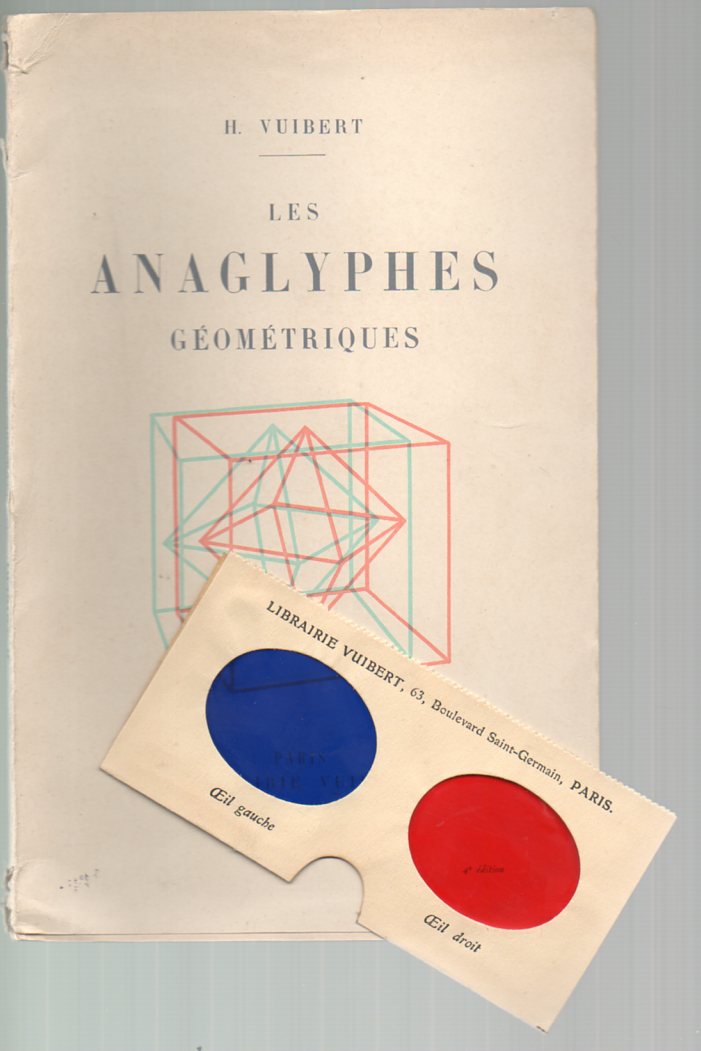
    Vuibert308 Stereo viewing geometrical figures may or may not be useful–I find it a little off-putting, creating a slight dizzying effect, though I’m sure it helps others (particularly children?) see complex geometrical figures a little more easily., especially when it comes to crystalography images. Education was certainly what Henry Vuibert , the author of Les Anaglyphes Geometriques had in mind when he published the work in 1912.  He had a long history in mathematics education, having founded the firm that bears his name back in 1877, a publishing house specializing in school texts in the maths, physics and general sciences.  (We offer the book for purchase at out blog bookstore.)

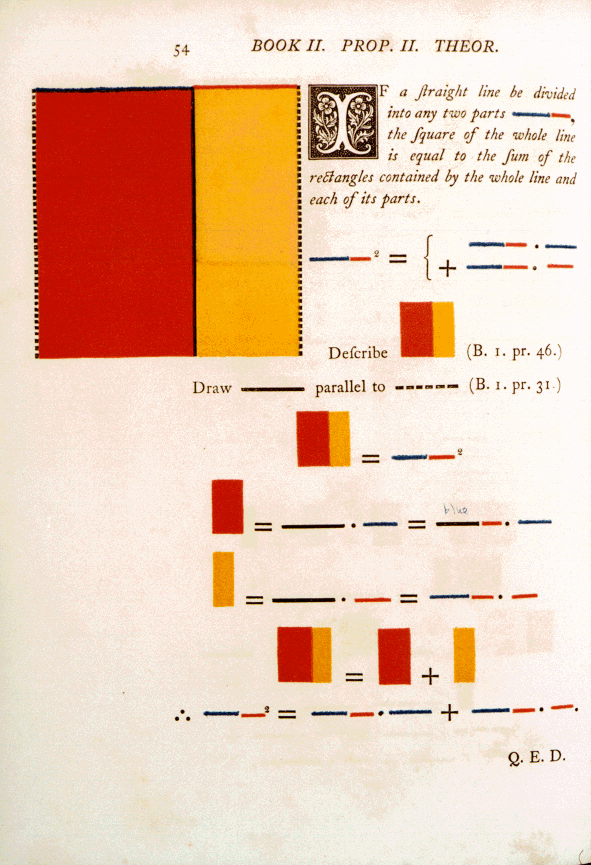
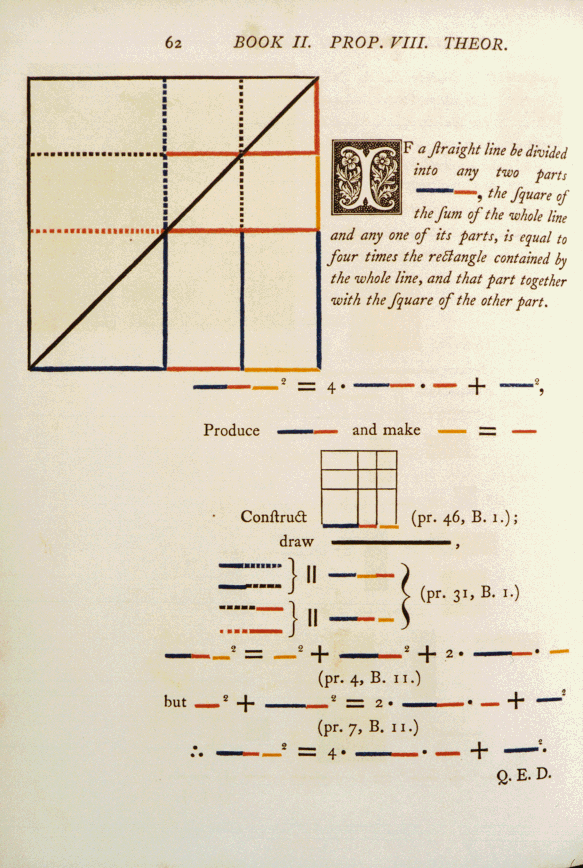
    Vuibert’s book is a very early example of the use of the anaglyphe–examples of the use of the method go back to the 1850’s, when d’Almeida used a version of the idea to punctuate lectures using a magic lantern; the (printing) process of the anaglyphe wasn’t patented until the 1890’s by L.D. DuHaron.  It does confuse me or remind me quite a bit of Oliver Byrne’s beautiful monster The First Six Books of Euclid in which coloured diagrams and symbols are used instead of letters for the greater ease of readers… printed at the Chiswick Press by C. Whittingham for William Pickering in 1847.  The book is, well, unusual and probably not at all usefu11.  Bryne replaced all of the algebraic notation, identifying letters and almost all of the descriptive text with color and color codes, leaving Euclid mysterious, hidden, awkward, impervious, and, yes, beautiful2. As a matter of opinion this work presages the cubists (and especially Piet Mondrian) by 60 years, and all by accident artwork. 

    Byrnes 11.8


    There are certainly much earlier works that tried to get at a fuller representation of geometrical objects, not the least of which was a 16th century Elements of Euclid in which the figures were cut-out paper, pasted into the book and attached to a string so that the reader could pull out the illustration and see it displayed in three dimensions. The elements of geometrie of the most auncient philosopher Euclide of Megara. Faithfully (now first translated into the Englishe toung…3, printed in London in 1570, was no doubt a great and exasperating labor of love, a complex “pop-up” book accomplished with sixteenth century technology.  (The photo below shows the Smithsonian Institution’s copy.)

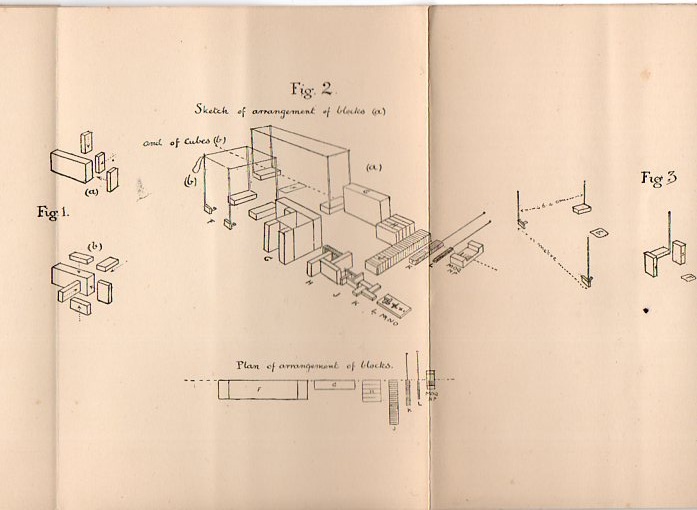
    Of course there’s the very old fashioned way of representing mathematical concepts, and that’s with sticks and stones and blocks and such.  For visceral memory and practical applications, the idea is hard to beat, unless of course, you really beat it , which is difficult to do.  But to me that’s just what Major G. Mackinlay did in his Realistic Arithmetic,  for Teaching Children the Elements of Arithmetic by Means of Special Blocks4, published in London in 1900–his ideas for the use of blocks was very sound and stable; his instructions (and in particular his illustrations) for what to do with the blocks was not.  I am reminded of inscrutable, badly translated and designed instructional manuals for tech stuff that need a manual for the manual. 

    Here’s one of the folding plates describing how to assemble the blocks:

    Math blockis309

    Then there are other sorts of wooden (and etc.) three-dimensional models, such as the (600+) gorgeous geometric designs housed in the Institute Henri Poincare, transferred there from the laboratory of geometry of the Faculty of Sciences of the University of Paris in 19285.  Most of these models were constructed around the time of vast change in mathematics and art (1900-1920), which means that many of them predate the revolutionary ascensions of  Cubism and non-representational art.

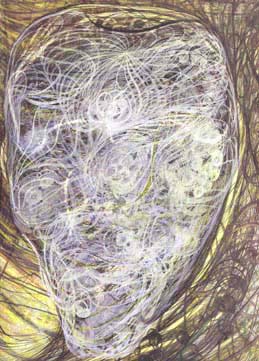
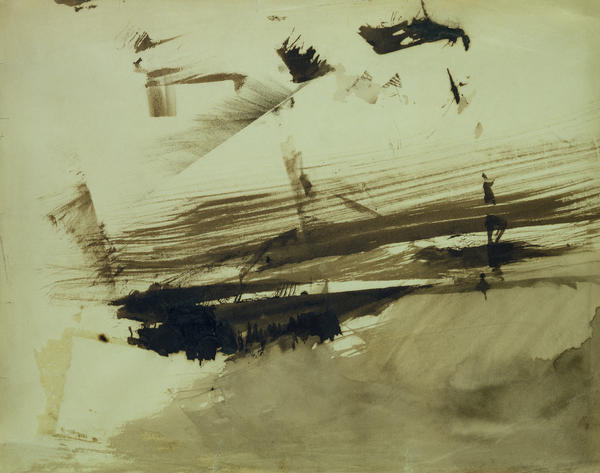
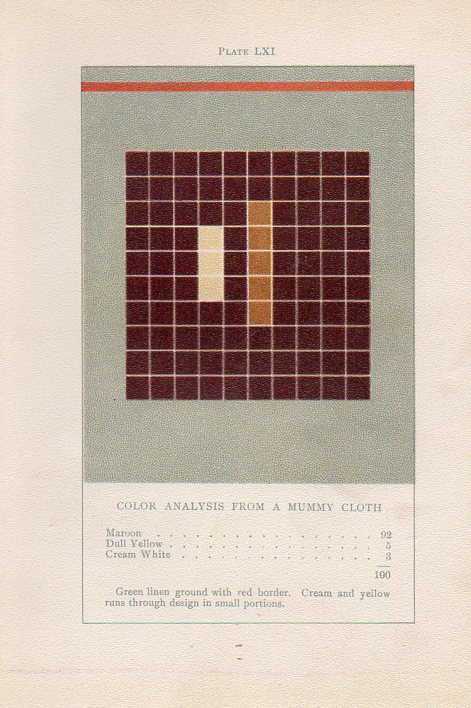
    And as long as were at the point of unintentional and under-recogniozed epochal works, I think that there is a broad book that could be done on exactly this topic, calling into play such examples as Georgina Houghton, Victor Higo, Emily Vanderpoel, and many others. 

    Georgina Houghton, for example, produced this non-representational painting in 1870 (or thereabouts):

    Georgiana

     And Victor Hugo, from the 1860’s

    Evocation of an island Painting  - Evocation of an island Fine Art Print

    And Emily Vanderpoel (1900 or so):

    Art-vanderpoel186
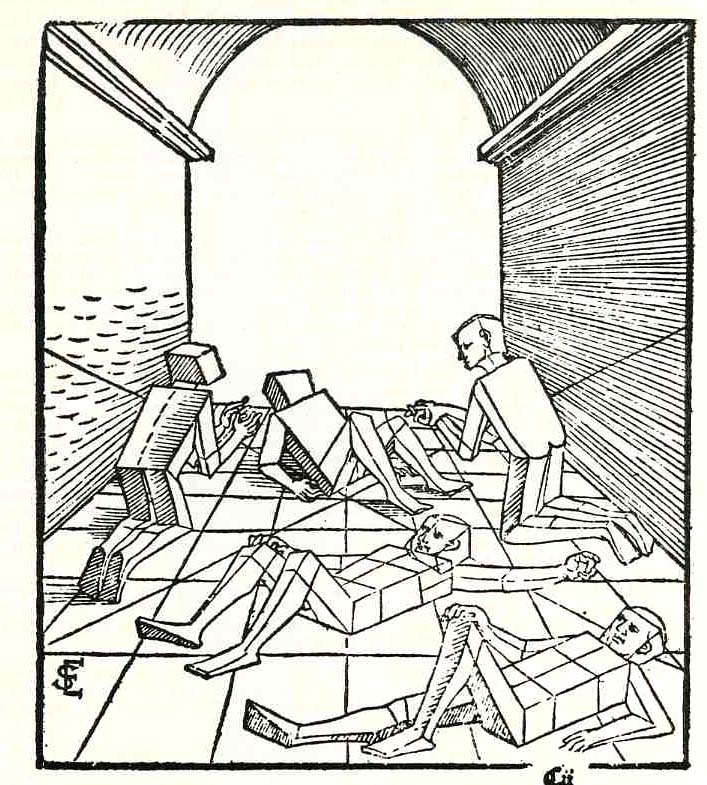
    In another, much earlier case of removing detail and adding abstraction for the sake of simplicity in representing an idea,  Erhard Schoen, in his Unnderweissung der proportzion und stellung der posssen liegent und dtehent, printed in Nurenberg  in 1538, presented these cubed figures (below).  He used simplified geometric form to stand in for the curvy humans, replacing them with proportional stacks of boxes which would more easily explain to the younger reader how to represent the human body in space and in proportion to other things. 

    Schoen

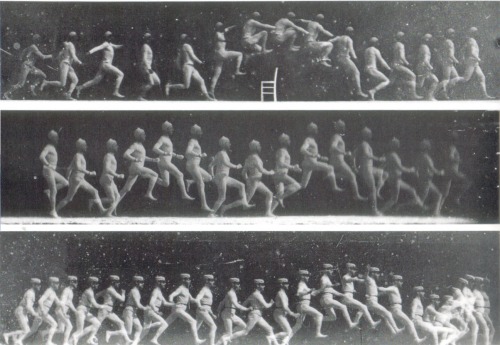
    I think that these were monumentally combative images showing humans in a radical, previously unknown way, much like the moving-through-space-and-time photographs of the somewhat forgotten Etienne Marey, who in the 1870’s created what was essentially the world’s first “slow motion” device. One iteration of Marey’s apparatus was basically a long series of ganged cameras recording a motion for a Marey12 simple task at a given time frame and presented on a continuous strip of photographic paper, sort of like a motion picture with the camera speed set at three frames per second. The resulting images were phenomenal and showed people for the first time the exactness of all manners of simple motions–motions that no longer looked so “simple” once all of its aspects could be studied from captured photographic evidence.  Even the act of hopping over a small stool or bending to pick up a bucket of water were enormously revealing in a way like Robert Hooke’s Micrographia displayed the great detail and complexity of the seemingly simple fly.  Perhaps the most famous of Marey’s series of images was that of a galloping horse, which also for the first time revealed what exactly the horse’s legs were doing and proving that almost every painter in the history of art represented the galloping horse incorrectly.  His series of photographs (as in this sample below) show a fairly close fit to the work of the futurists (like for example Duchamp) who would come into being after another four decades. 

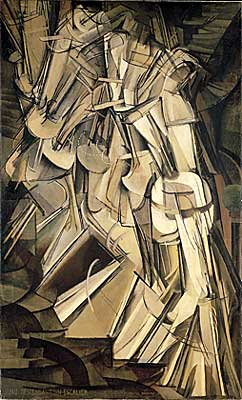
    Marey  And Duchamp’s Nude Descending (1912):

    Duchamp


    I do want to make it clear that this is just a simple note, a thinking-out-loud piece on how attempts to visualize things differently for the sake of explanation or education can come “unintentionally” close to what would become epochal works.  More later.

    Notes

    1. Augustus De Morgan, mathematician and logician, wrote a very highly critical book A Budget of Paradoxes in which he describes hubbub, fakirs, frauds, perpetual motion machines, squaring the circle efforts, millstones and other useless books in the maths, and in here he sniffily dismisses Byrne’s work. At best, to De Morgan, the Byrne book is “curious”. But useless and curious, as I have seen many thousands of times, does not mean that it can’t be attractive and beautiful, and the Byrne book is probably the leading candidate in the Bad & Beautiful category.

    2. In his Victorian Book Design McLean calls the Byrne book “…one of the oddest and most beautiful books of the whole century…a decided complication of Euclid, but a triumph for Charles Whittingham [the printer]”.

    3.  This is also the first appearance of Euclid in English.  The full title: The Elements of geometrie of the most auncient philosopher Euclide of Megara faithfully (now first) translated into the Englishe toung by H. Billingsley, citizen of London; whereunto are annexed certaine scholies, annotations, and inventions, of the best mathematiciens, both of time past and in this our age; with a very fruitfull praeface made by M.I. Dee, specifying the chief mathematicall scieces, what they are, and whereunto commodious; where, also are disclosed certaine new secrets mathematicall and mechanicall, untill these our daies, greatly missed. London, Imprinted by I. Daye, 1570.

    4.  From the Report of the Annual Meeting of the British Association for the Advancement of Science, 1906:


    5.  From the IHP website:  “Most of the models  were created by Martin Schilling in Leipzig between 1900 and 1920 and  a few of them  (in wood)  were made between 1912 and 1915 by J. Caron, Professor of Descriptive Geometry in charge of  the “graphic work” course at the ENS at the beginning of the century (between 1912 and 1915).”

    Also this:   “In the thirties, the surrealists, led by Max Ernst, were interested in these geometric objects. André Breton alludes to them in  “Crise de l’objet” , an article  in the magazine  Cahiers d’Art (May 1936, No. 1-2, p. 21-26.). Man Ray took photographs of the models, which where published in same issue. He would later use them to compose what he called  “Shakespearean Equations”. Many artists, painters, architects and sculptors drew inspiration from them.”


  • The Alpha and Omega of Computer Questions; Asimov, 1953 and 1955

    JF PTak Science Books  Post 1375

    Asimiv question087
     

    Following up on yesterday’s post on the world’s first (popularly-published) computer magazine (Computers and Automation)  is this Isaac Asimov short story on what might be the first great computer question.  The story in mind, “Question”, appeared in the March 1955 issue of this same magazine, a two-pager sandwiched between an ad for Remington Rand UNIVAC and an article on computers and weather prediction.  It is the first appearance too of Asimov’s massive computer of the future, Multivac, a giant machine with corridors and nooks where technicians could stop and have a seat to enjoy a cup of coffee.  And it seemed to at least one worker that it wasn’t quite right to be sitting inside the machine, that the billion-tube, two billion relay computer was more than just a flow of electrons. (The ENIAC, which was basically the world’s first computer, had 20,000+ tubes, so a billion as  conceived by Asimov would’ve been a very big machine indeed, a 500,000-ENIACs-sized behemoth.) And a very hot one.   The workers wondered if you could ever tell if the machine was alive, if it thought on its own, if it attacked aparat from its instructions and programs. 

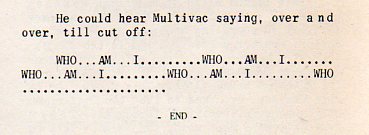
    As it turns out, the answer was positive, and not only that, but Multivac could speak.  Its answer to “the question” was “who…am…I…?”, repeated several times in the closing sentence of this rocket-fast short story.  I guess that that would give you pause, as it would anyone had the question come to them from their own computer while communicating along the spine of the great global “mind”, the Internet, and perhaps someday it will, at some time in the near-ish future when the height of our own computer-y heights looks as quaint to them as a half-million ENIAC idea of 1955’s premier scifi writer looks to us today.

    I know almost nothing about Asimov, but he seems to return to this idea of the Big Computer, Multivac, and ultimate question a few years later.  It seems as though there was an issue of serendipity involve with the structure of the “Question” story and that of another writer’s ending for a story called “Problem for Emmy” by Robert Sherman Townes. Asimov admitted the similarities but also maintained that he didn’t know of Townes and had never read his story–be that as it may, Asimov promised that he would never reprint the story, and it seems as though he never did.  But it looks as though he resurrected his idea somewhat, which is fine, because the whole idea of ultimate/penultimate questions and massive computers is a great genre. 

    Asimov wrote a story called “The Last Question” in 1956, a year later, writing about a trillion years of human history in the space of another terrifically-short short story, the short story that Asimov found to be his own favorite.  If “Question” posted the ultimate question put to the super-colossal Multivac computer,  ultimate question in “The Last Question” may well then be the ultimate answer.  You’ll have to see the ending of the story for yourself to see what it was–I can’t spoil it. 

    Notes:

    1.  I’m just a little surprised that Asimov was hung up on tubes in 1953–transistors had been in the air by 1947/8, published in 1948, and pretty-published by 1952.  I figure he should’ve been aware of them and how they would transform computer construction.  Maybe not. Perhaps he just wanted to write about a billion-tube computer. “Multivac ” stands for “muliple vacuum tubes”, and then “multiple vacuum tubes analog computer”, so using transistors might be a little at cross-odds with the name and the idea of the machine.  It woulod be interesting to put together a list of questions/answers of these early fictional machines, a longlist of which appears here.

    2. The two characters in the story by the way are named “Alexander Adell and Bertram Lupov”, both of which suggest the name Alexander Graham Bell to my head.


  • The World’s First Popularly-Published Computer Journal

    JF Ptak Science Books   Post 1374

    Computer history082

    Nothing quite gives you the taste for the ancient history of a very modern topic–like computers–than by looking through some of the earliest popular publications on the subject. This can actually be done pretty quickly if you wanted to just get a broad taste for the subject in its modern infancy–just reading the titles of the papers and taking in the advertisements might be enough. So here’s two volumes of a very scarce and interesting journal by old Edmund Berkeley that may do this job perfectly.  Berkeley was a bona fide mover and shaker in the early days of electronic computing in the United States–he had a lot on his mind, contributed many written words and ideas, and also tried to make a fair living while doing so (there was a bit of Sideshow Ed in him for some of the things he tried to sell.  

    Computers and Automation, the brainchild of the brainy not-child Edmund Berkeley, was the first popularly-published  magazine published regarding the computer, its applications, it programming, and really just about everything else.  (It appeared seven years after the Mathematical Tables and Aids to Computation  was published in 1943, almost entirely to the mathematics and engineering communities.) Computers was published by Edmund Berkeley & Associates in NYC beginning in 1952., beginning its publishing journey as The Computing Machinery Field, its name changing to Computers and Automation in February 1953 (in volume 2, number 2).   All issues have some fair space devoted to advertising, even though the issues generally ran between 32 and 40pp. Berkeley was a real-enough mathematician, engineer and computer pioneer, but he also had a pretty large taste for making these interests pay–which was essential, as the original print runs were not very large, though his advertisers were impressive. (According to the first issue, approximately 1200 people were on the mailing list for the journal, with around 2000 issues being printed each number. All told, this is not a large print run, and thus not many of the early issues have survived.)  He was not averse to being somewhat outre with his journal—in addition to having contributors like Grace Hopper and Alton Householder, he also had Fletcher Pratt and Isaac Asimov writing some pretty arresting pieces from the SciFi/Futurama point of view.

    Computer history083

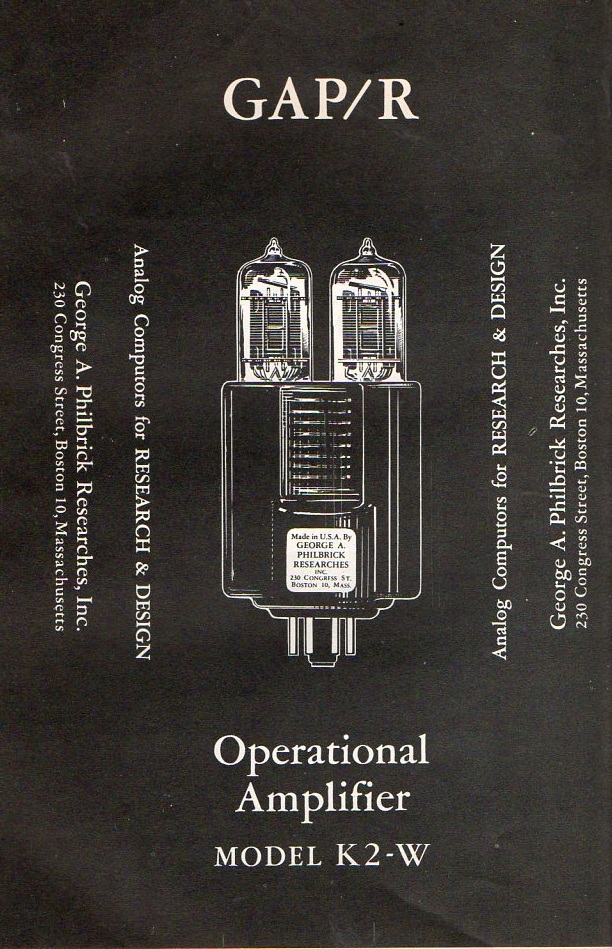
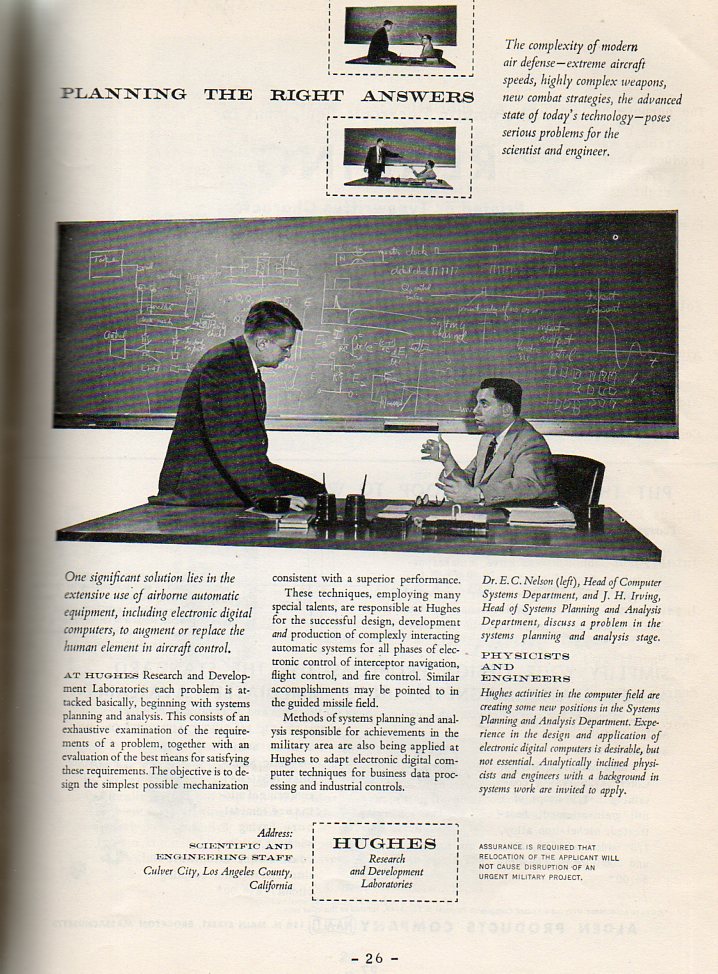
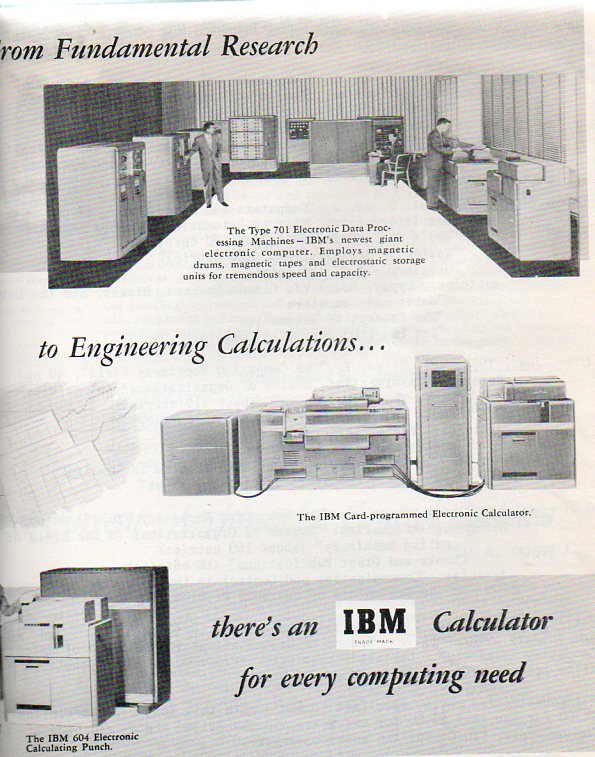
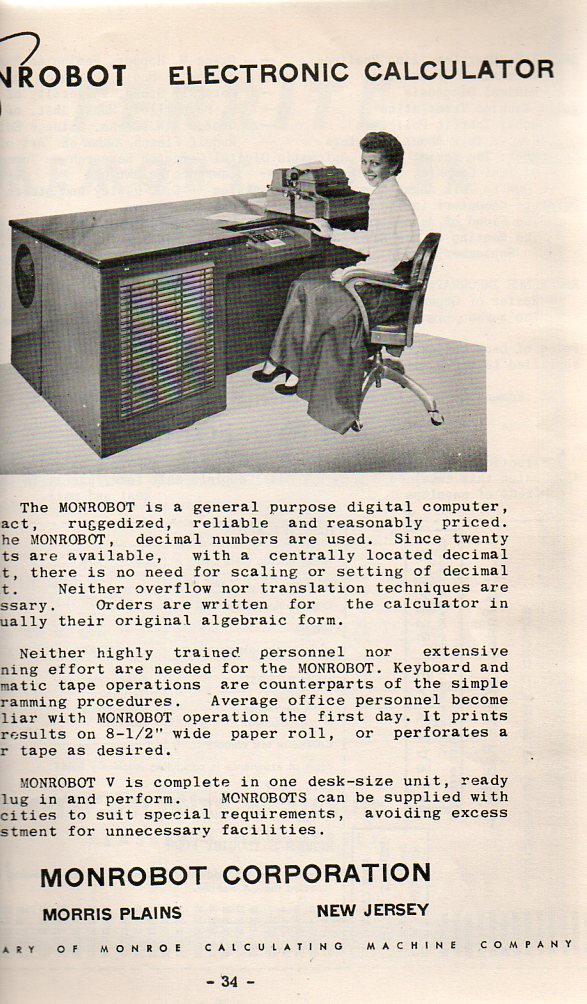
    A Note on the Advertisements: in short, they’re wonderful. For example, on the back cover of vol2/1 is Edmund Berkeley & Associates “SMALL ROBOTS”, advertising “Simon, the Mechanical Brains”, “Squee, the Robot Squirrel”, and other gadgets. To give you an example the other ads in this issue alone are for “The Circle Computer”, “General Ceramics Ferramic Cores”, “Magnetic Metals Co. Amplifier Cores”, Ross Ashby’s “Design for a Brain”, Consolidated Engineering’s SADIC System, Monroe Calculator’s Monrobot Electronic Calculator, George Philbrick’s “Computor (sic) products”, and a lovely two-page spread for Remington Rand. Further into the year are ads for Burroughs, IBM (604 ands 607), Electronic Associates Inc, Prokar capacitors, and many others.

    Some of the subjects include: The ERA 1103 computer, NIMWIT, Applications of the Computer, what the computer *is*, Admiral Grace Murray Hopper’s compiler, mechanical translation, Harper’s subroutines, the cost of coding, computer “self-repair”, automation at Ford, and so on.  Also includes perhaps the earliest announcement of the first all-transistor computer (October 1954, IBM’s “new experimental transistorized computer” , the earliest (?) printing of Asimov’s Three Laws of Robotics in a scientific journal, and more.

    Computer history086

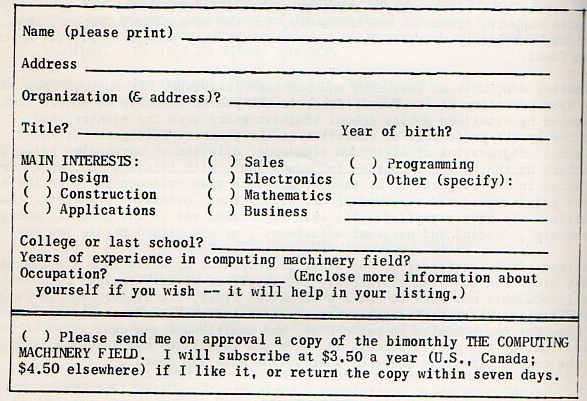
    Each section generally has three of the following categories (per issue) : computer glossary, roster of member organizations, who’s who, an annotated books and journals section, and other aligned concerns.  For example, there’s this bit, an application (cut-out) card for “Who’s Who in the Computing Field for December 1952”–utterly simple, it seems as though anyone who filled out the card was in, the “who’s who” part of this that we normally celebrate with fame or achievement really was just telling the rest of the people in the field who was exactly who.

    Computer history084

    The contents:

    Volume 2/1, January 1953. 45pp.

    Householder, A.S. Brains, Electronic and Otherwise; Williams, S.B. (President, ACM) What Computers Do; Murphy, E.F. and E.C. Berkeley. Automatic Computers on Election Night.

    Volume 2/2 , March 1953. 37pp.

    Boehm, George A.W. Gypsy, Model VI, Claude Shannon, Nimwit and the Mouse; Paynter, Henry. Water and Computers; and the editor Berkeley, The Concept of Automation, and Berkeley (with Neil Macdonald, Berkeley’s other name). The ERA 1003 Automatic Computer

    Volume 2/3, April 1953. 40pp.

    Fletcher Pratt, The Art of Solving Secret Ciphers and the Digital Computer; Berkeley, Avenues for Future Development in Computing Machinery;  Gene Hegedus, Hungarian Prelude to Automation..

    Volume 2/4. May 1953. 33pp.

    Grace Murray Hopper,  Compiling Routines; A.D. Booth, Mechanical Translation; Marshall Stone,  Medical Diagnosis.

    Volume 2/5. July 1953.

    Yehosuha Bar-Hillel (the great logician),  Machine Translation; George Boehm, Robot Traffic Policemen; Rudolf Flesch,  How to Talk to Computers.

    Volume 2/6. September 1953.

    Tommaso Fortuna,  The Soviet Union: Automatic Digital Computer Research.; Wainwright, Lawrence Wainwright,  Digital Computer Questionnaire; and a general DISCUSSION: “How to Talk About Computers”, with GG Hawley, Samuel Scharff, C.B. Crumb, and EC Berkeley.

    Volume 2/7. October 1953. 36pp.

    Brown, David W. Brown Computers in the Factory; Neil (Berkeley) Macdonald,  The Flood of Automatic Computers. 

    Volume 2/8. November 1953. 40pp.

    John W.Carr  III. Who Will Man the New Digital Computers?; E.F. Cooley,  Electronic Equipment Applied to Periodic Billing; Glenn.Hagen,  Air-Floating: a New Principle in Magnetic Recording of Information.

    Volume 2/9 December 1953. 36pp.

    Clippinger, Richard Clippinger, How a Central Computing Laboratory can Help Industry; R.T. Wiseman, “Combined” Operations in a Life Insurance Company instead of “fractured operations”.

    These are the contents for 1953; the volume for 1954 bulks up a little, but is still under an inch thick.   The MTAC journal stays quite slender throughout its pre-1960 life (it has virtually no advertisement and is entirely academic), and there are more and more computer articles appearing in old stand-by associated journals like the Proceedings of the Institute of  Radio Engineers (which by 1959 will published a massive supplemental volume called “the Computer Issue” which I’ll talk about soon.  For the time being, I just wanted to make an inroad into this journal–I’ll expand on he articles in just a bit. 

    Computer history085


  • An Elementary and Perhaps Useful Cheat Sheet for Names of Big Numbers

    JF Ptak Science Books

    I thought to include this little cheat sheet for the names of large numbers—I didn’t know the name for some big number, and had to go and find it. Here’s a bunch that I cobbled quickly together to serve as a recipe should you ever need a big-number-name and not know it.  I’ve only used the modern American and British versions of these names, and I’ve avoided numbers that just won’t work for me here (as I’m just looking for simple stuff) like

    10^{10^{10^{10^{10^{1.1}}}}} (~ googolplex1,941,887,670,000), (years),  which is the “scale of an estimated Poincaré recurrence time for the quantum state of a hypothetical box containing a black hole with the estimated mass of the entire universe, observable or not, assuming a certain inflationary model with an inflation whose mass is 10−6 Planck masses.”  so says University of Albert physicist Donald Page, quantum cosmologist and Stephen Hawking co-author. 
    A googol is already a big number at 1×10100; a googolplex is terrifically larger, being 10googol,  or. 10(10100).

    I’ve left out almost everything, actually, including the beautiful numbers from ancient India, including the sublimely-named “untold” as exactly 1010*2122  appearing in Bodhisattva‘s maths in the Avataṃsaka Sūtra..

    Hindu theology incorporates spectacular leaps of time, numbers which jump geometrically, reaching ever greater heights, describing a small part of a small bit of teh beginning of the Cycle of Brahma.  (See far below.)

    I’ll save the suspense—the largest number identified here is 1×10^3003, which is a millinillion, and it looks like this:
    100.000.000.000.000.000.000.000.000.000.000.000.00 0.000.000.000.000.000.000.000.000.000.000.000.000. 000.000.000.000.000.000.000.000.000.000.000.000.00 0.000.000.000.000.000.000.000.000.000.000.000.000. 000.000.000.000.000.000.000.000.000.000.000.000.00 0.000.000.000.000.000.000.000.000.000.000.000.000. 000.000.000.000.000.000.000.000.000.000.000.000.00 0.000.000.000.000.000.000.000.000.000.000.000.000. 000.000.000.000.000.000.000.000.000.000.000.000.00 0.000.000.000.000.000.000.000.000.000.000.000.000. 000.000.000.000.000.000.000.000.000.000.000.000.00 0.000.000.000.000.000.000.000.000.000.000.000.000. 000.000.000.000.000.000.000.000.000.000.000.000.00 0.000.000.000.000.000.000.000.000.000.000.000.000. 000.000.000.000.000.000.000.000.000.000.000.000.00 0.000.000.000.000.000.000.000.000.000.000.000.000. 000.000.000.000.000.000.000.000.000.000.000.000.00 0.000.000.000.000.000.000.000.000.000.000.000.000. 000.000.000.000.000.000.000.000.000.000.000.000.00 0.000.000.000.000.000.000.000.000.000.000.000.000. 000.000.000.000.000.000.000.000.000.000.000.000.00 0.000.000.000.000.000.000.000.000.000.000.000.000. 000.000.000.000.000.000.000.000.000.000.000.000.00 0.000.000.000.000.000.000.000.000.000.000.000.000. 000.000.000.000.000.000.000.000.000.000.000.000.00 0.000.000.000.000.000.000.000.000.000.000.000.000. 000.000.000.000.000.000.000.000.000.000.000.000.00 0.000.000.000.000.000.000.000.000.000.000.000.000. 000.000.000.000.000.000.000.000.000.000.000.000.00 0.000.000.000.000.000.000.000.000.000.000.000.000. 000.000.000.000.000.000.000.000.000.000.000.000.00 0.000.000.000.000.000.000.000.000.000.000.000.000. 000.000.000.000.000.000.000.000.000.000.000.000.00 0.000.000.000.000.000.000.000.000.000.000.000.000. 000.000.000.000.000.000.000.000.000.000.000.000.00 0.000.000.000.000.000.000.000.000.000.000.000.000. 000.000.000.000.000.000.000.000.000.000.000.000.00 0.000.000.000.000.000.000.000.000.000.000.000.000. 000.000.000.000.000.000.000.000.000.000.000.000.00 0.000.000.000.000.000.000.000.000.000.000.000.000. 000.000.000.000.000.000.000.000.000.000.000.000.00 0.000.000.000.000.000.000.000.000.000.000.000.000. 000.000.000.000.000.000.000.000.000.000.000.000.00 0.000.000.000.000.000.000.000.000.000.000.000.000. 000.000.000.000.000.000.000.000.000.000.000.000.00 0.000.000.000.000.000.000.000.000.000.000.000.000. 000.000.000.000.000.000.000.000.000.000.000.000.00 0.000.000.000.000.000.000.000.000.000.000.000.000.

    000.000

     And the rest (I’m sorry to say that one cannot make columns in typepad posts):

    106 Million

    109 Billion

    1012 Trillion

    1015 Quadrillion

    1018 Quintillion

    1021 Sextillion

    1024 Septillion

    1027 Octillion

    1030 Nonillion

    1033 Decillion

    1036 Undecillion


    ·Posted by :

    ·in:


  • An X-Ray of Cubism? Jouffret and Visualizing the Fourth Dimension, 1903 and 1906.

    JF Ptak Science Books   Post 1361

    Is this an X-Ray of Cubism?

    Jouffret

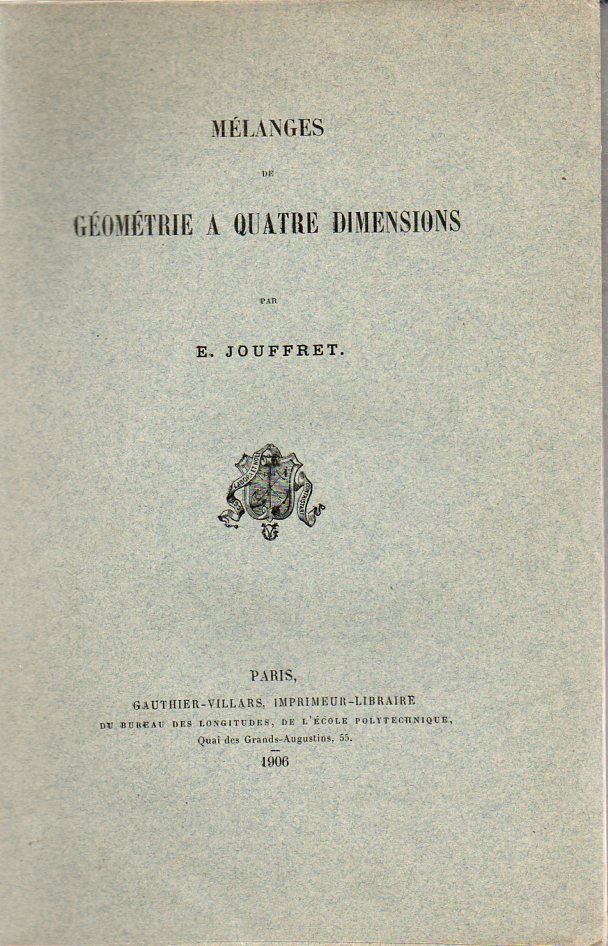
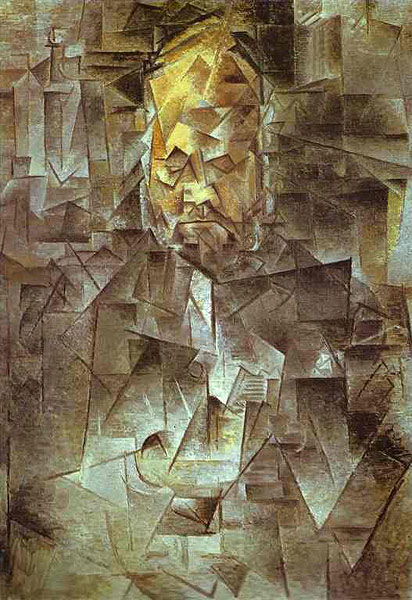
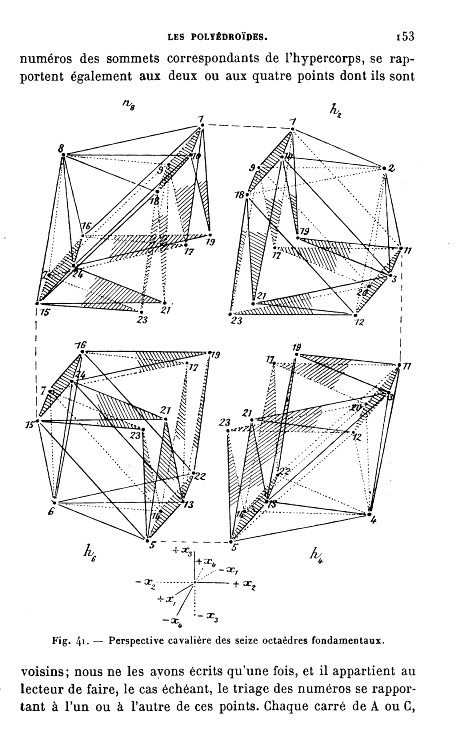
    Emile Jouffret brought an amazing and lovely pair of books to the mathematical dining table, both coming at about the mid-point of a period of perhaps the most sweeping multidisciplinary revolutions in human history.  Published in 19031 and 19062 [and both originals available at our blog bookstore] they both may have had an impact as a visualization tool for the newest movement in art since the creation of Impressionism (1850’s-1870’s): Braque and Picasso’s  Cubism. When you compare the illustrations in the Jouffret books you cannot help but to see a connection to the work of (the morally-lonely) Picasso (and especially in his 1910 portrait of the movement-molding art dealer Ambroise Vollard, below). Georges Braque and the that the two would make in 1906, the first year of the Cubist movement. 

    Jouffret’s 1903 book was hardly the first on the topic, though it may be the first of the major, book-length treatments of the topic, as well as the most  heavily illustrated.  Thinking on the fourth dimension goes back as far as Kant, at least, and the real work begins in the first half of the 19th century.

    The first major3 work arrives with Hermann Grassmann’s “Die Lineale Ausdehnungdlehre” (Theory of Linear Extensions) in 1844 (and the subsequent translations of the work as well as original work by Arthur Cayley); followed by Ludwig Shclafli (1814-1895) “Theorie der vier flachen….” (Theory of Continuous Manifolds, 1852 but not published until 1906), Riemann’s 1854 speech (which was not published until 1867 and which appeared translated by William Kingdom Clifford in Nature in 1873, G.F. Rodwells “On Space of Four Dimensions” (Nature, May 1873),  Dodgson/Carroll‘s  Through the Looking Glass (1872) deep references, Zollner “On Space of Four Dimensions” 

    Jouffret499

    (April 1878 and subsequent publications, and who is referenced in Kandinsky’s [difficult -to-me On the Spiritual in Art of 1912), W.I. Stringham (1847-1909) “Regular Figures in n-Dimensional Space” (American Journal of Mathematics, 1880), and E.A. Hamilton Gordon, “Fourth Dimension”, April 1887, to name some of the major figures.  And then of course comes Edwin Abbott’s Flatland, a Romance of Many Dimensions, by a Square (1884) and Charles Howard Hinton, who published a number of different works beginning in 1880 (“What is the Fourth Dimension?”, 1880 plus Scientific Romances 1884, and The Fourth Dimension, 1904) and lasting through the turn of the century.  There is also H.G. Wells, whose The Time Machine began to appear in parts as early as  1894, though it did appear in the same issue of the  Science Schools Journal as the Hamilton Gordon article, in April 1887, as the “Chronic Argonauts”). Wells’ also approaches the fourth dimension in “The Plattner Story”, in 1896 and The Invisible Man in 1897. Other literary contemporaries of Wells who used the fourth dimension in their work include Oscar Wilde (“The Canterville Ghost”, 1891), George Macdonald (Lilith, 1895), and Joseph Conrad and Ford Maddox Hueffer The Inheritors, (1901)–the most convincing and scientific of all of these literary efforts though lies with Wells. From about this point on–from the time that Jouffret enters the scene in 1903–the fourth dimension has become part of the culture, and a popular culture at that…especially after the Cubists begin their assault on visual representation in about  1906.

    The Jouffret books are beautiful, and very interesting–they would have been better served with a bibliography, which would have been very nice to have–that said, Jouffret does have a fair number of footnotes to earlier work, so it is not as though his work is without attribution.  But it is a very interesting adventure. (Just a note–the fourth dimension and non-Euclidean geometries would get their first bibliography in D.M.Y. Sommerville’s classic  Bibliography of Non-Euclidean Geometry in 1911, which is a must-have for all of those interested in this topic…it is massively packed with all manner of major and minor works as well as obscuriana.  It is not, unfortunately, annotated.)

    1. Jouffret, E.  Traite Elementaire de Geometrie a Quartre Dimensions et Introduction a la Geometrie a n-Dimensions. 

    2.  Jouffret. Melanges de Geometrie a Quatre Dimensions.  Paris, Gauthier-Villars, 1906.  220pp.

    3. Most of the data in this long and winding sentence has been culled from Linda Dalrymple Henderson’s terrific The Fourth Dimension and Non-Euclidean Geometry in Modern Art, Princeton, 1983–most of my references come from the first 45 pages or so of her book, which is the Bible of all modern works on the fourth dimension/math/physics/art.

    Picasso_vollard1910


  • The Guts of Mathematics, Archimedes’ Dog, and the Greaseless Anatomy of Machines

     JF Ptak Science Books  Post 1326

    “…with his blood he confused the lines of his art”—On the death of Archimedes, in Valerius Maximus

    “….Bark, bark bark!”–Archimedes’ dog

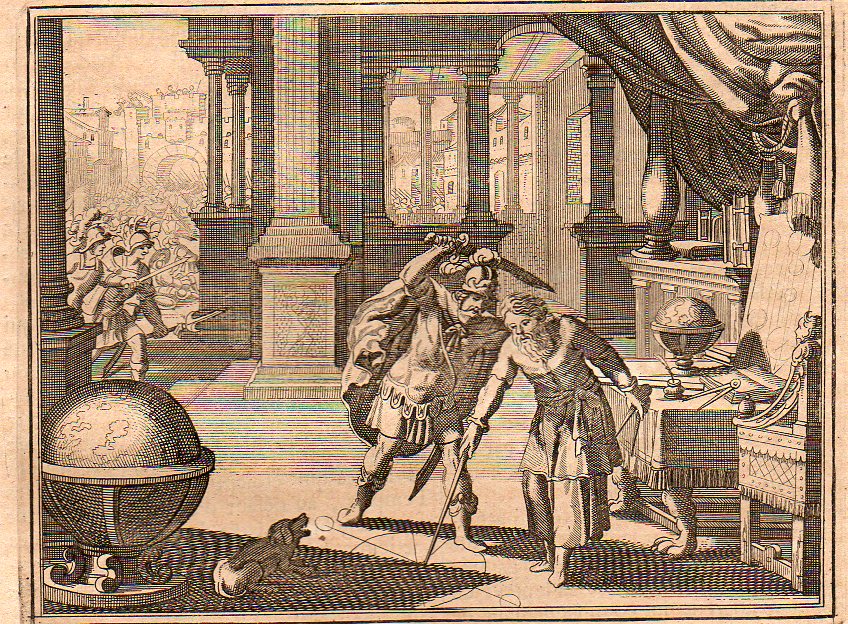
    I came across this unusual and not-web-reproduced image of an infamous scene in the history of mathematics, the murder of Archimedes.(The original is available for purchase from our blog bookstore.)  There have been a number of depictions of the event, a few dozen artists it seems–including Daumier and Delacroix and others whose name do not begin with “d”–who have chosen to try and capture the moment.  (The website at  NYU reproduces some of them;  Drexel also has a very good space devoted to Archimedes and is a great source for quotes dealing with the event.) This one comes from (I think) Histoire Universelle published by the ubiquitous Peter van der Aa in Amsterdam at the turn of the 18th century, and falls in line with many of its comrades in that it depicts the tragedy in the second before it occurred.  One thing it has that other scenes do not–a barking dog.  Maybe it belonged to Archimedes, maybe not.  But there was a dog depicted here, and it was barking at the scene, probably barking at the man about to stab the mathematician, which means it would’ve been the mathematician’s dog.  But Archimedes certainly didn’t hear the dog if he couldn’t be interrupted by the battle outside his door or the Roman who yelled at him to turn.  (I believe Roger Clemens when he says that he didn’t realize he was throwing that bat fragment at someone, saying he was in the zone.  It happens.)

    Archimedes 1705348
     Archimedes dog 1705349

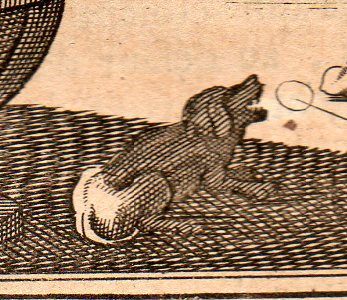
    And a detail of the dog: shows him barking from a reclined position.  Jarred awake by the intruder, he sees the  action just before the critical motion–not quite awake, no time to stand, the dog (snarling with teeth barred) tries its best. (I am romanticizng the dog part of course. My own dog, Bluey, now 14 or so, simply stared at the people who walked into my house last night with their luggage, thinking that mine was the bed and breakfast where they had their reservations.  He sat and stared, and they stared at him.  Missing their destination by one house, how disappointed they must’ve been to think that their retreat was filled with an old dog, kid toys, a dead Christmas tree, and the rest of the jumble.)

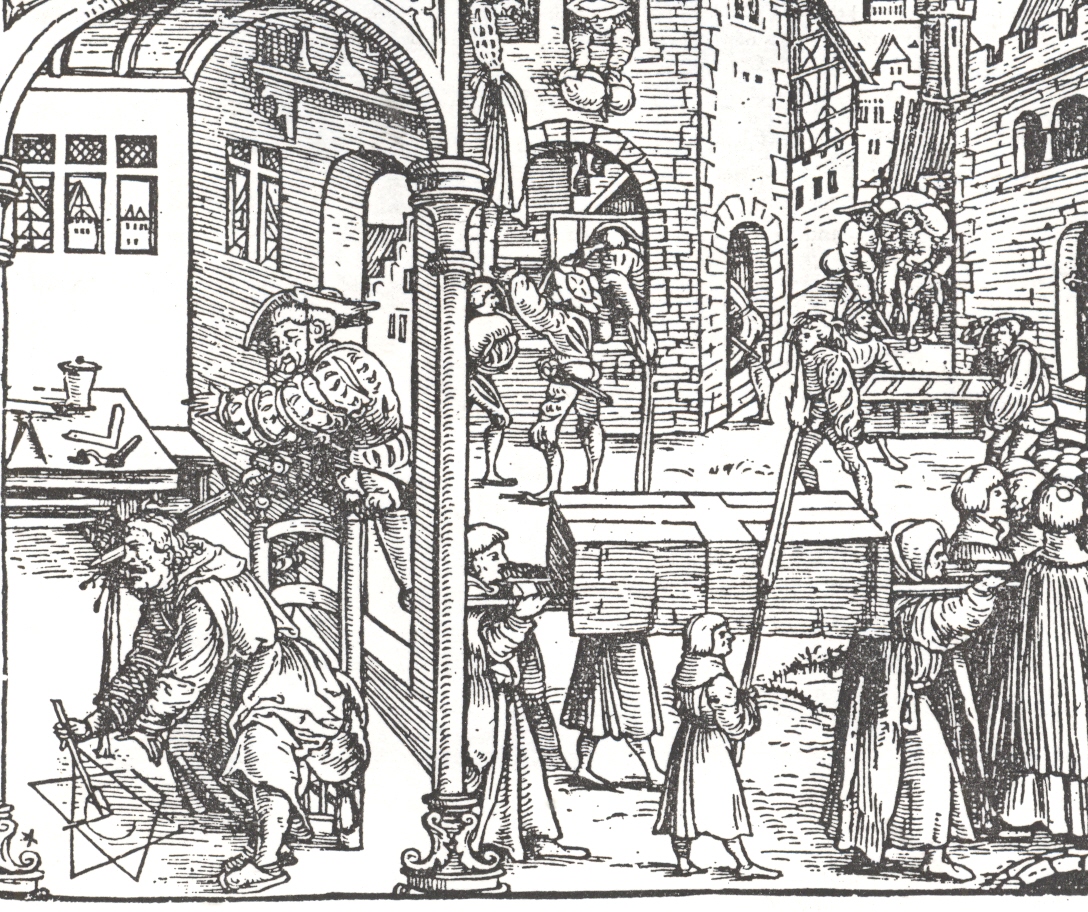
    I’m not aware of any artist who steals the moment quite so graphically at Jost Ammon (below) does, though. He also makes no effort to remove the millenium-old event from his own Renaissance environment.

    ==blog==july 8==arch 2

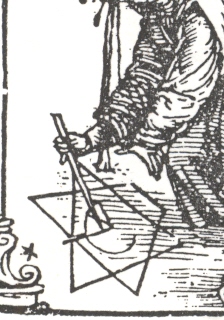
       Seldom do we see a maxim so vividly depicted as with these lines from Valerius Maximus:  Archimedes trying to hold a thought in his head while a Roman soldier comes tugging at him, Archimedes pushing the soldier away to protect the geometrical work that he was scribbling in the sand, and then having his head full of thoughts spilled onto the drawing he was trying to protect.  What we see in the detail is almost exactly (or on the verge of being exactly) from the Valerius quote fragment  “…with his blood he confused the lines of his art”:  Archimedes has spoiled his geometry in the moment before his cleaved head releases the control of his muscles.  It is a nasty image, the pissed-off Roman soldier—who theoretically was just looking for spoils in the looted city of Syracuse—having had enough of the three-second hesitation by the old man and reacts badly, beheading him the hard way. (I’ve written about this pirnt earlier in this blog, here.)

     ==blog==july 8==arch This is definitely the great CSI moment in the history of mathematics, so far as Mr. Ammon is concerned.  There is no chance not to see that there is no heraldry to the moment, no faint-away moment, just blood in the sand. 
    And for some reason–except for the dog part–all I can really think about here is the anatomy of the machines that were shown by the great Precisionists of early 20th century art, the artists who depicted the modern industrial landscape and its tools with fantastic precision and modern-Gothic-y grace. 
    The artists who found modernity–a modernity found mostly in America–in massive factories, and shining metal, and spokes and gears and all of the other components of factories. There was of course the Marinetti manifesto preceding all of this, and the 1913 69th St Armory Show,  and the coming of the French (Duchamp and Picabia  & Co.) in 1915 and the Tzara/Huelsenbeck/Ball Dadaist 1916 movements and the rest….but what I’m reaching for is the slightly later work, the early ‘twenties, with Hartley and Stella and Sheeler And Demuth and Schamberg (and even the early O’Keefe).  This is where I think we see machine art, an oddly realistic semi-cubist something, depicting the power and form and grace of the machine itself rather than the expression of its dynamism. 
    But what happens (for me, anyway) is this–that when the guts of the machines are revealed, that when we see inside to the components, the very anatomy of modernity, we see a clean, rustless, oil-less, greaseless, world.  Big and heavy, massive things of terrific density, and they smell like nothing except their own immobility, which so far as I know smells like nothing.  As much as I find these artworks beautiful, I miss that their core wasn’t represented–I’d would’ve liked a little more mess.  This is antithetical I’m sure to the message, but it is the essence of the machine. 

    Zoom Image
    [Charles Sheeler, Stacks in Celebration, 1954.] And humans didn’t often make it into these images–as much as I like the artwork of Louis Lozowick, I like it more when he peoples-up his ultra-tech/urban images.  That’s another story. 

  • A Beautiful Manuscript of Square Roots, ca. 1830

    JF Ptak Science Books  (Re-visitng Post 935)

     309

    (Note: we’ll deal with square root of  3 at another time…)

    The author of this manuscript (which is available for purchase at our blog bookstore), Charles Fisher, took a solitary pleasure in calculating the square roots of numbers from 2  to 589, not bothering to write down the 24 perfect squares to 576.  (The sqrt being r2 = x for every non-negative real number x.) From the few bits that I have checked the man seems to have done a good job back there in the 1830’s. 

    I cannot determine where this book was written or who Mr. Fisher was, though it is possible that he was a (Baptist) Minister from the few short textual notes that pop up here and there. 


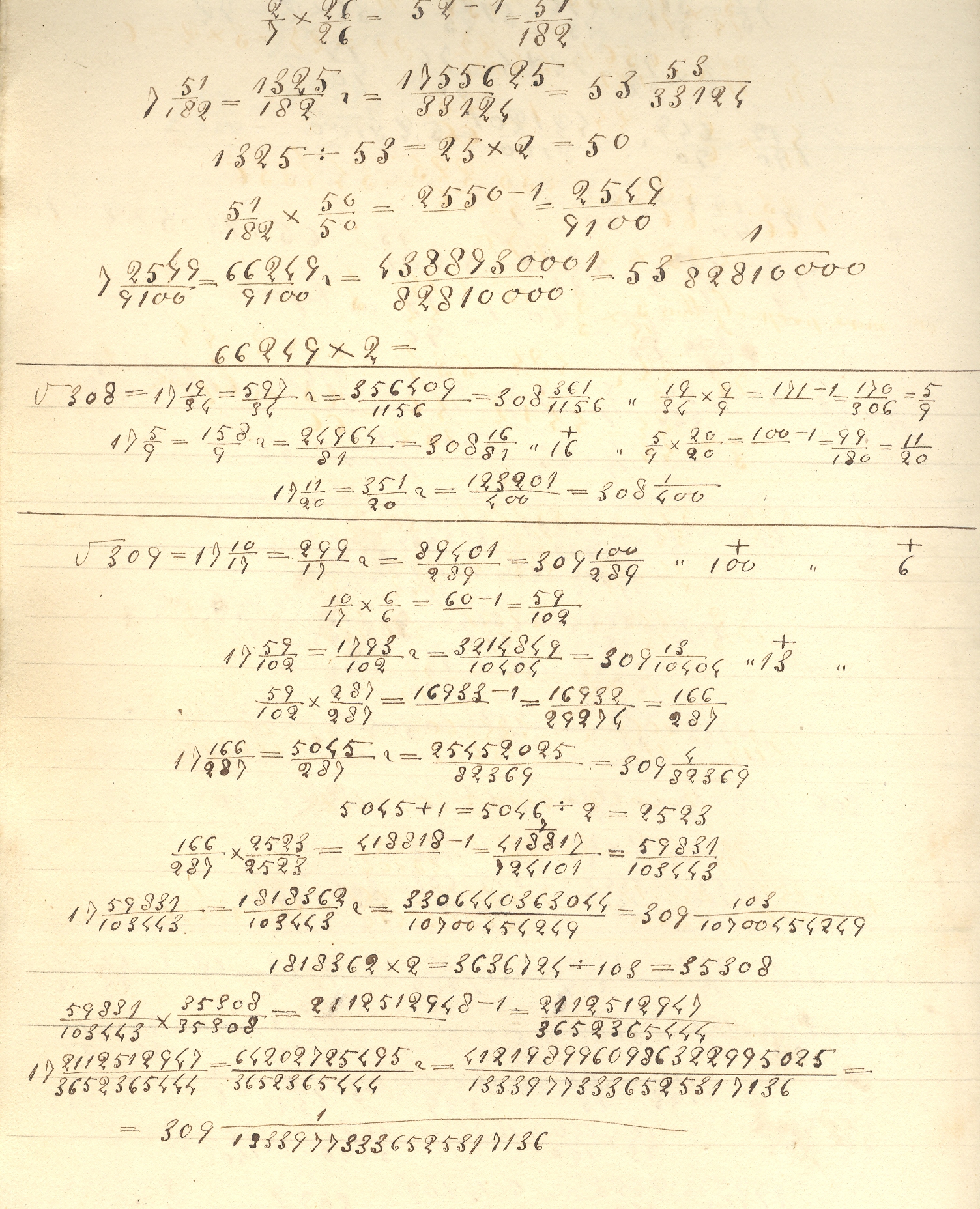
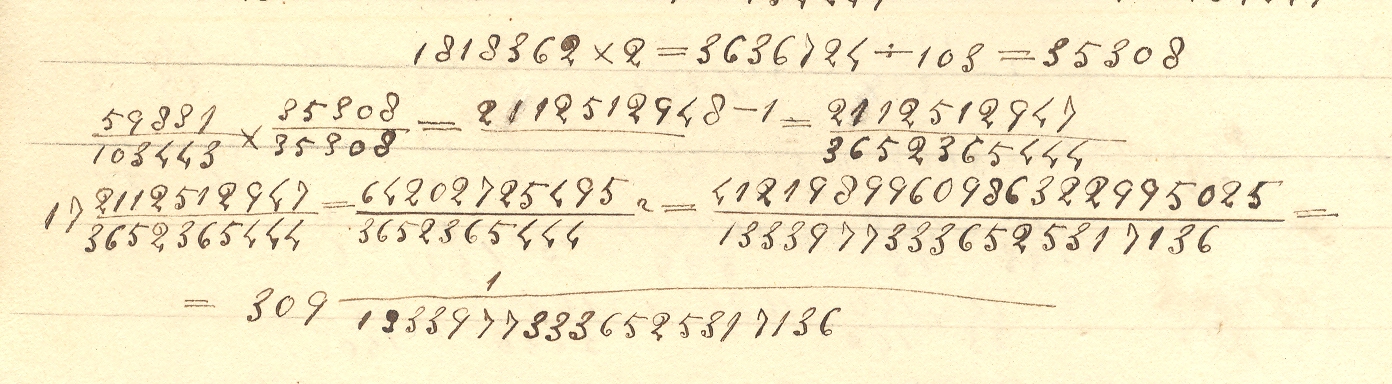
    His work is pretty elegant.  Take for example his solution (and proof) for the square root (hereafter sqrt(x)) 309,

    309 det

    which the calculator living under this page says is 17.578395831246947    Mr. Fisher’s answer is 17 10/17 = 799/17=89401/989=309 100/989, and after some more involved arithmetic comes t the lovely proof number of   

    4121989960986322995025 /13339773336525317136 or

    309.00000000000000000007496379247

    Which is getting pretty close. 

    309 193

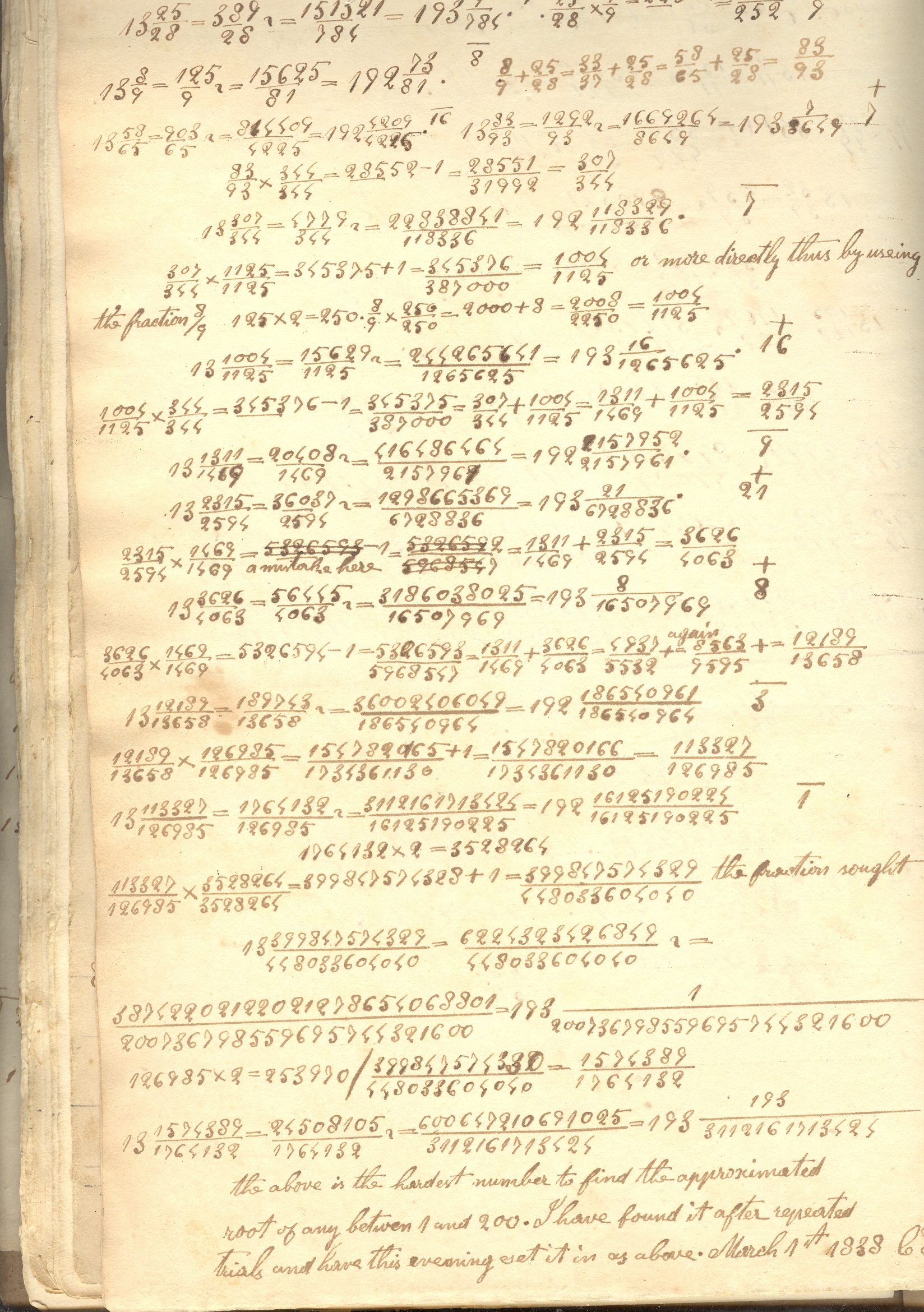
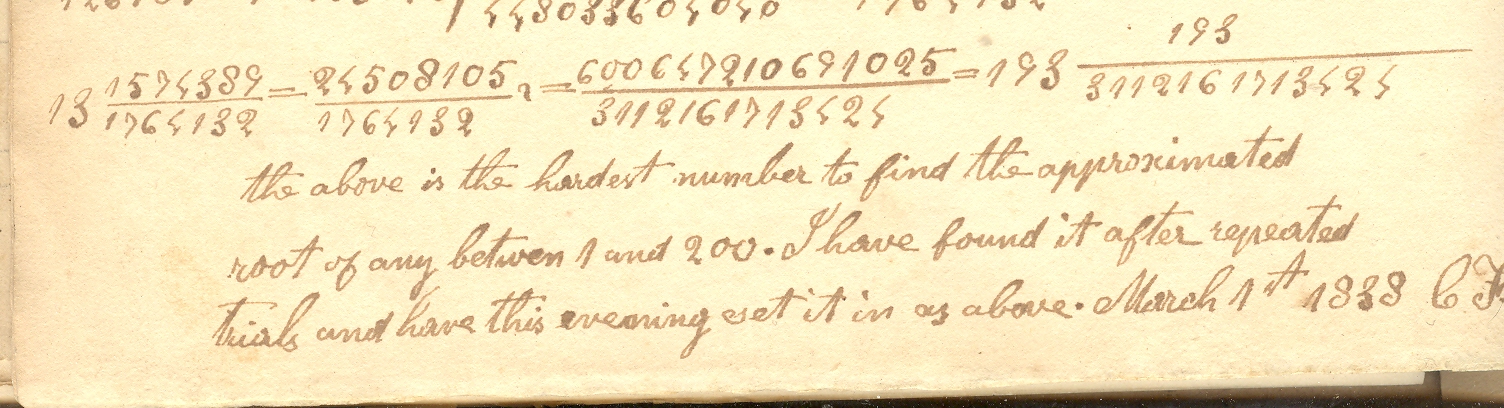
    The only note that Mr. Fisher makes on his calculations is for the sqrt(193), which he notes as “the hardest number to find the approximate root of any between 1 and 200. I have found it after repeated trials and have this evening wrote it in as above. March 1st, 1833. CF.”

    309 193 det

    ·Posted by :

    ·in:


  • The Compass of Music

    JF Ptak Science Books  Post 1252

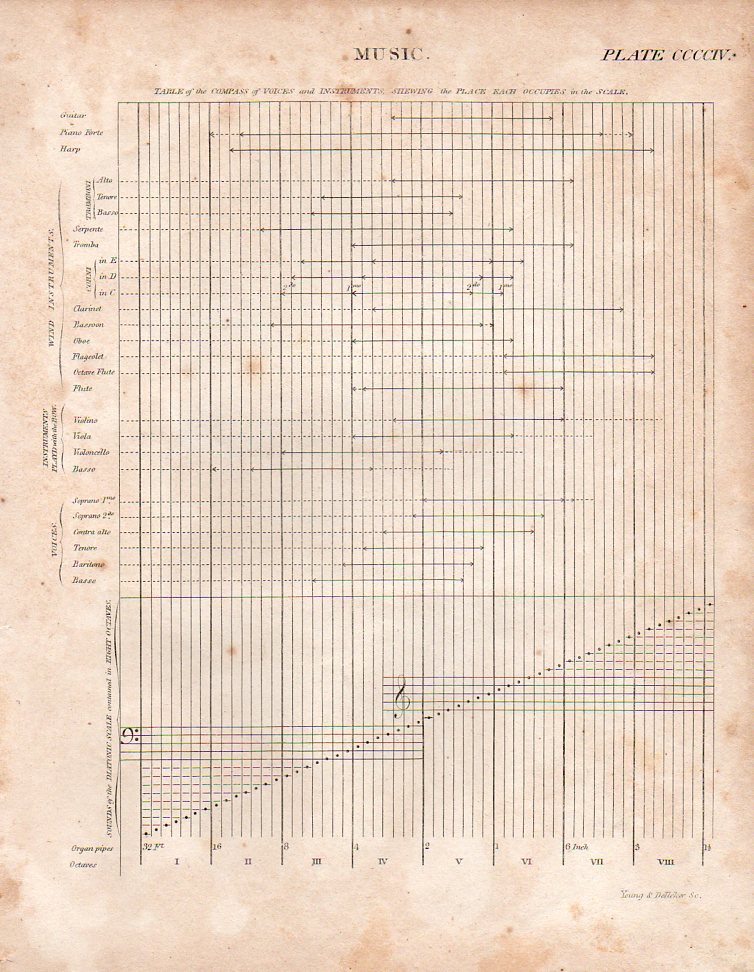
    This engraved plate from Abraham Rees’  Cyclopedia… is the wonderful invention of Alexandre Choron (1771-1834), and appeared (perhaps for the first time in an English press) in London in 1814.  It is a concise and interesting display of the comparisons of the reach of instruments along the eight octaves, and is a very strong example of clear and useful graphical display of quantitative data. 

    Music compass a949
    The full subtitle:  “Table of the Compass of Voices and Instruments, Shewing the Place Each Occupies in the Scale”.  (The original print is also available for purchase through our blog bookstore.)

    From Grove Music Online:

    Choron, Alexandre(-Etienne)

    (b Caen, 21 Oct 1771: d Paris, 29 June 1834). French writer on music, instructor, publisher and composer. While still a boy, he taught himself Hebrew and German and acquired a permanent interest in scientific experiment and a fascination for music theory and the techniques of composition. Although he reached the age of 16 before taking music lessons, he had already attained elementary skill on keyboard and other instruments. He greatly valued a friendship with Grétry which began in his 20th year and which suggests that he moved to Paris after his father’s death.


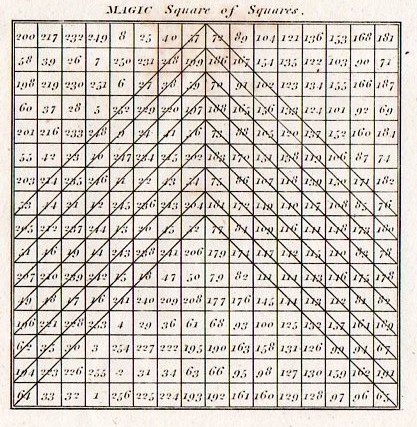
  • Logic Trees, Magic Squares, Magic Circles and Magic Square of Squares

    JF Ptak Science Books LLC  Post 1238

    [Associated posts: The Mother of all Renaissance Logical Graphs, The Knight’s Tour, Porphyry and Boethius and Census Art and the Display of Quantitative Data, 1860.]

    Magic square and circles det sq881
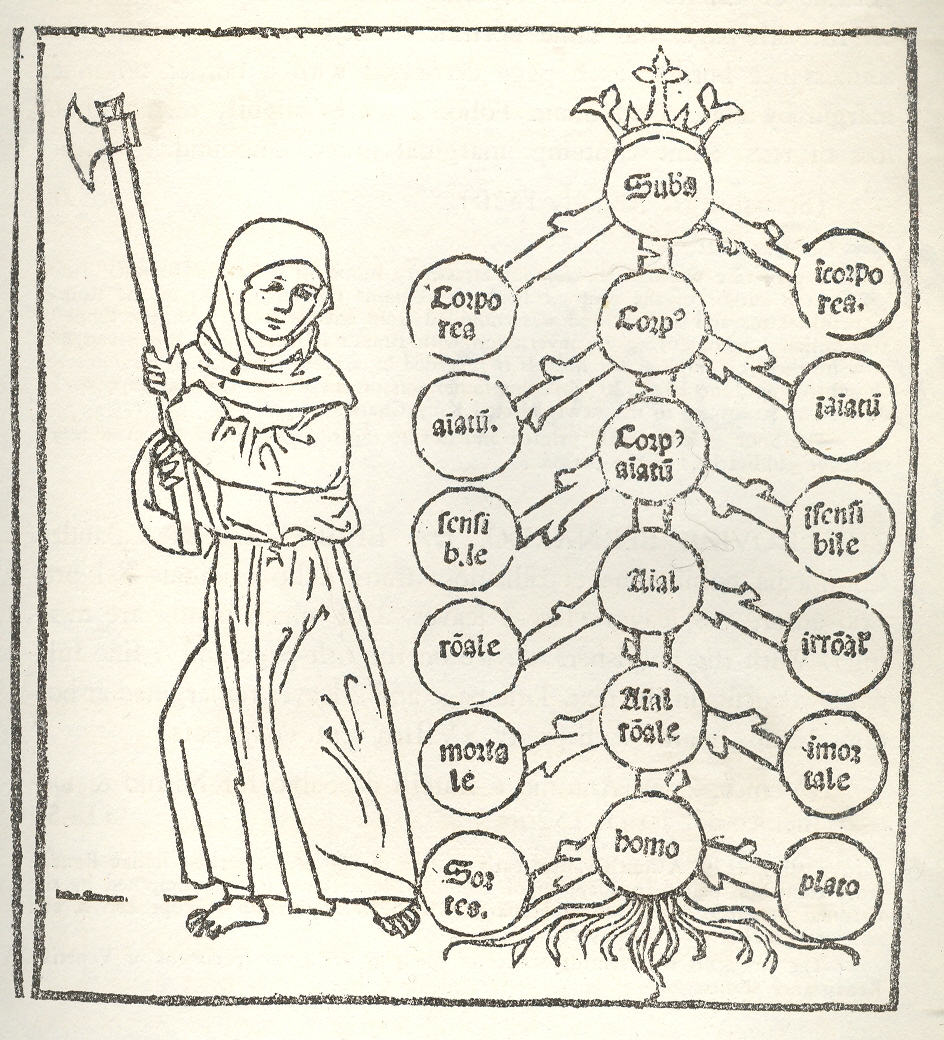
    Well now:  I don’t know what the provocation or inducement is here to hurtle this axe-swinging monk to attack Porphyry’s Tree1, though it would be interesting in a forensic sort of way to know what the tree’s section might reveal. The “tree” was a diagrammatic creation of a 3rd century Syrian mathematician/logician/philosopher named Porphyry who– much taken with Aristotle (and with the Categories in particular)– developed a systematic approach to the organization of thought in diagrammatic form.1--logic tree

    What’s inside a tree of logic and memory?  Is there a  xylem-y/phloem-y stuff besides a three-dimensional representation of the structure of organizational thinking?  Or is the 2-dimensional rip a fatal blow to other dimensions, and like Eddington’s Turtles, it’s a simple slice of Flatland all the way down?  

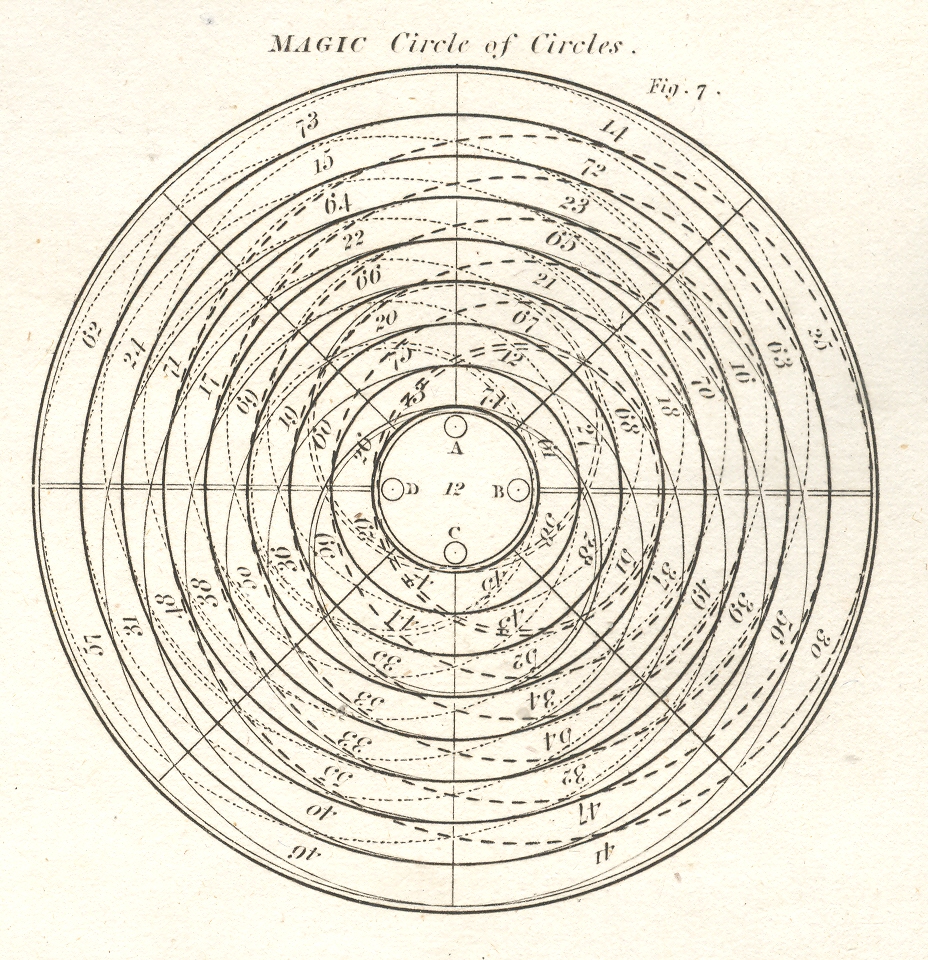
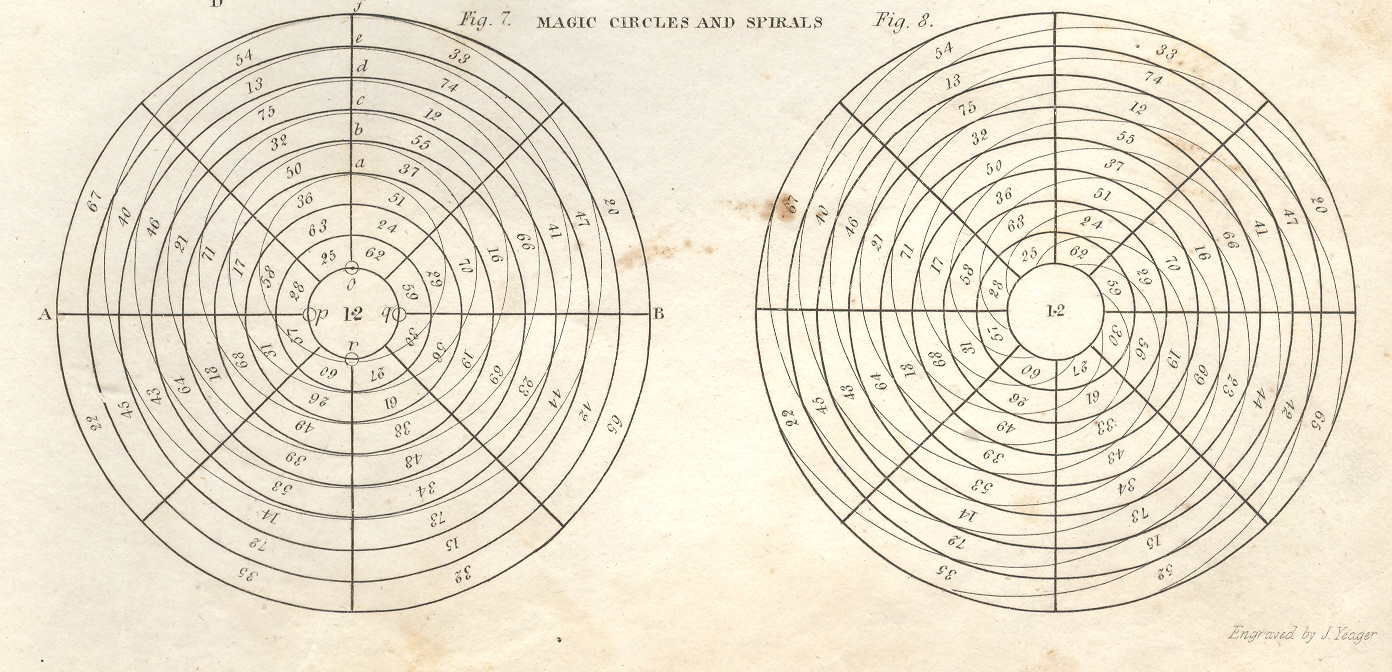
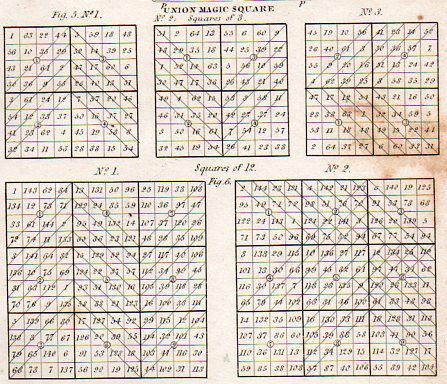
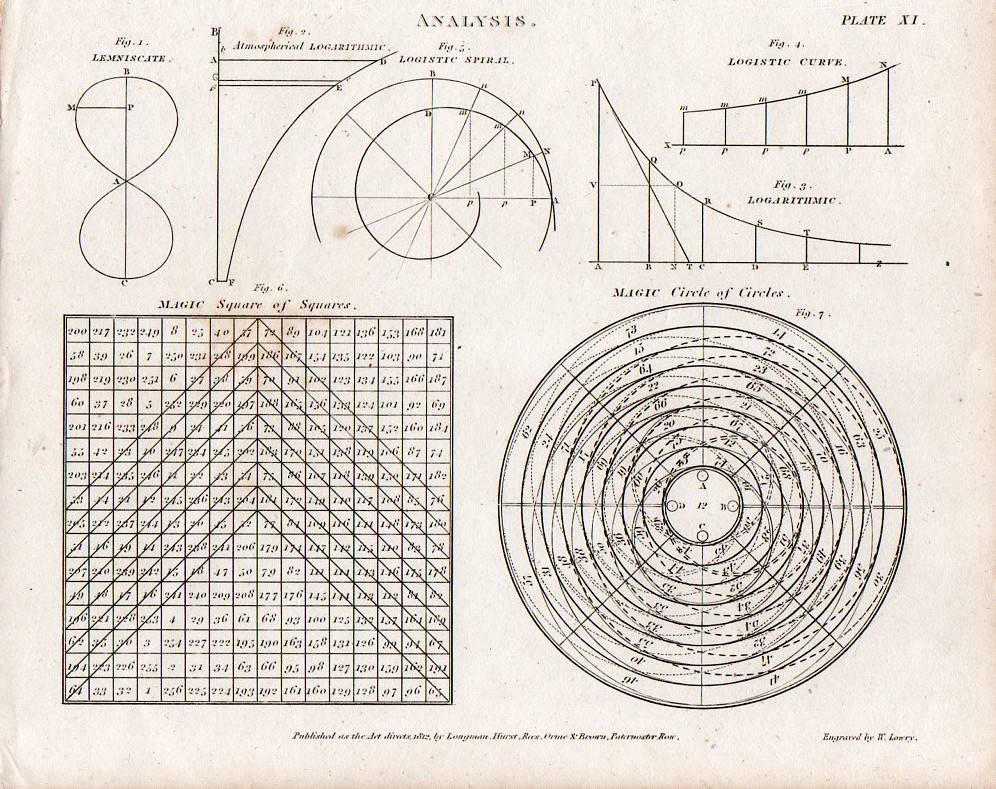
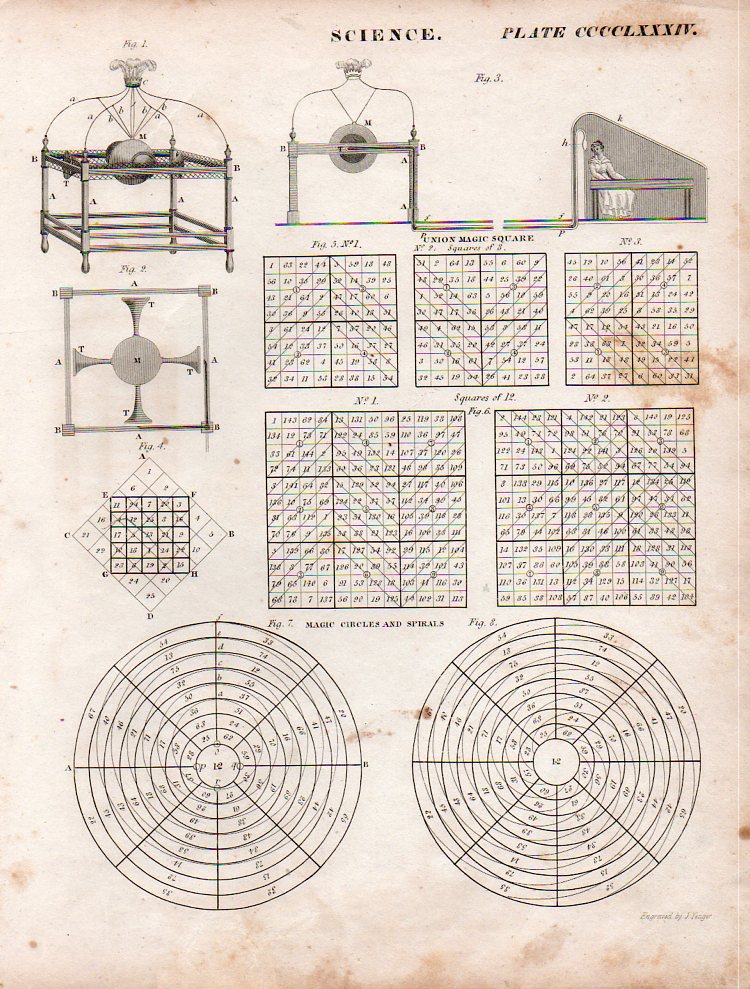
    Perhaps Porphyry’s tree rings would look like this, a magic circle or spiral, which would make some sense, and would bring to bear an associated use of turtles—or tortoises, I should say.  It turns out that perhaps the very first use of the magic circle, rolling back its origins through the Islamic world to India and to Persia and then to Japan,  and then finally to China where, in about 2000 BCE, the magic square appears in an image with the Emperor Yu,  inscribed on the back of a tortoise.

    1--logic tree magic circle 

    1--logic tree magic cricles

    [Magic circle source:  Abraham Rees Encyclopedic Dictionary , printed 1805-1815. The originals are available from our blog bookstore.]

    Magic squarezz and circles det883

    Magic square and circles880
    Magic squarezz and circles882

    Notes:

    1. This image appears in the rare Destructio sive eradicatio totius arboris Porphirii : magni philosophi ac sacrae theologiae doctoris eximii Augustini Anchonitani ordinis fratrum Heremitarum Sancti Augustini, cũ quadã decretali eiusde, published in 1503.