JF Ptak Science Books Post 1326
“…with his blood he confused the lines of his art”—On the death of Archimedes, in Valerius Maximus
“….Bark, bark bark!”–Archimedes’ dog
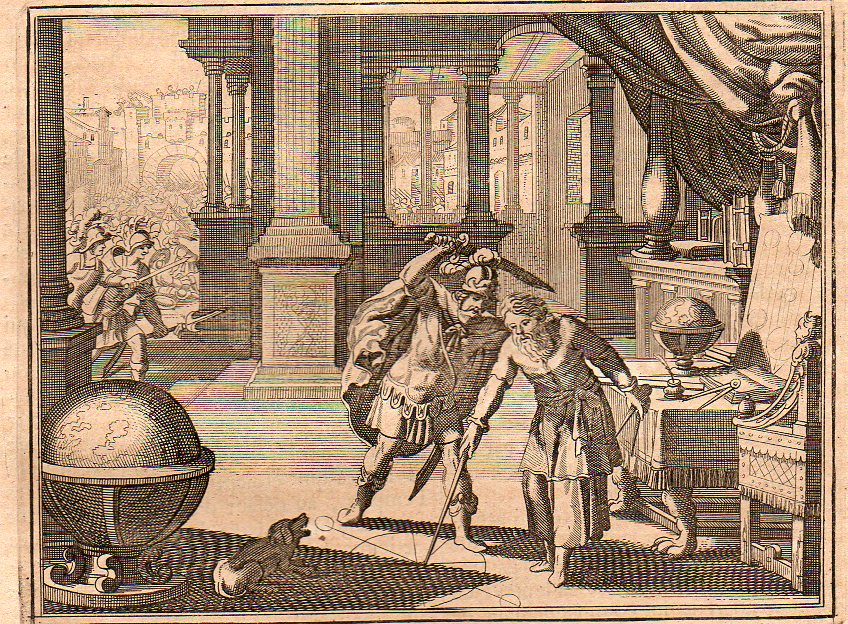
I came across this unusual and not-web-reproduced image of an infamous scene in the history of mathematics, the murder of Archimedes.(The original is available for purchase from our blog bookstore.) There have been a number of depictions of the event, a few dozen artists it seems–including Daumier and Delacroix and others whose name do not begin with “d”–who have chosen to try and capture the moment. (The website at NYU reproduces some of them; Drexel also has a very good space devoted to Archimedes and is a great source for quotes dealing with the event.) This one comes from (I think) Histoire Universelle published by the ubiquitous Peter van der Aa in Amsterdam at the turn of the 18th century, and falls in line with many of its comrades in that it depicts the tragedy in the second before it occurred. One thing it has that other scenes do not–a barking dog. Maybe it belonged to Archimedes, maybe not. But there was a dog depicted here, and it was barking at the scene, probably barking at the man about to stab the mathematician, which means it would’ve been the mathematician’s dog. But Archimedes certainly didn’t hear the dog if he couldn’t be interrupted by the battle outside his door or the Roman who yelled at him to turn. (I believe Roger Clemens when he says that he didn’t realize he was throwing that bat fragment at someone, saying he was in the zone. It happens.)
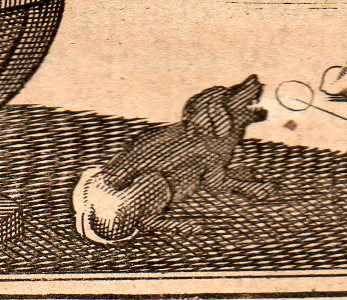
And a detail of the dog: shows him barking from a reclined position. Jarred awake by the intruder, he sees the action just before the critical motion–not quite awake, no time to stand, the dog (snarling with teeth barred) tries its best. (I am romanticizng the dog part of course. My own dog, Bluey, now 14 or so, simply stared at the people who walked into my house last night with their luggage, thinking that mine was the bed and breakfast where they had their reservations. He sat and stared, and they stared at him. Missing their destination by one house, how disappointed they must’ve been to think that their retreat was filled with an old dog, kid toys, a dead Christmas tree, and the rest of the jumble.)
I’m not aware of any artist who steals the moment quite so graphically at Jost Ammon (below) does, though. He also makes no effort to remove the millenium-old event from his own Renaissance environment.
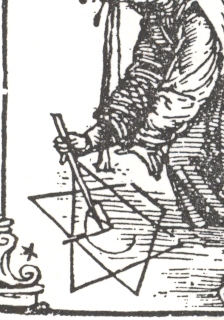
Seldom do we see a maxim so vividly depicted as with these lines from Valerius Maximus: Archimedes trying to hold a thought in his head while a Roman soldier comes tugging at him, Archimedes pushing the soldier away to protect the geometrical work that he was scribbling in the sand, and then having his head full of thoughts spilled onto the drawing he was trying to protect. What we see in the detail is almost exactly (or on the verge of being exactly) from the Valerius quote fragment “…with his blood he confused the lines of his art”: Archimedes has spoiled his geometry in the moment before his cleaved head releases the control of his muscles. It is a nasty image, the pissed-off Roman soldier—who theoretically was just looking for spoils in the looted city of Syracuse—having had enough of the three-second hesitation by the old man and reacts badly, beheading him the hard way. (I’ve written about this pirnt earlier in this blog, here.)
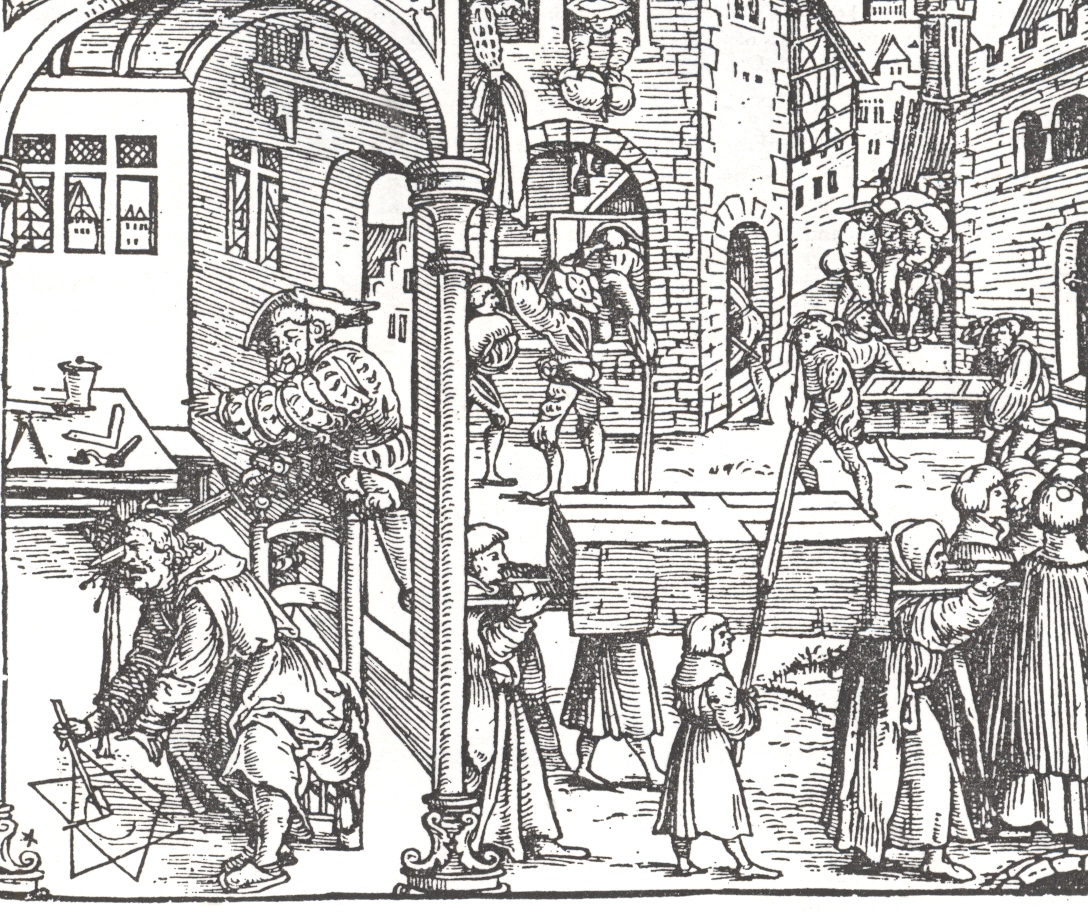 This is definitely the great CSI moment in the history of mathematics, so far as Mr. Ammon is concerned. There is no chance not to see that there is no heraldry to the moment, no faint-away moment, just blood in the sand.
|
|||||||
