JF Ptak Science Books Post 1575 [Part of the History of Lines series]

The history of lines is full and rich with symbols, some of which have absolutely nothing to do with the extension of trust and belief and hope and fear–unless you’re a young student studying math or chemistry or physics. One symbol in the maths that seems to have no exact age except to say that it is semi-ancient is the addition sign. (It will be interesting in this series on the history of lines to address the origins of other symbols like the sign for pi, division. multiplication, percent, inequality, equality and so on.)
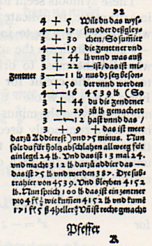
I say “semi-ancient” because the symbol for addition is a hieratic form of the Egyptian hieroglyphic, looking like a capital “A” in a way, without the horizontal crossbar. The earliest appearance of a symbol for addition in Europe was in the 13th century, with the letter “p“, appearing in various forms, as well as the word “plus”, “used in connection with the Rule of False Position”1. The concept also appears as the word itself, as “et”, or “and”, which just so happens to closely resemble the symbol that the concept would become a few centuries later. The earliest appearance of the symbol we would recognize instantly today as an addition sign came in the 1489 book by Wideman, the Behenunde und kuepsche Rechnung (seen above in detail and in full, from the 1532 edition of the work), while the first time the “+” appears in an algebraic equation for the first time 25 years later, in a work by Vander Hoecke.
It is interesting to think of the life of these symbols before they became themselves.
I am not certain of this, but it seems that the first “+” printed in the United States did not occur until the 20th edition of James Hodder’s2 Arithmetic3 was printed in Boston in 1719, and this at the press of James Franklin (1697-1735), the fourth child of ten in the Franklin family that included Benjamin (1706-1790). So it is entirely possible that 13-year-old Ben helped his older brother print the first addition sign in the British Colonies.
Notes:
1. D.E. Smith, The History of Mathematics, volume II, p. 397
2. Hodder in 1672 wrote “note that a + (plus) sign doth signifie Addition, and two lines thus = Equality, or Equation, but a X thus, Multiplication,” no other symbols being used.” (Smith p395)
3. In his introduction, Hodder says: