JF Ptak Science Books Post 1657
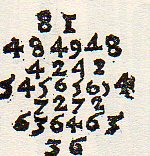
Many thanks! to Ray Girvan and Thony Christie for solving this multiplication problem!
Ray Girvan (JS Blog–Journal of a Southern Bookreader) http://jsbookreader.blogspot.com/2011/11/taglientes-multiplication-by-columns.html
Thony Christie (Renaissance Mathematicus) http://thonyc.wordpress.com/2011/11/10/1202/
Giovanni Tagliente was many things, though perhaps he wasn’t mathematically inclined, not really. He was however a very capable putting together books and addressing some elementary needs of the working classes that reached out into the mass of the great unwashed offering instructionals on how to do the basics of–in this case– applied mathematics, as with this book, Libro de abacho…1, this edition printed in Venice in 1564. This was a small, pocket-sized book2, a references on how to do the stuff of daily (and not so daily) calculations, and in principle was a concise, Humanist guideline for getting through the daily bits of the calculating and mercantile life.
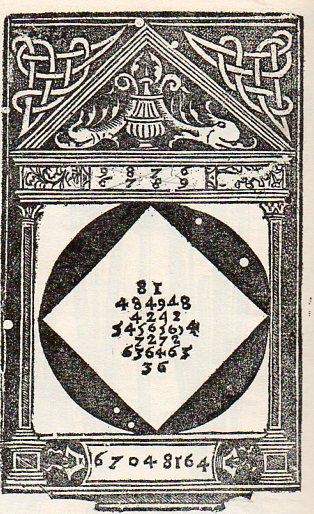
The above image is a woodcut diagram “explaining” how to do multiplication.
To the 21st century eye however the actual explanations of how to conduct Tagliente’s approach to actually “doing” the math might not be so evident. They seems to be inspired acts in helping the reader understand the process, say, of multiplication, though it does appear a little mysterious, and explanations for the actual process are–as the author(s) says–self-evident in the woodcut, and are not elaborated in the text.
I’ve been unsuccessful thus far in determining how the product to the problem of 9876 x 6789 (67.048,164) was reached via adding the individual results of the factors’ multiplications, though seeing the individually parts of the calculation is apparent3 (explained below).
I thought that this would be easier, because it was after all easier once upon a time, at least to people not me.
I think that I get a D+ on this one. All I really wanted to say is that Tagliente’s diagrams are pretty.