JF Ptak Science Books LLC Post 925
I’m going to take a drive through five
fifths—all of which don’t come close to making a whole—to get to my ultimate
destination, a ribbon of numbers circling the earth.
In
American l aw, “taking the fifth (Amendment)” allows you the prohibition of
incriminating yourself, giving the supposed ability to look innocent whole not
saying anything about anything for fear of legal repercussions, though this
sausagey implosion from guilt seldom looks pretty.
There’s
the fifth column (as in Hemingway’s play by this name), the
not-fourth-but-fifth force, the musical perfect fifth of highest consonance,
the Keplerian nestling of the five Platonic solids, Beethoven’s Fifth, a fifth of (good) scotch,
the fifth cardinal direction (the center), the five books of the Torah, the
five pillars of Islam, the worst categorization of hurricanes and tornadoes, living
in the fifth Mayan world, the fifth Fibonacci number, and on and on.
And
aside from being the number that Joe DiMaggio wore on his pinstripes, it is
also the number of the Euclidean postulate that called to all those who were
interested in the possibilities of the postulate not being so—that there exists
as perfect a non-Euclidean system as there is for the Euclidean. The fact of the matter is that this calls
into question the foundation, the very basis, of mathematics. Or used to.
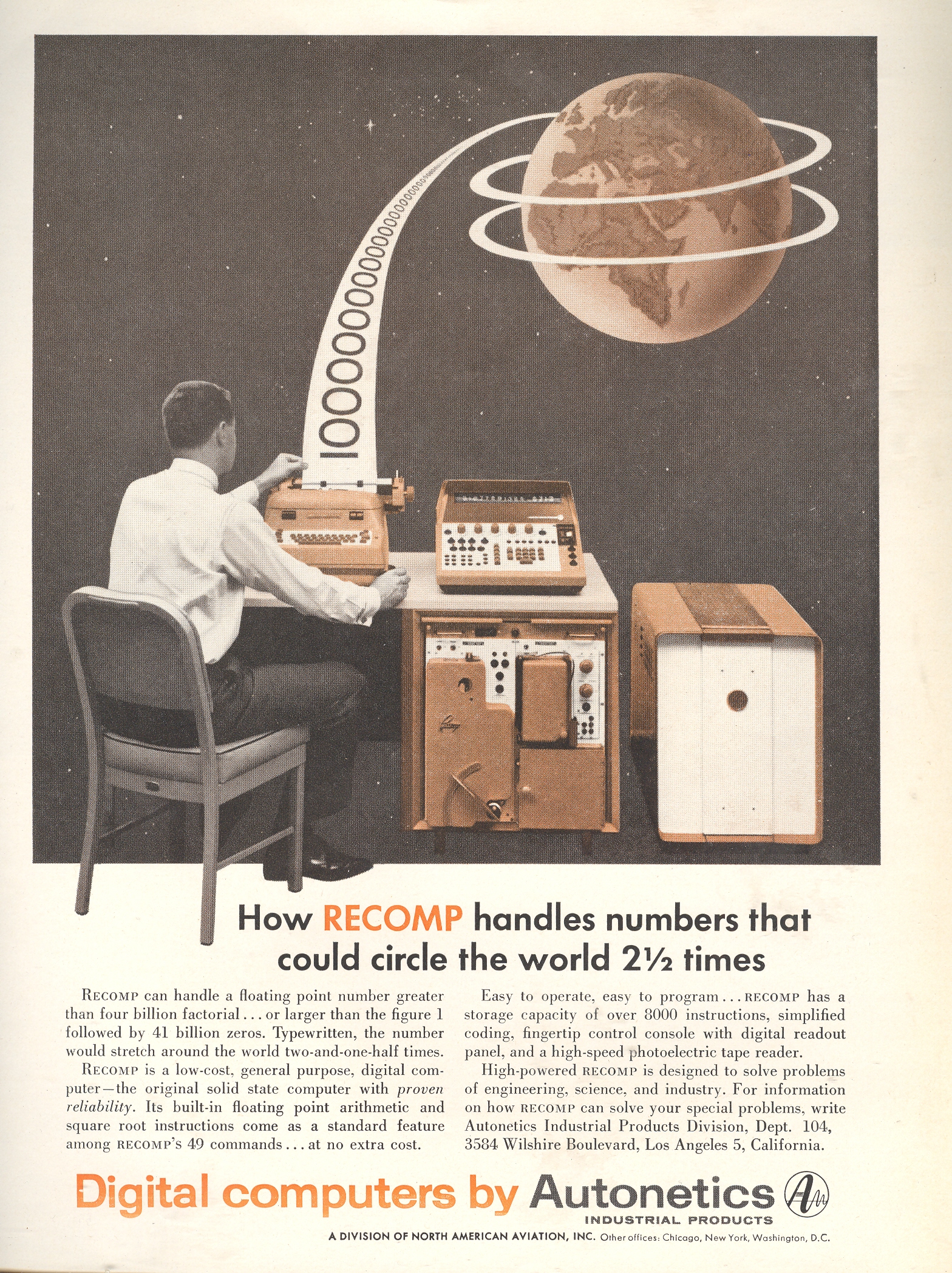
All
of this was brought into mind by this 1957 ad for the RECOMP computer produced
by Autonetics. The image of a sheet of
numbers circling the earth1, the product of digital computation, suggested
structure, mathematical imperative and solidification of numbers. But the point of this was the bottom line:
what was the point, and for that matter, what was the point? They were hardly physical things floating in
space, but ideas (except of course in the worlds of Flatland).
Euclidean
structure was the infallible, rigid, predictive, explanatory structure and the
most accurate descriptor of physical space.
This had certainly been the case for fifteen hundred years or so, or at
least until the struggling fifth postulate of
unwieldy. More to the point, the axiom,
the parallel postulate axiom, wasn’t as self-evident as the first four, and
wasn’t provable from the other nine of the first ten axioms. And so came the unbelievable question, what
if the fifth postulate wasn’t true? What
if there were other geometries—non-Euclidean geometries—that were as provable
as that of the Master? The possibility
of relegating the understanding of nature and the physical surroundings to
something other than the existing geometry was simply, positively,
extraordinary.
The
origins for this movement away from Euclid started with Girolamo Saccheri (his
book published in 1733 but not “discovered” for its non-Euclidean importance
for another 150 years) Georg Kluegel (1763), Johann Lambert (Theorie der
Parallellinien, 1766) and Adrien-Marie
Legendre (1752-1833, who was sort of in a similar boat with Saccheri in that
his work wasn’t actually published until after that of the next two
mathematicians); and coming to a point of real invention in the work of Nikolai Lobachevsky (1792-1856) and Janos Bolyai3 (1802-1860). (It would be
incorrect to credit these last two men [plus Gauss] with the creation of
non-Euclidean geometry given the longish and complex history of its
development.)
This
work brought into question the way in which the world was seen, and the very
foundation of recording visualized space.
This is all much messier than had been planned (so to speak) by almost all
previous mathematicians, questioning the very foundations of mathematics. The orderliness of the earth-circling numbers
doesn’t seem to be quite as they were, but as Henri Poincare stated, the “new”
system isn’t anything better or worse, just different, a new and more convenient way of looking at
things4.
Notes
- To be honest about it, the
foundations of math bit didn’t suggest itself right away. The first thing I thought when looking
at what this paper trail was supposed to represent—a string of numbers 41
billion zeroes long—didn’t look right.
Given the size of the numbers coming out of the “printer” there
would need to be five times as many rings around the earth. But when you read the text the numbers
are supposed to be “hand written”.
Therefore if you assume the numbers to be less than an inch high
and with no spaces in between, then this 2.5 times around the earth works
out to be accurate to the number of inches in the circumference. - Still earlier work is found
in the work of Omar
Khayyam‘s Discussion of Difficulties in Euclid, John
Wallis and Nasir
al-Din al-Tusi… among others. - Bolyai’s work—published as an
appendix to his father’s work on the foundations of geometry—was privately
reviewed by the great and impossibly smart Carl Gauss, who gave it a backhanded
series of compliments while at the same time saying “I thought so…” Which was true, evidently, as it looks
as though he was working on the problem beginning in 1799. - “If geometry were an
experimental science, it would not be an exact science. it would be
subject to continual revision … the geometrical axioms are therefore
neither synthetic a priori intuitions nor experimental facts. They are
conventions. Our choice among all possible conventions is guided by
experimental facts; but it remains free, and is only limited by the
necessity of avoiding every contradiction, and thus it is that postulates
may remain rigorously true even when the experimental laws which have determined
their adoption are only approximate. In other words the axioms of geometry
(I do not speak of those of arithmetic) are only definitions in disguise.
What then are we to think of the question: Is Euclidean geometry true? It
has no meaning. We might as well ask if the metric system is true and if
the old weights and measures are false; if Cartesian coordinates are true
and polar coordinates are false. One geometry cannot be more true than
another; it can only be more convenient.” –from: M J Greenberg, Euclidean
and non-Euclidean geometries: Development and history. (1980).