JF Ptak Science Books Post 2689
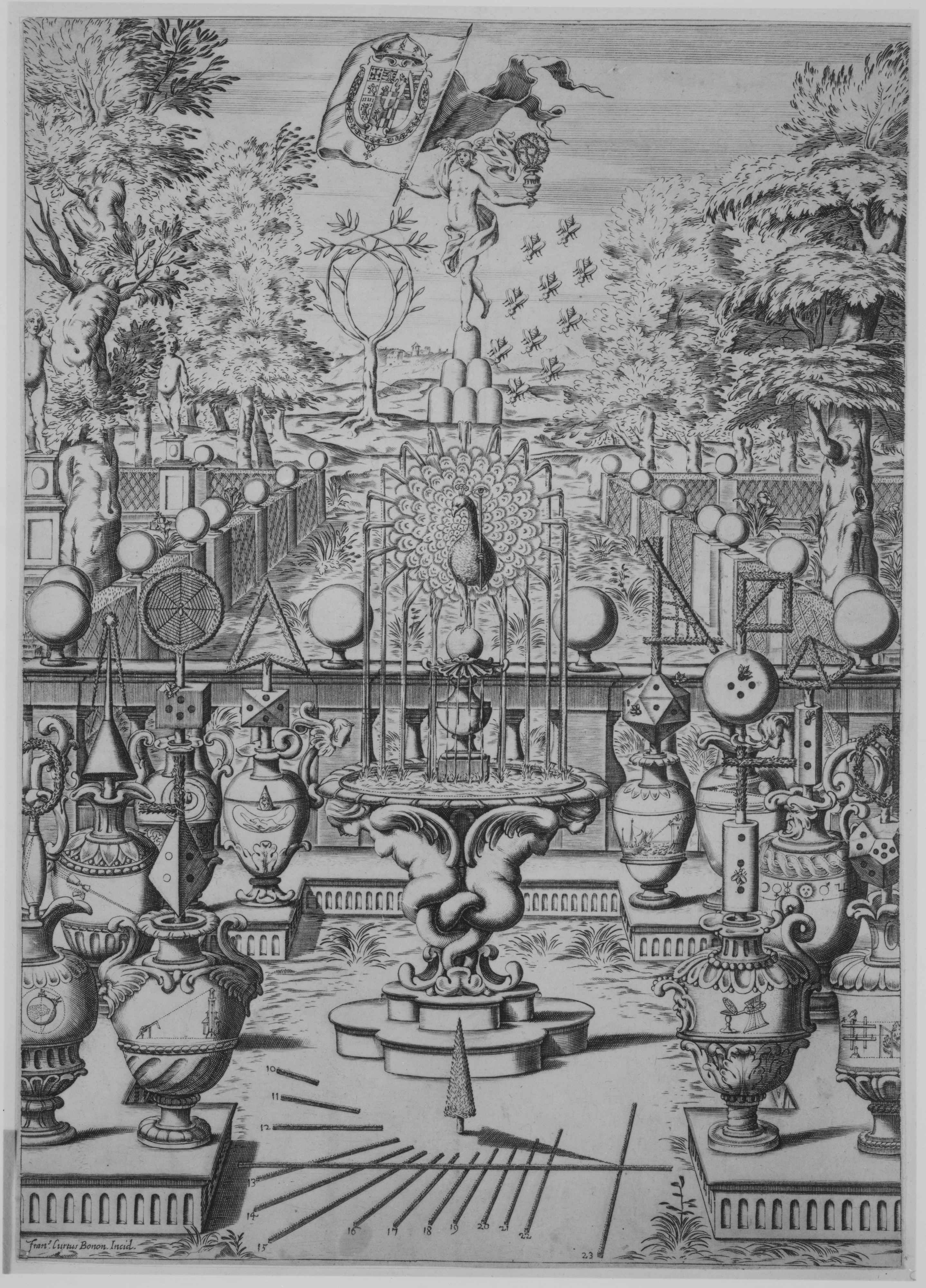 [Image: Metropolitan Museum of Art, http://www.metmuseum.org/collection/the-collection-online/search/359981?rpp=30&pg=1&ft=mathematics&pos=15]
This fine allegorical image is the creation of Francesco Curti (1603-1670), and according to the Metropolitan Museum of Art it is called “The Garden of Mathematical Sciences”, and was printed ca. 1660. There’s a lot of objects in this print, and it seems that perhaps most of them have a scientific application. It is an interesting exercise to identify them–I’ve found quite a few, though not all, how many can you identify?
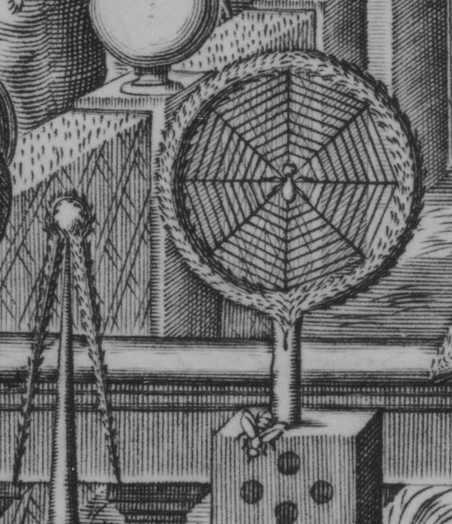
In the garden there are a geometrical spider, bees, proportional dividers, sundials, anamorphic images, the eye of god in a peacock display, Mercury, Archimedes’ death-ray mirror, navigational instruments, and no doubt much more, displayed and semi-hidden. For example, I think this is the well-known “geometrical spider” (middle far left), as seen in Mario Bettino’s Apiarium philosophiae mathematicae (Bologna, 1645):
Then there’s this classic image of the peacock, which through the history of Christian art has come to represent the concept of activity, resurrection, immortality–it has been used as a representation of Christ (in paintings like Fra Angelico’s great circular nativity painting, for example). In the Curti print, the peacock is holding a staff with an eye in it, which is probably that of god; the peacock stands on one leg, balanced with the eye staff, while the rest of the symbolism is filled by having an ever-flowing fountain flow from its feathers.
There are no doubt more to be found–there’s the timepiece in the foreground, numerous outlines of scientific instruments as garden plants, a demonstration of the optics of convex and concave lenses, and others. Have a look! Follow the link to the Metropolitan and open the very expandable image. (SOme answers, below)