JF Ptak Science Books Post 2640
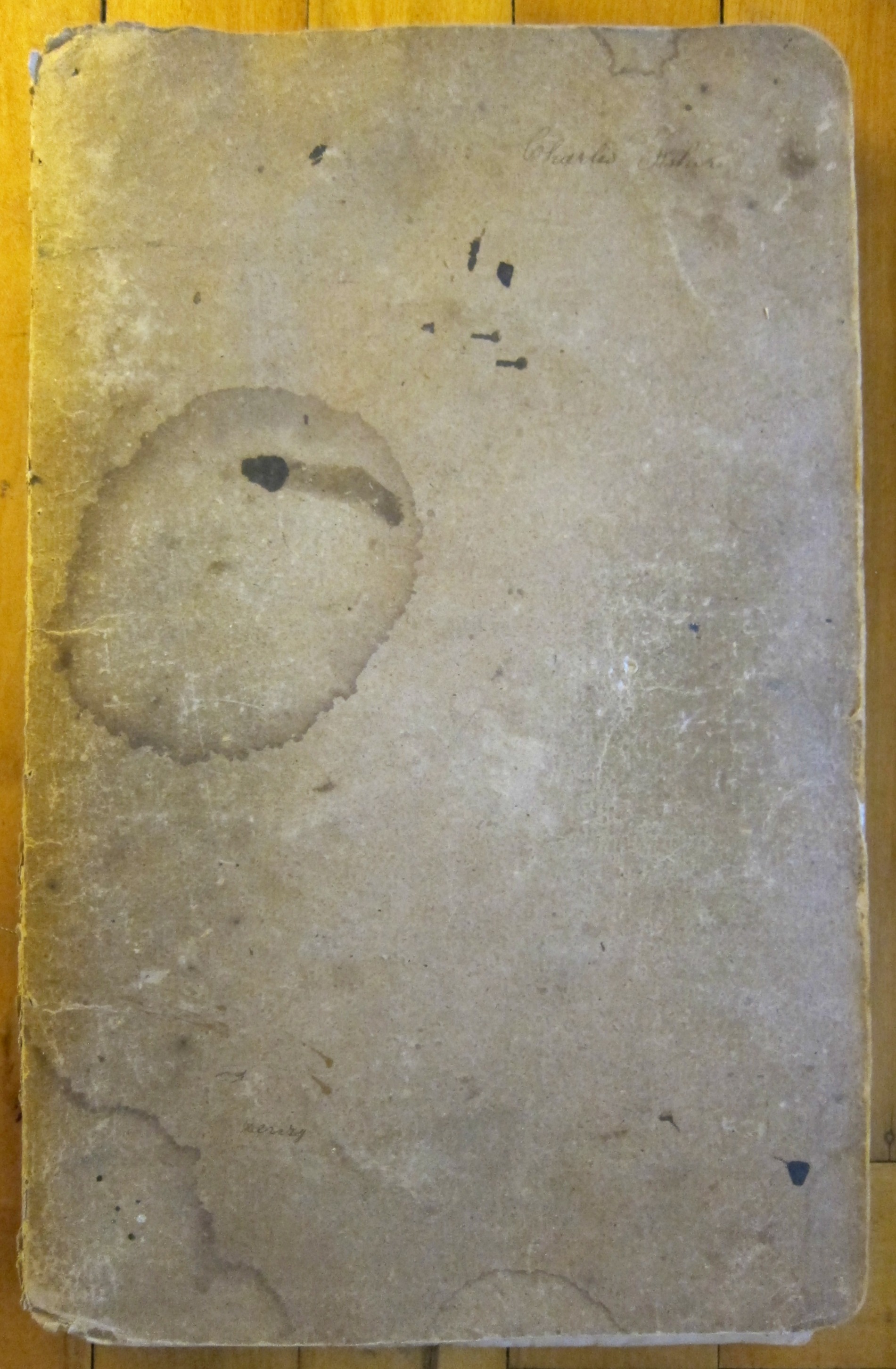
I’m returning to this earlier post, expanding it some, and correcting it a little–usually that comes with a fresh eye to something old and done. The work on hand is a mathematics manuscript by a man named Charles Fisher. It is an impressive collection of work on square roots, from √2 to √628. It is 13.5 x 8.5 inches and 160 pages long–it is all gathered together in separate quires, the text now just floating inside the original binding, which is very thick paper wrappers that have been handled so much that it feels like leather. Most of the manuscript is still bound, though several “signatures” are now loose within the binding. It is a good, solid copy in spite of what I just wrote–and it is a definite work of art.
The book is paginated according to the sq rt that Mr. Fisher was working on, so the first page is page 2 for √2. Also, the work figuring the square roots of 2 through 196 takes place on the top half or portion of the first 80 leaves, at that point he turns around and starts on the first leaf again, working out his answer for √197 (and √198) on the first page (or page 2) and so continues to the end of the book again, ending up at 628. The square roots seem pretty complete through the 400s and then gets very spotty after that, for whatever reason Mr. Fisher leaving some numbers alone. So far as I can determine the work is complete in itself.
The (seeming) author of this manuscript, Charles Fisher, evidently took a solitary pleasure in calculating the square roots of numbers from 2 to 628 not bothering to write down the 24 perfect squares to 576. (The sqrt being r2 = x for every non-negative real number x.) From the few bits that I have checked the man seems to have done a good job back there in the 1830’s. (Note: we’ll deal with square root of 3 at another time…)
I cannot determine where this book was written or who Mr. Fisher was. There is a transcription in the last leaf of the book of a community meeting dedicating people to building a meeting house in “Wertham” (?) near “Cumberland’, and that something like the minister or preacher would be shared with the local Baptist Church or something like that, and signed in January 1767. Fact is though that there is at least one contemporary date in the work and that is 1833 for figuring the √193.
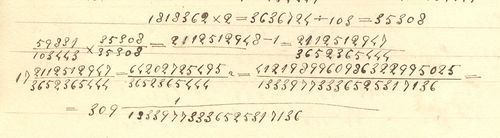
Fisher’s work is pretty elegant. Take for example his solution (and proof) for the square root (hereafter sqrt(x)) 309,
which the calculator living under this page says is 17.578395831246947 Mr. Fisher’s answer is 17 10/17 = 799/17=89401/989=309 100/989, and after some more involved arithmetic comes t the lovely proof number of
4121989960986322995025 /13339773336525317136 or
309.00000000000000000007496379247
Which is getting pretty close.
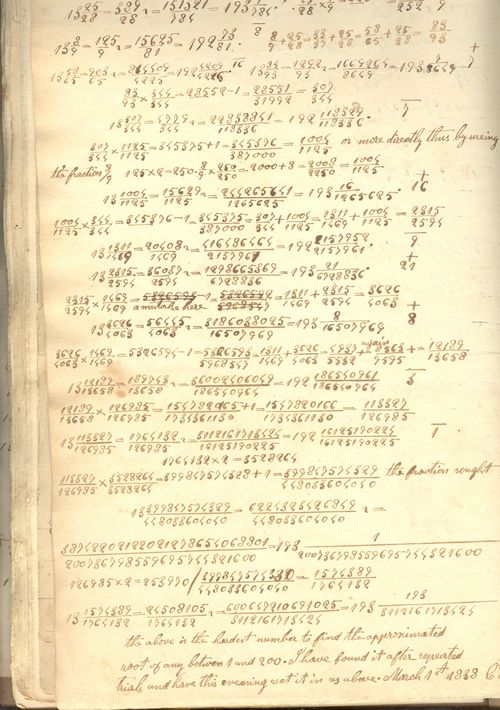
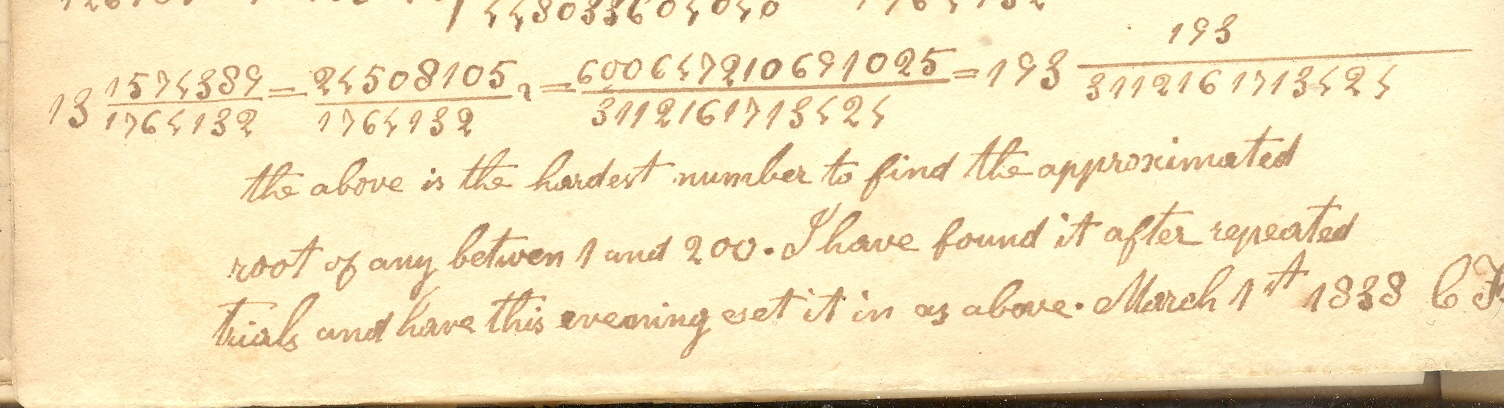
The only note that Mr. Fisher makes on his calculations is for the sqrt(193), which he notes as “the hardest number to find the approximate root of any between 1 and 200. I have found it after repeated trials and have this evening wrote it in as above. March 1st, 1833. CF.” (This may actually be 1838–I think it is dependent on interpretation.)
The lovely cover of the work:
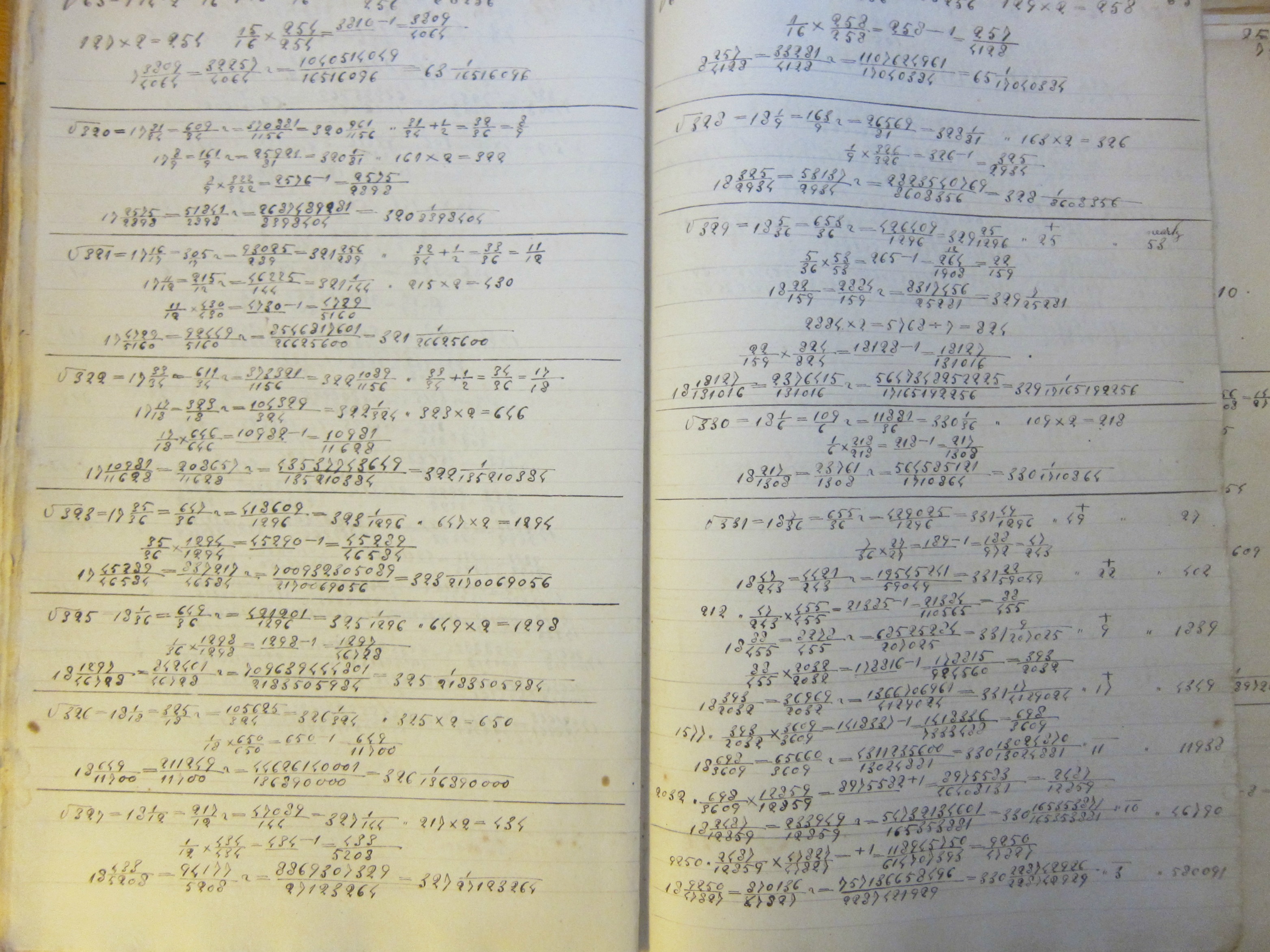
And a double-page sample of the work: