JF Ptak Science Books Post 264
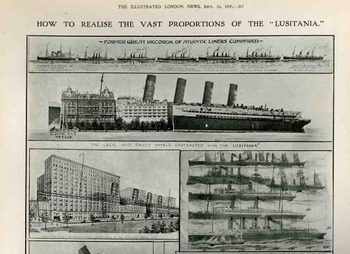
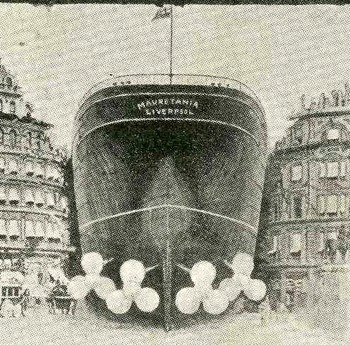
Just yesterday I made a post about Ships-in-the-Skyline as part of a series on the Visual Display of Information, saying that I recalled seeing another ship as part of a skyline but couldn’t recall the reference. Luckily just now I stumbled upon it, and it is better than memory served–it is also the sister ship of yesterday’s Mauretania, the even-more-famous Lusitania. This ten-part full-page illustration in The Illustrated London News for 14 September 1907 seems to cover all of the cityscape bases for ship comparison, and then some, from the Lusitania dwarfing the Cecil/Savoy Hotels, or behind the Manchester Town Hall, to being printed in outline against the enormous Auditorium Hotel in Chicago. I think that for most people, numbers don’t quite “do” for comparative discussions on unrelated objects–illustrations like this, though, form a perfect understanding almost instantly.
There are four other outstanding comparative views, though, that are just simply remarkable, using points of view that I’ve not noticed before.
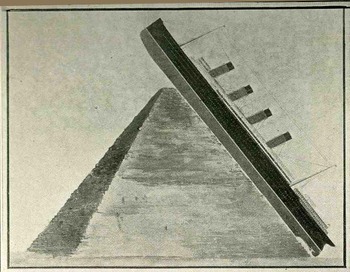
1. The first is the spectacular image of the Lusitania on the side of the Great Pyramid–taken alone, discretely and removed from context this image would be a prime example of the Found Dadaist division of my imaginary museum of Found Art..
2. This next image, below, is one of the rare times that buildings are displayed on a horizontal axis next to a ship–in this case, its the (Stieglitz) Flat Iron Building (NYC). A bonus with the Flat Iron Building was placing the plan of the structure on the superstructure of the Lusitania! This was a superb idea.
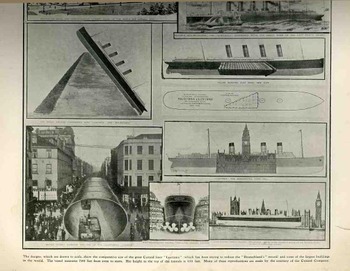
3. I’m certain that this bit of early 20th century pre-photoshopism must’ve stopped the casual view in their tracks–seeing the stern of the Lusitania completely filling up Northumberland Avenue at Trafalgar Square must’ve been a true surprise to the visual system.
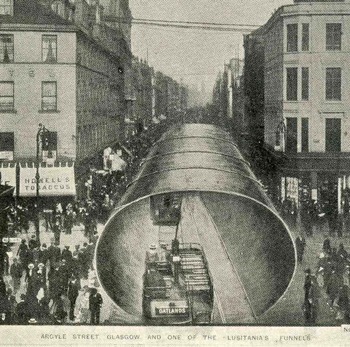
4. The last of the four shows one of the four great funnels of the Lusitania on its side allowing traffic to go through it for two blocks or so, resting on its side on the great Argyle Street in Glasgow. If all four stacks had been placed end-to-end, traffic could’ve continued through it for 7 blocks or more.