A Daily History of Holes, Dots, Lines, Science, History, Math, Physics, Art, the Unintentional Absurd, Architecture, Maps, Data Visualization, Blank and Missing Things, and so on. |1.6 million words, 7500 images, 4.9 million hits| Press & appearances in The Times, Le Figaro, Mensa, The Economist, The Guardian, Discovery News, Slate, Le Monde, Sci American Blogs, Le Pont, and many other places… 5000+ total posts since 2008.
This forms the absolute end of something, the “tip” of it, one of two, at the either end of slender cord. Even for this there must be a patent–and there were, evidently, many of them. This is just one, from 1922
It may be that the history of human locomotion is the story of fast sitting. Except for some of the earliest incarnations of powered movement, it seems one of the most significant engineering aspects moving a person forward is how that person should be carried in the vehicle. And, well, it seems that in the vast majority of cases, the person is sitting. (There are of course exceptions, notably in say the standing of the engineer in the Tom Thumb when that locomotive set the land speed record;or the Wright Brothers’ powered aircraft, where the pilot was laying down; or say in a chariot powered by a team of horses. Even in some of the earliest versions of steam-powered tractors, the mammoths were steered by a standing operator. It seems though that in very quick order the operator in most of these vehicles find themselves in a seated position.)
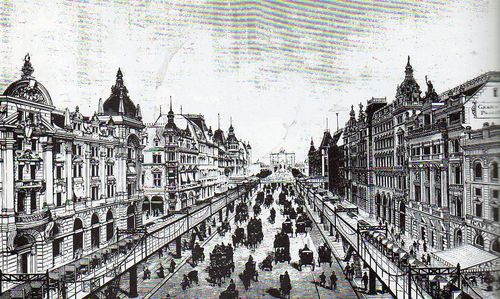
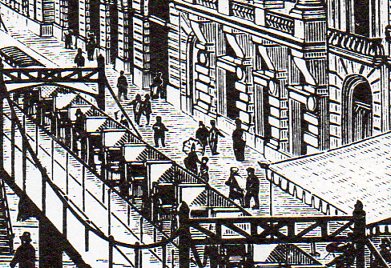
A very curious application of moving seated humans is seen in this woodcut of a chaired walkway–for all intents and purposes, the pedestrians looking to use the moving sidewalk would have been offered a chair instead. It seems as though as its base that this was a very simple form of an elevated subway or trolley, though without the train.
The moving seated sidewalk was the dreamchild of Alfred Speer (1823-1910), of Passaic, New Jersey, and it seems as though it might have been the first form of mass rapid transit in the city for which it was intended, which was NYC. It stood fairly high in the opinions of some prominent New Yorkers (like Horace Greeley and Peter Cooper) when it was presented in the early 1870’s, and even passed the New York State Legislature in an act authorizing funding for the program in 1873 and 1874–but it was each time vetoed by Governor John Dix, and the people-moving dream ended there, right before the Centennial. (See here for the New York Times obituary for Speer., and see All Ways NY blog for a longer look at Speer’s moving sidewalk, here.)
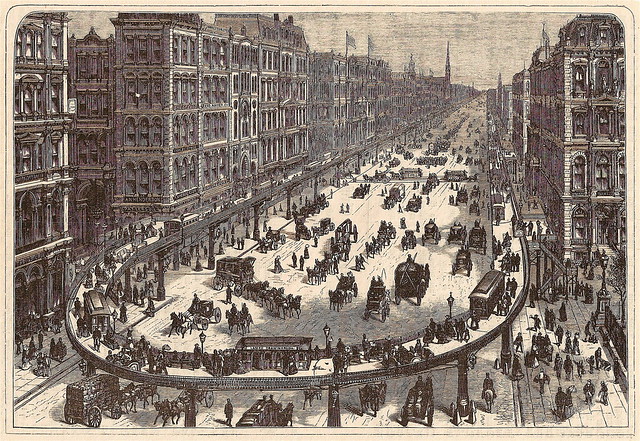
Here’s another version of Speer’s idea, though this look more like a moving sidewalk, complete with trolley cars, all of which were stationary objects located on the moving walkway. The idea of course was to free up the chaos and gridlock of the very busy areas of Broadway by placing a large chunk of the confusion on a moving second floor. It seems as though it might have been a good half-year idea or so, and the $3.7 million dollar price tag might’ve been a hefty one if you calculated the cost per minute of relieved traffic.
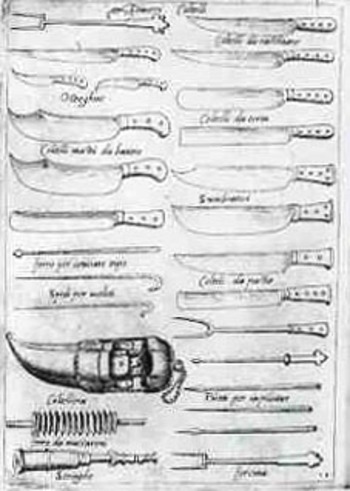
Apropos of nothing whatsoever, I’d like to look at four “first” F’s. the first is the first known published image of a fork , or forcina in Italian. This was a prickish utensil (seen in the image at the bottom-right), hiding none of its stabbing qualities with a middle tine, and shows for us all its direct decent from Mother Knife. It appears in the Opera dell’arte del cucinare by the great Renaissance chef and cook to Pope Pius V Bartolomeo Scappi (c. 1500 – 13 April 1577, buried in the church of SS. Vincenzo ad Anastasio alla Regola, dedicated to cooks and bakers) was published in 1573.
In the book he lists approximately 1000 recipes of the Renaissance cuisine (some of which, for Renaissance salads, appear at bottom) includes many images of kitchenware, the fork being perhaps the most famous. (I used to know the first time that a fork appeared in a painting–of the Last Supper of course, but I’ve forgotten, though it does come right on the heals of Scappi.)
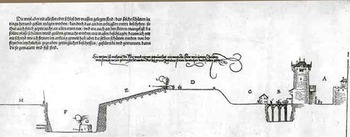
The second unrelated but interesting first “F” is perhaps the first image of a modern, canon-proofed fort, by none other than Albrecht Durer. This image appears in 1527 in his Etliche underricht zu bestestigung der Stat, Schloss und Flecken, and although his designs were impracticable (massive and massively expensive forts and fortified cities; pretty but very costly), there were certain elements of the work that were very useful—namely, the new face of some of te walls that he offered to the modern canons of the 1520’s. These weapons were vast improvements over their earlier brethren, and Durer responded to the extra and more accurate firepower by lowering and thickening the walls and giving them greater slope—this would aid in deflecting many of the shots that were not directly spot-on, and also would improve the chances of the fort’s survival against those hits by having thicker walls.
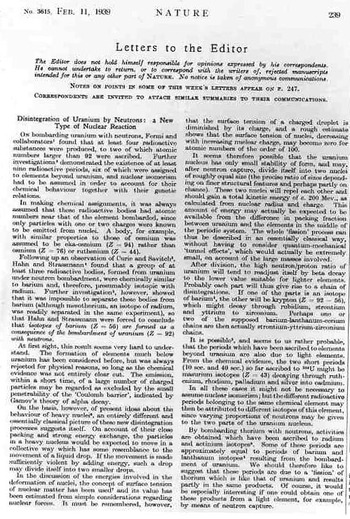
The third F is slightly related to Durer’s fort walls—this is the first appearance of the word “fission”. It appeared as so many of these sorts of 20th century announcements appeared with great sotto voce--this one, in a “Letter to the Editor” of the journal Nature (11 February 1939), by Lise Meitner and Otto Frisch.
The communication, “Disintegration of Uranium by Neutrons: a New Type of Nuclear Reaction” wasn’t a letter to the editor in the conventional sense of course but was meant to be the quickest line of communication of an important result and thus appeared somewhat truncated though the great stuff of the announcement was made known and understood. Niels Bohr’s “The Mechanism of Nuclear Fission” in the Physical Review (1 September 1939) may I think be the first use of “fission” in the title of a paper.)
There is a very big story here with Meitner and fission and Nazis and the Nobel. This leads to our fourth F: and that would be “F” as in “Failure” to the Nobel committee who in 1944 awarded the Nobel Prize to (German, non-Jewish) Otto Hahn for the discovery of nuclear fission while completely ignoring (purposefully, I would say) Meitner, who really, by all rights, should’ve gotten the award, and probably by herself. This is a more complex tale than I would care to deal with now, but I think that it is beyond doubt that the Nobel committee again (think Einstein and others) severely screwed this up in favor of maintaining their dislike for people with Meitner’s heritage. (And yes, she was Jewish; Einstein suffered too at the hands of the committee, not receiving his award, unbelievably, until 1921, *16 years* following what was probably the best single year that anyone ever had in the history of physics, ever, and then 14 years following his great year of 1907 and five years following 1916’s paper. And so on.) Yes, Meitner hung on in a not-good way in Germany for six bad years 1933-1938) until she finally get the hell out, but that really doesn’t tell the story very much. The fission bit with Hahn and Strassmann is a little bedeviling, but it really was Meitner who recognized the whole thing as being the process of fission. Period. And shame again on the Nobel people for getting it wrong, again, on purpose.
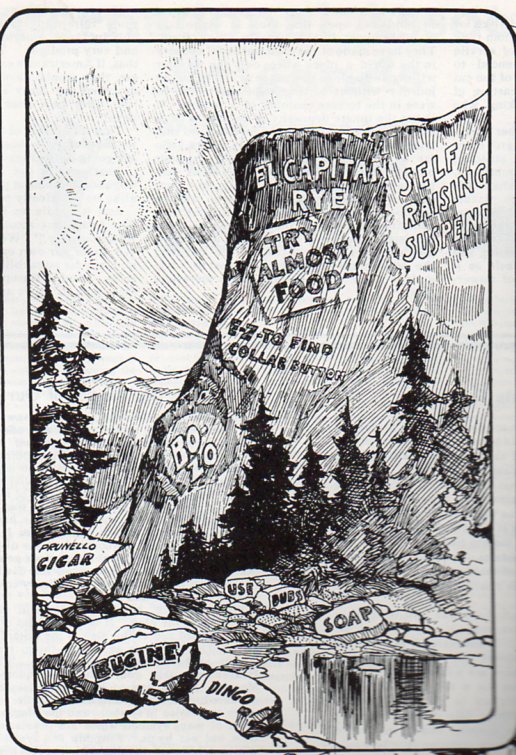
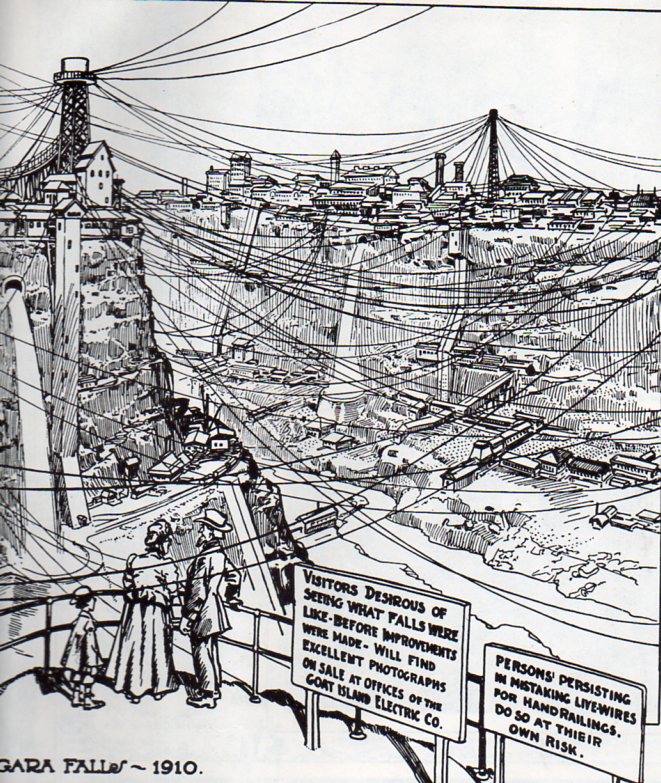
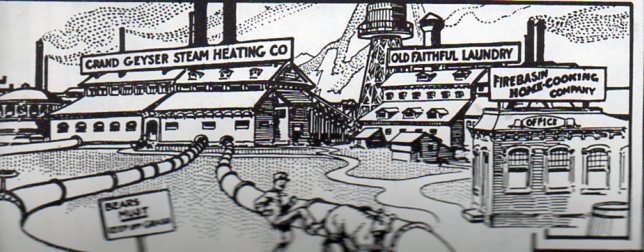
The way of the new world, the spread of commercialism and of consumerism, the increase in the size of a middle class that was actually approaching what we today would think of as a middle class, the wanting rise of places for disposable income to go from millions of new people with spare money to spend, led the sellers of stuff-immemorial to start advertising their bits on the side of out-of-doors everything. The fight for the attention span of the new consumer went from the newspapers and magazines to the side of buildings and then, as the motor car began to proliferate, to thousands of miles of roadway.
But when these cartoons appeared in (the first) Life magazine in 1905, the car was still a distant image so far as common ownership was concerned, so the competition for the visual space of the new buying market was center on outdoor displays wherever people might happen to be outdoors. (Remember, there’s no radio or television to absorb advert money and viewer attention, so efforts were magnified on billboards.)
So Life took a peep into the future and didn’t like what it saw: the possible vast expansion of ugliness in the pursuit of whatever dollar might fall out of whatever pocket. Just a little warning to America is all–the future of the country might not look as pretty it used to be, what with millions of new billboards to place.
The future Niagra Falls, five years hence:
Old Faithful, Yellowstone, as it could be in 1910:
Samuel Clemens (1835-1910), who became Mark Twain in 1863 and then mostly stayed that way, had a great mind and was a superb writer and story teller–he wasn’t necessarily a great inventor, however. In the ear;y sea of his great achievements, in 1871–just after the publication of his first real best-seller, Innocents Abroad, 1869)–Clemens applied for and was granted a patent for a bra clasp. I don’t know if it is the bra clasp, or not, but for whatever reason Clemens pursued this interest all the way to the end.
In the year after the publication of Roughing It, and three years before the publication of The Adventures of Tom Sawyer, Clemens patented–essentially–a blank book. It was a special book/holder for the very-popular practice of scrap booking, and it seems rather ironic that someone who filled up so many books with words would get a patent for the sale of books that didn’t have any. Curious.
I was about to start a new series of posts on the History of Lines , something left out of this blog, oddly, given the different posts on the History of Dots and the History of Holes (and the History of Blank and Empty Things). A lot of that–the History of Lines business–has to do with the interpretation of things on paper: heart rate, “brain waves”, the motion of a bumble bee, navigation, and of course, words. (The great Kickapoo tracker Famous Shoes in Larry McMurtry’s Streets of Laredo, one of the Lonesome Dove tetralogy, found that the one thing he couldn’t track in this world were the marks on the pages of a book.)
But I was distracted by the idea of seeing something in a different context, of associating something with a sense experience far beyond its origin, and so the History of Lines will wait just a little–something just a little beyond seeing some electrical function of the brain inscribed as a long line on a skinny piece of paper. What I found was this–the invention of Mr. E. Hardy, whose “Formenephone” detected the presence of combustible fire-damp or any other gas in mines, and which would then emit sounds on the accompanying (small) organ pipe. The apparatus would actually vibrate more rapidly as the gas content of the air increased. At the time (the notice of the invention appearing in the Scientific American Supplement #945 for 10 February 1894) the only other means of detecting these gases was by the change of the glow of a candle.
Perhaps this is in a way like the application of musical notes to the numbers pi or tau, though actually useful.
I’ll return to the History of Lines tomorrow.
Notes:
Formene, or marsh gas, is a “hydrocarbon which produces chloroform when the hydrogen in it is replaced with chlorine, loses hydrogen and yields anthracene”.
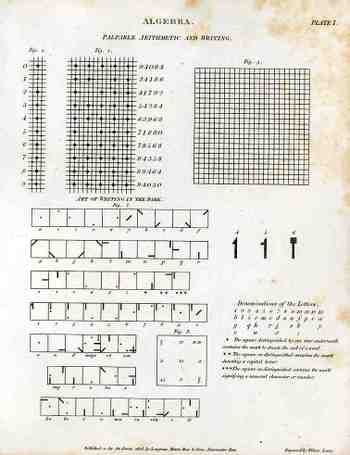
This curious illustration appears in forty-five volume Cyclopedia of Abraham Rees (published 1795-1820), displaying a system for communicating over distances at night. When this part of the Cyclopedia was printed in 1808, the electrical telegraph as we now it was still 37 years away from coming into being–45 years from being somewhat well-used. Before this time (visual) communications over long distances at night were limited to just these sorts of means–lighted semaphores, hand-held torches, that sort of thing. Signaling at sea at night was somewhat different at this time and didn’t include anything remotely close to the alphabet. So the rather complex system that we see at left is extremely uncommon–it seems also very cumbersome to put into effect.
Unfortunately I don’t have the text volume that would explain then entire system and implementation, so I’m going to guess that there was a large, powerful light source that was covered by a tight, black, covering tablet that would eliminate nearly all light leakage. The symbols for each letter of the alphabet (and numerals) would be cut out from another tablet that would fit over the face of the light source, placed between the blank and the light. To transmit a letter the user would then simply remove the blank covering tablet to reveal the light broadcast by the hole or slit in the tablet underneath. The blank would then be placed back, a new tablet for a new letter placed underneath, and the process would begin again: blank (dark); letter (light); blank (dark); letter (light), and so on to the end of the message. I guess the distance at which these symbols could be seen would be dependent on light source, atmospheric conditions, ad so on. The way that the letters are made into symbols seems to me very intelligent, so that you distinguish the differences from an appreciable distance. I like it–its an elegant idea. (Well, maybe it didn’t work in this manner, but it seems to make sense to me.)
One can only imagine what the early 19th-century mind would think if they saw this sort of fire-writing device, and how the progress of the history of technology came to produce such a thing:
Now, does someone look at the pen ashtray and think, “I NEED one of those!”, or what? To me it represents one of those representatives in the Humans-are-as-Soft-as-Soup category.
Here’s another sort of fire writing, more literal and of course much less applicable, unless you were recording the writing with a stop-action camera:
Lots of these images have to do with walking and falling, walking and falling at the same time, walking and catching yourself from falling over and over again, but in general that walk is only one step, so far as parachutes go.
The parachute has certainly been around for a long time–from ancient times if you squint your eyes hard enough–though it appears that it was in the Renaissance that the idea was taken more seriously as a practicable thing: at least it was first depicted then. Here for example is a form of falling that was seen as flying (Homo Volens or Flying Man), in this depiction of parachute-use by Fausto Veranzio Fausto (1551–1617) in his book of technological marvels called Machinae Novae (1595). Of course Leonardo left a footprint here as well, and before Veranzio.
More convincing and potentially beneficial parachutes were constructed for balloon escapes/aviator descents in the 19th century, as seen with the work of André-Jacques Garnerin (1769-1823), who was the inventor of the frameless parachute (a framed version seen below).
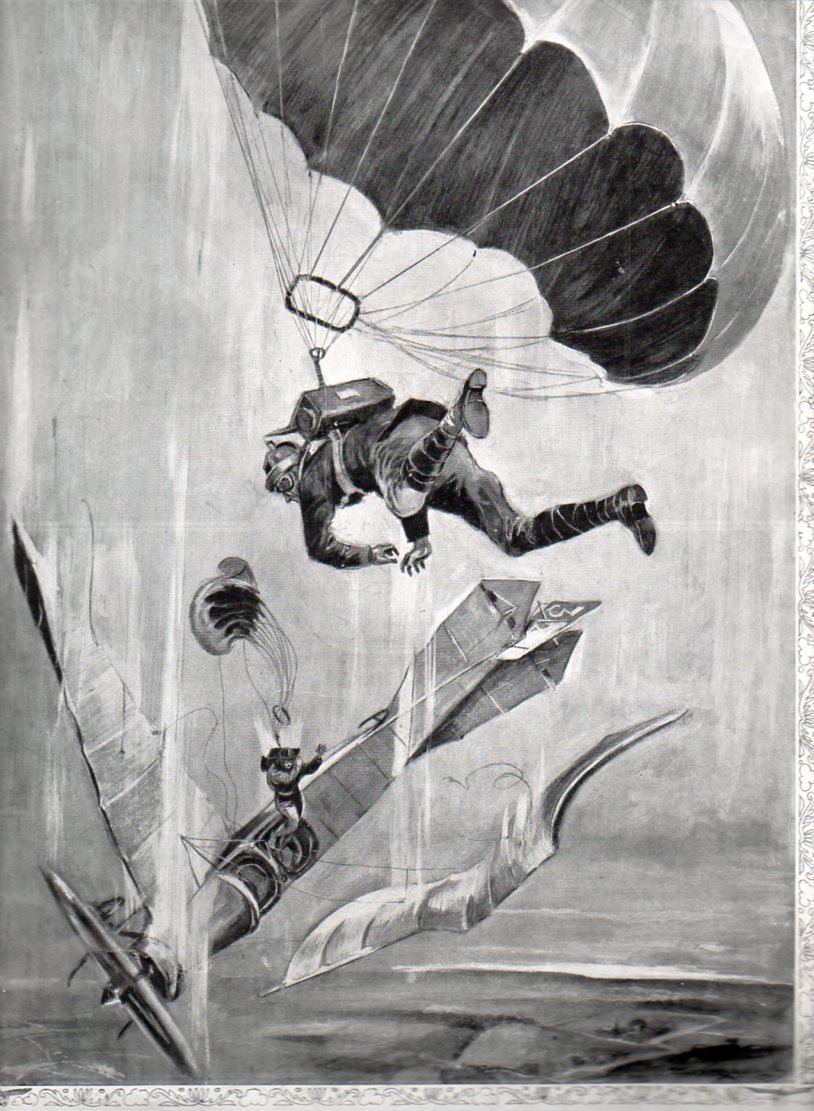
And in all that time of development through the nineteenth century, it still took another eight or nine years or so after the Wright’s flights to have employed the idea for pilots of the modern airplane. There was a series of varied “firsts” of leaving an aeroplane by parachute in 1911 and 1912, the earliest of which involved the pilot of an aircraft to fly with his parachute in his lap, then throwing the whole thing from the plane with the pilot following. Parachute history during this time, like 1910-1920, is a little complicated, filled with fits and starts, mostly not very successful, and most of them of a quality and dependability to make you want to land your aircraft even if you were flying only smoke and flame.
The image below seems to depict the 1912 exploits of the American and British inventors who at about he same time developed a parachute that could be worn in a box on the aviator’s back, contained in a box with a removable panel. It was a very heady development, and the whole idea–seen here in the pages of The Illustrated London News for 28 September 1912–must have seemed like science fiction to the casual reader, the caption beginning
“…our illustration appears to be somewhat fantastic…” The ripchord, one of the most important elements of a parachute, didn’t get introduced into the fray until about 1916, and the real utility of the parachute doesn’t seem to be developed until 1920 or so. In the meantime, the whole business of flying was pretty much being done without a safety net, so to speak.
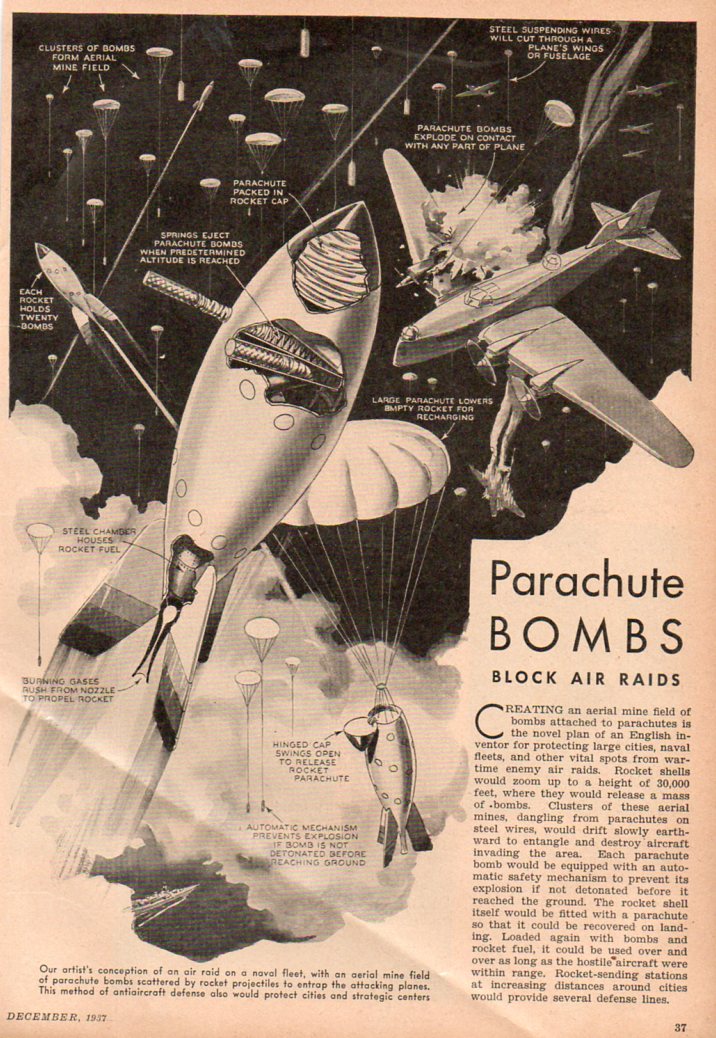
But what I realloy wanted to get to in this post is something that did look “somewhat fantastic” to the readers of its day, as it does to me now: parachute bombs. As a late-night, five-martini idea it looks great, especially in 1937. But the fact of the matter is that it does look like a bar stool plan similar to barrage balloons if barrage balloons were smaller, higher, fell and had bombs. One element of surprise though may have been what would happen to the great percentage of these bombs that were fired above and floated back down to Earth with their warhead still attache to the parachute and unexploded. The article states that the warhead would be disabled
before it hit the ground, but then what? I suspect that there would be thousands of these buggers littering the land/cityscape, which means that there would have to be an equivalent of an ambulance corps riding around finding, collecting and hauling these things off. Seems like a non-started to me. Plus there would be far more effective anti-aircraft elements developed very soon after this, not to mention the terribly significant mathematical and technical developments that would go into the fire control issue of the weaponry. ( But that’s another story, another long story, dealing with how to get aircraft out of the air–there’s some very sophisticated AA weaponry produced during WWI, s decade and a half before these parachute bombs, that would seem to make these things a bad afterthought.)
JF Ptak Science Books Post 1452.223221 and a quarter
I like the idea of having something called a Dividing Engine–perhaps it would divide seeds, or complex problems, or simple problems, or perhaps it would divide division.
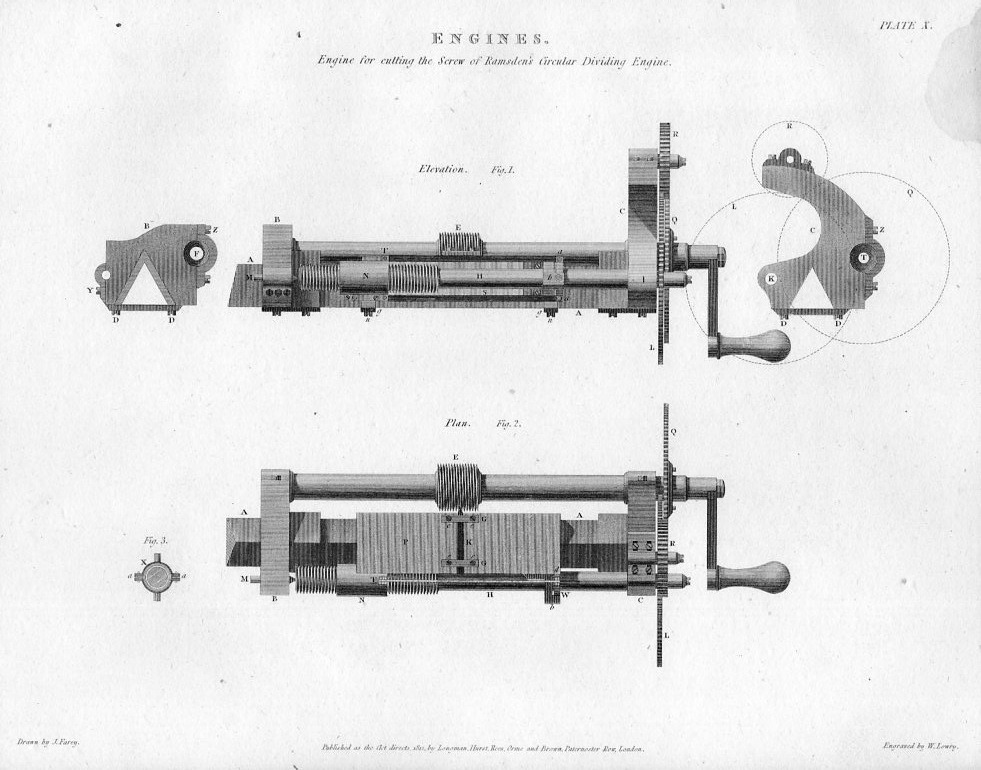
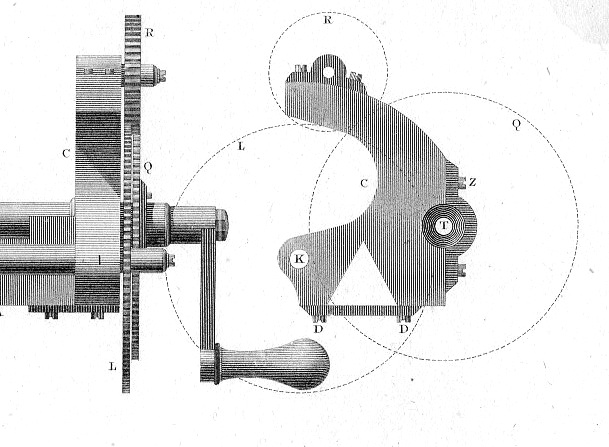
What it really refers to here is a precision tool that whose effects were extremely wide felt but about which we don’t really hear about today. This is the dividing engine of Jesse Ramsden,and Englishman who invented a circular instrument that would incise precise values on precision instruments like surveying compasses, delineate the linear and circular scales of measuring instruments used in astronomy and navigation, Before Ramsden, the engraved marks on instruments would have been made by each individual manufacturer, each of those depending on marks that they made in the past, generations of such things in a line, over and over, a quite individualized effort, necessarily dependent upon the precision of each manufacturer. In 1777 Ramsden produced an instrument1 of exception precision that was correct and fine and dependable2. [The image above was found in Abraham Rees’ monumental Encyclopedic Dictionary…, and is entitled “Engine for cutting the screw of Ramsden’s Circular Dividing Engine” and was published in 1814. Below is a detail of the plan for the winding of the gear works. In order for his machine to work at such a high degree of accuracy the component parts must also have been of a very high calibre–to that end Ramsden developed what is essentially the modern screw cutting lathe from which he manufactured the gear works for his Straight and Circular Dividing Engines.3]
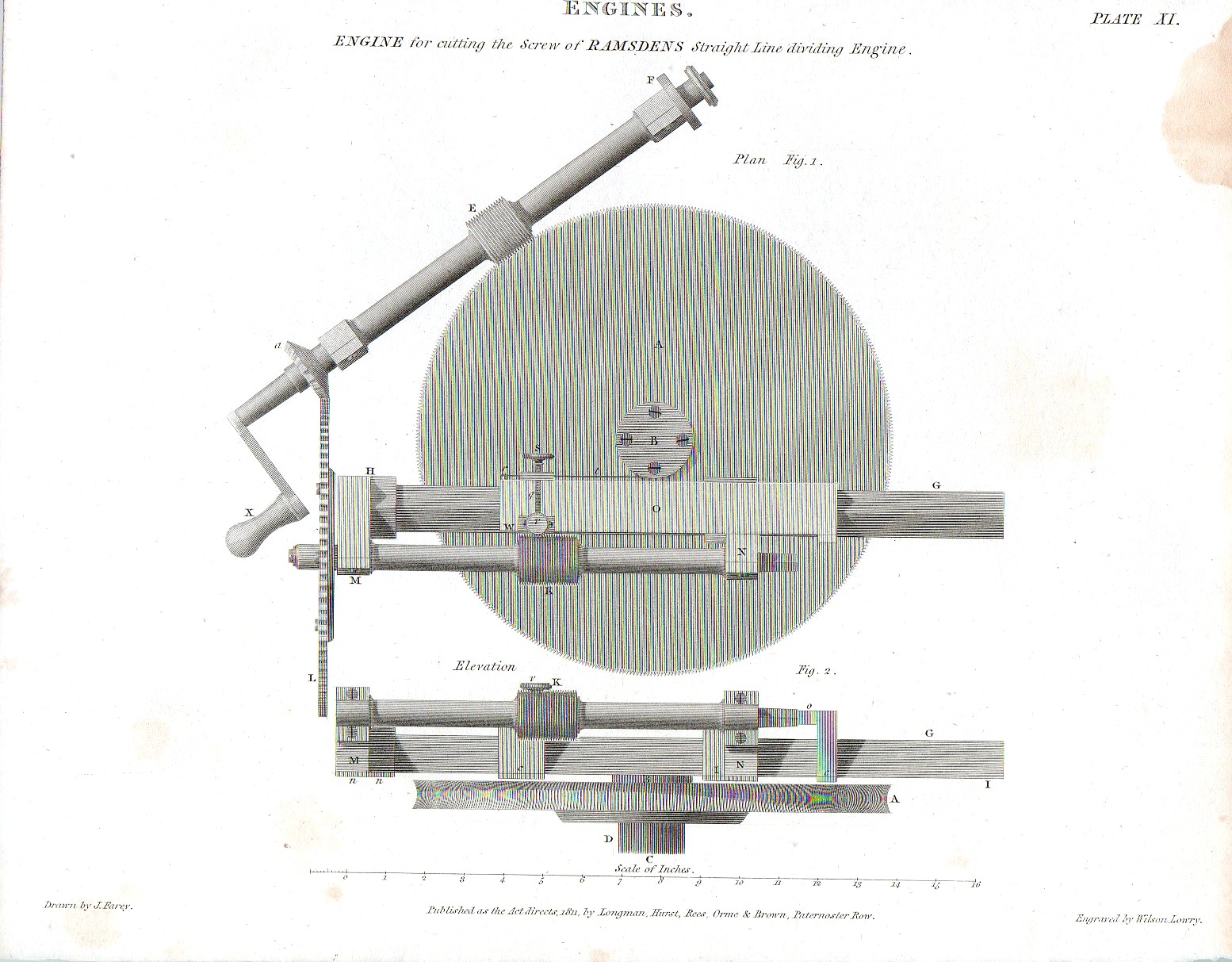
And then there was the “Engine for cutting the Screw of Ramsden’s Straight Line Dividing Engine”, which is an absolutely gorgeous piece of drawing. A person could crawl all over this image in varying degrees of microscopic inspection and find all sorts of beautiful internal images, a large example appears here:
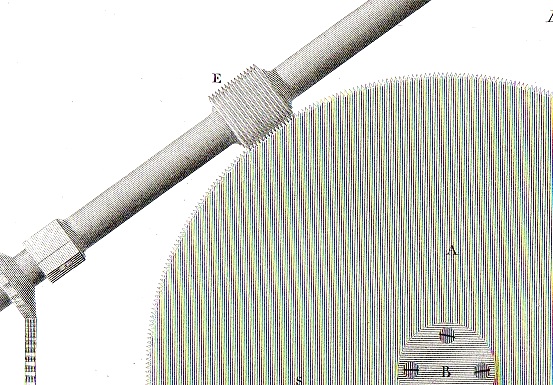
And its fantastic detail:
Basically though Ramsden’s inventions were key additions to the developing scientific technologies of the Industrial Revolution, integral improvements necessary for integral improvements.
Notes:
1. He published a Description of an Engine for dividing Mathematical Instruments in 1777.
2. “The dividing engine was simple to operate. The instrument being divided was fixed to a large wheel on top of the engine. When the treadle was pressed, the wheel and the instrument were turned through a fixed angle. Then with the right hand, a cutting tool guided by a system of swinging links was used to mark the instrument scale. The process was repeated until the complete scale had been divided. Although this was many times faster than hand-dividing, it was backbreaking work having to lean over the engine to work on a small instrument.”-“Dividing Engine.” Smithsonian National Museum of American History. americanhistory.si.edu/collections/navigation/object.cfm?recordnumber=694508
3. From WIki–“The first truly modern screw-cutting lathe was likely constructed by Jesse Ramsden in 1775. He appears to have been the first person to put a leadscrew into actual use (although, as Leonardo’s drawings show, he was not the first person ever to think of the idea), and he was the first to use diamond-tipped cutting tools.[2] His device also included a slide rest and change gear mechanism. These form the elements of a modern (non-CNC) lathe and are in use to this day. Ramsden was able to use his first screw-cutting lathe to make even more accurate lathes. With these, he was able to make an exceptionally accurate dividing engine and in turn, some of the finest astronomical, surveying, and navigational instruments of the 18th century.
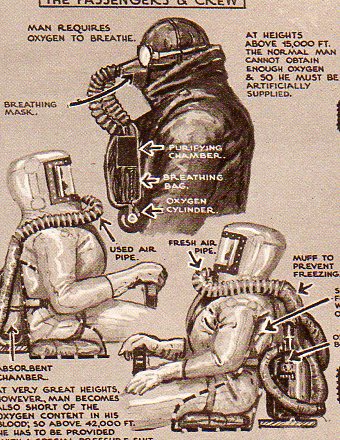
If I put my literary specs on and do a little free-association, what I see in these two figures is a Proustian thing, characters in search of time, freezing time, preserving it. Time, and everything else, everything that can be associated with a human experience captured and recaptured, recirculated, resuscitated, replayed, re-envisioned, remembered, recognized, over and over again. Kind of like a memory hell, in a way, only in Proust’s hands it all sounds and tastes so beautiful. Another peek without those wicked mega-specs and I see two robots from a pulsing Disney film, actions in search of characters–the possibilities are endless, particularly if you develop a little narrative. The real story of what is happening here is complex version of a simpler solution.
And the key to it all: hypoxia.
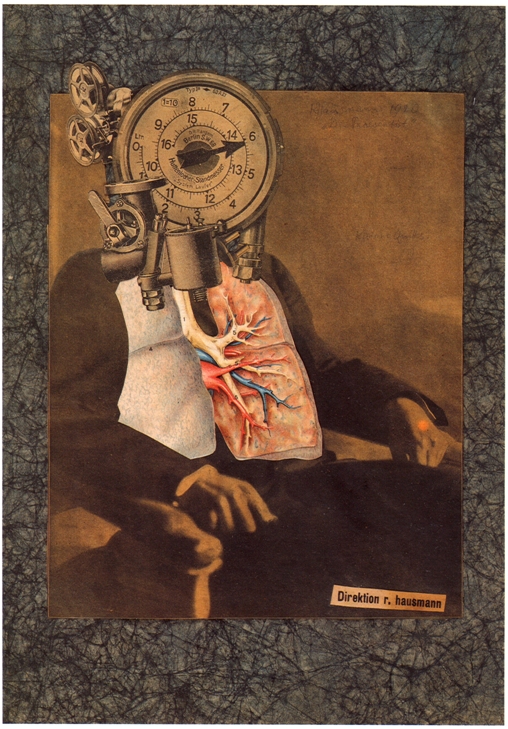
But I can’t leave this without at least a mention of Raoul Hausmann, whose “Self Portrait of a Dadasoph” is related to this line of collecting consciousnesses:
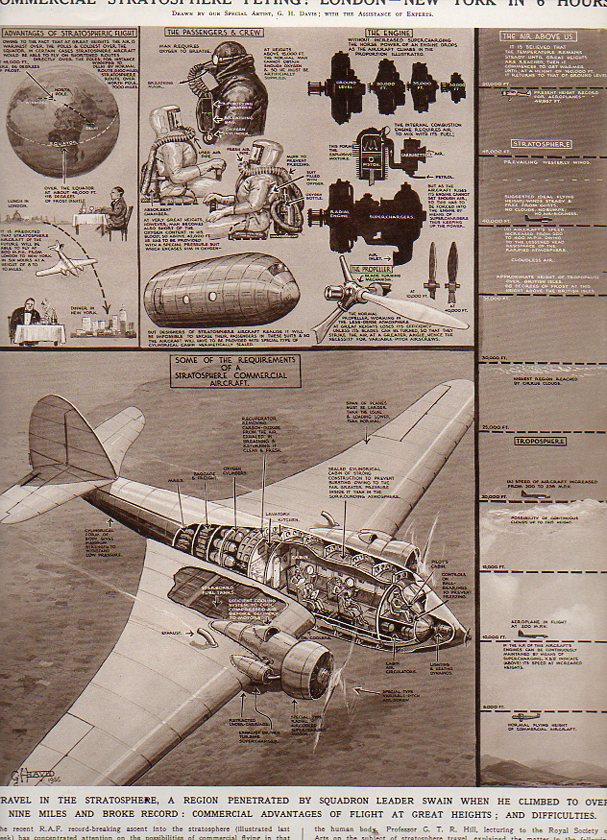
When this next image was published in the Illustrated London News in October 1936 the practical application of tropospheric flight was just about a reality. I should really say “popular” more so than “practical”. It presented two approaches to a looming problem in the progress of aviation–reaching altitudes in excess of 10,000 feet begins to present a host of problems to the passenger of that aircraft. The solution was to combat the pressures of high altitude flight, one of which was to pressurize each passenger and crew member in their own “space suit”. The combination of the artist G.H. Davis1 and the technical assistant compared this solution to the problem with a more simple and elegant solution. And that was relatively simple, at least in thought experiments: rather than pressure everyone individually, you could place everyone in a pressurized environment within the aircraft. And this is the point that the artist/techie make–earlier engineers came up with simple solutions to traveling at high altitudes–they just weren’t simple enough. And compared with the better design, the initial, simple, designs look a little monstrous.
Notes:
1. I include Mr. Davis as an iconic figure in the history of 20th century technical illustration–he has been featured on this blog many times.