JF Ptak Science Books Post 1341
If I put my literary specs on and do a little free-association, what I see in these two figures is a Proustian thing, characters in search of time, freezing time, preserving it. Time, and everything else, everything that can be associated with a human experience captured and recaptured, recirculated, resuscitated, replayed, re-envisioned, remembered, recognized, over and over again. Kind of like a memory hell, in a way, only in Proust’s hands it all sounds and tastes so beautiful. Another peek without those wicked mega-specs and I see two robots from a pulsing Disney film, actions in search of characters–the possibilities are endless, particularly if you develop a little narrative. The real story of what is happening here is complex version of a simpler solution.
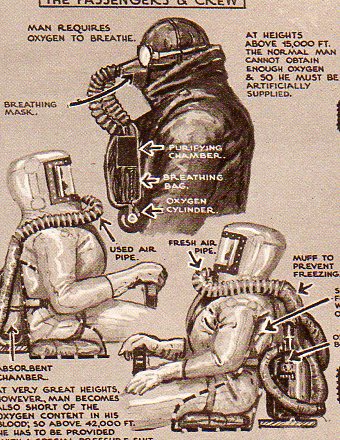
And the key to it all: hypoxia.
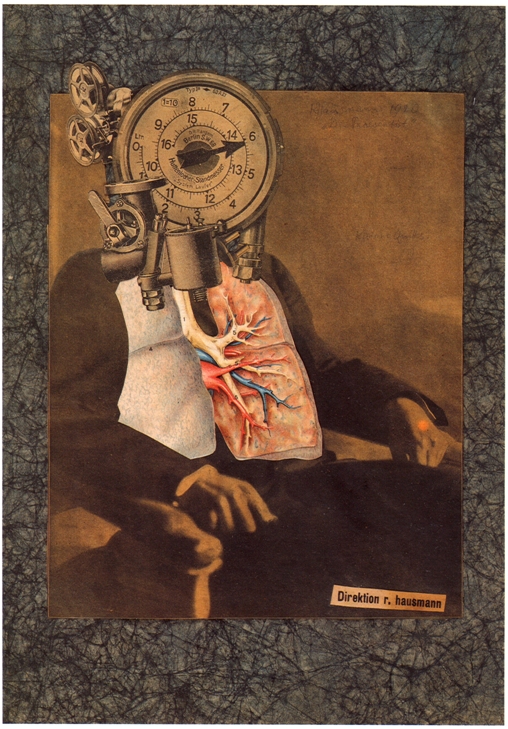
But I can’t leave this without at least a mention of Raoul Hausmann, whose “Self Portrait of a Dadasoph” is related to this line of collecting consciousnesses:
When this next image was published in the Illustrated London News in October 1936 the practical application of tropospheric flight was just about a reality. I should really say “popular” more so than “practical”. It presented two approaches to a looming problem in the progress of aviation–reaching altitudes in excess of 10,000 feet begins to present a host of problems to the passenger of that aircraft. The solution was to combat the pressures of high altitude flight, one of which was to pressurize each passenger and crew member in their own “space suit”. The combination of the artist G.H. Davis1 and the technical assistant compared this solution to the problem with a more simple and elegant solution.
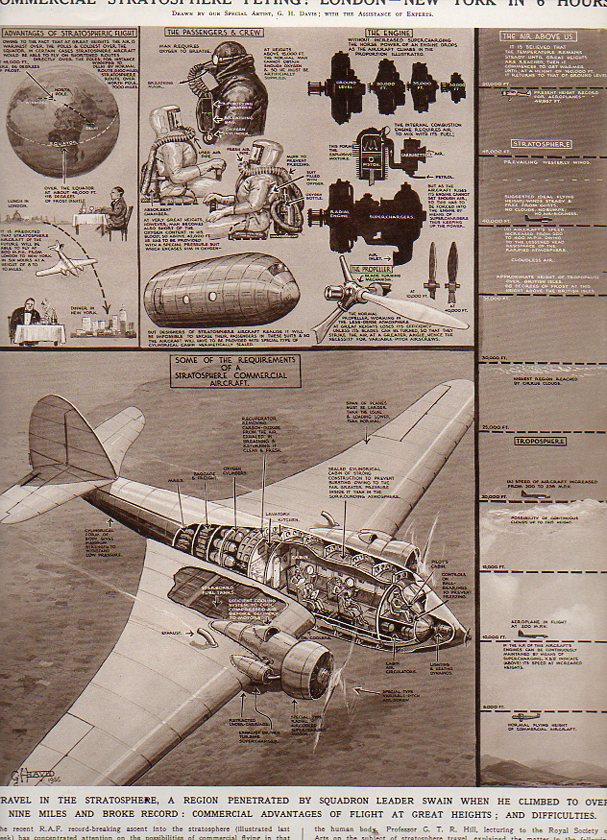
And that was relatively simple, at least in thought experiments: rather than pressure everyone individually, you could place everyone in a pressurized environment within the aircraft. And this is the point that the artist/techie make–earlier engineers came up with simple solutions to traveling at high altitudes–they just weren’t simple enough. And compared with the better design, the initial, simple, designs look a little monstrous.
Notes:
1. I include Mr. Davis as an iconic figure in the history of 20th century technical illustration–he has been featured on this blog many times.