A Daily History of Holes, Dots, Lines, Science, History, Math, Physics, Art, the Unintentional Absurd, Architecture, Maps, Data Visualization, Blank and Missing Things, and so on. |1.6 million words, 7500 images, 4.9 million hits| Press & appearances in The Times, Le Figaro, Mensa, The Economist, The Guardian, Discovery News, Slate, Le Monde, Sci American Blogs, Le Pont, and many other places… 5000+ total posts since 2008.

Category: Inventions

  • Dialing Remote Live Music–a Trip into the Future, 1892

    JF Ptak Science Books   Quick Post

    Theatrophone

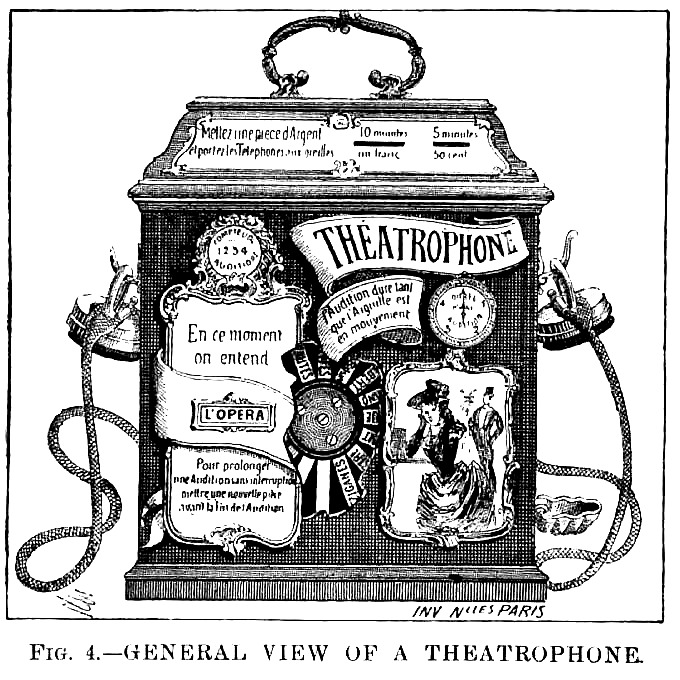
    There is a veyr interesting period in the history of thought transmission where answers were coming together–they were interesting technological answers in the steps towards mass broadcast that were fruitful for the time and capacity but which were ultimately overtaken by other events.  Such is the case in this case of early “radio” transmission, with the popular introduction of a device called the “Theatrophone”, explained in this article in the Scientific American for July 2, 1892.  The device was a telephone-like device that allowed people to listen to live performances of opera/symphony remotely–for a modest fee of one franc for ten minutes or half a franc for five minutes.  There was also a dial to select the sort of entertainment you wanted if there was a selection available, which you can see in the semi-cutaway in the image above (with “opera” being the selection).  I feel that the first exposure of this device to a general audience in 1892 would have been an astonishing next-step in the development of a new medium, like being exposed to the internet while only having known television. 

    The Theatrophone makes its big appearance in La Nature and Scientific American at a time of dynamic change in the development of radio. Elements of radio were established by Faraday (1831), Henry (1842), Maxwell (1864), Houston (1871), and Hertz (1888)–the experience in the 1890’s was different, with wireless transmission  nearly established, and with Elihu Thompson, Wm Crookes writing in 1892 about the possibility of this capacity in “Hertzian Waves” and with Tesla, FitzGerald, Lodge, Dolbear and other giant names saying in 1893 that sound transmission would soon be accomplished.  Marconi’s patent would be issued four years later in 1896, and by the end of the century and into 1902 there are reports of trans-Atlantic transmissions by Marconi and Fessenden.  But back in 1892, the Theatrophone offered a glimpse into the near-future, allowing people to listen to live entertainment, remotely. 

    • The Scientific American article is reproduced in full at the Radio History website, here: http://earlyradiohistory.us/1892the.htm

  • Heavy Electricity, 1879

    JF Ptak Science Books  Post 2496

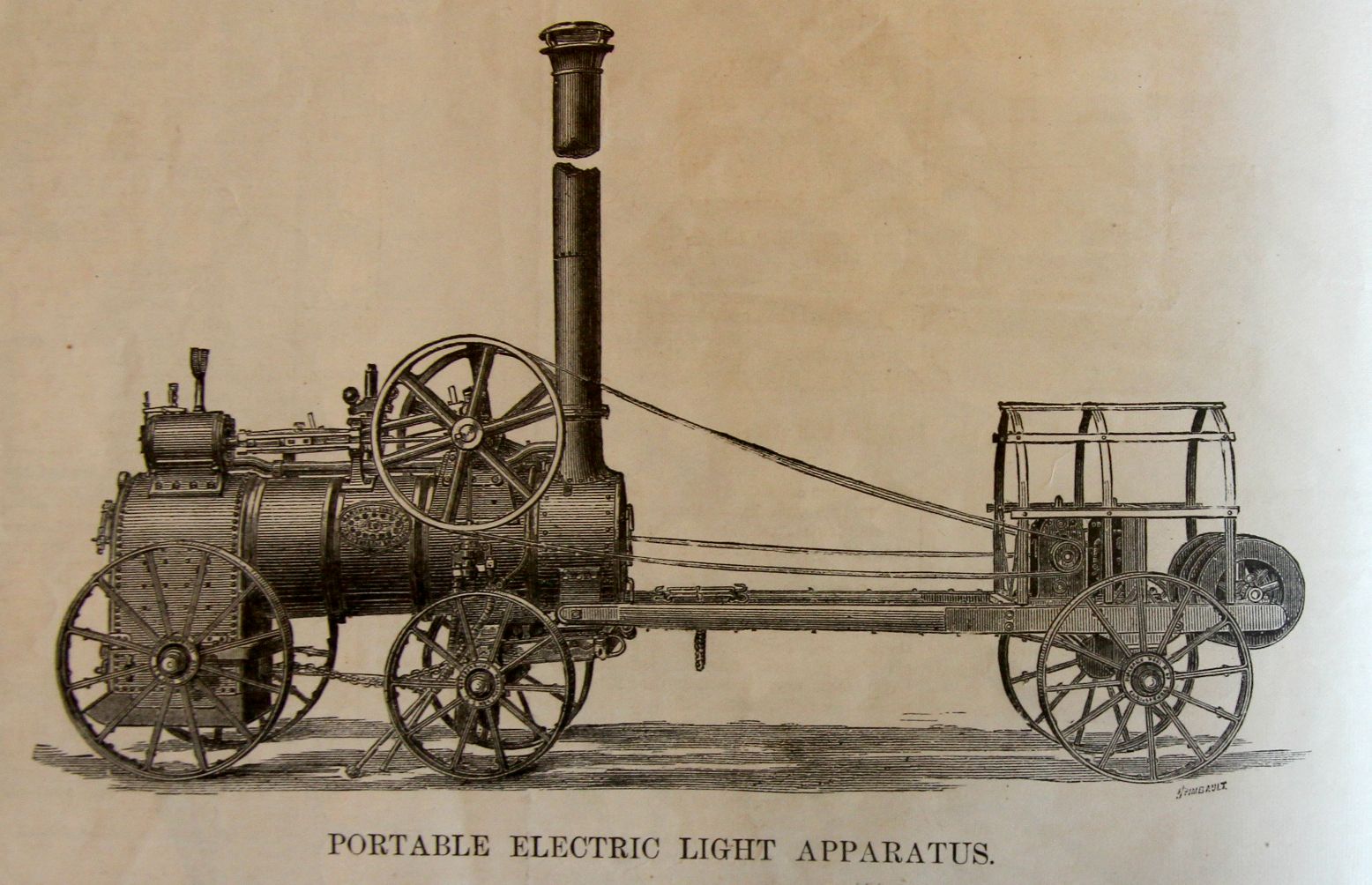
    Inventors had been experimenting with the electric light for decades before Thomas Edison patented his ever since it in the same year that this engraving appeared (1879).  Ever since is became possible to believe in the practicality of the power source of electricity (rather than the very problematic gas) with the demonstrate of Humphrey Davy’s electric arc lamp in 1809, people like Lindsay (1835) and Geisler (1856) and Becquerel (1867) and Woodward (1875) and many others tried to perfect the form of electrical lighting.  Edison of course came up with the best idea, and the rest is history (and adjudication).  

    It is really no that long ago–in my great-great grandfather’s time–that the possibility of the expansion of lighting by electricity was new and very exciting (as well as the delivery of electricity for other stuff, but that is another story). It is also a time of tremendous achievement in delivering the power, which really only extends backwards to 1820 with Oersted (and his electromagnetic motor, and the thought of seeing a land locomotive for providing portable electricity must have been an enormous intellectual treat.  And here it is:

    Electric light apparatus portable 1879[Source: Scientific American, Supplement, June 7, 1879; apologies for the uneven lighting, but the book was big and thick and making the surface flat was out of the question.]

    As stated in the short article, this is a “very convenient arrangement” for delivering lighting remotely (“to contractors”), and was produced by Gainborough’s Marhsall, Sons & Co. for the electrical engineering firm of Crompton & Fawkes of London.  The dynamo-electric machines are on the small two-wheeled carriage and is connected to the steam-powered source on the four-wheeled carriage; it was a 6hp engine that could produce 6,000 candle power illumination. To the right of the electric engines are spools with 300 yards of cable which would connect everything to the electric lamps–evidently from arrival to light would take one hour.  For the time this was a magical thing.  


  • Robotic Preachers of the Year 2000, as Seen from 1834.

    JF Ptak Science Books    Post 2260                                          History of the Future series

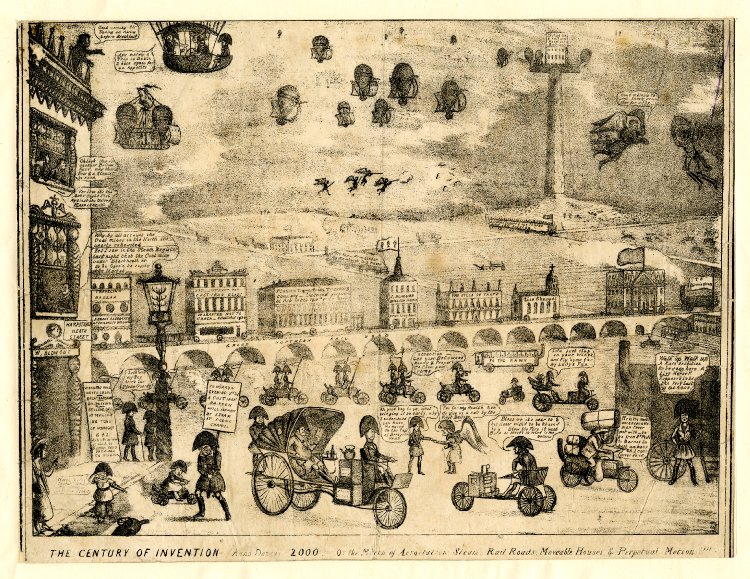
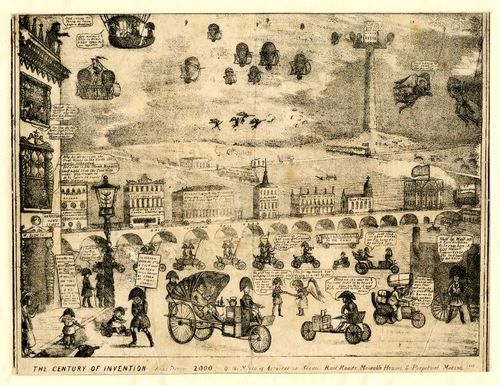
    “The century of invention Anno Domini 2000 or the march of aerostation, steam, rail roads, movable houses & perpetual motion” is a terrific lithograph, made ca. 1834, the handiwork and imagination of Charles Jameson Grant, a satirist and observer of high order.  He tried looking into the future 165 years hence, and in some practicable ways he got a lot of it right–the imagery wasn’t there, but the ideas were.  
    Grant year 2000

    [And as long as were slightly on the subject, the idea of “anno domini”, or “the year of our savior”, was an idea controlling the past and future aspects of time that came into being about 500 years after the birth of the event upon which the savior years are based.  The idea of anno domini was really in widespread use until the Middle ages were well underway, around the year 800.]

    It is difficult to make out from this print (found at the British Museum site, here) but the small visual clues and textual bits are very interesting.  First of all the print displays things like small and large individual steam-powered four-wheeled vehicles, as well as plenty of balloons (in the spirit of aviation, at this point in its fourth decade and entering a great heyday) passing each other in every which way, off on adventures, or work, or in a race (as with the “out of Sight Club”).   There are also numerous people flapping around in the sky (“winging it so early”)  with their (something)-powered wings, some of whom are hunting birds. 

    The main sensation here is speed, though I would not say it was democratic–the means to be able to got to Dublin in your balloon “for an appetite” and return later in the day would have been fantastic to the 1834 reader trying to image doing such a thing on such a whim, with a newspaper in your lap–but certainly it would be available to the leisurely class.  

    There was also an idea for balloonic (first time I’ve ever typed that!) communication, as one man in a balloon shouts to another to “give me a call by the first balloon”, meaning perhaps it is a communication device, or a balloon-delivered letter.  

    The dialog certainly portrays an attitude of unremarkable observation, conveying how commonplace flight and mobile towns and steam cars would be in the year 2000.  That’s where one of the great insights comes into play–at lower left there is a person remarking about a race, and the exclamation upon a great rarity being shown: a live horse.  That Grant would make this an issue is interesting, as it would certainly rub the 1830’s consciousness the opposite way of what the brain expected to see in the street, and that was horses.  Horses powered much of transportation at this time, and to imagine a world in which the horse would be gone would’ve been, well, unimaginable.

    Ditto too the great and extensive coal mines fueling the Industrial Revolution (and it isn’t as though factory workers in 1834 woke up int eh morning cheerfully exclaiming that, “Hey, We’re in the Industrial Revolution!”) going dry, the coal consumed.  

    Also at bottom there is a very unusual placard concerning robotics: “a cast iron Parson will preach by steam at Fudge Church”. Now this is doubly intriguing because it not only invokes a steam-powered person, but a (perhaps) thinking one.  It is also putting the word of god into the care and trust and tending–and right into the mouth–of a machine.In short–a robot preaching to a human choir.  This is still far removed from the singularity (and the assumption that Our Robot Overlords would have any interest in humans or their religious beliefs), and seems a bit on the primitive side in its display, but the intellectual imagery is pretty powerful stuff.  I assume that the power of this would’ve been less so at the time of publication, guessing that Grant was making more of a not-so-subtle satire on the steam-driven puffery of some preachers with the creativity of kettles, and that in the future this would be magnified to the point of steam and smoke. But still the idea of placing the deeply emotional stuff of belief systems in the control of a machine is extraordinary for the time, I think.

    So I think that if you hard enough at this print and don’t get distracted by the images Grant uses to try and visualize his ideas of eh future and concentrate on what these things represent, then I think that Grant got a lot of his vision right.  

  • Q: When is a Stringed Instrument a Trumpet?

    Marigini trumpet578JF Ptak Science Books  Quick Post

    A:  When it is a triangularly-based monochord called the “Trumpet of Marigni”.  It was designed 500 years ago to sound like a trumpet by virtue of the single string and the tremulations of the bridge.  I’m not so sure what it sounds like (though it sounded like a trumpet) but it certainly is a beautiful thing seen in profile. 

    This appears in A Course of Lectures on Natural Philosophy and the Mechanical Arts, by the encyclopedic polymath, Thomas Young.

    An 1845 version of the work and the engravings is available online–I’m using the engravings from the first edition that I have in hand, which are much cleaner than the later reprint. (I should say that the text is the same for the description of the illustrations so far as I can tell, though position and so on is different.)

    ·Posted by :

    ·in:

    —

  • Standard Corpse, Inc. & Deadpunk: Shaving, Cooling, Lifting, Electroplating, and Diapering the Dead

    JF Ptak Science Books   Post 1975   Follow Me on Pinterest

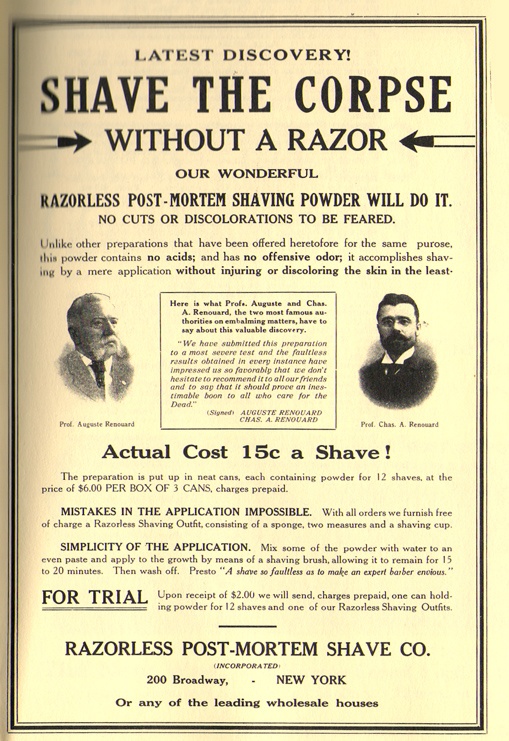
    The idea of creating an economy from a previously dead clientelle–the very after-market dead person–is relatively new. Once a middle class or lower working class with disposable income was created, celebrating the care of the dead was a paying option opened to the millions of families who were not the fastidious and celebratory wealthy.  Once the notion of having other people take care of the dearly departed became a part of the popular ritual of dealing with the dead, an entire new industry was born–spawning other related and associated industries for supplying the dead-care-givers with amenities and notions and necessities of a previously unthunk and unthinkable nature.  For example, the idea of needing to shave a corpse became an issue after it became fashionable to allow several days or more to pass between death and burial.  Beards and hair grow in death, so the people caring for the body and its display now were ordained an issue of economy in nultiple shavings of a corpse.  Now that may or may not have been an issue, but it was certainly presented as a possibility by the incredibly-named “Razorless Post- Mortem Shave Co.”


    Deadpunk shave

    {Many thanks to reader Max W for providing the information for the correct information for the citation of the above image–the magazine is Casket & Sunnyside for January 1912, and there are ample references to it in Charles Addams and Jessica Mitford.] The worry for the consideration of the cost of a shave (15 cents) for a dead person seems quite an inescapable weirdness and luxury. The weirdness of the name of the company nearly obscures it common nature–it isn’t exactly the Acme Corpse Company, but it is close to it, and it addresses just one small bit of minuatiae of deadness in the vast sea of Dead, Inc.

    The sellers of the razorless post-mortem shave equipment didn’t receive a patent for their process–nor did anyone else, for that matter, at least so far as I can determine. 

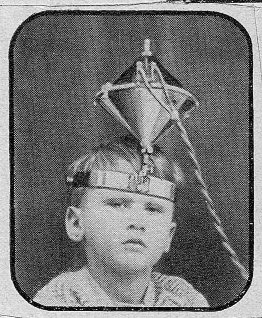
    Here are some further examples of Dead, Inc/DeadPunk patented death appliances:

    Post-mortem skull examination facilitator:

    Postmortem Underwear for the prevention of dead leakage and deodorization:


  • A Telephone Call From TomorrowLand and the Idea of Weighing Antique Surprise

    JF Ptak Science Books   Post 1973  Follow Me on Pinterest


    This ad appeared only 59 years ago–that’s four generations in dog years, two human generations (or one for the more later-in-life crew, which is appealing as I knew a man whose grandfather was born in the 18th century), and 15 generations in managing data and communications. Perhaps more.  It is difficult to imagine the intense surprise that attended this ad showing a practical and popular adaptation of a communications breakthrough. 

    Telephone future064

    The electromagnetic telegraph, which is arguably the first electrically-powered iteration of the internet, was in the works from the 1820’s until it was nailed by Samuel Morse in 1837.  It was 40 years to the development of the Bell telephone (another dramatic example of an invention/technological idea/breakthrough that was “in the wind”, a popular undiagnosed monumental meme, some decades in the making in the hands of Bell anbd Reiss and Meucci and Gray and even Edison). Two more decades (just past the turn of the century) until more-widespread wireless telegraphy, another two decades after that (1920’s) for poular radio, and another two decades after that (post WWII/1950’s) for popular television broadcating. 120 years between the patented invention of the Morse telegraph to 50 million Americans with televisions in 1955. 

    The “telephone” of 2013 is as removed as the telephone of 1955 as the telephone of 1955 was removed from the electromagnetic telegraph–we’re not meeting half-way in the meeting of improbable impossible worlds, of worlds of the future unimagined in the past.  That is what comes to mind when I see this add for the speaking telephone in 1954–the astounding, astonishing, speaking telephone, the phone that allowed you to not have the receiver to the ear, tht allowed you to do free-hand work and communicate at the same time.  It was an ambitious improvement, and as soon as the phone appeared, it became a standard of necessity if that necessity was within budget. 

    It is the weight of surprise that is so abundant looking at pictures like this, giving us the opportunity to imagine the surprise elements of another time. It may well be that the new 1954 user of the speakerphone would have looked at the first telephone systems of 1894 as we look on that 1954 telephone today.  Probably not so, though, probably it was much more imaginable to have forseen the 1954 possibilities in 1894 than for 1954 to have seen in the same amount of time to 2013:  the technological pieces necessary for part of that imagination had not yet been invented, the science ahead of the scifi. 

    The other part of this surprise element is that 1954 is well within living memory, and that this combinaiton of technology and physics and mathematics has grown so incredibly from the speakerphone to the massive changes in 2013–it is as surprising to imagine this as to imagine the same scenario for what ahppened a year before in biology:  it is difficult to grasp the  sweeping changes in that field from the identification of DNA in 1953  and how far those fields have come since. 

    I think that if one could quantify this sort of “surprise” that the greatest amount of “Surprise Integers” (or whatever) ever recorded would have taken place within these past 50 or 60 years. Which makes me wonder–will people 59 years hence see the pictures of our fabulous accomplishments in 2013 as quaint reminders of how much things changed between 2013 and 2072?  Will those “Surprise Integers” be as great for that period of time as the (“our”) preceding period with concomitant revolutions in thought?  My guess is “yes”–its just hard to imagine. 


  • Daily Dose from Dr. Odd: from the On-Beyond Quackery Department

    JF Ptak Science Books  Quick Post

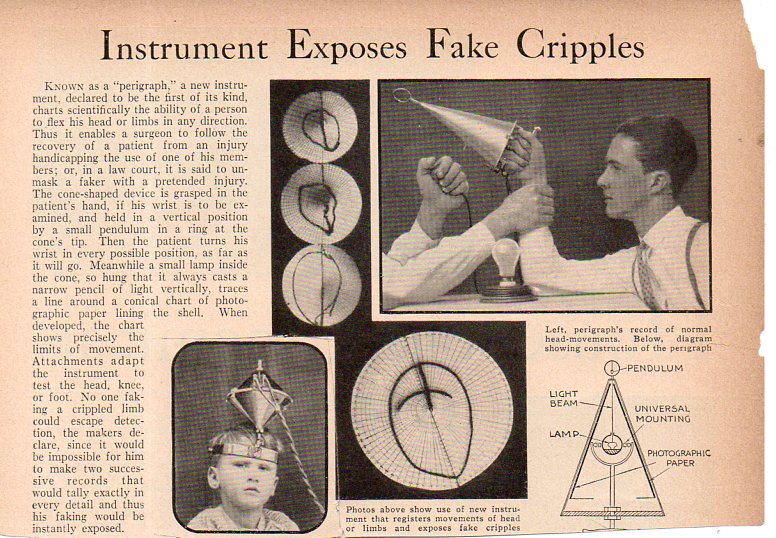
    Evidently there was a need real-or-perceived for this techno-attention, appearing in the March 1934 issue of Popular Mechanics:

    Fake cripples031

    Fake cripples030


  • Daily Dose of Dr. Odd: a Portrait of the Good Doctor

    JF Ptak Science Books   Quick Post      Part of the Daily Dose from Dr. Odd series


    Follow Me on Pinterest


    Dr odd013
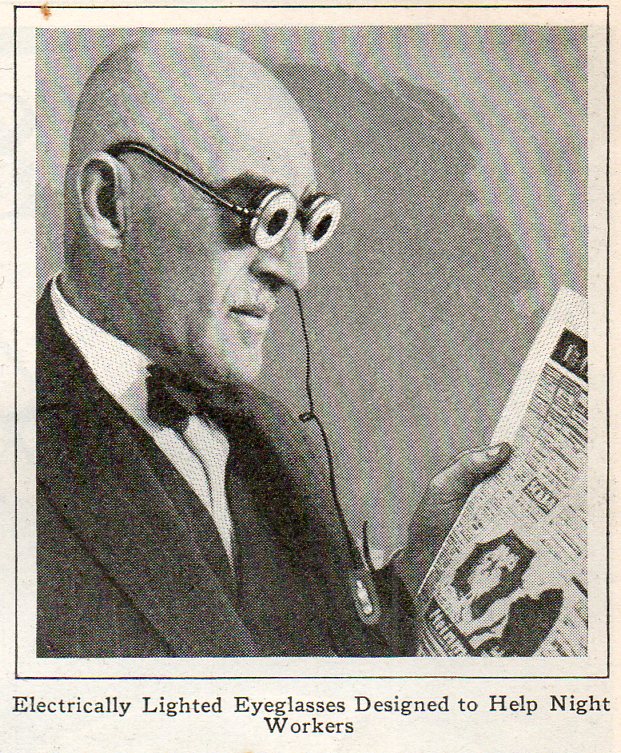
    Lurking in the pages of the Spetmeber 1930 issue of Popular Mechanics is this little-known portrait of Dr. Odd, who was simply displaying his latest gizmo: a battery-powered set of specs with lightbulbs on the rims to be used for reading in dim light. 


  • Roman Military TechnoPunk

    JF Ptak Science Books   Post 1959


    Blog--vegetius
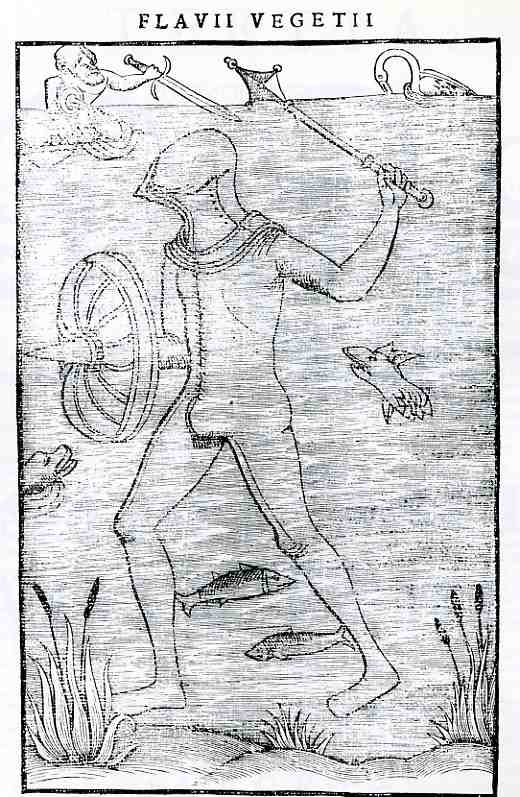
    The name of Flavius Vegetius is not so much popularly known today, though his influence is felt through the hands of other, more famous, writers and thinkers.  He was seen as the most adept writer on the Roman mind in warfare, and his De re militari libri quator… was his masterpiece.  It was reprinted in 1532 by Christian Wechel from sources reaching back to the original, which was written around 390 ACE, and found a wide readership not only for its authority on all things military/Roman but also for his iconic insights and aphorisms on warfare in general.  It was Machiavelli who came under his spell and who adopted some of Vegetius, who became further disseminated through the military followers of Machiavelli, and so on.

    I came to this work much more simply than all of this – I liked this image of the underwater warrior, who was somehow able to breathe while submerged.  I get the importance of this sort of undercover, guerrilla maneuver, but what I really like was the rarity of seeing a Renaissance illustration of human submarine life, which is pretty uncommon.  Also, the use of the lines to represent the underwater quality of the image—giving the woodcut an overall grey tone—is also very scarce in the history of illustration, at least before 1600.  And very neat!  One of the hallmarks of this printing of Vegetius was the liberal use of white space in many of the (119) woodcut illustrations, though it is clearly not on display in the woodcut that I’m sharing here.

    00-blog-Oct 28 vegetius939


  • 19th Century Smart Sticks: Calculating Pencils

    JF Ptak Science Books  Quick Post 


    Follow Me on Pinterest

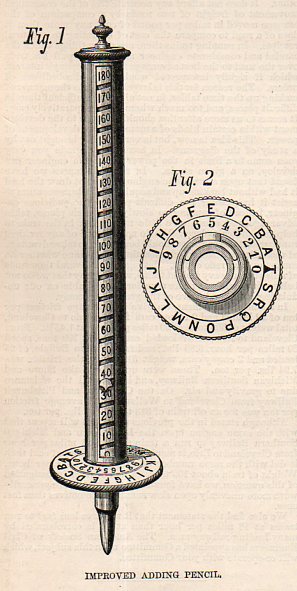
    This thinking stick comes to us via the courtesy of the Scientific American Supplement (19 August 1876, page 542), and shows a lovely Victorian non-SteamPunk answer to on-the-run calculation. It is an almost-elegant device, and seems as though it should work just fine. Its utility as a writing instrument seems a bit limited, as seems the calculator part, but the whole of it seems to be full of possibility–and a very nice piece of dedicated thinking. 

    Pencil052
    [Text describing the invention below.]

    Other nice examples of adding/writing found in the U.S. Patent Office via GooglePatents are seen below: