A Daily History of Holes, Dots, Lines, Science, History, Math, Physics, Art, the Unintentional Absurd, Architecture, Maps, Data Visualization, Blank and Missing Things, and so on. |1.6 million words, 7500 images, 4.9 million hits| Press & appearances in The Times, Le Figaro, Mensa, The Economist, The Guardian, Discovery News, Slate, Le Monde, Sci American Blogs, Le Pont, and many other places… 5000+ total posts since 2008.

Category: Inventions

  • Pistol- and Rifle-Cameras, 1884

    JF Ptak 

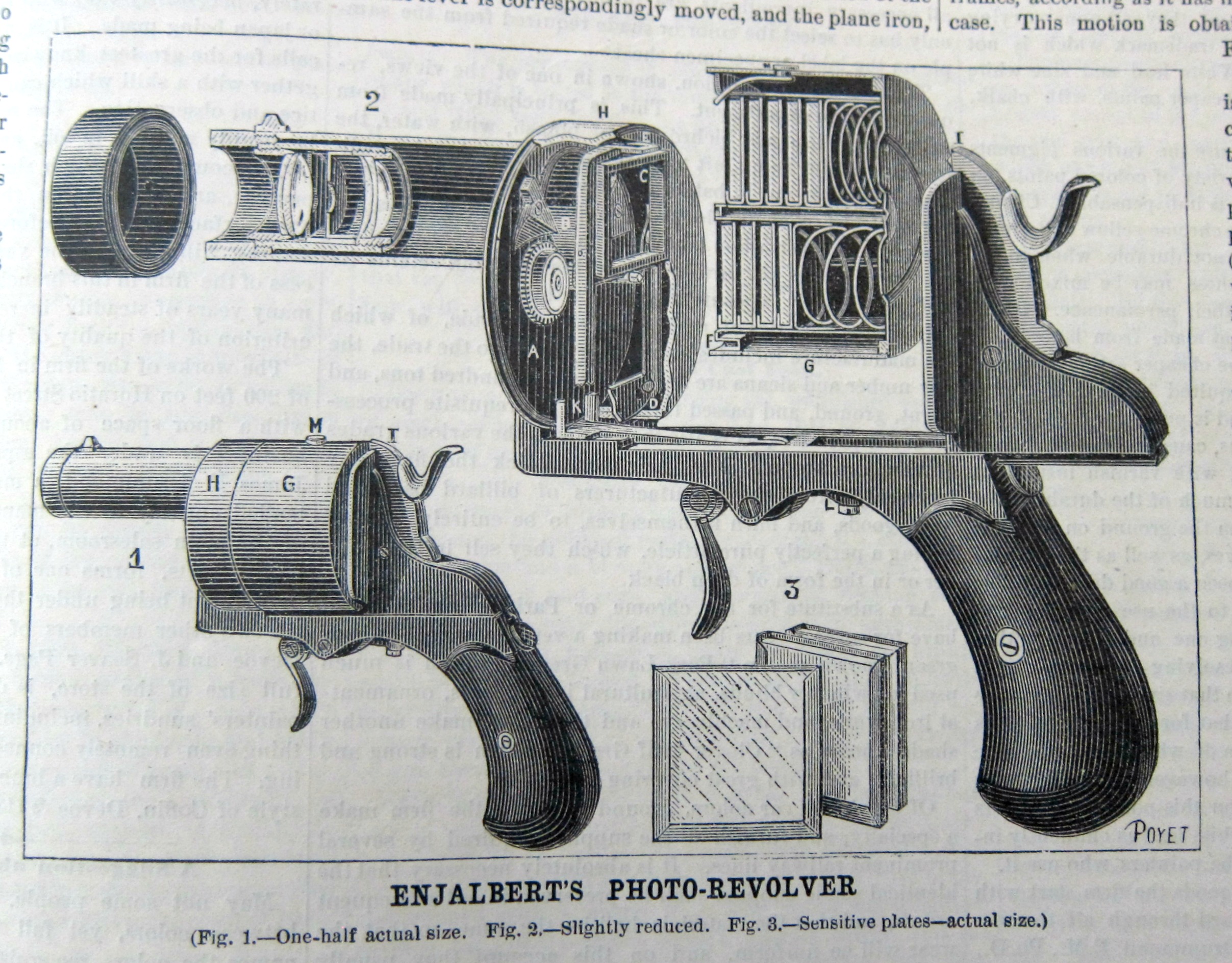
    There is an origin certainly for the reference to “shooting” fil or “shooting” a movie and such, and I think that it is fair to say that the following two illustrations of photographic innovations will explain that origin.  The first is E. Enjalbert’s “photo-revolver”, a woodcut and explanation of which appeared in Scientific American (“”A Photographic Revolver for Amateurs” ) May 17, 1884.  It really is an ingenious thing:  the lens of the camera was located in the barrel (#2) with the camera apparatus in section “H”; the photo-sensitive plates (life sized at #3), are both pushed forward and down with the action of the trigger/hammer.  It is a snappy design. On the other hand I don’t think I’d want to actually use the thing in an urban environment, as there might not be time for an explanation that “this is a ….”. 


    Inventions revolver camera

    (From the signature at bottom right of teh wood engraver this was no doubt published earlier in La Nature.)


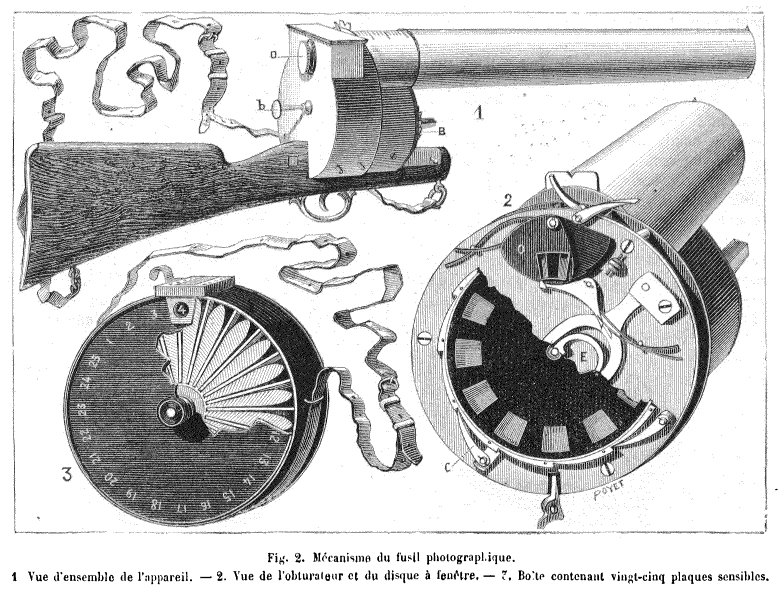
    And then there’s the great Etienne Marey’s “Fusil Photographique”, as it appeared in La Nature in 1882, which was an early and significant step in the development of cinematography, though again a highly problematic and time-invasive explanation out in public might escape the user:

    Invnetions camera rifle

    If there was any debate on the origin of the above-mentioned phrase, this might sway it.  


  • The Slim Ubiquity of Smiles in Patent Reports, 1850-1925

    JF Ptak Science Books   Post 2623

    “Better is the last smile, than the first laughter.”–J. Heywood Dialogue Prouerbes Eng. Tongue, 1550. 

    Young communist league detail


    I haven’t written very often on the word “smile” on this blog–less than ten times in 4000 posts, I think. (“Did Teeth Exist in the Renaissance?”, “The Mystery of the Sun’s Missing Smile”, “Is the Mona Lisa’s Smile Nothing?”, that sort of thing, all searchable in the Google search box.)  This came up this morning because I had an idea for morning coffee to check out “smile” in a patent search for 1850-1925 to see what sort of smile-somethings existed in the Patent Office records.  It turns out that even though “smile” appears in two dozen patents for this period, none of them are about the smile of smiling; rather they’re all anthropomorphized for varied and unrelated purposes–except that the thing it is they refer to looks like a “smile”. I thought I’d find something for an artificial smile, or smile-maker (whatever that would be), or something along those lines, but no.

    The differences in the patents in which the word “smile” was used is pretty impressive, and can almost approach a found-poetry status, but not quite–the word appears describing elements of patents for: chuck for bowspirits (1908), production of fertilizer (1918), window cleaner (1909), antifriction cage for roller-bearing rollers (1910), mechanism for a milking apparatus (1919), self-closing funnel (1913), life vest (1912), guide for a molding apparatus (1909), car-coupling for railroad cars (1876); bridle bit (1909); convertible freight car (1914), design for a horse shoe calk (1897), design for a stool (1885)…there are some others, but I think the point is made. Even though the word “smile” is used in many different ways to describe divergent pieces of machinery, they don’t really have anything in common from one patent to the next, save for the anthropormorphized shape of the object, which I find amusing. 

    The slightly odd thing that I have found in this adventure is that “smile” doesn’t seem to makes its way into English until 1550 (?), at least according to the OED, which sources the opening quote above from J. Heywood as the first appearance. Perhaps my post on “Did Teeth Exist in the Renaissance?” which is really about the smile in art shoud have asked that question more directly about the word “smile”…

    ·Posted by :

    ·in:

    — —

  • Zeppelin Barometers, 1917

    JF Ptak Science Books  Quick Post

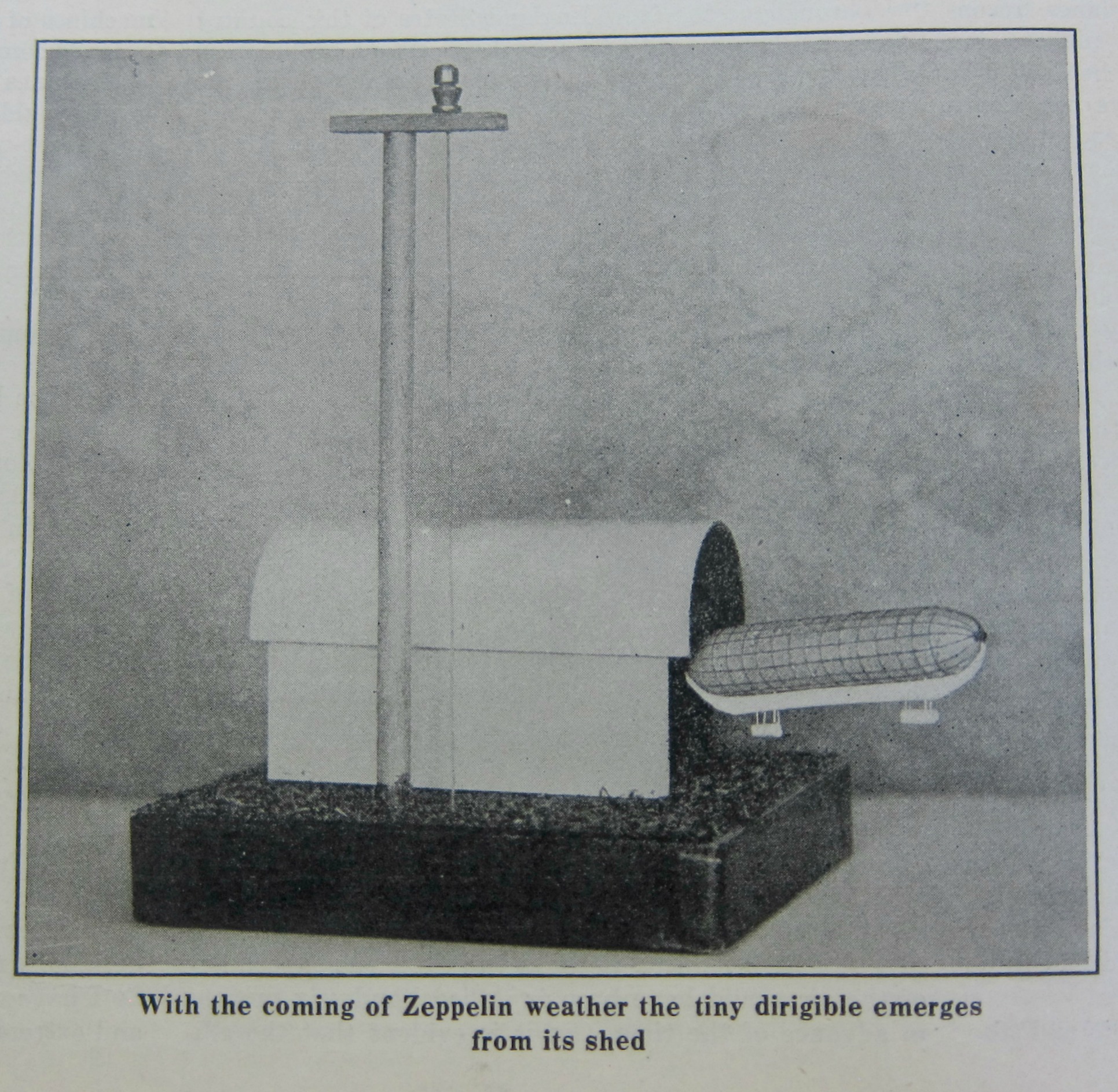
    And so it came to pass that in looking in the Scientific American for the earliest mention of battlefield tanks in WWI (appearing in April 1917) that I came upon these fine airship-related barometers.  I’ve written a short bit on the first appearance of the tank in Popular Mechanics just weeks after its battlefield inauguration and so I thought to look around a bit in some of the other popular places that this coverage should be found–Illustrated London News, Illustrirte Zeitung, and Scientific American.  I made it through the end of July of the weekly Sci Am without a peep on the “landship”, but then got completely distracted by several other items of great interest along the way, and so I need to stop and report.

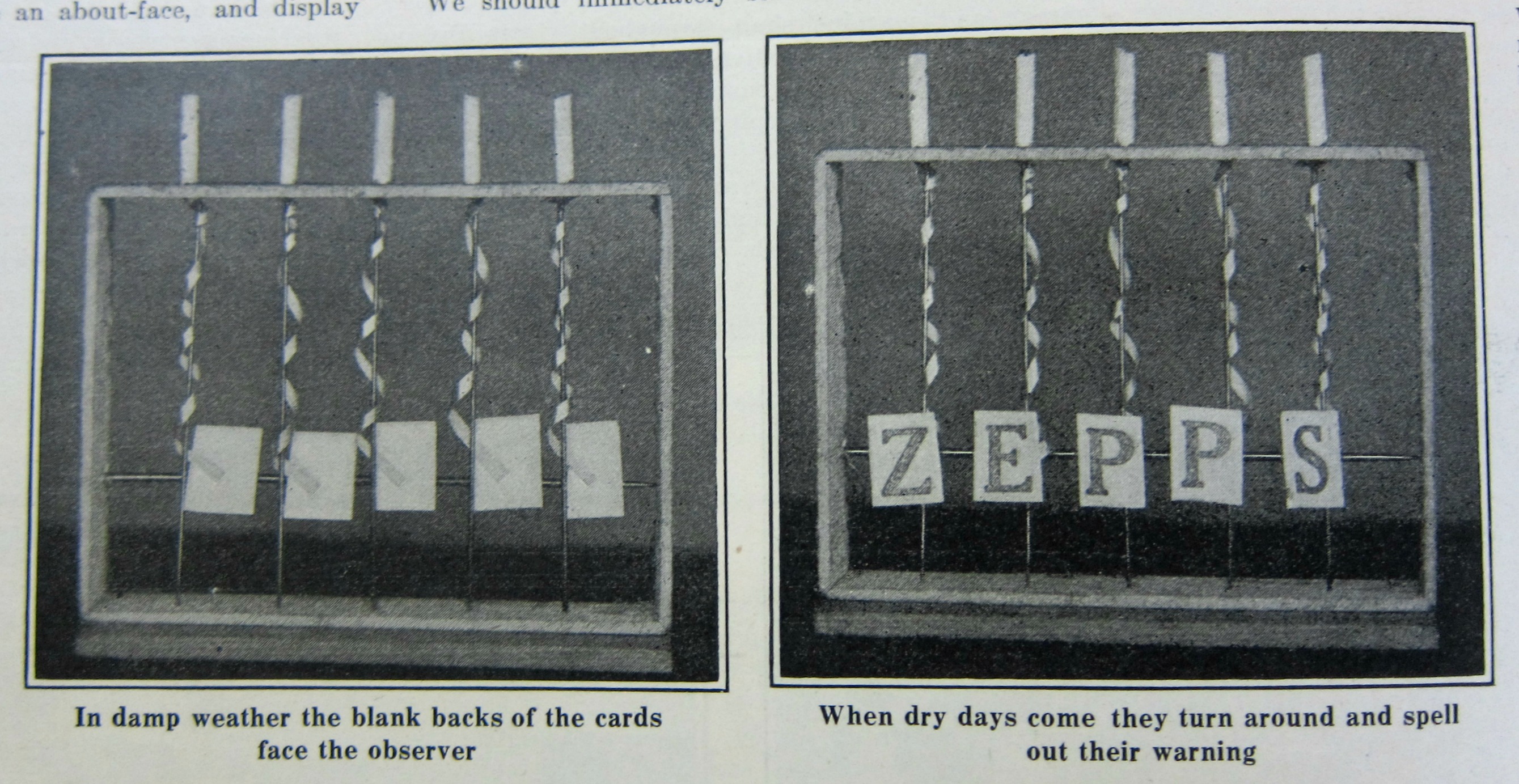
    And so from”landship” to “airship”–no tanks, but there was this fine, simple, and ingenious construction to alert the civilian that a change in the atmospheric pressure could be favorable to zeppelin attacks.  This simple apparatus is made of twisted jewelers (gold?) foil, one side of which is treated with varnish; the strips are so cut that when there is a change in the weather from damp to dry that the torsion would twist the foil a half turn, revealing the “ZEPPS”.  Pretty neat.

    WWI Project zepp barometer 1917

    [Source: Scientific American, May 12, 1917, p. 472.]


    There was a second instrument in that same short article that was a little more contrived and inventive, though I am particularly drawn to the simple ZEPPS above. 

    I am certain that the airship folks will like these…

    WWI Project Zeppelin barometer

    ·Posted by :

    ·in:

    — —

  • Finger-tip Lights for Theater Ushers, 1917

    JF Ptak Science Books  Quick Post

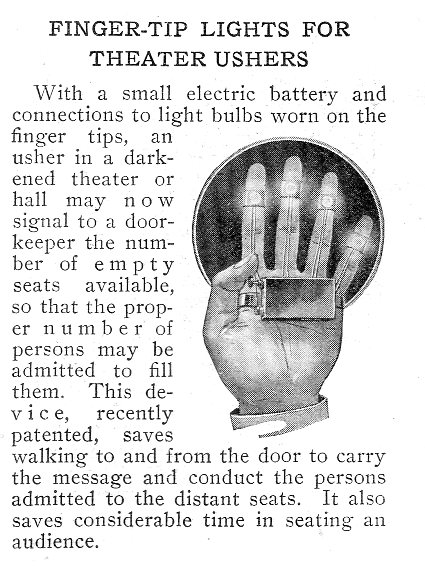
    This invention/innovation looks coy and sweet today, but it actually addressed an issue in 1917.  This was the year that “Hollywood production” in movies really begins, though there was already an explosion of movie houses in the U.S., “Hollywood” or not. Cinemas were plentiful and packed, and from the numbers I’ve seen already in 1917 50% of Americans were going to the movies several times a month–this number would top out in the 30’s when it approach nearly 70%.  So ushers standing at points throughout a movie house finding stray seats for people being held back by the doorman could have signaled the number of available seats with his lighted fingers, and moved the waiting line along more quickly than a lot of whispered back-and-forth strolls around the house. 

    Inventions finger tip431

    Popular Mechanics, April, 1917, p. 525, 

    ·Posted by :

    ·in:

    —

  • Fighting Chlorine Gas With Cotton and Gauze, August 1915

    JF Ptak Science Books  Quick Post

    WWI Project gas protection b475


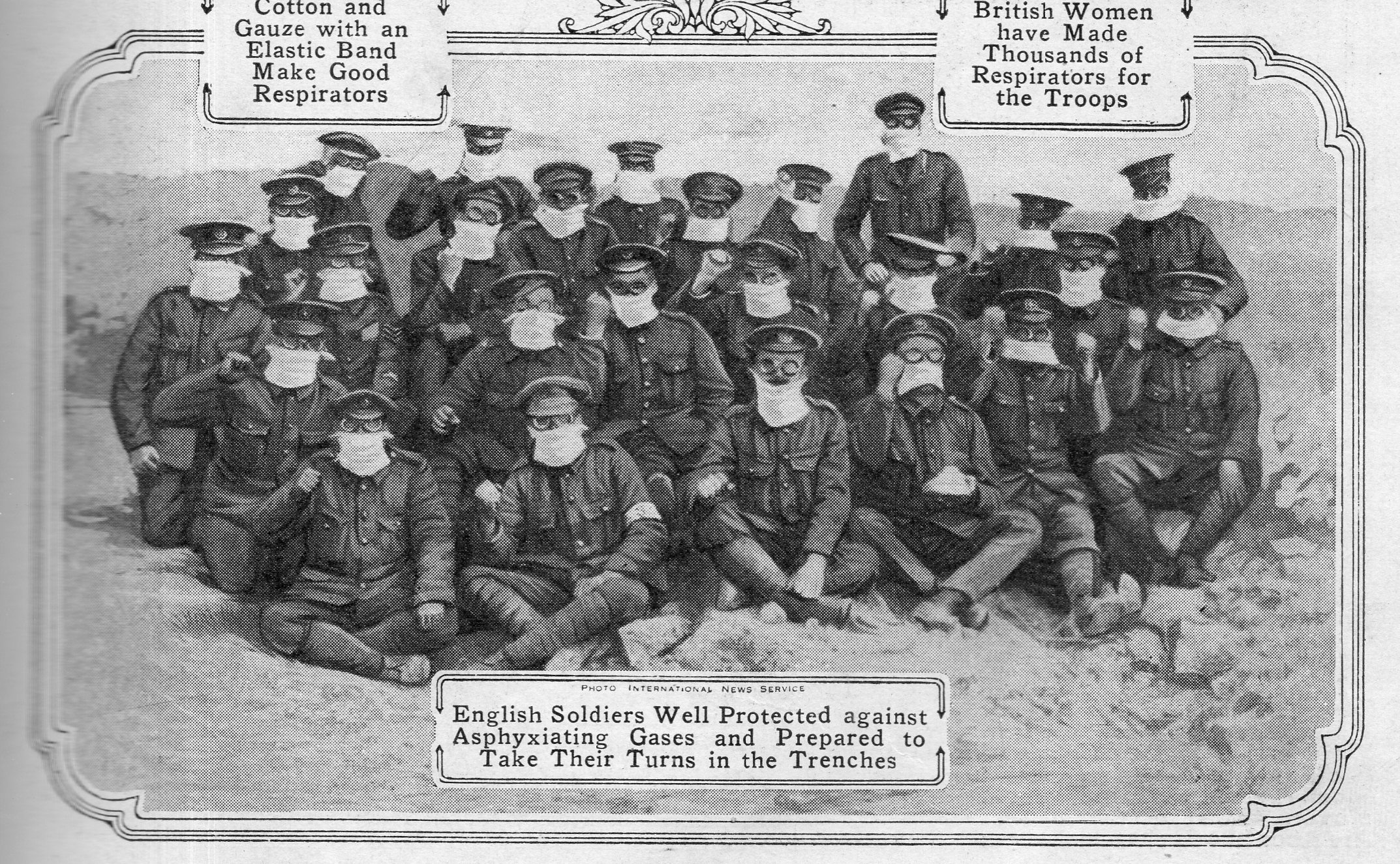
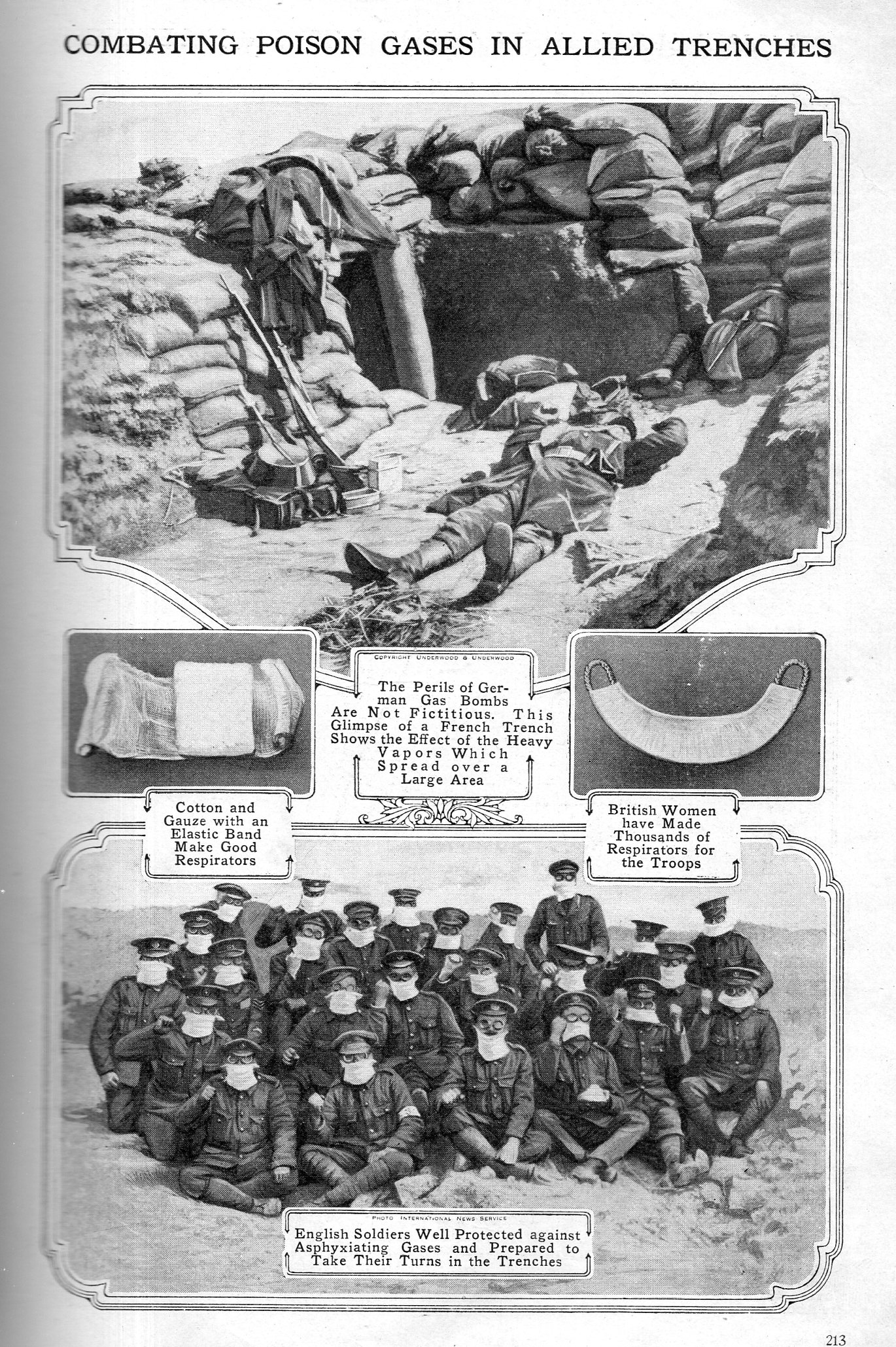
    This photo is so filled with dread and sadness, a squad of English soldiers posing with their volunteer-made cloth gas masks.  The image appeared in the August, 1915 issue of Popular Mechanics, and showed the state of gas protection for infantry as it existed in the earliest stages of gas warfare in WWI.  Popular Mechanics addressed the issue of poison gas in an earlier (monthly) issue, but it really wasn’t until this present issue where there was a series of articles/photos relating to poison gas protection. The first employment of poison (chlorine) gas occurred a few months earlier on 22 April 1915 against the French by the Germans at Ypres, in Belgium, and it turned out to have a ripping and widely disastrous effect on the French lines in what would be the first and only major offensive launched by the Germans that year. .  


    WWI Project gas protection474

    ·Posted by :

    ·in:

    —

  • The Dawn of the Robots

    JF Ptak Science Books   Quick Post 

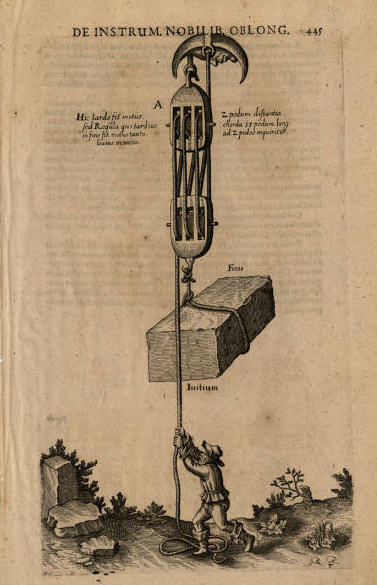
    Well, this is not anywhere near the first image of a pulley, not anywhere close–I don’t even know when that might have appeared in a manuscript in the 9th century or whatever–but it is certainly a very attractive gang of pulleys.  It occurs in Robert Fludd’s (1574-1637), Utriusque Cosmi . . . Historia (1617), and in it I see Hero/Heron of Alexandria (10-70 ACE), who I always associate with the pulley, and of course with his famous inventions, which in some respect are early forms of ‘robots”. In this image, the pulley-robot of some complex means is operating the “drive element” and producing (still) the necessary energy to produce change. And–this is a fine image.

    Fludd pulley

    [Source:  University of Utah,http://content.lib.utah.edu/cdm/compoundobject/collection/naturae/id/1587/show/1265/rec/1]


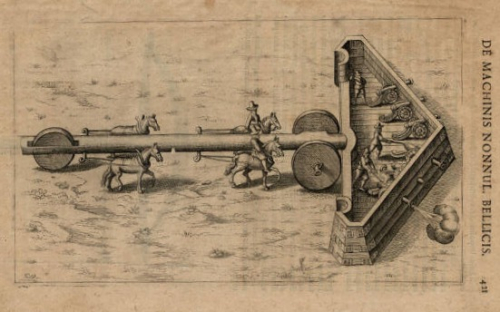
  • A High-Renaissance “Tank”, 1623

    JF Ptak Science Books   Post 2623

    A Possible-reality from the visionary Robert Fludd

    Fludd tank e

    [Source:  University of Utah, http://content.lib.utah.edu/cdm/compoundobject/collection/naturae/id/1587/show/1265/rec/1]


    Fludd
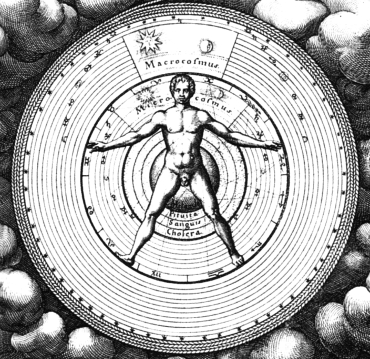
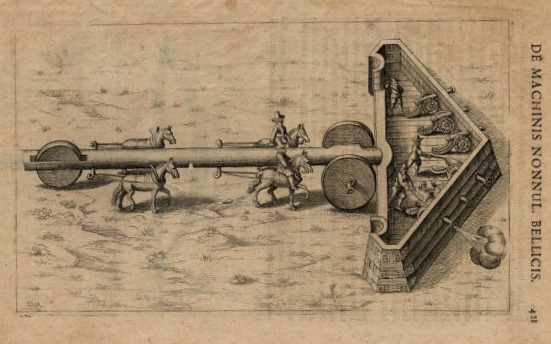
    Robert Fludd’s (1574-1637), title page for his  Utriusque Cosmi . . . Historia (1617) features this complicated astrological wheel with a Vitruvian-man-like image at the vortex of the imaged pulls and pushes of the cosmos.  In addition to everything else, real and imagined, Rosicrucianism and astrology and puffy-birds, Fludd, who was  an English physician, delved deeply into the real stuff of the world in this book in addition to all of the other make-believe–optics, the musical intervals, perspective drawing, hydraulic engineering, construction of lifting machines, military engineering and many other interesting, physical science topics.  But this drawing, right there on the title page, reveals Fludd’s real interests and shows what governs what he does.  Everything else, the math and and the physics, services this need.  Of course the image is beautiful, which is why it is here, but it is also a deeply personal, exploitative, cover-all for the things that Fludd wanted to find. 

    But there is a lot of other interesting, and potentially-applicable, real-world stuff and proposals in the book as we can see in the exotic and wonder-full image of the high-Renaissance “tank” that leads this short post.  I’m not so sure that this thing would actually move–I assume that it has wheels or something in the front part to help it move along, otherwise that weapon would go nowhere.  Even if it was assumed to be mobile, I wonder about whether four horses is enough to move along something that size plus six canon and at least three men.  Even with 5’/6′ wheels, it seems not so likely that this would roll across a battlefield.  All that said, this did exist in the realm of possibility, and Fludd had much else.  Since I’ve been doing research on the first battlefield appearances of tanks, this one particular image caught my attention.  


  • A Fine, Hand-Held Adding Machine, 1869

    JF Ptak Science Books  Quick Post

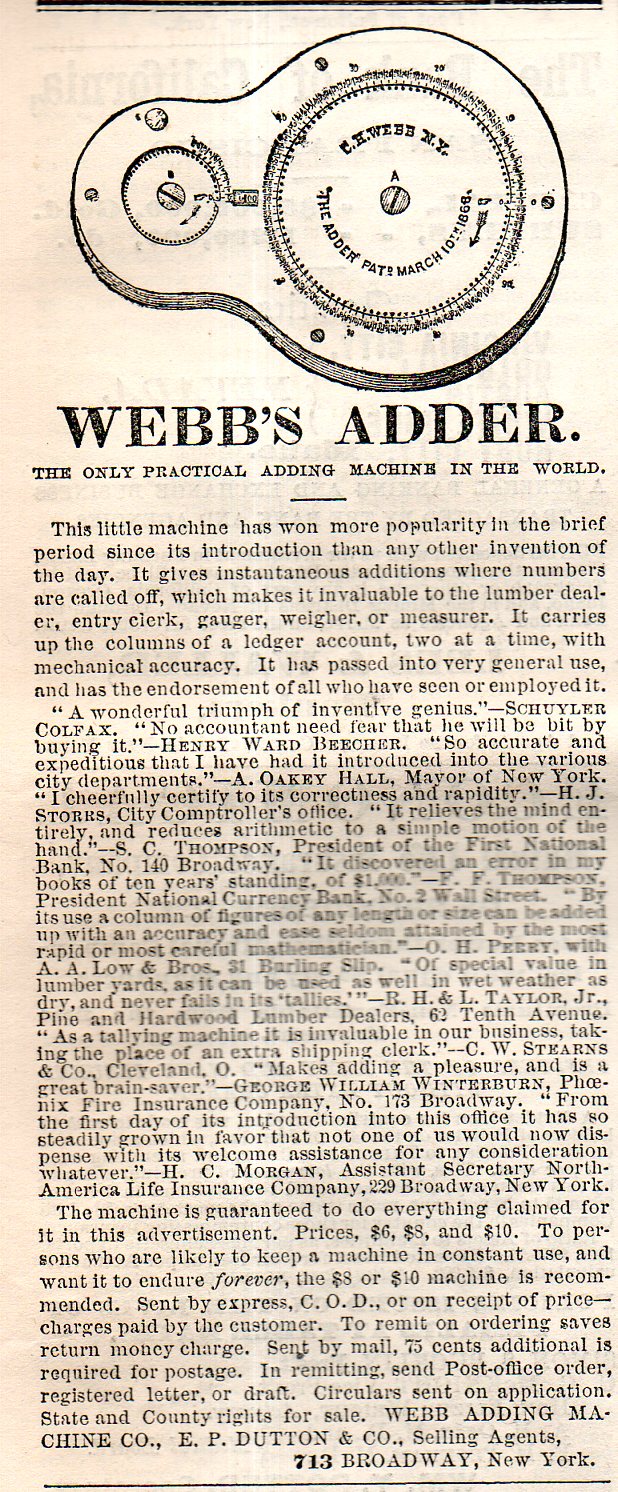
    I found this wonderful ad in the July, 1869 issue of American Agriculturalist--in real life the woodcut is about 1.5″x 4″ and was designed well enough to attract the attention of a practicing farmer needing arithmetical help. It was an intelligent design and speaks well of the readership. The adder–patented just a year earlier by Charles Henry Webb (1834-1905)–would have a long life in various incarnations, a history of which can be found in this excellent article at History-Computer.com (http://history-computer.com/CalculatingTools/Gadgets/Webb.html)

    Webb adder 1869465


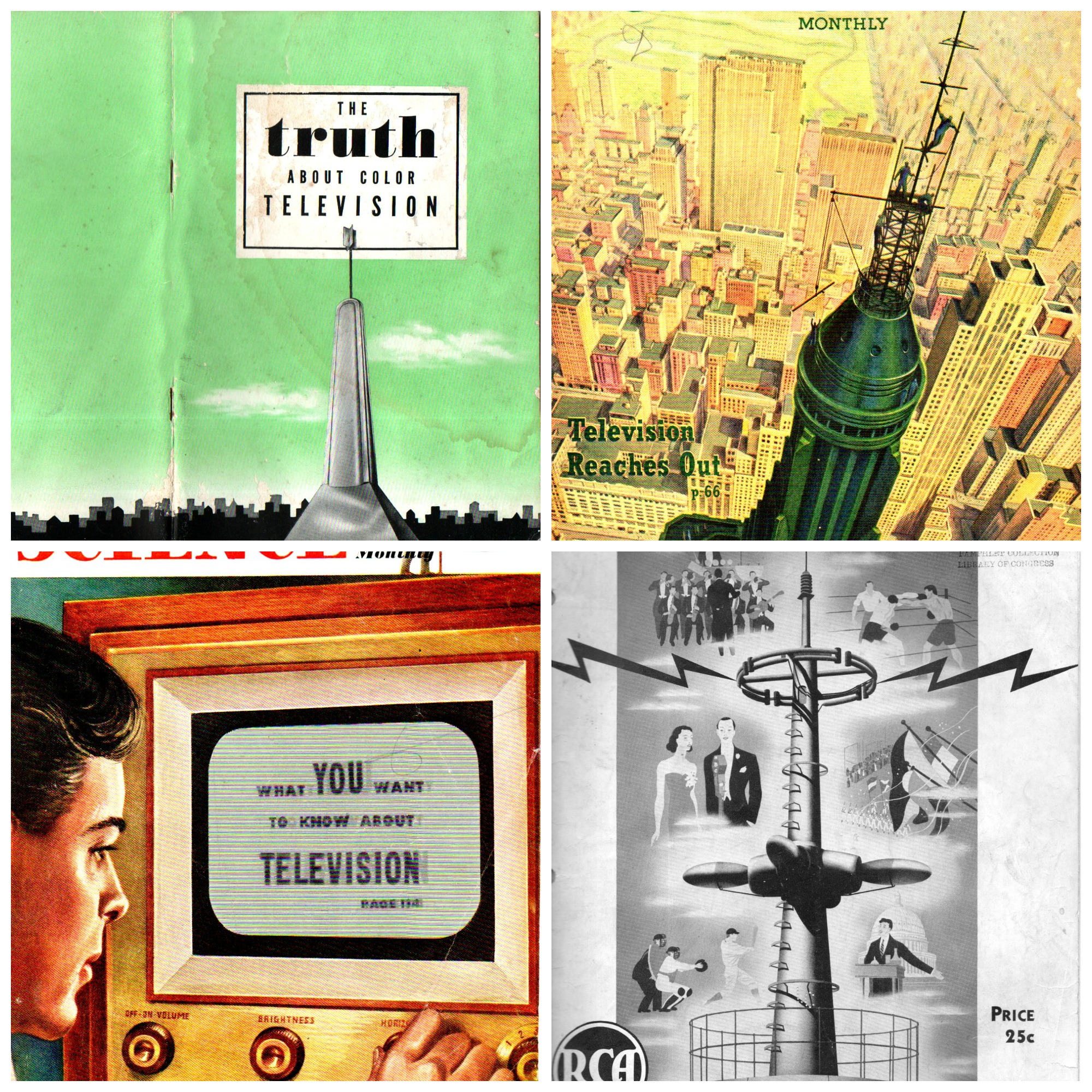
  • Television Reaches Out, 1939-1949

    JF Ptak Science Books  Quick Post

    Here are a few things on the top of the stack in the telecom box–I think that I left them like that as a treat to myself for the next time I opened the box:  


    TV montage


  • Talking Phonographs and Talking Photographs, 1877/8

    JF Ptak Science Books    [Reposting Post 2601 with an update]

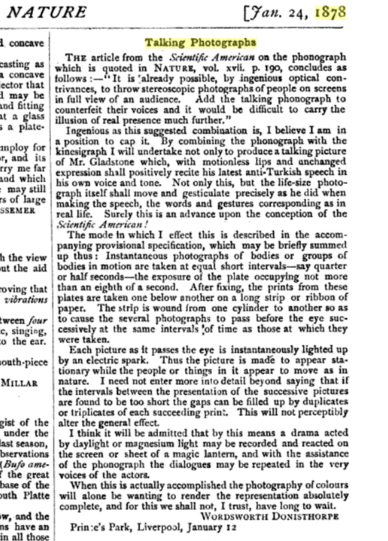
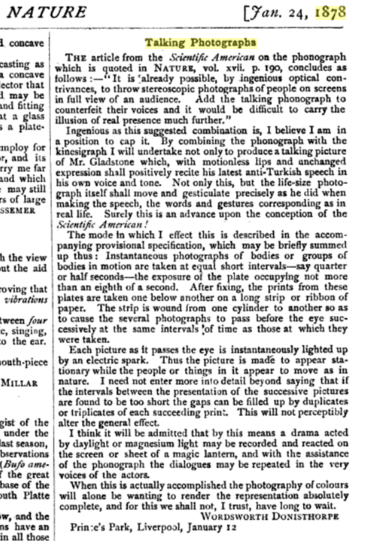
    There appeared in the wonderful pages of Nature (for 24 January 1878) a short but interesting technical communication from the probably/improbably-named Wordsworth Donisthorpe (1847-1914) about an invention that is deeply related to the early stages of motion pictures–in fact it was the first paper that coupled sound with the moving image. It appears eleven years before the first successful demonstration of a motion picture in 1889.  
    Talking photographs

     (The article is immediately preceded by another on the change of habits in toads.)

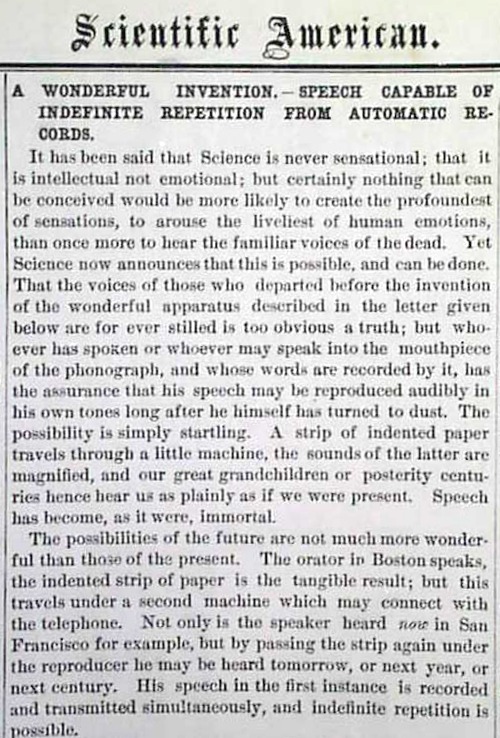
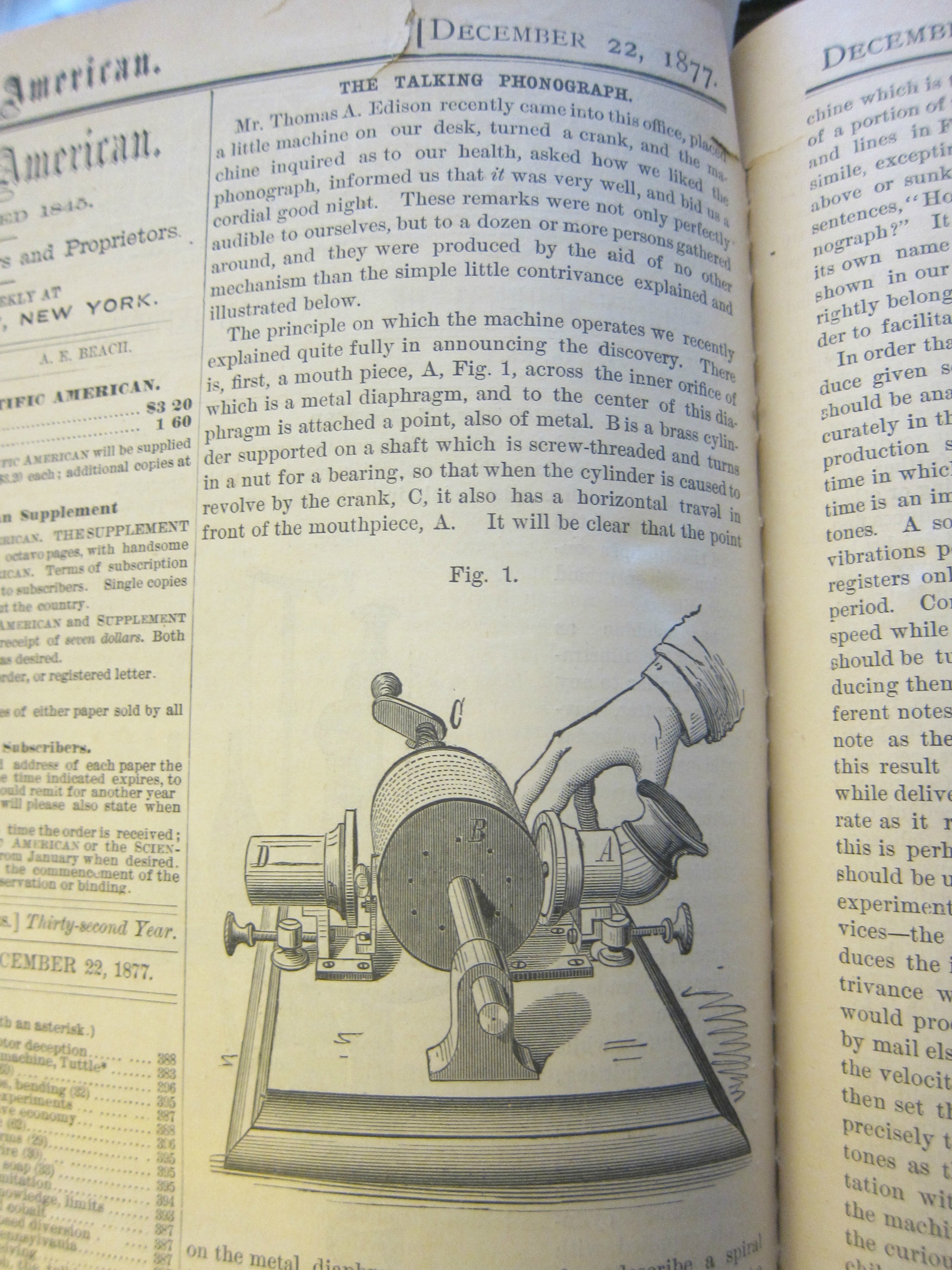
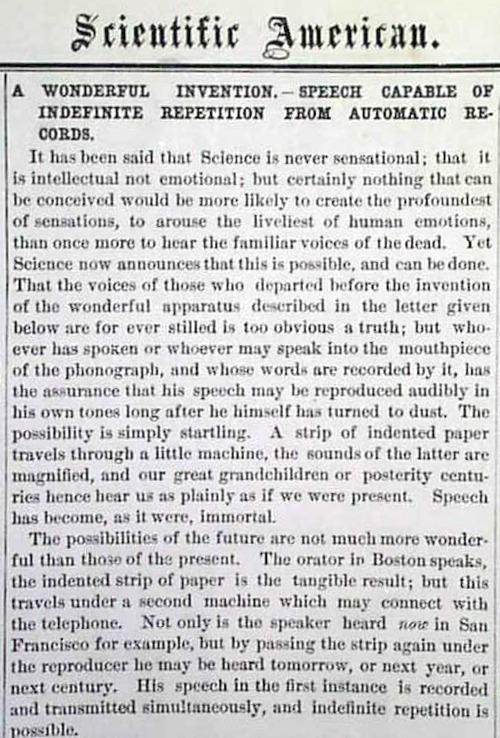
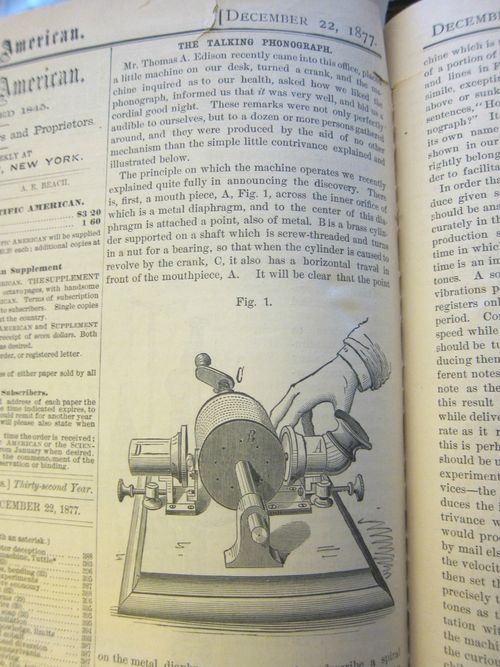
    What Mr. Donisthorpe is talking about in the pages of the Scientific American is really the back-door entry to an even bigger topic: the first announcement of Thomas Edison’s phonograph as it appeared on the back of the first  page in the last issue for the year, 29 December 1877.  “A Wonderful Invention–Speech Capable of Indefinite Repetition from Automatic records” was the aarticle by Edward Johnson on the introduction of Thomas Edison’s phonograph.It is one and a half columns long, but contains a very compact 1500 words.  
      Edison phonograph

    Edison’s name was not a popular item in the average American home before his invention of the phonograph.  It was actually some months later, after the initial announcement in 1877, that Edison became justifiably famous.  It is difficult today to place the amazement and astonishment that greeted the invention–there was nothing like it, before, ever–except for writing, of course, and then the recording telegraph.  It was a sensational piece of power, being able to record and save sound–and then play it back again.  It was the first time in human history that the auditory sense world could be audibly preserved.

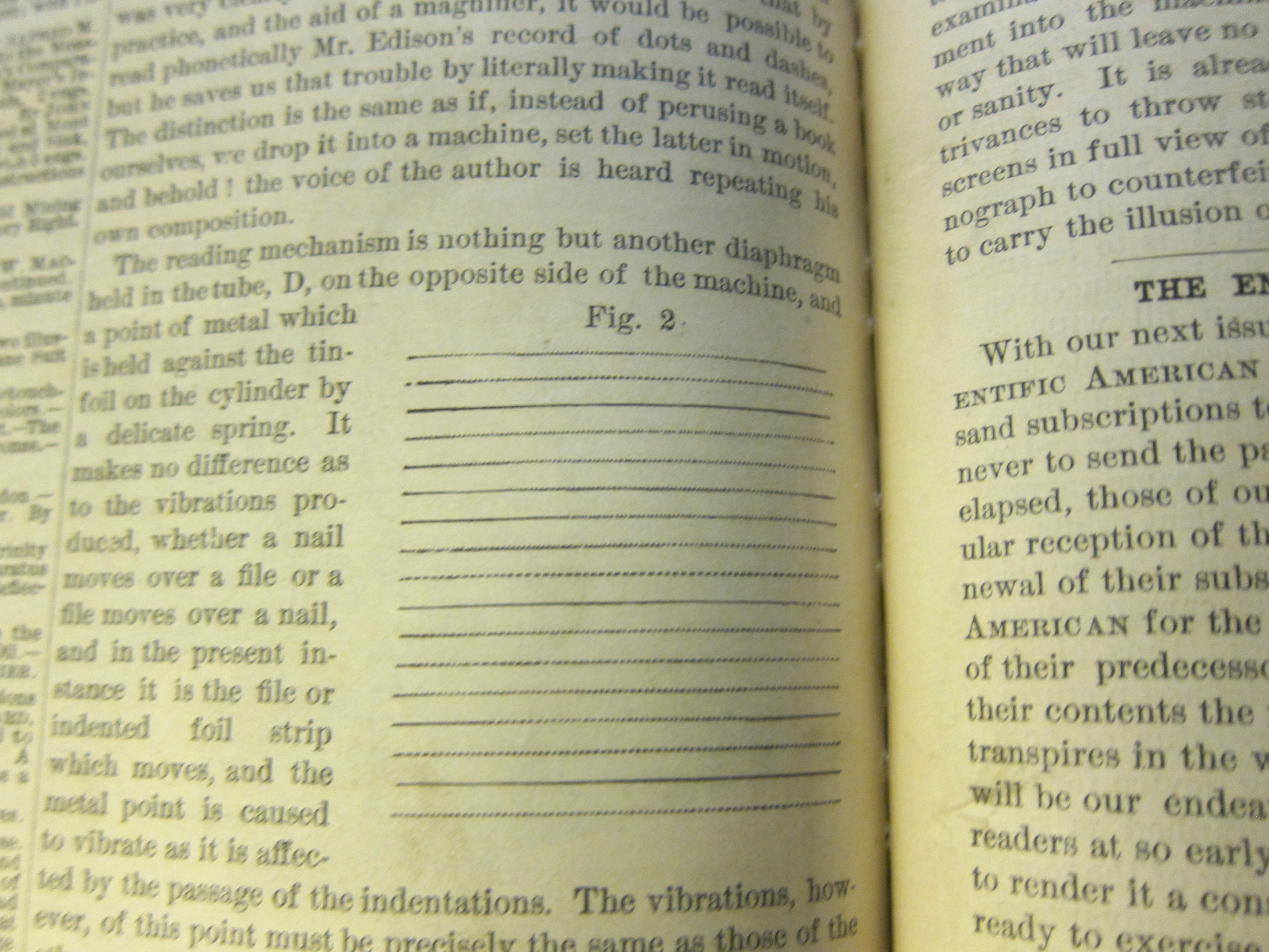
    The first announcement in Scientific American appeared slightly earlier still, in the November 17 issue for 1877.  

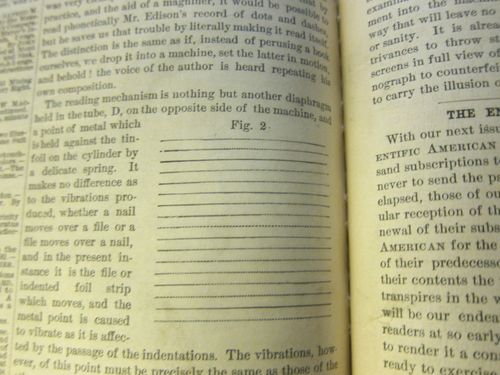
    This is a wood engraving of the impressions left on the recording cylinder–it must be the first image of a saved sound.  
    Edison 1877 phonograph


    Edison 1877 Dots

    There is also a two-page report on Edison’s visit to the offices of  Nature and his very successful demonstration of his new phonograph  machine (the patent for which is applied for December 27, 1877). The editors  record their favorable impressions of the machine and describe it in some detail–there is even a small woodcut illustration of the device. In all the  article occupies pages 190-191 of the weekly issue. (Edison,  Thomas. “The Talking Phonograph“,  London:  Nature,  January 3, 1878.)

    So it comes to pass that the idea of saving and manipulating sound and then applying that to moving images come to rest within a few dozen pages of one another in Nature–it must have been an exhilarating experience at the time.

    Notes:

    A hat tip to Cadre History http://histv2.free.fr/cadrehistory.htm a site with a LOT of material of high interest (in general) and with good references (in particular). 

    An interesting book to check out: Stephen Herbert, M. Heard.  Industry, Liberty, and a Vision: Wordsworth Donisthorpe’s Kinesigraph.