JF Ptak Science Books [Reposting Post 2601 with an update]
There appeared in the wonderful pages of Nature (for 24 January 1878) a short but interesting technical communication from the probably/improbably-named Wordsworth Donisthorpe (1847-1914) about an invention that is deeply related to the early stages of motion pictures–in fact it was the first paper that coupled sound with the moving image. It appears eleven years before the first successful demonstration of a motion picture in 1889.
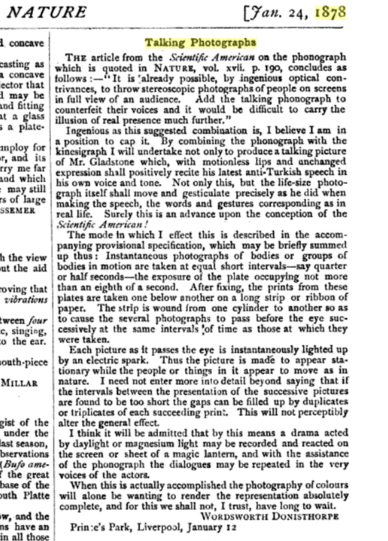
(The article is immediately preceded by another on the change of habits in toads.)
What Mr. Donisthorpe is talking about in the pages of the Scientific American is really the back-door entry to an even bigger topic: the first announcement of Thomas Edison’s phonograph as it appeared on the back of the first page in the last issue for the year, 29 December 1877. “A Wonderful Invention–Speech Capable of Indefinite Repetition from Automatic records” was the aarticle by Edward Johnson on the introduction of Thomas Edison’s phonograph.It is one and a half columns long, but contains a very compact 1500 words.
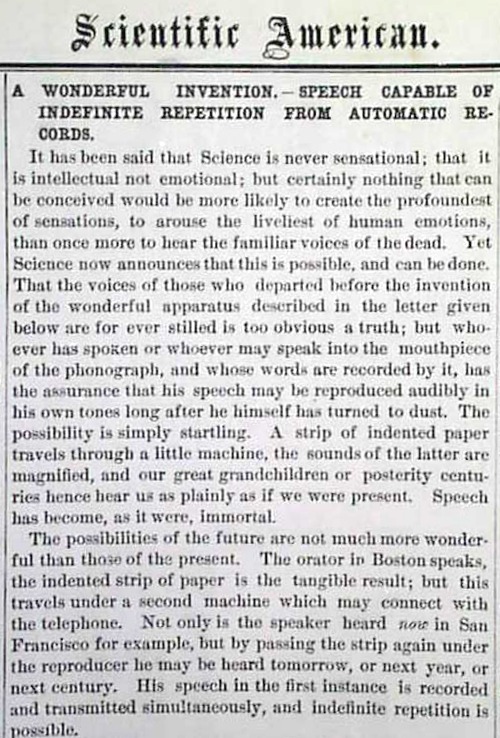
Edison’s name was not a popular item in the average American home before his invention of the phonograph. It was actually some months later, after the initial announcement in 1877, that Edison became justifiably famous. It is difficult today to place the amazement and astonishment that greeted the invention–there was nothing like it, before, ever–except for writing, of course, and then the recording telegraph. It was a sensational piece of power, being able to record and save sound–and then play it back again. It was the first time in human history that the auditory sense world could be audibly preserved.
The first announcement in Scientific American appeared slightly earlier still, in the November 17 issue for 1877.
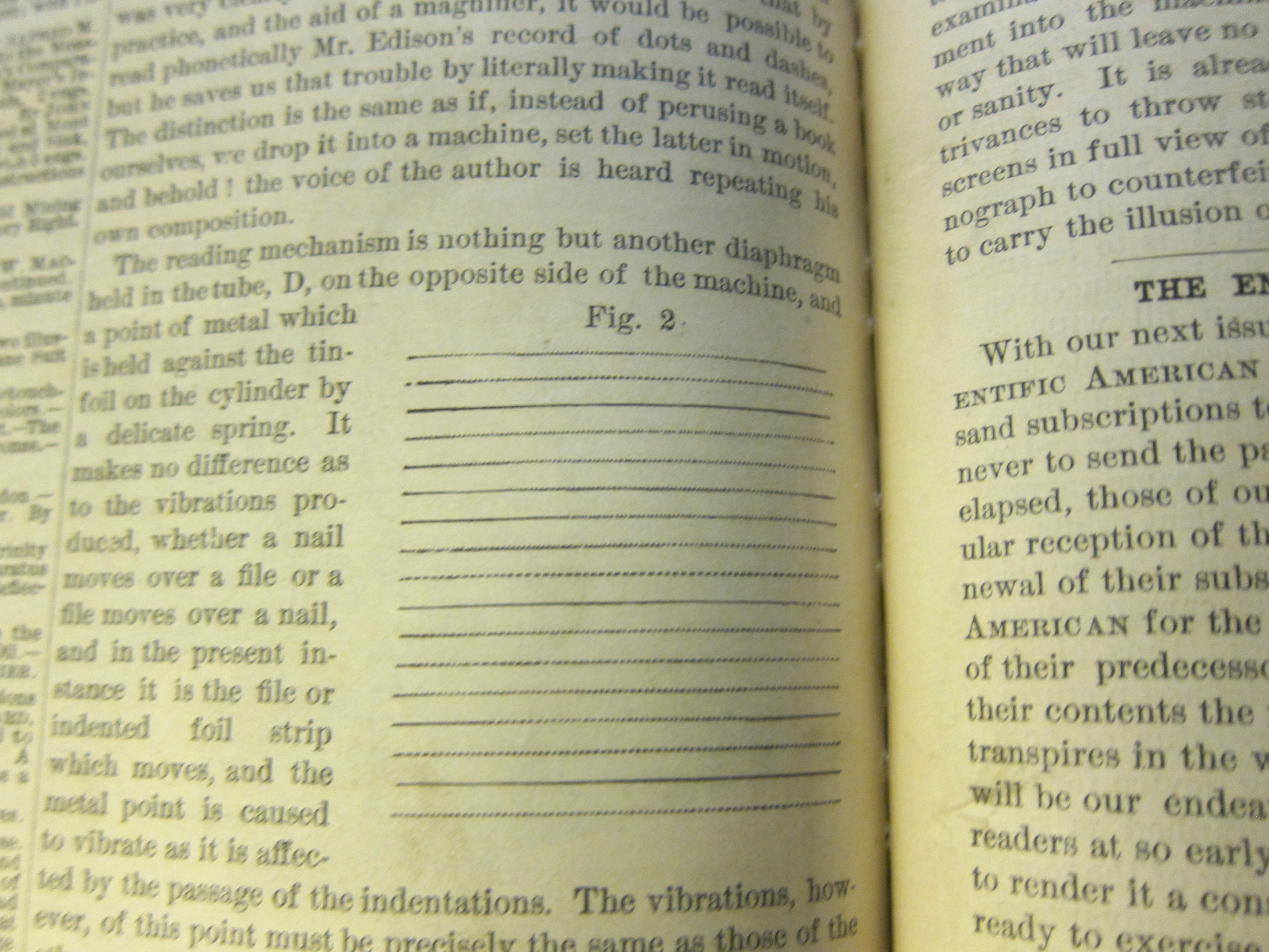
This is a wood engraving of the impressions left on the recording cylinder–it must be the first image of a saved sound.
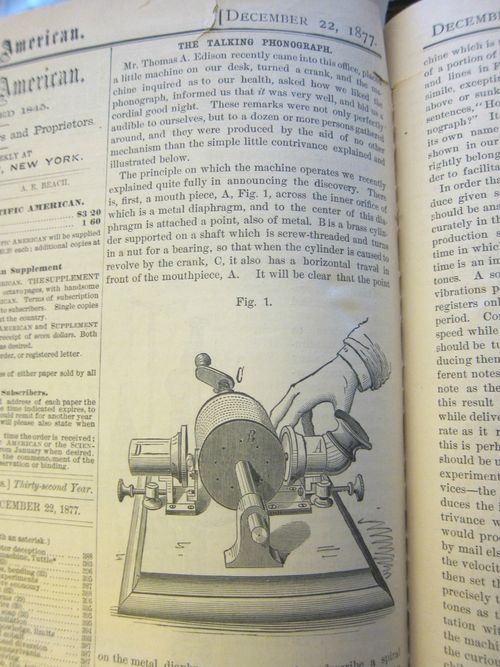
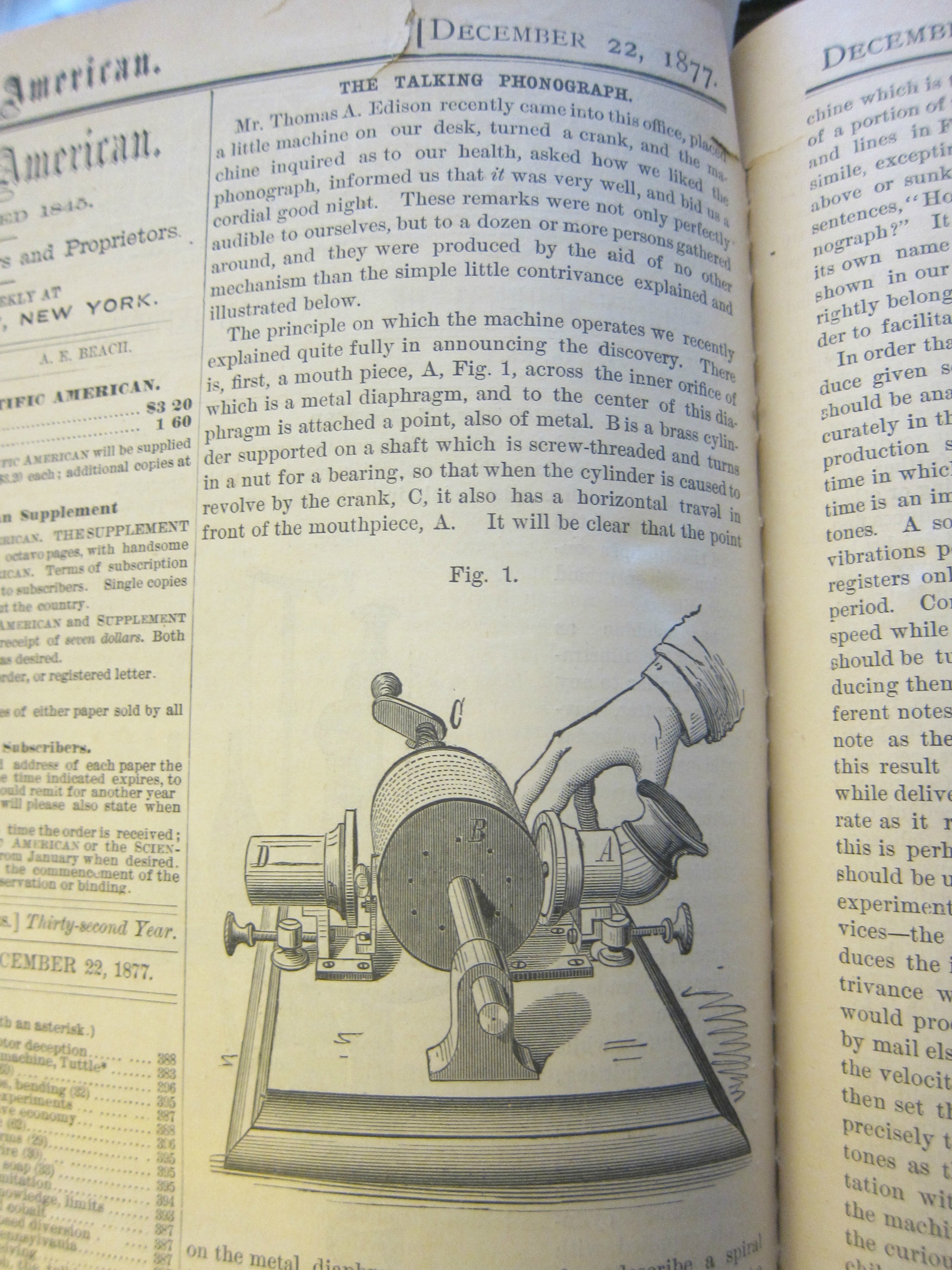
There is also a two-page report on Edison’s visit to the offices of Nature and his very successful demonstration of his new phonograph machine (the patent for which is applied for December 27, 1877). The editors record their favorable impressions of the machine and describe it in some detail–there is even a small woodcut illustration of the device. In all the article occupies pages 190-191 of the weekly issue. (Edison, Thomas. “The Talking Phonograph“, London: Nature, January 3, 1878.)
So it comes to pass that the idea of saving and manipulating sound and then applying that to moving images come to rest within a few dozen pages of one another in Nature–it must have been an exhilarating experience at the time.
Notes:
A hat tip to Cadre History http://histv2.free.fr/cadrehistory.htm a site with a LOT of material of high interest (in general) and with good references (in particular).
An interesting book to check out: Stephen Herbert, M. Heard. Industry, Liberty, and a Vision: Wordsworth Donisthorpe’s Kinesigraph.